183
CUNI System for the Building Educational Applications 2019
Shared Task: Grammatical Error Correction
Jakub N´aplava and Milan Straka
Charles University,
Faculty of Mathematics and Physics, Institute of Formal and Applied Linguistics
{naplava,straka}@ufal.mff.cuni.cz
Abstract
In this paper, we describe our systems submit-ted to the Building Educational Applications (BEA) 2019 Shared Task (Bryant et al.,2019). We participated in all three tracks. Our models are NMT systems based on the Transformer model, which we improve by incorporating several enhancements: applying dropout to whole source and target words, weighting tar-get subwords, averaging model checkpoints, and using the trained model iteratively for cor-recting the intermediate translations. The sys-tem in the Restricted Track is trained on the provided corpora with oversampled “cleaner” sentences and reaches 59.39 F0.5 score on the test set. The system in the Low-Resource Track is trained from Wikipedia revision histo-ries and reaches 44.13 F0.5 score. Finally, we finetune the system from the Low-Resource Track on restricted data and achieve 64.55 F0.5 score, placing third in the Unrestricted Track.
1 Introduction
Starting with the 2013 and 2014 CoNLL Shared Tasks on grammatical error correction (GEC), much progress has been done in this area. The need to correct a variety of error types lead most researchers to focus on models based on ma-chine translation (Brockett et al.,2006) rather than custom designed rule-based models or a combi-nation of single error classifiers. The machine translation systems turned out to be particular-ity effective whenJunczys-Dowmunt and Grund-kiewicz (2016) presented state-of-the-art statisti-cal machine translation system. Currently, mod-els based on statistical and neural machine trans-lation achieve best results: in restricted settings with training limited to certain public training sets (Zhao et al.,2019); unrestricted settings with no restrictions on training data (Ge et al., 2018); and also in low-resource track where the training
data should not come from any annotated corpora (Lichtarge et al.,2018).1
In this paper, we present our models and their results in the restricted, unrestricted, and low-resource tracks. We start with a description of related work in Section2. We then describe our systems together with the implementation details in Section3. Section4is dedicated to our results and ablation experiments. Finally, in Section5we conclude the paper with some proposals on future work.
2 Related Work
Transformer (Vaswani et al.,2017) is currently one of the most popular architectures used in machine translation. Its self-attentive layers allow better gradient flow when compared to recurrent neural models and the masking in decoder provides faster training. Junczys-Dowmunt et al.(2018) propose several improvements for training Transformer on GEC: using dropout on whole input words, assign-ing weight to target words based on their align-ment to source words, and they also propose to oversample sentences from the training set in or-der to have the same error rate as the test set.
Majority of work in grammatical error correc-tion has been done in restricted area with a fixed set of annotated training datasets. Lichtarge et al.
(2018), however, show that training a neural ma-chine translation system from Wikipedia edits can lead to surprisingly good results. As the authors state, corpus of Wikipedia edits is only weakly supervised for the task of GEC, because most of the edits are not corrections of grammatical errors and also they are not human curated specifically for GEC. To overcome these issues, the authors use iterative decoding which allows for incremen-tal corrections. In other words, the model can
peatedly translate its current output as long as the translation is more probable then keeping the sen-tence unchanged. Similar idea is also presented in (Ge et al.,2018), where the translation system is trained with respect to the incremental inference.
3 Our System
In this section, we present our three systems sub-mitted to each track of the BEA 2019 Shared Task. We start with the Restricted Track In Section3.1, where we present a series of improvements to the baseline Transformer model. In Section 3.2, we describe our model trained on Wikipedia revisions which was submitted to the Low-Resource Track. Finally, in Section3.3, we describe the model sub-mitted to the Unrestricted Track.
All our models are based on the Trans-former model from Tensor2Tensor framework ver-sion 1.12.0.2
3.1 Restricted Track
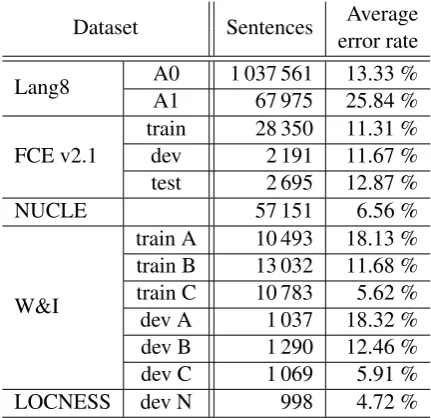
In the Restricted Track, we use the 5 pro-vided datasets for system development: FCE v2.1 (Yannakoudakis et al., 2011), Lang-8 Corpus of Learner English (Mizumoto et al., 2011; Tajiri et al., 2012), NUCLE (Dahlmeier et al., 2013), Write & Improve (W&I) and LOCNESS v2.1 (Bryant et al.,2019;Granger,1998). From Lang-8 corpus, we took only the sentences annotated by annotators with ID 0 (A0) and ID 1 (A1). All but the development sets from W&I and LOCNESS datasets were used for training. The simple statis-tics of these datasets are presented in Table1. The displayed error rate is computed using maximum alignment of original and annotated sentences as a ratio of non-matching alignment edges (insertion, deletion, and replacement).
We use the transformer base configuration of Tensor2Tensor as our baseline solution. The train-ing dataset consists of 1 230 231 sentences. Af-ter training, beam search decoding is employed to generate model corrections and we choose the checkpoint with the highest accuracy on a devel-opment set concatenated from the W&I and LOC-NESS development sets.
3.1.1 Transformer Big
The first minor improvement was to use the
transformer big configuration instead of trans-former base. This configuration has bigger
capac-2https://github.com/tensorflow/tensor2tensor
Dataset Sentences Average error rate
Lang8 A0 1 037 561 13.33 % A1 67 975 25.84 %
FCE v2.1
train 28 350 11.31 % dev 2 191 11.67 % test 2 695 12.87 %
NUCLE 57 151 6.56 %
W&I
[image:2.595.308.524.62.271.2]train A 10 493 18.13 % train B 13 032 11.68 % train C 10 783 5.62 % dev A 1 037 18.32 % dev B 1 290 12.46 % dev C 1 069 5.91 % LOCNESS dev N 998 4.72 %
Table 1: Statistics of available datasets. The error rate is computed as a ratio of non-matching alignment edges.
ity and asPopel and Bojar(2018) show, it reaches substantially better results on certain translation tasks.
3.1.2 Source and Target Word Dropout
Dropout (Srivastava et al., 2014) is a regulariza-tion technique that turned out to be particularly ef-fective in the field of neural networks. It works by masking several randomly selected activations during training, which should prevent the neural network from overfitting the training data. In the area of NLP, it is a common approach to apply dropout to whole embeddings, randomly zeroing certain dimensions. As Junczys-Dowmunt et al.
(2018) show, we can also apply dropout to whole source words to reduce trust in the source words. Specifically, full source word embedding vector is set to zero vector with probability p. We further note this probability as thesource word dropout.
To make regularization even more effective, we decided to dropout also whole target word embed-dings. We refer to the probability with which we dropout entire target word embeddings as the tar-get word dropout.
3.1.3 Edited MLE
model copies the input unchanged to the output. To overcome this issue, Junczys-Dowmunt et al.
(2018) propose to change the maximum likelihood objective to assign bigger weights to target tokens different from the source tokens. More specifi-cally, they start by computing the word alignment between each source x = (x0, x1, ..xN) and
tar-get sentencey= (y0, y1, ...yM). Then they set the
weightλtof the target wordytto 1 if it is matched,
and otherwise, if it is an insertion or replacement of a source token,λtis set to some predefined
con-stant. Modified log-likelihood training objective then takes following form:
L(x, y) =−
M X
t=1
λtlogP(yt|x, y0, . . . , yt−1).
3.1.4 Data oversampling
It is crucial to have training data from the same domain as the test data, i.e., training data con-taining similar errors with similar distribution as the test data. As we can see in the Table 1, the vast majority of our training data comes from the Lang-8 corpus. However, as it is quite noisy and of low quality, it matches the target domain the least. Therefore, we decided to oversample other datasets. Specifically, we add the W&I training data 10 times, all FCE data 5 times and NUCLE corpus 5 times to the training data. The oversam-pled training set consists of 1 900 551.
In Table 1, we can also see token error rate of each corpus. The development error rate in W&I and LOCNESS varies from 5.91% up to 18.32%. This gives us a basic idea how the test data looks like, and since the test data does not contain anno-tations from which set (A,B, C, N) it comes, we decided not to optimize the training data against the token error rate any further.
3.1.5 Checkpoint Averaging
Popel and Bojar(2018) report that averaging sev-eral last Transformer model checkpoints during training leads both to lower variance results and also to slightly better performance than the base-line without averaging. They propose to save checkpoints every one hour and average either 8 or 16 last checkpoints. Since we found out that the model overfits the oversampled dataset quite quickly, we save checkpoints every 30 minutes.
3.1.6 Iterative decoding
A system for grammatical error correction should correct all errors in the text while keeping the rest
Data:input sent; max iters; threshold
foriter in [1,2,..,max iters]do
beam results= decode(input sent);
identity cost=+∞;
non identity cost=+∞;
non identity sent= None
forbeam item in beam resultsdo
text=beam item[”text”];
cost=beam item[”cost”];
iftext == input sentthen
identity cost=cost;
else if cost<non identity cost
then
non identity cost = cost;
non identity sent = text;
end
ifnon identity cost≤
threshold·identity costthen
input sent=non identity sent;
else
break;
end end
returninput sent;
Algorithm 1:Iterative decoding algorithm
of the text intact. In many situations with multi-ple errors in a sentence, the trained system, how-ever, corrects only a subset of its errors.Lichtarge et al. (2018) andGe et al. (2018) propose to use the trained system iteratively to allow the sys-tem to correct certain errors during further itera-tions. Iterative decoding is done as long as the cost of the correction is less than the cost of the identity translation times a predefined constant. WhileLichtarge et al.(2018) use the same trained model log-likelihoods as the cost function, Ge et al.(2018) utilize an external language model for it. Because the restricted track does not contain enough training data to train a quality language model, we adopted the first approach and utilize the trained system log-likelihoods as a stopping criterion.
mod-ification of the Tensor2Tensor framework, and for
threshold > 1 (i.e., allow generating changes which are less likely than identical sentence) the results are the same.
3.1.7 Implementation Details
Apart from the first experiment in which we use
transformer base configuration, all our experi-ments are based on transformer bigarchitecture. We use Adafactor optimizer (Shazeer and Stern,
2018), linearly increasing the learning rate from 0 to 0.011 over the first 8000 steps, then decrease it proportionally to the number of steps after that.3 We also experimented with Adam optimizer with default learning rate schedule, however, training converged poorly. We hypothesise that this was caused by the higher learning rate.
All systems are trained on 4 Nvidia P5000 GPUs for approximately 2 days. The vocabu-lary consists of approximately 32k most common word-pieces, batch size is 2000 word-pieces per each GPU and all sentences with more than 150 word-pieces are discarded. Model checkpoints are saved every 30 minutes. We ran a grid search to find values of all hyperparameters described in the previous sections.
At evaluation time, we run iterative decoding using a beam size of 4. Beam-search length-balance decoding hyperparameter alpha is set to 0.6. This applies to all further experiments.
3.2 Low-Resource Track
The dataset for our experiments in the Low-Resource Track consists of nearly 190M seg-ment pairs extracted from Wikipedia XML revi-sion dumps. To acquire these, we downloaded all English Wikipedia revision dumps (155GB in size) and processed them with the WikiRevision
dataset problem from Tensor2Tensor. The pro-cessing pipeline extracts individual pages with chronological snapshots, removes all non-text ele-ments and downsamples the snapshots. With low probability, additional spelling noise is added by either inserting a random character, deleting a ran-dom character, transposing two adjacent charac-ters or replacing a character with a random one. With the same low probability, a random text sub-string (up to 8 characters) may also be replaced with a marker, which should force the model to
3We use 8000 warmup steps and learn-ing rate schedule=rsqrt decay
learn infilling. Finally, the texts from two consec-utive snapshots are aligned and sequences between matching segments are extracted to form a training pair. Only 4% of identical samples are preserved.
Despite having an enormous size compared to 1.2M sentences in the Restricted Track, the train-ing pairs extracted from Wikipedia are extremely noisy, containing a lot of edits that are in no sense grammatical correction. It is also worth noting that the identical data modified by the spelling and in-filling operations form nearly 50% of the training pairs.
Since we want to re-use the system in other sce-narios, we train the model on the original (untok-enized) training data. To evaluate the model on the BEA development and test data, we detokenize the data using Moses,4run model inference and finally tokenize corrected sentences using spaCy.5
The training segments may contain newline and tab symbols; therefore, we applied additional post-processing in which we replaced both these sym-bols with spaces.
Because overfitting should not be an issue with the Wikipedia data, we decided to use
transformer clean big tpu configuration, follow-ing Lichtarge et al. (2018). This configura-tion, compared to transformer big, performs no dropouts. The vocabulary consists of approxi-mately 32k most common word-pieces, batch size is 2000 word-pieces per each GPU and all sen-tences with more than 150 word-pieces are dis-carded. We train the model for approximately 10 days on 4 Nvidia P5000 GPUs. After training, the last 8 checkpoints saved in 1 hour intervals are av-eraged. Finally, we run a grid search to find opti-mal values ofthreshold andmax itersin iterative decoding algorithm.
3.3 Unrestricted Track
Our system submitted to the Unrestricted Track is the best system from the Low-Resource Track finetuned on the oversampled training data as de-scribed in Section 3.1.4. Since our system in the Unrestricted Track was trained on detokenized data, the training sentences for finetuning were also detokenized. The tokenization and detok-enization was done in the same way as described in Section3.2.
4
Track P R F0.5 Best Rank Restricted 67.33 40.37 59.39 69.47 10 / 21 Unrestricted 68.17 53.25 64.55 66.78 3 / 7 Low Resource 50.47 29.38 44.13 64.24 5 / 9
Table 2: Official shared task F0.5scores on the test set.
System A B C N Combined
Transformer-base architecture 39.98 32.68 23.97 14.49 32.47 Transformer-big architecture 39.70 35.13 26.22 20.20 34.20 + 0.2 src drop, 0.1 tgt drop, 3 MLE 42.06 38.25 28.72 23.80 38.15 + Extended dataset 45.99 41.79 32.52 27.89 40.86 + Averaging 8 checkpoints 47.90 44.13 36.19 29.05 43.29 + Iterative decoding 48.75 45.46 37.09 30.19 44.27
Table 3: Development combined F0.5score of incremental improvements of our system.
We finetune the system with the Adafactor op-timizer. The learning rate linearly increases from 0 to 0.0003 over the first 20 000 steps and then re-mains constant. We employ source word dropout, target word dropout and weighted MLE. The train-ing data for finetuntrain-ing and the rest of the traintrain-ing scheme are identical to Section3.1.7.
4 Results
We now present the results of our system. Addi-tionally, we present several ablation experiments, which are evaluated on the concatenation of W&I and LOCNESS development sets (the Dev com-bined).
4.1 Shared Task Results
The official results of our three systems on the blind test set are presented in Table 2. All our systems have substantially higher precision than recall. It is an interesting observation that the sys-tem in the unrestricted track has similar precision as the model in the restricted track while having higher recall.
4.2 Restricted Track
The first experiment we conducted is devoted to the incremental enhancements that we proposed in Section 3.1. As Table3 indicates, applying each enhancement results in higher performance on the development set. By applying all incremental im-provements, total F0.5 score on the development set increases by 11.8%.
We improved the F0.5 score by adding
Source Target
MLE
Dev word word combined dropout dropout F0.5
0 0 1 34.20
0.1 37.89
0.2 38.26
0.1 35.43
0.2 33.98
2 34.56 3 34.28 4 34.17
0.2 0.1 37.89
0.2 3 38.68
[image:5.595.168.432.62.122.2]0.2 0.1 3 38.15
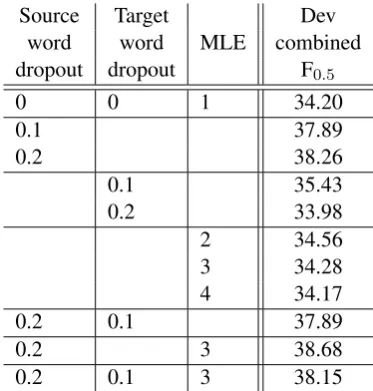
Table 4: The effect of source word dropout, target word dropout, and MLE weight on development combined F0.5score.
source word dropout, target word dropout and MLE weighting by almost 4%. To find out opti-mal values of all three hyper-parameters, we ran a small grid search. The results of this experi-ment are presented in Table4. The source-word dropout improves the results the most, MLE pro-vides minor gains, while the influence of target-word dropout on the results is unclear.
[image:5.595.322.509.305.501.2]av-1
2
3
4
5
6
7
Number of iterations
0.80
0.84
0.88
0.92
0.96
1.00
1.04
1.08
1.12
1.16
1.20
1.24
1.28
1.32
1.36
1.40
1.44
1.48
Threshold
[image:6.595.72.531.58.440.2]42.8
43.2
43.6
44.0
44.4
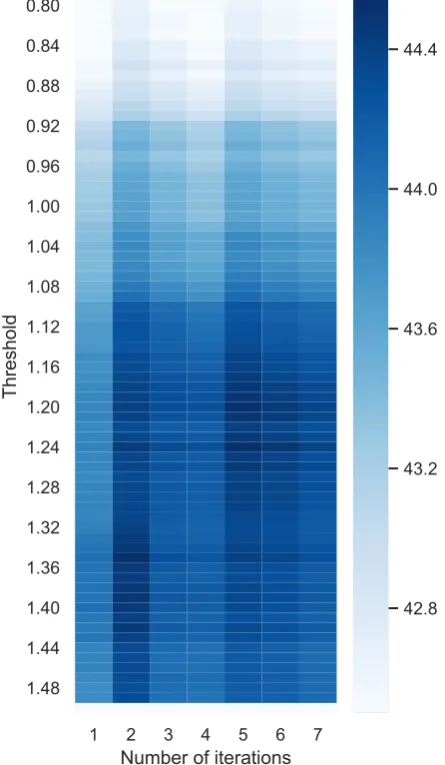
Figure 1: Performance of iterative decoding depending on number of iterations and threshold parameters.
eraged the better the results are.
Finally, we inspect the effect of iterative decod-ing. Specifically, we run an exhaustive grid search to find optimal values ofthresholdandmax iters. The results of this experimented are visualised in Figure 1. We can see that increasing threshold
from 1 to values around 1.20 leads to substan-tially better results. Moreover, using more itera-tions also has a positive impact on the model per-formance. Both of these improvements are caused by the model generating more corrections which are deemed less likely to the model, i.e., we in-crease recall at the expense of precision.
4.3 Low-Resource Track
We train following models in the Low-Resource Track:
1. the transformer big configuration with
[image:6.595.71.294.64.447.2]Checkpointing Dev combined F0.5 No checkpointing 41.55 Averaging 4 checkpoints 43.00 Averaging 6 checkpoints 43.13 Averaging 8 checkpoints 43.29
Table 5: Maximum development combined F0.5score achieved by averaging the given number of check-points.
ID Model
Dev combined
F0.5
1 transformer big 22.03
0.2 src drop, 0.1 tgt drop
2 transformer clean big tpu 26.05 no src drop, no tgt drop
3 transformer clean big tpu 24.80 0.2 src drop, 0.1 tgt drop
4 transformer clean big tpu 21.16 no spelling or infillment errors
Table 6: Development combined F0.5 score achieved with different models in the Low-Resource Track.
input word dropout set to 0.2 and tar-get word dropoutto 0.1 – settings similar to the best system in the Restricted Track but without edited MLE;
2. the transformer clean big tpu configuration – this configuration uses no internal dropouts;
3. the transformer clean big tpu configu-ration with input word dropout 0.2 and
target word dropout0.1;
4. the transformer clean big tpu configura-tion trained on sentences extracted from Wikipedia revisions without introducing additional spelling errors and infillment marker.
All but the fourth model use the training data as described in Section3.2 and the training scheme is in all models identical. The results of all models are presented in Table6.
[image:6.595.307.523.199.353.2]in-1
2
3
4
5
6
7
Number of iterations
0.60
0.62
0.64
0.66
0.68
0.70
0.72
0.74
0.76
0.78
0.80
0.82
0.84
0.86
0.88
0.90
0.92
0.94
0.96
0.98
1.00
1.02
1.04
1.06
1.08
1.10
1.12
Threshold
[image:7.595.73.292.60.443.2]24.6
25.2
25.8
26.4
27.0
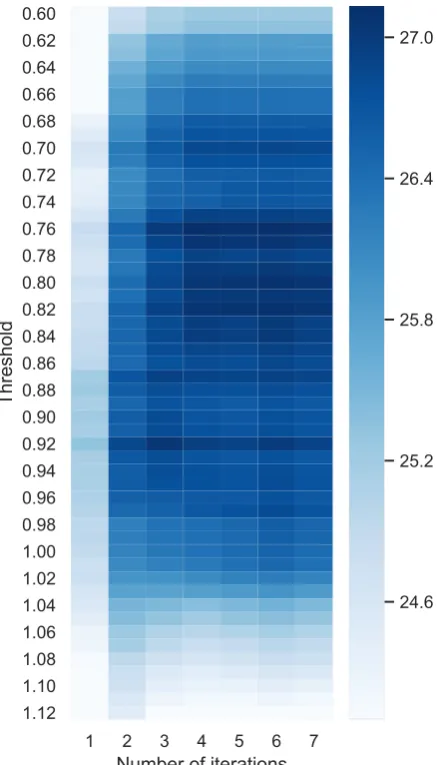
Figure 2: Performance of iterative decoding depending on number of iterations and threshold parameters.
ternal dropouts in the first experiment, the perfor-mance drops by additional 2.8%. This confirms our assumption that the enormous amount of data is strong enough regularizer and the usage of ad-ditional regularizers leads to worse performance.
The results of the fourth model, which was trained on data without additional spelling and in-fillment noise, are almost 5% worse than when training on data with this noise. It would be an interesting experiment to evaluate the effect of spelling and infillment noise separately, but this was not done in this paper.
We also run an exhaustive grid search to find op-timal values ofthresholdandmax itersin iterative decoding. As we can see in Figure2, the optimal value ofthreshold is now below 1 indicating that precision is now increased at the expense of recall. A performance gain in using more than one itera-tion is clearly visible.
4.4 Unrestricted Track
In the Unrestricted Track, we tried finetuning the pretrained system with two different learning rate schedules:
• linearly increase learning rate from 0 to 0.011 over the first 8000 steps, then decrease it proportionally to the number of steps after that – exactly same as while training system from scratch in the Restricted Track (see Sec-tion3.1.7);
• linearly increase learning rate from 0 to 3e-4 then keep the learning rate constant as pro-posed byLichtarge et al.(2018).
All other hyper-parameters and the training pro-cess remain the same as described in Section3.3.
The first finetuning scheme overfitted the train-ing corpus quite quickly while reachtrain-ing score of 48.33. The second scheme converged slower and reached a higher score of 48.82.
5 Conclusion
We have presented our three systems submitted to the BEA 2019 Shared Tasks. By employ-ing larger architecture, source and target word dropout, edited MLE, dataset extension, check-point averaging, and iterative decoding, our sys-tem reached 59.39 F0.5 score in the Restricted Track, finishing 10thout of 21 participants.
In the Low Resource Track, we utilized Wikipedia revision edits as a training data, reach-ing 44.14 F0.5 score. Finally, we finetuned this model using the annotated training data, obtaining 65.55 F0.5score in the Unrestricted Track, ranking 3rdout of 7 submissions.
As future work, we would like to explore itera-tive decoding algorithm more thoroughly. Specif-ically, we hope that allowingthreshold parameter to change in each iteration might provide gains. We would also like to train systems on Wikipedia revisions in other languages.
Acknowledgements
This research was also partially supported by SVV project number 260 453 and GAUK 578218 of the Charles University.
References
Chris Brockett, William B Dolan, and Michael Gamon. 2006. Correcting esl errors using phrasal smt tech-niques. In Proceedings of the 21st International Conference on Computational Linguistics and the 44th annual meeting of the Association for Compu-tational Linguistics, pages 249–256. Association for Computational Linguistics.
Christopher Bryant, Mariano Felice, Øistein E. Ander-sen, and Ted Briscoe. 2019. The BEA-2019 Shared Task on Grammatical Error Correction. In Proceed-ings of the 14th Workshop on Innovative Use of NLP for Building Educational Applications. Association for Computational Linguistics.
Daniel Dahlmeier, Hwee Tou Ng, and Siew Mei Wu. 2013. Building a large annotated corpus of learner english: The nus corpus of learner english. In Pro-ceedings of the eighth workshop on innovative use of NLP for building educational applications, pages 22–31.
Tao Ge, Furu Wei, and Ming Zhou. 2018. Reaching human-level performance in automatic grammatical error correction: An empirical study. arXiv preprint arXiv:1807.01270.
Sylviane Granger. 1998. The computer learner corpus: A versatile new source of data for SLA research. In Sylviane Granger, editor,Learner English on Com-puter, pages 3–18. Addison Wesley Longman, Lon-don and New York.
Marcin Junczys-Dowmunt and Roman Grundkiewicz. 2016. Phrase-based machine translation is state-of-the-art for automatic grammatical error correction. arXiv preprint arXiv:1605.06353.
Marcin Junczys-Dowmunt, Roman Grundkiewicz, Shubha Guha, and Kenneth Heafield. 2018. Ap-proaching neural grammatical error correction as a low-resource machine translation task. arXiv preprint arXiv:1804.05940.
Jared Lichtarge, Christopher Alberti, Shankar Kumar, Noam Shazeer, and Niki Parmar. 2018. Weakly su-pervised grammatical error correction using iterative decoding.arXiv preprint arXiv:1811.01710.
Tomoya Mizumoto, Mamoru Komachi, Masaaki Na-gata, and Yuji Matsumoto. 2011. Mining revision log of language learning sns for automated japanese error correction of second language learners. In Pro-ceedings of 5th International Joint Conference on Natural Language Processing, pages 147–155.
Martin Popel and Ondˇrej Bojar. 2018. Training tips for the transformer model. The Prague Bulletin of Mathematical Linguistics, 110(1):43–70.
Noam Shazeer and Mitchell Stern. 2018. Adafactor: Adaptive learning rates with sublinear memory cost. arXiv preprint arXiv:1804.04235.
Nitish Srivastava, Geoffrey Hinton, Alex Krizhevsky, Ilya Sutskever, and Ruslan Salakhutdinov. 2014. Dropout: a simple way to prevent neural networks from overfitting. The Journal of Machine Learning Research, 15(1):1929–1958.
Toshikazu Tajiri, Mamoru Komachi, and Yuji Mat-sumoto. 2012. Tense and aspect error correction for esl learners using global context. In Proceedings of the 50th Annual Meeting of the Association for Computational Linguistics: Short Papers-Volume 2, pages 198–202. Association for Computational Lin-guistics.
Ashish Vaswani, Noam Shazeer, Niki Parmar, Jakob Uszkoreit, Llion Jones, Aidan N Gomez, Łukasz Kaiser, and Illia Polosukhin. 2017. Attention is all you need. InAdvances in neural information pro-cessing systems, pages 5998–6008.
Helen Yannakoudakis, Ted Briscoe, and Ben Medlock. 2011. A new dataset and method for automatically grading esol texts. InProceedings of the 49th An-nual Meeting of the Association for Computational Linguistics: Human Language Technologies-Volume 1, pages 180–189. Association for Computational Linguistics.