Proceedings of the 55th Annual Meeting of the Association for Computational Linguistics, pages 665–677 Vancouver, Canada, July 30 - August 4, 2017. c2017 Association for Computational Linguistics Proceedings of the 55th Annual Meeting of the Association for Computational Linguistics, pages 665–677
Vancouver, Canada, July 30 - August 4, 2017. c2017 Association for Computational Linguistics
Hybrid Code Networks: practical and efficient end-to-end dialog control
with supervised and reinforcement learning
Jason D. Williams
Microsoft Research [email protected]
Kavosh Asadi
Brown University [email protected]
Geoffrey Zweig∗ Microsoft Research
Abstract
End-to-end learning of recurrent neural networks (RNNs) is an attractive solu-tion for dialog systems; however, cur-rent techniques are data-intensive and re-quire thousands of dialogs to learn
sim-ple behaviors. We introduce Hybrid
Code Networks (HCNs), which combine
an RNN withdomain-specific knowledge
encoded as software and system action templates. Compared to existing end-to-end approaches, HCNs considerably re-duce the amount of training data required, while retaining the key benefit of inferring a latent representation of dialog state. In addition, HCNs can be optimized with su-pervised learning, reinforcement learning, or a mixture of both. HCNs attain state-of-the-art performance on the bAbI dialog dataset (Bordes and Weston, 2016), and outperform two commercially deployed customer-facing dialog systems.
1 Introduction
Task-oriented dialog systems help a user to ac-complish some goal using natural language, such as making a restaurant reservation, getting techni-cal support, or placing a phonetechni-call. Historitechni-cally, these dialog systems have been built as a pipeline, with modules for language understanding, state tracking, action selection, and language genera-tion. However, dependencies between modules in-troduce considerable complexity – for example, it is often unclear how to define the dialog state and what history to maintain, yet action selection re-lies exclusively on the state for input. Moreover, training each module requires specialized labels.
∗Currently at JPMorgan Chase
Recently, end-to-end approaches have trained recurrent neural networks (RNNs) directly on text transcripts of dialogs. A key benefit is that the RNN infers a latent representation of state, obviat-ing the need for state labels. However, end-to-end methods lack a general mechanism for injecting domain knowledge and constraints. For example, simple operations like sorting a list of database re-sults or updating a dictionary of entities can ex-pressed in a few lines of software, yet may take thousands of dialogs to learn. Moreover, in some practical settings, programmed constraints are es-sential – for example, a banking dialog system would require that a user is logged in before they can retrieve account information.
This paper presents a model for end-to-end
learning, called Hybrid Code Networks (HCNs)
which addresses these problems. In addition to learning an RNN, HCNs also allow a developer to express domain knowledge via software and ac-tion templates. Experiments show that, compared to existing recurrent end-to-end techniques, HCNs achieve the same performance with considerably less training data, while retaining the key benefit of end-to-end trainability. Moreover, the neural network can be trained with supervised learning or reinforcement learning, by changing the gradi-ent update applied.
This paper is organized as follows. Section 2
describes the model, and Section 3compares the
model to related work. Section 4 applies HCNs
to the bAbI dialog dataset (Bordes and Weston,
2016). Section5then applies the method to real customer support domains at our company. Sec-tion6illustrates how HCNs can be optimized with reinforcement learning, and Section7concludes.
What’s the weather this week in Seattle?
Choose action template Entity
output Action
type?
Anything else? text
Dense + softmax RNN
Entity tracking
Bag of words vector Forecast() 0.93
Normal-ization.
X
Anything else? 0.07 <city>, right? 0.00 API call
API
WeatherBot
Utterance embedding
2 3 4
7 9
11
14 15
18
6
12 13
17
Action mask Context features
Fully-formed action API
result
1
5
Entity extraction
t+1
t+1
8
10
[image:2.595.79.529.65.258.2]t+1 16
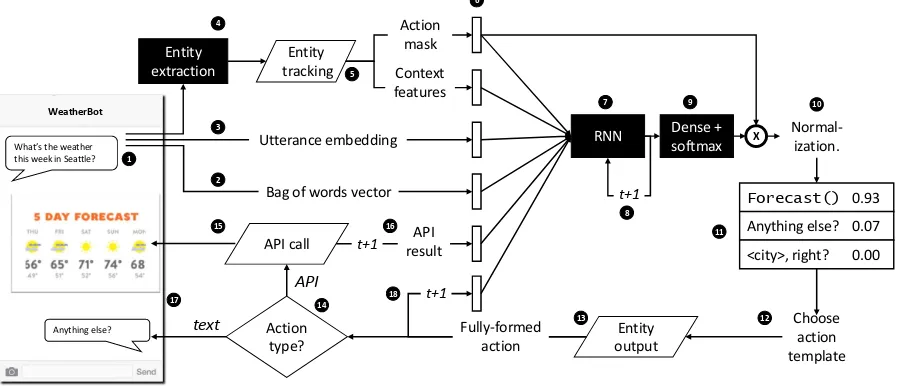
Figure 1: Operational loop. Trapezoids refer to programmatic code provided by the software developer, and shaded boxes are trainable components. Vertical bars under “6” represent concatenated vectors which form the input to the RNN.
2 Model description
At a high level, the four components of a Hy-brid Code Network are a recurrent neural net-work; domain-specific software; domain-specific action templates; and a conventional entity extrac-tion module for identifying entity menextrac-tions in text. Both the RNN and the developer code maintain state. Each action template can be a textual com-municative action or an API call. The HCN model is summarized in Figure1.
The cycle begins when the user provides an ut-terance, as text (step 1). The utterance is featurized in several ways. First, a bag of words vector is formed (step 2). Second, an utterance embedding is formed, using a pre-built utterance embedding model (step 3). Third, an entity extraction module identifies entity mentions (step 4) – for example, identifying “Jennifer Jones” as a<name>entity. The text and entity mentions are then passed to “Entity tracking” code provided by the developer (step 5), which grounds and maintains entities – for example, mapping the text “Jennifer Jones” to a specific row in a database. This code can option-ally return an “action mask”, indicating actions which are permitted at the current timestep, as a bit vector. For example, if a target phone number has not yet been identified, the API action to place a phone call may be masked. It can also option-ally return “context features” which are features the developer thinks will be useful for
distinguish-ing among actions, such as which entities are cur-rently present and which are absent.
The feature components from steps 1-5 are con-catenated to form a feature vector (step 6). This vector is passed to an RNN, such as a long
short-term memory (LSTM) (Hochreiter and
Schmidhu-ber,1997) or gated recurrent unit (GRU) (Chung et al., 2014). The RNN computes a hidden state (vector), which is retained for the next timestep (step 8), and passed to a dense layer with a soft-max activation, with output dimension equal to the number of distinct system action templates (step 9).1Thus the output of step 9 is a distribution over
action templates. Next, the action mask is applied as an element-wise multiplication, and the result is normalized back to a probability distribution (step 10) – this forces non-permitted actions to take on probability zero. From the resulting distribution (step 11), an action is selected (step 12). When RL is active, exploration is required, so in this case an action issampledfrom the distribution; when RL is not active, the best action should be chosen, and so the action with thehighest probabilityis always selected.
The selected action is next passed to “Entity output” developer code that can substitute in en-tities (step 13) and produce a fully-formed action – for example, mapping the template “<city>,
1Implementation details for the RNN such as size, loss,
right?” to “Seattle, right?”. In step 14, control branches depending on the type of the action: if it is an API action, the corresponding API call in the developer code is invoked (step 15) – for example, to render rich content to the user. APIs can act as sensors and return features relevant to the dialog, so these can be added to the feature vector in the next timestep (step 16). If the action is text, it is rendered to the user (step 17), and cycle then re-peats. The action taken is provided as a feature to the RNN in the next timestep (step 18).
3 Related work
Broadly there are two lines of work applying ma-chine learning to dialog control. The first de-composes a dialog system into a pipeline, typ-ically including language understanding, dialog state tracking, action selection policy, and lan-guage generation (Levin et al.,2000;Singh et al.,
2002;Williams and Young,2007;Williams,2008;
Hori et al., 2009; Lee et al., 2009; Griol et al.,
2008;Young et al.,2013;Li et al.,2014). Specifi-cally related to HCNs, past work has implemented the policy as feed-forward neural networks (Wen et al.,2016), trained with supervised learning fol-lowed by reinforcement learning (Su et al.,2016).
In these works, the policy has not been
recur-rent– i.e., the policy depends on the state tracker to summarize observable dialog history into state features, which requires design and specialized la-beling. By contrast, HCNs use an RNN which au-tomatically infers a representation of state. For learning efficiency, HCNs use an external light-weight process for tracking entity values, but the policy is not strictly dependent on it: as an illustra-tion, in Section5below, we demonstrate an HCN-based dialog system which has no external state tracker. If there is context which is not apparent in the text in the dialog, such as database status, this can be encoded as a context feature to the RNN.
The second, more recent line of work applies recurrent neural networks (RNNs) to learn “end-to-end” models, which map from an observable dialog history directly to a sequence of output words (Sordoni et al., 2015; Shang et al., 2015;
Vinyals and Le, 2015; Yao et al., 2015; Serban et al.,2016;Li et al.,2016a,c;Luan et al.,2016;
Xu et al.,2016;Li et al.,2016b;Mei et al.,2016;
Lowe et al., 2017; Serban et al., 2017). These systems can be applied to task-oriented domains by adding special “API call” actions, enumerating
database output as a sequence of tokens (Bordes and Weston, 2016), then learning an RNN using Memory Networks (Sukhbaatar et al.,2015), gated
memory networks (Liu and Perez, 2016), query
reduction networks (Seo et al., 2016), and
copy-augmented networks (Eric and Manning, 2017).
In each of these architectures, the RNN learns to manipulate entity values, for example by saving them in a memory. Output is produced by gen-erating a sequence of tokens (or ranking all pos-sible surface forms), which can also draw from this memory. HCNs also use an RNN to accu-mulate dialog state and choose actions. However, HCNs differ in that they use developer-provided action templates, which can contain entity refer-ences, such as “<city>, right?”. This design re-duce learning complexity, and also enable the soft-ware to limit which actions are available via an ac-tion mask, at the expense of developer effort. To further reduce learning complexity in a practical system, entities are tracked separately, outside the the RNN, which also allows them to be substituted into action templates. Also, past end-to-end re-current models have been trained using supervised learning, whereas we show how HCNs can also be trained with reinforcement learning.
4 Supervised learning evaluation I
In this section we compare HCNs to existing ap-proaches on the public “bAbI dialog” dataset ( Bor-des and Weston,2016). This dataset includes two end-to-end dialog learning tasks, in the restaurant domain, called task5 and task6.2 Task5 consists of
synthetic, simulated dialog data, with highly regu-lar user behavior and constrained vocaburegu-lary. Di-alogs include a database access action which re-trieves relevant restaurants from a database, with results included in the dialog transcript. We test on the “OOV” variant of Task5, which includes en-tity values not observed in the training set. Task6 draws on human-computer dialog data from the second dialog state tracking challenge (DSTC2), where usability subjects (crowd-workers) inter-acted with several variants of a spoken dialog sys-tem (Henderson et al.,2014a). Since the database from DSTC2 was not provided, database calls have been inferred from the data and inserted into the dialog transcript. Example dialogs are pro-vided in the Appendix SectionsA.2andA.3.
specific software, as follows. First, for entity extraction (step 4 in Figure 1), we used a sim-ple string match, with a pre-defined list of entity names – i.e., the list of restaurants available in the database. Second, in the context update (step 5), we wrote simple logic for tracking entities: when an entity is recognized in the user input, it is retained by the software, over-writing any
pre-viously stored value. For example, if theprice
“cheap” is recognized in the first turn, it is retained asprice=cheap. If “expensive” is then recog-nized in the third turn, it over-writes “cheap” so
the code now holdsprice=expensive. Third,
system actions were templatized: for example, system actions of the form “prezzo is a nice restau-rant in the west of town in the moderate price range” all map to the template “<name>is a nice restaurant in the <location> of town in the
<price> price range”. This results in 16 tem-plates for Task5 and 58 for Task6.3 Fourth, when
database results are received into the entity state, they are sorted by rating. Finally, an action mask was created which encoded common-sense depen-dencies. These are implemented as simple if-then rules based on the presence of entity values: for example, only allow an API call if pre-conditions are met; only offer a restaurant if database results have already been received; do not ask for an en-tity if it is already known; etc.
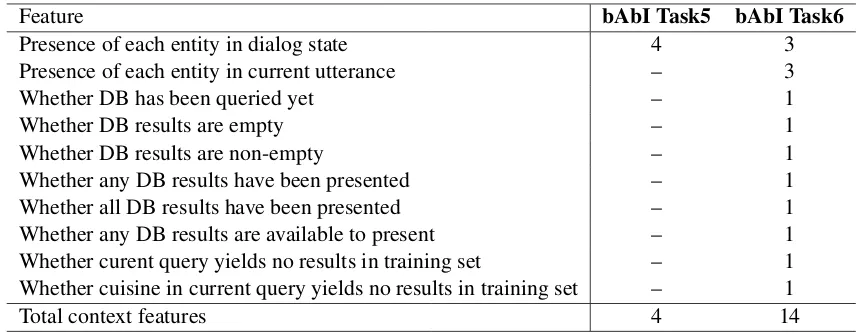
For Task6, we noticed that the system can say that no restaurants match the current query with-out consulting the database (for an example dia-log, see SectionA.3in the Appendix). In a prac-tical system this information would be retrieved from the database and not encoded in the RNN. So, we mined the training data and built a table of search queries known to yield no results. We also added context features that indicated the state of the database – for example, whether there were any restaurants matching the current query. The complete set of context features is given in
Ap-pendix Section A.4. Altogether this code
con-sisted of about 250 lines of Python.
We then trained an HCN on the training set, employing the domain-specific software described above. We selected an LSTM for the recurrent layer (Hochreiter and Schmidhuber, 1997), with the AdaDelta optimizer (Zeiler,2012). We used the development set to tune the number of hid-3A handful of actions in Task6 seemed spurious; for these,
we replaced them with a special “UNK” action in the training set, and masked this action at test time.
den units (128), and the number of epochs (12). Utterance embeddings were formed by averaging word embeddings, using a publicly available 300-dimensional word embedding model trained us-ing word2vec on web data (Mikolov et al.,2013).4
The word embeddings were static and not updated during LSTM training. In training, each dialog formed one minibatch, and updates were done on full rollouts (i.e., non-truncated back propagation through time). The training loss was categorical cross-entropy. Further low-level implementation details are in the Appendix SectionA.1.
We ran experiments with four variants of our model: with and without the utterance embed-dings, and with and without the action mask (Fig-ure1, steps 3 and 6 respectively).
Following past work, we report average turn ac-curacy – i.e., for each turn in each dialog, present the (true) history of user and system actions to the network and obtain the network’s prediction as a string of characters. The turn is correct if the string matches the reference exactly, and incorrect if not. We also report dialog accuracy, which indicates if all turns in a dialog are correct.
We compare to four past end-to-end approaches (Bordes and Weston,2016;Liu and Perez,2016;
Eric and Manning,2017;Seo et al.,2016). We em-phasize that past approaches have applied purely sequence-to-sequence models, or (as a baseline)
purely programmed rules (Bordes and Weston,
2016). By contrast, Hybrid Code Networks are a
hybrid of hand-coded rules and learned models. Results are shown in Table 1. Since Task5 is synthetic data generated using rules, it is possi-ble to obtain perfect accuracy using rules (line 1). The addition of domain knowledge greatly simpli-fies the learning task and enables HCNs to also at-tain perfect accuracy. On Task6, rules alone fare poorly, whereas HCNs outperform past learned models.
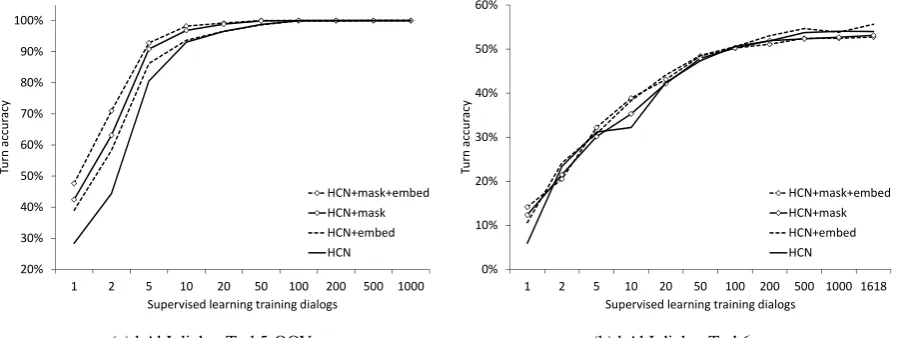
We next examined learning curves, training with increasing numbers of dialogs. To guard against bias in the ordering of the training set, we averaged over 5 runs, randomly permuting the or-der of the training dialogs in each run. Results are in Figure2. In Task5, the action mask and utter-ance embeddings substantially reduce the number of training dialogs required (note the horizontal axis scale is logarithmic). For Task6, the
bene-4Google News 100B model fromhttps://github.
Task5-OOV Task6
Model Turn Acc. Dialog Acc. Turn Acc. Dialog Acc.
Rules 100% 100% 33.3% 0.0%
Bordes and Weston(2016) 77.7% 0.0% 41.1% 0.0%
Liu and Perez(2016) 79.4% 0.0% 48.7% 1.4%
Eric and Manning(2017) — — 48.0% 1.5%
Seo et al.(2016) 96.0% — 51.1% —
HCN 100% 100% 54.0% 1.2%
HCN+embed 100% 100% 55.6% 1.3%
HCN+mask 100% 100% 53.1% 1.9%
[image:5.595.114.485.61.214.2]HCN+embed+mask 100% 100% 52.7% 1.5%
Table 1: Results on bAbI dialog Task5-OOV and Task6 (Bordes and Weston,2016). Results for “Rules”
taken fromBordes and Weston(2016). Note that, unlike cited past work, HCNs make use of
domain-specific procedural knowledge.
20% 30% 40% 50% 60% 70% 80% 90% 100%
1 2 5 10 20 50 100 200 500 1000
Tu
rn
a
cc
ur
ac
y
Supervised learning training dialogs
HCN+mask+embed HCN+mask HCN+embed HCN
(a) bAbI dialog Task5-OOV.
0% 10% 20% 30% 40% 50% 60%
1 2 5 10 20 50 100 200 500 1000 1618
Tu
rn
a
cc
ur
ac
y
Supervised learning training dialogs
HCN+mask+embed HCN+mask HCN+embed HCN
(b) bAbI dialog Task6.
Figure 2: Training dialog count vs. turn accuracy for bAbI dialog Task5-OOV and Task6. “embed” indicates whether utterance embeddings were included; “mask” indicates whether the action masking code was active.
fits of the utterance embeddings are less clear. An error analysis showed that there are several sys-tematic differences between the training and test-ing sets. Indeed, DSTC2 intentionally used differ-ent dialog policies for the training and test sets, whereas our goal is to mimic the policy in the training set.
Nonetheless, these tasks are the best public benchmark we are aware of, and HCNs exceed performance of existing sequence-to-sequence models. In addition, they match performance of past models using an order of magnitude less data (200 vs. 1618 dialogs), which is crucial in practi-cal settings where collecting realistic dialogs for a new domain can be expensive.
5 Supervised learning evaluation II
We now turn to comparing with purely hand-crafted approaches. To do this, we obtained logs from our company’s text-based customer support dialog system, which uses a sophisticated rule-based dialog manager. Data from this system is attractive for evaluation because it is used by real customers – not usability subjects – and because its rule-based dialog manager was developed by customer support professionals at our company, and not the authors. This data is not publicly available, but we are unaware of suitable human-computer dialog data in the public domain which uses rules.
[image:5.595.79.528.285.454.2]as “I need to update my operating system”. They are then routed to one of several hundred domains, where each domain attempts to resolve a particu-lar problem. In this study, we collected human-computer transcripts for the high-traffic domains “reset password” and “cannot access account”.
We labeled the dialog data as follows. First, we enumerated unique system actions observed in the data. Then, for each dialog, starting from the beginning, we examined each system action, and determined whether it was “correct”. Here, cor-rect means that it was the most appropriate action among the set of existing system actions, given the history of that dialog. If multiple actions were ar-guably appropriate, we broke ties in favor of the existing rule-based dialog manager. Example
di-alogs are provided in the Appendix SectionsA.5
andA.6.
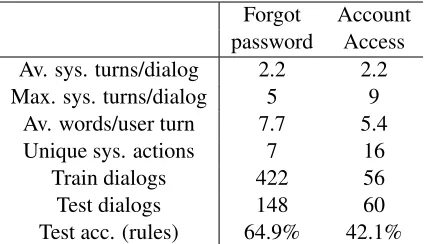
If a system action was labeled as correct, we left it as-is and continued to the next system action. If the system action was not correct, we replaced it with the correct system action, and discarded the rest of the dialog, since we do not know how the user would have replied to this new system action. The resulting dataset contained a mixture of com-plete and partial dialogs, containing only correct system actions. We partitioned this set into train-ing and test dialogs. Basic statistics of the data are shown in Table2.
In this domain, no entities were relevant to the control flow, and there was no obvious mask logic since any question could follow any question. Therefore, we wrote no domain-specific software for this instance of the HCN, and relied purely on the recurrent neural network to drive the conver-sation. The architecture and training of the RNN was the same as in Section4, except that here we did not have enough data for a validation set, so we instead trained until we either achieved 100% accuracy on the training set or reached 200 epochs. To evaluate, we observe that conventional mea-sures like average dialog accuracy unfairly penal-ize the system used to collect the dialogs – in our case, the rule-based system. If the system used for collection makes an error at turnt, the labeled
dialog only includes the sub-dialog up to turn t,
and the system being evaluated off-line is only evaluated on that sub-dialog. In other words, in our case, reporting dialog accuracy would favor the HCN because it would be evaluated on fewer turns than the rule-based system. We therefore
Forgot Account
password Access
Av. sys. turns/dialog 2.2 2.2
Max. sys. turns/dialog 5 9
Av. words/user turn 7.7 5.4
Unique sys. actions 7 16
Train dialogs 422 56
Test dialogs 148 60
[image:6.595.311.525.62.184.2]Test acc. (rules) 64.9% 42.1%
Table 2: Basic statistics of labeled customer sup-port dialogs. Test accuracy refers to whole-dialog accuracy of the existing rule-based system.
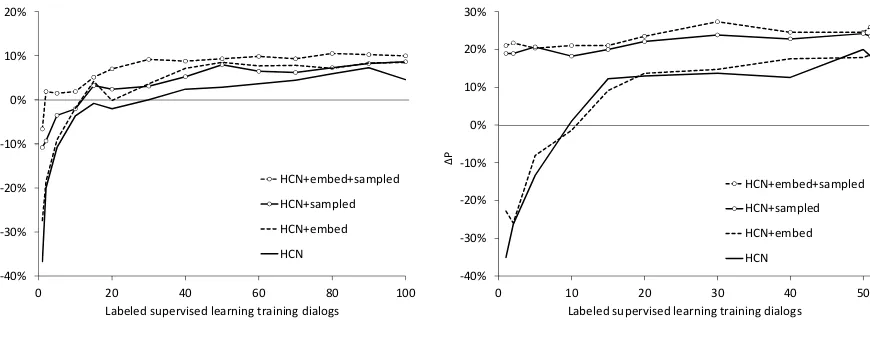
use a comparative measure that examines which method produces longer continuous sequences of correct system actions, starting from the begin-ning of the dialog. Specifically, we report∆P =
C(HCN-win)−C(rule-win)
C(all) , whereC(HCN-win) is the number of test dialogs where the rule-based ap-proach output a wrong action before the HCN;
C(rule-win) is the number of test dialogs where
the HCN output a wrong action before the rule-based approach; and C(all) is the number of
di-alogs in the test set. When ∆P > 0, there are
more dialogs in which HCNs produce longer con-tinuous sequences of correct actions starting from the beginning of the dialog. We run all experi-ments 5 times, each time shuffling the order of the training set. Results are in Figure3. HCNs exceed performance of the existing rule-based system af-ter about 30 dialogs.
In these domains, we have a further source of knowledge: the rule-based dialog managers them-selves can be used to generate example “sunny-day” dialogs, where the user provides purely ex-pected inputs. From each rule-based controller, synthetic dialogs were sampled to cover each ex-pected user response at least once, and added to the set of labeled real dialogs. This resulted in 75 dialogs for the “Forgot password” domain, and 325 for the “Can’t access account” domain. Train-ing was repeated as described above. Results are also included in Figure 3, with the suffix “sam-pled”. In the “Can’t access account” domain, the sampled dialogs yield a large improvement, proba-bly because the flow chart for this domain is large, so the sampled dialogs increase coverage. The gain in the “forgot password” domain is present but smaller.
-40% -30% -20% -10% 0% 10% 20%
0 20 40 60 80 100
Δ
P
Labeled supervised learning training dialogs HCN+embed+sampled HCN+sampled HCN+embed HCN
(a) “Forgot password” domain.
-40% -30% -20% -10% 0% 10% 20% 30%
0 10 20 30 40 50
ΔP
Labeled supervised learning training dialogs HCN+embed+sampled HCN+sampled HCN+embed HCN
[image:7.595.86.521.63.233.2](b) “Can’t access account” domain.
Figure 3: Training dialogs vs. ∆P, where ∆P is the fraction of test dialogs where HCNs produced
longer initial correct sequences of system actions than the rules, minus the fraction where rules produced longer initial correct sequences than the HCNs. “embed” indicates whether utterance embeddings were included; “sampled” indicates whether dialogs sampled from the rule-based controller were included in the training set.
production-grade rule-based systems with a reasonable number of labeled dialogs, and adding synthetic “sunny-day” dialogs improves performance further. Moreover, unlike existing pipelined approaches to dialog management that rely on an explicit state tracker, this HCN used no explicit state tracker, highlighting an advantage of the model.
6 Reinforcement learning illustration
In the previous sections, supervised learning (SL) was applied to train the LSTM to mimic dialogs provided by the system developer. Once a system operates at scale, interacting with a large number of users, it is desirable for the system to continue to learnautonomouslyusing reinforcement learn-ing (RL). With RL, each turn receives a measure-ment of goodness called areward; the agent ex-plores different sequences of actions in different situations, and makes adjustments so as to max-imize the expected discounted sum of rewards, which is called thereturn, denotedG.
For optimization, we selected apolicy gradient
approach (Williams, 1992), which has been suc-cessfully applied to dialog systems (Jurˇc´ıˇcek et al.,
2011), robotics (Kohl and Stone, 2004), and the board game Go (Silver et al., 2016). In policy gradient-based RL, a modelπis parameterized by
w and outputs a distribution from which actions
are sampled at each timestep. At the end of a tra-jectory – in our case, dialog – the return G for
that trajectory is computed, and the gradients of the probabilities of the actions taken with respect to the model weights are computed. The weights are then adjusted by taking a gradient step propor-tional to the return:
w←w+α(X
t
Owlogπ(at|ht;w))(G−b) (1)
whereαis a learning rate;atis the action taken at timestept;htis the dialog history at timet;Gis the return of the dialog;OxF denotes the Jacobian ofFwith respect tox;bis a baseline described be-low; andπ(a|h;w)is the LSTM – i.e., a stochastic
policy which outputs a distribution over a given
a dialog history h, parameterized by weightsw. The baselinebis an estimate of the average return
of the current policy, estimated on the last 100 di-alogs using weighted importance sampling.5
Intu-itively, “better” dialogs receive a positive gradient step, making the actions selected more likely; and “worse” dialogs receive a negative gradient step, making the actions selected less likely.
SL and RL correspond to different methods of updating weights, so both can be applied to the same network. However, there is no guarantee that the optimal RL policy will agree with the SL train-ing set; therefore, after each RL gradient step, we
5The choice of baseline does not affect the long-term
check whether the updated policy reconstructs the training set. If not, we re-run SL gradient steps on the training set until the model reproduces the training set. Note that this approach allows new training dialogs to be added at any time during RL optimization.
We illustrate RL optimization on a simulated dialog task in the name dialing domain. In this system, a contact’s name may have synonyms (“Michael” may also be called “Mike”), and a con-tact may have more than one phone number, such as “work” or “mobile”, which may in turn have synonyms like “cell” for “mobile”. This domain has a database of names and phone numbers taken from the Microsoft personnel directory, 5 entity
types – firstname, nickname, lastname,
phonenumber, and phonetype – and 14 ac-tions, including 2 API call actions. Simple en-tity logic was coded, which retains the most re-cent copy of recognized entities. A simple action mask suppresses impossible actions, such as plac-ing a phonecall before a phone number has been retrieved from the database. Example dialogs are provided in Appendix SectionA.7.
To perform optimization, we created a simu-lated user. At the start of a dialog, the simusimu-lated user randomly selected a name and phone type, in-cluding names and phone types not covered by the dialog system. When speaking, the simulated user can use the canonical name or a nickname; usually answers questions but can ignore the system; can provide additional information not requested; and can give up. The simulated user was parameter-ized by around 10 probabilities, set by hand.
We defined the reward as being 1 for
success-fully completing the task, and0otherwise. A
dis-count of0.95was used to incentivize the system to
complete dialogs faster rather than slower, yield-ing return0for failed dialogs, andG = 0.95T−1 for successful dialogs, where T is the number of
system turns in the dialog. Finally, we created a set of 21 labeled dialogs, which will be used for supervised learning.
For the RNN in the HCN, we again used an LSTM with AdaDelta, this time with 32 hidden units. RL policy updates are made after each dia-log. Since a simulated user was employed, we did not have real user utterances, and instead relied on context features, omitting bag-of-words and utter-ance embedding features.
We first evaluate RL by randomly initializing an
0% 10% 20% 30% 40% 50% 60% 70%
D
ia
lo
g
su
cc
es
s r
at
e
[image:8.595.310.524.68.223.2]Reinforcement learning training dialogs 10 interleaved 10 initial 5 initial 3 initial 1 initial 0
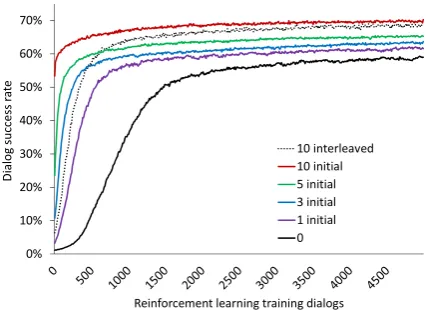
Figure 4: Dialog success rate vs. reinforcement learning training dialogs. Curve marked “0” be-gins with a randomly initialized LSTM. Curves marked “N initial” are pre-trained withN labeled dialogs. Curve marked “10, interleaved” adds one SL training dialog before RL dialog 0, 100, 200, ... 900.
LSTM, and begin RL optimization. After 10 RL updates, we freeze the policy, and run 500 dialogs with the user simulation to measure task comple-tion. We repeat all of this for 100 runs, and report average performance. In addition, we also report results by initializing the LSTM using supervised learning on the training set, consisting of 1, 2, 5, or 10 dialogs sampled randomly from the training set, then running RL as described above.
Results are in Figure4. Although RL alone can find a good policy, pre-training with just a hand-ful of labeled dialogs improves learning speed dra-matically. Additional experiments, not shown for space, found that ablating the action mask slowed training, agreeing withWilliams(2008).
Finally, we conduct a further experiment where we sample 10 training dialogs, then add one to the training set just before RL dialog 0, 100, 200,
... , 900. Results are shown in Figure 4. This
shows that SL dialogs can be introduced as RL is in progress – i.e., that it is possible to interleave RL and SL. This is an attractive property for prac-tical systems: if a dialog error is spotted by a de-veloper while RL is in progress, it is natural to add a training dialog to the training set.
7 Conclusion
systems. HCNs support a separation of concerns where procedural knowledge and constraints can be expressed in software, and the control flow is learned. Compared to existing end-to-end ap-proaches, HCNs afford more developer control and require less training data, at the expense of a small amount of developer effort.
Results in this paper have explored three differ-ent dialog domains. On a public benchmark in the restaurants domain, HCNs exceeded performance of purely learned models. Results in two trou-bleshooting domains exceeded performance of a commercially deployed rule-based system. Fi-nally, in a name-dialing domain, results from di-alog simulation show that HCNs can also be opti-mized with a mixture of reinforcement and super-vised learning.
In future work, we plan to extend HCNs by incorporating lines of existing work, such as in-tegrating the entity extraction step into the neu-ral network (Dhingra et al.,2017), adding richer utterance embeddings (Socher et al., 2013), and supporting text generation (Sordoni et al.,2015). We will also explore using HCNs with automatic speech recognition (ASR) input, for example by forming features from n-grams of the ASR n-best results (Henderson et al., 2014b). Of course, we also plan to deploy the model in a live dialog sys-tem. More broadly, HCNs are a general model for stateful control, and we would be interested to explore applications beyond dialog systems – for example, in NLP medical settings or human-robot NL interaction tasks, providing domain con-straints are important for safety; and in resource-poor settings, providing domain knowledge can amplify limited data.
References
Antoine Bordes and Jason Weston. 2016.
Learn-ing end-to-end goal-oriented dialog. CoRR
abs/1605.07683. http://arxiv.org/abs/1605.07683.
Franois Chollet. 2015. Keras. https://github.
com/fchollet/keras.
Junyoung Chung, Caglar Gulcehre, KyungHyun Cho, and Yoshua Bengio. 2014. Empirical evaluation of gated recurrent neural networks on sequence
model-ing. InProc NIPS 2014 Deep Learning and
Repre-sentation Learning Workshop.
Bhuwan Dhingra, Lihong Li, Xiujun Li, Jianfeng Gao, Yun-Nung Chen, Faisal Ahmed, and Li Deng. 2017.
Towards end-to-end reinforcement learning of
dia-logue agents for information access. In Proc
As-sociation for Computational Linguistics, Vancouver, Canada.
Mihail Eric and Christopher D Manning. 2017.
A copy-augmented sequence-to-sequence ar-chitecture gives good performance on task-oriented dialogue. CoRR abs/1701.04024.
https://arxiv.org/abs/1701.04024.
David Griol, Llus F. Hurtado, Encarna Segarra, and Emilio Sanchis. 2008. A statistical approach to
spo-ken dialog systems design and evaluation. Speech
Communication50(8–9).
Matthew Henderson, Blaise Thomson, and Jason Williams. 2014a. The second dialog state tracking
challenge. InProc SIGdial Workshop on Discourse
and Dialogue, Philadelphia, USA.
Matthew Henderson, Blaise Thomson, and Steve Young. 2014b. Word-based Dialog State Tracking
with Recurrent Neural Networks. InProc SIGdial
Workshop on Discourse and Dialogue, Philadel-phia, USA.
Sepp Hochreiter and Jurgen Schmidhuber. 1997.
Long short-term memory. Neural Computation
9(8):1735–1780.
Chiori Hori, Kiyonori Ohtake, Teruhisa Misu, Hideki
Kashioka, and Satoshi Nakamura. 2009.
Sta-tistical dialog management applied to WFST-based dialog systems. In Acoustics, Speech and Signal Processing, 2009. ICASSP 2009. IEEE International Conference on. pages 4793–4796.
https://doi.org/10.1109/ICASSP.2009.4960703.
Filip Jurˇc´ıˇcek, Blaise Thomson, and Steve Young. 2011. Natural actor and belief critic: Reinforcement algorithm for learning parameters of dialogue
sys-tems modelled as pomdps. ACM Transactions on
Speech and Language Processing (TSLP)7(3):6.
Nate Kohl and Peter Stone. 2004. Policy gradient re-inforcement learning for fast quadrupedal
locomo-tion. In Robotics and Automation, 2004.
Proceed-ings. ICRA’04. 2004 IEEE International Conference
on. IEEE, volume 3, pages 2619–2624.
Cheongjae Lee, Sangkeun Jung, Seokhwan Kim, and Gary Geunbae Lee. 2009. Example-based dialog modeling for practical multi-domain dialog system.
Speech Communication51(5):466–484.
Esther Levin, Roberto Pieraccini, and Wieland Eckert. 2000. A stochastic model of human-machine
inter-action for learning dialogue strategies. IEEE Trans
on Speech and Audio Processing8(1):11–23.
Jiwei Li, Michel Galley, Chris Brockett, Jianfeng Gao, and Bill Dolan. 2016a. A diversity-promoting ob-jective function for neural conversation models. In
Jiwei Li, Michel Galley, Chris Brockett, Georgios Sp-ithourakis, Jianfeng Gao, and Bill Dolan. 2016b. A
persona-based neural conversation model. In Proc
Association for Computational Linguistics, Berlin, Germany.
Jiwei Li, Will Monroe, Alan Ritter, Michel Galley, Jianfeng Gao, and Dan Jurafsky. 2016c. Deep
rein-forcement learning for dialogue generation. InProc
Conference on Empirical Methods in Natural Lan-guage Processing, Austin, Texas, USA.
Lihong Li, He He, and Jason D. Williams. 2014. Tem-poral supervised learning for inferring a dialog
pol-icy from example conversations. In Proc IEEE
Workshop on Spoken Language Technologies (SLT), South Lake Tahoe, Nevada, USA.
Fei Liu and Julien Perez. 2016. Gated
end-to-end memory networks. CoRR abs/1610.04211.
http://arxiv.org/abs/1610.04211.
Ryan Thomas Lowe, Nissan Pow, Iulian Vlad Serban, Laurent Charlin, Chia-Wei Liu, and Joelle Pineau. 2017. Training end-to-end dialogue systems with
the ubuntu dialogue corpus. Dialogue and
Dis-course8(1).
Yi Luan, Yangfeng Ji, and Mari Ostendorf. 2016.
LSTM based conversation models. CoRR
abs/1603.09457. http://arxiv.org/abs/1603.09457.
Hongyuan Mei, Mohit Bansal, and Matthew R.
Wal-ter. 2016. Coherent dialogue with
attention-based language models. CoRR abs/1611.06997.
http://arxiv.org/abs/1611.06997.
Tomas Mikolov, Ilya Sutskever, Kai Chen, Greg S Cor-rado, and Jeff Dean. 2013. Distributed representa-tions of words and phrases and their
compositional-ity. In Proc Advances in Neural Information
Pro-cessing Systems, Lake Tahoe, USA. pages 3111– 3119.
Min Joon Seo, Hannaneh Hajishirzi, and Ali
Farhadi. 2016. Query-regression networks for
machine comprehension. CoRR abs/1606.04582.
http://arxiv.org/abs/1606.04582.
Iulian V. Serban, Alessandro Sordoni, Yoshua Bengio,
Aaron Courville, and Joelle Pineau. 2016. Building
end-to-end dialogue systems using generative hierarchical neural network models. InProceedings of the Thirtieth AAAI Conference on Artificial Intel-ligence. AAAI Press, AAAI’16, pages 3776–3783.
http://dl.acm.org/citation.cfm?id=3016387.3016435. Iulian Vlad Serban, Alessandro Sordoni, Ryan Lowe,
Laurent Charlin, Joelle Pineau, Aaron Courville, and Yoshua Bengio. 2017. A hierarchical latent variable encoder-decoder model for generating dialogues. Lifeng Shang, Zhengdong Lu, , and Hang Li. 2015.
Neural responding machine for short-text
conversa-tion. In Proc Association for Computational
Lin-guistics, Beijing, China.
David Silver, Aja Huang, Chris J. Maddison, Arthur Guez, Laurent Sifre, George Van Den Driessche, Ju-lian Schrittwieser, Ioannis Antonoglou, Veda Pan-neershelvam, Marc Lanctot, et al. 2016. Mastering the game of Go with deep neural networks and tree
search. Nature529(7587):484–489.
Satinder Singh, Diane J Litman, Michael Kearns, and Marilyn A Walker. 2002. Optimizing dialogue man-agement with reinforcement leaning: experiments
with the NJFun system. Journal of Artificial
Intelli-gence16:105–133.
Richard Socher, Alex Perelygin, Jean Wu, Jason Chuang, Chris Manning, Andrew Ng, and Chris Potts. 2013. Recursive deep models for semantic
compositionality over a sentiment treebank. InProc
Conference on Empirical Methods in Natural Lan-guage Processing, Seattle, Washington, USA. Alessandro Sordoni, Michel Galley, Michael Auli,
Chris Brockett, Yangfeng Ji, Meg Mitchell, Jian-Yun Nie, Jianfeng Gao, and Bill Dolan. 2015. A neu-ral network approach to context-sensitive generation
of conversational responses. In Proc HLT-NAACL,
Denver, Colorado, USA.
Pei-Hao Su, Milica Gaˇsi´c, Nikola Mrkˇsi´c, Lina Rojas-Barahona, Stefan Ultes, David Vandyke, Tsung-Hsien Wen, and Steve Young. 2016. Continuously
learning neural dialogue management. In arXiv
preprint: 1606.02689.
Sainbayar Sukhbaatar, Arthur Szlam, Jason Weston, and Rob Fergus. 2015. End-to-end memory
net-works. In Proc Advances in Neural Information
Processing Systems (NIPS), Montreal, Canada.
Theano Development Team. 2016. Theano: A
Python framework for fast computation of mathe-matical expressions.arXiv e-printsabs/1605.02688.
http://arxiv.org/abs/1605.02688.
Oriol Vinyals and Quoc Le. 2015. A neural
conversa-tional model. InProc ICML Deep Learning
Work-shop.
Tsung-Hsien Wen, Milica Gasic, Nikola Mrksic, Lina Maria Rojas-Barahona, Pei-Hao Su, Ste-fan Ultes, David Vandyke, and Steve J. Young.
2016. A network-based end-to-end trainable
task-oriented dialogue system. CoRR abs/1604.04562.
http://arxiv.org/abs/1604.04562.
Jason D. Williams. 2008. The best of both worlds: Uni-fying conventional dialog systems and POMDPs. In
Proc Intl Conf on Spoken Language Processing (IC-SLP), Brisbane, Australia.
Jason D. Williams and Steve Young. 2007. Partially observable Markov decision processes for spoken
dialog systems. Computer Speech and Language
21(2):393–422.
Ronald J Williams. 1992. Simple statistical gradient-following algorithms for connectionist
Zhen Xu, Bingquan Liu, Baoxun Wang, Chengjie Sun,
and Xiaolong Wang. 2016. Incorporating
loose-structured knowledge into LSTM with recall gate for conversation modeling. CoRRabs/1605.05110.
http://arxiv.org/abs/1605.05110.
Kaisheng Yao, Geoffrey Zweig, and Baolin Peng. 2015. Attention with intention for a neural network
conversation model. InProc NIPS workshop on
Ma-chine Learning for Spoken Language Understanding and Interaction.
Steve Young, Milica Gasic, Blaise Thomson, and Ja-son D. Williams. 2013. POMDP-based Statistical
Spoken Dialogue Systems: a Review. Proceedings
of the IEEEPP(99):1–20.
Matthew D. Zeiler. 2012. ADADELTA: an
adap-tive learning rate method. CoRR abs/1212.5701.
http://arxiv.org/abs/1212.5701.
A Supplemental Material
A.1 Model implementation details
The RNN was specified using Keras version 0.3.3, with back-end computation in Theano version
0.8.0.dev0 (Theano Development Team, 2016;
Chollet, 2015). The Keras model specification is given below. The input variableobs includes all features from Figure1step 6 except for the previ-ous action (step 18) and the action mask (step 6, top-most vector).
# Given:
# obs_size, action_size, nb_hidden
g = Graph() g.add_input(
name=’obs’,
input_shape=(None, obs_size) )
g.add_input(
name=’prev_action’,
input_shape=(None, action_size) )
g.add_input(
name=’avail_actions’,
input_shape=(None, action_size) )
g.add_node( LSTM(
n_hidden,
return_sequences=True, activation=’tanh’, ),
name=’h1’, inputs=[
’obs’,
’prev_action’, ’avail_actions’ ]
)
g.add_node(
TimeDistributedDense( action_size,
activation=’softmax’, ),
name=’h2’, input=’h1’ )
g.add_node( Activation(
activation=normalize, ),
name=’action’,
inputs=[’h2’,’avail_actions’], merge_mode=’mul’,
create_output=True )
g.compile(
optimizer=Adadelta(clipnorm=1.), sample_weight_modes={
’action’: ’temporal’ },
loss={
’action’:’categorical_crossentropy’ }
)
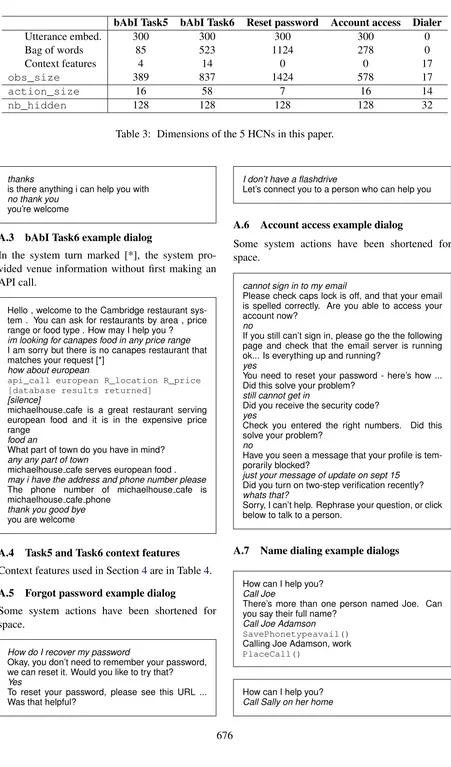
Model sizes are given in Table 3. Example di-alogs are given below for each of the 5 dialog sys-tems. For space and readability, the entity tags that appear in the user and system sides of the
dialogs have been removed – for example, Call
<name>Joan</name>is shown asCall Joan.
A.2 bAbI Task5 example dialog
good morning
hello what can i help you with today
i’d like to book a table with italian food
i’m on it
[silence]
where should it be
in paris
how many people would be in your party
for six people please
which price range are looking for
in a cheap price range please
ok let me look into some options for you
[silence]
api_call italian paris six cheap [database results returned]
[silence]
what do you think of this option:
resto madrid cheap spanish 8stars
no this does not work for me
sure let me find an other option for you
[silence]
what do you think of this option:
resto madrid cheap spanish 6stars
do you have something else
sure let me find an other option for you
[silence]
what do you think of this option:
resto madrid cheap spanish 1stars
it’s perfect
great let me do the reservation
may i have the phone number of the restaurant
bAbI Task5 bAbI Task6 Reset password Account access Dialer
Utterance embed. 300 300 300 300 0
Bag of words 85 523 1124 278 0
Context features 4 14 0 0 17
obs_size 389 837 1424 578 17
action_size 16 58 7 16 14
[image:12.595.74.525.47.814.2]nb_hidden 128 128 128 128 32
Table 3: Dimensions of the 5 HCNs in this paper.
thanks
is there anything i can help you with
no thank you
you’re welcome
A.3 bAbI Task6 example dialog
In the system turn marked [*], the system pro-vided venue information without first making an API call.
Hello , welcome to the Cambridge restaurant sys-tem . You can ask for restaurants by area , price range or food type . How may I help you ?
im looking for canapes food in any price range
I am sorry but there is no canapes restaurant that matches your request [*]
how about european
api_call european R_location R_price [database results returned]
[silence]
michaelhouse cafe is a great restaurant serving european food and it is in the expensive price range
food an
What part of town do you have in mind?
any any part of town
michaelhouse cafe serves european food .
may i have the address and phone number please
The phone number of michaelhouse cafe is michaelhouse cafe phone
thank you good bye
you are welcome
A.4 Task5 and Task6 context features Context features used in Section4are in Table4.
A.5 Forgot password example dialog
Some system actions have been shortened for space.
How do I recover my password
Okay, you don’t need to remember your password, we can reset it. Would you like to try that?
Yes
To reset your password, please see this URL ... Was that helpful?
I don’t have a flashdrive
Let’s connect you to a person who can help you
A.6 Account access example dialog
Some system actions have been shortened for space.
cannot sign in to my email
Please check caps lock is off, and that your email is spelled correctly. Are you able to access your account now?
no
If you still can’t sign in, please go the the following page and check that the email server is running ok... Is everything up and running?
yes
You need to reset your password - here’s how ... Did this solve your problem?
still cannot get in
Did you receive the security code?
yes
Check you entered the right numbers. Did this solve your problem?
no
Have you seen a message that your profile is tem-porarily blocked?
just your message of update on sept 15
Did you turn on two-step verification recently?
whats that?
Sorry, I can’t help. Rephrase your question, or click below to talk to a person.
A.7 Name dialing example dialogs
How can I help you?
Call Joe
There’s more than one person named Joe. Can you say their full name?
Call Joe Adamson
SavePhonetypeavail() Calling Joe Adamson, work PlaceCall()
How can I help you?
Feature bAbI Task5 bAbI Task6
Presence of each entity in dialog state 4 3
Presence of each entity in current utterance – 3
Whether DB has been queried yet – 1
Whether DB results are empty – 1
Whether DB results are non-empty – 1
Whether any DB results have been presented – 1
Whether all DB results have been presented – 1
Whether any DB results are available to present – 1
Whether curent query yields no results in training set – 1
Whether cuisine in current query yields no results in training set – 1
[image:13.595.83.512.61.228.2]Total context features 4 14
Table 4: Binary context features used to convey entity and database state in Section4.
Sorry, I don’t have a home number for Sally Smith. I only have a work phone. Do you want to call that number?
no