Proceedings of the First Grand Challenge and Workshop on Human Multimodal Language (Challenge-HML), pages 53–63, 53
Seq2Seq2Sentiment:
Multimodal Sequence to Sequence Models for Sentiment Analysis
Hai Pham1*, Thomas Manzini1*, Paul Pu Liang2, Barnab´as Pocz´os2 {1Language Technologies Institute,2Machine Learning Department}, CMU, USA
{htpham,tmanzini,pliang,bapoczos}@cs.cmu.edu
Abstract
Multimodal machine learning is a core research area spanning the language, vi-sual and acoustic modalities. The cen-tral challenge in multimodal learning in-volves learning representations that can process and relate information from multi-ple modalities. In this paper, we propose two methods for unsupervised learning of joint multimodal representations using se-quence to sese-quence (Seq2Seq) methods: a
Seq2Seq Modality Translation Modeland aHierarchical Seq2Seq Modality Transla-tion Model. We also explore multiple dif-ferent variations on the multimodal inputs and outputs of these seq2seq models. Our experiments on multimodal sentiment anal-ysis using the CMU-MOSI dataset indicate that our methods learn informative mul-timodal representations that outperform the baselines and achieve improved per-formance on multimodal sentiment analy-sis, specifically in the Bimodal case where our model is able to improve F1 Score by twelve points. We also discuss future direc-tions for multimodal Seq2Seq methods.
1 Introduction
Sentiment analysis, which involves identifying a speaker’s sentiment, is an open research problem. In this field, the majority of work done focused on unimodal methodologies - primarily textual analy-sis - where investigating was limited to identifying usage of words in positive and negative scenar-ios. However, unimodal textual sentiment anal-ysis through usage of words, phrases, and their interdependencies were found to be insufficient for extracting affective content from textual opinions
(Rosas et al.,2013).1 As a result, there has been a recent push towards using statistical methods to extract additional behavioral cues not present in the language modality from the video and audio modalities. This research field is known as multi-modal sentiment analysis and it extends the con-ventional text-based definition of sentiment anal-ysis to a multimodal setup where different modal-ities contribute to modeling the sentiment of the speaker. For example, (Kaushik et al.,2013) ex-plores modalities such as audio, while (W¨ollmer et al., 2013) explores a multimodal approach to predicting sentiment. This push has been further bolstered by the advent of multimodal social me-dia platforms, such as YouTube, Facebook, and VideoLectures which are used to express personal opinions on a worldwide scale. As a result, several multimodal datasets, such as CMU-MOSI (Zadeh et al.,2016) and later CMU-MOSEI (Zadeh et al.,
2018c), ICT-MMMO (W¨ollmer et al.,2013) and YouTube (Morency et al.,2011), take advantage of the abundance of multimodal data on the Internet. At the same time, neural network based multimodal models have been proposed that are highly effective at learning multimodal representations for multi-modal sentiment analysis (Chen et al.,2017;Poria et al.,2017;Zadeh et al.,2018a,b).
Recent progress has been limited to supervised learning using labeled data, and does not take ad-vantage of the abundant unlabeled data on the In-ternet. To address this gap, our work is primarily one of unsupervised representation learning. We attempt to learn a multimodal representation of our data in a structured paradigm and explore whether a joint multimodal representation trained via un-supervised learning can improve the performance for multimodal sentiment analysis. While represen-tation learning has been an area of rapid research
1
in the past years, there has been limited work that explores multimodal setting. To this end, we pro-pose two methods: aSeq2Seq Modality Translation Modeland aHierarchical Seq2Seq Modality Trans-lation Modelfor unsupervised learning of multi-modal representations. Our results show that us-ing multimodal representations learned from our Seq2Seq modality translation method outperforms the baselines and achieves improved performance on multimodal sentiment analysis.
2 Related Work
In the past, approaches to text-based emotion and sentiment recognition rely mainly on rule-based techniques, bag of words (BoW) modeling or SNoW architecture (Chaumartin, 2007) using a large sentiment or emotion lexicon (Mishne et al.,
2005), or statistical approaches that assume the availability of a large dataset annotated with polar-ity or emotion labels.
Multimodal sentiment analysis has gained a lot of research interests over the last few years ( Baltru-saitis et al.,2017). Probably the most challenging task in multimodal sentiment analysis is to find a joint representation of multiple modalities. This problem is has been approached in a number of ways. Earlier works such as (Ngiam et al.,2011;
Lazaridou et al., 2015; Kiros et al., 2014) have pushed some progress towards this direction.
Recently, more advanced neural network mod-els were proposed to learn multimodal representa-tions. The Multi-View LSTM (MV-LSTM) ( Ra-jagopalan et al., 2016) was suggested to exploit fusion and temporal relationships. MV-LSTM par-titions memory cells and gates into multiple regions corresponding to different views. Tensor Fusion Network (Zadeh et al.,2017) presented an efficient method based on Cartesian-product to take into consideration intramodal and intermodal relations between video, audio and text of the reviews to create a novel feature representation for each utter-ance. The Gated Multimodal Embedding model (Chen et al.,2017) created an algorithm using re-inforcement learning to train an on-off switch that decided what values the video and audio compo-nents would have. Noisy modalities are turned off and clean modalities are allowed to pass through. (Zadeh et al.,2018a) utilizes external multimodal memory mechanisms to store multimodal informa-tion and create multimodal representainforma-tions through time. (Zadeh et al.,2018b) proposed using
multi-ple attention coefficient assignments to represent multiple cross-modal interactions. However, all these methods discussed so far are purely super-vised approaches to multimodal sentiment analysis and do not leverage the power of unsupervised data and generative approaches towards learning multi-modal representations.
Besides supervised approaches, generative meth-ods based on generative adversarial networks (GAN) (Goodfellow et al., 2014) have attracted significant interest in learning joint distribution between two or more modalities (Donahue et al.,
2016;Li et al.,2017;Gan et al.,2017). Another method to deal with multimodal problems is to view them as conditional problems which learn to map a modality to the other (Mirza and Osindero,
2014;Kingma et al.,2014;Pandey and Dukkipati,
2017). Our work can be viewed as an extension of the conditional approach, as both utilize unsu-pervised learning. However, our work differs from those in that it takes into account the sequential dependency within each modality.
Finally, attention based layers have also proved themselves to be effective tools to boost perfor-mance of neural network models, such as in neural machine translation (Klein et al.;Bahdanau et al.,
2014;Luong et al.,2015), speech recognition ( Sri-ram et al.,2017) and in image captioning (Xu et al.,
2015). Our work also employs this mechanism in an attempt to better handle long-term dependencies of variable-length sequences.
3 Problem Formulation
Given a dataset with data X =
(Xtext, Xaudio, Xvideo) where Xtext, Xaudio, Xvideo stand for text, audio and video modality inputs, respectively. Typically a dataset is indexed by videos. This means that if we have n videos, then X = (X1, X2, ..., Xn) where Xi = (Xitext, Xiaudio, Xivideo),1 ≤ i ≤ n. The corresponding labels for these n videos are Y = (Y1, Y2, ..., Yn), Yi∈R.
tth word and Ti is the length of the ith video’s
text input, a.k.a time steps. Note that different videos will have different time steps. Similarly for this video, we have a sequence of audio input Xiaudio= (ai(1), ai(2), ..., ai(Ti))and video input Xivideo= (vi(1), vi(2), ..., vi(Ti)).
In this work we are tackling the input learning problem where we want to learn the embedding representation for all text, audio, and video modal-ities:X̃
i =f(Xi) =f((Xitext, Xiaudio, Xivideo)). In our baseline model, the function f is sim-ply the concatenation at time step level: x̃it = [wit;ait;vit]
In our proposed method, we learn X̃
i by
us-ing a Seq2Seq model. We do not calculate each embedding representation for each time step, but for the whole sequence. Formally, ̃
Xi = f(Xi) = Seq2Seq Encoder(Xi) where Seq2Seq Encoder is the encoder part of our Seq2Seq model.
Now, we have the transformed inputs X̃ = ( ̃X1,X̃2, ...,X̃n)and outputsY = (Y1, Y2, ..., Yn) fornvideos, wherẽX
i = ( ̃xi1,x̃i2, ...,x̃iTi). For simplicity, in the next formula, we omit the in-dex of video segmenti, and so the input becomes
̃
X = (̃x1,̃x2, ...,̃xT), and the labels becomeY = (y1, y2, ..., yT).
We will be using a Recurrent Neural Network (RNN) such as LSTM (Hochreiter and Schmidhu-ber,1997) or GRU (Chung et al.,2015) to model this sequence. In detail, this RNN has a stack of K hidden layers h = (h1, h2, ..., hK), each con-tainsDhidden neurons:hk= (hk1, hk2, ..., hkD), k∈ [1, K]. We denoteW andbto be weight and bias, then for the first layer which contacts directly with input:
h1t=H(Wxh1x̃t+Wh1h1h1t−1+bh1) (1)
whereH is the RNN cell function. For example of LSTM, it containsinput, forget, outputandcell state. At hidden layerk∈ [2, K]:
hkt=H(Wht−1hthtk−1+Whkhkhkt−1+bhk) (2)
Optionally, we apply a soft attention mechanism
on top of the last hidden layer hK, with shared weightWαoverT time steps, then we can obtain
the attention outputα:
α=sof tmax ⎛ ⎜ ⎜ ⎜
⎝ ⎡ ⎢ ⎢ ⎢ ⎢ ⎢ ⎢ ⎢ ⎣
WαhK1
WαhK2
... WαhKT
⎤ ⎥ ⎥ ⎥ ⎥ ⎥ ⎥ ⎥ ⎦ ⎞ ⎟ ⎟ ⎟
⎠
[image:3.595.323.509.61.169.2](3)
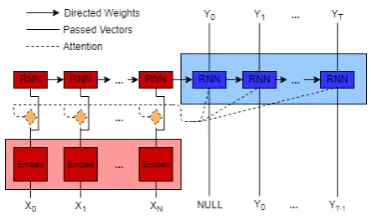
Figure 1:Seq2Seq Modality Translation Model with input (X1, ..., XN)and output is(Y1, ..., YT). Seq2Seq makes use of the whole input sequence in the decoding phase for every tokenYi. If attention model (yellow color) is used, for each
Yi, it learns a separate weight vectorw.r.teach token of input
Xto see which token should the decoder “attend” more.
The last hidden layer’s output now becomes:
A= [hK1 , hK2 , ..., hKT]α=HKα (4)
And the last output layer with regression score is:
̃
yt=WAyA+by (5)
Finally, we calculate the loss with respect to the labels. As in (Chen et al.,2017), we choose Mean Absolute Error (MAE) as our loss and later train with stochastic gradient descent:
LM AE( ̃Y , Y) =E[∣ ̃Y −Y∣] (6)
4 Proposed Approach
In this section we describe the different approaches that we plan to take to improve affect recognition through learning multimodal representations.
4.1 Seq2Seq Modality Translation Model
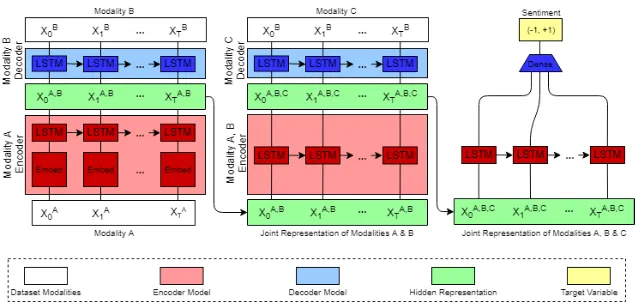
Figure 2: Hierarchical Seq2Seq Modality Translation Model: first we train with 2 modalities, then we add one more on the second phase, from which the results will be fed into RNN for sentiment prediction. The green boxes denote the joint representation learned by Seq2Seq models: the joint representation of modalities A and B will be fed into another Seq2Seq model which in turn learns the joint representation of AB and another modality C. Finally the joint representation of ABC will be fed into a RNN to predict sentiment.
involved. As a result, this representation can be used for tasks that involve learning joint represen-tation across multiple modalities. The detail is in Algorithm1.
Algorithm 1 Seq2Seq Modality Translation X, Y, Sare 2 modalities and sentiment sequences
1: Phase 1: Train Seq2Seq
2: EXY ←Seq2Seq RN N Encode(X) 3: Ỹ ←Seq2Seq RN N Decode(E
XY) 4: loss=cross entropy( ̃Y , Y) 5: Backprop to update params
6: Phase 2: Sentiment Regression
7: EXY ←Seq2Seq RN N Encode(X) ▷trained encoder in Seq2Seq model
8: R=RN N(EXY) 9: score←Regression(R) 10: loss←M AE(score, S) 11: Backprop to update params
Formally, the Seq2Seq Modality Translation Model consists of 2 separate steps: encoding and decoding, each phase typically consists of a sin-gle RNN or a stack of them. This model accepts variable-length inputs ofXandY, and the network should be trained to maximize the translational condition probability p(Y∣X). For encoding, it encodes the whole input sequence X into an em-bedded representation. The hidden state output of each time step is based on the previous hidden state along with the input sequence (refer to Figure1):
hn=RN N(hn−1, Xn) (7)
The encoder’s output is the final hidden state’s out-put of the encoding RNN:
E =hN =RN N(hN−1, XN) (8)
where N is the length of the input sequence X. The decoder tries to decode each tokenYi at a time
based onEand all previous decoded tokens, which is formulated as:
p(Y) =
T
∏
i=1
p(Yi∣E, Y1, ..., Yi−1) (9)
The Seq2Seq training target is to find the best trans-lation sequence which is as close to the ground truth Y as possible, or formally:
̂
Y =arg max
Y
p(Y∣X) (10)
And while there are some other search algorithms such as random sampling or greedy search to de-code each token (Neubig, 2017), we use the tra-ditional beam search approach (Sutskever et al.,
2014).
4.2 Hierarchical Seq2Seq Modality Translation Model
is in turn treated as input sequence for the next Seq2Seq Modality Translation Model to decode the third modalityZ. The final multimodal repre-sentationEXY Z represents the joint representation of(X, Y, Z). The Hierarchical Seq2Seq Modality Translation Model is described as in Algorithm2.
Algorithm 2 Hierarchical Seq2Seq Modality Translation: X, Y, Z, Sare 3 modalities and senti-ment sequences
1: Phase 1: Train Seq2Seq for 2 modalities
2: EXY ←Seq2Seq RN N Encode(X) 3: Ỹ ←Seq2Seq RN N Decode(E
XY) 4: loss=cross entropy( ̃Y , Y) 5: Backpropagate to update parameters
6: Phase 2: Train Seq2Seq for 3 modalities
7: EXY Z←Seq2Seq RN N Encode(EXY) 8: Z̃←Seq2Seq RN N Decode(E
XY Z) 9: loss=cross entropy( ̃Z, Z)
10: Backpropagate to update parameters
11: Phase 3: Sentiment Regression
12: EXY Z←Seq2Seq RN N Encode(EXY) 13: R=RN N(EXY Z)
14: score←Regression(R) 15: loss←M AE(score, S)
16: Backpropagate to update parameters
This strategy is also illustrated in Figure2. The output of the second Seq2Seq model is the input of the last RNN model where we will train to predict regression sentiment scores. This last Seq2Seq model will be trained using MAE loss function and it perform subsequent regression process.
5 Experimental Setup
We explored the applications of this model to the CMU-MOSI dataset (Zadeh et al.,2016). We im-plemented a baseline LSTM model based off the work done in (Chen et al.,2017). Our implemen-tation uses 66.67% of the data for training from which we take a 15.15% held-out set for validation, and the remaining 33.33% is used for testing. Fi-nally, we evaluated our proposed model against the baseline results generated by the implementation of (Chen et al.,2017). Here we compared our re-sults against the various multimodal configurations evaluating our performance using precision, recall, and F1 scores.
5.1 Dataset and Input Modalities
The dataset that we use to explore applications of our model is the CMU Multimodal Opinion-level Sentiment Intensity dataset (CMU-MOSI). The
dataset contains video, audio, and transcriptions of 89 different speakers in 93 different videos di-vided into 2199 separate opinion sentiments. Each video has an associated sentiment label in the range from -3 to 3. The low end of the spectrum (-3) in-dicates strongly negative sentiment, where as the high end of the spectrum indicates strongly posi-tive sentiment (+3), and ratings of 0 indicate neutral sentiment. The CMU-MOSI dataset is currently subject to much research (Poria et al.,2017;Chen et al.,2017;Zadeh et al.,2018a,b) and the current state of the art is achieved by (Poria et al.,2017) with an F1 score of 80.3 using a context aware model across entire videos. The state of the art us-ing only individual segments is achieved by (Zadeh et al.,2018a) with an F1 score of 77.3.
With respect to raw features that are being given as inputs to our model, we perform feature extrac-tion in the same manner as described in (Chen et al.,2017). In the text domain, pretrained 300 di-mensional GLoVe embeddings (Pennington et al.,
2014) were used to represent the textual tokens. In the audio domain, low level acoustic features including 12 Mel-frequency cepstral coefficients (MFCCs), pitch tracking and voiced/unvoiced seg-menting features (Drugman and Alwan,2011), glot-tal source parameters (Childers and Lee, 1991;
Drugman et al., 2012; Alku, 1992; Alku et al.,
1997,2002), peak slope parameters and maxima dispersion quotients (Kane and Gobl,2013) were extracted automatically using COVAREP ( Degot-tex et al.,2014). Finally, in the video domain, Facet (iMotions,2017) is used to extract per-frame ba-sic and advanced emotions and facial action units as indicators of facial muscle movement (Ekman,
1992;Ekman et al.,1980).
In situations where the same time alignment be-tween different modalities are required, we choose the granularity of the input to be at the level of words. The words are aligned with audio using P2FA (Yuan and Liberman,2008) to get their exact utterance times. The visual and acoustic modalities are aligned to words using these utterance times.
5.2 Baselines
Method Feature BINARY (−1, +1) 7-CLASS (−3, ..., +3) Prec Recall F1 Prec Recall F1
UniModal-Baseline
Text (T) 0.77 0.76 0.76 0.32 0.35 0.33
Audio (A) 0.56 0.56 0.56 0.12 0.19 0.14 Video (V) 0.57 0.47 0.48 0.12 0.19 0.12
Table 1: Unimodal baseline results with 3 metrics: Precision, Recall and F-Score (F1)
finally in the trimodal domain we concatenate all three modalities. This baseline not only serves to act as a benchmark for comparing our results but also acts as a starting point for our code develop-ment. As such, any improvements in our metrics are strictly as a result of the representations that we have learned and not structural changes in our model.
5.3 Multimodal Model Variations
Throughout our experimentation, we apply the al-gorithms in Section4with several intuitive varia-tions of how to translate modalities. Below are all approaches that we try to maximize our chances of learning a strong representation.
For bimodal, we translate one modality into an-other one. For example, A→V stands for translat-ing from Audio to Video, and take the embeddtranslat-ing state, which we refer to asembed(A+V), to predict sentiment. Here we employ the Seq2Seq Modality Translation Model mentioned in Algorithm1.
For trimodal, there are a lot more variations as follows. First, since we have 3 different modal-ity and Seq2Seq is only capable of translating one modality to another, we use the Hierarchi-cal Seq2Seq Modality Translation Model which is mentioned in Algorithm 2, e.g. we trans-late fromT toAto have the joint representation
embed(T+A), and then continue the translation fromembed(T+A) to the rest modality which is
V, which in turn yields the joint representation
embed(T+A+V) to make sentiment prediction. Second, we reuse the previous Seq2Seq Modal-ity Translation Model to translate a concatenation of 2 modality to the rest, e.g. concat(T+V) to A, and vice versa, e.g. translating from A back to
concat(T+V).
Finally, we still use the Seq2Seq Modality Trans-lation Model to translate from a concatenation of 2 modality to another concatenation of other 2. With this setting, at least one modality is repeated, and base on many previous works and our experience, we tend to favor text modality (T) over the other two and make it repeated.
6 Results
6.1 Baseline Unimodal Results
We see that with the baseline model, as shown Table1, the text modality is by far the most dis-criminative when it comes to detecting emotion. This implies that users rely heavily on their word choice and language to convey meaning and emo-tion. While this may be true, we know that other works such as (Zadeh et al., 2018a;Poria et al.,
2017) have achieved higher scores by combining all these different modalities. This implies that with some careful thinking and pointed model con-struction, we should be able to improve upon our baseline unimodal results through the integration of additional modalities into our model.
6.2 Baseline Multimodal Results
The results of our different baseline multimodal approaches is shown in Table2 for bimodal and Table3for trimodal. We see that of the multimodal baselines the model which combines the 3 modali-ties of text, speech, and video performed the best. The baseline model which combined text and au-dio arrived in second place followed closely by the combined text and video model. The model which combines video and audio arrived in last place by a significant margin. This corroborates our results from our unimodal baselines which implied that the text modality is the most discriminative modality in this dataset.
Method Feature BINARY (−1, +1) 7-CLASS (−3, ..., +3) Prec Recall F1 Prec Recall F1
BiModal-Baseline
concat(T + V) 0.78 0.67 0.55 0.01 0.16 0.05
concat(T + A) 0.44 0.66 0.53 0.02 0.15 0.04
concat(A + V) 0.55 0.47 0.48 0.13 0.16 0.11
BiModal-Seq2Seq
T→V 0.67 0.67 0.67 0.26 0.22 0.22 T→A 0.66 0.64 0.65 0.28 0.24 0.18 A→T 0.55 0.60 0.56 0.17 0.34 0.11 A→V 0.55 0.55 0.54 0.16 0.18 0.16 V→T 0.58 0.58 0.58 0.05 0.16 0.08 V→A 0.58 0.62 0.58 0.12 0.17 0.01
Table 2: Bimodal results with 3 metrics: Precision, Recall and F-Score (F1)
Method Feature BINARY (−1, +1) 7-CLASS (−3, ..., +3) Prec Recall F1 Prec Recall F1
TriModal-Baseline concat(T + V + A) 0.75 0.75 0.75 0.24 0.27 0.24
TriModal-Seq2Seq
embed(T, V)→A 0.56 0.60 0.57 0.10 0.16 0.09
embed(T, A)→V 0.60 0.55 0.56 0.26 0.15 0.07
embed(A, V)→T 0.66 0.53 0.44 0.16 0.04 0.09
embed(A, T)→V 0.59 0.51 0.52 0.13 0.15 0.09
embed(V, T)→A 0.59 0.60 0.59 0.11 0.17 0.10
embed(V, A)→T 0.57 0.61 0.58 0.11 0.17 0.09
concat(T, V)→A 0.67 0.66 0.65 0.22 0.17 0.18
concat(A, T)→V 0.54 0.55 0.63 0.19 0.15 0.21
concat(V, A)→T 0.59 0.59 0.58 0.16 0.12 0.12 T→concat(A, V) 0.70 0.65 0.66 0.23 0.22 0.18 A→concat(T, V) 0.55 0.53 0.54 0.18 0.20 0.18
concat(T, A)→concat(T, V) 0.62 0.60 0.61 0.23 0.24 0.22
concat(T, V)→concat(T, A) 0.68 0.70 0.67 0.31 0.24 0.19
Table 3: Trimodal results with 3 metrics: Precision, Recall and F-Score (F1)
6.3 Analysis of Baseline Failure Cases
The common trend that we see among all of those baseline models is the consistent failure to identify extreme cases of either positive or negative emo-tions. We believe that this phenomenon is due to two possibilities. First we see that there are very few cases of highly positive (+3) and highly nega-tive (−3) examples in the training data. As a result the models that are trained are highly biased to-wards not selecting+3or−3ratings. Secondly, our baseline models are performing categorical classi-fication as opposed to regression or ordinal classifi-cation. We plan to solve by training the model to perform this type of prediction as a regression task as opposed to a categorical classification task.
6.4 Bimodal Seq2Seq Results
Our bimodal models require the exploration of two modalities, one for the encoding step and another for the decoding step. We explored several differ-ent differdiffer-ent encoder/decoder frameworks for these models. The first model that we explored were representations generated from encoding exactly one modality and then decoding exactly one
dif-ferent modality. The results of this approach are included below in Table2. Here we can see that the Seq2Seq Modality Translation Model outperforms the baseline method in terms of F1 consistently and outperforms in terms of precision and recall in several cases, but not all.
6.5 Trimodal Seq2Seq Results
We try all variations mentioned in Section5.3and the full breakdown of these results can be found in the Table3. According to that, while the Hier-archical Seq2Seq Modality Translation Model is a natural extension to the normal Seq2Seq Modal-ity Translation model, it does not perform well on the CMU-MOSI dataset. Otherwise, using the normal non-hierarchical model with concatenation variations does improve the performance, and par-ticularly beats the baseline (for only F1 score) on the model which translates fromconcat(T,V) to
modality but the result shrinks dramatically. One possible reason for this behavior is the scarcity of training data. Given that at every phase of Seq2Seq translation, we only have 1289 train samples, 230 validation and 269 test samples, Seq2Seq, which typically requires more data for training a good model, does not work efficiently. This affects even more in the hierarchical Seq2Seq cases where we train two phases of Seq2Seq. We project the performance will improve if we work on other dataset which is bigger, or if we pretrain our model on other dataset first before applying it to MOSI.
7 Discussion
The language modality is the most discriminative as well as the most important towards learning mul-timodal representations. While we outperform the baseline multimodal approach we were unable to outperform the baseline unimodal text approach. Clearly from these results we know that that the text modality is the most discriminative of all of these modalities. However, it appears that these models which we have described are not able to truly separate the importance of the text modality. The fact that we are merging these modalities into a shared representation space is likely decreasing the resolution of the text domain and thus decreasing the modeling power of the domain. This is why we believe that the top performing multimodal model is one that incorporates the text domain so much (see Tables2and3).
It is worth noting that some of the learned rep-resentations were quite poor when it came to their use in prediction. For example, representations that were learned using only audio and video generally performed poorly. This is to be expected given the already known information that these modalities are not as discriminative as the language modality. At the same time, some of the worse performing representations were learned in the methodology of learning a representation based on an existing embedding. We believe this to be due to the repre-sentation losing the resolution of the original two domains from which the original source embedding was learned and instead being focused on learning the best representation to predict the final modality.
8 Future Directions
This research opens up a promising direction in joint unsupervised learning of multimodal
repre-sentations and supervised learning of multimodal temporal data. We propose the following exten-sions that could improve performance:
Firstly, using an Variational Autoencoder (VAE) (Kingma and Welling,2013) in conjunction with LSTM Encoder/Decoder model (as in the case of VAE Seq2Seq model) would be an interesting avenue to explore. This is because VAEs have been shown to learn better representations as com-pared to vanilla autoencoders (Kingma and Welling,
2013;Pu et al.,2016).
Secondly, since our method for multimodal rep-resentation learning is unsupervised, we could take advantage of larger external datasets to pre-train the multimodal representations before fine-tuning fur-ther with CMU-MOSI. We believe this will boost performance because we have limited data in CMU-MOSI for training (CMU-CMU-MOSI has 2199 training segments). Some datasets that come to mind in-clude the Persuasion Opinion Multimodal (POM) dataset (Park et al.,2014) with 1000 total videos (longer than segments) and the IEMOCAP dataset with 10000 total segment. Since these datasets also consist of monologue speaker videos, we expect the learnt multimodal representations to generalize.
Thirdly, our method does not train our combined model end to end: the representations that we use to generated during on training run and the sen-timent classification model are trained separately. Exploring an end-to-end version of this model end to end could possibly result in better performance where we could additionally fine tune the learned multimodal representation for sentiment analysis.
9 Conclusion
To conclude, this paper investigate the problem of multimodal representation learning to leverage the abundance of unlabeled multimedia data avail-able on the internet. We presente two methods for unsupervised learning of joint multimodal repre-sentations using multimodal Seq2Seq models: the
10 Acknowledgements
The authors are thankful to the many student peers who commented on and critiqued this work. Spe-cific thanks to Louis-Phillipe Morency and Amir Zadeh for their helpful discussions and thoughtful critiques. We are grateful to our peers who helped us evaluate our methodology, in particular Stephen Tsou and Kshitij Khode. Finally, we also thank the anonymous reviewers for helpful and constructive feedback.
References
Paavo Alku. 1992. Glottal wave analysis with pitch synchronous iterative adaptive inverse filtering.
Speech communication11(2-3):109–118.
Paavo Alku, Tom B¨ackstr¨om, and Erkki Vilkman. 2002. Normalized amplitude quotient for parametrization of the glottal flow. the Journal of the Acoustical So-ciety of America112(2):701–710.
Paavo Alku, Helmer Strik, and Erkki Vilkman. 1997. Parabolic spectral parameter - a new method for quantification of the glottal flow. Speech Commu-nication22(1):67–79.
Dzmitry Bahdanau, Kyunghyun Cho, and Yoshua Ben-gio. 2014. Neural machine translation by jointly learning to align and translate. arXiv preprint arXiv:1409.0473.
Tadas Baltrusaitis, Chaitanya Ahuja, and Louis-Philippe Morency. 2017. Multimodal machine
learning: A survey and taxonomy. CoRR
abs/1705.09406. http://arxiv.org/abs/1705.09406.
Franc¸ois-R´egis Chaumartin. 2007. Upar7: A knowledge-based system for headline sentiment
tagging. In Proceedings of the 4th International
Workshop on Semantic Evaluations. Associa-tion for Computational Linguistics, Strouds-burg, PA, USA, SemEval ’07, pages 422–425.
http://dl.acm.org/citation.cfm?id=1621474.1621568.
Minghai Chen, Sen Wang, Paul Pu Liang, Tadas Bal-trusaitis, Amir Zadeh, and Morency Louis-Phillippe. 2017. Multimodal sentiment analysis with word-level fusion and reinforcement learning. ICMI, Glassgow, United Kingdom.
Donald G Childers and CK Lee. 1991. Vocal qual-ity factors: Analysis, synthesis, and perception.
the Journal of the Acoustical Society of America
90(5):2394–2410.
Junyoung Chung, Caglar Gulcehre, Kyunghyun Cho, and Yoshua Bengio. 2015. Gated feedback recur-rent neural networks. In International Conference on Machine Learning. pages 2067–2075.
Gilles Degottex, John Kane, Thomas Drugman, Tuomo Raitio, and Stefan Scherer. 2014. Covarep - a col-laborative voice analysis repository for speech tech-nologies. InAcoustics, Speech and Signal Process-ing (ICASSP), 2014 IEEE International Conference on. IEEE, pages 960–964.
Jeff Donahue, Philipp Kr¨ahenb¨uhl, and Trevor Darrell. 2016. Adversarial feature learning. arXiv preprint arXiv:1605.09782.
Thomas Drugman and Abeer Alwan. 2011. Joint ro-bust voicing detection and pitch estimation based on residual harmonics. InInterspeech. pages 1973– 1976.
Thomas Drugman, Mark Thomas, Jon Gudnason, Patrick Naylor, and Thierry Dutoit. 2012. Detec-tion of glottal closure instants from speech signals: A quantitative review. IEEE Transactions on Audio, Speech, and Language Processing20(3):994–1006.
Paul Ekman. 1992. An argument for basic emotions.
Cognition & emotion6(3-4):169–200.
Paul Ekman, Wallace V Freisen, and Sonia Ancoli. 1980. Facial signs of emotional experience.Journal of personality and social psychology39(6):1125.
Zhe Gan, Liqun Chen, Weiyao Wang, Yunchen Pu, Yizhe Zhang, Hao Liu, Chunyuan Li, and Lawrence Carin. 2017. Triangle generative adversarial net-works.arXiv preprint arXiv:1709.06548.
Ian Goodfellow, Jean Pouget-Abadie, Mehdi Mirza, Bing Xu, David Warde-Farley, Sherjil Ozair, Aaron Courville, and Yoshua Bengio. 2014. Generative ad-versarial nets. InAdvances in neural information processing systems. pages 2672–2680.
Sepp Hochreiter and J¨urgen Schmidhuber. 1997. Long short-term memory. Neural computation9(8):1735– 1780.
iMotions. 2017. Facial expression analysis. goo.gl/1rh1JN.
John Kane and Christer Gobl. 2013. Wavelet maxima dispersion for breathy to tense voice discrimination.
IEEE Transactions on Audio, Speech, and Language Processing21(6):1170–1179.
Lakshmish Kaushik, Abhijeet Sangwan, and John HL Hansen. 2013. Sentiment extraction from natural au-dio streams. In Acoustics, speech and signal pro-cessing (icassp), 2013 ieee international conference on. IEEE, pages 8485–8489.
Diederik P Kingma, Shakir Mohamed, Danilo Jimenez Rezende, and Max Welling. 2014. Semi-supervised learning with deep generative models. InAdvances in Neural Information Processing Systems. pages 3581–3589.
Ryan Kiros, Ruslan Salakhutdinov, and Richard S Zemel. 2014. Unifying visual-semantic embeddings with multimodal neural language models. arXiv preprint arXiv:1411.2539.
G. Klein, Y. Kim, Y. Deng, J. Senellart, and A. M. Rush. ???? OpenNMT: Open-Source Toolkit for Neural Machine Translation. ArXiv e-prints.
Angeliki Lazaridou, Nghia The Pham, and Marco Ba-roni. 2015. Combining language and vision with a multimodal skip-gram model. arXiv preprint arXiv:1501.02598.
Chongxuan Li, Kun Xu, Jun Zhu, and Bo Zhang. 2017. Triple generative adversarial nets. arXiv preprint arXiv:1703.02291.
Minh-Thang Luong, Hieu Pham, and Christopher D Manning. 2015. Effective approaches to attention-based neural machine translation. arXiv preprint arXiv:1508.04025.
Mehdi Mirza and Simon Osindero. 2014. Condi-tional generative adversarial nets. arXiv preprint arXiv:1411.1784.
Gilad Mishne et al. 2005. Experiments with mood clas-sification in blog posts. InProceedings of ACM SI-GIR 2005 workshop on stylistic analysis of text for information access. volume 19, pages 321–327.
Louis-Philippe Morency, Rada Mihalcea, and Payal Doshi. 2011. Towards multimodal sentiment anal-ysis: Harvesting opinions from the web. In Proceed-ings of the 13th international conference on multi-modal interfaces. ACM, pages 169–176.
Graham Neubig. 2017. Neural machine translation and sequence-to-sequence models: A tutorial. arXiv preprint arXiv:1703.01619.
Jiquan Ngiam, Aditya Khosla, Mingyu Kim, Juhan Nam, Honglak Lee, and Andrew Y Ng. 2011. Multi-modal deep learning. InProceedings of the 28th in-ternational conference on machine learning (ICML-11). pages 689–696.
Gaurav Pandey and Ambedkar Dukkipati. 2017. Vari-ational methods for conditional multimodal deep learning. InNeural Networks (IJCNN), 2017 Inter-national Joint Conference on. IEEE, pages 308–315.
Sunghyun Park, Han Suk Shim, Moitreya Chatterjee, Kenji Sagae, and Louis-Philippe Morency. 2014.
Computational analysis of persuasiveness in social multimedia: A novel dataset and multimodal
pre-diction approach. In Proceedings of the 16th
In-ternational Conference on Multimodal Interaction. ACM, New York, NY, USA, ICMI ’14, pages 50–57.
https://doi.org/10.1145/2663204.2663260.
Jeffrey Pennington, Richard Socher, and Christopher D Manning. 2014. Glove: Global vectors for word representation. InEMNLP. volume 14, pages 1532– 1543.
Soujanya Poria, Erik Cambria, Devamanyu Hazarika, Navonil Majumder, Amir Zadeh, and Louis-Philippe Morency. 2017. Context-dependent sentiment anal-ysis in user-generated videos. InProceedings of the 55th Annual Meeting of the Association for Compu-tational Linguistics (Volume 1: Long Papers). vol-ume 1, pages 873–883.
Yunchen Pu, Zhe Gan, Ricardo Henao, Xin Yuan, Chunyuan Li, Andrew Stevens, and Lawrence Carin. 2016. Variational autoencoder for deep learning of images, labels and captions. In D. D. Lee, M. Sugiyama, U. V. Luxburg, I. Guyon, and R. Gar-nett, editors, Advances in Neural Information Pro-cessing Systems 29, Curran Associates, Inc., pages 2352–2360.
Shyam Sundar Rajagopalan, Louis-Philippe Morency, Tadas Baltrusaitis, and Roland Goecke. 2016. Ex-tending Long Short-Term Memory for Multi-View Structured Learning, Springer International Publish-ing, Cham, pages 338–353.
Ver´onica P´erez Rosas, Rada Mihalcea, and Louis-Philippe Morency. 2013. Multimodal sentiment analysis of spanish online videos. IEEE Intelligent Systems28(3):38–45.
Anuroop Sriram, Heewoo Jun, Sanjeev Satheesh, and Adam Coates. 2017. Cold fusion: Training seq2seq models together with language models. arXiv preprint arXiv:1708.06426.
Ilya Sutskever, Oriol Vinyals, and Quoc V Le. 2014. Sequence to sequence learning with neural networks. In Advances in neural information processing sys-tems. pages 3104–3112.
Martin W¨ollmer, Felix Weninger, Tobias Knaup, Bj¨orn Schuller, Congkai Sun, Kenji Sagae, and Louis-Philippe Morency. 2013. Youtube movie reviews: Sentiment analysis in an audio-visual context. IEEE Intelligent Systems28(3):46–53.
Kelvin Xu, Jimmy Ba, Ryan Kiros, Kyunghyun Cho, Aaron Courville, Ruslan Salakhudinov, Rich Zemel, and Yoshua Bengio. 2015. Show, attend and tell: Neural image caption generation with visual at-tention. In International Conference on Machine Learning. pages 2048–2057.
Jiahong Yuan and Mark Liberman. 2008. Speaker iden-tification on the scotus corpus.Journal of the Acous-tical Society of America123(5):3878.
Amir Zadeh, Minghai Chen, Soujanya Poria, Erik Cam-bria, and Louis-Philippe Morency. 2017. Tensor fusion network for multimodal sentiment analysis. In Proceedings of the 2017 Conference on Empiri-cal Methods in Natural Language Processing. pages 1114–1125.
Amir Zadeh, Paul Pu Liang, Soujanya Poria, Pra-teek Vij, Erik Cambria, and Louis-Philippe Morency. 2018b. Multi-attention recurrent network for hu-man communication comprehension.arXiv preprint arXiv:1802.00923.
Amir Zadeh, Paul Pu Liang, Jon Vanbriesen, Soujanya Poria, Erik Cambria, Minghai Chen, and Louis-Philippe Morency. 2018c. Multimodal language analysis in the wild: Cmu-mosei dataset and inter-pretable dynamic fusion graph. In Association for Computational Linguistics (ACL).