University of Warwick institutional repository:
http://go.warwick.ac.uk/wrap
A Thesis Submitted for the Degree of PhD at the University of Warwick
http://go.warwick.ac.uk/wrap/57935
This thesis is made available online and is protected by original copyright.
Please scroll down to view the document itself.
Library Declaration and Deposit Agreement
1.
STUDENT DETAILS
Please complete the following:
Full name: Luis Alberto Serra Barragán
University ID number: 0758737
2.
THESIS DEPOSIT
2.1 I understand that under my registration at the University, I am required to deposit my thesis with the University in BOTH hard copy and in digital format. The digital version should normally be saved as a single pdf file.
2.2 The hard copy will be housed in the University Library. The digital version will be deposited in the
University’s Institutional Repository(WRAP). Unless otherwise indicated (see 2.3 below) this will be made openly accessible on the Internet and will be supplied to the British Library to be made available online via its Electronic Theses Online Service (EThOS) service.
[At present, theses submitted for a Master’s degree by Research (MA, MSc, LLM, MS or MMedSci) are not being deposited in WRAP and not being made available via EthOS. This may change in future.]
2.3 In exceptional circumstances, the Chair of the Board of Graduate Studies may grant permission for an embargo to be placed on public access to the hard copy thesis for a limited period. It is also possible to apply separately for an embargo on the digital version. (Further information is available in theGuide to Examinations for Higher Degrees by Research.)
2.4If you are depositing a thesis for a Master’s degree by Research, please complete section (a) below. For all other research degrees, please complete both sections (a) and (b) below:
(a) Hard Copy
I hereby deposit a hard copy of my thesis in the University Library to be made publicly available to readers immediately as agreed by the Chair of the Board of Graduate Studies.
I agree that my thesis may be photocopied. YES
(b) Digital Copy
I hereby deposit a digital copy of my thesis to be held in WRAP and made available via EThOS.
Please choose one of the following options:
EITHER My thesis can be made publicly available online. YES
OR My thesis can be made publicly available only after: 10/07/13 YES
OR My full thesis cannot be made publicly available online but I am submitting a separately identified additional, abridged version that can be made available online.
YES
3.
GRANTING OF NON-EXCLUSIVE RIGHTS
Whether I deposit my Work personally or through an assistant or other agent, I agree to the following:
Rights granted to the University of Warwick and the British Library and the user of the thesis through this agreement are non-exclusive. I retain all rights in the thesis in its present version or future versions. I agree that the institutional repository administrators and the British Library or their agents may, without changing content, digitise and migrate the thesis to any medium or format for the purpose of future preservation and accessibility.
4.
DECLARATIONS
(a) I DECLARE THAT:
I am the author and owner of the copyright in the thesis and/or I have the authority of the authors and owners of the copyright in the thesis to make this agreement. Reproduction of any part of this thesis for teaching or in academic or other forms of publication is subject to the normal limitations on the use of copyrighted materials and to the proper and full acknowledgement of its source.
The digital version of the thesis I am supplying is the same version as the final, hard-bound copy submitted in completion of my degree, once any minor corrections have been completed.
I have exercised reasonable care to ensure that the thesis is original, and does not to the best of my knowledge break any UK law or other Intellectual Property Right, or contain any confidential material.
I understand that, through the medium of the Internet, files will be available to automated agents, and may be searched and copied by, for example, text mining and plagiarism detection software.
(b) IF I HAVE AGREED (in Section 2 above) TO MAKE MY THESIS PUBLICLY AVAILABLE
DIGITALLY, I ALSO DECLARE THAT:
I grant the University of Warwick and the British Library a licence to make available on the Internet the thesis in digitised format through the Institutional Repository and through the British Library via the EThOS service.
If my thesis does include any substantial subsidiary material owned by third-party copyright holders, I have sought and obtained permission to include it in any version of my thesis available in digital format and that this permission encompasses the rights that I have granted to the University of Warwick and to the British Library.
5.
LEGAL INFRINGEMENTS
I understand that neither the University of Warwick nor the British Library have any obligation to take legal action on behalf of myself, or other rights holders, in the event of infringement of intellectual property rights, breach of contract or of any other right, in the thesis.
Please sign this agreement and return it to the Graduate School Office when you submit your thesis.
Essays on Environmentally Friendly Behaviour and
Environmental Policy
Luis Alberto Serra Barragán
A thesis submitted in partial fulfillment of the requirements for
the degree of Doctor of Philosophy in Economics
The Department of Economics, The University of Warwick
Table of Contents
Acknowledgements
... vii
Declaration
... viii
Abstract
... ix
INTRODUCTION
...1
Chapter 1: Payments for Environmental Services and motivation crowding-out: A
Psychological Games approach
... 23
1 Introduction ... 24
2 A plausible motivation to provide an environmental service ... 30
3 The Model ... 35
3.1
A Psychological Games approach
... 35
3.1.1
The altruistic-sacrifice function
... 36
3.1.2
Equilibrium
... 41
3.2
Baseline provision setting
... 42
3.3
Monetary incentives
... 45
3.4
Limited monetary incentives
... 49
3.5
Non-monetary incentives
... 52
3.6
Provision under a dual incentive
... 55
4 Policy Implications ... 58
5 Discussion... 61
6 Conclusion ... 66
References ... 68
Appendix ... 80
A.
The N-player case
... 80
B.
Specification of the utility function
... 86
C.
A family of sacrifice functions
... 88
D.
Conditions for AS Equilibria
... 92
E.
A command and control policy
... 93
F.
Comparison of models
... 95
G.
Proofs
... 95
Chapter 2: This land is your land, this land is my land:
The environmental behaviour of native-born and immigrants
... 98
1 Introduction ... 99
2 Data and Methods... 107
2.1
Variables of interest
... 113
2.2
Method
... 120
3 Results ... 122
3.1
Immigrants and native-born
... 122
3.2
Immigrants and the length of residence
... 137
3.3
Acculturation and second generation immigrants
... 150
4 Discussion... 164
5 Conclusion ... 172
Appendix ... 184
Chapter 3: Identity selection and the activation of pro-environmental behaviour
... 241
1 Introduction ... 242
2 The Model ... 249
2.1
Motivation example
... 249
2.2
The model set up
... 250
3 Identity selection ... 254
4 Identity selection under a monetary environmental policy ... 256
5 Discussion... 262
6 Conclusion ... 267
References ... 268
List of Tables
Chapter 1: Payments for Environmental Services and motivation crowding-out: A
Psychological Games approach
Table 1:
Material payoffs of a standard public good game ... 42
Table 2:
Material payoffs of a standard public good game
with subsidy... 46
Table 3:
Material payoffs of a standard public good game
with limited monetary incentives ... 50
Table 4:
Scaled material payoffs of a standard public good game ... 82
Table 5:
Scaled material payoffs of a standard public good game with subsidy.. 83
Table 6:
Scaled material payoffs of a standard public good game with limited
monetary incentives ... 83
Table 7:
Equilibria comparison in all the games ... 95
Chapter 2: This land is your land, this land is my land:
The environmental behavior of native-born and immigrants
Table 1:
Proportion of individuals by environmental behaviour and by region of
the world
... 184
Table 2:
Proportion of individuals by environmental behaviour and by level of
income of country ... 185
Table 3:
Distribution and origin of native-born and immigrants: WVS dataset
years 1989-2007 ... 185
Table 4:
Source and host region of immigrants (frequencies)
... 186
Table 5:
Where do individuals migrate? Number and percentage of immigrants to
countries by level of income
... 186
Table 6:
Where do individuals come from? Number and percentage of immigrants
to countries by level of income
... 187
Table 7:
Environmental behaviour by region of the world
... 187
Table 8:
Immigrant and native-born perceptions about local environmental
problems
... 188
Table 9:
Brant Test (Willingness to pay higher taxes) ... 190
Table 10:
Brant Test (Willingness to give part of own income) ... 190
Table 11:
Brant Test (Willingness to buy things at a 20% higher price) ... 191
Table 12:
Environmentally friendly behaviours: WVS dataset years 1989-2007 191
Table 13:
Variables that affect environmental behaviour: WVS dataset years
1989-2007
... 193
Table 14:
Correlation matrix of all explanatory variables
... 194
Table 15:
Money and the Environment (immigrant status estimations)
... 196
Table 16:
Specific pro-environmental behaviour (immigrant status estimations) 198
Table 17:
Environmental politically related behaviour (immigrant status
estimations) ... 200
Table 18:
Money and the Environment (length of residence estimations)
... 202
Table 19:
Specific pro-environmental behaviour (length of residence estimations)
... 204
Table 20:
Environmental politically related behaviour (length of residence
estimations) ... 207
Table 21:
Money and the environment (all groups estimations) ... 209
Table 23:
Environmental politically related behaviour (all groups estimations) . 213
Table 24:
Marginal effects by money and the environment (immigrant status
estimations) ... 216
Table 25:
Marginal effects by specific pro-enviromental behaviour (immigrant
status estimations) ... 218
Table 26:
Marginal effects by environmental politically related behaviour
(immigrant status estimations) ... 220
Table 27:
Marginal effects by money and the environment (length of residence
estimations) ... 222
Table 28:
Marginal effects by specific pro-environmental behaviour (length of
residence estimations) ... 224
Table 29:
Marginal effects by environmental politically related behaviour (length
of residence estimations) ... 226
Table 30:
Marginal effects by money and the environment (all groups estimations)
... 228
Table 31:
Marginal effects by specific pro-environmental behaviour (all groups
estimations) ... 230
Table 32:
Marginal effects by environmental politically related behaviour (all
groups estimations) ... 233
Table 33:
Environmentally friendly behaviours by length of residence: WVS
dataset years 1989-2007 ... 235
List of Figures
Chapter 2: This land is your land, this land is my land:
The environmental behaviour of native-born and immigrants
Figure 1:
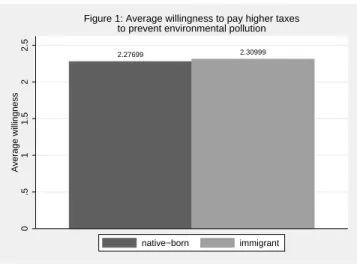
Average willingness to pay higher taxes by immigrant status ... 123
Figure 2:
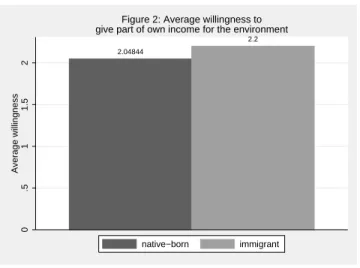
Average willingness to give part of own income for the environment by
immigrant status ... 124
Figure 3:
Average willingness to buy things at a 20% higher price if it helped to
protect the environment by immigrant status ... 124
Figure 4:
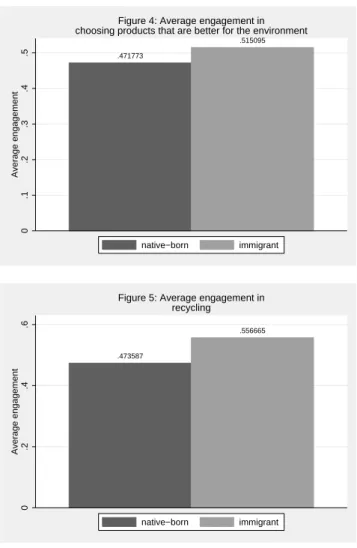
Average engagement in choosing products that are better for the
environment by immigrant status
... 125
Figure 5:
Average engagement in recycling by immigrant status... 125
Figure 6:
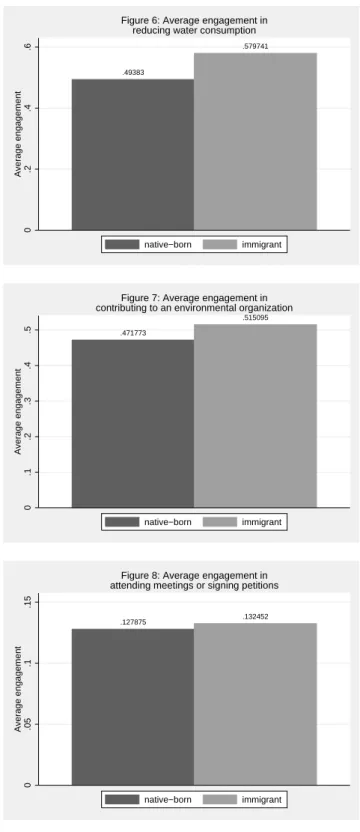
Average engagement in reducing water consumption by immigrant status
... 126
Figure 7:
Average engagement in contributing to an environmental organization by
immigrant status ... 126
Figure 8:
Average engagement in attending meetings or signing petitions by
immigrant status ... 126
Figure 9:
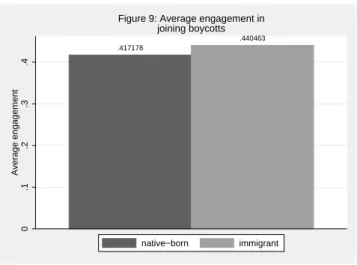
Average engagement in joining boycotts by immigrant status... 127
Figure 10:
Average willingness to pay higher taxes by length of residence... 138
Figure 11:
Average willingness to give part of own income for the environment by
length of residence... 138
Figure 12:
Average willingness to buy things at a 20% higher price if it helped to
protect the environment by length of residence... 138
Figure 13:
Average engagement in choosing products that are better for the
environment by length of residence
... 139
Figure 14:
Average engagement in recycling by length of residence ... 139
Figure 15:
Average engagement in reducing water consumption by length of
residence
... 140
Figure 16:
Average engagement in contributing to an environmental organization by
length of residence... 140
Figure 17:
Average engagement in attending meetings or signing petitions by length
of residence
... 140
Figure 18:
Average engagement in joining boycotts by length of residence ... 141
Figure 19:
Average willingness to pay higher taxes by all groups ... 151
Figure 20:
Average willingness to give part of own income for the environment by
all groups
... 151
Figure 21:
Average willingness to buy things at a 20% higher price if it helped to
protect the environment by all groups ... 152
Figure 22:
Average engagement in choosing products that are better for the
environment by all groups
... 153
Figure 23:
Average engagement in recycling by all groups ... 153
Figure 24:
Average engagement in reducing water consumption by all groups ... 153
Figure 25:
Average engagement in contributing to an environmental organization by
all groups
... 154
Figure 26:
Average engagement in attending meetings or signing petitions by all
groups
... 154
Acknowledgments
Foremost, I would like to thank my beautiful wife Elisa. She has shared her life, love,
friendship and dreams with me for the last 12 years and, hopefully, she will continue to
do so
ad infinitum
.
Special mention must be made to my dear little Nicolás. With his smile he has given
me strength when I am weakest. He is light when everything seems dark. Moreover, he
is living proof that dreams do come true. Together, my sweet boy, we will beat it. I love
you.
There are no words I can use to express my love, gratitude and admiration to my
parents Blanca and Alberto. They have guided me and loved me in happiness and in my
darkest hours. I can only dream of being half as good a parent to Nicolás as they are to
me. They are always in my heart.
Thank you Hortensia and Claudia, my sisters, for always be willing to help your little
brother in every single way, and for being more than just sisters, more than just friends,
more than just educators. Thank you also Aída, my sister-in-law, for adopting me as a
brother and for all the great "General Palanca" memoirs.
He cannot read and he cannot speak, but he certainly masters the language of love
and loyalty. From the very first day I met you, you have been always right next to me. I
know we will always remain together, my dearest Rulo.
I would like to wholeheartedly thank Dr. Luis Toharia Cortés. He was not only a
good mentor, a good friend and a respected economist, he was a great human being. All
of us who had the pleasure to cross paths with him deeply miss him.
Finally, grateful acknowledgement is made for financial support to the Consejo
Nacional de Ciencia y Tecnología (CONACYT) and the Secretaría de Educación
Declaration
I declare the following:
The material contained in this thesis is my own work.
Abstract
The thesis consists of three chapters of self-contained studies.
In Chapter 1, I examine the decision of individuals to secure the provision of an
environmental service under a Psychological Games framework. Since environmental
services are considered public goods, there is an ongoing depletion of natural resources.
While standard economic theory predicts the introduction of a PES is supposed to
correct the associated externality by establishing a market which offers a monetary
compensation to owners of vital natural resources as a recognition of their effort in
providing the environmental services, this chapter argues such intervention might
backfire: a motivation crowding-out arises if individuals believe others reciprocate
friendly behaviour solely to receive the monetary compensation, ultimately decreasing
total environmental protection. Even if environmental protection does take place, the
motivation of individuals to secure the provision of the environmental service becomes
commodified by the PES. Finally, awarding the PES only to a subset of individuals will
also have negative effects on environmental protection, since those not receiving the
PES will not want to do for free something that others are being paid to do.
Environmental policy implications of this economic instrument are further discussed.
In Chapter 2, a sample of the World Values Survey dataset is analyzed to show
there are substantial behavioural differences between immigrants and native-born
regarding pro-environmental action. In particular, while neither native-born nor
immigrants are more willing to sacrifice money to save the environment, immigrants
actually engage more on activities like choosing products that are better for the
environment, recycling, and reducing water consumption. The engagement in
pro-environmental behaviour of immigrants is region-specific and depends on their source
region. Moreover, such relatively higher actual engagement in environmentally friendly
behaviours can be explained by their high socio-economic status and their high
education level, i.e. “selective immigration”. When the behaviour of immigrants by
their length of residence in the host country is analyzed, no differences in
pro-environmental attitudes or pro-pro-environmental behaviour are found, a result which
suggests they do not develop a “sense of belongingness” to the host country. Finally, in
line with the standard finding in the literature of acculturation in environmental
behaviour, this chapter finds that immigrants conform through time to some of the
pro-environmental actions of native-born.
Introduction
The thesis Essays on Environmentally Friendly Behaviour and Environmen-tal Policy consists of three self-contained studies. These are (i) Payments for Environmental Services and motivation crowding-out: A Psychological Games approach, (ii) This land is your land, this land is my land: The environmental behaviour of native-born and immigrants and (iii) Identity selection and the ac-tivation of pro-environmental behaviour. Here, an introduction to each chapter is addressed.
1 Payments for Environmental Services and motivation
crowding-out: A Psychological Games approach
Research produced by the Millenium Ecosystem Assessment of the United Nations showed that over the past 55 years, humans have changed ecosystems more rapidly and extensively than in any comparable period of time in human history due to fast growing demand for food, fresh water, timber, bre and fuel.1 Since the environmental services that natural resources provide are consid-ered public goods,2depletion often occurs because of the diculty of excluding
1http://www.maweb.org/en/index.aspx
potential users from its benets. The problem is originated by the individuals' incentives to free ride from the provision activities of others, which is reected in a straightforward and pessimistic fashion in Hardin's [26] tragedy of the com-mons, Olson's [40] impossibility of collective action argument, and the Prisoner's Dilemma.
While some successful cases of independent sustainable management of nat-ural resources have been documented, the problem persists in most parts of the world. Land is usually managed for private benet and, since the cost of secur-ing the provision of the environmental services falls only on local land managers, it is generally more attractive for them to convert their land into more protable uses, such as agriculture, rather than maintain it in its natural state.
Economists argue that this externality would be corrected by establishing a market which oers a monetary compensation to owners of vital natural re-sources as a recognition to their eort in providing an environmental service which generates benets to other individuals. Such market, denominated Pay-ments for Environmental Services (PES), is regarded as the ecient means to provide environmental services.3
However, some researchers have discussed the possibility that the monetary reward can erode culturally-rooted conservation values (Wunder [60]; Kosoy et al [34]; and Vatn [57]), and a few have empirically tested such issue (Reeson and Tisdell [45] and Kerr et al [32]).4
While standard economic theory predicts that landowners would react to the monetary payment of the PES scheme by increasing the provision of environ-mental services, there is substantial evidence from the psychology and economic
3A commonly accepted denition of PES is found in Wunder [60]. PES are: i) a voluntary transaction in which; ii) a well-dened environmental service (ES) or a land-use likely to secure that service; iii) is being purchased by at least one ES buyer; iv) from at least one ES provider; v) if, and only if, the ES provider ensures the supply of the ES (conditionality).
literature pointing out that this (external) incentive might actually have the opposing eect and undermine the internalized motivation of the landowners to behave in such way.5 Such phenomenom is known in the literature as motivation crowding-out.6
Once a PES has been established the following questions arise: Is the moti-vation of participants to protect the environment undermined by the monetary payment? Even if participants do secure the environmental provision, will they do it because their culturally-rooted values are strengthened by the reward or merely because of the monetary payment?7 If some potential participants are excluded,8will their motivation be undermined once they realize others are paid for doing something they do (i.e. environmental protection) for free?
To address such issues, Chapter 1 sheds light on a mechanism through which a monetary payment negatively aects the motivation of individuals for envi-ronmental protection. Moreover, it establishes a set of conditions under which: a) environmental protection takes place because individuals are motivated to reciprocate others' friendly behaviour; b) environmental protection takes place because individuals receive a monetary payment in compensation, but their mo-tivation is undermined; c) environmental protection does not take place even if a payment is oered in return; and d) partial environmental protection might or might not take place if a payment is oered only to a subset of potential
5See Chapter 1 for references on such evidence.
6The idea of motivation crowding-out was pointed out as early as Titmuss [54], who claimed that paying blood donors deters their social values and reduces their willingness to donate blood. See Chapter 1 for references on further motivation crowding-out literature.
7A plausible culturally-rooted value which dictates individuals to preserve the environment is a sense of belongingness or sense of place. If individuals hold an attachment to a particular physical space, they would take the necessary action to preserve it without any external motivation. Would the monetary payment reinforce such positive emotional bond or would it replace it instead? Section 4 in Chapter 1 discusses this issue in more detail.
participants.
Chapter 1 proposes a Psychological Games approach (Geanakoplos et al [24]) to analyze the consequences of introducing a subsidy to contributions into a 2 -player public good game where the individual preferences about contributions to the public good are assumed to be belief-dependent. Moreover, the model in-cludes two relevant behavioural features widely studied in Economics and Social Psychology: reciprocity and self-sacrice. With respect to the former, most ex-perimental results coincide that a consistent feature of the individuals' behaviour is conditional cooperation. For that reason, the model assumes individuals are driven by reciprocity and they are able to coordinate eorts to provide the pub-lic good.9 With respect to the latter, reciprocity norms are strengthened by sacricial behaviour, especially when such sacrice helps a group of individuals to attain a particular goal.10 Taken together, these behavioural modications to the (standard) rational paradigm imply that individuals would be able to provide the public good (i.e. secure the provision of the environmental service) as long as they believe others sacrice personal gains in favour of a social gain, and when they believe others believe that as well, and when they believe oth-ers believe they believe that as well, and so on. Moreover, not only does the inclusion of such behavioural features allow the representation of a variety of public good games outcomes also produced by the rational paradigm and alter-native inuential economic models (e.g. Fehr and Schmidt [19] and Rabin [43]), but it also facilitates the representation of the motivation crowding-out eect, something those models cannot do.
Most economic models of motivation crowding-out conceive such eect as a
9See Chapter 1 for references on experiments which show results on rewarding good be-haviour, sanctioning bad bebe-haviour, and reciprocity.
product of a change in (Frey and Stutzer [23]): individual's preferences; the per-ceived nature of the performed task; the task environment; or the individual's self-perception. Models related to moral motivation consider that motivation crowding-out occurs when the monetary payment produces a dissonance within the individual's personal norms realm (Brekke et al [12]). Others (Bénabou and Tirole [7]) consider that since individuals do not know their own moral values perfectly and they only learn how good they are by observing their own behaviour, monetary payments might make the individuals unsure of why they contributed in the rst place; hence, the monetary payment destroys the own-signaling eect of doing good deeds. With respect to the environment, mo-tivation crowding-out has been studied by Ballet et al [4], Grepperud [25], and Nyborg [38] (in the context of the eects of taxation on individual responsibil-ity), Barile et al [5] (in the context of nudging vs mandatory policies), Feldman and Perez [20] and Ferrara and Missios [21] (in the context of framing eects on recycling behaviour), and Reeson and Tisdell [45] (in the context of provision of environmental services). However, none of the studies related to the envi-ronment have proposed a new analytical framework to understand motivation crowding-out.
Additionally, Chapter 1 studies the impact on the individuals' motivation of non-monetary incentives and a combination of monetary and non-monetary in-centives. Finally, it analyzes the policy implications of both types of incentives and provides a discussion which compares the results of the model to those of other motivation crowding-out models and situates its results within a theoret-ical environmental protective behaviour sphere.
2 This land is my land, this land is your land: The
envi-ronmental behaviour of native-born and immigrants
Immigrants and problems are words commonly (and unfairly) used in the same sentence by governments, particularly those of developed countries.11 They are seen as a burden which puts pressure on the job market through wage inequalities and higher unemployment rates. They are feared to have a detrimental eect on the scal sustainability of the welfare state. Finally, im-migrants are also thought to increase crime rates and have a negative impact on the social cohesion of the host country.12
Since the United Nations Conference on Human Environment held in Stock-holm in 1972, the environment became a matter of national (and international) concern. Not surprisingly, immigrants were also blamed to contribute to the en-vironmental degradation of the host country.13 One of the most relevant mani-festations of such belief is the debate led by the Sierra Club (the most inuential grassroots environmental organization in the U.S.) about the environmental
im-11Despite the general aversion to immigration, at least four types of potential gains to the host country are acknowledged (Nannestad [37]): 1) the immigration surplus, i.e. immigrants could make a society richer; 2) the positive eect on the age distribution of the host society; 3) a smoothing eect on the labour market; and 4) the increase in the aggregate demand for domestic goods and services. Borjas [9] also considers that benets of immigration to native-born result from production complementarities between immigrant workers and other factors of production. Further potential benets are discussed in Ratha et al [44].
12See Chapter 2 for literature which provides evidence that does not support either of such negative impacts of immigration on the host country.
pact that immigrants posed in the U.S. and global ecosystems (Harris [28]). The stance of immigration restriction supporters was that immigrants engage in negative environmental behaviours just like Americans, therefore assuming no immigrant/native-born environmental behaviour dierences. If such argu-ment is true, then immigration should be restricted in the U.S. but promoted in countries where the native-born display a strong pro-environmental behaviour. But, do immigrants really have the same environmental behaviour than native-born? Research on the topic is scarce and so far, it has provided mixed results. Moreover, it has focused on the environmental behaviour of native-born and immigrants at state and national levels only.14
The results provided by the literature on the environmental behaviour of immigrants and native-born can be accomodated by two competing hypothe-ses regarding the individuals' environmental attitudes: the New Environmen-tal Paradigm (NEP) proposed by Dunlap and Van Liere [17], and the Post-materialistic hypothesis (PMH). The former proposes that the pro-environmental attitudes of individuals are a global phenomenon. Thus, individuals would hold the same environmental attitudes regardless of their culture, income, and educa-tion level attained. The latter claims that individuals develop pro-environmental attitudes once they achieve a standard of living such that they can shift their attention from economic security concerns to quality-of-life issues.
Is the behaviour of immigrants a real threat to the host country's envi-ronment? Should immigration policies therefore remain restrictive? Should environmental awareness programmes and environmental policy in general be group-targeted? If there are environmental behavioural dierences between native-born and immigrants, do all immigrants display the same behaviour? In order to tackle such questions, Chapter 2 uses a sample of the World Values
vey dataset to analyze worldwide behavioural dierences between immigrants and native-born by looking at the probability of engagement of both groups of individuals across a wide range of pro-environmental behaviours like water con-sumption reduction, recycling and contributing to environmental organizations, among others. The method used for the analysis consists in a series of ordered probit and probit estimations that analyze each of the environmental behaviour indicators. The proposed model predicts the probability that the individual engages in a specic environmental behaviour considering his immigrant sta-tus or his length of residence in the host country (in the case of immigrants). The parameters oered by the estimations would give information about which group holds stronger environmental attitudes, but they will not give informa-tion about how much stronger they are. Thus, marginal eects are computed to provide a quantitative measure of environmental behaviour dierences between immigrants and native-born.
The PMH, though, is not the only reason why environmental behavioural dif-ferences between immigrants and native-born may arise. As Pefer and Mayone Stycos [42] point out, an alternative explanation to immigrants holding stronger environmental attitudes than native-born might be that environmental prob-lems in their country of origin sensitized them and motivated them to engage in pro-environmental action (Martinez-Alier and Hershberg [36]). Likewise, an alternative explanation to immigrants holding weaker environmental attitudes than native-born is that immigrants lack a sense of belongingness or a sense of place that would make them feel attached and identied to their physical surroundings.15 Without that close relationship between immigrants and their place of residence, the need to take pro-environmental actions when required could be absent.
The Sierra Club's assumption of immigrants having the same environmental behaviour as U.S. native-born is closely related to another central theme in the discussion: the eect on such behaviour of their length of residence in the country. This process, denominated as environmental acculturation by Padilla [41], helps the immigrants to learn the ways of the dominant culture. Thus, the more time an immigrant spends on the host country, the more likely he is to adhere to the behavioural rules of the native-born.16
Since acculturation seems to drive the environmental behaviour of immi-grants by their length of residence, Chapter 2 incorporates such feature into the analysis. Furthermore, since it has been acknowledged that environmental behaviour dierences among immigrants and native-born might arise because of the presence (or lack) of a sense of place, the analysis uses an instrument
15The rst to conceptualize the sense of place of individuals was Tuan [55]. He regarded the place as the centre of meaning or eld of care which emphasizes human emotions and relationships. The individuals' sense of place is the perspective from which individuals position themselves in relation to others to advocate particular standpoints regarding natural resources management (Cantrill and Senecah [14]).
to avoid comparing individuals with heterogenous attachment to their place of residence: the immigrants' ospring. Hence, by comparing the behaviour of native-born to that of second generation immigrants, it is assured that there will not exist a variation in sense of place due to immigrant status, while allow-ing to isolate the eect of length of residence on their environmental behaviour.
3 Identity selection and the activation of pro-environmental
behaviour
Psychologists, sociologists and a growing number of economists have now rec-ognized that worldwide environmental degradation is not merely a by-product of industrial and technological evolution, but behavioural and attitudinal as well. A certain environmentally friendly behaviour might be followed by those individuals who are attached to a specic set of norms. Norms are shared beliefs about how the individuals should act, and they are enforced by the threat of sanctions or the promise of rewards (Schwartz and Howard [47]). Norms can be divided into two groups according to their level of internalisation: personal and social (Thøgersen [52]).
A personal norm is a self-expectation of specic action in a particular con-text, commonly experienced as a feeling of moral obligation (Schwartz [46]). Inasmuch as norms are a behavioural guide for individuals, their violation leads to sanctions. When a sanction is executed by the same individual it is said that the norm has been internalised. According to Schwartz [46], and Schwartz and Howard [47], internalised norms are personal norms. Thus, personal norms are followed because of internalised values and conceptions of what is right and wrong.
social norm on account of (real or imagined) social pressure (Ajzen [2]). Biel and Thøgersen [8] consider that social norms are a reason for departure from rational choice insofar as they prescribe the manifestation of a particular behaviour and the proscription of other in a given context. In that sense, Fehr and Fischbacher [18] explain that, despite little is known about the formation process of social norms, they are greatly driven by non-selsh motives and largely enforced by sanctions.
Norm adhesion is of great relevance to the analysis of pro-environmental be-haviour. Bamberg and Schmidt [6], Bratt [10], Harland et al [27] and Thøgersen have documented an important correlation between environmentally responsible behaviour and social and personal norms. While there is research which demon-strates that personal norms often have stronger and more reliable behavioural implications than social norms (Thøgersen [51]), other studies have shown there are cases where this need not be true (Bamberg and Schmidt [6] and Hunecke et al [29]), at least in an indirect way.
aect the activation of norms indirectly encompass the salience of need and ac-tions, benets and costs, framing eects (e.g. market vs non-market frames), behaviour of others, and communication. These situational factors alter the individuals' perception of fairness and justice, reciprocity and commitment in social dilemmas with consequences on cooperation.
The personal factors refer to the environmental responsibility that arises in individuals from the activation of personal norms. One inuential model representing this activation mechanism is Schwartz's Norm Activation Theory (Schwartz [46]). Under such model, a norm is activated when: a) the individual recognizes his private actions have a public good aspect, or in other words, become aware of the consequences of his actions; and b) the individual ascribes personal responsibility for the issue at hand.
Hence, information campaigns which promote environmental responsibility can trigger irksome feelings of cognitive dissonance on individuals, imposing on them an excessive feeling of moral responsibility.
The type of norms activated through situational factors are norms related to cooperation or social norms. Communication, fairness, reciprocity and framing eects have been the drivers of social norms activation which have received most attention by researchers.17
Most research focused on social norms activation failure due to a change in the prevailing situational factors is related to the analysis of framing eects. In particular, interest has been drawn to analyze the eects of monetary incentives on the behaviour of individuals in laboratory experiments (Frey and Jegen [22] and Reeson and Tisdell [45]).
Yet, an issue overlooked by the literature of norm activation is that the iden-tity of individuals can also trigger a specic norm of environmental behaviour given that identities describe social roles. An identity is a set of meanings re-lated to the self that functions as a reference that guides behaviour in dierent contexts (Stets and Biga [49]). An environmental identity prescribes a course of action that is compatible with the individuals' sense of who they are (Clayton and Opotow [16]). Furthermore, Weber et al [59] stress that the identity of the decision maker is a signicant factor for cooperation in social interaction scenarios.
Stets and Biga [49] claim that while traditional environmental sociology linked attitude processes to the determination of environmentally responsible behaviour, it is the identity process which inuences such type of behaviour. The identity of the individual is also relevant for policy design. An individual's sense of self is linked to his social environment (Akerlof and Kranton [3]), and so it is
reasonable to suspect that by changing situational factors, environmental policy might in turn aect the individuals' sense of who they are. Hence, understanding which identities are salient is important to evaluate how individuals react to a particular threat or distribution of rewards (Clayton and Opotow [16]).
In order to ll the aforementioned gap, Chapter 3 outlines an identity selec-tion model based on Teraji [50] and self-vericaselec-tion theory, and inquires about how identity selection can activate a particular environmentally friendly norm. In a two-period economy, there are two types of selves or identities the indi-vidual can adopt: selsh and pro-environmental. In the rst period and given a particular self, individuals decide their level of contribution to a public good and obtain material payos associated to such contribution. Pro-environmental selves additionally receive cognitive payos related to a warm glow of giving. In the second period, individuals decide whether to keep their identity. If they keep the same identity their payos are materialized and are equivalent to those of period one. But if they change their identity they face a cost of social dis-approval. Chapter 3 shows that without any external intervention, individuals prefer to be consistent across the two periods with respect to their identity selection. However, if a monetary environmental policy (a situational factor) is introduced, the identity selection process is aected in an asymmetric fash-ion: while selsh selves still remain selsh, pro-environmental selves might now change their identity because of a situational factor that no longer allows the activation of the social norm which prescribes a pro-environmental behaviour.
establish the origin of the environmentally friendly inclination of the individ-ual, just the mechanism through which such preference is distorted. In turn, Chapter 3 proposes that the literature has paid no attention to the identity of individuals as a source of pro-environmental behaviour or to environmental policies as key determinants of such source.
The remainder of the thesis consists of three chapters of self-contained stud-ies. Chapter 1: Payments for Environmental Services and motivation crowding-out: A Psychological Games approach, Chapter 2: This land is your land, this land is my land: The environmental behaviour of native-born and immigrants and Chapter 3: Identity selection and the activation of pro-environmental be-haviour. Conclusions and implications of each chapter and conclusions of the thesis are addressed in the Conclusion.
References
[1] Abrahamson, P. R. 1997. Postmaterialism and Environmentalism: A Com-ment on an Analysis and a Reappraisal. Social Science Quarterly, 78(1):21-23.
[2] Ajzen, I. 1988. Attitudes, personality, and behavior. Milton Keynes: Open University Press.
[3] Akerlof, G. A., and Kranton, R. E. 2000. Economics and Identity. The Quarterly Journal of Economics, 115(3):715-53.
[4] Ballet, J., Bazin, D., Lioui, A., and Touahri, D. 2007. Green taxation and individual responsibility. Ecological Economics, 732-39.
of Economics, University of Bath, Bath, UK.
[6] Bamberg, S., and Schmidt, P. 2003. Incentives, morality, or habit? Pre-dicting students' car use for university routes with the models of Ajzen, Schwartz, and Triandis. Environment and Behavior, 35(2):264-85.
[7] Bénabou, R., and Tirole, J. 2003. Intrinsic and Extrinsic Motivation. Review of Economic Studies, 70(3):489-520.
[8] Biel, A., and Thøgersen, J. 2007. Activation of social norms in social dilem-mas: A review of the evidence and reections on the implications for envi-ronmental behaviour. Journal of Economic Psychology, 28(1):93-112.
[9] Borjas, G.J. 1995. The Economic Benets from Immigration. Journal of Economic Perspectives, 9(2):3-22.
[10] Bratt, C. 1999. The impact of norms and assumed consequences on recy-cling behavior. Environment and Behavior, 31(5):630-56.
[11] Brechin, S., and Kempton W. 1994. Global Environmentalism: A Chal-lenge to the Postmaterialist Thesis? Social Science Quarterly, 75(2):245-69.
[12] Brekke, K. A., Kipperberg, G., and Nyborg, K. 2010. Social Interaction in Responsibility Ascription: The Case of Household Recycling. Land Eco-nomics, 86(4):766-84.
[14] Cantrill, J.G., and Senecah, S.L. 2001. Using the sense of self-in-place construct in the context of environmental policy-making and landscape planning. Environmental Science and Policy, 4(4-5):185-203.
[15] Cardenas, J.C., Stranlund, J., and Willis, C. 2000. Local Environ-mental Control and Institutional Crowding-Out. World Development, 28(10):1719-33.
[16] Clayton, S., and Opotow, S. 2003. Identity and the Natural Environment. In: S. Clayton, and S. Opotow: Identity and the Natural Environment: The Psychological Signicance of Nature. Cambridge, Massachusetts: MIT Press, 1-24.
[17] Dunlap, R. E., and Van Liere, K.V. 1978. The New Environmental Paradigm. Journal of Environmental Education 9(4):10-19.
[18] Fehr, E., and Fischbacher, U. 2004. Social norms and human cooperation. Trends in Cognitive Science, 8(4):185-90.
[19] Fehr, E., and Schmidt, K. 1999. A Theory of Fairness, Competition and Cooperation. The Quarterly Journal of Economics, 114(3):817-68.
[20] Feldman, Y, and Perez, O. 2012. Motivating Environmental Action in a Pluralistic Regulatory Environment: An Experimental Study of Framing, Crowding Out, and Institutional Eects in the Context of Recycling Poli-cies. Law & Society Review, 46(2):405-42.
[22] Frey, B. S., and Jegen, R. 2001. Motivation crowding theory: A survey of empirical evidence. Journal of Economic Surveys, 15(5):589-611.
[23] Frey, B., and Stutzer, A. 2008. Environmental morale and motivation. In: The Cambridge Handbook of Psychology and Economic Behaviour. A. Lewis (ed):406-28, Cambridge University Press.
[24] Geanakoplos, J., Pearce, D., and Stacchetti, E. 1989. Psychological Games and Sequential Rationality. Games and Economic Behavior, 1(1):60-79.
[25] Grepperud, S. 2007. Environmental voluntary behaviour and crowding-out eects: regulation or laissez-faire? European Journal of Law and Eco-nomics, 23:135-49.
[26] Hardin, G. 1968. The Tragedy of the Commons. Science, 162(1968):1243-48.
[27] Harland, P., Staats, H. J., and Wilke, H. A. M. 1999. Explaining pro-environmental intention and behavior by personal norms and the theory of planned behavior. Journal of Applied Social Psychology, 29(12):2505-28.
[28] Harris, T.J. 1998. No. Chesapeake: The Sierra Club Maryland Chapter Newsletter Online. Available at http://tamalpais.sierraclub.org/ch...eb/articles/proposal/proposal.html.
[30] Inglehart R. 1995. Public Support for Environmental Protection: Objec-tive Problems and SubjecObjec-tive Values in 43 Societies. PS: Political Science and Politics, 28(1):57-72.
[31] Kerr, N. L. 1995. Norms in social dilemmas. In D. Schroeder: Social dilemmas: Social psychological perspectives, New York: Pergamon Press, 31-47.
[32] Kerr, J., Vardhan, M., and Jindal, R. 2011. Prosocial behavior and in-centives: Evidence from eld experiments in rural Mexico and Tanzania. Ecological Economics, October 2011
[33] Kidd, Q., and Lee, A.R. 1997. Postmaterialist Values and the Environ-ment: A Critique and Reappraisal. Social Science Quarterly, 78(1):1-15.
[34] Kosoy, N., Corbera, C., and Brown, K. 2008. Participation in payments for ecosystem services: case studies from the Lacandon rainforest. Geoforum, 39(6):2073-83.
[35] Lapham, S. J., Montgomery, P., and Niner, D. 1993. We the American Foreign Born, Washington, D.C.: Economics and Statistics Administration, U.S. Department of Commerce.
[36] Martinez-Alier, J., and Hershberg, E. 1992. Environmentalism and the Poor: The Ecology of Survival. Items (Social Science Research Council), 46(1):1-5.
[38] Nyborg, K. 2008. Will Green Taxes Undermine Moral Motivation? Paper based on the presentation Do Green Taxes Undermine Moral Motivation?, presented at the Department of Economics, University of Oslo, for the Standing Committee on Finance and Economic Aairs and the Standing Committee on Energy and the Environment of the Norwegian Parliament, Oslo, January 22, 2008.
[39] Nyborg, K. 2011. I don't want to hear about it: Rational ignorance among duty-oriented consumers. Journal of Economic Behavior & Organization 79(3):263-74.
[40] Olson, M. 1965. The Logic of Collective Action: Public Goods and the Theory of the Groups. Harvard University Press.
[41] Padilla, A. 1980. The Role of Cultural and Ethnic Loyalty in Accultura-tion. In Acculturation: Theory, Models, and Some New Findings, ed. A. Padilla, Boulder, CO: Westview Press, 47-84.
[42] Pfeer, M. J., and Mayone Stycos, J. 2002. Immigrant Environmental Behaviors in New York City. Social Science Quarterly, 83(1):64-81.
[43] Rabin, M. 1993. Incorporating Fairness into Game Theory and Eco-nomics. The American Economic Review, 83(5):1281-302.
[44] Ratha, D., Mohapatra, S., and Scheja, E. 2011. Impact of migration on economic and social development: a review of evidence and emerging is-sues. Policy Research Working Paper Series 5558, The World Bank.
[46] Schwartz, S. H., 1977. Normative Inuence on Altruism. In L. Berkowitz: Advances in Experimental Social Psychology, Vol. 10, New York: Academic Press, 221-79.
[47] Schwartz, S. H., and Howard, J. A. 1982. Helping and cooperation: A self-based motivational model. In V. J. Derlega, and J. Grzelak: Cooperation and helping behavior: Theories and research, New York: Academic Press, 327-53.
[48] Stern, P. C., Dietz, T., Guagnano, G. A., and Kalof, L. 1999. A Value-Belief-Norm Theory of Support for Social Movements: The Case of Envi-ronmentalism. Research in Human Ecology, 6(2):81-97.
[49] Stets, J. E., and Biga, C. F. 2003. Bringing Identity Theory into Environ-mental Sociology. Sociological Theory, 21(4):398-423.
[50] Teraji, S. 2009. The economics of possible selves. The Journal of Socio-Economics 38(1):45-51.
[51] Thøgersen, J. 1999. The ethical consumer. Moral norms and packaging choice. Journal of Consumer Policy, 22(4):439-60.
[52] Thøgersen, J. 2007. Norms for environmentally responsible behaviour: An extended taxonomy. Journal of Environmental Psychology, 26(4):247-61.
[53] Thøgersen, J. 2009. The Motivational Roots of Norms for Environmentally Responsible Behavior. Basic and Applied Social Psychology, 31(4):348-62.
[54] Titmuss, R. 1970. The Gift Relationship. London: Allen and Unwin.
[56] Van Liere, K.D., and Dunlap, R.E. 1978. Moral Norms and Environmental Behavior: An Application of Schwartz's Norm-Activation Model to Yard Burning. Journal of Applied Psychology, 8(2):174-88.
[57] Vatn, A. 2010. An institutional analysis of payments for environmental services. Ecological Economics, 69(6):1245-52.
[58] Velez, M.A., Murphy, J.J., and Stranlund, J. 2010. Centralized and De-centralized management of local common pool resources in the developing world: Experimental evidence from shing communities in Colombia. Eco-nomic Inquiry, 48(2):254-65.
[59] Weber, J. M., Kopelman, S., and Messick, D. M. 2004. A conceptual review of decision making in social dilemmas: Applying a logic of appropiateness. Personality and Social Psychology Review, 8(3):281-307.
[60] Wunder, S. 2005. Payments for Environmental Services: Some nuts and bolts. Center for International Forestry Research, Occasional Paper No. 42.
Chapter 1: Payments for Environmental
Services and motivation crowding-out: A
Psychological Games approach.
Luis Serra-Barragán
∗Abstract
Payments for Environmental Services (PES) are widely regarded as the state-of-the-art environmental policy to address the ongoing deple-tion of natural resources. The radeple-tionale is that since the environmental services that natural resources provide are considered public goods, de-pletion occurs because of the diculty of excluding potential users from its benets. Thus, since the cost of securing the provision of the envi-ronmental services falls only on local land managers, it is more attractive for them to convert their land into more protable uses than maintain it in its natural state. PES are supposed to correct this externality by establishing a market which oers a monetary compensation to owners of vital natural resources as a recognition of their eort in providing the environmental services. This chapter argues that even in the absence of PES, individuals can secure the provision of an environmental service by reciprocating friendly behaviour when they believe others are willing to make a personal sacrice. Yet, the introduction of a PES might back-re: a motivation crowding-out arises if individuals believe others recip-rocate friendly behaviour solely to receive the monetary compensation, ultimately decreasing total environmental protection. Even if environ-mental protection does take place, the motivation of individuals to secure the provision of the environmental service becomes commodied by the PES. Finally, awarding the PES only to a subset of individuals will also have negative eects on environmental protection, since those not receiv-ing the PES will not want to do for free somethreceiv-ing that others are bereceiv-ing paid to do. Environmental policy implications on other economic instru-ments are further discussed.
There are thousands of individual rules that can be used to manage resources. No one, including a scientically trained professional sta, can do a complete analysis of any particular situation E. Ostrom, 2000.
∗Contact information: The Department of Economics, The University of Warwick,
JEL Nos.: C72, D03, H23, H41, Q57, Q58.
Keywords: psychological games; crowding-out; reciprocity; public good; payments for environmental services; natural resources management; environ-mental policy; sense of place.
Introduction
Research produced by the Millenium Ecosystem Assessment of the United Nations showed that over the past 55 years, humans have changed ecosystems more rapidly and extensively than in any comparable period of time in human history due to fast growing demand for food, fresh water, timber, bre and fuel.1 Since the environmental services that natural resources provide are consid-ered public goods,2depletion often occurs because of the diculty of excluding potential users from its benets. The problem is originated by the individuals' incentives to free ride from the provision activities of others, which is reected in a straightforward and pessimistic fashion in Hardin's [53] tragedy of the com-mons, Olson's [76] impossibility of collective action argument, and the Prisoner's Dilemma.
While some successful cases of independent sustainable management of nat-ural resources have been documented, the problem persists in most parts of the world. Land is usually managed for private benet and, since the cost of secur-ing the provision of the environmental services falls only on local land managers, it is generally more attractive for them to convert their land into more protable
1http://www.maweb.org/en/index.aspx
uses, such as agriculture, rather than maintain it in its natural state.
Economists argue that this externality would be corrected by establishing a market which oers a monetary compensation to owners of vital natural re-sources as a recognition of their eort in providing an environmental service which generates benets to other individuals. Such market, denominated Pay-ments for Environmental Services (PES), is regarded as the ecient means to provide environmental services.3 However, some researchers have discussed the possibility that the monetary reward can erode culturally-rooted conservation values (Wunder [98]; Kosoy et al [66]; and Vatn [96]), and a few have empirically tested such issue (Reeson and Tisdell [83] and Kerr et al [63]).4
While standard economic theory predicts that landowners would react to the monetary payment of the PES scheme by increasing the provision of environ-mental services, there is substantial evidence from the psychology and economic literature pointing out that this (external) incentive might actually have the opposing eect and undermine the internalized motivation of the landowners to behave in such way.5 Such phenomenom is known in the literature as motivation crowding-out.6
3A commonly accepted denition of PES is found in Wunder [98]. PES are: i) a voluntary transaction in which; ii) a well-dened environmental service (ES) or a land-use likely to secure that service; iii) is being purchased by at least one ES buyer; iv) from at least one ES provider; v) if, and only if, the ES provider ensures the supply of the ES (conditionality).
4Cardenas et al [12] and Velez et al [97] have tested motivation crowding-out originated by the introduction of a non-monetary formal regulation in a framed-eld common-pool extrac-tion setting.
5In the Psychology literature see Deci and Flaste [20] and Deci et al [21] for a supportive comprehensive summary on the negative eects of external incentives on intrinsic motivation. In the Economics literature see Frey and Jegen [38] for an overview. For survey-based and econometric evidence see Frey and Oberholzer-Gee [40], Frey and Götte [39], Torgler et al [93], Greiner and Gregg [50], and Georgellis et al [44]. For experimental evidence see Gneezy and Rustichini [45] and [46], Irlenbusch and Sliwka [56], Eckel et al [25], Meier [71], Mellstrom and Johannesson [72], Reeson and Tisdell [83], Perino et al [81], d'Adda [17], Bernasconi et al [7], and Goeschl and Perino [47]. In the environmental policy arena see Frey [37] and Frey and Stutzer [41]. Finally, for evidence that do not support motivation crowding-out see Cameron and Pierce [11], Eisenberger et al [26], Thøgersen [90] and Lacetera and Macis [67].
Once a PES is established the following questions arise: is the motivation of participants to protect the environment undermined by the monetary pay-ment? Even if participants do secure the environmental provision, will they do it because their culturally-rooted values are strengthened by the reward or merely because of the monetary payment?7 If some potential participants are excluded,8will their motivation be undermined once they realize others are paid for doing something they do (i.e. environmental protection) for free?
To address such issues, this chapter sheds light on a mechanism through which a monetary payment negatively aects the motivation of individuals for environmental protection. It proposes a Psychological Games approach (Geanakoplos et al [94]) to analyze the consequences of introducing a subsidy (PES) to contributions into a 2 -player public good game where the individ-ual preferences about contributions to the public good (environmental service) are assumed to be belief-dependent. The motivation of individuals to provide the public good is given by a sense of reciprocity9 and self-sacrice10. Taken together, these behavioural features imply that individuals would be able to
[41]): all external interventions aect intrinsic motivation, not just rewards; such interventions out individuals' motivation if they are perceived to be controlling, whereas they crowd-in crowd-intrcrowd-insic motivation if they are perceived to be supportcrowd-ing; lastly, the relative price eect should be considered simultaneously to the motivation crowding-out eect. See Nyborg and Rege [75] for a survey of motivation crowding-out economic models based on: altruism, social norms, fairness, commitment, and cognitive evaluation theory.
7A plausible culturally-rooted value which dictates individuals to preserve the environment is a sense of belongingness or sense of place. If individuals hold an attachment to a particular physical space, they would take the necessary action to preserve it without any external motivation. Would the monetary payment reinforce such positive emotional bond or would it replace it instead? Section 4 discusses this issue in more detail.
8Some PES-like programmes do not establish a market and they are government managed instead. In such case, a limited budget impedes to include all potential participants. Two examples of PES programmes of this type are Pago por Servicios Ambientales (PSA) in Costa Rica and Pago por Servicios Ambientales Hidrológicos (PSAH) in Mexico, the two most ambitious PES in Latin America.
9 See Section 2 for a justication and references.
provide the public good (i.e. the environmental service) as long as they believe the other sacrices personal gains in favour of a social gain, and when they believe the other believes that as well, and when they believe the other believes they believe that as well, and so on.
Because of these behavioural features, the approach presented in this chap-ter is related to the social preferences lichap-terature, specically to models like Fehr and Schmidt (FS) [31], Rabin [82], Dufwenberg and Kirchsteiger [24] (DK) and Falk and Fischbacher [28] (FF). However, it especially shares more similiarities with reciprocity models insofar as the motivation to provide the environmental service is intention-driven like in Rabin [82] and the DK and FF models. It is even closer to the FF model because such motivation is also outcome-dependent. Although most dierences betweeen the FF model and the framework provided in this chapter will be addressed in the Discussion, let us state the following: while it is true that the FF model can predict the same outcomes provided by the reciprocity analysis of this chapter, their framework cannot -without any substantial modications- analyze this chapter's main result: the motivation crowding-out produced by a PES. The reason is that the intention-based reci-procity present in the FF model is not enough to establish the motivation that drives the actions of the individuals (see Stanca et al [89]). Therefore, the nov-elty of the current approach is that it both predicts the same results provided by stylized facts about linear public goods games, and something social preferences models -in general- and reciprocity models -in particular- cannot: motivation crowding-out.
motivation consider that motivation crowding-out occurs when the monetary payment produces a dissonance within the individual's personal norms realm (Brekke et al [10]). Others (Bénabou and Tirole [6]) consider that since indi-viduals do not know their own moral values perfectly and they only learn how good they are by observing their own behaviour, monetary payments might make the individuals unsure of why they contributed in the rst place; hence, the monetary payment destroys the own-signaling eect of doing good deeds. With respect to the environment, motivation crowding-out has been studied by Ballet et al [4], Grepperud [51], and Nyborg [74] (in the context of the eects of taxation on individual responsibility), Barile et al [5] (in the context of nudg-ing vs mandatory policies), Feldman and Perez [32] and Ferrara and Missios [33] (in the context of framing eects on recycling behaviour), and Reeson and Tisdell [83] (in the context of provision of environmental services). However, none of the studies related to the environment have proposed a new analytical framework to understand motivation crowding-out.
PES will not want to do for free something that others are being paid to do. Thus, the chapter proposes something that is not captured in any of the pre-vious models: the crowding-out eect can also be triggered by a change in the individual's perception of others' motivation once the monetary payment is de-livered. Such change of beliefs might destroy the underlying contract of mutual acknowledgment between parties about each other's engagement regarding the provision of the environmental service. Finally, this chapter makes the case that the proposed framework is more suitable to analyze the motivation crowding-out problems posed by PES in the provision of environmental services than any of the aforementioned studies.
2 A plausible motivation to provide
an environmental service
As an illustration to the motivation crowding-out problem produced by PES and the mechanism through which it is originated, consider the following situa-tion. Suppose Helen (H) and Nick (N) are neighbours and that they must decide how to allocate their time between two activities. One is a private activity (e.g. reading) and the other is a public activity (e.g. taking care of a common garden that lies within their properties). Both of them have the same amount of time and have the same preferences for reading and for taking care of the garden. If Helen (Nick) chooses to take care of the garden, Nick (Helen) obtains a higher reward from reading, i.e. collaboration is dominated by betrayal, and if Helen (Nick) chooses to read, then choosing to read also gives Nick (Helen) a better reward. The following is a representation of their payos:
H/N Gardening Reading
Gardening 4,4 0,5
Reading 5,0 1,1
It is immediate to see that this game is a Prisoner's Dilemma and that although both Helen and Nick would benet from cooperating to provide the public good, it is in their self-interest to defect. Hence, in the Nash Equilibrium of the game, gardening (i.e. the public good) is not provided.11
Robust experimental evidence has shown that such gloomy scenario for Helen and Nick is not inescapable, and also put forward dierent explanations as for why they might in fact be willing to cooperate to do some gardening.12
Most experimental results coincide that a feature that is present in the in-dividuals' behaviour is conditional cooperation. Thus, driven by reciprocity, Helen and Nick could be able to coordinate eorts to do some gardening.13 Additionally, there is evidence from the Social Psychology literature that reci-procity norms are strengthened by sacricial behaviour, especially when such sacrice helps a group of individuals to attain a particular goal.14
Consider again Helen and Nick's situation, only this time suppose that the amount of time they would spend gardening does not depend only on the other's decision, but also on their expectation about the other's decision, and on their expectation of the other's expectation about their decision, and so on. In other words, suppose that the benets that Helen and Nick derive from their deci-sion do not depend only on the amount of time spent on reading or gardening,
12Communication as a driver for cooperation is discussed in Isaac and Walker [57], and Ostrom and Walker [79]. The use of selective incentives to promote cooperation has been explored by Ostrom et al [80], Fehr and Gächter [29], and Andreoni et al [3]. Social preferences are modeled in Rabin [82], Fehr and Schmidt [31], Dufwenberg and Kirchsteiger [24], and Falk and Fischbacher [28]. Institutional arrangements are investigated by Ostrom et al [78]. In-group identication is analyzed by Ellemers et al [27], and Hewstone et al [54]. Finally, when social interaction is repeated, credible threats or promises about future behaviour can inuence current behaviour. So, according to the Folk Theorem, cooperation is attainable if individuals are patient enough. See Dal Bó [18] for experimental evidence on this matter.
13In a survey of several one-shot public goods experiments, Dawes and Thaler [19] showed that rewarding good behaviour was contingent on others' behaviour. With respect to the sanctioning of bad behaviour, evidence is provided by Goranson and Berkowitz [48], Greenberg [49], Güth et al [52], Kahneman [60], Kahneman et al [61], Roth et al [84], and Fehr and Gächter [29]. The analysis of reciprocity is found in Sudgen [88], Keser and van Vinden [64], Fischbacher et al [35], Charness and Rabin [13], Croson et al [16], Croson [15], and Fischbacher and Gächter [34].