2737
Exploiting Explicit Paths for Multi-hop Reading Comprehension
Souvik Kundu†∗and Tushar Khot‡ and Ashish Sabharwal‡ and Peter Clark‡ †Department of Computer Science, National University of Singapore
‡Allen Institute for Artificial Intelligence, Seattle, WA, U.S.A.
[email protected], {tushark,ashishs,peterc}@allenai.org
Abstract
We propose a novel, path-based reasoning approach for the multi-hop reading compre-hension task where a system needs to com-bine facts from multiple passages to answer a question. Although inspired by multi-hop reasoning over knowledge graphs, our pro-posed approach operates directly over unstruc-tured text. It generates potential paths through passages and scores them without any di-rect path supervision. The proposed model, named PathNet, attempts to extract implicit relations from text through entity pair repre-sentations, and compose them to encode each path. To capture additional context, Path-Net also composes the passage representations along each path to compute a passage-based representation. Unlike previous approaches, our model is then able to explain its reason-ing via these explicit paths through the pas-sages. We show that our approach outper-forms prior models on the multi-hop Wikihop dataset, and also can be generalized to apply to the OpenBookQA dataset, matching state-of-the-art performance.
1 Introduction
Many reading comprehension (RC) datasets (Ra-jpurkar et al., 2016; Trischler et al., 2017; Joshi et al.,2017) have been proposed recently to eval-uate a system’s ability to answer a question from a given text passage. However, most of the ques-tions in these datasets can be answered by using only a single sentence or passage. As a result, systems designed for these tasks may not be able to compose knowledge from multiple sentences or passages, a key aspect of natural language under-standing. To remedy this, new datasets (Weston et al., 2015; Welbl et al., 2018; Khashabi et al., 2018a;Mihaylov et al.,2018) have been proposed,
∗
Work performed while doing an internship at the Allen Institute for Artificial Intelligence.
Query: ( always breaking my heart , record label, ?)
Supporting Passages:
(p1) “ Always Breaking My Heart ” is the second sin-gle from Belinda Carlisle ’s A Woman and a Man al-bum , released in 1996 ( see 1996 in music ) . It ...
(p2) A Woman and a Man is the sixth studio al-bum by American singer Belinda Carlisle , released in the United Kingdom on September 23, 1996 by Chrysalis Records (then part of the EMI Group, ...
Candidates: chrysalis records, emi group, virgin records, ...
Answer: chrysalis records
Paths:
(“Always Breaking My Heart” ... single from... A Woman and a Man)
(A Woman and a Man ...released... by... Chrysalis Records)
Figure 1: Example illustrating our proposed path ex-traction and reasoning approach.
requiring a system to combine information from multiple sentences in order to arrive at the answer, referred to asmulti-hop reasoning.
Multi-hop reasoning has been studied for ques-tion answering (QA) over structured knowledge graphs (Lao et al., 2011; Guu et al., 2015; Das et al.,2017). Many of the successful models ex-plicitly identify paths in the knowledge graph that led to the answer. A strength of these models is high interpretability, arising from explicit path-based reasoning over the underlying graph struc-ture. However, they cannot be directly applied to QA in the absence of such structure.
knowl-edge from all passages, and are therefore unable to provide explicit reasoning paths.
We propose an approach1 for multiple choice RC that explicitly extracts potential paths from text (without direct path supervision) and encodes the knowledge captured by each path. Figure 1 shows how to apply this approach to an exam-ple in the WikiHop dataset. It shows two sam-ple paths connecting an entity in the question (Always Breaking My Heart) to a candidate an-swer (Chrysalis Records) through a singer ( Be-linda Carlisle) and an album (A Woman and a Man).
To encode the path, our model, named PathNet, first aims to extract implicit (latent) relations be-tween entity pairs in a passage based on their con-textual representations. For example, it aims to ex-tract the implicitsingle fromrelation between the song and the name of the album in the first pas-sage. Similarly, it extracts thereleased byrelation between the album and the record label in the sec-ond passage. It learns to compose the extracted implicit relations such that they map to the main relation in the query, in this caserecord label. In essence, the motivation is to learn to extract im-plicit relations from text and to identify their valid compositions, such as: (x,single from, y), (y, re-leased by, z) → (x, record label, z). Due to the absence of direct supervision on these relations, PathNet does not explicitly extract these relations. However, our qualitative analysis on a sampled set of instances from WikiHop development set shows that the top scoring paths in 78% of the correctly answered questions have implied relations in the text that could be composed to derive the query relations.
In addition, PathNet also learns to compose ag-gregated passage representations in a path to cap-ture more global information: encoding(p1), en-coding(p2)→(x,record label, z). This passage-based representation is especially useful in do-mains such as science question answering where the lack of easily identifiable entities limits the ef-fectiveness of the entity-based path representation. While this passage-based representation is less in-terpretable than the entity-based path representa-tion, it still identifies the two passages used to se-lect the answer, compared to a spread out attention over all documents produced by previous
graph-1The source code is available at https://github. com/allenai/PathNet
based approaches.
We make three main contributions:
(1) A novel path-based reasoning approach for multi-hop QA over text that produces explanations in the form of explicit paths; (2) A model, PathNet, which aims to extract implicit relations from text and compose them; and (3) Outperforming prior models on the target WikiHop dataset2 and gen-eralizing to the open-domain science QA dataset, OpenBookQA, with performance comparable to prior models.
2 Related Work
We summarize related work in QA over text, semi-structured knowledge, and knowledge graphs.
Multi-hop RC. Recent datasets such as bAbI (Weston et al.,2015), Multi-RC (Khashabi et al., 2018a), WikiHop (Welbl et al., 2018), and OpenBookQA (Mihaylov et al., 2018) have en-couraged research in multi-hop QA over text. The resulting multi-hop models can be categorized into state-based and graph-based reasoning mod-els. State-based reasoning models (Dhingra et al., 2017;Shen et al.,2017;Hu et al.,2018) are closer to a standard attention-based RC model with an additional “state” representation that is iteratively updated. The changing state representation re-sults in the model focusing on different parts of the passage during each iteration, allowing it to combine information from different parts of the passage. Graph-based reasoning models (Dhingra et al.,2018;Cao et al.,2018;Song et al.,2018), on the other hand, create graphs over entities within the passages and update entity representations via recurrent or convolutional networks. In contrast, our approach explicitly identifies paths connecting entities in the question to the answer choices.
Semi-structured QA. Our model is closer to Integer Linear Programming (ILP) based meth-ods (Khashabi et al., 2016; Khot et al., 2017; Khashabi et al., 2018b), which define an ILP program to find optimal support graphsfor con-necting the question to the choices through a semi-structured knowledge representation. How-ever, these models require a manually authored and tuned ILP program, and need to convert text into a semi-structured representation—a process that is often noisy (such as using Open IE
tu-2Other systems, such as by Zhong et al. (2019), have
ples (Khot et al., 2017), SRL frames (Khashabi et al., 2018b)). Our model, on the other hand, is trained end-to-end, and discover relevant rela-tional structure from text. Instead of an ILP pro-gram, Jansen et al. (2017) train a latent ranking perceptron using features from aggregated syntac-tic structures from multiple sentences. However, their system operates at the detailed (and often noisy) level of dependency graphs, whereas we identify entities and let the model learn implicit relations and their compositions.
Knowledge Graph QA.QA datasets on knowl-edge graphs such as Freebase (Bollacker et al., 2008), require systems to map queries to a sin-gle relation (Bordes et al., 2015), a path (Guu et al., 2015), or complex structured queries (Be-rant et al., 2013) over these graphs. While early models (Lao et al., 2011; Gardner and Mitchell, 2015) focused on creating path-based features, re-cent neural models (Guu et al., 2015; Das et al., 2017;Toutanova et al.,2016) encode the entities and relations along a path and compose them using recurrent networks. Importantly, the input knowl-edge graphs have entities and relations that are shared across all training and test examples, which the model can exploit during learning (e.g., via learned entity and relation embeddings). When reasoning with text, our model must learn these representations purely based on their local context.
3 Approach Overview
We focus on the multiple-choice RC setting: given a question and a set of passages, the task is to find the correct answer among a predefined set of candidates. The proposed approach can be ap-plied tom-hop reasoning, as discussed briefly in the corresponding sections for path extraction, en-coding, and scoring. Since our target datasets primarily need 2-hop reasoning3 and the
poten-tial of semantic drift with increased number of hops (Fried et al., 2015; Khashabi et al., 2019), we focus on and assess the case of 2-hop paths (m = 2). As discussed later (see Footnote 4), our path-extraction step scales exponentially with
m. Usingm = 2keeps this step tractable, while still covering almost all examples in our target datasets.
In WikiHop, a questionQis given in the form of a tuple(he, r,?), whereherepresents the head
en-3We found that most WikiHop questions can be answered
with 2 hops and OpenBookQA also targets 2-hop questions.
tity andr represents the relation betweenhe and the unknown tail entity. The task is to select the unknown tail entity from a given set of candidates
{c1, c2, . . . cN}, by reasoning over supporting pas-sagesP =p1, . . . ,pM. To perform multi-hop rea-soning, we extract multiple pathsP(cf. Section4)
connectingheto eachckfrom the supporting pas-sages P. Thej-th 2-hop path for candidateckis denotedpkj, wherepkj =he →e1 → ck, ande1 is referred to as theintermediate entity.
In OpenBookQA, different from WikiHop, the questions and candidate answer choices are plain text sentences. To construct paths, we extract all head entities from the question and tail enti-ties from candidate answer choices, considering all noun phrases and named entities as entities. This often results in many 2-hop paths connect-ing a question to a candidate answer choice via the same intermediate entity. With{he1, he2, . . .} representing the list of head entities from a ques-tion, and{ck1, ck2, . . .}the list of tail entities from candidateck, thej-th path connectingckα toheβ
can be represented as: pα,βkj = heα → e1 → ckβ.
For simplicity, we omit the notationsαandβfrom path representation.
Next, the extracted paths are encoded and scored (cf. Section5). Following, the normalized path scores are summed for each candidate to give a probability distribution over the candidate an-swer choices.
4 Path Extraction
The first step in our approach is extracting paths from text passages. Consider the example in Fig-ure1. Path extraction proceeds as follows:
(a) We find a passage p1 that contains a head entity he from the questionQ. In our example, we would identify the first supporting passage that containsalways breaking my heart.
(b) We then find all named entities and noun phrases that appear in the same sentence ashe or in the subsequent sentence. Here, we would col-lectBelinda Carlisle, A Woman and a Man, and
albumas potential intermediate entitye1.
(c) Next, we find a passagep2that contains the
(d) Finally, we check whether p2 contains any
of the candidate answer choices. For instance,p2
containschrysalis recordsandemi group.
The resulting extracted paths can be summa-rized as a set of entity sequences. In this case, for the candidate answerchrysalis records, we ob-tain a set of two paths:(always breaking my heart →Belinda Carlisle→chrysalis records), (always breaking my heart → A Man and a Woman → chrysalis records). Similarly, we can collect paths for the other candidate,emi group.
Notably, our path extraction method can be eas-ily extended for more hops. Specifically, for m -hop reasoning, steps (b) and (c) are repeated(m− 1)times, where the intermediate entity from step (c) becomes the head entity for the subsequent step (b). For larger values ofm, maintaining tractabil-ity of this approach would require optimizing the complexity of identifying the passages containing an entity (steps (a) and (c)) and limiting the num-ber of neighboring entities considered (step (b)).4
For one hop reasoning, i.e., when a single pas-sage is sufficient to answer a question, we con-struct the path withe1 asnull. In this case, both
he andck are found in a single passage. In this way, for a task requiring more hops, one only need to guess the maximum number of hops. If some questions in that task require less hops, our pro-posed approach can easily handle that by assign-ing the intermediate entity tonull. For instance, in this work, our approach can handle 1-hop reason-ing although it is developed for 2-hop.
5 PathNet: Path-based Multi-hop QA Model
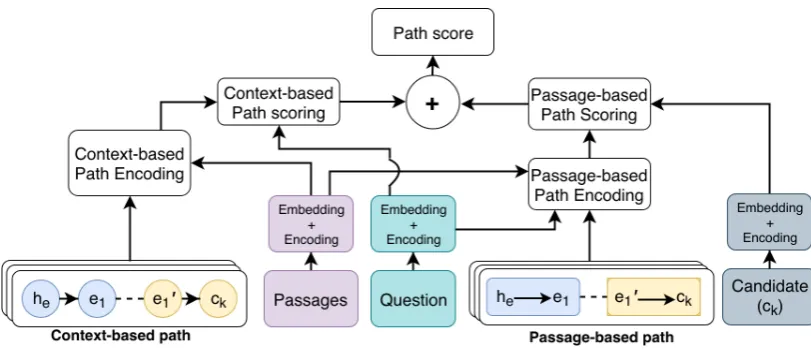
Once we have all potential paths, we score them using the proposed model, named PathNet, whose overview is depicted in Figure2. The key compo-nent is the path-scorer module that computes the score for each pathpkj. We normalize these scores across all paths, and compute the probability of a candidateckbeing the correct answer by summing the normalized scores of the paths associated with
ck:
prob(ck) =
X
j
score(pkj). (1)
Next, we describe three main model compo-nents, operating on the following inputs: question
4If the search step takes no more thanssteps and
iden-tifies a fixed number kof passages, and we select up toe
neighboring entities, our approach would have a time com-plexity of O (ke)m−1sm
[image:4.595.330.501.60.219.2]for enumeratingm-hop paths.
Figure 2: Architecture of the proposed model.
Q, passagesp1andp2, candidateck, and the loca-tions ofhe,e1,e01, ckin these passages: (1) Em-bedding and Encoding (§ 5.1) (2) Path Encoding (§ 5.2) (3) Path Scoring (§ 5.3). In Figure3, we present the model architecture for these three com-ponents used for scoring the paths.
5.1 Embedding and Encoding
We start by describing how we embed and con-textually encode all pieces of text: question, sup-porting passages, and candidate answer choices. For word embedding, we use pretrained 300 di-mensional vectors from GloVe (Pennington et al., 2014), randomly initializing vectors for out of vo-cabulary (OOV) words. For contextual encoding, we use bi-directional LSTM (BiLSTM) (Hochre-iter and Schmidhuber,1997).
Let T, U, and V represent the number of to-kens in thep-th supporting passage, question, and
k-th answer candidate, respectively. The final en-coded representation for the p-th supporting pas-sage can be obtained by stacking these vectors into
Sp ∈ RT×H, where H is the number of hidden
units for the BiLSTMs. The sequence level en-coding for the question, Q ∈ RU×H, and for the k-th candidate answer,Ck ∈RV×H, are obtained
similarly. We use row vector representation (e.g.,
R1×H) for all vectors in this paper.
5.2 Path Encoding
Figure 3: Architecture of the path scoring module, shown here for 2-hop paths.
5.2.1 Context-based Path Encoding
This component aims to implicitly encode the re-lation betweenheande1, and betweene10andck.
These implicit relation representations are them composed together to encode a path representation forhe→e1. . . e10 →ck.
First, we extract the contextual representations for each ofhe, e1, e10, andck. Based on the
lo-cationsof these entities in the corresponding pas-sages, we extract the boundary vectors from the passage encoding representation. For instance, if
he appears in the p-th supporting passage from token i1 toi2 (i1 ≤ i2), then the contextual en-coding ofhe, ghe ∈ R
2H is taken to be: g he =
sp1,i1 || sp1,i2, where || denotes the concatena-tion operaconcatena-tion. Ifheappears in multiple locations within the passage, we use the mean vector rep-resentation across all of these locations. The lo-cation encoding vectorsge1,ge10, andgck are
ob-tained similarly.
Next, we extract the implicit relation between
he ande1 as rhe,e1 ∈ R
H, using a feed forward
layer:
rhe,e1 =FFL(ghe,ge1) , (2)
where FFL is defined as:
FFL(a,b) =tanh(aWa + bWb) . (3)
Herea∈RH0andb∈
RH
00
are input vectors, and
Wa ∈ RH
0×H
andWb ∈ RH
00×H
are trainable weight matrices. The bias vectors are not shown here for simplicity. Similarly, we compute the im-plicit relation betweene10andckasre10,ck ∈R
H,
using their location encoding vectorsge10andgck.
Finally, wecomposeall implicit relation vectors along the path to obtain a context-based path
rep-resentationxctx∈RH given by:
xctx=comp(rhe,e1 , re10,ck) (4)
For fixed length paths, we can use a feed for-ward network as the composition function. E.g., for 2-hop paths, we use FFL(rhe,e1 , re10,ck). For
variable length paths, we can use recurrent compo-sition networks such as LSTM, GRU. We compare these composition functions in Section6.3.
5.2.2 Passage-based Path Encoding
In this encoder, we use entire passages to com-pute the path representation. As before, suppose (he, e1) and (e10, ck) appear in supporting passages
p1andp2, respectively. We encode each ofp1and p2 into a single vector based on passage-question
interaction. As discussed below, we first compute a question-weighted representation for passage to-kens and then aggregate it across the passage.
Question-Weighted Passage Representation:
For the p-th passage, we first compute the atten-tion matrix A ∈ RT×U, capturing the similarity
between the passage and question words. Then, we calculate a question-aware passage representa-tionSq1
p ∈ RT×H, where Sqp1 = AQ. Similarly, a passage-aware question representation, Qp ∈
RU×H, is computed, whereQp=A>Sp.
Further, we compute another passage represen-tation Sq2
p = AQp ∈ RT×H. Intuitively, Sqp1 captures important passage words based on the question, whereas Sq2
Aggregate Passage Representation: To derive a single passage vector, we first concatenate the two passage representations for each token, ob-taining Sqp = Sqp1 || Sqp2 ∈ RT×2H. We then use
an attentive pooling mechanism for aggregating the token representations. The aggregated vector
˜
sp ∈R2H for thep-th passage is obtained as:
apt ∝exp(sqp,tw>); ˜sp =apSqp (5)
where w ∈ R2H is a learned vector. In this
way, we obtain the aggregated vector representa-tions for both supporting passages p1 and p2 as
˜
sp1 ∈R
2H and˜s p2 ∈R
2H, respectively.
Composition: We compose the aggregated pas-sage vectors to obtain the paspas-sage-based path rep-resentationxpsg∈RH similar to Equation4:
xpsg=comp(˜sp1 , ˜sp2) (6)
Similar to the composition function in context-based path encoding, this composition function can be a feed-forward network for fixed length or recurrent networks for variable length paths.
5.3 Path Scoring
Encoded paths are scored from two perspectives.
Context-based Path Scoring: We score context-based paths based on their interaction with the question encoding. First, we aggregate the question into a single vector. We take the first and last hidden state representations from the question encodingQ to obtain an aggregated question vector representation.
The aggregated question vectorq˜∈RH is
˜
q = (q0||qU)Wq , (7)
whereWq∈R2H×His a learnable weight matrix.
The combined representationyxctx,q ∈ R
H of the
question and a context-based path is computed as:
yxctx,q = FFL(xctx, q˜) Finally, we derive scores for context-based paths:
zctx=yxctx,qw
>
ctx , (8)
wherewctx∈RH is a trainable vector.
Passage-based Path Scoring: We also score paths based on the interaction between the passage-based path encoding vector and the can-didate encoding. In this case, only cancan-didate en-coding is used since passage-based path enen-coding
already uses the question representation. We ag-gregate the representationCkfor candidateckinto a single vector ˜ck ∈ RH by applying an
atten-tive pooling operation similar to Equation5. The score for passage-based path is then computed as follows:
zpsg= ˜ckx>psg (9)
Finally, the unnormalized score for pathpkj is:
z=zctx + zpsg (10)
and its normalized version, score(pkj), is calcu-lated by applying the softmax operation over all the paths and candidate answers.
6 Experiments
We start by describing the experimental setup, and then present results and an analysis of our model.
6.1 Setup
We consider the standard (unmasked) version of the recently proposed WikiHop dataset (Welbl et al., 2018). WikiHop is a large scale multi-hop QA dataset consisting of about 51K questions (5129 Dev, 2451 Test). Each question is associ-ated with an average of 13.7 supporting Wikipedia passages, each with 36.4 tokens on average.
We also evaluate our model on
Open-BookQA (Mihaylov et al., 2018), a very recent and challenging multi-hop QA dataset with about 6K questions (500 Dev, 500 Test), each with 4 candidate answer choices. Since OpenBookQA does not have associated passages for the ques-tions, we retrieve sentences from a text corpus to create single sentence passages.
We start with a corpus of 1.5M sentences used by previous systems (Khot et al., 2017) for sci-ence QA. It is then filtered down to 590K sen-tences by identifying sensen-tences about generalities and removing noise. We assume sentences that start with a plural noun are likely to capture gen-eral concepts, e.g. “Mammals have fur”, and only consider such sentences. We also eliminate noisy and irrelevant sentences by using a few rules such as root of the parse tree must be a sentence, it must not contain proper nouns. This corpus is also pro-vided along with our code.
Model Accuracy (%) Dev Test
Welbl et al.(2018) - 42.9
Dhingra et al.(2018) 56.0 59.3
Song et al.(2018) 62.8 65.4
Cao et al.(2018) 64.8 67.6 PathNet 67.4† 69.6†
Table 1: Accuracy on the WikiHop dataset.
†Statistically significant (Wilson,1927)
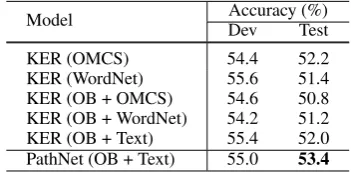
[image:7.595.92.268.185.272.2]Model Accuracy (%) Dev Test KER (OMCS) 54.4 52.2 KER (WordNet) 55.6 51.4 KER (OB + OMCS) 54.6 50.8 KER (OB + WordNet) 54.2 51.2 KER (OB + Text) 55.4 52.0 PathNet (OB + Text) 55.0 53.4
Table 2: Accuracy on the OpenBookQA dataset.
i.e., 1-hop paths. To facilitate 2-hop reasoning, we first retrieve sentences based on words inq, and for each retrieved sentences1, we find sentences that
overlap with both s1 andc. Each path is scored using idf(q, s1)·idf(s1, s2)·idf(s2, c), wheres2is
the second retrieved sentence and idf(w)is the idf score of tokenwbased on the input corpus:
idf(x, y) =
P
w∈x∩yidf(w)
min(P
w∈xidf(w),
P
w∈yidf(w))
For efficiency, we perform beam search and ig-nore any chain if the score drops below a threshold (0.08). Finally we take the top 100 chains and use these sentences as passages in our model.
We use Spacy5for tokenization. For word em-bedding, we use the 840B 300-dimensional pre-trained word vectors from GloVe and we do not update them during training. For simplicity, we do not use any character embedding. The number of hidden units in all LSTMs is 50 (H = 100). We use dropout (Srivastava et al.,2014) with probabil-ity 0.25 for every learnable layer. During training, the minibatch size is fixed at 8. We use the Adam optimizer (Kingma and Ba, 2015) with learning rate 0.001 and clipnorm 5. We use cross entropy loss for training. This being a multiple-choice QA task, we use accuracy as the evaluation metric.
6.2 Main Results
Table 1 compares our results on the WikiHop dataset with several recently proposed multi-hop
5https://spacy.io/api/tokenizer
QA models. We show the best results from each of the competing entries. Welbl et al.(2018) pre-sented the results of BiDAF (Seo et al.,2017) on the WikiHop dataset. Dhingra et al. (2018) in-corporated coreference connections inside GRU network to capture coreference links while ob-taining the contextual representation. Recently, Cao et al.(2018) andSong et al.(2018) proposed graph neural network approaches for multi-hop reading comprehension. While the high level idea is similar for these work, Cao et al. (2018) used ELMo (Peters et al., 2018) for a contextual em-bedding, which has proven to be very useful in the recent past in many NLP tasks.
As seen in Table 1, our proposed model Path-Net significantly outperforms prior approaches on WikiHop. Additionally, we benefit from inter-pretability: unlike these prior methods, our model allows identifying specific entity chains that led to the predicted answer.
Table 2 presents results on the OpenBookQA dataset. We compare with the Knowledge En-hanced Reader (KER) model (Mihaylov et al., 2018). The variants reflect the source from which the model retrieves relevant knowledge: the open book (OB), WordNet subset of ConceptNet, and Open Mind Common Sense (OMCS) subset of ConceptNet, and the corpus of 590K sentences (Text). Since KER does not scale to a corpus of this size, we provided it with the combined set of sentences retrieved by our model for all the Open-BookQA questions. The model computes various cross-attentions between the question, knowledge, and answer choices, and combines these atten-tions to select the answer. Overall, our proposed approach marginally improved over the previous models on the OpenBookQA dataset6. Note that, our model was designed for the closed-domain setting where all the required knowledge is pro-vided. Yet, our model is able to generalize on the open-domain setting where the retrieved knowl-edge may be noisy or insufficient to answer the question.
6.3 Effectiveness of Model Components
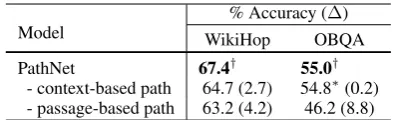
Table 3 shows the impact of context-based and passage-based path encodings. Performance of the model degrades when we ablate either of
6Sun et al.(2018) used the large OpenAI fine-tuned
the two path encoding modules. Intuitively, in context-based path encodings, limited and more fine-grained context is considered due to the use of specific entity locations. On the contrary, the passage-based path encoder computes the path representations considering the entire passage representations (both passages which contain the head entity and tail entity respectively). As a result, even if the intermediate entity can not be used meaningfully, the model poses the ability to form an implicit path representation. Passage-based path encoder is more helpful on OpenBookQA as it is often difficult to find meaningful explicit context-based paths through entity linking across passages. Let us consider the following example taken from OpenBookQA development set where our model successfully predicted the correct answer.
Question: What happens when someone on top of a bicycle starts pushing it ’s peddles in a circular motion ?
Answer: thebikeaccelerates Best Path: (bicycle, pedal,bike)
p1: bicycles require continuous circular motion on pedals
p2: pushing on the pedals of abikecause that bike to move.
In this case, the extracted path through entity linking is not meaningful as the path composition would connect bicycles to bike 7. However, when the entire passages are considered, they contain sufficient information to help infer the answer.
Table 4 presents the results on WikiHop de-velopment set when different composition func-tions are used for Equation (4). Recurrent net-works, such as LSTM and GRU, enable the path encoder to model an arbitrary number of hops. For 2-hop paths, we found that a simple feed for-ward network (FFL) performs slightly better than the rest. We also considered sharing the weights (FFL shared) when obtaining the relation vectors
rhe,e1 andre10,ck. Technically, the FFL model is
performing the same task in both cases: extract-ing implicit relations and the parameters could be shared. However, practically, the unshared
7
Entities in science questions can be phrases and events (e.g., “the bike accelerates”). Identifying and matching such entities are very challenging in case of the OpenBookQA dataset. We show that our entity-linking approach, designed for noun phrases and named entities, is still able to perform comparable to state-of-the-art methods on science question answering, despite this noisy entity matching.
Model
% Accuracy (∆) WikiHop OBQA PathNet 67.4† 55.0†
[image:8.595.317.514.61.121.2]- context-based path 64.7 (2.7) 54.8∗(0.2) - passage-based path 63.2 (4.2) 46.2 (8.8)
Table 3: Ablation results on development sets.
∗Improvement over this is not statistically significant.
Model Accuracy (%) WikiHop ∆
FFL (PathNet) 67.4 -FFL Shared 66.7 0.7
LSTM 67.1 0.3
[image:8.595.339.494.166.237.2]GRU 67.3 0.1
Table 4: Various composition functions to generate path representation (xctx) on WikiHop development set.
weights perform better, possibly because it gives the model the freedom to handle answer candi-dates differently, especially allowing the model to consider the likelihood of a candidate being a valid answer toanyquestion, akin to a prior.
6.4 Qualitative Analysis
One key aspect of our model is its ability to indi-cate the paths that contribute most towards predict-ing an answer choice. Table5 illustrates the two highest-scoring paths for two sample WikiHop questions which lead to correct answer prediction. In the first question, the top-2 paths are formed by connectingZoo LaketoGautengthrough the inter-mediate entities Johannesburg and South Africa, respectively. In the second example, the science fiction novelThis Day All Gods Dieis connected to the publisherBantam Booksthrough the author
Stephen R. Donaldson, and the collectionGap Cy-clefor first and second paths, respectively.
We also analyzed 50 randomly chosen questions that are annotated as requiring multi-hop reason-ing in the WikiHop development set and that our model answered correctly. In 78% of the ques-tions, we found at least one meaningful path8 in the top-3 extracted paths, which dropped to 62% for top-1 path. On average, 66% of the top-3 paths returned by our model were meaningful. In con-trast, only 46% of three randomly selected paths per question made sense, even when limited to the paths for the correct answers. That is, a random baseline, even with oracle knowledge of the cor-rect answer, would only find a good path in 46%
8A path is considered meaningful if it has valid relations
Question: ( zoo lake , located in the administrative territorial entity, ?)
Answer: gauteng
Rank-1 Path: (zoo lake, Johannesburg, gauteng)
Passage1: ... Zoo Lake is a popular lake and public park in Johannesburg , South Africa . It is part of the Hermann Eckstein Park and is ...
Passage2: ... Johannesburg ( also known as Jozi , Joburg and eGoli ) is the largest city in South Africa and is one of the 50 largest urban areas in the world . It is the provincial capital of Gauteng , which is ...
Rank-2 Path: (zoo lake, South Africa, gauteng)
Passage1: ... Zoo Lake is a popular lake and public park in Johannesburg , South Africa . It is ...
Passage2: ... aka The Reef , is a 56-kilometre - long north - facing scarp in the Gauteng Province of South Africa . It consists of a ...
Question: ( this day all gods die , publisher, ?)
Answer: bantam books
Rank-1 Path: (this day all gods die, Stephen R. Donaldson, bantam books)
Passage1: ... All Gods Die , officially The Gap into Ruin : This Day All Gods Die , is a science fiction novel by Stephen R. Donaldson , being the final book of The Gap Cycle ...
Passage2: ... The Gap Cycle ( published 19911996 by Bantam Books and reprinted by Gollancz in 2008 ) is a science fiction story , told in a series of 5 books , written by Stephen R. Donaldson . It is an ...
Rank-2 Path: (this day all gods die, Gap Cycle, bantam books)
Passage1: ... All Gods Die , officially The Gap into Ruin : This Day All Gods Die , is a science fiction novel by Stephen R. Donaldson , being the final book of The Gap Cycle ...
[image:9.595.78.519.58.311.2]Passage2: ... The Gap Cycle ( published 19911996 by Bantam Books and reprinted by Gollancz in 2008 ) is a science fiction story ...
Table 5: Two top-scoring paths for sample WikiHop Dev questions. In the Rank-1 path for the first question, the model composes the implicitlocated inrelations between (Zoo lake, Johannesburg) and (Johannesburg, Gauteng).
of the cases. We also analyzed 50 questions that our model gets wrong. The top-scoring paths here were of lower quality (only 16.7% were meaning-ful). This provides qualitative evidence that our model’s performance is correlated with the qual-ity of the paths it identifies, and it does not simply
guess using auxiliary information such as entity types, number of paths,9etc.
7 Conclusion
We present a novel, path-based, multi-hop reading comprehension model that outperforms previous models on WikiHop and OpenBookQA. Impor-tantly, we illustrate how our model can explain its reasoning via explicit paths extracted across mul-tiple passages. While we focused on 2-hop rea-soning required by our evaluation datasets, the ap-proach can be generalized to longer chains and to longer natural language questions.
Acknowledgment
We thank Johannes Welbl for helping us evaluat-ing our model on the WikiHop test set. We thank Rodney Kinney, Brandon Stilson and Tal Fried-man for helping to produce the clean corpus used for OpenBookQA. We thank Dirk Groeneveld for
9A model that returns the answer with the highest number
of paths would score only 18.5% on the WikiHop develop-ment set.
retrieving the sentences from this corpus using the 2-hop retrieval. Computations on beaker.org were supported in part by credits from Google Cloud.
References
Jonathan Berant, Andrew Chou, Roy Frostig, and Percy Liang. 2013. Semantic parsing on freebase from question-answer pairs. InProceedings of EMNLP.
Kurt Bollacker, Colin Evans, Praveen Paritosh, Tim Sturge, and Jamie Taylor. 2008. Freebase: a collab-oratively created graph database for structuring hu-man knowledge. InProceedings of ACM SIGMOD international conference on Management of data.
Antoine Bordes, Nicolas Usunier, Sumit Chopra, and Jason Weston. 2015. Large-scale simple question answering with memory networks. InNIPS.
Nicola De Cao, Wilker Aziz, and Ivan Titov. 2018. Question answering by reasoning across docu-ments with graph convolutional networks. CoRR, abs/1808.09920.
Rajarshi Das, Arvind Neelakantan, David Belanger, and Andrew McCallum. 2017. Chains of reasoning over entities, relations, and text using recurrent neu-ral networks. InProceedings of EACL.
Bhuwan Dhingra, Hanxiao Liu, Zhilin Yang, William Cohen, and Ruslan Salakhutdinov. 2017. Gated-attention readers for text comprehension. In Pro-ceedings of ACL.
Daniel Fried, Peter Jansen, Gustave Hahn-Powell, Mi-hai Surdeanu, and Peter Clark. 2015. Higher-order lexical semantic models for non-factoid an-swer reranking. TACL, 3:197–210.
Matt Gardner and Tom M. Mitchell. 2015. Effi-cient and expressive knowledge base completion us-ing subgraph feature extraction. In Proceedings of EMNLP.
Kelvin Guu, John Miller, and Percy Liang. 2015. Traversing knowledge graphs in vector space. In
Proceedings of EMNLP.
Sepp Hochreiter and J¨urgen Schmidhuber. 1997. Long short-term memory. Neural Computation, 9(8):1735–1780.
Minghao Hu, Yuxing Peng, Zhen Huang, Xipeng Qiu, Furu Wei, and Ming Zhou. 2018. Reinforced mnemonic reader for machine reading comprehen-sion. InProceedings of IJCAI.
Peter Jansen, Rebecca Sharp, Mihai Surdeanu, and Pe-ter Clark. 2017. Framing qa as building and ranking intersentence answer justifications. Computational Linguistics, 43:407–449.
Mandar Joshi, Eunsol Choi, Daniel Weld, and Luke Zettlemoyer. 2017. TriviaQA: A large scale dis-tantly supervised challenge dataset for reading com-prehension. InProceedings of ACL.
Daniel Khashabi, Erfan Sadeqi Azer, Tushar Khot, Ashutosh Sabharwal, and Dan Roth. 2019. On the capabilities and limitations of reasoning for natural language understanding. CoRR, abs/1901.02522.
Daniel Khashabi, Snigdha Chaturvedi, Michael Roth, Shyam Upadhyay, and Dan Roth. 2018a. Looking beyond the surface: A challenge set for reading com-prehension over multiple sentences. InProceedings of NAACL.
Daniel Khashabi, Tushar Khot, Ashish Sabharwal, Pe-ter Clark, Oren Etzioni, and Dan Roth. 2016. Ques-tion answering via integer programming over semi-structured knowledge. InProceedings of IJCAI.
Daniel Khashabi, Tushar Khot, Ashish Sabharwal, and Dan Roth. 2018b. Question answering as global rea-soning over semantic abstractions. InProceedings of AAAI.
Tushar Khot, Ashish Sabharwal, and Peter Clark. 2017. Answering complex questions using open informa-tion extracinforma-tion. InProceedings of ACL.
Diederik P. Kingma and Jimmy Lei Ba. 2015. Adam: A method for stochastic optimization. In Proceed-ings of ICLR.
Guokun Lai, Qizhe Xie, Hanxiao Liu, Yiming Yang, and Eduard H. Hovy. 2017. Race: Large-scale read-ing comprehension dataset from examinations. In
EMNLP.
Ni Lao, Tom M. Mitchell, and William W. Cohen. 2011. Random walk inference and learning in a large scale knowledge base. In Proceedings of EMNLP.
Todor Mihaylov, Peter Clark, Tushar Khot, and Ashish Sabharwal. 2018. Can a suit of armor conduct elec-tricity? A new dataset for open book question an-swering. InProceedings of EMNLP.
Jeffrey Pennington, Richard Socher, and Christo-pher D. Manning. 2014. GloVe: Global vectors for word representation. InProceedings of EMNLP.
Matthew E. Peters, Mark Neumann, Mohit Iyyer, Matt Gardner, Christopher Clark, Kenton Lee, and Luke Zettlemoyer. 2018. Deep contextualized word rep-resentations. InProceedings of NAACL.
Alec Radford, Karthik Narasimhan, Tim Salimans, and Ilya Sutskever. 2018. Improving language under-standing by generative ptraining. Technical re-port, Technical rere-port, OpenAI.
Pranav Rajpurkar, Jian Zhang, Konstantin Lopyrev, and Percy Liang. 2016. SQuAD: 100,000+ questions for machine comprehension of text. InProceedings of EMNLP.
Minjoon Seo, Aniruddha Kembhavi, Ali Farhadi, and Hannaneh Hajishirzi. 2017. Bidirectional attention flow for machine comprehension. InProceedings of ICLR.
Yelong Shen, Po-Sen Huang, Jianfeng Gao, and Weizhu Chen. 2017. Reasonet: Learning to stop reading in machine comprehension. InProceedings of KDD.
Linfeng Song, Zhiguo Wang, Mo Yu, Yue Zhang, Radu Florian, and Daniel Gildea. 2018. Exploring graph-structured passage representation for multi-hop reading comprehension with graph neural net-works. CoRR, abs/1809.02040.
Nitish Srivastava, Geoffrey Hinton, Alex Krizhevsky, Ilya Sutskever, and Ruslan Salakhutdinov. 2014. Dropout: A simple way to prevent neural networks from overfitting. JMLR, 15(1):1929–1958.
Kai Sun, Dian Yu, Dong Yu, and Claire Cardie. 2018. Improving machine reading comprehension with general reading strategies. CoRR, abs/1810.13441.
Adam Trischler, Tong Wang, Xingdi Yuan, Justin Har-ris, Alessandro Sordoni, Philip Bachman, and Ka-heer Suleman. 2017. NewsQA: A machine compre-hension dataset. In Proceedings of the 2nd Work-shop on Representation Learning for NLP.
Johannes Welbl, Pontus Stenetorp, and Sebastian Riedel. 2018. Constructing datasets for multi-hop reading comprehension across documents. TACL, 6:287–302.
Jason Weston, Antoine Bordes, Sumit Chopra, and Tomas Mikolov. 2015. Towards AI-complete ques-tion answering: A set of prerequisite toy tasks.
CoRR, abs/1502.05698.
Edwin B. Wilson. 1927. Probable inference, the law of succession, and statistical inference. JASA, 22(158):209–212.