
The adoption of reinforcement learning in the logistics industry: A case study at a large international retailer
143
0
0
Full text
(2) Master thesis. The adoption of reinforcement learning in the logistics industry: A case study at a large international retailer November 2019 Author. Name Programme Institute. Email address. Graduation committee. M.W.T. Gemmink (Martijn) MSc Business Information Technology University of Twente PO Box 217 7500 AE Enschede The Netherlands M . W . T . GEMMINK @ ALUMNUS . UTWENTE . NL. First supervisor. Dr. Maria-Eugenia Iacob Department of Industrial Engineering and Business Information Systems University of Twente, Enschede, The Netherlands [email protected]. Second supervisor. Dr. Marten van Sinderen Faculty of Electrical Engineering, Mathematics and Computer Science University of Twente, Enschede, The Netherlands [email protected]. Company supervisor. Pieter Meints MSc. Logistics Support Albert Heijn, Zaandam, The Netherlands [email protected]. Daily supervisor. Ing. Jean Paul Sebastian Piest MSCM Department of Industrial Engineering and Business Information Systems University of Twente, Enschede, The Netherlands [email protected].
(3) Preface.
(4)
(5) Management summary. Whereas supervised and unsupervised learning has already reached widespread adoption within the logistics industry, reinforcement learning remains largely uncharted territory. Reinforcement learning is particularly interesting as agents can learn based on experience in a real-world or simulated environment. Current applications of the technique focuses primarily on games, however reinforcement learning could also be implemented within the business processes of logistic organizations. Because no clear and concise model for reinforcement learning adoption exists, this thesis is aimed at developing one. The main research question is therefore: How can logistic organizations effectively assess and adopt reinforcement learning into their business processes? Conducting exploratory research and a literature review formed the basis for a business process model aimed at logistic organizations in order to implement reinforcement learning. The exploratory research was an attempt to design and develop a reinforcement learning agent that could solve (a part of) the product allocation problem within the warehouses of Albert Heijn, also called slotting. The agent successfully learned how to allocate products according to the requirements as prioritized by the company. The insights of both the literature body and the creation of the agent were used to create the model to re-engineer business processes in the logistics industry using reinforcement learning. The model was validated using expert opinions and the performance of the agent gives logistic organizations an idea about whether and how to use reinforcement learning in their business processes. The agent achieves high scores in the product allocation problem, but members of the Logistics Support department are still able to outperform the agent. Using intelligence amplification however, the cooper-.
(6) ation between the agent and the operational employees, the performance in terms of time and score of the slotting increased. The contribution of this thesis to practice is that the model supports AI novice and AI ready departments within logistic organizations to re-engineer their business processes using reinforcement learning. Because these organizations have limited skills to implement a reinforced agent themselves, an example agent is provided that is ready to be used and experiment with. The scientific relevance is twofold. Current adoption models lack the unique determinants for artificial intelligence and reinforcement learning, the methodology of this research could alleviate this problem for future research. Secondly, this research also indicates that using intelligence amplification, agents using reinforcement learning also benefit from the cooperation between a human and the agent. The model can be considered a first step in taking reinforcement learning beyond simple games and towards actual business processes..
(7) Acknowledgement. Utrecht, 15 November, 2019 Dear reader, This thesis concludes my master Business Information Technology at the University of Twente. Little over 6 years ago I started my bachelor at this beautiful campus in Enschede and I’ve never regretted the decision to study at the UT ever since. Starting in 2013, the bachelor Business IT - featuring a valuable combination of computer science and management courses - brought me to where I am today. In those years I have been developing my personal, academic and professional skills. I have made a lot of friends during my time as a student and I cherish many unforgettable memories such as a study tour to South East Asia. I would like to thank the people who were important during the writing of this thesis. First of all, I would like to thank my supervisors Maria Iacob, Marten van Sinderen and Sebastian Piest, for guiding me in writing this thesis and all the valuable feedback they have provided. As my daily supervisor, Sebastian always found the time to discuss my progress which really helped me in tackling issues and keep moving forward, thanks Sebastian! I would also like to thank Pieter Meints for his contribution and feedback during the project as my company supervisor at Albert Heijn. I always felt a member of the Logistics Support team and that really motivated me during the writing of the thesis. I really enjoyed having the opportunity to take a look at the logistic operations of Albert Heijn. Finally, I would like to thank my girlfriend, Niké, my family and friends for always supporting me throughout my studies. I could not have done it without them. I wish you pleasant reading, Martijn Gemmink.
(8)
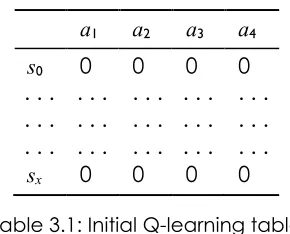
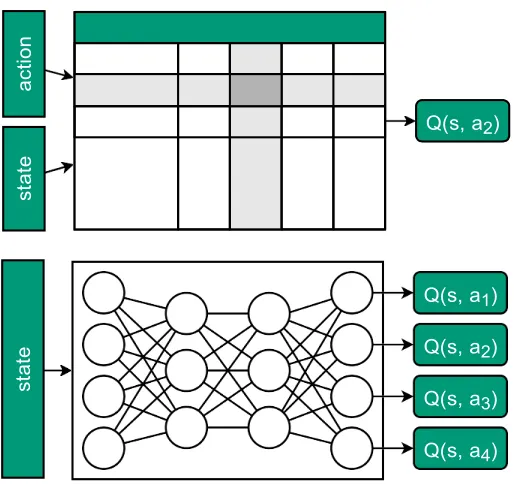
(9) List of figures. 2.1 The engineering cycle [46] .............................................................................. 27 2.2 Research methodology ................................................................................... 28 2.3 The literature selection process, based on Wolfswinkel et al. [47] ............... 29 3.1 3.2 3.3 3.4 3.5 3.6 3.7 3.8 3.9 3.10 3.11 3.12 3.13 3.14 3.15 3.16. Definitions of AI in four dimensions [35] ........................................................... 35 Artificial Intelligence overview [6] ................................................................... 36 Agents interact with environments through sensors and actuators [35]...... 37 Schematic diagram of a simple reflex agent [35] ......................................... 38 Schematic diagram of a model-based reflex agent [35]............................. 39 Schematic diagram of a goal-based agent [35] .......................................... 39 Schematic diagram of a utility-based agent [35] ......................................... 40 A general learning agent [35]......................................................................... 40 Representation of states and transitions [35] ................................................. 41 Representation of a node inside a neural network ..................................... 42 The most common activation functions ....................................................... 43 A neural network ............................................................................................ 43 A small neural network including the weights.............................................. 43 Reinforcement learning, derived from the MDP .......................................... 47 Differences between Q-table and the Q-network ...................................... 51 The Actor-Critic architecture [4] ................................................................... 52. 4.1 4.2 4.3 4.4. Technology Acceptance Model [12, 13] ....................................................... 56 Diffusion of Innovations (DOI) [33]................................................................... 57 Unified Theory of Acceptance and Use of Technology (UTAUT) [42] ........... 58 The technology-organization-environment (TOE) framework [16] ............... 59.
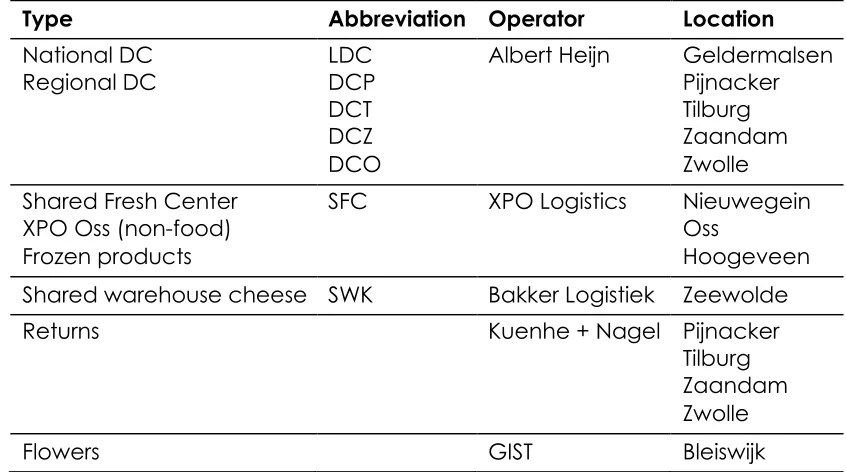
(10) 4.5 4.6 4.7 4.8 4.9. Decision making according to problem complexity and workload [17] . . 59 Machine learning taxonomies [6] ................................................................... 61 Decision tree for cost reduction [6] ................................................................. 61 Decision tree for insight generation [6] ........................................................... 62 Level of AI competency [31] ........................................................................... 63. 5.1 5.2 5.3 5.4 5.5 5.6 5.7 5.8 5.9 5.10 5.11 5.12 5.13 5.14 5.15 5.16 5.17 5.18 5.19 5.20 5.21 5.22 5.23 5.24 5.25. The task environment and the scenarios ........................................................ 71 Sample container with correct stacking group and class ............................ 73 The neural network of A2C .............................................................................. 76 Results for semi autonomous agent for scenario A ........................................ 77 Results for fully autonomous agent for scenario A ......................................... 77 Results based on sparse and immediate rewards for scenario A ................. 78 Results based on sparse and immediate rewards for scenario B.................. 78 Baseline results for scenario A .......................................................................... 79 Baseline results for scenario B .......................................................................... 79 Rewards with various batch sizes for scenario A .......................................... 79 Rewards with various batch sizes for scenario B ........................................... 79 Rewards with 0, 2 and 4 hidden layers in scenario A ................................... 80 Rewards with 0, 2 and 4 hidden layers in scenario B ................................... 80 Rewards with 256, 512 and 1024 nodes per layer in scenario A.................. 81 Rewards with 256, 512 and 1024 nodes per layer in scenario B .................. 81 Rewards with various learning rates in scenario A ....................................... 82 Rewards with various learning rates in scenario B ........................................ 82 Rewards with various entropy values in scenario A ..................................... 82 Rewards with various entropy values in scenario B ...................................... 82 Rewards with various gamma values in scenario A ..................................... 84 Rewards with various gamma values in scenario B ..................................... 84 The circuit for scenario E ................................................................................ 86 Rewards of the agent with optimized parameters in scenario A ............... 89 Rewards of the agent with optimized parameters in scenario B ................ 89 Rewards of the agent with optimized parameters in scenario C ............... 89. 6.1 The positioning of the model. .......................................................................... 94 7.1 7.2 7.3 7.4 7.5. Workload for team lead................................................................................... 95 A method for RL-driven business process re-engineering .............................. 96 Overview of RL algorithms ............................................................................... 99 Workload for the development team ........................................................... 100 Workload for the operational employees..................................................... 102. 8.1 Validation for each phase in the model ....................................................... 107 8.2 The activities also performed during the exploratory research .................. 108 C.1 The circuit for scenario A............................................................................... 129 C.2 The circuit for scenario B ............................................................................... 131.
(11) C.3 The circuit for scenario C .............................................................................. 133.
(12)
(13) List of tables. 1.1 The report contents .......................................................................................... 26 2.1 The concept matrix by Webster & Watson [45].............................................. 30 2.2 The advanced concept matrix by Wolfswinkel et al. [47] ............................. 30 3.1 Initial Q-learning table ..................................................................................... 50 3.2 Q-learning table after training ........................................................................ 50 5.1 5.2 5.3 5.4 5.5 5.6 5.7 5.8 5.9 5.10. Locations and types of DCs of Albert Heijn .................................................... 66 An example of the locations for scenario A ................................................... 71 An example of the products for scenario A ................................................... 72 The scoreboard for the slotting as shown in Table 5.2.................................... 74 One hot encoding on 3 products ................................................................... 75 Default parameters for the A2C algorithm ..................................................... 78 Optimized (hyper)parameters used per scenario ......................................... 84 Products to slot in scenario E ........................................................................... 86 Locations and optimal slotting for scenario E ................................................ 87 Performance of the participants for different actors and scenarios .......... 88. A.1 A.2 A.3 B.1 B.2 B.3 C.1. Number of results for the reinforcement learning SLR ................................. 124 The concept matrix for deep learning and reinforced learning ................ 125 AI concepts .................................................................................................... 126 Number of results for technology adoption SLR ........................................... 127 The concept matrix for technology adoption ............................................. 128 Technology adoption concepts ................................................................... 128 Products to slot in scenario A........................................................................ 129.
(14) C.2 C.3 C.4 C.5 C.6 C.7 C.8 C.9. Locations and optimal slotting for scenario A ............................................ 130 The scoreboard for the optimal slotting in scenario A................................ 130 Products to slot in scenario B ........................................................................ 131 Locations and optimal slotting for scenario B ............................................. 132 The scoreboard for the optimal slotting in scenario B ................................ 132 The scoreboard for the optimal slotting in scenario C ............................... 133 Products to slot in scenario C ....................................................................... 134 Locations and optimal slotting for scenario C ............................................ 135.
(15) Abbreviations. A2C AGV AH AI BPMN CNN DC DDQN DNN DOI DP DQN GUI GPU IA IT LS LSP MDP ML NN RL RNN SLR TAM TD TOE TPB TRA UTAUT WMS. Advantange Actor-Critic Autonomous guided vehicle Albert Heijn Artificial intelligence Business process model and notation Convolutional neural network Distribution center Double Deep Q-Network Deep neural network Diffusion of innovations Dynamic programming Deep Q-Network Graphical user interface Graphics processing unit Intelligence amplification Information technology Logistics Support Logistic service provider Markov decision process Machine learning Neural network Reinforced learning Recurrent neural network Structured literature review Technology acceptance model Temporal-difference Technology-organization-environment Theory of planned behavior Theory of reasoned action Unified theory of acceptance and use of technology Warehouse Management System.
(16)
(17) Contents. Preface Management summary .........................................................................5 Acknowledgement ................................................................................7 List of figures .......................................................................................... 11 List of tables ........................................................................................... 14 Abbreviations ........................................................................................ 16. I. Initiation. 1. Introduction ........................................................................................... 23. 1.1. Background. 1.1.1 1.1.2. Albert Heijn .................................................................................................................... 24 Ahold Delhaize ............................................................................................................. 24. 1.2. Motivation. 25. 1.3. Problem definition. 25. 1.4. Research goal. 25. 1.5. Research questions. 25. 1.6. Report contents. 26. 24.
(18) 2. Methodology ........................................................................................ 27. 2.1. Problem investigation. 2.1.1 2.1.2. Structured literature review ......................................................................................... 28 Exploratory research .................................................................................................... 30. 2.2. Treatment design. 31. 2.3. Treatment validation. 31. 2.3.1 2.3.2. Single-case mechanism experiments ........................................................................ 31 Expert opinions .............................................................................................................. 31. 28. Problem. II. investigation. 3. Reinforcement learning ....................................................................... 35. 3.1. Artificial intelligence. 3.1.1 3.1.2 3.1.3 3.1.4 3.1.5. Intelligent agents .......................................................................................................... 36 Task environments......................................................................................................... 37 Agent programs ........................................................................................................... 38 Problem-solving ............................................................................................................ 41 Learning techniques .................................................................................................... 41. 3.2. Deep learning. 3.2.1 3.2.2. Neural networks ............................................................................................................ 42 The need for DL ............................................................................................................. 45. 3.3. Reinforcement learning. 3.3.1 3.3.2 3.3.3 3.3.4. Core concepts of RL .................................................................................................... 46 RL approaches ............................................................................................................. 48 RL algorithms ................................................................................................................. 49 Challenges of RL ........................................................................................................... 53. 4. Technology adoption ........................................................................... 55. 4.1. Adoption models. 4.1.1 4.1.2 4.1.3 4.1.4. Technology Acceptance Model (TAM)..................................................................... 55 Diffusion of Innovations (DOI) ...................................................................................... 56 Unified Theory of Acceptance and Use of Technology (UTAUT)...............................58 Technology-Organization-Environment (TOE)........................................................... 58. 4.2. Intelligence amplification. 59. 4.3. AI adoption in logistics. 59. 4.4. AI in practice. 60. 4.5. Maturity models. 62. 5. Exploratory research ............................................................................ 65. 5.1. Background. 5.1.1 5.1.2 5.1.3 5.1.4 5.1.5. Replenishment .............................................................................................................. 65 Distribution centers ....................................................................................................... 65 Logistics Support ........................................................................................................... 66 Transport ........................................................................................................................ 66 Stores .............................................................................................................................. 67. 36. 42. 46. 55. 65.
(19) 5.2. AI maturity at the department. 67. 5.2.1 5.2.2. Team day at the university .......................................................................................... 67 Demonstration agent .................................................................................................. 68. 5.3. Identifying a suitable business process. 5.3.1 5.3.2 5.3.3. Estimating the number of order pickers per shift ...................................................... 69 Optimal rack locations ................................................................................................ 69 Slotting ........................................................................................................................... 70. 5.4. Automating the slotting process. 5.4.1 5.4.2 5.4.3. Task environment .......................................................................................................... 70 Reward function ........................................................................................................... 72 Implementation ............................................................................................................ 74. 5.5. Intelligence amplification. 5.5.1 5.5.2. Experiment setup .......................................................................................................... 85 Results ............................................................................................................................ 87. 5.6. Conclusion. 68. 70. 84. 87. Treatment design. III 6. Requirements specification . . . . . . . . . . . . . . . . . . . . . . . . . . . . . . . . . . . 93. 6.1 6.2. Stakeholders Requirements. 93 94. 6.3. Positioning of the artifact. 94. 7. Model . . . . . . . . . . . . . . . . . . . . . . . . . . . . . . . . . . . . . . . . . . . . . . . . . . . . . . .. 95. 7.1. Team lead. 95. 7.2. Development team. Develop and test a small simulation environment . . . . . . . . . . . . . . . . . . . . . . Implement a real-world scenario . . . . . . . . . . . . . . . . . . . . . . . . . . . . . . . . . . Tuning the (hyper)parameters . . . . . . . . . . . . . . . . . . . . . . . . . . . . . . . . . . . . . Implementing the agent (and fallback) . . . . . . . . . . . . . . . . . . . . . . . . . . . . .. 99. 100 100 100 101. 7.3. Operations. 101. 6.2.1 6.2.2. 7.1.1 7.1.2 7.1.3 7.1.4 7.2.1 7.2.2 7.2.3 7.2.4 7.3.1 7.3.2 7.3.3. Functional requirements . . . . . . . . . . . . . . . . . . . . . . . . . . . . . . . . . . . . . . . . . . Non-functional requirements . . . . . . . . . . . . . . . . . . . . . . . . . . . . . . . . . . . . . . .. Identify suitable business processes . . . . . . . . . . . . . . . . . . . . . . . . . . . . . . . . . . Design task environment . . . . . . . . . . . . . . . . . . . . . . . . . . . . . . . . . . . . . . . . . . Assess RL approach and method . . . . . . . . . . . . . . . . . . . . . . . . . . . . . . . . . . . Requirements engineering . . . . . . . . . . . . . . . . . . . . . . . . . . . . . . . . . . . . . . . .. Evaluating the task environment . . . . . . . . . . . . . . . . . . . . . . . . . . . . . . . . . . . Evaluating the impact on the operation . . . . . . . . . . . . . . . . . . . . . . . . . . . . . Start with updated business process . . . . . . . . . . . . . . . . . . . . . . . . . . . . . . . .. IV. 94 94. 97 97 98 99. 102 102 103. Treatment validation. 8. Model validation ................................................................................. 107. 8.1. Validation setup. 107.
(20) 8.2. Team lead expert opinion. V. 108. Closure. 9. Conclusion. 9.1 9.2. Limitations and future work Recommendations for Albert Heijn. ............................................................ 113 116 116. Postface References . . . . . . . . . . . . . . . . . . . . . . . . . . . . . . . . . . . . . . . . . . . . . . . . . . 119 Appendices . . . . . . . . . . . . . . . . . . . . . . . . . . . . . . . . . . . . . . . . . . . . . . . . . 123 A. Literature review results of reinforcement learning. 123. B C D. Literature review results of technology adoption Scenarios Advantage Actor-Critic agent Python implementation. 126 129 136.
(21) I. Initiation. 1. Introduction .............................................. 23. 2. Methodology ............................................27. 1.1 1.2 1.3 1.4 1.5 1.6. 2.1 2.2 2.3. Background Motivation Problem definition Research goal Research questions Report contents. Problem investigation Treatment design Treatment validation.
(22)
(23) 1. Introduction. Modern artificial intelligence enables computers not only to solve problems based on human instructions but to solve them on their own [15]. Many believe that the future of AI is filled with potential and that it will become an important part of the logistics industry [6]. According to McKinsey the AI revolution is not in its infancy, but the majority of the economic impact is yet to come [9]. In recent years artificial intelligence has been studied intensively leading to a much better understanding of the technology. Artificial intelligence research has been around for 50 years and marketing has reached an all-time high [20, 26]. Because of modern computer power and large amounts of data, artificial intelligence is becoming increasingly interesting for logistic organizations that now can (partially) automate tasks that require a decent level of intelligence [6, 9]. "Artificial intelligence (AI) is once again set to thrive; unlike past waves of hype and disillusionment, today’s current technology, business, and societal conditions have never been more favorable to widespread use and adoption of AI." [6]. Almost everything we currently hear from in the field is thanks to deep learning. Deep learning works by using statistics to find patterns in data and it has proven to be successful in recent years. The sudden rise and fall of different techniques have characterized research for a long time and an analysis of more than sixteen thousand papers suggests the same could happen to deep learning in the near future. The research also identified upcoming trends in the field, one that keeps coming up is reinforced learning1. Reinforced learning gained momentum in October 2015, when DeepMind’s AlphaGo defeated the world champion in a game of Go. With reinforced learning an agent is trained using punishments and rewards, much like how humans learn in the real world [19]. 1Reinforced and reinforcement learning are used interchangeably throughout the thesis, but are. the same..
(24) 24. Chapter 1. Introduction. AI has become more favorable than ever before because of Big Data, cloud computing and processing power. AI is becoming an integral part of the future of logistic organizations. AI has the potential to "fundamentally extend human efficiency in terms of reach, quality, and speed by eliminating mundane and routine work" [6]. Logistics is becoming an AI-driven industry and there are already many examples such as autonomous guided vehicles (AGVs), intelligent robot sorting, predictive demand, capacity planning and many more [6].. 1.1. Background This research has been conducted over an eight month period at the Logistics Support department of Albert Heijn. The department ensures that the processes in the distribution centers run smoothly.. 1.1.1. Albert Heijn The organization is named after its founder Albert Heijn (1865 – 1945). Albert Heijn took over the small grocery store of his father Jan Heijn in Oostzaan, a municipality and a town in the Zaanstreek, The Netherlands. A few years later Albert Heijn opened its second store in Purmerend and started with its own production companies which roasted coffee beans and baked cookies to be sold in the expanding number of stores. In 1927 the number of stores reached 107. Albert Heijn passed away in 1945 and three years later the company went public. Albert Heijn wanted its stores to be accessible to both the wealthy and the poor, his motto was: “The everyday affordable, the special accessible.” The mission of Albert Heijn is to offer all ingredients for a better life. Bringing good, safe, sustainable and healthy food to millions of customers. The stores have a wide range of high-quality items and friendly, helpful service, long opening hours and online ordering enable customers to shop for groceries around the clock. Albert Heijn (AH) is currently the largest and oldest food retailer in the Netherlands. Albert Heijn has more than a thousand shops across the Netherlands and another 40 in Belgium. The organization is owned by Ahold Delhaize.. 1.1.2. Ahold Delhaize Ahold Delhaize is the result of a merger in 2016 between the Dutch Ahold and the Belgian Delhaize. The headquarters of the organization is located in Zaandam, The Netherlands. The organization operates retail companies across 11 countries, employing over 372 thousand people in more than 6 thousand stores. Last year in 2018, the net sales were 62.8 billion euro. Every week 50 million customers are served at the supermarkets, drug stores, convenience stores and liquor stores in one of the 19 local brands of Ahold Delhaize, of which Albert Heijn is one..
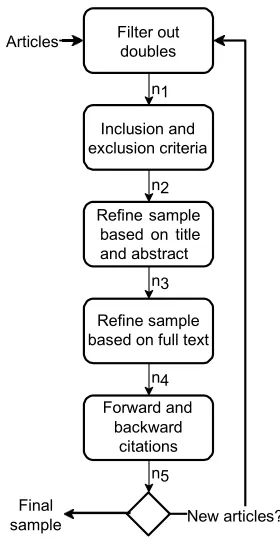
(25) 1.2 Motivation. 1.2. 25. Motivation Whereas supervised and unsupervised learning have been studied extensively, reinforcement learning kept a low profile over the years. Recently reinforcement learning gained momentum due to breakthroughs such as defeating the world champion in a game of Go. There is not much literature connecting reinforcement learning to practice that goes beyond games and towards actual implementation in a large industry such as logistics.. 1.3. Problem definition Logistic organizations lack the tools to effectively identify whether (parts) of their business processes are suitable for reinforcement learning. But even when these processes are identified, the implementation is not as straightforward as supervised and unsupervised learning.. 1.4. Research goal This thesis aims at easing the adoption of reinforcement learning in the logistics industry with a clear and concise model that is on a business process level that helps these organizations to effectively implement reinforcement learning.. 1.5. Research questions Based on the problem statement the main research question that has been identified is: RQ. How can logistic organizations effectively assess and adopt reinforcement learning into their business processes?. To be able to answer the research question the following sub-questions have been formulated: SQ1. What is the current state of artificial intelligence and especially deep and reinforcement learning in the logistics industry?. SQ2. What are the most important artificial intelligence adoption models and frameworks in the logistics industry?. SQ3. Which types of business processes are suitable for reinforcement learning?. SQ4. Which steps help logistic organizations in successfully implementing reinforcement learning?. SQ5. To what extent can the developed model help logistic organizations in the adoption of reinforcement learning?.
(26) Chapter 1. Introduction. 26. 1.6. Report contents The structure of this thesis is build around the different phases of the Design Science Methodology of Wieringa [46]. First the background information on the two main topics, technology adoption and reinforcement learning is considered in the problem investigation. The exploratory research implementation of reinforcement learning at Albert Heijn is also considered in Part II. Part III and IV are part of the design cycle in designing and validation the treatment. Part V includes both the conclusion and the discussion. In Table 1.1 the part(s) and their relation to the research questions is depicted. Question. Type. Methodology. Part(s). SQ1 SQ2 SQ3 SQ4 SQ5. Knowledge Knowledge Design Design Design. Problem investigation Problem investigation Exploratory research / treatment design Exploratory research / treatment design Treatment validation. Part II Part II Part II & III Part III & IV Part IV. Table 1.1: The report contents.
(27) 2. Methodology. The method of research will be based on the Design Science Methodology of Wieringa [46], which is about studying an artifact in context. The goal is to develop a model that helps logistic organizations to effectively adopt reinforcement learning. This design problem, according to Wieringa, can be formulated as follows: Improve the adoption of reinforcement learning in logistic organizations by designing a model that is on a business process level in order to effectively utilize its potential [46]. The engineering cycle is a rational problem-solving process which contains the task to carry out design science research. The engineering cycle is depicted in Figure 2.1. The cycle provides a logical structure of tasks and tells us that in order to justify a treatment we must understand the problem [46]. In design science, only the first three tasks of the engineering cycle are performed, starting with the problem investigation.. Treatment implementation. Treatment validation. Implementation evaluation / Problem investigation. Treatment design. Figure 2.1: The engineering cycle [46]. For this thesis an approach will be taken that consists of the design cycle appended by exploratory research that has similarities to systems engineering, see Figure 2.2..
(28) Chapter 2. Methodology. 28. First a number of iterations are performed in an attempt to adopt reinforcement learning at the Logistics Support department of Albert Heijn, the largest food retailer in the Netherlands. The exploratory research together with a structured literature review will form a solid foundation for the problem investigation discussed in section 2.1. The next step is the treatment design, in which the requirements for the to be developed model are specified and the treatment(s) are discussed. The treatment design can be found in section 2.2. The final step of the design cycle is the treatment validation discussed in section 2.3. Exploratory research. Treatment implementation. Treatment validation. Implementation evaluation / Problem investigation. Treatment design. Figure 2.2: Research methodology. 2.1. Problem investigation The task is to investigate a problematic situation, starting with identifying, describing, explaining and evaluating the problem to be treated [46]. The problem investigation is twofold, both a structured literature review (SLR) found in section 2.1.1 and exploratory research in section 2.1.2 is considered. The goal of the exploratory research is to start the treatment design task with a strong literature foundation and the experience of actually carrying out a reinforcement learning adoption project at a large logistic organisation.. 2.1.1. Structured literature review This literature review aims to identify the problems, approaches, tools and applications of artificial intelligence and especially reinforcement learning as well as its adoption in logistic organizations in an attempt to identify what hinders progress in this regard. Both the scientific body as well as material from the logistics field will be considered. An effective literature review creates a firm foundation for advancing knowledge [45]. First the literature search and selection will be discussed which also addresses the structured literature review and how the literature will be reviewed. For both main topics, a different search strategy was used..
(29) 2.1 Problem investigation. 29. Literature search and selection. Based on the research questions two main topics have been identified, reinforcement learning and technology adoption. Artificial intelFilter out doubles ligence is huge and during the last 50 years Articles the field has become very disparate makn1 ing it difficult to grasp [8]. The field of Inclusion and technology adoption and acceptance is on exclusion criteria the other side of the spectrum being much n2 more clear and concise. Because of the nature of the fields two separate methodoloRefine sample based on title gies were used. The specifics of each reand abstract search method are discussed at the beginn3 ning of appendix A and B. The method of Refine sample research for the structured literature review is based on full text based on the guidelines of Kitchenham et al. [22]. The two topics formed the basis n4 for a systematic literature review (SLR). A SLR Forward and backward makes the review more valuable because it recitations quires a legitimization for every choice made n5 in the search process [47]. Before commencFinal ing with the review, first the sources have to New articles? sample be identified. The following sources will be used: Figure 2.3: The literature selec• • • • • • • •. tion process, based on Wolfswinkel et al. [47]. Scopus WWW . SCOPUS. COM Web of Science WWW . WEBOFKNOWLEDGE . COM IEEE Explore WWW . IEEE . ORG / WEB / PUBLICATIONS/ XPLORE Research Gate WWW . RESEARCHGATE . NET Springer Links WWW . SPRINGERLINK . COM Science Direct WWW. SCIENCEDIRECT .COM Google Scholar WWW . SCHOLAR . GOOGLE . COM University of Twente Library WWW . UTWENTE . NL / EN / LISA / LIBRARY. First Scopus and Web of Science were used for a preliminary search for the title, keywords and abstract. The selection of the final sample will be based on the selection process of Wolfswinkel et al. [47]. An iterative selection process that starts with filtering out the doubles. For every topic there will be inclusion and exclusion criteria that limits and improves the quality of articles found. From the remaining sample the title and abstract will be read and when relevant, the full text also. Forward and backward citations are used to evaluate the foundation on which the author(s) statements are based and to find more relevant articles. The literature selection process can be found in Figure 2.3. Reviewing the literature. With the final selection of articles the next step is to review the literature and to identify the key concepts that arise. Webster & Watson recommend using a concept matrix when reviewing the articles, synthesizing the literature by discussing each identified concept. The concept matrix can be found in Table 2.1..
(30) Chapter 2. Methodology. 30. Articles 1 2 .... Concepts A. B x. C x x. D. . .. x. x. x. Table 2.1: The concept matrix by Webster & Watson [45]. Articles 1 2 .... Concepts A. AB x x. B x. C. . .. x. x. x. Table 2.2: The advanced concept matrix by Wolfswinkel et al. [47]. In order to expose potential relevant relations between concepts and their properties the concept matrix can be extended by merging concepts. Identifying what concepts to merge is a continuous process during the analysis. The advanced concept matrix proposed by Wolfswinkel et al. can be found in Table 2.2.. 2.1.2. Exploratory research The technology adoption models, combined with the specifications of reinforcement learning from literature will be the starting point of a small engineering cycle within the Logistics Support department of Albert Heijn. The goal of this exploratory research is to explore to what extent reinforcement learning can be adopted. The results of this exploratory research will be used as input for the model. The exploratory research consists of three phases. Identifying suitable business processes. Based on the determinants of reinforcement learning and the puzzles it is able to solve one can identify which business processes are suitable for the technique. Three potential business processes will be identified based on unstructured interviews with employees of the LS department. One business process will be picked based on criteria defined before selecting the processes. The criteria are based on the literature body of RL. Implementation of reinforcement learning. In this phase an attempt will be made to automate (a part of) the business process using reinforcement learning. Multiple experiments will be conducted to test different algorithms in order to get an understanding about what their advantages and drawbacks are in terms of performance and ease-of-use, starting with the most basic algorithm and scaling up from there. The implementation attempt will also give an idea about the performance of RL in a business process..
(31) 2.2 Treatment design. 31. Adoption within the LS department. A single technical implementation is not sufficient for actual adoption, the organizational aspects of the adoption of reinforcement learning need to be considered. The aim is to determine what makes a logistic organization adopt a new technology such as artificial intelligence and in particular reinforcement learning. A logbook will be kept on all actions taken and whether or not they contributed to the adoption.. 2.2. Treatment design In this step of the design cycle the requirements are identified and how they contribute to the goals of the artifact [46]. The requirements are defined based on the experience gained by the exploratory implementation of RL in the LS department. The validity of the treatment design will also be assessed.. 2.3. Treatment validation The final step is the validation of the model. The aim of the validation is to "develop a design theory of an artifact in context that allows us to predict what would happen if the artifact were transferred to its intended problem context" [46]. The experimental research is also part of the validation. With the validation complete, an assessment can be made to what extent the model is able to help logistics organizations in adopting reinforcement learning into their business processes. And secondly to what extent RL is able to solve the problems it faces. Finally the limitations of the model and directions for future work are identified.. 2.3.1. Single-case mechanism experiments Single-case mechanism experiments are conducted for the exploratory implementation of a real-world business process at the LS department. These experiments will be carried out with multiple types of agents and environments to assess if the agents are able to perform in the business process identified in the exploratory research.. 2.3.2. Expert opinions Both the exploratory implementation of RL in a business process and the model itself will be validated by expert opinions. Employees of the LS department have the ability to imagine how the developed agent will interact inside the business process and what effects this would have. They will also validate whether the model could help the LS department to effectively utilize reinforcement learning into their business processes..
(32)
(33) II. Problem investigation. 3. Reinforcement learning .......................... 35. 4. Technology adoption .............................. 55. 5. Exploratory research ............................... 65. 3.1 3.2 3.3. 4.1 4.2 4.3 4.4 4.5. 5.1 5.2 5.3 5.4 5.5 5.6. Artificial intelligence Deep learning Reinforcement learning. Adoption models Intelligence amplification AI adoption in logistics AI in practice Maturity models. Background AI maturity at the department Identifying a suitable business process Automating the slotting process Intelligence amplification Conclusion.
(34)
(35) 3. Reinforcement learning. Reinforcement learning is a field within artificial intelligence. Intelligence is our important ability to perceive, understand, predict and manipulate a world that is far more complicated than ourselves. AI is not only concerned with understanding but also with building intelligent entities. Definitions of AI can be categorized in four categories, see Figure 3.1. The top dimensions are about reasoning and the bottom ones address behaviour. The definitions on the left are concerned with human performance whereas the right ones address rationality. A system is considered rational when it does the "right thing", given what it knows. Russell and Norvig define AI as the study of intelligent agents that receive percepts from the environment and perform actions [35]. This chapter starts with the general concept of AI, the importance of deep learning and finally dives into reinforcement learning.. Figure 3.1: Definitions of AI in four dimensions [35].
(36) Chapter 3. Reinforcement learning. 36. 3.1. Artificial intelligence AI was first mentioned at a conference in July 1956, but research into the nature of intelligence goes back to the Greeks and other philosophers [8]. In the 1980s researchers were finding out that creating AI was more complicated than anticipated and many companies failed to deliver on their promises, leading to the so-called "AI Winter" [8, 35]. Recently due to the greater use of the scientific method in experimenting with and comparing approaches AI has advanced more rapidly. Sub-fields of AI are more integrated and AI has found common ground with other disciplines [35]. Deng et al. identified three main waves in the world of AI. The first wave in the 1960s was based on expert knowledge engineering - often symbolic logic rules on very narrow application domains. The second wave which came around in the 1980s was based on machine learning or shallow learning due to the lack of abstractions [15]. AI has seen a large resurgence over the past ten years and deep learning - the current wave - is one of the most contributing factors [9]. This is visualized in Figure 3.2. Other important factors are big data and technological advances in creating general AI [48]. Currently we are able to create narrow AI, which is able to solve specific problems, general AI is able to solve multiple problems, like humans. The stage in which AI exceeds humans significantly super AI can be reached [6].. Figure 3.2: Artificial Intelligence overview [6]. 3.1.1. Intelligent agents Agents help in representing, analyzing, designing and implementing complex software systems [20]. According to Russel and Norvig: "An agent is anything that can be viewed as perceiving its environment through sensors and acting upon that environment trough actuators", this is visualized in Figure 3.3. The agent percepts inputs from its sensors and the history of what the agent has perceived is called the percept sequence. An agent’s behavior is described by the agent function that maps any given percept sequence to an action. For complex problems this will be a very large - often infinite - table so often there is a bound to the length of sequences to consider. The agent program is the actual implementation of the agent function [35]..
(37) 3.1 Artificial intelligence. 37. Figure 3.3: Agents interact with environments through sensors and actuators [35]. Rationality is an important concept in the book because it answers the question whether an agent is good or bad, intelligent or stupid. Whether an agent is rational is assessed by considering the consequences of the agent’s behavior. The definition of a rational agent, according to Russel and Norvig: "For each possible percept sequence, a rational agent should select an action that is expected to maximize its performance measure, given the evidence provided by the percept sequence and whatever built-in knowledge the agent has" [35]. The environment states whether the agent’s actions were rational. It is difficult to construct performance measures, both because "success" is often not clear. The authors state that "it is better to design performance measures according to what one actually wants in the environment, rather than according to how one thinks the agent should behave". Rationality is not perfect, because there is a level of uncertainty in the outcome. Omniscience is when the outcome is known beforehand, but this is impossible in reality. Agents sometimes have to perform certain actions to maximize the expected outcome, also called information gathering. In uncharted territory an agent might also perform some exploration in order to get familiar with the environment. The extent to which an agent is dependent on prior knowledge rather than its own percepts tells something about its level of autonomy [35]. 3.1.2. Task environments When designing an agent the environment needs to be specified as fully as possible. The authors define the task environment as the performance measure, environment, actuators and sensors. An example of a performance measure for a self-driving car is whether it is driving safe. The environment is the road, pedestrians and other traffic. The actuators can be the gas and brake pedal. Finally the sensors can be the cameras that register the road [35]. When describing a task environment the following dimensions need to be taken into account:.
(38) Chapter 3. Reinforcement learning. 38. • Fully observable vs. partially observable: Whether the agent’s sensors give the agent the complete state. • Single agent vs. multiagent: If the performance of an agent is dependent on the behaviour of another, the task environment is multiagent. Agents can both cooperate and compete to a certain level. • Deterministic vs. stochastic: When the next state of the environment is completely determined by the current state and the action by the agent, it is deterministic. • Episodic vs. sequential: When an agent performs a single action and its actions are based on previous ones, it is episodic. An agent’s short-term actions in a sequential environment can have long-term consequences. • Static vs. dynamic: In static environments the environment does not change while an agent is considering an action. Dynamic environments continuously require the agent to take actions, even if it is still deciding. • Discrete vs. continuous: When the environment has a finite number of states and potential actions, it is considered discrete. Continuous environments handle environments that have infinite distinct states. 3.1.3. Agent programs Russel and Norvig identify four basic kinds of agent programs, each program is considered below. Simple reflex agents. As the name implies this is the simplest type of agents. An agent selects actions based only on the current percept, ignoring the percept history. Based on sensor data and condition-action rules the agent takes actions. The schematic overview of a simple reflex agent is shown in Figure 3.4. Simple reflex agents work best when the task environment is fully observable [35].. Figure 3.4: Schematic diagram of a simple reflex agent [35] Model-based reflex agents. Model-based reflex agents can handle partial observability because they keep track of parts of the environment it cannot see. These agents maintain an internal state based on the percept history. The agent requires knowledge to be encoded into the agent program, how the environment evolves independently of the agent.
(39) 3.1 Artificial intelligence. 39. Figure 3.5: Schematic diagram of a model-based reflex agent [35]. Figure 3.6: Schematic diagram of a goal-based agent [35]. and how the agent’s own actions affect the world. A model is created that attempts to describe the environment on which the agent decides its actions [35]. The model-based reflex agent is shown in Figure 3.5. Goal-based agents. Having knowledge about the environment is not always sufficient to know what to do. Here goal-based agents come into the equation. The agent has some sort of goal that help in deciding an action that is desirable. The goal can be straightforward when it is short term or immediately after an action but can be complex when it is achieved in the long run [35]. The schematic representation of a goal-based agent can be found in Figure 3.6. Utility-based agents. In order to generate high-quality behaviour in most environments, goals are not sufficient. Considering rationality, the goal does not always justify the means. Utility-based agents therefore also take into account utility, which is essentially an internalization of the performance measure. When multiple actions result in the same goal or the goals are uncertain, a utility function can produce an appropriate trade-off [35]. The schematic overview of a utility-based agent is shown in Figure 3.7..
(40) Chapter 3. Reinforcement learning. 40. Figure 3.7: Schematic diagram of a utility-based agent [35]. Figure 3.8: A general learning agent [35] Learning. Agents can improve through learning. In creating state-of-the-art systems the preferred method is to build learning machines and then to teach them. Learning also has the advantage that it is allows agents to operate in unknown environments. The learning element is responsible for making improvements and the performance element is responsible for selecting actions, the previously considered agent. A fixed performance standard, called a critic, is used as an indication for the learning element for the agent’s success. A learning agent could also have a problem generator, which suggests actions that lead to new and informative experiences. According to Russel and Norvig: "Learning in intelligent agents can be summarized as a process of modification of each component of the agent to bring the components into closer agreement with the available feedback information, thereby improving the overall performance of the agent" [35]. A general learning agent is visualized in Figure 3.8. Representation of states and transitions. So far different agent programs have been discussed but not the representation of the state and its transitions. In an atomic representation each state of the world has no internal structure. A factored representation splits up each state.
(41) 3.1 Artificial intelligence. 41. Figure 3.9: Representation of states and transitions [35]. into a fixed set of variables and attributes, each of which can have a value. In a factored representation states can share attributes. Structured representation is the most expressive of the three because it can explicitly describe various and varying relationships [35]. The representation of states and transitions in increasing expressiveness are shown in Figure 3.9. Most of the time the more expressive language is much more concise, however learning and reasoning become more complex as the expressive power of the representation increases. "To gain the benefits of expressive representations while avoiding their drawbacks, intelligent systems for the real world may need to operate at all points along the axis simultaneously" [35]. 3.1.4. Problem-solving This section deals with the numerous ways in which agents can achieve its goals when no single action will do. Simple reflex agents cannot operate effectively in environments which are large and where it would take too long to learn. Goalbased agents consider actions and their outcomes however before searching for a solution, a goal as well as the problem must be identified. The decisions which the agent needs to make to reach the goal state is called the solution. An agent searches for the optimal (or most shallow) path towards the solution. There are numerous uniformed and informed search methods. Uninformed search is when only the problem definition is considered whereas informed search also considers the solution [35]. Searching for a solution works only for a single category of problems. When the problem is observable, deterministic in which the solution is a number of actions. When the problem is does not meet that requirements, different search techniques are needed. Online search is when an agent is faced with a state space that is unknown and must be explored [35]. In an environment in which an agent is trying to plan ahead and other agents are planning against us, for example in a game of chess, again other strategies are needed which work in competitive environments [35].. 3.1.5. Learning techniques There are multiple techniques to make an agent learn. Learning improves the agent performance on future tasks after making observations about the world..
(42) Chapter 3. Reinforcement learning. 42. Any component of an agent can be improved, the improvements depend on four major factors: • • • •. Which component to improve. What prior knowledge the agent has. The representation of the component and its data. The feedback available to learn from.. There are three types of feedback that correspond to the three types of learning. Unsupervised learning means the agent is learning patterns even though no feedback is supplied, this often involves clustering. In supervised learning the agent observes inputs and the corresponding outputs and maps those in a function. The distinction is not always clear in real-world cases, e.g. semi-supervised learning in which is a combination of both supervised and unsupervised learning [35]. The final type of feedback is reinforcement learning, discussed in detail in section 3.3.. 3.2. Deep learning The "deep" in deep learning (DL) means that it uses one or multiple neural networks [35]. In this section neural networks are introduced as well as its importance in terms of recent developments.. 3.2.1. Neural networks As mentioned before a neural network consists of neurons (or nodes). A node takes inputs, performs some calculations and produces an output. An example of a node with two inputs x1 and x2 can be found in Figure 3.10 [35]. The calculation that happens in the example are: 1. Each input is multiplied by the weight. So x1 → x1 ∗w1 and x2 → x2 ∗w2. 2. The weighted inputs are added together with a bias b such that (x1· w 1 )+ (x2 ∗w 2 )+ b. 3. Finally the sum is passed through an activation function in such a way that y = f (x1 ∗ w1 + x2 ∗ w2 + b). The activation function is used to turn an unbounded input into an output that has a predictable form. There are multiple actix1 w1 vation functions but one of the most comy mon is the Sigmoid function. The Sigmoid x2 w2 function only outputs numbers in the range (0, 1), it compresses values [35]. There are Figure 3.10: Representation of a multiple activation functions, an overview of node inside a neural network the most common can be found in Figure 3.11. A neural network (NN) consists of many connected neurons, each producing a sequence of real-valued activations. The first layer is called the input layer which is a number of neurons which get activated through sensors perceiving the environment. When the input neurons get activated the other layer(s) get activated using weighted connections from the previous layer. The credit assignment is the.
(43) 3.2 Deep learning. 43. Figure 3.11: The most common activation functions. problem of finding the right weights that make the NN work properly. Deep learning (DL) is the process of creating NNs with many layers and accurately assigning credit to those layers [37]. An example of a neural network can be found in Figure 3.12. A hidden layer is any layer between the input and the output, the number of hidden layers can vary [35]. Output layer. Input layer Hidden layers. x1 h1. y1 h3. x2. y2 h2. h4. x3. y3 Figure 3.12: A neural network. x1. w1. w2. h1. w5 y. w3 x2. w4. h2. w6. Figure 3.13: A small neural network including the weights. Imagine a small neural network with two nodes in the input layer, one node in the output layer and one hidden layer in between with two nodes. The resulting neural network is depicted in Figure 3.13. Consider w = [0.5, 1, 0.8, 0.4, 0.3, 0.8], so w1 = 0.5 and w6 = 0.8. The processes of passing inputs forward in order to get an output is called feedforward. b = [1, 0.1, 6] which are the respective biases in each node [35]. If we input x = [4, 2] into the network with Sigmoid sa(x) with a = 1 as its activation.
(44) Chapter 3. Reinforcement learning. 44. function the result can be calculated using the following equations: h1 = f ((w1 ∗ x1)+ (w2 ∗ x2)+ b1) = f ((0.5 ∗ 4)+ (1 ∗ 2)+ 1) = f (5) = 0.99. h2 = f ((w3 ∗ x1)+ (w4 ∗ x2)+ b2) = f ((0.8 ∗ 4)+ (0.4 ∗ 2)+ 0.1) = f (4.1) = 0.98. y = f ((w5 ∗ h1)+ (w6 ∗ h2)+ b3) = f ((0.3 ∗ 0.99)+ (0.8 ∗ 0.98)+ 6) = f (7.08) = 0.99. When training a neural network, one attempts to minimize the loss. The lower the loss, the better are the predictions the network makes. A loss function often used is the mean squared error (MSE) [35]. The MSE can be denoted as: 1 2 MSE = n (y y ∑ true − pred ) n i=1 n = number of samples y = the variable being predicted. ytrue = the actual variable. ypred = the predicted variable output from the network With a clear goal of minimizing the loss we can write the loss as a multivariable function L(w1, w2, w3, w4, w5, w6, b1, b2, b3). When we want to tweak for example w2 and want to know how the loss L would change we need the partial derivative ∂L ∂w 1[35]. Using the chain rule, this partial derivative can be written in the following formula: ∂ypred ∂L ∂L = ∗ ∂w 1 ∂ypred ∂w1 ∂ypred ∂h 1 ∂L = ∗ ∗ ∂ypred ∂h 1 ∂w 1 The system of calculating partial derivatives starting from the back is called backpropagation. Using backpropagation one knows how to change the weights and biases in a network to make a better prediction. To train a network an optimization algorithm called stochastic gradient descent (SGD) is used that determines exactly how much the weights and biases need to change [35]. The update equation of.
(45) 3.2 Deep learning. 45. SGD looks like: ∂L w1 ← w1 − η ∂w1 The learning rate is denoted as η which controls how fast we train. These steps are repeated for every sample we train on and slowly the network will improve [35]. 3.2.2. The need for DL DL already plays an important role in our lives and this is constantly increasing. Some of the application areas currently using DL are cancer diagnosis, custom made medicine, self-driving cars and forecasting. DL is about using optimizing techniques in order improve the accuracy and reduce the training time of neural networks. Shrestha et al. reviewed multiple optimization methods for different types of architectures. Their review includes convolutional neural networks (CNN), deep residual neural networks (DRN), recurrent neural networks (RNN) and reinforced learning (RL) [39]. The building blocks for simple NNs have been around for many decades but only recently they have attracted wide-spread attention by outperforming alternative methods. There are two types of NNs: feed-forward (FNN) and recurrent (RNN), both of which have been successful in the past. RNNs are the deepest of all NNs but also require much more powerful computers that FNNs because of their cyclic nature [37]. A feed-forward network has connections in one directions whereas a recurrent network feeds outputs back to its inputs. Neural networks are often used when more than one output needs to be considered [35]. When shallow neural networks were not capable in replicating human intelligence the machine learning community started focusing on DL [32]. It is not always clear when and if DL will outperform shallow NNs. Similarly there is no clear winner on which type of NN is best [39]. Poggio et al. reviewed and extended the theoretical literature about the conditions under which DL can be exponentially better than shallow learning [30]. An application in literature is enhancing transportation systems using DL. Wang et al. provide a comprehensive survey that focuses on the utilization of DL models to enhance the intelligence of the transportation systems. The authors identified which type of DL was best suited for the task at hand. Based on their results the authors identified a common pattern in applying DL models, starting with a simple DNN and slowly moving towards more sophisticated models. To reduce overfitting, a common problem on DL models, a useful strategy is to apply dropout which randomly ignores parameters during training [43]. Sze et al. wrote a review paper about the efficient processing of deep neural networks. DNNs deliver high accuracy on many AI tasks however the computational complexity and therefore its costs are high. The authors highlight important benchmarking metrics for practitioners to use [40]. DL has proven to be extremely successful however big challenges await. DL currently lacks interpretability and often require much more training than humans [15]. In the near future Deep Neural Networks will be able to - just like humans actively perceive patterns by sequentially direction attention to relevant parts of.
(46) 46. Chapter 3. Reinforcement learning. the data [37]. To tackle these problems both fundamental and applied research is needed, a new wave will not come without one or more breakthroughs in this regard. One of the potential breakthroughs Deng et al. mention is deep reinforced learning [15]. Garnelo et al. argue that a key objective for DL is to develop architectures capable of discovering objects and relations in raw data and to be able to represent them in ways that are useful for downstream processing [18]. During the next 5 to 10 years human level AI could be constructed, a thought based on thorough analysis of current rends in DL and brain reverse engineering [38].. 3.3. Reinforcement learning By using reinforced learning, an agent can learn what to do in the absence of feedback of a teacher. Without feedback, the agent does not know what actions are good and bad. Instead of learning an agent good and bad actions, one could also let it explore on its own and provide a reward when the agent attempts a good action. Rewards in environments can come at the end, immediately or anywhere in between depending on the problem. When playing a game of chess, it is difficult to reward individual actions but it is clear that checkmate is the goal [35]. Reinforced learning (RL) is a technique that can learn to predict consequences of behaviour in environments in order to optimize its actions [14]. "The task of reinforced learning is to use observed rewards to learn an optimal (or nearly optimal) policy for the environment." [35] Reinforced learning encompasses all of AI, an agent is placed in an environment and must learn to behave successfully. Reinforced learning can be passive, where the policy is fixed and the task is to learn the utilities of states. Another possibility is active learning, where the agent must also learn what to do. In order for an agent to gain a lot of valuable experience exploration is used. An example of exploring is when an agent takes an action it has not taken before to learn. An agent that explores more contributes to the learning and therefore increasing its rewards in the future. Exploitation is when an agent takes an action that - given its current knowledge - maximizes its utility [35]. RL is trained based on a simulation and therefore the underlying models used by most RL algorithms assume noise-free state information, whereas in practice the feedback is buried in noise and prone to delays [10]. Despite the difficulties deep reinforced learning enables scaling to problems that were previously unthinkable [3].. 3.3.1. Core concepts of RL In this section the core building blocks of reinforcement learning will be discussed, these concepts are used for RL algorithms and are not mutually exclusive. Markov decision process. Reinforced learning is based on the Markov decision process (MDP) mathematical framework to tackle its problems. The MDP - introduced by Bellman in 1957 produces an easy framework to model complex problems. The framework is used to model decision making in situations where outcomes are controlled partially random and partially by the decision maker [5]..
(47) 3.3 Reinforcement learning. 47. A MDP is denoted as (S, A, Pa, Ra) [4], where: • S is the set of states. • A is the set of actions. t t • Pa(s, s ) = Pr(st+1 = s | st = s, at = a) is the probability that the action a in state s at time t will result in state st. • Ra(s, st) is the reward received by the transition from state s to st, by action a. The problem of a MDP is to find an optimal policy. A function π(s) that specifies which action to take in state s. The MDP in which an agent is interacting can be found in Figure 3.14. An action can be anything from a chess move or controlling a steering wheel. Rewards can be sparse, for example in a game of chess when they will come at Figure 3.14: Reinforcement learning, derived from the end or immediate in a game the MDP of pong. With sparse rewards it is often difficult to untangle what actions contributed to the final result. In order to reward immediate rewards more than potential future rewards a discount factor γ can be used. The learning rate α is often used as a step size to determine to what extent newly acquired information overwrites old information. The horizon H tells us something about whether actions can take on forever or at a number of timesteps, it describes when the agent is finished [35]. Reinforced learning can solve MDPs without explicit specification of the transition probabilities. In reinforcement learning, instead of explicit specification of the transition probabilities, the transition probabilities are accessed through a simulator that is typically restarted many times from a uniformly random initial state [35]. Dynamic programming. Dynamic programming (DP) refers to a collection of algorithms that can be used to compute an optimal policy given a perfect model, such as a MDP [35]. DP uses a value function to structure and organize the search for good policies. Policy evaluation refers to the iterative computation of value functions for a given policy. And policy improvement is the computation of an improved policy given the value function for that policy. When combining these methods we obtain policy iteration and value iteration, the most popular DP methods. DP is not very practical for large problems, but are quite efficient for solving deterministic MDPs [4]. Monte Carlo methods. This learning method estimates value functions and discovers optimal policies without having complete knowledge about the environment. Mote Carlo methods only require experiences consisting of states, actions and rewards from interactions with the (simulated) environment. As Andrew et al. put it: "Learning from actual.
(48) Chapter 3. Reinforcement learning. 48. experience is striking because it requires no prior knowledge of the environment’s dynamics, yet is can still attain optimal behaviour". The methods are solving RL problems based on averaging sample returns. The underlying concept of Monte Carlo methods is to use randomness to solve problems that might be deterministic in principle. In off-policy methods, the agent also explores, but learns a deterministic policy that can be different from the policy followed. With on-policy methods the agent attempts to find the best policy that still explores [4]. Temporal-difference learning. Solving the underlying MDP is not the only way to tackle a learning problem. Another way is to use temporal-difference (TD) learning. TD is a model-free approach to learning how to predict a quantity that depends on future values. TD is a combination of Monte Carlo and dynamic programming (DP) ideas. TD methods can learn directly from raw experience without a model. TD methods learn based on estimates, "they learn a guess from a guess" also called boostrapping. Imagine updating Fridays weather forecast made on Monday when it is Wednesday and a much more accurate forecast can be made. With Monte Carlo methods one must wait until the end of an episode, because only then is the return known, whereas with TD methods one need wait only one timestep. In Monte Carlo methods in which experimental actions are taken, the learning is slowed down significantly. This is not such a big problem in TD methods because they learn after every action. Even though TD methods learn from immediate actions they still converge. It is still not clear whether Monte Carlo or TD methods converge faster but in practice TD methods usually converge faster [4]. 3.3.2. RL approaches There are numerous approaches used for RL, most can be categorized in the following approaches: 1. Model-based learning, use a model to find actions that have maximum rewards. 2. Value learning, estimating how good it is to take an action or reach a certain state. 3. Policy gradient, deriving a policy directly. These approaches are not mutually exclusive but provide a way to classify the RL algorithms discussed in section 3.3.3. Model-based RL. The idea of model-based RL is using a model and cost function to identify the optimal path of actions. A model predicts the next state after taking an action based on a model that is being optimized. Model-based RL agents are reflexagents in which sensory input is processed and results in an action. Model-based RL has a strong competitive edge over other RL approaches because of its sample efficiency. The drawback however is that is is limited to the task it is designed for [35]. If physical simulation takes time, for example in robotics, model-based RL is a popular approach..
Figure
![Table 2.1: The concept matrix by Webster & Watson [45]](https://thumb-us.123doks.com/thumbv2/123dok_us/9616001.464281/30.596.215.381.240.317/table-concept-matrix-webster-watson.webp)
+7
![Figure 3.16: The Actor-Critic architecture [4]](https://thumb-us.123doks.com/thumbv2/123dok_us/9616001.464281/52.596.191.406.136.350/figure-the-actor-critic-architecture.webp)
![Figure 4.3: Unified Theory of Acceptance and Use of Technology (UTAUT) [42]](https://thumb-us.123doks.com/thumbv2/123dok_us/9616001.464281/58.596.87.511.64.333/figure-unified-theory-acceptance-use-technology-utaut.webp)
![Figure 4.5: Decision making according to problem complexity and workload [17]](https://thumb-us.123doks.com/thumbv2/123dok_us/9616001.464281/59.596.86.512.67.304/figure-decision-making-according-problem-complexity-workload.webp)
![Figure 4.7: Decision tree for cost reduction [6]](https://thumb-us.123doks.com/thumbv2/123dok_us/9616001.464281/61.596.84.508.73.310/figure-decision-tree-cost-reduction.webp)
![Figure 4.9: Level of AI competency [31]](https://thumb-us.123doks.com/thumbv2/123dok_us/9616001.464281/63.596.90.511.70.336/figure-level-of-ai-competency.webp)
Outline
Related documents
Louis Public Schools Career Education Office (1994), Personal and Career Development. Center on Education and Work (Madison, WI: Center on Education
eRouter DOCSIS Embedded Router: An eSAFE that is compliant with [eRouter], providing IPv4 and/or IPv6 data forwarding, address configuration, and Domain Name services to
Therefore, this study suggests that additional support services need to be provided to previously unsuccessful online learners, while students who succeed online should be
PPPM total health care costs and utilization after lung cancer diagnosis were significantly higher among patients diagnosed at Stage IV disease and lowest among patients diagnosed
In this paper, we tried to propose an organization model for self-organizing multi-agent system based on self-adaptation features to control emergence..
These studies, and others (Hisrich and Brush 1986; Hertz 1986; Devine and Clutterbuck 1985), conclude that women business owners face discrimination when seeking business
To summarize, the clear effect of percentage of water-filled porosity on oil uptake (Papers I and II) together with possibilities to calculate regression equations that can
Generally, the customer has the right to determine who receives the payment. A mandatory amount or percentage applied to a customer account does not meet any of the four criteria
