1055
Fluency Boost Learning and Inference for
Neural Grammatical Error Correction
Tao Ge Furu Wei Ming Zhou
Microsoft Research Asia, Beijing, China
{tage, fuwei, mingzhou}@microsoft.com
Abstract
Most of the neural sequence-to-sequence (seq2seq) models for grammatical error correction (GEC) have two limitations: (1) a seq2seq model may not be well gen-eralized with only limited error-corrected data; (2) a seq2seq model may fail to completely correct a sentence with mul-tiple errors through normal seq2seq infer-ence. We attempt to address these limita-tions by proposing a fluency boost
learn-ing and inference mechanism. Fluency
boosting learning generates fluency-boost sentence pairs during training, enabling the error correction model to learn how to improve a sentence’s fluency from more instances, while fluency boosting infer-ence allows the model to correct a sen-tence incrementally through multi-round seq2seq inference until the sentence’s flu-ency stops increasing. Experiments show our approaches improve the performance of seq2seq models for GEC, achieving state-of-the-art results on both CoNLL-2014 and JFLEG benchmark datasets.
1 Introduction
Sequence-to-sequence (seq2seq) models (Cho
et al.,2014;Sutskever et al.,2014) for grammati-cal error correction (GEC) have drawn growing at-tention (Yuan and Briscoe,2016;Xie et al.,2016; Ji et al., 2017; Schmaltz et al., 2017;Sakaguchi et al.,2017;Chollampatt and Ng,2018) in recent years. However, most of the seq2seq models for
GEC have two flaws. First, the seq2seq models
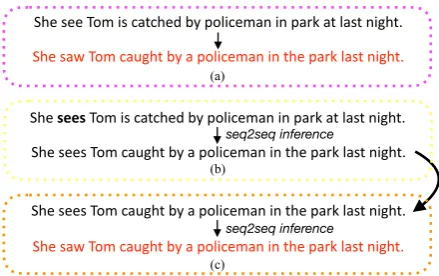
are trained with only limited error-corrected sen-tence pairs like Figure1(a). Limited by the size of training data, the models with millions of pa-rameters may not be well generalized. Thus, it is
She see Tom is catched by policeman in park at last night.
She saw Tom caught by a policeman in the park last night.
She sees Tom is catched by policeman in park at last night. She sees Tom caught by a policeman in the park last night.
She sees Tom caught by a policeman in the park last night.
She saw Tom caught by a policeman in the park last night. (a)
(b)
(c)
seq2seq inference
[image:1.595.311.531.223.361.2]seq2seq inference
Figure 1: (a) an error-corrected sentence pair; (b)if the sentence becomes slightly different, the model fails to correct it perfectly;(c)single-round seq2seq inference cannot perfectly correct the sen-tence, but multi-round inference can.
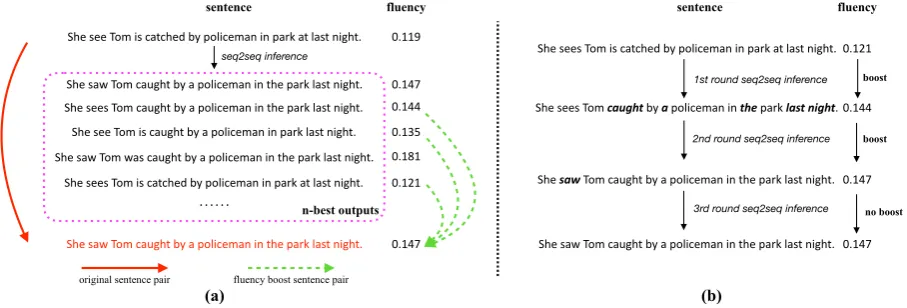
common that the models fail to correct a sentence perfectly even if the sentence is slightly different from the training instance, as illustrated by Figure 1(b). Second, the seq2seq models usually cannot perfectly correct a sentence with many grammati-cal errors through single-round seq2seq inference, as shown in Figure 1(b) and 1(c), because some errors in a sentence may make the context strange, which confuses the models to correct other errors. To address the above-mentioned limitations in model learning and inference, this paper proposes a novel fluency boost learning and inference mech-anism, illustrated in Figure2.
For fluency boosting learning, not only is a seq2seq model trained with original error-corrected sentence pairs, but also it generates less fluent sentences (e.g., from its n-best outputs) to establish new error-corrected sentence pairs by pairing them with their correct sentences during training, as long as the sentences’ fluency1 is
be-1A sentence’s fluency score is defined to be inversely
She see Tom is catched by policeman in park at last night.
She saw Tom caught by a policeman in the park last night.
She see Tom is caught by a policeman in park last night. She sees Tom caught by a policeman in the park last night. She saw Tom caught by a policeman in the park last night.
She saw Tom was caught by a policeman in the park last night. She sees Tom is catched by policeman in park at last night.
……
0.119
0.147 0.144 0.135 0.181 0.121
0.147 n-best outputs
original sentence pair fluency boost sentence pair
She sees Tom is catched by policeman in park at last night.
She sees Tom caught by a policeman in the park last night.
She saw Tom caught by a policeman in the park last night.
She saw Tom caught by a policeman in the park last night.
1st round seq2seq inference
2nd round seq2seq inference
3rd round seq2seq inference
0.121
0.144
0.147
0.147
boost
no boost
(a) (b)
boost
sentence fluency sentence fluency
[image:2.595.73.527.63.217.2]seq2seq inference
Figure 2: Fluency boost learning and inference:(a)given a training instance (i.e., an error-corrected sen-tence pair), fluency boost learning establishes multiple fluency boost sensen-tence pairs from the seq2seq’s n-best outputs during training. The fluency boost sentence pairs will be used as training instances in sub-sequent training epochs, which helps expand the training set and accordingly benefits model learning; (b)fluency boost inference allows an error correction model to correct a sentence incrementally through multi-round seq2seq inference until its fluency score stops increasing.
low that of their correct sentences, as Figure2(a) shows. Specifically, we call the generated error-corrected sentence pairs fluency boost sentence pairs because the sentence in the target side al-ways improves fluency over that in the source side. The generated fluency boost sentence pairs dur-ing traindur-ing will be used as additional traindur-ing in-stances during subsequent training epochs, allow-ing the error correction model to see more gram-matically incorrect sentences during training and accordingly improving its generalization ability.
For model inference, fluency boost inference mechanism allows the model to correct a sentence incrementally with multi-round inference as long as the proposed edits can boost the sentence’s flu-ency, as Figure 2(b) shows. For a sentence with multiple grammatical errors, some of the errors will be corrected first. The corrected parts will make the context clearer, which may benefit the model to correct the remaining errors.
Experiments demonstrate fluency boost learn-ing and inference enable neural seq2seq models to perform better for GEC and achieve state-of-the-art results on multiple GEC benchmarks.
Our contributions are summarized as follows:
• We present a novel learning and inference
mechanism to address the limitations in pre-vious seq2seq models for GEC.
• We propose and compare multiple novel
flu-ency boost learning strategies, exploring the learning methodology for neural GEC.
• Our approaches are proven to be effective
to improve neural seq2seq GEC models to achieve state-of-the-art results on CoNLL-2014 and JFLEG benchmark datasets.
2 Background: Neural grammatical
error correction
As neural machine translation (NMT), a typical neural GEC approach uses a Recurrent Neural Network (RNN) based encoder-decoder seq2seq model (Sutskever et al., 2014; Cho et al., 2014) with attention mechanism (Bahdanau et al.,2014) to edit a raw sentence into the grammatically cor-rect sentence it should be, as Figure1(a) shows.
Given a raw sentence xr = (xr1,· · ·, xrM)
and its corrected sentence xc = (xc
1,· · ·, xcN)
in which xrM and xcN are the M-th and N-th words of sentencexrandxcrespectively, the er-ror correction seq2seq model learns a probabilis-tic mapping P(xc|xr) from error-corrected sen-tence pairs through maximum likelihood estima-tion (MLE), which learns model parametersΘcrt to maximize the following equation:
Θ∗crt= arg max
Θcrt X
(xr,xc)∈S∗
logP(xc|xr
;Θcrt) (1)
where S∗ denotes the set of error-corrected sen-tence pairs.
For model inference, an output sequencexo = (xo1,· · · , xoi,· · · , xoL) is selected through beam search, which maximizes the following equation:
P(xo|xr) = L Y
i=1
P(xoi|x
r
xr
seq2seq error correction
xo1 xo2 xo3 xo4
xc 0.142
0.150 0.150 0.152 0.143 0.140 xc
seq2seq error generation
xo1 xo2 xo3 xo4
xc 0.150
0.150
0.141 0.151 0.153 0.144
(xo1, xc) (xo4,xc)
seq2seq
error correction (xo3, xc) (xo4,xc)
xr
seq2seq error correction
xo5 xo6 xo7 xo8
xc 0.142
0.150 0.150 0.152 0.143 0.140 xc
seq2seq error generation
xo1 xo2 xo3 xo4
xc 0.150
0.150
0.141 0.151 0.153 0.144
(xo1, xc) (xo4,xc) (xo7, xc) (xo8,xc)
[image:3.595.79.511.63.219.2](a) (b) (c)
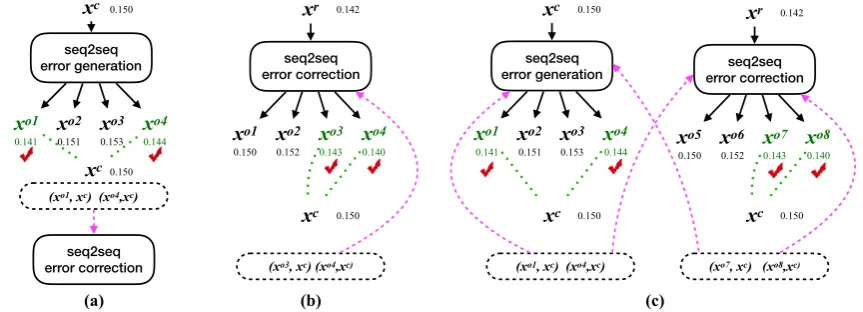
Figure 3: Three fluency boost learning strategies: (a) back-boost,(b)self-boost,(c) dual-boost; all of them generate fluency boost sentence pairs (the pairs in the dashed boxes) to help model learning during training. The numbers in this figure are fluency scores of their corresponding sentences.
3 Fluency boost learning
Conventional seq2seq models for GEC learns model parameters only from original
error-corrected sentence pairs. However, such
error-corrected sentence pairs are not sufficiently avail-able. As a result, many neural GEC models are not very well generalized.
Fortunately, neural GEC is different from NMT. For neural GEC, its goal is improving a sentence’s fluency2 without changing its original meaning; thus, any sentence pair that satisfies this condition (we call it fluency boost condition) can be used as a training instance.
In this paper, we define f(x) as the fluency score of a sentencex:
f(x) = 1
1 +H(x) (3)
H(x) =−
P|x|
i=1logP(xi|x<i)
|x| (4)
where P(xi|x<i) is the probability of xi given
contextx<i, computed by a language model, and
|x|is the length of sentence x. H(x) is actually the cross entropy of the sentencex, whose range is
[0,+∞). Accordingly, the range off(x)is(0,1]. The core idea of fluency boost learning is to generate fluency boost sentence pairs that satisfy the fluency boost condition during training, as Fig-ure2(a) illustrates, so that these pairs can further help model learning.
In this section, we present three fluency boost learning strategies: back-boost, self-boost, and
2Fluency of a sentence in this paper refers to how likely
the sentence is written by a native speaker. In other words, if a sentence is very likely to be written by a native speaker, it should be regarded highly fluent.
dual-boost that generate fluency boost sentence pairs in different ways, as illustrated in Figure3.
3.1 Back-boost learning
Back-boost learning borrows the idea from back translation (Sennrich et al.,2016) in NMT, refer-ring to training a backward model (we call it error generation model, as opposed to error correction model) that is used to convert a fluent sentence to a less fluent sentence with errors. Since the less flu-ent sflu-entences are generated by the error generation seq2seq model trained with error-corrected data, they usually do not change the original sentence’s meaning; thus, they can be paired with their cor-rect sentences, establishing fluency boost sentence pairs that can be used as training instances for er-ror correction models, as Figure3(a) shows.
Specifically, we first train a seq2seq error gener-ation modelΘgenwithSf∗which is identical toS∗ except that the source sentence and the target sen-tence are interchanged. Then, we use the model
Θgen to predict n-best outputs xo1,· · · , xon given a correct sentence xc. Given the fluency boost condition, we compare the fluency of each outputxok (where1 ≤ k ≤ n) to that of its
cor-rect sentencexc. If an output sentence’s fluency score is much lower than its correct sentence, we call ita disfluency candidateofxc.
To formalize this process, we first define
Yn(x;Θ) to denote the n-best outputs predicted by modelΘgiven the inputx. Then, disfluency candidates of a correct sentencexccan be derived:
Dback(xc) ={xok|xok∈ Yn(xc;Θgen)∧ f(xc)
f(xok) ≥σ}
Algorithm 1Back-boost learning
1: Train error generation modelΘgenwithSf∗;
2: foreach sentence pair(xr,xc)∈ Sdo 3: ComputeDback(xc)according to Eq (5);
4: end for
5: foreach training epochtdo 6: S0← ∅
;
7: Derive a subsetSt by randomly sampling|S∗|
ele-ments fromS;
8: foreach(xr,xc)∈ S
tdo
9: Establish a fluency boost pair(x0,xc)
by ran-domly samplingx0∈ Dback(xc);
10: S0← S0∪ {(x0,xc)}
; 11: end for
12: Update error correction modelΘcrtwithS∗∪ S0;
13: end for
whereDback(xc)denotes the disfluency candidate set for xc in back-boost learning. σ is a thresh-old to determine ifxokis less fluent thanxcand it
should be slightly larger3than1.0, which helps fil-ter out sentence pairs with unnecessary edits (e.g., I like this book.→I like the book.).
In the subsequent training epochs, the error cor-rection model will not only learn from the original error-corrected sentence pairs (xr,xc), but also learn from fluency boost sentence pairs (xok,xc)
wherexok is a sample ofD
back(xc).
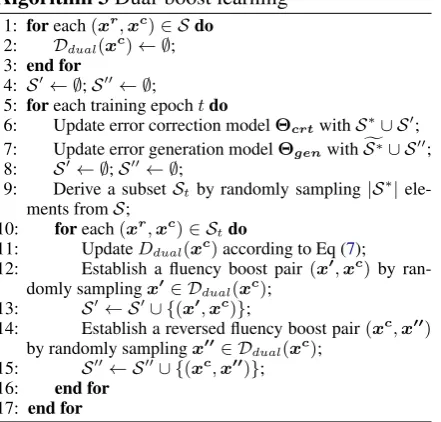
We summarize this process in Algorithm 1
whereS∗is the set of original error-corrected sen-tence pairs, and S can be tentatively considered identical toS∗ when there is no additional native data to help model training (see Section3.4). Note that we constrain the size ofStnot to exceed|S∗|
(the 7th line in Algorithm1) to avoid that too many fluency boost pairs overwhelm the effects of the original error-corrected pairs on model learning.
3.2 Self-boost learning
In contrast to back-boost learning whose core idea is originally from NMT, self-boost learning is original, which is specially devised for neu-ral GEC. The idea of self-boost learning is il-lustrated by Figure 3(b) and was already briefly
introduced in Section 1 and Figure 2(a).
Un-like back-boost learning in which an error gen-eration seq2seq model is trained to generate dis-fluency candidates, self-boost learning allows the error correction model to generate the candidates by itself. Since the disfluency candidates gener-ated by the error correction seq2seq model trained with error-corrected data rarely change the input
3In this paper, we setσ = 1.05since the corrected
tence in our training data improves its corresponding raw sen-tence about 5% fluency on average.
Algorithm 2Self-boost learning
1: foreach sentence pair(xr,xc)∈ Sdo 2: Dself(xc)← ∅;
3: end for 4: S0← ∅
5: foreach training epochtdo
6: Update error correction modelΘcrtwithS∗∪ S0;
7: S0← ∅
8: Derive a subsetSt by randomly sampling|S∗|
ele-ments fromS;
9: foreach(xr,xc)∈ Stdo
10: UpdateDself(xc)according to Eq (6);
11: Establish a fluency boost pair(x0,xc) by ran-domly samplingx0∈ Dself(xc);
12: S0← S0∪ {
(x0,xc)}; 13: end for
14: end for
sentence’s meaning; thus, they can be used to es-tablish fluency boost sentence pairs.
For self-boost learning, given an error corrected pair(xr,xc), an error correction modelΘcrtfirst predictsn-best outputsxo1,· · ·,xon for the raw
sentencexr. Among then-best outputs, any out-put that is not identical toxccan be considered as an error prediction. Instead of treating the error predictions useless, self-boost learning fully ex-ploits them. Specifically, if an error predictionxok
is much less fluent than that of its correct sentence
xc, it will be added to xc’s disfluency candidate setDself(xc), as Eq (6) shows:
Dself(xc) =Dself(xc)∪
{xok|xok∈ Y
n(xr;Θcrt)∧ f(xc) f(xok) ≥σ}
(6)
In contrast to back-boost learning, self-boost generates disfluency candidates from a different perspective – by editing the raw sentencexrrather than the correct sentence xc. It is also notewor-thy thatDself(xc) is incrementally expanded be-cause the error correction modelΘcrtis dynami-cally updated, as shown in Algorithm2.
3.3 Dual-boost learning
Algorithm 3Dual-boost learning
1: foreach(xr,xc)∈ Sdo 2: Ddual(xc)← ∅;
3: end for
4: S0← ∅;S00← ∅;
5: foreach training epochtdo
6: Update error correction modelΘcrtwithS∗∪ S0;
7: Update error generation modelΘgenwithSf∗∪ S 00
; 8: S0← ∅
;S00← ∅
;
9: Derive a subsetSt by randomly sampling|S∗|
ele-ments fromS;
10: foreach(xr,xc)∈ Stdo
11: UpdateDdual(xc)according to Eq (7);
12: Establish a fluency boost pair (x0,xc) by ran-domly samplingx0∈ Ddual(xc);
13: S0← S0∪ {
(x0,xc)};
14: Establish a reversed fluency boost pair(xc,x00)
by randomly samplingx00∈ Ddual(xc);
15: S00← S00∪ {(xc,x00)}; 16: end for
17: end for
As Figure3(c) shows, disfluency candidates in dual-boost learning are from both the error gener-ation model and the error correction model :
Ddual(xc) =Ddual(xc)∪
{xok|xok ∈ Y
n(xr;Θcrt)∪ Yn(xc;Θgen)∧ f(xc) f(xok) ≥σ}
(7)
Moreover, the error correction model and the er-ror generation model are dual and both of them are dynamically updated, which improves each other: the disfluency candidates produced by er-ror generation model can benefit training the erer-ror correction model, while the disfluency candidates created by error correction model can be used as training data for the error generation model. We summarize this learning approach in Algorithm3.
3.4 Fluency boost learning with large-scale native data
Our proposed fluency boost learning strategies can be easily extended to utilize the huge volume of native data which is proven to be useful for GEC.
As discussed in Section 3.1, when there is no additional native data,Sin Algorithm1–3is iden-tical toS∗. In the case where additional native data
is available to help model learning,S becomes:
S =S∗∪ C
where C = {(xc,xc)} denotes the set of self-copied sentence pairs from native data.
4 Fluency boost inference
As we discuss in Section 1, some sentences with multiple grammatical errors usually cannot be per-fectly corrected through normal seq2seq inference
Corpus #sent pair
Lang-8 1,114,139
CLC 1,366,075
NUCLE 57,119
[image:5.595.361.469.61.133.2]Total 2,537,333
Table 1: Error-corrected training data.
which does only single-round inference. Fortu-nately, neural GEC is different from NMT: its source and target language are the same. The char-acteristic allows us to edit a sentence more than once through multi-round model inference, which motivates our fluency boost inference. As Fig-ure 2(b) shows, fluency boost inference allows a sentence to be incrementally edited through multi-round seq2seq inference as long as the sentence’s fluency can be improved. Specifically, an error correction seq2seq model first takes a raw sen-tencexras an input and outputs a hypothesisxo1.
Instead of regarding xo1 as the final prediction,
fluency boost inference will then takexo1 as the
input to generate the next output xo2. The
pro-cess will not terminate unless xot does not
im-provexot−1in terms of fluency.
5 Experiments
5.1 Dataset and evaluation
As previous studies (Ji et al., 2017), we use the public Lang-8 Corpus (Mizumoto et al., 2011; Tajiri et al., 2012), Cambridge Learner
Cor-pus (CLC) (Nicholls, 2003) and NUS Corpus
of Learner English (NUCLE) (Dahlmeier et al., 2013) as our original error-corrected training data. Table 1 shows the stats of the datasets. In addi-tion, we also collect 2,865,639 non-public error-corrected sentence pairs from Lang-8.com. The native data we use for fluency boost learning is English Wikipedia that contains 61,677,453 sen-tences.
We use CoNLL-2014 shared task dataset with original annotations (Ng et al.,2014), which con-tains 1,312 sentences, as our main test set for eval-uation. We use MaxMatch (M2) precision, recall andF0.5(Dahlmeier and Ng,2012b) as our evalua-tion metrics. As previous studies, we use CoNLL-2013 test data as our development set.
5.2 Experimental setting
[image:5.595.74.295.71.282.2]Model seq2seq fluency boost seq2seq (+LM) fluency boost (+LM)
P R F0.5 P R F0.5 P R F0.5 P R F0.5
[image:6.595.76.522.62.179.2]normal seq2seq 61.06 18.49 41.81 61.56 18.85 42.37 61.75 23.30 46.42 61.94 23.70 46.83 back-boost 61.66 19.54 43.09 61.43 19.61 43.07 61.47 24.74 47.40 61.24 25.01 47.48 self-boost 61.64 19.83 43.35 61.50 19.90 43.36 62.13 24.45 47.49 61.67 24.76 47.51 dual-boost 62.03 20.82 44.44 61.64 21.19 44.61 62.22 25.49 48.30 61.64 26.45 48.69 back-boost (+native) 63.93 22.03 46.31 63.95 22.12 46.40 62.04 27.43 49.54 61.98 27.70 49.68 self-boost (+native) 64.33 22.10 46.54 64.14 22.19 46.54 62.18 27.59 49.71 61.64 28.37 49.93 dual-boost (+native) 65.77 21.92 46.98 65.82 22.14 47.19 62.64 27.40 49.83 62.70 27.69 50.04 back-boost (+native)? 67.37 24.31 49.75 67.25 24.35 49.73 64.61 28.44 51.51 64.46 28.78 51.66 self-boost (+native)? 66.52 25.13 50.03 66.78 25.33 50.31 63.82 30.15 52.17 63.34 31.63 52.21 dual-boost (+native)? 66.34 25.39 50.16 66.45 25.51 50.30 64.72 30.06 52.59 64.47 30.48 52.72
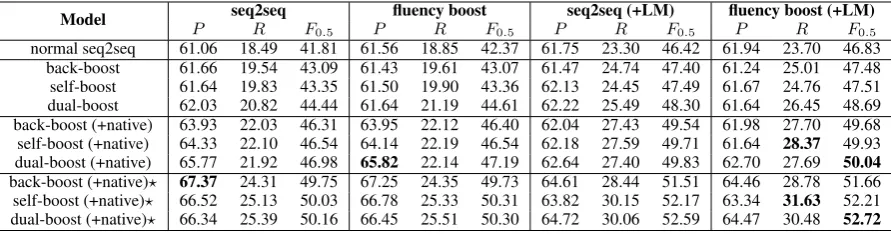
Table 2: Performance of seq2seq for GEC with different learning (row) and inference (column) meth-ods on CoNLL-2014 dataset. (+LM) denotes decoding with the RNN language model through shallow fusion. The last 3 systems (with?) use the additional non-public Lang-8 data for training.
• Whether is fluency boost learning mechanism
helpful for training the error correction model, and which of the strategies (back-boost, self-boost, dual-boost) is the most effective?
• Whether does our fluency boost inference
im-prove normal seq2seq inference for GEC?
• Whether can our approach improve neural
GEC to achieve state-of-the-art results?
The training details for our seq2seq error cor-rection model and error generation model are as follows: the encoder of the seq2seq models is a 2-layer bidirectional GRU RNN and the decoder is a 2-layer GRU RNN with the general attention mechanism (Luong et al.,2015). Both the dimen-sionality of word embeddings and the hidden size of GRU cells are 500. The vocabulary sizes of the encoder and decoder are 100,000 and 50,000 re-spectively. The models’ parameters are uniformly initialized in [-0.1,0.1]. We train the models with an Adam optimizer with a learning rate of 0.0001 up to 40 epochs with batch size= 128. Dropout is applied to non-recurrent connections at a ratio of 0.15. For fluency boost learning, we generate dis-fluency candidates from 10-best outputs. During model inference, we set beam size to 5 and decode 1-best result with a 2-layer GRU RNN language model (Mikolov et al.,2010) through shallow fu-sion (G¨ulc¸ehre et al.,2015) with weightβ = 0.15. The RNN language model is trained from the na-tive data mentioned in Section5.1, which is also used for computing fluency score in Eq (3). UNK tokens are replaced with the source token with the highest attention weight.
We resolve spelling errors with a public spell checker4as preprocessing, asXie et al.(2016) and Sakaguchi et al.(2017) do.
4
https://azure.microsoft.com/en-us/services/cognitive-services/spell-check/
5.3 Experimental results
5.3.1 Effectiveness of fluency boost learning
Table2compares the performance of seq2seq er-ror correction models with different learning and inference methods. By comparing by row, one can observe that our fluency boost learning approaches improve the performance over normal seq2seq learning, especially on the recall metric, since the fluency boost learning approaches generate a va-riety of grammatically incorrect sentences, allow-ing the error correction model to learn to correct much more sentences than the conventional learn-ing strategy. Among the proposed three fluency boost learning strategies, dual-boost achieves the best result in most cases because it produces more diverse incorrect sentences (average |Ddual| ≈
9.43) than either back-boost (avg|Dback| ≈ 1.90)
or self-boost learning (avg|Dself| ≈8.10). With introducing large amounts of native text data, the performance of all the fluency boost learning ap-proaches gets improved. One reason is that our learning approaches produce more error-corrected sentence pairs to let the model be better general-ized. In addition, the huge volume of native data benefits the decoder to learn better to generate a fluent and error-free sentence.
We test the effect of hyper-parameter σ in Eq (5–7) on fluency boost learning and show the re-sult in Table3. Whenσ is slightly larger than 1.0 (e.g.,σ = 1.05), the model achieves the best per-formance because it effectively avoids generating sentence pairs with unnecessary or undesirable ed-its that affect the performance, as we discussed in Section3.1. Whenσcontinues increasing, the dis-fluency candidate set|Ddual|drastically decreases, making the dual-boost learning gradually degrade to normal seq2seq learning.
σ 0 0.95 1.0 1.05 1.1 2.0
|Ddual| 41.18 39.21 29.40 9.43 3.87 0.01
[image:7.595.308.526.60.279.2]F0.5 43.20 43.30 43.39 44.44 43.30 41.78
Table 3: The effect of σ on dual-boost learning with normal seq2seq inference. |Ddual|is the
av-erage size of dual-boost disfluency candidate sets.
Correct sentence How autism occurs is not well understood.
Disfluency candidates
How autism occurs is not good understood. How autism occur is not well understood. What autism occurs is not well understood. How autism occurs is not well understand. How autism occurs does not well understood.
Table 4: Examples of disfluency candidates for a correct sentence in dual-boost learning.
candidates5generated in dual-boost learning given a correct sentence in the native data. It is clear that our approach can generate less fluent sentences with various grammatical errors and most of them are typical mistakes that a human learner tends to make. Therefore, they can be used to establish high-quality training data with their correct sen-tence, which will be helpful for increasing the size of training data to numbers of times, accounting for the improvement by fluency boost learning.
5.3.2 Effectiveness of fluency boost inference The effectiveness of various inference approaches can be observed by comparing the results in Table
2 by column. Compared to the normal seq2seq
inference and seq2seq (+LM) baselines, fluency boost inference brings about on average 0.14 and 0.18 gain on F0.5 respectively, which is a
signif-icant6 improvement, demonstrating multi-round
edits by fluency boost inference is effective. Take our best system (the last row in Table
2) as an example, among 1,312 sentences in
the CoNLL-2014 dataset, seq2seq inference with shallow fusion LM edits 566 sentences. In con-trast, fluency boost inference additionally edits 23 sentences during the second round inference, im-provingF0.5from 52.59 to 52.72.
5.3.3 Towards the state-of-the-art for GEC
Now, we answer the last question raised in Section 5.2by testing if our approaches achieve the state-of-the-art result.
We first compare our best models – dual-boost learning (+native) with fluency boost inference and shallow fusion LM – to top-performing GEC systems evaluated on CoNLL-2014 dataset:
5
We give more details about disfluency candidates, in-cluding error type proportion, in the supplementary notes.
6p <0.0005according to Wilcoxon Signed-Rank Test.
System P R F0.5
Spell check 53.01 8.16 25.25
CAMB14 39.71 30.10 37.33
CAMB16SMT 45.39 21.82 37.33
CAMB16NMT - - 39.90
CAMB17 (CAMB16SMTbased) 51.09 25.30 42.44
CAMB17 (AMU16 based) 59.88 32.16 51.08
AMU14 41.62 21.40 35.01
AMU16 61.27 27.98 49.49
AMU16? 63.52 30.49 52.21
CUUI 41.78 24.88 36.79
VT16? 60.17 25.64 47.40
NUS14 53.55 19.14 39.39
NUS16 - - 44.27
NUS17 62.74 32.96 53.14
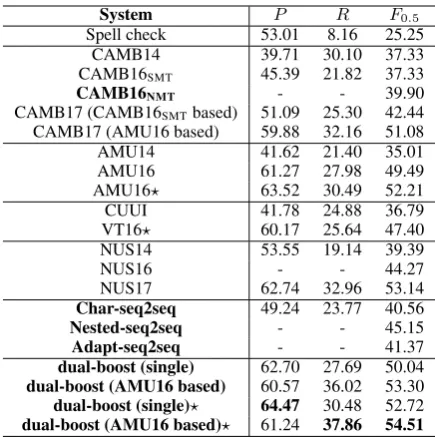
[image:7.595.76.287.62.91.2]Char-seq2seq 49.24 23.77 40.56 Nested-seq2seq - - 45.15 Adapt-seq2seq - - 41.37 dual-boost (single) 62.70 27.69 50.04 dual-boost (AMU16 based) 60.57 36.02 53.30 dual-boost (single)? 64.47 30.48 52.72 dual-boost (AMU16 based)? 61.24 37.86 54.51
Table 5: Performance of systems on CoNLL-2014 dataset. The system with bold fonts are based on
seq2seq models. ? denotes the system uses the
non-public error-corrected data from Lang-8.com.
• CAMB14, CAMB16SMT, CAMB16NMT and
CAMB17: GEC systems (Felice et al., 2014;
Yuan et al., 2016; Yuan and Briscoe, 2016; Yannakoudakis et al., 2017) developed by Cambridge University.
• AMU14 and AMU16: SMT-based GEC
sys-tems (Junczys-Dowmunt and Grundkiewicz,
2014,2016) developed by AMU.
• CUUI and VT16: the former system (
Ro-zovskaya et al., 2014) uses a classifier-based approach, which is improved by the latter
sys-tem (Rozovskaya and Roth, 2016) through
combining with an SMT-based approach.
• NUS14, NUS16 and NUS17: GEC systems
(Susanto et al.,2014;Chollampatt et al.,2016a; Chollampatt and Ng,2017) that combine SMT with other techniques (e.g., classifiers).
• Char-seq2seq: a character-level seq2seq model (Xie et al.,2016). It uses a rule-based method to synthesize errors for data augmentation.
• Nested-seq2seq: a nested attention neural hy-brid seq2seq model (Ji et al.,2017).
• Adapt-seq2seq: a seq2seq model adapted to
incorporate edit operations (Schmaltz et al., 2017).
Table 5 shows the evaluation results on the
CoNLL-2014 dataset. Without using the
sin-gle model obtains 50.04F0.5, larlgely outperform-ing the other seq2seq models and only inferior to CAMB17 (AMU16 based) and NUS17. It should be noted, however, that the CAMB17 and NUS17 are actually re-rankers built on top of an SMT-based GEC system (AMU16’s framework); thus, they are ensemble models. When we build our ap-proach on top of AMU16 (i.e., we take AMU16’s outputs as the input to our GEC system to edit on top of its outputs), we achieve 53.30 F0.5 score. With introducing the non-public training data, our single and ensemble system obtain 52.72 and 54.51F0.5score respectively, which is a state-of-the-art result7on CoNLL-2014 dataset.
Moreover, we evaluate our approach on JFLEG corpus (Napoles et al.,2017). JFLEG is the latest released dataset for GEC evaluation and it contains 1,501 sentences (754 in dev set and 747 in test set). To test our approach’s generalization ability, we evaluate our single models used for CoNLL eval-uation (in Table5) on JFLEG without re-tuning.
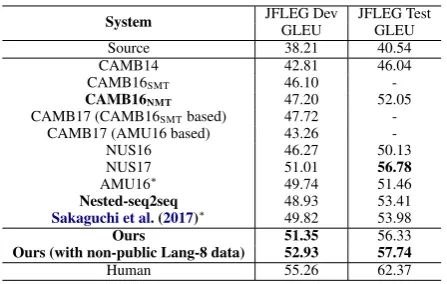
Table6shows the JFLEG leaderboard. Instead
of M2 score, JFLEG uses GLEU (Napoles et al., 2015) as its evaluation metric, which is a fluency-oriented GEC metric based on a variant of BLEU (Papineni et al.,2002) and has several advantages over M2 for GEC evaluation. It is observed that our single models consistently perform well on JFLEG, outperforming most of the CoNLL-2014 top-performing systems and yielding a state-of-the-art result8 on this benchmark, demonstrating that our models are well generalized and perform stably on multiple datasets.
6 Related work
Most of advanced GEC systems are classifier-based (Chodorow et al.,2007;De Felice and Pul-man,2008;Han et al.,2010;Leacock et al.,2010; Tetreault et al.,2010a;Dale and Kilgarriff,2011)
7
The state-of-the-art result on CoNLL-2014 dataset has been recently advanced by Chollampatt and Ng (2018) (F0.5=54.79) and Grundkiewicz and Junczys-Dowmunt
(2018) (F0.5=56.25), which are contemporaneous to this
pa-per. In contrast to the basic seq2seq model in this paper, they used advanced approaches for modeling (e.g., convolutional seq2seq with pre-trained word embedding, using edit opera-tion features, ensemble decoding and advanced model combi-nations). It should be noted that their approaches are orthog-onal to ours, making it possible to apply our fluency boost learning and inference mechanism to their models.
8The recently proposed SMT-NMT hybrid system
(Grundkiewicz and Junczys-Dowmunt,2018), which is tuned towards GLEU on JFLEG Dev set, reports a higher result (GLEU=61.50 on JFLEG test set).
System JFLEG Dev JFLEG Test
GLEU GLEU
Source 38.21 40.54
CAMB14 42.81 46.04
CAMB16SMT 46.10
-CAMB16NMT 47.20 52.05
CAMB17 (CAMB16SMTbased) 47.72
-CAMB17 (AMU16 based) 43.26
-NUS16 46.27 50.13
NUS17 51.01 56.78
AMU16∗ 49.74 51.46
Nested-seq2seq 48.93 53.41
Sakaguchi et al.(2017)∗ 49.82 53.98
Ours 51.35 56.33
Ours (with non-public Lang-8 data) 52.93 57.74
[image:8.595.308.532.60.202.2]Human 55.26 62.37
Table 6: JFLEG Leaderboard. Ours denote the single dual-boost models in Table5. The systems
with bold fonts are based on seq2seq models. ∗
denotes the system is tuned on JFLEG.
or MT-based (Brockett et al., 2006; Dahlmeier and Ng, 2011, 2012a; Yoshimoto et al., 2013; Yuan and Felice,2013;Behera and Bhattacharyya, 2013). For example, top-performing systems ( Fe-lice et al.,2014;Rozovskaya et al.,2014;
Junczys-Dowmunt and Grundkiewicz, 2014) in
CoNLL-2014 shared task (Ng et al.,2014) use either of the
methods. Recently, many novel approaches (
Su-santo et al.,2014;Chollampatt et al.,2016b,a; Ro-zovskaya and Roth,2016;Junczys-Dowmunt and Grundkiewicz, 2016;Mizumoto and Matsumoto, 2016;Yuan et al.,2016;Hoang et al.,2016; Yan-nakoudakis et al., 2017) have been proposed for
GEC. Among them, seq2seq models (Yuan and
Briscoe,2016;Xie et al.,2016;Ji et al.,2017; Sak-aguchi et al., 2017;Schmaltz et al., 2017; Chol-lampatt and Ng, 2018) have caught much atten-tion. Unlike the models trained only with origi-nal error-corrected data, we propose a novel flu-ency boost learning mechanism for dynamic data augmentation along with training for GEC, despite some previous studies that explore artificial error generation for GEC (Brockett et al.,2006;Foster and Andersen,2009;Rozovskaya and Roth,2010, 2011;Rozovskaya et al., 2012; Felice and Yuan, 2014;Xie et al., 2016;Rei et al., 2017). More-over, we propose fluency boost inference which allows the model to repeatedly edit a sentence as long as the sentence’s fluency can be improved. To the best of our knowledge, it is the first to conduct multi-round seq2seq inference for GEC, while similar ideas have been proposed for NMT (Xia et al.,2017).
(Leacock et al., 2010; Rei and Yannakoudakis, 2016; Kaneko et al., 2017) and GEC evaluation (Tetreault et al., 2010b; Madnani et al., 2011; Dahlmeier and Ng, 2012c; Napoles et al., 2015; Sakaguchi et al., 2016; Napoles et al., 2016; Bryant et al., 2017; Asano et al., 2017). We do not introduce them in detail because they are not much related to this paper’s contributions.
7 Conclusion
We propose a novel fluency boost learning and inference mechanism to overcome the limitations of previous neural GEC models. Our proposed fluency boost learning fully exploits both error-corrected data and native data, largely improv-ing the performance over normal seq2seq learn-ing, while fluency boost inference utilizes the characteristic of GEC to incrementally improve a sentence’s fluency through multi-round inference. The powerful learning and inference mechanism enables the seq2seq models to achieve state-of-the-art results on both CoNLL-2014 and JFLEG benchmark datasets.
Acknowledgments
We thank all the anonymous reviewers for their professional and constructive comments. We also thank Shujie Liu for his insightful discussions and suggestions.
References
Hiroki Asano, Tomoya Mizumoto, and Kentaro Inui. 2017. Reference-based metrics can be replaced with reference-less metrics in evaluating grammatical er-ror correction systems. InIJCNLP.
Dzmitry Bahdanau, Kyunghyun Cho, and Yoshua Bengio. 2014. Neural machine translation by jointly learning to align and translate. CoRR, abs/1409.0473.
Bibek Behera and Pushpak Bhattacharyya. 2013. Automated grammar correction using hierarchical phrase-based statistical machine translation. In IJC-NLP.
Chris Brockett, William B Dolan, and Michael Gamon. 2006. Correcting esl errors using phrasal smt tech-niques. InCOLING/ACL.
Christopher Bryant, Mariano Felice, and E Briscoe. 2017. Automatic annotation and evaluation of error types for grammatical error correction. InACL.
Kyunghyun Cho, Bart van Merrienboer, Caglar Gul-cehre, Dzmitry Bahdanau, Fethi Bougares, Holger Schwenk, and Yoshua Bengio. 2014. Learning phrase representations using rnn encoder–decoder for statistical machine translation. InEMNLP.
Martin Chodorow, Joel R Tetreault, and Na-Rae Han. 2007. Detection of grammatical errors involving prepositions. InACL-SIGSEM workshop on prepo-sitions.
Shamil Chollampatt, Duc Tam Hoang, and Hwee Tou Ng. 2016a. Adapting grammatical error correction based on the native language of writers with neural network joint models. InEMNLP.
Shamil Chollampatt and Hwee Tou Ng. 2017. Con-necting the dots: Towards human-level grammatical error correction. InWorkshop on Innovative Use of NLP for Building Educational Applications.
Shamil Chollampatt and Hwee Tou Ng. 2018. A multi-layer convolutional encoder-decoder neural network for grammatical error correction. arXiv preprint arXiv:1801.08831.
Shamil Chollampatt, Kaveh Taghipour, and Hwee Tou Ng. 2016b. Neural network translation models for grammatical error correction. arXiv preprint arXiv:1606.00189.
Daniel Dahlmeier and Hwee Tou Ng. 2011. Correcting semantic collocation errors with l1-induced para-phrases. InEMNLP.
Daniel Dahlmeier and Hwee Tou Ng. 2012a. A beam-search decoder for grammatical error correction. In
EMNLP/CoNLL.
Daniel Dahlmeier and Hwee Tou Ng. 2012b. Bet-ter evaluation for grammatical error correction. In
NAACL.
Daniel Dahlmeier and Hwee Tou Ng. 2012c. Bet-ter evaluation for grammatical error correction. In
NAACL.
Daniel Dahlmeier, Hwee Tou Ng, and Siew Mei Wu. 2013. Building a large annotated corpus of learner english: The nus corpus of learner english. In Work-shop on innovative use of NLP for building educa-tional applications.
Robert Dale and Adam Kilgarriff. 2011. Helping our own: The hoo 2011 pilot shared task. InEuropean Workshop on Natural Language Generation.
Rachele De Felice and Stephen G Pulman. 2008. A classifier-based approach to preposition and deter-miner error correction in l2 english. InCOLING.
Mariano Felice and Zheng Yuan. 2014. Generating ar-tificial errors for grammatical error correction. In
Mariano Felice, Zheng Yuan, Øistein E Andersen, He-len Yannakoudakis, and Ekaterina Kochmar. 2014. Grammatical error correction using hybrid systems and type filtering. InCoNLL (Shared Task).
Jennifer Foster and Øistein E Andersen. 2009. Gen-errate: generating errors for use in grammatical er-ror detection. InWorkshop on innovative use of nlp for building educational applications.
Roman Grundkiewicz and Marcin Junczys-Dowmunt. 2018. Near human-level performance in grammati-cal error correction with hybrid machine translation.
arXiv preprint arXiv:1804.05945.
C¸ aglar G¨ulc¸ehre, Orhan Firat, Kelvin Xu, Kyunghyun Cho, Lo¨ıc Barrault, Huei-Chi Lin, Fethi Bougares, Holger Schwenk, and Yoshua Bengio. 2015. On us-ing monolus-ingual corpora in neural machine transla-tion.CoRR, abs/1503.03535.
Na-Rae Han, Joel R Tetreault, Soo-Hwa Lee, and Jin-Young Ha. 2010. Using an error-annotated learner corpus to develop an esl/efl error correction system. InLREC.
Di He, Yingce Xia, Tao Qin, Liwei Wang, Nenghai Yu, Tieyan Liu, and Wei-Ying Ma. 2016. Dual learning for machine translation. InNIPS.
Duc Tam Hoang, Shamil Chollampatt, and Hwee Tou Ng. 2016. Exploiting n-best hypotheses to improve an smt approach to grammatical error correction. In
IJCAI.
Jianshu Ji, Qinlong Wang, Kristina Toutanova, Yongen Gong, Steven Truong, and Jianfeng Gao. 2017. A nested attention neural hybrid model for grammati-cal error correction. InACL.
Marcin Junczys-Dowmunt and Roman Grundkiewicz. 2014. The amu system in the conll-2014 shared task: Grammatical error correction by data-intensive and feature-rich statistical machine translation. In
CoNLL (Shared Task).
Marcin Junczys-Dowmunt and Roman Grundkiewicz. 2016. Phrase-based machine translation is state-of-the-art for automatic grammatical error correction.
arXiv preprint arXiv:1605.06353.
Masahiro Kaneko, Yuya Sakaizawa, and Mamoru Ko-machi. 2017. Grammatical error detection us-ing error-and grammaticality-specific word embed-dings. InIJCNLP.
Claudia Leacock, Martin Chodorow, Michael Gamon, and Joel Tetreault. 2010. Automated grammatical error detection for language learners. Synthesis lec-tures on human language technologies, 3(1):1–134.
Thang Luong, Hieu Pham, and Christopher D. Man-ning. 2015. Effective approaches to attention-based neural machine translation. InEMNLP.
Nitin Madnani, Joel Tetreault, Martin Chodorow, and Alla Rozovskaya. 2011. They can help: Using crowdsourcing to improve the evaluation of gram-matical error detection systems. InACL.
Tomas Mikolov, Martin Karafit, Lukas Burget, Jan Cer-nock, and Sanjeev Khudanpur. 2010. Recurrent neural network based language model. In INTER-SPEECH.
Tomoya Mizumoto, Mamoru Komachi, Masaaki Na-gata, and Yuji Matsumoto. 2011. Mining revision log of language learning sns for automated japanese error correction of second language learners. In IJC-NLP.
Tomoya Mizumoto and Yuji Matsumoto. 2016. Dis-criminative reranking for grammatical error correc-tion with statistical machine translacorrec-tion. InNAACL.
Courtney Napoles, Keisuke Sakaguchi, Matt Post, and Joel Tetreault. 2015. Ground truth for grammatical error correction metrics. InACL/IJCNLP.
Courtney Napoles, Keisuke Sakaguchi, and Joel Tetreault. 2016. There’s no comparison: Reference-less evaluation metrics in grammatical error correc-tion. InEMNLP.
Courtney Napoles, Keisuke Sakaguchi, and Joel Tetreault. 2017. Jfleg: A fluency corpus and benchmark for grammatical error correction. arXiv preprint arXiv:1702.04066.
Hwee Tou Ng, Siew Mei Wu, Ted Briscoe, Christian Hadiwinoto, Raymond Hendy Susanto, and Christo-pher Bryant. 2014. The conll-2014 shared task on grammatical error correction. In CoNLL (Shared Task).
Diane Nicholls. 2003. The cambridge learner corpus: Error coding and analysis for lexicography and elt. InCorpus Linguistics 2003 conference.
Kishore Papineni, Salim Roukos, Todd Ward, and Wei-Jing Zhu. 2002. Bleu: a method for automatic eval-uation of machine translation. InACL.
Marek Rei, Mariano Felice, Zheng Yuan, and Ted Briscoe. 2017. Artificial error generation with machine translation and syntactic patterns. arXiv preprint arXiv:1707.05236.
Marek Rei and Helen Yannakoudakis. 2016. Composi-tional sequence labeling models for error detection in learner writing. InACL.
Alla Rozovskaya, Kai-Wei Chang, Mark Sammons, Dan Roth, and Nizar Habash. 2014. The illinois-columbia system in the conll-2014 shared task. In
CoNLL (Shared Task).
Alla Rozovskaya and Dan Roth. 2011. Algorithm se-lection and model adaptation for esl correction tasks. InACL.
Alla Rozovskaya and Dan Roth. 2016. Grammatical error correction: Machine translation and classifiers. InACL.
Alla Rozovskaya, Mark Sammons, and Roth Dan. 2012. The ui system in the hoo 2012 shared task on error correction. InWorkshop on Building Edu-cational Applications Using NLP.
Keisuke Sakaguchi, Courtney Napoles, Matt Post, and Joel Tetreault. 2016. Reassessing the goals of matical error correction: Fluency instead of gram-maticality. Transactions of the Association of Com-putational Linguistics, 4(1):169–182.
Keisuke Sakaguchi, Matt Post, and Benjamin Van Durme. 2017. Grammatical error correction with neural reinforcement learning. InIJCNLP.
Allen Schmaltz, Yoon Kim, Alexander Rush, and Stu-art Shieber. 2017. Adapting sequence models for sentence correction. InEMNLP.
Rico Sennrich, Barry Haddow, and Alexandra Birch. 2016. Improving neural machine translation models with monolingual data. InACL.
Raymond Hendy Susanto, Peter Phandi, and Hwee Tou Ng. 2014. System combination for grammatical er-ror correction. InEMNLP.
Ilya Sutskever, Oriol Vinyals, and Quoc V. Le. 2014.
Sequence to sequence learning with neural net-works.CoRR, abs/1409.3215.
Toshikazu Tajiri, Mamoru Komachi, and Yuji Mat-sumoto. 2012. Tense and aspect error correction for esl learners using global context. InACL.
Joel Tetreault, Jennifer Foster, and Martin Chodorow. 2010a. Using parse features for preposition selec-tion and error detecselec-tion. InACL.
Joel R Tetreault, Elena Filatova, and Martin Chodorow. 2010b. Rethinking grammatical error annotation and evaluation with the amazon mechanical turk. In
Workshop on Innovative Use of NLP for Building Educational Applications.
Yingce Xia, Fei Tian, Lijun Wu, Jianxin Lin, Tao Qin, Nenghai Yu, and Tie-Yan Liu. 2017. Deliberation networks: Sequence generation beyond one-pass de-coding. InNIPS.
Ziang Xie, Anand Avati, Naveen Arivazhagan, Dan Ju-rafsky, and Andrew Y Ng. 2016. Neural language correction with character-based attention. arXiv preprint arXiv:1603.09727.
Helen Yannakoudakis, Marek Rei, Øistein E Ander-sen, and Zheng Yuan. 2017. Neural sequence-labelling models for grammatical error correction. InEMNLP.
Ippei Yoshimoto, Tomoya Kose, Kensuke Mitsuzawa, Keisuke Sakaguchi, Tomoya Mizumoto, Yuta Hayashibe, Mamoru Komachi, and Yuji Matsumoto. 2013. Naist at 2013 conll grammatical error correc-tion shared task. InCoNLL (Shared Task).
Zheng Yuan and Ted Briscoe. 2016. Grammatical er-ror correction using neural machine translation. In
NAACL.
Zheng Yuan, Ted Briscoe, Mariano Felice, Zheng Yuan, Ted Briscoe, and Mariano Felice. 2016. Can-didate re-ranking for smt-based grammatical error correction. InWorkshop on Innovative Use of NLP for Building Educational Applications.
Zheng Yuan and Mariano Felice. 2013. Constrained grammatical error correction using statistical ma-chine translation. InCoNLL (Shared Task).