2137
Robust Distant Supervision Relation Extraction via Deep Reinforcement
Learning
Pengda Qin], Weiran Xu], William Yang Wang[ ]Beijing University of Posts and Telecommunications, China
[University of California, Santa Barbara, USA
{qinpengda, xuweiran}@bupt.edu.cn {william}@cs.ucsb.edu
Abstract
Distant supervision has become the stan-dard method for relation extraction. How-ever, even though it is an efficient method, it does not come at no cost—The re-sulted distantly-supervised training sam-ples are often very noisy. To combat the noise, most of the recent state-of-the-art approaches focus on selecting one-best sentence or calculating soft attention weights over the set of the sentences of one specific entity pair. However, these methods are suboptimal, and the false positive problem is still a key stumbling bottleneck for the performance. We ar-gue that those incorrectly-labeled candi-date sentences must be treated with a hard decision, rather than being dealt with soft attention weights. To do this, our pa-per describes a radical solution—We ex-plore a deep reinforcement learning strat-egy to generate the false-positive indicator, where we automatically recognize false positives for each relation type without any supervised information. Unlike the removal operation in the previous studies, we redistribute them into the negative ex-amples. The experimental results show that the proposed strategy significantly im-proves the performance of distant supervi-sion comparing to state-of-the-art systems.
1 Introduction
Relation extraction is a core task in informa-tion extracinforma-tion and natural language understand-ing. The goal of relation extraction is to predict relations for entities in a sentence (Zelenko et al., 2003; Bunescu and Mooney, 2005; GuoDong et al., 2005). For example, given a sentence
Negative set
Positive set
False Positive
Negative set
Positive set
False Positive
Policy Based Agent
Policy Gradient Training
Redistribute Training Dataset
𝑅𝑒𝑤𝑎𝑟𝑑
𝐴𝑐𝑡𝑖𝑜𝑛
[image:1.595.307.534.224.349.2]Classifier 𝑇𝑟𝑎𝑖𝑛
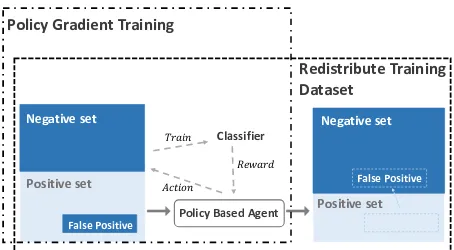
Figure 1: Our deep reinforcement learning frame-work aims at dynamically recognizing false posi-tive samples, and moving them from the posiposi-tive set to the negative set during distant supervision.
“Barack Obamais married toMichelle Obama.”, a relation classifier aims at predicting the relation of “spouse”. In downstream applications, rela-tion extracrela-tion is the key module for construct-ing knowledge graphs, and it is a vital compo-nent of many natural language processing applica-tions such as structured search, sentiment analysis, question answering, and summarization.
stud-ies (Lin et al., 2016) have proposed the use of at-tention mechanisms to place soft weights on a set of noisy sentences, and select samples. However, we argue that only selecting one example or based on soft attention weights are not the optimal strat-egy: To improve the robustness, we need a system-atic solution to make use of more instances, while removing false positives and placing them in the right place.
In this paper, we investigate the possibility of using dynamic selection strategies for robust dis-tant supervision. More specifically, we design a deep reinforcement learning agent, whose goal is to learn to choose whether to remove or remain the distantly supervised candidate instance based on the performance change of the relation classi-fier. Intuitively, our agent would like to remove false positives, and reconstruct a cleaned set of distantly supervised instances to maximize the re-ward based on the classification accuracy. Our proposed method is classifier-independent, and it can be applied to any existing distant supervision model. Empirically, we show that our method has brought consistent performance gains in var-ious deep neural network based models, achieving strong performances on the widely used New York Times dataset (Riedel et al., 2010). Our contribu-tions are three-fold:
• We propose a novel deep reinforcement learning framework for robust distant super-vision relation extraction.
• Our method is model-independent, meaning that it could be applied to any state-of-the-art relation extractors.
• We show that our method can boost the per-formances of recently proposed neural rela-tion extractors.
In Section 2, we will discuss related works on distant supervision relation extraction. Next, we will describe our robust distant supervision frame-work in Section 3. In Section 4, empirical evalu-ation results are shown. And finally, we conclude in Section 5.
2 Related Work
Mintz et al. (2009) is the first study that combines dependency path and feature aggregation for dis-tant supervision. However, this approach would
introduce a lot of false positives, as the same en-tity pair might have multiple relations. To alleviate this issue, Hoffmann et al. (2011) address this is-sue, and propose a model to jointly learn with mul-tiple relations. Surdeanu et al. (2012) further pro-pose a multi-instance multi-label learning frame-work to improve the performance. Note that these early approaches do not explicitly remove noisy instances, but rather hope that the model would be able to suppress the noise.
Recently, with the advance of neural network techniques, deep learning methods (Zeng et al., 2014, 2015) are introduced, and the hope is to model noisy distant supervision process in the hid-den layers. However, their approach only selects one most plausible instance per entity pair, evitably missing out a lot of valuable training in-stances. Recently, Lin et al. (2016) propose an attention mechanism to select plausible instances from a set of noisy instances. However, we believe that soft attention weight assignment might not be the optimal solution, since the false positives should be completely removed and placed in the negative set. Ji et al. (2017) combine the external knowledge to rich the representation of entity pair, in which way to improve the accuracy of atten-tion weights. Even though these above-menatten-tioned methods can select high-quality instances, they ig-nore the false positive case: all the sentences of one entity pair belongs to the false positives. In this work, we take a radical approach to solve this problem—We will make use of the distantly la-beled resources as much as possible, while learn-ing a independent false-positive indicator to re-move false positives, and place them in the right place. After our ACL submission, we notice that a contemporaneous study Feng et al. (2018) also adopts reinforcement learning to learn an instance selector, but their reward is calculated from the prediction probabilities. In contrast, while in our method, the reward is intuitively reflected by the performance change of the relation classifier. Our approach is also complement to most of the ap-proaches above, and can be directly applied on top of any existing relation extraction classifiers.
3 Reinforcement Learning for Distant Supervision
a prior study that has underutilized the distantly-supervised samples (Lin et al., 2016), we consider an RL agent for robust distant supervision rela-tion extracrela-tion. We first describe the definirela-tions of our RL method, including the policy-based agent, external environment, and pre-training strategy. Next, we describe the retraining strategy for our RL agent. The goal of our agent is to deter-mine whether to retain or remove a distantly-supervised sentence, based on the performance change of relation classifier. Finally, we describe the noisy-suppression method, where we teach our policy-based agent to make a redistribution for a cleaner distant supervision training dataset.
Distant supervision relation extraction is to pre-dict the relation type of entity pair under the automatically-generated training set. However, the issue is that these distantly-supervised sen-tences that mention this entity pair may not ex-press the desired relation type. Therefore, what our RL agent should do is to determine whether the distantly-supervised sentence is a true posi-tive instance for this relation type. For reinforce-ment learning, external environreinforce-ment and RL agent are two necessary components, and a robust agent is trained from the dynamic interaction between these two parts (Arulkumaran et al., 2017). First, the prerequisite of reinforcement learning is that the external environment should be modeled as a Markov decision process (MDP). However, the traditional setting of relation extraction cannot sat-isfy this condition: the input sentences are inde-pendent of each other. In other words, we cannot merely use the information of the sentence being processed as the state. Thus, we add the informa-tion from the early states into the representainforma-tion of the current state, in which way to model our task as a MDP problem (Fang et al., 2017). The other component, RL agent, is parameterized with a pol-icy networkπθ(s, a) = p(a|s;θ). The probability distribution of actionsA= {aremove, aremain}is calculated by policy network based on state vec-tors. What needs to be noted is that, Deep Q Net-work (DQN) (Mnih et al., 2013) is also a widely-used RL method; however, it is not suitable for our case, even if our action space is small. First, we cannot compute the immediate reward for ev-ery operation; In contrast, the accurate reward can only be obtained after finishing processing the whole training dataset. Second, the stochastic pol-icy of the polpol-icy network is capable of
prevent-ing the agent from gettprevent-ing stuck in an intermedi-ate stintermedi-ate. The following subsections detailedly in-troduce the definitions of the fundamental compo-nents in the proposed RL method.
States In order to satisfy the condition of MDP, the statesincludes the information from the cur-rent sentence and the sentences that have been re-moved in early states. The semantic and syntactic information of sentence is represented by a con-tinuous real-valued vector. According to some state-of-the-art supervised relation extraction ap-proaches (Zeng et al., 2014; Nguyen and Grish-man, 2015), we utilize both word embedding and position embedding to convert sentence into vec-tor. With this sentence vector, the current state is the concatenation of the current sentence vector and the average vector of the removed sentences in early states. We give relatively larger weight for the vector of the current sentence, in which way to magnify the dominating influence of the current sentence information for the decision of action.
Actions At each step, our agent is required to determine whether the instance is false positive for target relation type. Each relation type has a agent1. There are two actions for each agent: whether to remove or retain the current instance from the training set. With the initial distantly-supervised dataset that is blended with incorrectly-labeled instances, we hope that our agent is ca-pable of using the policy network to filter noisy instances; Under this cleaned dataset, distant su-pervision is then expected to achieve better per-formance.
Rewards As previously mentioned, the intuition of our model is that, when the incorrectly-labeled instances are filtered, the better performance of re-lation classifier will achieve. Therefore, we use the change of performance as the result-driven reward for a series of actions decided by the agent. Com-pared to accuracy, we adopt the F1 score as the
evaluation criterion, since accuracy might not be an indicative metric in a multi-class classification setting where the data distribution could be imbal-anced. Thus, the reward can be formulated as the
1
RL Agent Train
Relation
Classifier 𝐹"
#$"
𝐹"#
× +𝓡# + ×(−𝓡#)
Noisy dataset
𝑃-./# Cleaned dataset
𝑃-#$"
Cleaned dataset
𝑃-#
Removed part
Removed part
Train
𝓡#= 𝛼(𝐹"#- 𝐹"#$")
Relation Classifier
RL Agent Epoch 𝑖 − 1:
Epoch 𝑖: datasetNoisy
𝑃-./#
+𝑁-./#
{𝑃6#$",𝑁6#$"} 𝑁-#$"
𝑁-./#+ 𝑁-#
[image:4.595.109.491.65.223.2]{𝑃6#,𝑁6#}
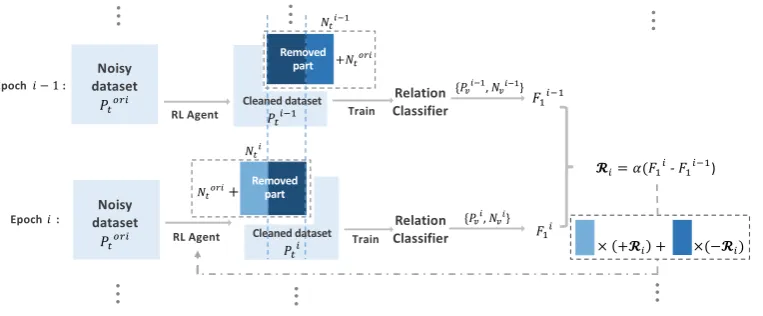
Figure 2: The proposed policy-based reinforcement learning framework. The agent tries to remove the wrong-labeled sentences from the distantly-supervised positive dataset Pori. In order to calculate the reward,Poriis split into the training partPtoriand the validation partPvori; their corresponding negative part are represented asNtoriandNvori. In each epochi, the agent performs a series of actions to recognize the false positive samples fromPtoriand treat them as negative samples. Then, a new relation classifier is trained under the new dataset{Pti, Nti}. With this relation classifier,F1 score is calculated from the
new validation set{Pvi, Nvi}, wherePviis also filtered by the current agent. After that, the current reward is measured as the difference ofF1between the adjacent epochs.
difference between the adjacent epochs:
Ri=α(F1i−F1i−1) (1)
As this equation shows, in stepi, our agent is given a positive reward only if F1 gets improved;
oth-erwise, the agent will receive a negative reward. Under this setting, the value of reward is propor-tional to the difference ofF1, andαis used to
con-vert this difference into a rational numeric range. Naturally, the value of the reward is in a contin-uous space, which is more reasonable than a bi-nary reward (−1 and1), because this setting can reflect the number of wrong-labeled instance that the agent has removed. In order to avoid the ran-domness ofF1, we use the averageF1 of last five
epochs to calculate the reward.
Policy Network For each input sentence, our policy network is to determine whether it ex-presses the target relation type and then make re-moval action if it is irrelevant to the target rela-tion type. Thus, it is analogous to a binary re-lation classifier. CNN is commonly used to con-struct relation classification system (Santos et al., 2015; Xu et al., 2015; Shen and Huang, 2016), so we adopt a simple CNN with window size
cw and kernel size ck, to model policy network
π(s;θ). The reason why we do not choice the vari-ants of CNN (Zeng et al., 2015; Lin et al., 2016)
that are well-designed for distant supervision is that these two models belong to bag-level mod-els (dealing with a bag of sentences simultane-ously) and deal with the multi-classification prob-lem; We just need a model to do binary sentence-level classification. Naturally, the simpler network is adopted.
3.1 Training Policy-based Agent
3.1.1 Pre-training Strategy
The pre-training strategy, inspired from
AlphaGo (Silver et al., 2016), is a common strategy in RL related works to accelerate the training of RL agents. Normally, they utilize a small part of the annotated dataset to train policy networks before reinforcement learning. For example, AlphaGo uses the collected experts moves to do a supervised learning for Go RL agent. However, in distant supervision relation extraction task, there is not any supervised in-formation that can be used unless let linguistic experts to do some manual annotations for part of the entity pairs. However, this is expensive, and it is not the original intention of distant supervision. Under this circumstance, we propose a compromised solution. With well-aligned corpus, the true positive samples should have evident advantage in quantity compared with false positive samples in the distantly-supervised dataset. So, for a specific relation type, we directly treat the distantly-supervised positive set as the positive set, and randomly extract part of distantly-supervised negative set as the negative set. In order to better consider prior information during this pre-training procedure, the amount of negative samples is 10 times of the number of positive samples. It is because, when learning with massive negative samples, the agent is more likely to develop toward a better direction. Cross-entropy cost function is used to train this binary classifier, where the negative label corresponds to the removing action, and the positive label corresponds to the retaining action.
(2)
J(θ) =X i
yilog[π(a=yi|si;θ)]
+ (1−yi)log[1−π(a=yi|si;θ)]
Due to the noisy nature of the distantly-labeled in-stances, if we let this pre-training process overfit this noisy dataset, the predicted probabilities of most samples tend to be close to 0 or 1, which is difficult to be corrected and unnecessarily in-creases the training cost of reinforcement learning. So, we stop this training process when the accu-racy reaches85% ∼ 90%. Theoretically, our ap-proach can be explained as increasing the entropy of the policy gradient agent, and preventing the en-tropy of the policy being too low, which means that the lack of exploration may be a concern.
3.1.2 Retraining Agent with Rewards
As shown in Figure 2, in order to discover incorrectly-labeled instances without any super-vised information, we introduce a policy-based RL method. What our agent tries to deal with is the noisy samples from the distantly-supervised positive dataset; Here we call it as the DS
pos-itive dataset. We split it into the training
posi-tive set Ptori and the validation positive set Pvori; naturally, both of these two set are noisy. Cor-respondingly, the training negative set Ntori and the validation negative setNvoriare constructed by randomly selected from the DS negative dataset. In every epoch, the agent removes a noisy sam-ple set Ψi from Ptori according to the stochastic policy π(a|s), and we obtain a new positive set
Pt = Ptori−Ψi. Because Ψi is recognized as the wrong-labeled samples, we redistribute it into the negative setNt = Ntori+ Ψi. Under this set-ting, the scale of training set is constant for each epoch. Now we utilize the cleaned data{Pt, Nt} to train a relation classifier. The desirable situa-tion is that RL agent has the capacity to increase the performance of relation classifier through relo-cating incorrectly-labeled false positive instances. Therefore, we use the validation set{Pvori, Nvori}
to measure the performance of the current agent. First, this validation set is filtered and redistributed by the current agent as{Pv, Nv}; theF1score of
the current relation classifier is calculated from it. Finally, the difference of F1 scores between the
current and previous epoch is used to calculate re-ward. Next, we will introduce several strategies to train a more robust RL agent.
Removing the fixed number of sentences in each epoch In every epoch, we let the RL agent to remove a fixed number of sentences or less (when the number of the removed sentences in one epoch does not reach this fixed number during training), in which way to prevent the case that the agent tries to remove more false positive instances by removing more instances. Under the restriction of fixed number, if the agent decides to remove the current state, it means the chance of removing other states decrease. Therefore, in order to obtain a better reward, the agent should try to remove a instance set that includes more negative instances.
Algorithm 1Retraining agent with rewards for relationk. For a clearer expression,kis omitted in the following algorithm.
Require: Positive set{Ptori, Pvori}, Negative set{Ntori, Nvori}, the fixed number of removalγt, γv
1: Load parametersθfrom pre-trained policy network
2: Initializes∗as the all-zero vector with the same dimension ofsj
3: forepochi= 1→N do
4: forsj ∈Ptorido
5: sej =concatenation(sj, s∗)
6: Randomly sampleaj ∼π(a|sej;θ); computepj =π(a= 0|sej;θ)
7: ifaj == 0then
8: Save tupletj = (sej, pj)inT and recompute the average vector of removed sentencess ∗
9: end if
10: end for
11: RankT based onpj from high to low, obtainTrank
12: fortiinTrank[:γt]do
13: Addti[0]intoΨi
14: end for
15: Pti = Ptori−Ψi, Nti =Ntori+ Ψi, and generate the new validation set{Pvi, Nvi}with current agent
16: Train the relation classifier based on{Pti, Nti}
17: CalculateF1ion the new validation set{Pvi, Nvi}, and SaveF1i,Ψi
18: R=α(F1i−F1i−1)
19: Ωi−1 = Ψi−1−Ψi∩Ψi−1; Ωi = Ψi−Ψi∩Ψi−1
20:
21: Updataθ:g∝ 5θPΩilogπ(a|s;θ)R+5
θ
PΩi−1logπ(a|s;θ)(−R)
22: end for
the ability to distinguish the obvious false posi-tive instances, which means the discrimination of the indistinguishable wrong-labeled instances are still ambiguous. Particularly, this indistinguish-able part is the criterion to reflect the quality of the agent. Therefore, regardless of these easy-distinguished instances, the different parts of the removed parts in different epochs are the determi-nant of the change of F1 scores. Therefore, we
definite two sets:
Ωi−1 = Ψi−1−(Ψi∩Ψi−1) (3)
Ωi = Ψi−(Ψi∩Ψi−1) (4)
whereΨiis the removed part of epochi.Ωi−1and
Ωiare represented with the different colors in Fig-ure 2. IfF1score increases in the epochi, it means
the actions of the epochiis more reasonable than that in the epochi−1. In other words,Ωiis more negative thanΩi−1. Thus, we assign the positive
reward toΩi and the negative reward toΩi−1, and
vice versa. In summary, the ultimate loss function
is formulated as follow:
(5)
J(θ) =
Ωi X
logπ(a|s;θ)R
+
Ωi−1
X
logπ(a|s;θ)(−R)
3.2 Redistributing Training Dataset with Policy-based Agents
Through the above reinforcement learning proce-dure, for each relation type, we obtain a agent as the false-positive indicator. These agents possess the capability of recognizing incorrectly-labeled instances of the corresponding relation types. We adopt these agents as classifiers to recognize false positive samples in the noisy distantly-supervised training dataset. For one entity pair, if all the sen-tence aligned from corpus are classified as false positive, then this entity pair is redistributed into the negative set.
4 Experiments
re-distribute training dataset by moving false positive samples to negative sample set. Therefore, our ex-periments are intended to demonstrate that our RL agents possess this capability.
4.1 Datast and Evaluation Metrics
We evaluate the proposed method on a commonly-used dataset2, which is first presented in Riedel et al. (2010). This dataset is generated by aligning entity pairs from Freebase with New York Times corpus(NYT). Entity mentions of NYT corpus are recognized by the Stanford named entity recog-nizer (Finkel et al., 2005). The sentences from the years 2005-2006 are used as the training corpus and sentences from 2007 are used as the testing corpus. There are 52 actual relations and a special relation N A which indicates there is no relation between the head and tail entities. The sentences ofN A are from the entity pairs that exist in the same sentence of the actual relations but do not appear in the Freebase.
Similar to the previous works, we adopt the held-out evaluation to evaluate our model, which can provide an approximate measure of the clas-sification ability without costly human evaluation. Similar to the generation of the training set, the entity pairs in test set are also selected from Free-base, which will be predicted under the sentences discovered from the NYT corpus.
4.2 Experimental Settings
4.2.1 Policy-based Agent
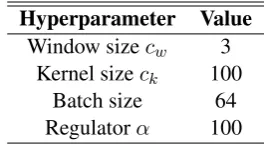
The action space of our RL agent just includes two actions. Therefore, the agent can be modeled as a binary classifier. We adopt a single-window CNN as this policy network. The detailed hyperparam-eter settings are presented in Table 1. As for word embeddings, we directly use the word embedding file released by Lin et al. (2016)3, which just keeps the words that appear more than 100 times in NYT. Moreover, we have the same dimension set-ting of the position embedding, and the maximum length of relative distance is−30and30(“-” and “+” represent the left and right side of the enti-ties). The learning rate of reinforcement learning is 2e−5. For each relation type, the fixed num-ber γt, γv are according to the pre-trained agent. When one relation type has too many distant-supervised positive sentences (for example,
/lo-2
http://iesl.cs.umass.edu/riedel/ecml/
3https://github.com/thunlp/NRE
Hyperparameter Value
Window sizecw 3
Kernel sizeck 100
Batch size 64
Regulatorα 100
Table 1: Hyperparameter settings.
ID Relation Original Pretrain RL
1 /peo/per/pob 55.60 53.63 55.74
2 /peo/per/n 78.85 80.80 83.63
3 /peo/per/pl 86.65 89.62 90.76
4 /loc/loc/c 80.78 83.79 85.39
5 /loc/cou/ad 90.9 88.1 89.86
6 /bus/per/c 81.03 82.56 84.22
7 /loc/cou/c 88.10 93.78 95.19
8 /loc/adm/c 86.51 85.56 86.63
9 /loc/nei/n 96.51 97.20 98.23
[image:7.595.347.480.62.135.2]10 /peo/dec/p 82.2 83.0 84.6
Table 2: Comparison of F1 scores among
three cases: the relation classifier is trained with the original dataset, the redistributed dataset generated by the pre-trained agent, and the redistributed dataset generated by our RL agent respectively. The name of relation types are abbreviated: /peo/per/pob represents
/people/person/place of birth
cation/location/contains has 75768 sentences), we sample a subset of size 7,500 sentences to train the agent. For the average vector of the removed sentences, in the pre-training process and the first state of the retraining process, it is set as all-zero vector.
4.2.2 Relation Classifier for Calculating Reward
In order to evaluate a series of actions by agent, we use a simple CNN model, because the simple net-work is more sensitive to the quality of the training set. The proportion betweenPtoriandPvoriis 2:1, and they are all derived from the training set of Riedel dataset; the corresponding negative sample setsNtoriandNvoriare randomly selected from the Riedel negative dataset, whose size is twice that of their corresponding positive sets.
4.3 The Effectiveness of Reinforcement Learning
In Table 2, we list theF1 scores before and after
pos-0 0.05 0.1 0.15 0.2 0.25 0.3 0.35 0.4
Recall
0.3 0.4 0.5 0.6 0.7 0.8 0.9 1
Precision
[image:8.595.317.513.63.134.2]CNN+ONE CNN+ONE+RL CNN+ATT CNN+ATT+RL
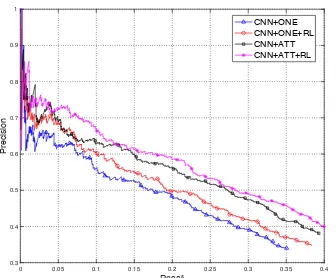
Figure 3: Aggregate PR curves of CNN˙based model.
0 0.05 0.1 0.15 0.2 0.25 0.3 0.35 0.4
Recall
0.4 0.5 0.6 0.7 0.8 0.9 1
Precision
PCNN+ONE PCNN+ONE+RL PCNN+ATT PCNN+ATT+RL
Figure 4: Aggregate PR curves of PCNN˙based model.
itive instances4. Because of the randomness of deep neural network on the small-scale dataset, we just train policy-based agents for these 10 relation types. First, compared withOriginal case, most of
the Pretrainagents yield obvious improvements:
It not only demonstrates the rationality of our pre-training strategy, but also verifies our hypothe-sis that most of the positive samples in Riedel dataset are true positive. More significantly, af-ter retraining with the proposed policy-based RL method, the F1 scores achieve further
improve-ment, even for the case the Pretrain agents per-form bad. These comparable results illustrate that the proposed policy-based RL method is capable of making agents develop towards a good direc-tion.
4The supervised relation classification task Semeval-2010
Task 8 (Hendrickx et al., 2009) annotates nearly 1,000 in-stances for each relation type.
Model - +RL p-value
CNN+ONE 0.177 0.190 1.24e-4
CNN+ATT 0.219 0.229 7.63e-4
PCNN+ONE 0.206 0.220 8.35e-6
[image:8.595.98.266.64.203.2]PCNN+ATT 0.253 0.261 4.36e-3
Table 3: Comparison of AUC values between pre-vious studies and our RL method, and the p-value of t-test.
4.4 Impact of False Positive Samples
Zeng et al. (2015) and Lin et al. (2016) are both the robust models to solve wrong labeling problem of distant supervision relation extraction. Zeng et al. (2015) combine at-least-one multi-instance learning with deep neural network to extract only one active sentence to predict the relation between entity pair; Lin et al. (2016) combine all sen-tences of one entity pair and assign soft attention weights to them, in which way to generate a com-positive relation representation for this entity pair. However, the false positive phenomenon also in-cludes the case that all the sentences of one en-tity pair are wrong, which is because the corpus is not completely aligned with the knowledge base. This phenomenon is also common between Riedel dataset and Freebase through our manual inspec-tion. Obviously, there is nothing the above two methods can do in this case.
The proposed RL method is to tackle this prob-lem. We adopt our RL agents to redistribute Riedel dataset by moving false positive samples into the negative sample set. Then we use Zeng et al. (2015) and Lin et al. (2016) to predict relations on this cleaned dataset, and compare the performance with that on the original Riedel dataset. As shown in Figure 3 and Figure 4, under the assistant of our RL agent, the same model can achieve obvious im-provement with more reasonable training dataset. In order to give the more intuitive comparison, we calculate the AUC value of each PR curve, which reflects the area size under these curves. These comparable results also indicate the effectiveness of our policy-based RL method. Moreover, as can be seen from the result of t-test evaluation, all the p-values are less than 5e-02, so the improvements are significant.
4.5 Case Study
[image:8.595.98.262.275.414.2]Relation /people/person/place of birth
FP 1. GHETTO SUPERSTAR ( THE MAN THAT I AM) – Ranging fromPittsburgh
to Broadway,Billy Porterperforms his musical memoir.
FP 1. “They are trying to create a united front at home in the face of the pressuresSyria is facing,“ saidSami Moubayed, a political analyst and writer here.
2. “Iran injectedSyriawith a lot of confidence: stand up, show defiance,“ saidSami Moubayed, a political analyst and writer in Damascus.
Relation /people/deceased person/place of death
FP 1. Some New York citymayors –William O’Dwyer, Vincent R. Impellitteri and Abraham Beame – were born abroad.
[image:9.595.318.510.291.394.2]2. Plenty of local officials have, too, including twoNew York citymayors, James J. Walker, in 1932, andWilliam O’Dwyer, in 1950.
Table 4: Some examples of the false positive samples detected by our policy-based agent. Each row denotes the annotated sentences of one entity pair.
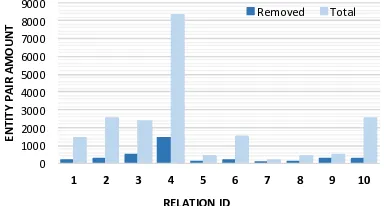
proportional to the original scale, which is in ac-cordance with the actual accident situation. At the same time, we analyze the correlation between the false positive phenomenon and the number of sentences of entity pairs : With this the number ranging from 1 to 5, the corresponding percent-ages are [55.9%, 32.0%, 3.7%, 4.4%, 0.7%]. This distribution is consistent with our assumption. Be-cause Freebase is, to some extent, not completely aligned with the NYT corpus, entity pairs with fewer sentences are more likely to be false posi-tive, which is the major factor hindering the per-formance of the previous systems. In Table 4, we present some false positive examples selected by our agents. Taking entity pair (Sami Moubayed,
Syria) as an example, it is obvious that there is not
any valuable information reflecting relation
/peo-ple/person/place of birth. Both of these sentences
talks about the situation analysis ofSyriafrom the political analyst Sami Moubayed. We also found that, for some entity pairs, even though there are multiple sentences, all of them are identical. This phenomenon also increases the probability of the appearance of false positive samples.
5 Conclusion
In this work, we propose a deep reinforcement learning framework for robust distant supervision. The intuition is that, in contrast to prior works that utilize only one instance per entity pair and use soft attention weights to select plausible distantly supervised examples, we describe a policy-based framework to systematically learn to relocate the false positive samples, and better utilize the un-labeled data. More specifically, our goal is to
0 1000 2000 3000 4000 5000 6000 7000 8000 9000
1 2 3 4 5 6 7 8 9 10
EN
TI
TY
PAI
R
AMOUNT
RELATION ID
Removed Total
Figure 5: This figure presents the scale of the re-moved part for each relation type, where the hori-zontal axis corresponds to the IDs in Table 2.
teach the reinforcement agent to optimize the se-lection/redistribution strategy that maximizes the reward of boosting the performance of relation classification. An important aspect of our work is that our framework does not depend on a spe-cific form of the relation classifier, meaning that it is a plug-and-play technique that could be poten-tially applied to any relation extraction pipeline. In experiments, we show that our framework boosts the performance of distant supervision relation ex-traction of various strong deep learning baselines on the widely used New York Times - Freebase dataset.
Acknowledge
References
Kai Arulkumaran, Marc Peter Deisenroth, Miles
Brundage, and Anil Anthony Bharath. 2017. A
brief survey of deep reinforcement learning. arXiv
preprint arXiv:1708.05866.
Razvan Bunescu and Raymond J Mooney. 2005.
Sub-sequence kernels for relation extraction. In NIPS,
pages 171–178.
Meng Fang, Yuan Li, and Trevor Cohn. 2017. Learning how to active learn: A deep reinforcement learning
approach.arXiv preprint arXiv:1708.02383.
Jun Feng, Minlie Huang, Li Zhao, Yang Yang, and Xi-aoyan Zhu. 2018. Reinforcement learning for rela-tion classificarela-tion from noisy data.
Jenny Rose Finkel, Trond Grenager, and Christopher Manning. 2005. Incorporating non-local informa-tion into informainforma-tion extracinforma-tion systems by gibbs
sampling. InProceedings of the 43rd annual
meet-ing on association for computational lmeet-inguistics, pages 363–370. Association for Computational Lin-guistics.
Zhou GuoDong, Su Jian, Zhang Jie, and Zhang Min. 2005. Exploring various knowledge in relation
ex-traction. InProceedings of the 43rd annual meeting
on association for computational linguistics, pages 427–434. Association for Computational Linguis-tics.
Iris Hendrickx, Su Nam Kim, Zornitsa Kozareva,
Preslav Nakov, Diarmuid ´O S´eaghdha, Sebastian
Pad´o, Marco Pennacchiotti, Lorenza Romano, and
Stan Szpakowicz. 2009. Semeval-2010 task 8:
Multi-way classification of semantic relations
be-tween pairs of nominals. In Proceedings of
the Workshop on Semantic Evaluations: Recent Achievements and Future Directions, pages 94–99. Association for Computational Linguistics.
Raphael Hoffmann, Congle Zhang, Xiao Ling, Luke Zettlemoyer, and Daniel S Weld. 2011. Knowledge-based weak supervision for information extraction
of overlapping relations. InProceedings of the 49th
Annual Meeting of the Association for Computa-tional Linguistics: Human Language Technologies-Volume 1, pages 541–550. Association for Compu-tational Linguistics.
Guoliang Ji, Kang Liu, Shizhu He, Jun Zhao, et al.
2017. Distant supervision for relation extraction
with sentence-level attention and entity descriptions.
InAAAI, pages 3060–3066.
Yankai Lin, Shiqi Shen, Zhiyuan Liu, Huanbo Luan, and Maosong Sun. 2016. Neural relation extraction
with selective attention over instances. InACL (1).
Mike Mintz, Steven Bills, Rion Snow, and Dan Juraf-sky. 2009. Distant supervision for relation
extrac-tion without labeled data. In Proceedings of the
Joint Conference of the 47th Annual Meeting of the
ACL and the 4th International Joint Conference on Natural Language Processing of the AFNLP: Vol-ume 2-VolVol-ume 2, pages 1003–1011. Association for Computational Linguistics.
Volodymyr Mnih, Koray Kavukcuoglu, David Sil-ver, Alex Graves, Ioannis Antonoglou, Daan
Wier-stra, and Martin Riedmiller. 2013. Playing atari
with deep reinforcement learning. arXiv preprint
arXiv:1312.5602.
Thien Huu Nguyen and Ralph Grishman. 2015. Event detection and domain adaptation with convolutional
neural networks. InACL (2), pages 365–371.
Sebastian Riedel, Limin Yao, and Andrew McCal-lum. 2010. Modeling relations and their mentions
without labeled text. In Machine Learning and
Knowledge Discovery in Databases, pages 148–163. Springer.
Benjamin Roth, Tassilo Barth, Michael Wiegand, and Dietrich Klakow. 2013. A survey of noise reduction
methods for distant supervision. InProceedings of
the 2013 workshop on Automated knowledge base construction, pages 73–78. ACM.
Cicero Nogueira dos Santos, Bing Xiang, and Bowen Zhou. 2015. Classifying relations by ranking with
convolutional neural networks. arXiv preprint
arXiv:1504.06580.
Yatian Shen and Xuanjing Huang. 2016. Attention-based convolutional neural network for semantic
re-lation extraction. InProceedings of COLING 2016,
the 26th International Conference on Computational Linguistics: Technical Papers.
David Silver, Aja Huang, Chris J Maddison, Arthur Guez, Laurent Sifre, George Van Den Driessche, Ju-lian Schrittwieser, Ioannis Antonoglou, Veda Pan-neershelvam, Marc Lanctot, et al. 2016. Mastering the game of go with deep neural networks and tree
search. Nature, 529(7587):484–489.
Mihai Surdeanu, Julie Tibshirani, Ramesh Nallapati, and Christopher D Manning. 2012. Multi-instance
multi-label learning for relation extraction. In
Pro-ceedings of the 2012 Joint Conference on Empirical Methods in Natural Language Processing and Com-putational Natural Language Learning, pages 455– 465. Association for Computational Linguistics.
Kun Xu, Yansong Feng, Songfang Huang, and
Dongyan Zhao. 2015. Semantic relation
clas-sification via convolutional neural networks
with simple negative sampling. arXiv preprint
arXiv:1506.07650.
Dmitry Zelenko, Chinatsu Aone, and Anthony
Richardella. 2003. Kernel methods for relation
ex-traction. Journal of machine learning research,
Daojian Zeng, Kang Liu, Yubo Chen, and Jun Zhao. 2015. Distant supervision for relation extraction via
piecewise convolutional neural networks. In
Pro-ceedings of the 2015 Conference on Empirical Meth-ods in Natural Language Processing (EMNLP), Lis-bon, Portugal, pages 17–21.
Daojian Zeng, Kang Liu, Siwei Lai, Guangyou Zhou, Jun Zhao, et al. 2014. Relation classification via
convolutional deep neural network. In COLING,