S-
MART: Novel Tree-based Structured Learning Algorithms
Applied to Tweet Entity Linking
Yi Yang
School of Interactive Computing Georgia Institute of Technology
Ming-Wei Chang Microsoft Research [email protected]
Abstract
Non-linear models recently receive a lot of attention as people are starting to dis-cover the power of statistical and em-bedding features. However, tree-based models are seldom studied in the con-text of structured learning despite their re-cent success on various classification and ranking tasks. In this paper, we propose S-MART, a tree-based structured learning
framework based on multiple additive re-gression trees. S-MARTis especially
suit-able for handling tasks with dense fea-tures, and can be used to learn many dif-ferent structures under various loss func-tions.
We apply S-MART to the task of tweet
entity linking — a core component of tweet information extraction, which aims to identify and link name mentions to en-tities in a knowledge base. A novel infer-ence algorithm is proposed to handle the special structure of the task. The exper-imental results show that S-MART
signif-icantly outperforms state-of-the-art tweet entity linking systems.
1 Introduction
Many natural language processing (NLP) prob-lems can be formalized as structured prediction tasks. Standard algorithms for structured learning include Conditional Random Field (CRF) (Laf-ferty et al., 2001) and Structured Supported Vec-tor Machine (SSVM) (Tsochantaridis et al., 2004). These algorithms, usually equipped with a linear model and sparse lexical features, achieve state-of-the-art performances in many NLP applica-tions such as part-of-speech tagging, named entity recognition and dependency parsing.
This classical combination of linear models and sparse features is challenged by the recent
emerg-ing usage of dense features such as statistical and embedding features. Tasks with these low dimen-sional dense features require models to be more sophisticated to capture the relationships between features. Therefore, non-linear models start to re-ceive more attention as they are often more expres-sive than linear models.
Tree-based models such as boosted trees (Fried-man, 2001) are flexible non-linear models. They can handle categorical features and count data bet-ter than other non-linear models like Neural Net-works. Unfortunately, to the best of our knowl-edge, little work has utilized tree-based methods for structured prediction, with the exception of TreeCRF (Dietterich et al., 2004).
In this paper, we propose a novel structured learning framework called S-MART (Structured Multiple Additive Regression Trees). Unlike TreeCRF, S-MART is very versatile, as it can be
applied to tasks beyond sequence tagging and can be trained under various objective functions.
S-MARTis also powerful, as the high order
relation-ships between features can be captured by non-linear regression trees.
We further demonstrate how S-MART can be
applied to tweet entity linking, an important and challenging task underlying many applications in-cluding product feedback (Asur and Huberman, 2010) and topic detection and tracking (Math-ioudakis and Koudas, 2010). We apply S-MARTto
entity linking using a simple logistic function as the loss function and propose a novel inference al-gorithm to prevent overlaps between entities.
Our contributions are summarized as follows:
• We propose a novel structured learning framework called S-MART. S-MART
com-bines non-linearity and efficiency of tree-based models with structured prediction, leading to a family of new algorithms. (Sec-tion 2)
• We apply S-MART to tweet entity
link-ing. Building on top of S-MART, we
pro-pose a novel inference algorithm for non-overlapping structure with the goal of pre-venting conflicting entity assignments. (Sec-tion 3)
• We provide a systematic study of evaluation criteria in tweet entity linking by conduct-ing extensive experiments over major data sets. The results show that S-MART
sig-nificantly outperforms state-of-the-art entity linking systems, including the system that is used to win the NEEL 2014 challenge (Cano and others, 2014). (Section 4)
2 Structured Multiple Additive Regression Trees
The goal of a structured learning algorithm is to learn a joint scoring functionS between an input xand an output structurey,S : (x,y)→R. The structured output y often contains many interde-pendent variables, and the number of the possible structures can be exponentially large with respect to the size ofx. At test time, the predictionyfor xis obtained by
arg max
y∈Gen(x)S(x,y),
whereGen(x)represents the set of all valid output structures forx.
Standard learning algorithms often directly op-timize the model parameters. For example, as-sume that the joint scoring function S is param-eterized byθ. Then, gradient descent algorithms can be used to optimize the model parameters θ
iteratively. More specifically,
θm =θm−1−ηm∂L(y
∗, S(x,y;θ))
∂θm−1 , (1)
where y∗ is the gold structure, L(y∗, S(x,y;θ)) is a loss function andηmis the learning rate of the
m-th iteration.
In this paper, we propose a framework called
Structured Multiple Additive Regression Trees (S-MART), which generalizes Multiple Additive Regression Trees (MART) for structured learn-ing problems. Different from Equation (1),
S-MART does not directly optimize the model
pa-rameters; instead, it approximates the optimal scoring function that minimize the loss by adding (weighted) regression tree models iteratively.
Due to the fact that there are exponentially many input-output pairs in the training data, S-MART assumes that the joint scoring function
can be decomposed as
S(x,y) = X
k∈Ω(x)
F(x,yk),
whereΩ(x) contains the set of the all factors for inputxandykis the sub-structure ofy that
cor-responds to thek-th factor inΩ(x). For instance, in the task of word alignment, each factor can be defined as a pair of words from source and target languages respectively. Note that we can recover yfrom the union of{yk}K1 .
The factor scoring function F(x,yk) can be
optimized by performing gradient descent in the function space in the following manner:
Fm(x,yk) =Fm−1(x,yk)−ηmgm(x,yk) (2)
where functiongm(x,yk)is the functional
gradi-ent.
Note that gm is afunctionrather than a vector.
Therefore, modelinggm theoretically requires an
infinite number of data points. We can address this difficulty by approximatinggmwith a finite
num-ber of point-wise functional gradients
gm(x,yk=uk) = (3)
∂L(y∗, S(x,y
k=uk))
∂F(x,yk=uk)
F(x,yk)=Fm−1(x,yk)
whereuk index a valid sub-structure for thek-th
factor ofx.
The key point of S-MARTis that it approximates
−gm by modeling the point-wise negative
func-tional gradients using a regression treehm. Then
the factor scoring function can be obtained by
F(x,yk) = M X
m=1
ηmhm(x,yk),
where hm(x,yk) is also called a basis function
andηmcan be simply set to 1 (Murphy, 2012).
The detailed S-MART algorithm is presented in
Algorithm 1. The factor scoring functionF(x,yk)
is simply initialized to zero at first (line 1). After this, we iteratively update the function by adding regression trees. Note that the scoring function is shared by all the factors. Specifically, given the current decision functionFm−1, we can consider
Algorithm 1 S-MART: A family of structured
learning algorithms with multiple additive regres-sion trees
1: F0(x,yk) = 0
2: form= 1toMdo: .going over all trees 3: D← ∅
4: forall examplesdo: .going over all examples 5: foryk∈Ω(x)do: .going over all factors 6: For alluk, obtaingkuby Equation (3) 7: D←D∪ {(Φ(x,yk=uk),−gku)} 8: end for
9: end for
10: hm(x,yk)←TrainRegressionTree(D) 11: Fm(x,yk) =Fm−1(x,yk) +hm(x,yk) 12: end for
training dataD for modeling the regression tree. For each training example, S-MARTfirst computes
the point-wise functional gradients according to Equation (3) (line 6). Here we usegku as the
ab-breviation forgm(x,yk =uk). In line 7, for each
sub-structure uk, we create a new training
exam-ple for the regression problem by the feature vec-torΦ(x,yk=uk)and the negative gradient−gku.
In line 10, a regression tree is constructed by min-imizing differences between the prediction values and the point-wise negative gradients. Then a new basis function (modeled by a regression tree) will be added into the overallF (line 11).
It is crucial to note that S-MART is a fam-ily of algorithms rather than a single algorithm. S-MART is flexible in the choice of the loss
functions. For example, we can use either lo-gistic loss or hinge loss, which means that
S-MART can train probabilistic models as well as
non-probabilistic ones. Depending on the choice of factors, S-MART can handle various structures
such as linear chains, trees, and even the semi-Markov chain (Sarawagi and Cohen, 2004).
S-MART versus MART There are two key
differences between S-MART and MART. First,
S-MART decomposes the joint scoring function S(x,y)into factors to address the problem of the exploding number of input-output pairs for struc-tured learning problems. Second, S-MART
mod-els a single scoring functionF(x,yk)over inputs
and output variables directly rather thanO differ-ent functionsFo(x), each of which corresponds to
a label class.
S-MART versus TreeCRF TreeCRF can be
viewed as a special case of S-MART, and there
are two points where S-MART improves upon
TreeCRF. First, the model designed in (Dietterich
et al., 2004) is tailored for sequence tagging prob-lems. Similar to MART, for a tagging task withO
tags, they choose to modelO functionsFo(x, o0) instead of directly modeling the joint score of the factor. This imposes limitations on the feature functions, and TreeCRF is consequently unsuit-able for many tasks such as entity linking.1Second,
S-MARTis more general in terms of the objective
functions and applicable structures. In the next section, we will see how S-MARTcan be applied to
a non-linear-chain structure and various loss func-tions.
3 S-MARTfor Tweet Entity Linking
We first formally define the task of tweet entity linking. Asinput, we are given a tweet, an entity database (e.g., Wikipedia where each article is an entity), and a lexicon2which maps a surface form
into a set of entity candidates. For each incoming tweet, all n-grams of this tweet will be used to find matches in the lexicon, and each match will form a mention candidate. Asoutput, we map every men-tion candidate (e.g., “new york giants”) in the mes-sage to an entity (e.g., NEWYORKGIANTS) or to Nil(i.e., a non-entity). A mention candidate can often potentially link to multiple entities, which we call possibleentity assignments.
This task is a structured learning problem, as the final entity assignments of a tweet should not over-lap with each other.3 We decompose this
learn-ing problem as follows: we make each mention candidate a factor, and the score of the entity as-signments of a tweet is the sum of the score of each entity and mention candidate pair. Although all mention candidates are decomposed, the non-overlapping constraint requires the system to per-form global inference.
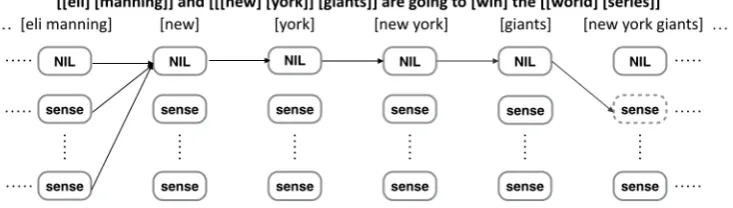
Consider the example tweet in Figure 1, where we show the tweet with the mention candidates in brackets. To link the mention candidate “new york giants” to a non-Nilentity, the system has to link previous overlapping mention candidates to
Nil. It is important to note that this isnot a lin-ear chain problem because of the non-overlapping constraint, and the inference algorithm needs to be
1For example, entity linking systems need to model the similarity between an entity and the document. The TreeCRF formulation does not support such features.
2We use the standard techniques to construct the lexicon from anchor texts, redirect pages and other information re-sources.
Figure 1: Example tweet and its mention candidates. Each mention candidate is marked as a pair of brackets in the original tweet and forms a column in the graph. The graph demonstrates the non-overlapping constraint. To link the mention candidate “new york giants” to a non-Nilentity, the system has to link previous four overlapping mention candidates toNil. The mention candidate “eli manning” is not affected by “new york giants”.Note that this is not a standard linear chain problem.
carefully designed.
3.1 Applying S-MART
We derive specific model for tweet entity linking task with S-MARTand use logistic loss as our
run-ning example. The hinge loss version of the model can be derived in a similar way.
Note that the tweet and the mention candidates are given. Letxbe the tweet,ukbe the entity
as-signment of thek-th mention candidate. We use functionF(x, yk =uk)to model the score of the
k-th mention candidate choosing entityuk.4 The
overall scoring function can be decomposed as fol-lows:
S(x,y={uk}Kk=1) =
K X
k=1
F(x, yk=uk)
S-MART utilizes regression trees to model the
scoring functionF(x, yk = uk), which requires
point-wise functional gradient for each entity of every mention candidate. Let’s first write down the logistic loss function as
L(y∗, S(x,y)) =−logP(y∗|x) = logZ(x)−S(x,y∗)
whereZ(x) = Pyexp(S(x,y))is the potential function. Then the point-wise gradients can be computed as
gku = ∂F(x, y∂L k=uk)
=P(yk=uk|x)−1[yk∗ =uk],
where 1[·] represents an indicator function. The conditional probabilityP(yk=uk|x)can be
com-puted by a variant of the forward-backward algo-rithm, which we will detail in the next subsection.
4Note that each mention candidate has different own en-tity sets.
3.2 Inference
The non-overlapping structure is distinct from lin-ear chain and semi-Markov chain (Sarawagi and Cohen, 2004) structures. Hence, we propose a carefully designed forward-backward algorithm to calculate P(yk = uk|x) based on current
scor-ing function F(x, yk = uk) given by the
re-gression trees. The non-overlapping constraint distinguishes our inference algorithm from other forward-backward variants.
To compute the forward probability, we sort5
the mention candidates by their end indices and define forward recursion by
α(u1,1) = exp(F(x, y1 =u1)) α(uk, k) = exp(F(x, yk=uk))
·PY−1
p=1
exp(F(x, yk−p =Nil))
· X
uk−P
α(uk−P, k−P) (4)
where k− P is the index of the previous non-overlapping mention candidate. Intuitively, for the k-th mention candidate, we need to identify its nearest non-overlapping fellow and recursively compute the probability. The overlapping mention candidates can only take theNilentity.
Similarly, we can sort the mention candidates by their start indices and define backward
sion by
β(uK, K) =1
β(uk, k) = X
uk+Q
exp(F(x, yk+Q =uk+Q))
·
QY−1
q=1
exp(F(x, yk+q =Nil))
·β(uk+Q, k+Q) (5)
where k + Q is the index of the next non-overlapping mention candidate. Note that the third terms of equation (4) or (5) will vanish if there are no corresponding non-overlapping mention candi-dates.
Given the potential function can be computed by Z(x) = Pukα(uk, k)β(uk, k), for entities
that are notNil,
P(yk=uk|x) =exp(F(x, ykZ=(xu)k))·β(uk, k)
·PY−1
p=1
exp(F(x, yk−p =Nil))
· X
uk−P
α(uk−P, k−P) (6)
The probability for the special token Nil can be obtained by
P(yk=Nil|x) = 1− X
uk6=Nil
P(yk =uk|x) (7)
In the worst case, the total cost of the forward-backward algorithm isO(max{T K, K2}), where T is the number of entities of a mention candi-date.6
Finally, at test time, the decoding problem
arg maxyS(x,y) can be solved by a variant of the Viterbi algorithm.
3.3 Beyond S-MART: Modeling entity-entity
relationships
It is important for entity linking systems to take advantage of the entity-to-entity information while making local decisions. For instance, the identi-fication of entity “eli manning” leads to a strong clue for linking “new york giants” to the NFL team.
Instead of defining a more complicated struc-ture and learning everything jointly, we employ a
6The cost isO(K2)only if every mention candidate of the tweet overlaps other mention candidates. In practice, the algorithm is nearly linear w.r.tK.
two-stage approach as the solution for modeling entity-entity relationships after we found that
S-MART achieves high precision and reasonable
re-call. Specifically, in the first stage, the system identifies all possible entities with basic features, which enables the extraction of entity-entity fea-tures. In the second stage, we re-train S-MARTon
a union of basic features and entity-entity features. We define entity-entity features based on the Jac-card distance introduced by Guo et al. (2013).
Let Γ(ei) denotes the set of Wikipedia pages
that contain a hyperlink to an entityei andΓ(t−i)
denotes the set of pages that contain a hyperlink to any identified entityej of the tweettin the first
stage excludingei. The Jaccard distance between
eiandtis
Jac(ei, t) = ||Γ(Γ(eei)∩Γ(t−i)| i)∪Γ(t−i)|.
In addition to the Jaccard distance, we add one ad-ditional binary feature to indicate if the current tity has the highest Jaccard distance among all en-tities for this mention candidate.
4 Experiments
Our experiments are designed to answer the fol-lowing three research questions in the context of tweet entity linking:
• Do non-linear learning algorithms perform better than linear learning algorithms?
• Do structured entity linking models perform better than non-structured ones?
• How can we best capture the relationships be-tween entities?
4.1 Evaluation Methodology and Data
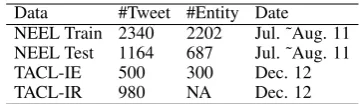
these sets.7 The statistics of the datasets are
pre-sented in Table 1.
IE-driven evaluation The IE-driven evaluation is the standard evaluation for an end-to-end entity linking system. We follow Carmel et al. (2014) and relax the definition of the correct mention boundaries, as they are often ambiguous. A men-tion boundary is considered to be correct if it over-laps (instead of being the same) with the gold men-tion boundary. Please see (Carmel et al., 2014) for more details on the procedure of calculating the precision, recall and F1 score.
The NEEL and TACL-IE datasets have differ-ent annotation guidelines and differdiffer-ent choices of knowledge bases, so we perform the following procedure to clean the data and unify the annota-tions. We first filter out the annotations that link to entities excluded by our knowledge base. We use the same knowledge base as the ERD 2014 com-petition (Carmel et al., 2014), which includes the union of entities in Wikipedia and Freebase. Sec-ond, we follow NEEL annotation guideline and re-annotate TACL-IE dataset. For instance, in or-der to be consistent with NEEL, all the user tags (e.g. @BarackObama) are re-labeled as entities in TACL-IE.
We train all the models with NEEL Train dataset and evaluate different systems on NEEL Test and TACL-IE datasets. In addition, we sam-ple 800 tweets from NEEL Train dataset as our development set to perform parameter tuning.
IR-driven evaluation The IR-driven evaluation is proposed by Fang and Chang (2014). It is motivated by a key application of entity linking — retrieval of relevant tweets for target entities, which is crucial for downstream applications such as product research and sentiment analysis. In particular, given a query entity we can search for tweets based on the match with some potential sur-face forms of the query entity. Then, an entity linking system is evaluated by its ability to cor-rectly identify the presence or absence of the query entity in every tweet. Our IR-driven evaluation is based on the TACL-IR set, which includes 980 tweets sampled for ten query entities of five entity types (roughly 100 tweets per entity). About 37% of the sampled tweets did not mention the query entity due to the anchor ambiguity.
7We plan to release the cleaned data and evaluation code if license permitted.
Data #Tweet #Entity Date NEEL Train 2340 2202 Jul. ˜Aug. 11 NEEL Test 1164 687 Jul. ˜Aug. 11 TACL-IE 500 300 Dec. 12
[image:6.595.325.505.61.113.2]TACL-IR 980 NA Dec. 12
Table 1: Statistics of data sets.
4.2 Experimental Settings
Features We employ a total number of 37 dense features as our basic feature set. Most of the fea-tures are adopted from (Guo et al., 2013)8,
includ-ing various statistical features such as the proba-bility of the surface to be used as anchor text in Wikipedia. We also add additional Entity Type features correspond to the following entity types: Character, Event, Product and Brand. Finally, we include several NER features to indicate each mention candidate belongs to one the following NER types: Twitter user, Twitter hashtag, Person, Location, Organization, Product, Event and Date.
Algorithms Table 2 summarizes all the algo-rithms that are compared in our experiments. First, we consider two linear structured learning algo-rithms: Structured Perceptron (Collins, 2002) and Linear Structured SVM (SSVM) (Tsochantaridis et al., 2004).
For non-linear models, we consider polynomial SSVM, which employs polynomial kernel inside the structured SVM algorithm. We also include LambdaRank (Quoc and Le, 2007), a neural-based learning to rank algorithm, which is widely used in the information retrieval literature. We further compare with MART, which is designed for performing multiclass classification using log loss without considering the structured informa-tion. Finally, we have our proposed log-loss
S-MARTalgorithm, as described in Section 3.9
Note that our baseline systems are quite strong. Linear SSVM has been used in one of the state-of-the-art tweet entity linking systems (Guo et al., 2013), and the system based on MART is the win-ning system of the 2014 NEEL Challenge (Cano and others, 2014)10.
Table 2 summarizes several properties of the al-gorithms. For example, most algorithms are
struc-8We consider features of Base, Capitalization Rate, Pop-ularity, Context Capitalization and Entity Type categories.
9Our pilot experiments show that the log-loss
S-MARTconsistently outperforms the hinge-loss S-MART.
Model Structured Non-linear Tree-based Structured Perceptron X
Linear SSVM X
Polynomial SSVM X X
LambdaRank X
MART X X
[image:7.595.73.299.61.133.2]S-MART X X X
Table 2: Included algorithms and their properties.
tured (e.g. they perform dynamic programming at test time) except for MART and LambdaRank, which treat mention candidates independently.
Parameter tuning All the hyper-parameters are tuned on the development set. Then, we re-train our models on full training data (including the dev set) with the best parameters. We choose the soft margin parameter C from {0.5,1,5,10} for two structured SVM methods. After a prelimi-nary parameter search, we fixed the number of trees to 300 and the minimum number of docu-ments in a leaf to 30 for all tree-based models. For LambdaRank, we use a two layer feed for-ward network. We select the number of hidden units from{10,20,30,40}and learning rate from
{0.1,0.01,0.001}.
It is widely known that F1 score can be affected by the trade-off between precision and recall. In order to make the comparisons between all algo-rithms fairer in terms of F1 score, we include a post-processing step to balance precision and re-call for all the systems. Note the tuning is only conducted for the purpose of robust evaluation. In particular, we adopt a simple tuning strategy that works well for all the algorithms, in which we add a bias termbto the scoring function value ofNil:
F(x, yk =Nil)←F(x, yk=Nil) +b.
We choose the bias term b from values between
−3.0to3.0on the dev set and apply the same bias term at test time.
4.3 Results
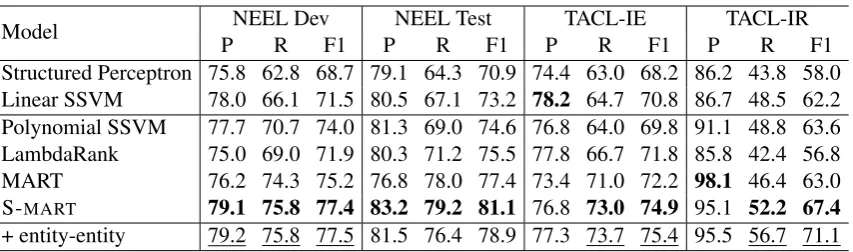
Table 3 presents the empirical findings for
S-MART and competitive methods on tweet entity
linking task in both IE and IR settings. In the fol-lowing, we analyze the empirical results in details.
Linear models vs. non-linear models Table 3 clearly shows that linear models perform worse than non-linear models when they are restricted to the IE setting of the tweet entity linking task. The story is similar in IR-driven evaluation, with
−502 −1 0 1 2
60 70 80
Bias
F1
score SP
Linear SSVM Poly. SSVM MART
[image:7.595.313.523.63.214.2]NN S-MART
Figure 2: Balance precisions and recalls. X-axis corresponds to values of the bias terms for the special tokenNil. Note that S-MARTis still the overall winning system without tuning the threshold.
the exception of LambdaRank. Among the lin-ear models, linlin-ear SSVM demonstrates its supe-riority over Structured Perceptron on all datasets, which aligns with the results of (Tsochantaridis et al., 2005) on the named entity recognition task.
We have many interesting observations on the non-linear models side. First, by adopting a polynomial kernel, the non-linear SSVM further improves the entity linking performances on the NEEL datasets and TACL-IR dataset. Second, LambdaRank, a neural network based model, achieves better results than linear models in IE-driven evaluation, but the results in IR-IE-driven eval-uation are worse than all the other methods. We believe the reason for this dismal performance is that the neural-based method tends to overfit the IR setting given the small number of training ex-amples. Third, both MART and S-MART
signifi-cantly outperform alternative linear and non-linear methods in IE-driven evaluation and performs bet-ter or similar to other methods in IR-driven eval-uation. This suggests that tree-based non-linear models are suitable for tweet entity linking task. Finally, S-MART outperforms previous
state-of-the-art method Structured SVM by a surprisingly large margin. In the NEEL Test dataset, the dif-ference is more than 10% F1. Overall, the results show that the shallow linear models are not ex-pressive enough to capture the complex patterns in the data, which are represented by a few dense features.
Model PNEEL DevR F1 PNEEL TestR F1 P TACL-IER F1 PTACL-IRR F1 Structured Perceptron 75.8 62.8 68.7 79.1 64.3 70.9 74.4 63.0 68.2 86.2 43.8 58.0 Linear SSVM 78.0 66.1 71.5 80.5 67.1 73.2 78.2 64.7 70.8 86.7 48.5 62.2 Polynomial SSVM 77.7 70.7 74.0 81.3 69.0 74.6 76.8 64.0 69.8 91.1 48.8 63.6 LambdaRank 75.0 69.0 71.9 80.3 71.2 75.5 77.8 66.7 71.8 85.8 42.4 56.8 MART 76.2 74.3 75.2 76.8 78.0 77.4 73.4 71.0 72.2 98.1 46.4 63.0
S-MART 79.1 75.8 77.4 83.2 79.2 81.1 76.8 73.0 74.9 95.1 52.2 67.4
[image:8.595.88.515.60.186.2]+ entity-entity 79.2 75.8 77.5 81.5 76.4 78.9 77.3 73.7 75.4 95.5 56.7 71.1
Table 3: IE-driven and IR-driven evaluation results for different models. The best results with basic features are inbold. The results are underlined if adding entity-entity features gives the overall best results.
Table 3, S-MARTcan achieve higher precision and
recall points compared to MART on all datasets in terms of IE-driven evaluation, and can improve F1 by 4 points on NEEL Test and TACL-IR datasets. The task of entity linking is to produce non-overlapping entity assignments that match the gold mentions. By adopting structured learning technique, S-MART is able to automatically
take into account the non-overlapping constraint during learning and inference, and produce global optimal entity assignments for mention candidates of a tweet. One effect is that S-MART can easily
eliminate some common errors caused by popular entities (e.g. new york in Figure 1).
Modeling entity-entity relationships Entity-entity relationships provide strong clues for Entity-entity disambiguation. In this paper, we use the sim-ple two-stage approach described in Section 3.3 to capture the relationships between entities. As shown in Table 3, the significant improvement in IR-driven evaluation indicates the importance of incorporating entity-entity information.
Interestingly, while IR-driven results are signif-icantly improved, IE-driven results are similar or even worse given entity-entity features. We be-lieve the reason is that IE-driven and IR-driven evaluations focus on different aspects of tweet en-tity linking task. As Guo et al. (2013) shows that most mentions in tweets should be linked to the most popular entities, IE setting actually pays more attention on mention detection sub-problem. In contrast to IE setting, IR setting focuses on en-tity disambiguation, since we only need to decide whether the tweet is relevant to the query entity. Therefore, we believe that both evaluation policies are needed for tweet entity linking.
Balance Precision and Recall Figure 2 shows the results of tuning the bias term for balancing
precision and recall on the dev set. The results show that S-MART outperforms competitive
ap-proaches without any tuning, with similar margins to the results after tuning. Balancing precision and recall improves F1 scores for all the systems, which suggests that the simple tuning method per-forms quite well. Finally, we have an interest-ing observation that different methods have vari-ous scales of model scores.
5 Related Work
Linear structured learning methods have been pro-posed and widely used in the literature. Popu-lar models include Structured Perceptron (Collins, 2002), Conditional Random Field (Lafferty et al., 2001) and Structured SVM (Taskar et al., 2004; Tsochantaridis et al., 2005). Recently, many struc-tured learning models based on neural networks have been proposed and are widely used in lan-guage modeling (Bengio et al., 2006; Mikolov et al., 2010), sentiment classification (Socher et al., 2013), as well as parsing (Socher et al., 2011). Cortes et al. (2014) recently proposed a boosting framework which treats different struc-tured learning algorithms as base learners to en-semble structured prediction results.
Early research on entity linking has focused on well written documents (Bunescu and Pasca, 2006; Cucerzan, 2007; Milne and Witten, 2008). Due to the raise of social media, many techniques have been proposed or tailored to short texts in-cluding tweets, for the problem of entity linking (Ferragina and Scaiella, 2010; Meij et al., 2012; Guo et al., 2013) as well as the related problem of named entity recognition (NER) (Ritter et al., 2011). Recently, non-textual information such as spatial and temporal signals have also been used to improve entity linking systems (Fang and Chang, 2014). The task of entity linking has attracted a lot of attention, and many shared tasks have been hosted to promote entity linking research (Ji et al., 2010; Ji and Grishman, 2011; Cano and others, 2014; Carmel et al., 2014).
Building an end-to-end entity linking system in-volves in solving two interrelated sub-problems: mention detection and entity disambiguation. Ear-lier research on entity linking has been largely fo-cused on the entity disambiguation problem, in-cluding most work on entity linking for well-written documents such as news and encyclope-dia articles (Cucerzan, 2007) and also few for tweets (Liu et al., 2013). Recently, people have focused on building systems that consider mention detection and entity disambiguation jointly. For example, Cucerzan (2012) delays the mention de-tection decision and consider the mention detec-tion and entity linking problem jointly. Similarly, Sil and Yates (2013) proposed to use a reranking approach to obtain overall better results on men-tion detecmen-tion and entity disambiguamen-tion.
6 Conclusion and Future Work
In this paper, we propose S-MART, a family of
structured learning algorithms which is flexible on the choices of the loss functions and structures. We demonstrate the power of S-MARTby applying
it to tweet entity linking, and it significantly out-performs the current state-of-the-art entity linking systems. In the future, we would like to investigate the advantages and disadvantages between tree-based models and other non-linear models such as deep neural networks or recurrent neural net-works.
Acknowledgments We thank the reviewers for their insightful feedback. We also thank Yin Li and Ana Smith for their valuable comments on earlier version of this paper.
References
S. Asur and B.A. Huberman. 2010.
Predict-ing the future with social media. arXiv preprint arXiv:1003.5699.
Boris Babenko, Ming-Hsuan Yang, and Serge Be-longie. 2011. Robust object tracking with online multiple instance learning. Pattern Analysis and Machine Intelligence, IEEE Transactions on, pages 1619–1632.
Yoshua Bengio, Holger Schwenk, Jean-S´ebastien Sen´ecal, Fr´ederic Morin, and Jean-Luc Gauvain. 2006. Neural probabilistic language models. In In-novations in Machine Learning, pages 137–186. R. C Bunescu and M. Pasca. 2006. Using
encyclo-pedic knowledge for named entity disambiguation. InProceedings of the European Chapter of the ACL (EACL), pages 9–16.
AE Cano et al. 2014. Microposts2014 neel challenge. InMicroposts2014 NEEL Challenge.
Amparo E Cano, Giuseppe Rizzo, Andrea Varga, Matthew Rowe, Milan Stankovic, and Aba-Sah Dadzie. 2014. Making sense of microposts (# microposts2014) named entity extraction & linking challenge. Making Sense of Microposts (# Microp-osts2014).
David Carmel, Ming-Wei Chang, Evgeniy Gabrilovich, Bo-June Paul Hsu, and Kuansan Wang. 2014. Erd’14: entity recognition and disambiguation chal-lenge. InACM SIGIR Forum, pages 63–77.
Michael Collins. 2002. Discriminative training meth-ods for hidden markov models: Theory and exper-iments with perceptron algorithms. InProceedings of the conference on Empirical methods in natural language processing (EMNLP), pages 1–8.
Corinna Cortes, Vitaly Kuznetsov, and Mehryar Mohri. 2014. Learning ensembles of structured prediction rules. InProceedings of ACL.
Silviu Cucerzan. 2007. Large-scale named entity dis-ambiguation based on wikipedia data. In Proceed-ings of the Conference on Empirical Methods in Nat-ural Language Processing (EMNLP), pages 708– 716.
Silviu Cucerzan. 2012. The msr system for entity link-ing at tac 2012. InText Analysis Conference. Thomas G Dietterich, Adam Ashenfelter, and Yaroslav
Bulatov. 2004. Training conditional random fields via gradient tree boosting. In Proceedings of the twenty-first international conference on Machine learning (ICML), pages 28–35.
Yuan Fang and Ming-Wei Chang. 2014. Entity link-ing on microblogs with spatial and temporal signals.
P. Ferragina and U. Scaiella. 2010. TAGME: on-the-fly annotation of short text fragments (by Wikipedia entities). In Proceedings of ACM Conference on Information and Knowledge Management (CIKM), pages 1625–1628.
Jerome H Friedman. 2001. Greedy function approx-imation: a gradient boosting machine. Annals of Statistics, pages 1189–1232.
Stephen Guo, Ming-Wei Chang, and Emre Kiciman. 2013. To link or not to link? a study on end-to-end tweet entity linking. In Proceedings of the North American Chapter of the Association for Computa-tional Linguistics (NAACL), pages 1020–1030. Heng Ji and Ralph Grishman. 2011. Knowledge base
population: Successful approaches and challenges. In Proceedings of the 49th Annual Meeting of the Association for Computational Linguistics, pages 1148–1158.
Heng Ji, Ralph Grishman, Hoa Trang Dang, Kira Grif-fitt, and Joe Ellis. 2010. Overview of the tac 2010 knowledge base population track. In Third Text Analysis Conference (TAC).
John Lafferty, Andrew McCallum, and Fernando CN Pereira. 2001. Conditional random fields: Prob-abilistic models for segmenting and labeling se-quence data. In Proceedings of the 18th inter-national conference on Machine learning (ICML), pages 282–289.
Ping Li, Qiang Wu, and Christopher J Burges. 2007. Mcrank: Learning to rank using multiple classifica-tion and gradient boosting. InAdvances in neural information processing systems (NIPS), pages 897– 904.
Xiaohua Liu, Yitong Li, Haocheng Wu, Ming Zhou, Furu Wei, and Yi Lu. 2013. Entity linking for tweets. InProceedings of the Association for Com-putational Linguistics (ACL), pages 1304–1311. Michael Mathioudakis and Nick Koudas. 2010.
Twit-termonitor: trend detection over the twitter stream. In Proceedings of the 2010 ACM SIGMOD Inter-national Conference on Management of data (SIG-MOD), pages 1155–1158.
E. Meij, W. Weerkamp, and M. de Rijke. 2012. Adding semantics to microblog posts. In Proceed-ings of International Conference on Web Search and Web Data Mining (WSDM), pages 563–572. Tomas Mikolov, Martin Karafi´at, Lukas Burget, Jan
Cernock`y, and Sanjeev Khudanpur. 2010. Recur-rent neural network based language model. In IN-TERSPEECH, pages 1045–1048.
D. Milne and I. H. Witten. 2008. Learning to link with Wikipedia. InProceedings of ACM Conference on Information and Knowledge Management (CIKM), pages 509–518.
Kevin P Murphy. 2012. Machine learning: a proba-bilistic perspective. MIT press.
C Quoc and Viet Le. 2007. Learning to rank with nonsmooth cost functions. pages 193–200.
A. Ritter, S. Clark, Mausam, and O. Etzioni. 2011. Named entity recognition in tweets: an experimen-tal study. InProceedings of the Conference on Em-pirical Methods for Natural Language Processing (EMNLP), pages 1524–1534.
Byron P Roe, Hai-Jun Yang, Ji Zhu, Yong Liu, Ion Stancu, and Gordon McGregor. 2005. Boosted de-cision trees as an alternative to artificial neural net-works for particle identification. Nuclear Instru-ments and Methods in Physics Research Section A: Accelerators, Spectrometers, Detectors and Associ-ated Equipment, pages 577–584.
Sunita Sarawagi and William W Cohen. 2004. Semi-markov conditional random fields for information extraction. InAdvances in Neural Information Pro-cessing Systems (NIPS), pages 1185–1192.
Avirup Sil and Alexander Yates. 2013. Re-ranking for joint named-entity recognition and linking. In
Proceedings of ACM Conference on Information and Knowledge Management (CIKM), pages 2369– 2374.
Richard Socher, Cliff C Lin, Chris Manning, and An-drew Y Ng. 2011. Parsing natural scenes and nat-ural language with recursive nenat-ural networks. In
Proceedings of the 28th International Conference on Machine Learning (ICML), pages 129–136. Richard Socher, Alex Perelygin, Jean Y Wu, Jason
Chuang, Christopher D Manning, Andrew Y Ng, and Christopher Potts. 2013. Recursive deep mod-els for semantic compositionality over a sentiment treebank. InProceedings of the Conference on Em-pirical Methods in Natural Language Processing (EMNLP), pages 1631–1642.
Ben Taskar, Carlos Guestrin, and Daphne Roller. 2004. Max-margin markov networks. Advances in neural information processing systems, 16:25.
Ioannis Tsochantaridis, Thomas Hofmann, Thorsten Joachims, and Yasemin Altun. 2004. Support vec-tor machine learning for interdependent and struc-tured output spaces. In Proceedings of the twenty-first international conference on Machine learning (ICML), page 104.
Ioannis Tsochantaridis, Thorsten Joachims, Thomas Hofmann, and Yasemin Altun. 2005. Large mar-gin methods for structured and interdependent out-put variables. InJournal of Machine Learning Re-search, pages 1453–1484.