Gnat Britain © The Company of Biologists Limited 1984
PLASMA AND RED CELL IONIC COMPOSITION IN
RAINBOW TROUT EXPOSED TO PROGRESSIVE
TEMPERATURE INCREASES
BY A. H. HOUSTON AND T. F. KOSS
Department of Biological Sciences, Brock University, St Catharines, Canada L2S 3A1
Accepted 28 November 1983
SUMMARY
1. Yearling rainbow trout, Salmogairdneri Richardson, were exposed to progressive increases in temperature from 10 to 26-1 °C, and variations in haemoglobin, haematocrit and plasma and erythrocytic concentrations of Na+, K+, Ca , Mg24" and Cl~ were compared with those of animals main-tained at 10 °C.
2. Despite the effects which increases in temperature are known to have on branchial ventilation, perfusion and effective exchange area, and consequently upon passive water and electrolyte fluxes, plasma ion con-centrations were little affected at other than acutely stressful temperatures. Presumably this reflects the consequences of previously demonstrated changes in branchial, renal and erythrocytic (Na+/K+)- and (HCO3~)-activated ATPase and carbonic anhydrase activities.
3. Haemoglobin and haematocrit were also little influenced by increases in temperature between 10 °C and about 25 °C. It is unclear whether the decreases seen at higher temperatures reflected accelerated ageing and breakdown of circulating red cells or were a consequence of changes in tissue water content and distribution with resulting haemodilution.
4. Red cell levels of Cl~ and K+ increased more or less steadily at tem-peratures exceeding 16-18°C. So also did [Cl~]: [Hb] and [K*]:[Hb]. Sodium and [Na+]: [Hb] were essentially constant up to about 25 °C, but thereafter increased sharply. Much the same was true of Ca2+. However, red cell Ca2+ concentrations were normally <0-15 mmol I"1 cell water, and may be physiologically insignificant in the context of the present study. A more complex pattern of change was encountered in the case of Mg2"1". Concentra-tions of this ion and the [Mg2"1"]: [Hb] ratio declined between 10 °C and 20— 22°C and thereafter increased. A significant positive correlation existed between red cell levels of Cl~ and K ; significant negative correlations between Cl~ and Mg2"1" and K+ and Na+. Negative, but insignificant correla-tions were also seen between Ca2+ and both Cl~ and K+.
5. Given the known direct and indirect effects of inorganic ions upon haemoglobin-oxygen affinity, the reductions in intraerythrocytic pH which accompany increases in temperature and the effects of temperature per se on affinity, the compositional changes observed in this study would be expected to prompt reductions in haemoglobin-oxygen affinity and increases
in P50 values. Previous studies have, however, revealed little thermo-acclimatory variation in the P50 of this species. Thus, some as yet uniden-tified factor or factors may operate in opposition to these influences.
INTRODUCTION
Although the influence of temperature on the ionoregulatory abilities of freshwater fishes has been investigated in some detail (Houston, 1973), few studies have con-sidered the consequences of exposure to acutely high temperatures. This is somewhat surprising in view of the suggested involvement of osmoregulation in heat death (e.g. Doudoroff, 1945; Brett, 1952). We are, for example, unaware of studies in which rainbow trout, Salmo gairdneri, have been examined at temperatures exceeding 21 °C, which is well below their LTso of 26-2 °C (Kaya, 1978). In the present study, plasma Na+, K+, Ca2+, Mg2"1" and Cl~ ion levels have been determined in trout exposed to progressive increases in temperature from optimal (10°C) to near-lethal (26-l°C) levels over a 77-day period. In addition, because of the effects of increasing temperature on oxygen demand, and the role played by inorganic ions in the modulation of haemoglobin-oxygen affinity, haemoglobin, haematocrit and erythrocytic concentrations of these electrolytes were also determined.
MATERIALS AND METHODS
Origin and maintenance of experimental animals
Yearling trout ranging in weight from 75-2 to 309-5 g (x±s.E., 185'8±32-3g) were obtained from a commercial supplier (Goossens Trout Farm, Otterville, Ontario) and maintained in the laboratory under conditions similar to those previous-ly described (Houston & McCarty, 1978).
The dechlorinated St Catharines city water used in the study ranged in total hard-ness from 135-145 mg I"1 (as CaCO?) over the course of the study; total alkalinity from 90-95 mgl"1 (as CaCCh), and input pH from 7-4-7-8. Duty-operated thermo-regulators of local design and construction, equipped with platinum resistance ther-mistors and linked to heating and refrigeration units maintained water temperatures within ±0-2°C (maximum excursion) of cited values. Oxygen concentrations varied inversely with temperature, but normally exceeded 80 % saturation. A 12 h light: 12 h darkness photoperiod regime initiated at 07.00 h was maintained throughout the study.
Animals were fed twice daily (09.00, 15.00h) to satiation, and remained in ap-parently healthy condition throughout the study period.
Experimental design
59; Houston, Madden, Woods & Miles, 1971). In addition, maintenance of such catheters patent over prolonged periods is exceedingly difficult, and is complicated by the tissue necrosis which commonly accompanies long-term implantations (A. H. Houston, unpublished observations). Accordingly, we used the alternative approach — terminal sampling of groups of animals at selected time periods. In each instance 10 specimens were employed.
All animals were initially acclimated to 10°C for 14 days. The control group, continuously maintained at this temperature, was then sampled on days 14, 21, 28 and 42. Experimental animals were also sampled on day 14, and then exposed to two weekly step-input increases of 3-5 CC. Sampling at 17 °C was carried out on days 21 and 28 to insure constancy of status. No significant differences being encountered, these data were subsequently grouped and treated as a single sample. Thereafter, samples were taken after 7-day exposures to 20, 22, 239, 24-9 and 25-5 °C, i.e. on days 42, 49, 56, 63 and 70. One animal died at 24-9 °C, two at 25-5 °C. The remaining trout (3) were sampled following a 7-day exposure to 26-1 °C (day 77).
Sampling and analytical methods
Specimens were stunned, and blood drawn from the caudal vessels into chilled, ammonium heparin-treated syringes. Whole blood subsamples were taken for im-mediate determination of haematocrit and haemoglobin and chilled on ice before use. The remainder of each sample was then centrifuged and plasma drawn off by micropipette. Any plasma remaining in contact with the packed cell column was removed by absorption to filter paper, as was the buffy layer. Plasma and packed cell samples were stored at — 76 CC in individual sealed plastic containers prior to analysis. Earlier studies (Houston & Smeda, 1979) have shown that samples treated in this manner can be held for several months without significant changes in composition. Haematocrit determinations were carried out in the usual manner, and whole blood and packed cell haemoglobin determined by the alkaline haematin method (Anthony, 1961). Packed cell water content was estimated by desiccation (24 h at 70 °C, followed by 48 h at 103 °C). A Perkin-Elmer model 372 AAS was used in the emission mode for plasma and packed cell sodium and potassium determinations and in the absorp-tion mode for magnesium and calcium. Packed cell samples were digested for 48 h in O-Smmoll"1 HNO3 prior to analysis (Loenn & Oikari, 1982). Mixed standards approximating normal plasma composition were prepared. Use of emission rather than absorption spectroscopy, and employment of mixed rather than single-ion stan-dards substantially reduces sodium-potassium interference and in our experience improves analytical precision. Chloride determinations were carried out with the Buchler-Cotlove chloridometer.
consequence of differences in centrifugation conditions. Red cell ion concentration^ were calculated as:
[X]*c = {([X]pc - [X]P .cf)/[H2O]pc} X 1000, mmol I"1 cell water, (1)
where: X = ion species, rbc, pc and p = red blood cell, packed cell and plasma, cf = correction factor. This approach assumes that all cell water is available as solvent. It will be appreciated, moreover, that the resulting values are means for the entire aqueous phase, and do not take into account intracellular compartmentation, the effects of non-specific interionic attraction on activity, or the consequences of specific ion binding.
Statistical treatment of data
Descriptive statistics (means, standard errors, 95 % confidence intervals of the mean) were calculated from untransformed data. Single classification analysis of variance was used in group comparisons. In such cases, proportional data (haematocrit values, molar ratios) were routinely transformed to their arc-sin equivalents, other values to base-10 logarithms. Significance was attributed to dif-ferences at the 0-05 level or better. Correlation analyses were employed as required. In each instance simple linear (Y = aX+b), power (Y = aXb), exponential (Y = aebX) and logarithmic (Y = a+blnX) functions were tested, and decisions on 'best fit' based on the relative magnitudes of coefficients of determination.
RESULTS
Little variation with time was evident in trout maintained continuously at 10 °C. Accordingly, in subsequent Figures values for these animals have been reported as means + 95 % confidence intervals of the mean for all specimens (40) sampled at 14, 21, 28 and 42 days.
Haemoglobin and haematocrit
No significant changes in haemoglobin were encountered at temperatures below 24-9°C (Fig. 1). A sharp reduction was, however, apparent in the limited sample (N = 3) taken at 26-1 °C. Much the same was true of haematocrit values. Although these tended to increase in relation to those of the 10 °C fish, significant differences were apparent only at 17 and 25 °C. The decrease in haemoglobin at near-lethal temperature was, not unexpectedly, paralleled by a comparable reduction in haematocrit.
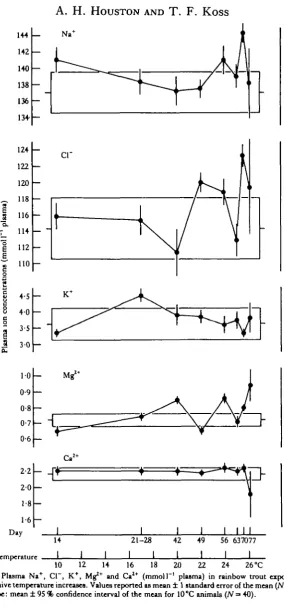
Plasma composition
in temperature. By contrast, plasma calcium was essentially thermostable, declining only at 26-1 °C.
Red cell composition
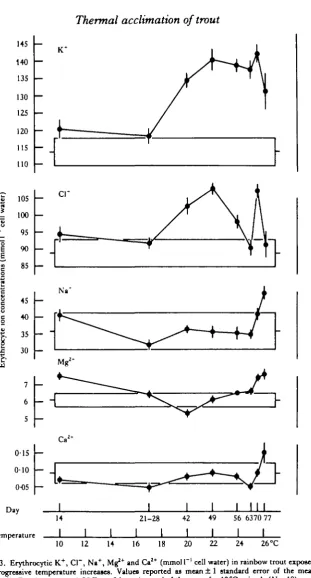
At temperatures exceeding 17 °C, red cell potassium ion concentrations increased sharply, reaching relatively stable values between 22 and 25-5 °C (Fig. 3). A modest decline was evident at 26-1 °C. A much less regular, but somewhat similar, pattern of variation was also observed in the case of chloride ion. By contrast, sodium and magnesium levels tended to decline between 10 and 17—20°C. This was followed by increases in concentration at higher temperature. Calcium concentrations exhibited little variation at other than extreme temperatures.
Ion-haemoglobin ratios
Several of these ions interact directly or indirectly with haemoglobin. Molar ion: haemoglobin ratios were therefore'calculated, and are summarized in Fig. 4. Those for [Ca]: [Hb] were so low as to suggest negligible physiological influence, and have
§
ocm e o
?
01
32
30
28
26
I 24
2220
Day
Temperature
I I I I 14
I
21-28
I I 42
I
49I
56 637077
J I
[image:5.451.82.377.296.610.2]10 12 14 16 18 20 22 24 26 °C
58
3
0.144
142
140
138
136
13+
124
122
120
118
116
114
112
110
4-5
40
3-5
30
10
0-9
0-8
0-7
0-6
2-2
20
1-8
A. H. HOUSTON AND T. F. KOSS
Na+
Cl
Ca2
16
-Day I I I I I
14 21-28
Temperature I I I L
42 49
I I
56 637077
I I
[image:6.451.93.378.46.655.2]10 12 14 16 18 20 22 24 26°C
145
140
135
130
125
120
115
110
105
100
95
90
85
Day
Temperature
14
J I
1
21-28 42 49 56 6370 77
[image:7.451.68.380.48.627.2]10 12 14 16 18 20 22 24 26°C
Fig. 3. Erythrocytic K+, Cl~, Na+, Mg*+ and Ca2+ (mmol 1 ' cell water) in rainbow trout exposed
to progressive temperature increases. Values reported as mean ± 1 standard error of the mean
60
A. H. HOUSTON AND T. F. KOSS22
20
18
16
14
SB"
X
+
Sa"
28
26
24
22
20
18
10
9
8
7
6
1-4
I
10
Day
Temperature
I I I I
14
J_
21-28 42
I I
49
I
56 637077
I I
10 12 14 16 18 20 22 24 26 °C
Fig. 4. Molar fCl"]:[Hb], [K+]:[Hb], [Na+]:[Hb] and [Mg^HHb] ratios in rainbow trout
exposed to progressive temperature increases. Values reported as mean ± 1 standard error of the mean (JV= 10). Envelope: mean ± 95 % confidence interval of the mean for 10°C animals (JV= 40).
DISCUSSION Plasma ion regulation
Fresh water fish exposed to increases in environmental temperature have to satisfy elevated oxygen requirements under circumstances of diminished oxygen availability. Standard oxygen consumption in rainbow trout, for example, rises by almost an order of magnitude over the thermal tolerance zone, while saturation oxygen levels fall by about 40% (Henry & Houston, 1984). Although modest increases in blood oxygen-carrying capacity may occur (Houston, 1980), the salmonids, as a group, appear to respond to such circumstances with increases in branchial ventilation, perfusion and exchange area. Since these, in turn, increase the rates of water and inorganic ion movement across the gills (Randall, Baumgarten & Malyusz, 1972), increases in passive ion and water fluxes would be anticipated, and have been demonstrated (e.g. Evans, 1969; Isaia, 1972; Motais & Isaia, 1972; Maetz, 1972; Cameron, 1976).
Earlier studies on the rainbow trout and related salmonid species (Gordon, 1959; Hickmanef al. 1964; Houston, Reaves, Madden & DeWilde, 1968; Byrne, Beamish & Saunders, 1972; McCarty & Houston, 1977; Murphy & Houston, 1977; Houston & Smeda, 1979) have demonstrated their ability to conserve plasma composition following long-term acclimation to constant temperatures ranging from 2 to 21 °C. The present study indicates that effective control of specific ions can extend to 25-0 or 25-5 °C, i.e. to near-lethal levels. Thus, the rates at which compensatory responses come into play must exceed the rates of temperature change employed in this study. The general nature of the mechanisms by means of which these animals compensate for the perturbing effects of increased temperature on water-electrolyte balance are indicated by a number of recent studies. One obvious response lies in restriction of passive permeabilities. The effects of temperature on rates of oxygen consumption, ventilatory flow and endosmosis are, however, roughly equivalent (Evans, 1969; Isaia, 1972; Motais & Isaia, 1972). Consequently, it is unlikely that reduced water permeability plays a major role in the adaptive process. Compensation for water-loading is achieved primarily by increases in urine output (Mackay & Beatty, 1968; Lloyd & Orr, 1969; Isaia, 1972; Motais & Isaia, 1972). Although urinary ion con-centrations are reduced, overall loss rates rise at higher temperatures (Houston, 1973; Mackay, 1974). Nevertheless, from the viewpoint of water balance per se, the mechanisms governing this temperature-related diuresis must be both precise and powerful for variations in water content are modest in relation to those in diffusional influx.
plasma sodium and chloride levels under such circumstances. Less is known respect to the other ionic species considered in this study.
Although there is little doubt as to (Na+/K+)-stimulated ATPase involvement in sodium transport, this system is extremely cold-sensitive (Giles & Vanstone, 1976; Russell & Chambers, 1976). Assays conducted at the temperatures actually experien-ced by trout reveal low levels of activity at other than relatively high temperatures (McCarty & Houston, 1977). This has lead to the suggestion that (Na+/K+ )-stimulated ATPase may, in this species at least, serve principally as a high tem-perature sodium uptake amplifier (McCarty & Houston, 1977). If this is the case, one or more cold-insensitive processes must operate in cold-adapted animals to maintain sodium balance. From this viewpoint carbonic anhydrase is of particular interest, for it is characterized by both an unusually high turnover number and low Qio. The system functions in both sodium and chloride transfers in fishes, presumably through provision of the H+ and HCO3" required for H+ or NH4"1": Na+ and HCO3": Cl~ exchanges (Kerstetter, Kirschner & Rafuse, 1970; Kerstetter & Kirschner, 1972; Maetz, 1974; Kerstetter & Keeler, 1976). A system possessing such characteristics could provide relatively thermostable basal sodium and chloride uptake rates. Consis-tent with this, branchial and renal carbonic anhydrase activities in rainbow trout are relatively high and temperature-insensitive over broad ranges of intermediate acclimation temperatures (Houston & McCarty, 1978), and this is true of the more eurythermal goldfish as well (Houston & Mearow, 1982). However, since chloride losses are also elevated at higher temperatures, some means of supplementing chloride, as well as sodium ion uptake, is required. Kerstetter & Kirschner (1972) have suggested that a HCC>3~:C1~ exchange driven by erythrocyte-generated HCC>3~ constitutes a major element of the chloride absorption mechanism in rainbow trout. Although the Kerstetter-Kirschner hypothesis has been questioned (e.g. Milne & Randall, 1976), the increases in red cell carbonic anhydrase activity which would be anticipated with acclimation to increased temperature have, in fact, been demon-strated in both trout and goldfish (Houston & McCarty, 1978; Smeda & Houston, 1979; Beaumont, Koss & Houston, 1981). Finally, the involvement of HCC*3~-stimulated ATPase in chloride transport has been postulated (Kerstetter & Kir-schner, 1974; Solomon, Silva, Bend & Epstein, 1975), and some increase in the branchial and renal activities of this system also accompanies the acclimatory process (McCarty & Houston, 1977). Thus, observations to date suggest that compensation for increased water-loading centres primarily on diuretic responses. Stabilization of electrolyte levels appears to be a more complex process involving changes in per-meability characteristics, and enhancement of active absorption and reabsorption processes in the gills and kidney.
Thermal acclimation of trout 63
temperature beyond which transport capacity cannot be increased. The value obtained in this way (25-3 ± 1-0 °C) proved to be almost coincident with the ultimate upper lethal temperature (Kaya, 1978). Much the same is true of red cell, branchial and renal carbonic anhydrase activities in both this species and the goldfish, and of branchial and renal (Na+/K+)-ATPase activities in the latter (Houston & McCarty, 1978; Smeda & Houston, 1979; Houston & Mearow, 1982). This is, perhaps, to be expected, given the long-postulated ionoregulatory involvement in heat death in fishes (e.g. Doudoroff, 1945; Brett, 1952).
Red cell composition
In an earlier study on rainbow trout acclimated to constant temperatures ranging from 2 to 18 °C, substantial increases in red cell potassium ion levels were observed at higher temperatures (Houston & Smeda, 1979). Associated with these were modest increases in chloride, and some reduction in sodium ion concentrations. Magnesium and calcium were little affected. With the exception of the biphasic changes in mag-nesium ion seen in the present study, a similar pattern of compositional variation was apparent over an equivalent range of temperatures. This can be reasonably well correlated with concomitant acclimatory changes in the erythrocytic carbonic anhydrase and (Na+/K+)- and (HCO3~)-stimulated ATPase activities of this species (Smeda & Houston, 1979; Houston & Mearow, 1981).
The ionoregulatory manifestations of the thermo-acclimatory process in fishes have frequently been interpreted on an implicit assumption that responses are directed toward the conservation of pre-existing conditions. This is not necessarily the case. Inorganic ions are powerful modulators of cellular activities (Bygrave, 1967), and have been implicated in the metabolic adjustments accompanying acclimation (Berisch, 1973). A number of inorganic ions also influence haemoglobin-oxygen affinities in vertebrates and, consequently, the readiness with which oxygen is taken up at the gills and subsequently released to tissues.
Chloride ion, for example, reduces affinity in much the same fashion as do 2,3-DPG, ATP, and other organophosphate polyanions (deBruin, Rollema, Janssen & Van Os, 1982), and addition of chloride favours the 'tense' or deoxyhaemoglobin state of the molecule and release of oxygen. At pH values comparable to those in the teleostean red cell (Steen & Turitzin, 1968; Dobson & Baldwin, 1982), increases in chloride concentration lead to sharp reductions in affinity. Thus, the increases in red cell chloride and [Cl]: [Hb] ratio observed at higher temperatures would be expected to facilitate oxygen release. Less is known with respect to potassium and sodium. Bonaventura, Sullivan & Bonaventura (1976) have demonstrated that NaCl sharply increases the P50 of the single haemoglobin of the Spot, Leiostomus xanthurus. This may, however, reflect the influence of added chloride rather than sodium. On the other hand, both Rossi-Fanelli, Antonini & Caputo (1961) and Bunn, Ransil & Chao (1971) have observed potassium- and sodium-associated decreases in the affinity of human haemoglobin for oxygen, with potassium exhibiting the more powerful in-fluence. If the haemoglobin of trout is similar in this respect, the increases in erythro-cytic potassium and [K]: [Hb] which accompany acclimation to higher temperatures K u l d be expected to augment any chloride effect.
little direct influence upon haemoglobin (Bunn et al. 1971). Both, however, potent affinity modulators. Forming complexes with ATP, the principal organo-phosphate modulator of the rainbow trout erythrocyte (Weber, Wood & Lomholt, 1976), they deny affinity-reducing interactions between ATP and haemoglobin. Cal-cium levels are, however, both low and thermostable. Consequently, little, if any, impact on affinity would be anticipated. On the other hand, substantial amounts of magnesium are found in the red cells of trout. The total amount decreases between 10 and 20 °C, a range over which oxygen consumption is sharply elevated (Henry & Houston, 1983). The proportion of this which may be free to complex with nucleoside triphosphates is unknown at present. Furthermore, we are aware of no studies in which both ATP and magnesium levels have been simultaneously measured as a function of temperature. Reported acclimatory variations in nucleoside triphosphate concentrations are, however, modest (Weber et al. 1976; Nikinmaa, Tuurala & Soivio, 1980) and, taken at face value, existing information suggests that [Mg2*]: [NTP] declines as temperature increases. Accordingly, the proportion of nucleoside triphosphate available for interaction with haemoglobin would be expected to in-crease. Under such circumstances an effect similar to that of chloride should ensue. Beyond this, several obvious strategies exist for potentiation of ionic effects on affinity. Coupling changes in the concentration of ions of similar influence would, for example, be expected to do this. Similarly, inverse concentration relationships between antagonistic ion pairs should provide a comparable effect. Thus, since chloride and potassium have similar effects, a direct relationship between changes in their con-centrations with temperature would be appropriate. If potassium and sodium exert effects on trout haemoglobins which are comparable to those on human haemoglobin, increases in one would be most effective if coupled with reductions in the other. The same is true of magnesium and calcium in relation to chloride and potassium. This possibility was examined by correlation analysis. In each instance, best fits between ion pairs were obtained with linear functions (Table 1). A significant direct correla-tion between chloride and potassium was observed over the entire range of tem-peratures considered. Between 10 and 24-9 °C, potassium and sodium were negatively correlated, and this was true of chloride and magnesium as well. Although no other significant correlations were encountered, those between chloride, potassium and calcium were of appropriate sign. Accordingly, these animals appear to couple acclimatory adjustments in red cell concentrations of ions that have additive or
Table 1. Variations in red cell concentrations (mmoll~l cell water) of ion pairs influencing haemoglobin-oxygen affinity
Ion K+,
Mg2 Me2 C a " Ca24 Na+ NS, rbc, pair cr +
, c r
+
, K+ •, c r , K+
, K+
Relationship
rbc[K+] = 44-89 + 0-868 rbc[Cl~]
rbctMg2*] = 10-07 - 0-037 rbc[Cr] rbctMg2*] = 5-45 + 0-009 rbc[K+]
rbc[Ca2+] = 009 - 00002 rbc[Cr] rbc[Ca2+] = 001 - 0001 rbc[K+]
rbc[Na+] = 5 1 - 8 - 0-124rbc[K+] not significant at the 005 level.
red blood cell.
Bftagonistic effects on haemoglobin-oxygen affinity in an adaptively appropriate manner.
In short, the changes in red cell ionic composition observed under non-acute tem-perature conditions in this, and earlier, studies'(Houston & Smeda, 1979; Houston & Mearow, 1981) are generally consistent with reductions in haemoglobin-oxygen affinity. In addition, several components of the complex haemoglobin system of the trout (Houston & Cyr, 1974; Braman, Stalnaker, Farley & Klar, 1977) are profoundly sensitive to temperature and hydrogen ion concentration (Brunori, 1975; Weber et al. 1975). Since erythrocytic pH falls as temperature increases (Dobson & Baldwin, 1982), both would also be expected to prompt reductions in affinity.
A compromise must, however, be effected between affinity requirements for oxygen loading under circumstances of diminished oxygen availability, and oxygen release to more rapidly metabolizing tissues. Existing information on this appears contradictory. Heath (1973), for example, observed a steady decrease in the arterial oxygen content of rainbow trout exposed to increases in temperature between 19 and 26 °C. Venous oxygen content also declined, reaching negligible levels at about 24°C. The arteriovenous oxygen differential, however, actually increased by about 20% between 15 and 24 °C. These observations are consistent with those of the present study. They point to temperature-related reduction in affinity, but suggest that this impediment to branchial oxygen loading is compensated by more ready release of oxygen to tissues. Against this must be placed the outcome of several studies on acclimatory changes in whole blood oxygen equilibrium relationships (e.g. Black, Kirkpatrick & Tucker, 1966; Cameron, 1971; Weber et al. 1976; Nikinmaa et al. 1980). The various factors (inorganic ions, nucleoside triphosphates, pH, tem-perature) considered in relation to acclimation to increased temperature would be expected to prompt significant increases in P50 • This does not, in fact, take place. Such changes as do occur in salmonids are, at best, modest in magnitude. Thus, one or more factors may oppose those prompting affinity reductions. This possibility is currently under investigation, and will be the subject of a subsequent report.
The authors gratefully acknowledge financial assistance provided through Natural Sciences and Engineering Research Council of Canada Operating Grant A6972 to the senior author.
R E F E R E N C E S
ANTHONY, E. H. (1961). The oxygen capacity of goldfish blood (Carassius auratus) in relation to thermal environment. J. exp. Biol. 38, 93-107.
BEAUMONT, A.-L., KOSS, T . F. & HOUSTON, A. H. (1981). Red cell carbonic anhydrase activity and chloride content in goldfish (Carassius auratus L.) exposed to constant and diurnally-cycling temperatures. Comp.
Biochem. Physiol. 70A, 431-434.
BERISCH, H. W. (1973). Molecular mechanisms of temperature adaptation in Arctic ectotherms and heterotherms. In Effects of Temperature on Ectothermic Organiims, (ed. W. Wieser), pp. 123-137. New York: Springer-Verlag.
BLACK, E. C , KIRKPATRICK, D. SC TUCKER, H. H. (1966). Oxygen dissociation curves of the blood of Atlantic salmon (Saimo salar) acclimated to summer and winter temperatures, jf. Fish. Res. Bd Can. 23, 1187—1195. BONAVENTURA, C , SULLIVAN, B. & BONAVENTURA, ] . (1976). Spot hemoglobin. Studies on the Root effect
hemoglobin of a marine teleost. J. biol. Chem. 251, 1871—1876.
^
JAN, J. C , STALNAKER, C. B., FARLEY, T . M. & KLAR, G. T . (1977). Starch gel electrophoresis of
BRETT, J. R. (1952). Temperature tolerance in young Pacific salmon, genus Oncorkynchus.J. Fish. Res. Bd C/U 9, 265-323. ^ BRUNORI, M. (1975). Molecular adaptation to physiological requirements: the hemoglobin system of trout.
Curr. Topics Cell. Regul. 9, 1-39.
BUNN, H. F., RANSIL, B. J. & CHAO, A. (1971). The interaction between erythrocyte organic phosphates, magnesium ion and hemoglobin. J. biol. Chem. 246, 5273-5279.
BYGRAVE, F. L. (1967). The ionic environment and metabolic control. Nature, Land. 214, 667-671. BYRNE, J. M., BEAMISH, F. W. H. & SAUNDERS, R. L. (1972). Influence of salinity, temperature and exercise
on plasma osmolarity and ionic concentrations in Atlantic salmon (Sabno solar). J. Fish. Res. Bd Can. 29, 1217-1220.
CAMERON, J. N. (1971). Oxygen dissociation characteristics of the blood of rainbow trout, Sabno gairdneri.
Comp. Biochem. Physiol. 38A, 699-704.
CAMERON, J. N. (1976). Branchial ion uptake in Arctic grayling: resting values and effects of acid-base distur-bance. J. exp. Biol. 64, 711-723.
CATLETT, R. H. & MILLICH, D . R. (1976). Intracellular and extracellular osmoregulation of temperature acchmated goldfish, Carassius auratus. Comp. Biochem. Physiol. 55A, 261-269.
DEBRUIN, S. H., ROLLEMA, H. S., JANSSEN, L. H. M. & VAN O S , G. A. J. (1974). The interaction of chloride
ions with human hemoglobin. Biochem. biophys. Res. Commun. 58, 210-215.
DOBSON, G. P. & BALDWIN, J. (1982). Regulation of blood oxygen affinity in the Australian blackfish, Gadopsis
marmoratus. II. Thermal acclimation. J. exp. Biol. 99, 245—254.
DOUDOROFF, P. (1945). The resistance and acclimatization of marine fishes to temperature changes. II. Experi-ments with Fundulus and Atherinops. Biol. Bull. mar. biol. Lab., Woods Hole 88, 194-206.
EVANS, D. H. (1969). Studies on the permeability to water of selected marine, freshwater and euryhaline teleosts. J. exp. Biol. 50, 689-703.
GILES, M. A. & VANSTONE, W. E. (1976). Changes in ouabain-sensitive adenosine triphosphatase activity in gills of coho salmon (Oncorhynchus kisutch) during parr-smolt transformation. J. Fish. Res. Bd Can. 33, 42-56.
GORDON, M. S. (1959). Ionic regulation in brown trout (Sabno trutta L).J. exp. Biol. 36, 227-252. HARDIG, J. & HOGLUND, L. B. (1983). On accuracy in estimating fish blood variables. Comp. Biochem. Physiol.
75A, 35-40.
HEATH, A. G. (1973). Ventilatory responses of teleost fish to exercise and thermal stress. Am. Zool. 13, 490-503. HENRY, J. A. C. & HOUSTON, A. H. (1984). Absence of respiratory acclimation to diumally-cycling temperature
conditions in rainbow trout. Comp. Biochem. Physiol. (in press).
HICKMAN, C. P., MCNABB, R. A., NELSON, ] . S., VAN BREEMAN, E. D . & COMFORT, D . (1964). Effect of
cold acclimation on electrolyte distribution in rainbow trout (Sabno gairdneri). Can.J. Zool. 42, 577—597. HOUSTON, A. H. (1973). Environmental temperature and the body fluid system of the teleost. In Responses of
Fish to Environmental Changes, (ed. W. Chavin), pp. 87-162. Springfield: Charles C. Thomas.
HOUSTON, A. H. (1980). Components of the hematological response of fishes to environmental temperature change. In Environmental Physiology of Fishes, (ed. M. A. All), pp. 241-298. New York: Plenum Pub. Corp. HOUSTON, A. H. & CYR, D . (1974). Thermoacclimatory variation in the haemoglobin systems of goldfish
(Carassius auratus) and rainbow trout (Salmo gairdneri). J. exp. Biol. 61, 455—461.
HOUSTON, A. H. & MCCARTY, L. S. (1978). Carbonic anhydrase (acetazolamide-sensitive esterase) activity in the blood, gill and kidney of the thermally acclimated rainbow trout, Salmo gairdneri. J. exp. Biol. 73, 15—27. HOUSTON, A. H-, MADDEN, J. A. & DEWILDE, M. A. (1969). Some physiological consequences of aortic
catheterization of brook trout, Salvelinus fontinalis. J. Fish. Res. Bd Can. 26, 1847-1856.
HOUSTON, A. H., MADDEN, J. A., WOODS, R. J. & MILES, H. M. (1971). Variations in the blood and tissue
chemistry of the brook trout, Salvehnus fontinabs, subsequent to handling, anesthetization and surgery.
J. Fish. Res. Bd Can. 28, 635-642.
HOUSTON, A. H. & MEAROW, K. M. (1981). Thennoacclimatory modification of red cell ionic composition in rainbow trout, Sabno gairdneri: possible relationship with ( N a+/ K+) - and (HCO3~)-gtimulated ATPase
activities. Comp. Biochem. Physiol. 70A, 315-319.
HOUSTON, A. H. & MEAROW, K. M. (1982). Branchial and renal ( N a+/ K+) ATPase and carbonic anhydrase
activities in a eurythermal freshwater teleost, Carassius auratus L. Comp. Biochem. Physiol. 71A, 175-180.
HOUSTON, A. H., REAVES, R. S., MADDEN, J. A. & DEWILDE, M. A. (1968). Environmental temperature and
the body fluid system of the freshwater teleost. I. Ionic regulation in thermally-acclimated rainbow trout,
Sabno gairdneri. Comp. Biochem. Physiol. 25, 563—581.
HOUSTON, A. H. & SMEDA, J. S. (1979). Thermoacclimatory changes in the ionic microenvironment of haemoglobin in the stenothermal rainbow trout (Salmo gairdneri) and eurythermal carp (Cyprinus carpto).
J. exp. Biol. 80, 317-340.
ISAIA, J. (1972). Comparative effects of temperature on the sodium and water permeabilities of the gills of a stenohaline freshwater fish (Carassius auratus) and a stenohaline marine fish (Serranus scriba, Serranus
cabrilla).J. exp. Biol. 57, 359-366.
M R S T E T T E R , T . H. SCKEELER, M. (1976). On the interaction of NH,+ and Na+ fluxes in the isolated trout gill.
J. exp. Biol. 64, S17-S27.
KERSTETTER, T . H. & KIRSCHNEX, L. B. (1972). Active chloride transport by the gills of rainbow trout {Salmo
gairdneri). J. exp. Biol. 56, 263-272.
KERSTETTER, T . H. & KIRSCHNBR, L. B. (1974). HCOT-dependent ATPase activity in the gills of rainbow trout (Salmo gairdneii). Comp. Biochem. Physiol. 48B, 581-589.
KEBSTKTTER, T . H., KIRSCHNER, L. B. & RAFUSE, D. (1970). On the mechanisms of sodium ion transport by the irrigated gills of rainbow trout (Salmo gairdneri). J. gen. Physiol. 56, 342—359.
LLOYD, R. & O R R , L. D . (1969). The diuretic response of rainbow trout to sublethal concentrations of ammonia.
Water Res. 3, 335-344.
LOENN, B.-E. St OIKAJU, A. (1982). Determination of muscle ions from trout, Salmo gairdneri, by a simple wet extraction technique. Comp. Biochem. Physiol. 72A, 49-53.
MCCAJITY, L. S. & HOUSTON, A. H. (1977). ( N a+/ K+) - and (HCO3~)-8timulated ATPase activities in the gilla and kidneys of the thermally-acclimated rainbow trout, Salmo gairdneri. Can.J. Zool. 55, 704-712. MACKAY, W. C. (1974). Effect of temperature on osmotic and ionic regulation in goldfish, Carassius auratus
h.J. comp. Physiol. 88, 1-9.
MACKAY, W. C. & BEATTY, D. D. (1968). The effect of temperature on renal function in the white sucker fish,
Catostomus commersoni. Comp. Biochem. Physiol. 26, 235-245.
MAETZ, J. (1972). Branchial sodium exchange and ammonia excretion in the goldfish Carassius auratus. Effect of ammonia-loading and temperature changes. .7. exp. Biol. 56, 601—620.
MAETZ, J. (1974). Aspects of adaptation to hypo-osmotic and hyper-osmotic environments. In Biochemical and
Biophysical Perspectives in Marine Biology, (eds D. C. Malius & K. R. Sargent), pp. 1-167. New York:
Academic Press.
MILNE, R. S. & RANDALL, D . J. (1976). Regulation of arterial pH during freshwater to sea water transfer in the rainbow trout, Salmo gairdneri. Comp. Biochem. Physio!. 53A, 157-160.
MOTAIS, R. & ISAIA, J. (1972). Temperature-dependence of permeability to water and to sodium of the gill epithelium of the eel, Anguilla anguilla. J. exp. Biol. 56, 587-600.
MURPHY, P. G. F. & HOUSTON, A. H. (1977). Temperature, photoperiod and water-electrolyte balance in rainbow trout, Salmo gairdneri. Can.J. Zool. 55, 1377-1388.
NIKINMAA, M., TUURALA, H. & Sorvio, A. (1980). Thermoacclimatory changes in blood oxygen binding properties and gill secondary lamellar structure of Salmo gairdneri. J. comp. Physiol. 140, 255-260. RANDALL, D. J., BAUMGARTEN, D. & MALYUSZ, M. (1972). The relationship between gas and ion transfer
across the gills of fishes. Comp. Biochem. Physiol. 41A, 629—637.
ROSSI-FANELLI, A., ANTONINI, E. & CAPUTO, A. (1961). Studies on the relations between molecular and functional properties of hemoglobin. II. The effect of salts on the oxygen equilibrium of human hemoglobin.
J. biol. Chem. 236, 397-401.
RUSSELL, J. C. & CHAMBERS, M. M. (1976). Comparative temperature dependence of (Na++K+)-ATPase.
Physiol. Chem. Phys. 8, 237-251.
SMEDA, J. S. & HOUSTON, A. H. (1979). Carbonic anhydrase (acetazolamide-sensitive esterase) activity in the red blood cells of thermally-acclimated rainbow trout, Salmo gairdneri. Comp. Biochem. Physiol. 62, 719—723.
SOLOMON, R. ] . , SILVA, P., BEND, J. R. & EPSTEIN, F. H. (1975). Thiocyanate inhibition of ATPase and its
relationship to anion transport. Am.jf. Physiol. 229, 801-806.
STEEN, J. B. & TURITZIN, S. N. (1968). The nature and biological significance of the pH difference across red cell membranes. Respir. Physiol. 5, 234—242.