SYNTHESIS AND CHARACTERIZATION (IR, ELEMENTAL
ANALYSIS, ELECTRONIC AND MAGNETIC SUSCEPTIBILITY
STUDIES) OF
2- N-PHENYL IMINO-3-PHENYL -4- (P- HYDROXY
PHENYL)-∆
4-
THIAZOLINE DERIVATIVES
Dinkar Malik*
Department of Chemistry, M. S. College, Saharanpur U.P.
ABSTRACT
The synthesis and characterization (IR, elemental analysis, electronic
and magnetic susceptibility studies) of the transition metal complex of
2- N-Phenyl imino-3-Phenyl -4- (p- Hydroxy Phenyl)-∆4-Thiazoline is
described; complexes are obtained in 71% yield from the treatment of
bromine, acetophenone and diphenyl urea in ethanolic solution. The
complexes were of the type ML2X2 (where M = Cu (II), Co (II) and Ni
(II), L= 2- N-Phenyl imino-3-Phenyl -4- (p- Hydroxy Phenyl)-∆4
-Thiazoline and X= Ci-, CH3COO-. The complexes were ionic which
show significant covalency in metal-ligand bond. All the synthesized
complexes were screened for their antifungal activity against different
fungi at different concentrations. The activity decreases with decrease of concentration and
the metal complexes are less toxic than the parent ligand.
KEYWORDS: 2- N-Phenyl imino-3-Phenyl -4- (p- Hydroxy Phenyl)-∆4-Thiazoline ligand, Complexes, Toxicity, IR, Elemental analysis.
INTRODUCTION
Complexes of transition metals ions containing ligands with N, S and N, S, O donors are
known to exibit interesting stereo chemical, electrochemical and electronic properties.
Semicarbazones and thio semicarbazones are amongst the most widely studied nitrogen and
oxygen/sulphur donor ligands. Besides, thio semicarbazones, in the last two decades, have
emerged as an important class of sulphur ligands particularly for transition metal ions. The
real impetus towards developing their coordination chemistry i.e. their physiochemical
Volume 4, Issue 8, 1618-1625. Research Article ISSN 2277– 7105
*Correspondence for
Author
Dinkar Malik
Department of Chemistry,
M. S. College, Saharanpur
U.P.
Article Received on 25 May 2015,
properties and significant biological activities. Thiazolines and their derivativatives have
created an interest due to their wide range of activity. Thiazoline and their derivatives
possess antimalarial, antheminitic, antifungal, antibacterialand antitubercular activities. Such
compounds can also be used as local anaesthetic, antiradiation drugs, antiviral and anti
protozoan agentand also in the rubber industry as vulcanization accelerators. Complexes of
the ligand 2- N-Phenyl imino-3-Phenyl -4- (p- Hydroxy Phenyl)-∆4- Thiazoline with
transition metals were prepared and characterized on the basis of IR, elemental analysis,
electronic and magnetic susceptibility studies. A critical review of literature revealed that no
systematic work on transition metal complexes of 2- N-Phenyl imino-3-Phenyl -4- (p-
Hydroxy Phenyl)-∆4-Thiazoline has been carried out. Khamamkar et. al. 2012 studied the
synthesis, spectral characterization and biological activity of Schiff’s base derived metal complexes. Schiff’s base derived complexes of derivatives of DHA were also studied by
Mane et.al.2001. Malik et. al. 2013, 2014, 2015 studied the structural and biological aspects
of transition metal complexes of the ligands oxazole and thiazole. The present paper deals
with the preparation and characterization of Cu(II), Co(II) and Ni(II) complexes with 2-
N-Phenyl imino-3-N-Phenyl -4- (p- Hydroxy N-Phenyl)-∆4- Thiazoline. Metal complexes play an
important role in biological activity. In many cases metal complexes are more potent than
free ligands. The newly prepared complexes were also screened for their antifungal activity
against different fungi at different concentrations (Bharti et al. 2010).
EXPERIMENTAL Materials and methods
All the chemicals and reagents used were of analytical grade: otherwise they were purified
before use. Organic solvent used was absolute alcohol. IR spectra of the ligand and
complexes are recorded in nujolmull. The electronic spectra were recorded in MgO at room
temperature on VSU-22 spectrophotometer. The measurements were carried out Guru Nanak
Dev University, Amristar. Metal and sulphur contents of these complexes were estimated
using the standard procedures reported in literature (Vogal 1961 and Vogal 1958). The
estimation of carbon, hydrogen and nitrogen were carried out at BHU, Varanasi and CDRI,
Lucknow and results are given in Table 1. Magnetic measurements were carried out at IIT
Table 1: Elemental Analysis Data.
Complexes %Calc./ Obs.
C H S N O M
C21H16N2OS 73.25
73.21 4.65 4.58 9.30 9.16 8.13 8.01 4.65
4.59 ---
[Cu(C21H16N2OS)2Cl2]
61.27 61.16 3.80 3.74 7.70 7.62 6.81 6.68 3.80 3.76 7.70 7.51
[Ni(C21H16N2OS)2Cl2]
61.61 61.46 3.90 3.79 7.82 7.72 6.82 6.68 3.90 3.80 7.20 7.11
[Co(C21H16N2OS)2Cl2]
61.64 61.53 3.89 3.82 7.85 7.76 6.84 6.71 3.91 3.84 7.23 7.16
[Cu(C21H16N2OS)2(CH3COO)2]
63.40 63.32 4.31 4.29 7.30 7.34 6.40 6.36 11.04 11.01 7.30 7.28
[Ni(C21H16N2OS)2(CH3COO)2]
63.81 63.72 4.30 4.25 7.31 7.24 6.42 6.36 11.09 11.03 6.80 6.68
[Co(C21H16N2OS)2(CH3COO)2]
63.82 63.62 4.33 4.28 7.30 7.34 6.42 6.37 11.02 11.01 6.29 6.28
The ligand 2- N-Phenyl imino-3-Phenyl -4- (p- Hydroxy Phenyl)-∆4-Thiazoline was prepared
using the procedure reported in the literature (Dodson et al. 1945).
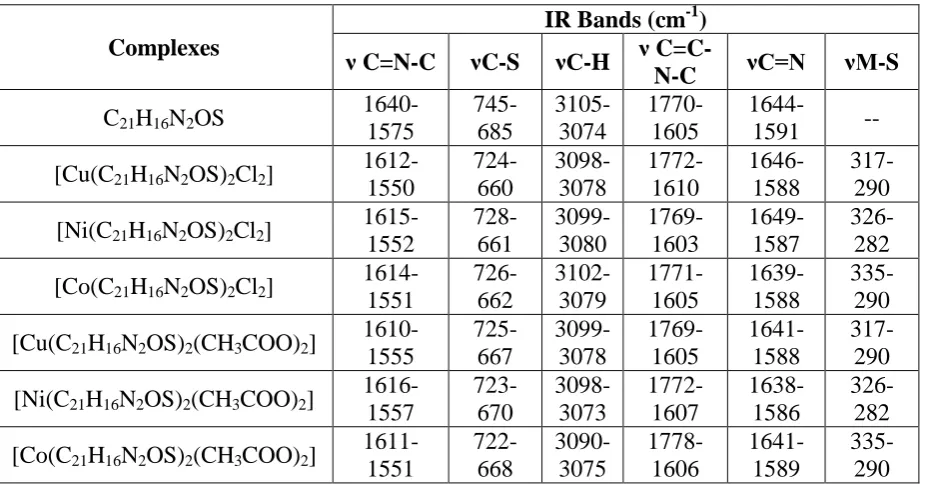
Table 2: Characteristic IR bands of ligands and complexes. Complexes
IR Bands (cm-1)
ν C=N-C νC-S νC-H ν
C=C-N-C νC=N νM-S
C21H16N2OS
1640-1575 745-685 3105-3074 1770-1605
1644-1591 --
[Cu(C21H16N2OS)2Cl2]
1612-1550 724-660 3098- 3078 1772-1610 1646-1588 317-290
[Ni(C21H16N2OS)2Cl2]
1615-1552 728-661 3099-3080 1769-1603 1649-1587 326-282
[Co(C21H16N2OS)2Cl2]
1614-1551 726-662 3102-3079 1771-1605 1639-1588 335-290
[Cu(C21H16N2OS)2(CH3COO)2]
1610-1555 725-667 3099-3078 1769-1605 1641-1588 317-290
[Ni(C21H16N2OS)2(CH3COO)2]
1616-1557 723-670 3098-3073 1772-1607 1638-1586 326-282
[Co(C21H16N2OS)2(CH3COO)2]
1611-1551 722-668 3090-3075 1778-1606 1641-1589 335-290
A shift in the νC=N-C and νC-S band frequencies is observed in all the complexes. This
shows that the lone pair of electron presents on the sulphur atom of thiazoline ring and
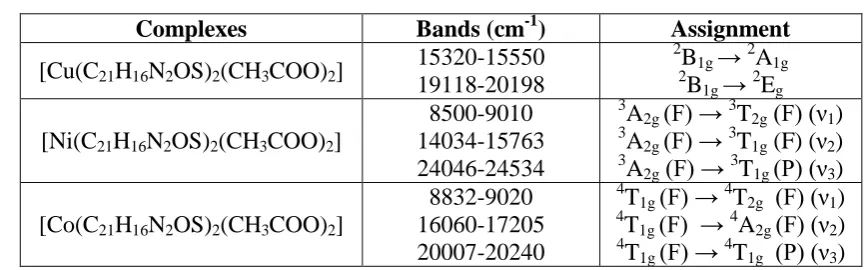
[image:3.595.69.532.407.649.2]Table 3Electronic spectral bands and their assignments
Complexes Bands (cm-1) Assignment
[Cu(C21H16N2OS)2(CH3COO)2]
15320-15550 19118-20198
2
B1g → 2A1g 2
B1g → 2Eg
[Ni(C21H16N2OS)2(CH3COO)2]
8500-9010 14034-15763 24046-24534
3
A2g (F) → 3T2g (F) (ν1) 3
A2g (F) → 3T1g (F) (ν2) 3
A2g (F) → 3T1g (P) (ν3)
[Co(C21H16N2OS)2(CH3COO)2]
8832-9020 16060-17205 20007-20240
4
T1g (F) → 4T2g (F) (ν1) 4
T1g (F) → 4A2g (F) (ν2) 4
T1g (F) → 4T1g (P) (ν3)
CZ-record UV-Viz. spectrometer provided with an automatic recorder was used to record the
electronic spectra of the complexes in ethanol at room temperature (Table 3).
Preparation of metal complexes
2- N-Phenyl imino-3-Phenyl -4- (p- Hydroxy Phenyl)-∆4- Thiazoline Dichloride/Diacetate
ligands and M(II) salts where M= Ni(II), Cu(II) and Co(II) are taken to synthesize the
complex. The respective metal salts in dry alcohol were taken into a round bottom flask and
mixed with required amount of ligand (1:2ratio). A little amount of alcohol was also added.
The reaction mixture was refluxed on water bath for at least two hours and then the reaction
mixture was concentrated to half of its volume. On keeping for overnight, crystals of metal
complexes separate out which were filtered, washed with alcohol and finally with ether and
then dried in vacuum. Similarly some complexes of thiazole thiazolidinones derivatives were
also synthesized by many workers (Maurya et. al. 2007, Issa et. al. 2008, Khalil et al. 2009;
Aridoss et al. 2009; Kaergoudar et al. 2008; Dawane et al. 2010; Adibpour et al. 2010;
Arshad et al. 2011 and Giri et al. 2009).
RESULTS AND DISCUSSION
Elemental Analysis shows that the C, H and N of 2- N-Phenyl imino-3-Phenyl -4- (p-
Hydroxy Phenyl)-∆4-Thiazoline ligand were (73.21, 4.58 and 8.01 respectively) which is
compatible with that required (73.25, 4.65 and 8.13 respectively).The ligand has three donor
sites viz. two nitrogen (one on thiazole ring and other on the imino group) and one ring
sulphur. Thiazolines are formally derived from imidazole by replacement of -NH by sulphur
in position one makes it better π acceptor due to the availability of empty d-orbital on sulphur
atom. The infra-red and far infra-red spectra of the ligand and its complexes were recorded to
IR Spectra
Formation of the ligand 2- N-Phenyl imino-3-Phenyl -4- (p- Hydroxy Phenyl)-∆4-Thiazoline
was confirmed by the presence of IR absorption bands. The ring nitrogen does not take any
part in the coordination because strong band obtained near about 1644-1591 cm-1 which is
due to ѵ (C=N) frequencies in the free ligand is completely unaffected after complex
formation. The lone pair of electron available on nitrogen atom of imino group is taking part
in complex formation because ν C=N-C asymmetric and symmetric stretching frequencies
appeared in the region 1640 and 1575 cm-1 respectively, decreases after complex formation.
The ring sulphur of thiazole ring is taking part in complex formation because the band
observed at 745-685 cm-1 in the free ligand assigned to asymmetric ѵ (C-S) is shifted to
lower frequency after complexation. From the above observations it is clear that the nitrogen
of the imino group and ring sulphur take part in coordination.
Elemental Analysis
The element analysis show that the percent of N= 6.88 % and Cu= 7.51% which were
compatible with required (N= 6.81 % and Cu =7.70% in complex [Cu(C21H16N2OS)2Cl2] and
the percent of N= 6.36 % and Cu= 7.28% which were compatible with required (N= 6.40 %
and Cu =7.30% in complex[Cu(C21H16N2OS)2(CH3COO)2].
The percent of N= 6.71 % and Co = 7.16% which were compatible with required (N= 6.84 %
and Co =7.23% in complex [Co(C21H16N2OS)2Cl2] and the percent of N= 6.37 % and Co=
6.28% which were compatible with required (N= 6.42 % and Co =6.29% in
complex[Co(C21H16N2OS)2(CH3COO)2].
The percent of N= 6.68 % and Ni= 7.11% which were compatible with required (N= 6.82 %
and Ni =7.30% in complex [Ni(C21H16N2OS)2Cl2] and the percent of N= 6.37 % and Ni=
6.68% which were compatible with required (N= 6.42 % and Ni =6.80% in
complex[Ni(C21H16N2OS)2(CH3COO)2].
Electronic Spectra
In the electronic spectra of Ni (II) complexes three bands at 8500-9010, 14034-15763 and
24046-24534 cm-1 were observed which may be assigned for 3A2g (F) → 3T2g (F) (ν1), 3A2g
(F) → 3
T1g (F) (ν2) and 3A2g (F) → 3T1g (P) (ν3) which are characteristic of octahedral Ni(II)
ion. The magnetic moment values are found in the range 2.90-3.20 B.M. This is in support of
The observed value of magnetic moment is found in the range 4.52-4.55 B.M. which is
expected for tetrahedral Co(II) complex. Three bands were observed at 8832-9020,
16060-17205 and 20007-20240 cm-1 which may be assigned to 4T1g (F) → 4T2g (F) (ν1), 4T1g (F) →
4
A2g (F) (ν2) and 4T1g (F) → 4T1g (P) (ν3) respectively for tetrahedral complexes.
Two bands were observed in the electronic spectra of Cu (II) complexes in the region
15320-15550 and 19118-20198 cm-1 which may be assigned to 2B1g → 2A1g and 2B1g → 2Eg
respectively in a planar field. The magnetic moment value foe the Cu(II) complexes lie in the
range 1.54-1.58 B.M. which support square planar geometry.
Fungicidal Activity
Sulphur and its various compounds are known which function as fungicides and pesticide.
Colloidal sulphur was used as insecticide. The thiazolinee and their complexes were screened
for the fungicidal activity against Drechslera-tetramera, Fusarium-oxysporum and
Macrophomera-phaseoli. The presence of N-C-S group and the phenyl group increases the
fungicidal activity. The presence of phenyl nucleus at position 3 exhibits the greater effect.
The metal complexes are less toxic than the free ligand. This might be due to the fact that free
sulphur is present in the ligand, responsible for toxicity is co-ordinated to metal in the
complex. It is also observed that the ligand as well as their metal complexes is more toxic at
higher concentration and the activity decreases with decrease in concentration.
ACKNOWLEDGEMENT
We gratefully acknowledge to Dr. K.K. Sharma, Principal M. S. College, Saharanpur (U.P.)
for providing necessary facilities.
REFERENCES
1. Adibpour N, Khalaj A, Rajabalian S. Synthesis and antibacterial activity of
isothiazolyloxazolidinones and analogous 3(2H)-isothiazolones. Eur J Med Chem., 2010;
45: 19-24.
2. Aridoss G, Amirthaganesan S, Kim MS, Kim JT, Jeong YT. Synthesis, spectral and
biological evaluation of some new thiazolidinones and thiazoles based on t-3-alkyl-r-2,
c-6-diarylpiperidin- 4-ones. Eur J Med Chem., 2009; 44: 4199-4210.
3. Arshad A, Osman H, Bagiey MC, Lan CK, Mohamad S, Safirah A, Zahariluddin M.
Synthesis and antimicrobial properties of some new thiazolyl coumarin derivatives. Eur J
4. Bharti SK, Nath G, Tilak R, Singh SK. Synthesis, anti-bacterial and anti-fungal activities
of some novel Schiff bases containing 2,4-disubstituted thiazole ring. Eur J Med Chem.,
2010; 45: 651-660.
5. Dawane BS, Konda SG, Mandawad GG, Shaikh BM. Poly(ethylene glycol) (PEG-400) as
an alternative reaction solvent for the synthesis of some new 1-(4-
(4-chlorophenyl)-2-thiazolyl)-3-aryl-5-(2-butyl-4-chloro-1H-imidazol-5yl)-2-pyrazolines and their in vitro
antimicrobial evaluation. Eur J Med Chem., 2010; 45: 387-392.
6. Dodson RM, King LC. The reaction of ketones with halogens and thio urea J. Am. Chem.
Soc., 1945; 67: 2242.
7. Earnshaw A, Magnetochemistry. Academic Press. New York., 1968
8. Giri RS, Thaker HM, Giordano T, Williams J, Rogers D, Sudersanam V, Vasu KK.
Design, Synthesis and characterization of novel 2-(2,4-
disubstituted-thiazole-5-yl)-3-aryl-3H-quinazoline- 4-one derivatives as inhibitors of NF-IB and AP-1 mediated
transcription activation and as potential anti-inflammatory agents. Eur J Med Chem.,
2009; 44: 2184-2189.
9. Issa RM, Khedr AM, Rizk H, 1H-NMR, IR and UV/VIS Spectroscopic Studies of Some
Schiff Bases Derived From 2-Aminobenzothiazole and 2-Amino-3-hydroxypyr, Journal
of the Chinese Chemical Society., 2008; 55: 875-884.
10.Karegoudar P, Karthikeyan MS, Prasad DJ, Mahalinga M, Holla BS, Kumari NS.
Synthesis of some novel 2,4-disubstituted thiazoles as possible antimicrobial agents. Eur
J Med Chem., 2008; 43: 261-267.
11.Khalil AM, Berghot MA, Gouda MA. Synthesis and antibacterial activity of some new
thiazole and thiophene derivatives. Eur J Med Chem., 2009; 44: 4434-4440.
12.Khamamkar Ashwini, Pallapothula Rao Venkateshwar. Synthesis, Spectral
Characterization and Biological activity of Schiff’s base derived metal complexes. J. Ind.
Council Chem., 2012; 29(1&2): 71-76.
13.Malik Dinkar, Yadav Punam, Kumar Sandeep A new method of Synthesis of the ligand
2- amino -4- (p- dihydroxy phenyl) Thiazole and characterizatin of its Nickel (Ii), Cobalt
(II) and Copper (II) complexes Int. J. Phys. & Appl. Sc., 2015; 2(2): 8-14.
14.Malik Dinkar, Yadav Punam, Kumar Sandeep Synthesis and Structural Investigation of
Transition Metal Complexes of the Ligand 2- Amino -4- (P- Dihydroxy Phenyl) Oxazole.
15.Malik Dinkar, Yadav Punam, Kumar Sandeep, Malik Vijai Studies on Structural and
biological aspects of transition metal complexes of the ligand 2-amino-4-(p-hydroxy
phenyl) thiazole. Discovery Pharmacy., 2013; 5(15): 15-17.
16.Malik Dinkar, Yadav Punam, Kumar Sandeep, Malik Vijai Studies on Structural and
Biological Aspects of Transition Metal complexes of the Ligand 2- Amino
-4-(P-Methoxy Phenyl) Thiazole. Int. J.Med. & Phrm. Chem., 2014: 1-3.
17.Malik Dinkar, Yadav Punam, Kumar Sandeep, Malik Vijai Synthesis, Characterization
and Fungicidal Activity 2- Amino -4-(P-Ethoxy Phenyl) Oxazole Complexes of
Transition Metal (II) ions. Res. J. of Chem. Sci., 2014; 4(4): 1-8.
18.Mane PS, Shirodkar SG, Arbad BR, Chondhekar TK I. JC, Sec A; Inorganic,
Bio-inorganic, Physical & Analytical Chemistry., 2001; 40(6): 648.
19.Maurya RC, Chourasia J, Sharma P, Synthesis, characterization and 3D molecular
modeling of some ternary complexes of Cu(II), Ni(II), Co(II), Zn(II), Sm(III), Th(IV) and
UO2(VI) with Schiff base derived from sulfa drug sulfabenzamide and
1,10-phenanthroline, Indian j. of chemistry., 2007; 46: 1594-1604.
20.Vogal AI. A Text Book of Quantitative Inorganic Analysis. 3rd ed. (English Language
Book Society and Longman)., 1961.