
http://wrap.warwick.ac.uk/
Original citation:Zemerly, M. J., Papaefstathiou, E., Atherton, T. J., Kerbyson, D. J. and Nudd, G. R. (1993) Smart integration : a test case study. University of Warwick. Department of Computer Science. (Department of Computer Science Research Report). (Unpublished) CS-RR-257
Permanent WRAP url:
http://wrap.warwick.ac.uk/60937
Copyright and reuse:
The Warwick Research Archive Portal (WRAP) makes this work by researchers of the University of Warwick available open access under the following conditions. Copyright © and all moral rights to the version of the paper presented here belong to the individual author(s) and/or other copyright owners. To the extent reasonable and practicable the material made available in WRAP has been checked for eligibility before being made available.
Copies of full items can be used for personal research or study, educational, or not-for-profit purposes without prior permission or charge. Provided that the authors, title and full bibliographic details are credited, a hyperlink and/or URL is given for the original metadata page and the content is not changed in any way.
A note on versions:
Research
Report
257
Smart Integration:
A
Test Case StudyM
J
Zemerly,E
Papaefstathiou,T J
Atherton'DJKerbyson,GRNudd
RR257
This study is concerned with characterisation of a parallel algorithm, namely partial 1D FFT on a
parallel system (2 x T800). Analytical expressions for the "execution time" for a single processor
bnaZprocessors are discussed and used to obtain a performance measure (execution time) for the
application at hand.
Deparunent of Computer Science
University of Warwick
Coventry CV47AL
UnitedKingdom
Smart
Integration:
A
Test
Case
Study*
M.
J.
Zemerly,
E. Papaefstathiou,
T.
J.
Atherton,
D. J. Kerbvson and G.
R.
Nudd
Department
of
Computer
ScienceUniversity of Warwick
Coventry CV4
7AL
email:
j[email protected]
November 30,
1993Abstract
This stuclv is concernecl rvith characterisation of a parallel aigorithur.
namely partial 1D FFT on a, parallel systern (2
x
T800). Alah'ticaler-pressions for the "execution time" for a single processol ancl 2 processols
are discussecl a1d used to obtain a perforrnance measllle (execution time)
for the application at hand.
1.
Introduction
The smart integration exercise is an additional task to test the PEPS ideology
on a small problem and to gain a better understanding of the intelactions
be-tween the diffelent methods involved
in
the pr.oject. Namely, chalactelisation'modelling, simulation and possibly benchmarking. This lepolt is concelned rvith
the characterisation issues and
will
describein
detail the different stages of thecharacterisation process. Initially, descriptions of the algorithm and the platform
will be provided, followed by a description of the characterisation rnethod.
*This work is carried out under the aegis of "Performance Evaluatiotr of Parallel Systems
2.
Description of
the
Algorithm
The algolithm selectecl fol this tasli is a 1D FFT. The reasons fol selection of the
FFT a1e its rvicle usage. possibilitv of rnanv for-rns of palallelisrn a,rtcl simplicitl'
of iurplcrnentation ancl anal;'sis. The rnethod usecl to caiculate the FFT is lrasecl
on
t[at
clesclibecl in Rabincl ancl Goid fRG75l ancl has the following options:rzrdix 2 irlplt:tneutation
clecimation in f'-ecltrency- (DIF)
o
2048 32-bit cornplex input sa,mpleso fixecl cocfficient,
(t/tl2,if2lz1
tobutter-flics.
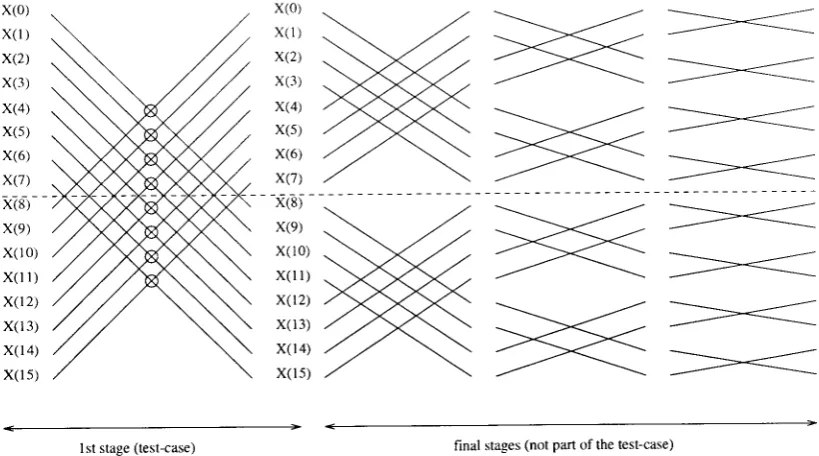
The FFT flou' chalt of the DIF butter'flr'
cornputc the sarne aclcl-multiph'
in
al}is given in Figule 1.
x(0) x(l) x(2) x(3) x(4) x(s) x(6) x(7) xi8)-
-x(e) x(10)
x(l l)
x(12) x(13) x(14)
x(l s)
x(0) x(l) x(2) x(3) x(4) x(5) x(6) x(7)
- -xts)
x(9) --t\\\
><><:
---r-.--><><:
---
-x(10)x(l l)
x(12) x(13) x(14) x(15)
,__--.-'-
=<
-><:
---=-.-\-'-
---rr\,---,' l.<
>*<:
--l---,,-}{
[image:4.595.68.478.395.623.2]I st stage (test-case) final stages (not part of the test-case)
Figure 1. Fiow chart of the FFT used (only 16 samples are shown here).
Only the
first
stage of the FFT is considered here; this is the only stage thatrequires data communication between processors. The other stages run in parallel
without any interaction and do not present any problematic form for performance
Figule 2 shou-s :r I'eplc's€rltation of a DIF br-rttcrflr-.
A+B
(A-B;*1Y
Figule 2. BLrtterflr'
fol
DIF FFT.The
C
ploglanr listingof
thepaltial DIF FFT
ttsccliu
this excrcise is gir-crrin
AppenclixA.
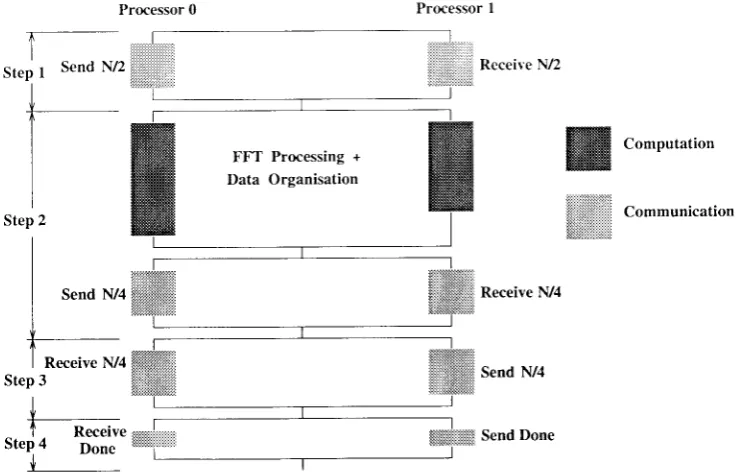
Fignrc 3 shol-s the cornpntation ancl clataflou' ltets-een the 2 DIOCeSSOI'S.Processor 0 Processor I
Computation
Receive N/4
Send N/4
Send Done
I
I-I
I
Step 2
I
I
Sena uraI
In*"*
*roStep 3
I
I Receive
[image:5.595.93.463.413.649.2]st"t
4
ooneFigure 3. Computation and data flou' diagram.
Note that a sequential program is needed to check the results of the
constants. Thc first is to ha,ve onlr' 2 r'ariables u'ith the values of thr: coc'fficit'rtts. The secorlcl implcrnentation is to courpltte the sine ta,ble (of size 3N/4) recl.tiletl
for- tire number of ciata samples of thc samc valuc, ancl stolc thern
iu
an al'l'a\' arrcl fetch the cor-r'ect coefficient everv tirnt: one is neecletl. This is uolmalil' clonc' rvhen cornputirrg an FFT. The listing of the FFT function for the secoucl rncthoclis givin in Appenclix
B.
The 2 irnplenientations rvill be discussecl hr:r'e.3.
Description of
the
Hardware
The platforrn selected is a 2 (4MBytex25NtIHz) T800 Parsvtec ura,chine connectc<l
as shonn in Figule 4. The data are kept in extelnal lnemol-)' and thc plograur iu
intelnal menlol)r. The tlansputers have 4 Iibl'tg on-chiP tnemot']r. Figule 4 shon's
[image:6.595.166.388.338.432.2]a schematic lepr-eserltation of the harclr,vale nsecl.
Figure 4. Srr.alt integlatiorr harclu'ale.
4.
Description of
the
Characterisation Method
The method used here to characterise the FFT algolithm is basecl on tire method
usecl
in
Zemelly [Zem93] and Nudd ela/.
[NPP+93]' The "executiontine"
isselected as a performance measure. For a program running on a single processor the execution time is equal to:
Trcpu
:
(z.xecutio. -F n-"*o.")x
Iwhere Dexecution is the number of clock cycles needed for proglam execution
with-out the memory effect and n-"-o.y, the number of extra clock cycles required
for accessing the external memory and can be defined in terms of the number of
memory accesses per program,
M:iis,
miss penalty and miss rate:(1)
Substituting ecpation (2)
in
e<ptatiorr (1) and gives:factoring the instmction c:ount t
x
Tn",,.r,.,) xr:xclucling the
Ttc,pt, - ? X (a"r",,,,,i.r. u,here Cexecution is the cpu clock c)tcle
+
ll:l:'
x \I,or"r rr.r' i rr*f lrr,'tinrr
I
(3)nlerrx)r\- effect.
Fol a ploglarr] rrulning o1l a nmlti-plocessol thele is a pcnaltl' of corlrunnication
ancl svrrchronisabioir l>etn'een plocessols. Palallcl algolithrns can be nroclelleci in tr,rro l'a)'s ac.colcling to the cornPutation-conrnluuicatiou lelationship as clescrilrt'tl
irr Basu el
ai.
IBSI{P9()] ancl Zemer'l1' [Zern93]: ovcrlappecl auci uou-otellappeclrnoclels.
In
both rnoclels the execntion of an ;rlgorithm is rnoclellecl asrepeti-tivr: steps u'hele a step corrsists of a conrputation fbllol-c,cl
bI
a commr.uricati<.,u.In
thc over'la,ppecl model. computation ancl corrununicatiou can bc' pat'tiallr- ot' completcll'oveliapped. In the non-or,r:r'laliPecl trroclei all the plocessols cio somecomputation aucl then synchrouise a,rrcl exchauge: clata.
It
is assnrnecl helc that aii inter-plocess corr]mtlnication titnes cau be estirrratecl a pr"iori ancl that thele ale no clueuing clcltrr.s in thc slstem. The clata clortraiu isassumecl p;rrtitionecl into sub-clorlairrs of eclual size aucl all the plocessor',s executc the sarrrc ploglam on a ciiffereut clata clouraiu (SPN'tD).
The srnart intcglation ploblcrn can lrc rrroclellecl irr either u'ar-s
but
the easictnon-ovellappecl moclel u,as selectecl
in
the implementation. Figule 5 sirol's thechala.ctelisation rnoclel selectccl
fol
the srrralt iutegr-trtion exelcise.As can bc seen from thc smalt integlation model shol.u irr figule 5 thelc' is onc
processing ancl
4
comrnunication moclules. 4 steps can be assumecl iret'e.ouh-one of thcrn u'ith the processing module ancl the otirels rvithout as shon-n in the
figule.
Assurning a perfect load balancing, the execution time T1. for- a proglam lunning
on a k plocessor system is given by:
tu:?+T"+To"+ft;
(4)where To
is
the execution time (for thepart that
can be paralielised) of thealgorithm on one pr-ocessor)
T.
is the execution time of the serial part of thealgorithm and initialisation time, Too is the parallel overhead plocessing required
when parallelising an algorithm and
l;
is the communication time for' "step" i.The value of
/;
can be estimated from the numbel of bytes transferredin
eachcycle using:
Processor 0 Processor I
Scnd N/2 Receive N/2
Computation
Step 2
Send N/4
Send Done
[image:8.595.79.471.130.406.2]Stcp
4
DoneFigure 5. Non-ovellzrp computa,tion-comrnunication moclel for- snart integla,tion.
wilere lstarr-up repr-csents thc message sta,rt-up ovelhcad ol latenc5', 1."..1 the pnre
communication time, u'hicli is invelsely propoltional to the
linli
banclu,idth, anclB is the nurnl)er of bytes tlansmitted betu'een adjacent processol-s.
Some of the parameters used in these equations are readily available as the clock
cycle time, numbel of processors and the memory miss rate rvhich is assumed
1 since the data is kept
in
the external memory. Other palameters have to bemeasuled from the system. These parameters are the number of execution cycles
required for the FFT, the number of external memory cycles required to access
the data, time penalty for accessing the external memory, either number of
in-structions
in
the program and average ciock cycle per instruction or number ofcycles required
to
execute the program, communication start-up time,commu-nication transfer rate, initialisation/sequential time of the parallel plogram (this factor is negligible in the case of smart integration) and the parallel overheads. In
the foilowing sections methods to obtain each of these parameters ale expla,ined
and discussed.
liiiiiiiiiiiiiiiiiiiiiti1 Communication
Rcccive N/4
5.
Measuring Characterisation
Pararneters
5.1.
Measuring
the
Program
Parameters
Filst the nurrrlrel of c'r'clc's of the fouliel tlansfolnr plogt'altt is obtainecl rtsing thc
lbllol'ing ptoceclult,.
1.
Cleate a softrn':rle execution glaPh for the furrctiorr in clttestion. For exatrtplelol
theffoultl
fnnctiori the execution graph n'ill look sourcthing like that:finit
(function
init)
vinit
(Variable
init)
11
(loop
1)L2
(1oop 2)t3
(loop
3)proc
(Main processing)Tire purposc of this glzrph is to come up n'ith ar] exl)r'essiort to calcrriatc'the total numbcr of clcles. Fol the alrole graph the total nrrrnbel of cr-clcs is:
C:
C(finit) -f C(r.init)*n1
x
[C(11)+"2
x
(C(12)*n3
x
(C(13)*ploc))]
(6)u,herc: n1,n2,n3 a.re the number-of loop execntion for 11, 12 ancl 13 r'espectir-el1'.
C() is a function that letttr-1s tlte
nlrlbel
of c)'cles perfirlctiol.
Hele n1 ancl n2 are 1 u'here n3 is 512.
2.
The next step is to identifl' the number of c1'6]g5 per- each nocle of the glaph(the C function).
In
orderto
do that the soulce code for eachpalt
is isolated. For example theisolated soulce code for the loop 13 is:
for(
cradix=O;
cradix
(
nbradix; cradix
++ ),
Then the soulce code of the isolated palt is compiled u'ith the option -S to ploduce
the assembly listing. If, for example, the file that contains the isolated for loop
is called test.c the follorving compile command tvas used:
Flom the assenrbll' 6e.1"
iu
the file test.s only thc par-tfor
the looir exr:ctrtiottis isolatc.cl exclucling trurction irritialisatiorl, I'etrlr'l] etc. The loop assettrlrh' coclc
aftel thc cxc:hision of illelevant cocle loohs like:
ldc
0stl-
.ti1
I lq.
ldl
.ti
1+1]d]
.ti1
af
cj
.L72f 14. .LA=.
T1?.
]d]
.ti1
adc
1stl
.ti1
j
.L15.Lt2:
Tlie next step is to use the csh sclipt irscnt.csh (see Appenclix C) to count hol'
m.any times the same instluction occuls irr the source cocle. This is clorre
ltr-typing:
csh inscnt.csir
This autornaticalll' rvill filter all tire assenbl5' codes in the cii'-ector'1' and otttput
t[e
result to the stdout. The result fol the above exanrple is shorvn in Table 1.times
operation cycles
total cycles1adc11
1.j22
1gt22
1j33
1ldc11
3ldl
26
2stlI2
total T7
[image:10.595.179.379.544.695.2]Thc,rr nsing t,he Tlansl-nrtcl clata book thc number- of c1'cles for each of thc' cotn-urancl is tiren extrat'tecl attcl thc' total ntturbel of c)'cles leclr-rirecl to ext'cttte thc-nocle is thcrr caiculatecl u'hic:h in this case is 17 c1-cles. This nurnbr:r irtclncles the thr: CPU c-vcles lecgilecl to acccss thr: intelnal rne,rnolr-. Thc extelual
llter]]or\-effect rvill lte cliscussecl latcr'. Since tlie othc'r'loops har-c t.xactll'thc saltte pattelr]
(int loop connter, coristant initialization integer cornparison. integel iucrcrnetrt )
\vc car] conclrr<lr: that the cl.clcs
fol
all the looPs are the saule :c(i1)
:c(12)
:c(13)
:17
The next step is to fincl the rnulber of cycles for all the primitive opclatiou,s.
finit
:
70 cvcles an<l r'init:
53 cvclesThe rnain butter'flr' ploccssing loop "proc" is the rnost irnpoltant palt of
plocess-ing and the a,ssemblr' count of opc:r'ations as r','cll as the nurrrl;er of cr-clcs lecg-rilecl
for execntion a,re listecl in Tablc 2.
tirles
opelation7
aclc10
acid10
bcnt4
clup1
fpadd2
fpldnlaclclsl4
fplclnlmulsn10
fpldnlsn6
fpstnlsn3
fpsub2
fpumulby226
ldl10
ldlp6
ldnl8
stltotal
\arne
cr-cles
totalaclcl
corrstant
1
7add
1
10lrr.te
count
2+I
30clr.rplicate top of
stacli
1+1
Sfp add
singlc
6+1+7
1+fp load non loca,l and acld
single
8+1+7
32fp loacl non local and
nuit
single
13+1+7
82fp load non local
single
2+1+7
100fp stole non local
single
2+1+7
60fp subtlact
single
6+1+7
42 fp multiply by2.0
6+1+1+7
30load
local
2
52load local
pointer'
1
10load
non-local
2
12stole
local
1
8497
Table
2.
Cycle count for the FFT routine ffourtr without sine[3N/a].in the cycles column in Table 2 extra cycles wele added as follorn's:
[image:11.595.86.471.358.640.2]o
Fol opelaucls greatel thart 4lrit
an extra tr1'cle tvasbit.
So in the case of a floating point opela,tion. 7aclded for evt:ll'extla 4
cvcles n-ere aclclecl.
Table 2 shos's that thr: tnnrltr,,r of cvcles r.'cc1-tireci to executc the nocle pr-oc (one buttcr'flr,) is 497 c);clcs. 17 c1'6lgs ale also leciuilecl
fol
the loop iteratiorr.Fot' cxample. using ecpation 6 fi'om step 2 the total nurrtbel of cr-cles lecptirerl to
execltc the slbloutirre "fft>ultr" for'1024 cornplex clata samples (512 butterflies)
rvitltout taliing irrto corrsiclelation the effcct of tlie exterrtal memolv is:
c:70+53+
1x
f17+1
x
(17+512x (17+497))]:263325
ct'clesA small ploblem irr finit is that clr-u'ing function initialisation a col]U)iler interral
function CRT stac:li ext<rrrdel is callecl. Since the soulce cocle for this functiorr is
not arraila,ble
it
\l'as asisLlr]]ed that the fr-urction is tr srnall hor.rsekeeping functionancl 10 clcles u,or-rlci lte sufficieut
to
executeit.
In
this exanpic this is uot aproblem since the rnain loop is the clornina,rt pelfolmance factol
ilut
in thc caseof small fulctious
it
shollcl lte consiclelecl as faillf- irnpoltant.Anot[er
loop is recluilccifol
t]re seconcl mcthoclfol
cotnpr-itirlg the sinc' all'ar'.Since the sine soutce cocle is not a,r'a.ilaltle another-pt'oglam u'as u'r-ittett to ttteasttLc the time
fbl
tlie sinc execution.A
thor-rsancl rneasllrements tlcre talien anci theavelage time rvas 195 ps
l,ith
avelage cliffelence of 0.5 1t.s a,ncl stanclald deviationof 0.25. The nrrmber ocl sincs requilecl
lol
N data sarrples is equal to 3N/4. Thenlmber- of c5,6lss of the subroutine
with
the sine alray n'as also oirtaineclin
asimilal wa)' to methocl one and is equal to 539 cycles.
For- timing tire events the tlansputer instluction ldtimer was used rvith high
pri-ority
switched onto
give an accul'acyof
1 microsecond. This is done becauseof reported inconsistency r,vith the TimeNowHigh$ time function plovided by
Parix, the Parsytec operating system (see [Gre93]). The tirningfunction is called SysTimer. The same plocedure has been followed to identify the cycles for the
SysTimer function. This is a very simple case since no execution graph is required
because no contlol statements are included in the code. The number of cycles for
SysTimer is 57.
5.2.
Effect of
the External
MemorY
The time penalty for the externai memory for the T800 transputel is disc.rrssed
in
the Transputer Databook [Inm89]. The Transputel externa,l memory ischar'-acterised by extra processor- cycles per external memory cycle' e [Inm89]' The
tirnc pcnaltl. to acccss the external menror1, clepencls orr the r-aluc' of
r
u-hicir ist_vpicall1- eclual
to
(ancl irr this (:ase asslllnecl to bc)5.
The extertral menrotr- isaccessc.,cl 22 tirrres per' bntter-flr' in the FFT as can be shon'rr from thc asseurlrh' solrr(:c cocle fi'om the nnmlrr,l of loacling ancl storing opet'atious of floating point
clat a.
5.3.
Measuring
the
Parallel
Overhead Parameters
The functiorr rnerncpl. usecl to organise the clata for processor
"0"
anci plocessor"1"
\\,as measuleclin
a sirnilal fashionto
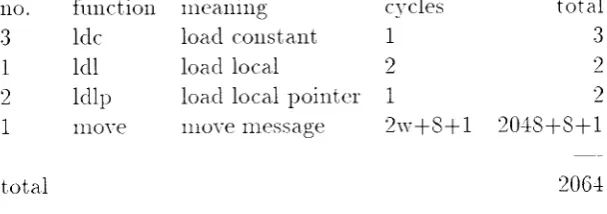
ffoultl
ancl thc, r'esr.rlts ale gilen ittTablc 3. Table 3 shol's the numbel of cvcles lec1tilccl to copr- 4
liltlte.
no.
function3
lclci
lcll2
lcllp1
rnor-etotal
111c'ar]1ng
loacl c.orrsta,nt loacl iocal
loacl local poiutcr
nlo\:e ltlessage
ct.cles
1
2
1
2l'*8*1
total
.-t
2
2
2048+8+1
206+
Table 3. Tirnings
fbl
the mencp)'function for 4 Iibl'te.5 cycles penalty for evcr')'r'ead/u'r'ite shoulcl also ire aclclecl fol meurcpl'. The total is 12304 c)'cles. Othel palameters sucir as the comrr.unication initialisatiorr u'ill be disc.ussecl lvithin the commnnication palaureters. Sorue othet' tliscellaneorts
instructions such as difference of times ancl assigning timing variables \\:el'e es-timatecl at 200 cycles. SysTirner is discussecl previously ancl
it
takes 57 c1'cles.SysTimer was called 16 times on processor' 0.
5.4.
Measuring
the
Communication
Parameters
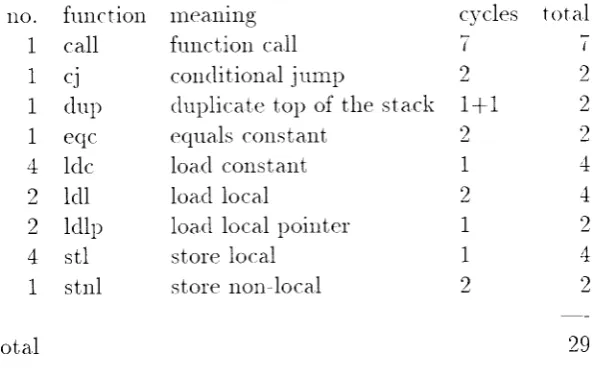
Table 4 shorvs the number of cycles required to initialise the links betrveen the
2 processols. Here The call operation has some extra cycles
for
the functionConnectlink
it
calls.A
program was writtento
measule the timeit
takes toconnect 2 processors (See Appendix E). This program rnakes a 100 links and then
takes the average of these and that value wiil be used insteacl of t(Connectlink).
The program was tested with Makelink and Getlink as well as Connectlink and
[image:13.595.125.429.325.432.2]11o. fttnction
1
call1.j
1
dup1
ec1c.4
lclc2
ldl2
ldlp4
stl1
stnltotal
Table 4. Tirnings
rneaning
function czrll
corrditional jump
duplic:ate toir of the stacii
ecprals constant
loacl constant
loacl local
load local poiutel
stole locai
stole non-local
cl
cles
totzrl7T
22
1+1
222
1,1 a12+
I2
T+
22
29ancl both gave almost the sarne lesults (see Taltle 5).
fbl initialisertion of links betl'eerr l)r'ocessol's.
Tirrre
II72.92y..s
Ploc 0 tc:rrninatcsTimc
1110.01p-<
Pr-oc 1 telminatesTime
1132.00p-s
Ploc 0 termiuatesTirne
1129.15p-s
Ploc 1 teltniuatesN{alielink
Proc 0Getlink
Ploc 1Conncctlink
Proc 0Connectlink
Ploc 1Table 5. Timings for N{akelink,
Getlink
and Connectlink fttnctiousSince
it
is Connectlink in'hich is used in the pr..ogr.'am the value of 1132 lrs n'ill lleused.
Also another program was
wlitten
to
measure the communication bandwidthbetween two processors and the communication start-up
time.
The pr-ogramlisting is given
in
AppendixD.
In
this program, the trvo plocessors are fir-st initialised to make a link between themselves. Then a block of data is sent flomthe first processor to the second and sent back and the time is lecolded for send
and receive the block on both processors. The bandwidth is calculated using
Bandwidth:
BlockSizelQ024x
7024x
0.5 xtime).
BlockSize was incleased inpowers of 2 flom 4 to 262144 byte and a bandwidth value was obtained for ever)/
block size. A plot of the bandwidth vs block size is shown in Figule 6.
Note
that
the bandwidth is valiable becauseit
includes the start-up time andtransfer time. The communication start-up time rvas obtained by fitting a straight
[image:14.595.131.431.134.320.2]Figure 6. Relatiorrship betu'een blocli size ancl banclrvidth.
line to half the tirne vs bloc:k sizc' clata ancl firrcling the time
at
block size of 0.Figure 7 sirou's the relationship ltetu'een llloc,li size ancl time.
Tlre plot only shou's up to block size 32 byte to shou' the stat't-ttp tirtle at zelo
block size clear-ly. The equation obtained fr-om the
fit
was (units in seconcls anclMbyte):
Comrrrunication time
:
stalt-up time*
transfer tirne:
0.0000507866+
0.973054 blocksizeNote
that
transfer time is equalto
the block size divided by the transfer rate(BlR).
The transfer rate is then equalto
(110.973054:1.03 l\4byte/s) Thestartup time is rounded-off to 51 ps.
6.
Program
Time
Measurement
The program time measurement wele taken betrveen diffelent stages of the
pro-gram and the times recorded for these stages are given on the standard output
and saved in a file. These times measured in ps are shown in Table 6.
As can be seen from Table 6 the butterfly plocessing took about 13251 ps on Drocessor 0 and 13296 on processor 1. The total execution times were 31269 and
Fiqr-ilc 7. Reiationship betu'ecn blocli size artcl time.
32573 1rs for- pl'oc(,rssot's 0 and 1 r'espectir-ely. Tlte pl'ogl'aln x'as also I'111] oll olle pr-ocessor alcl thc timc lecolclecl
fol
execriting thc ploglam \Yas 26515 p-s. Notctirat
t[e
tirpe talientol
the butter'fly plocessiug oII orle Plocessor'(26515 ps) i-sless
thal
thetirle
taken on 2 processols. That is ltecause the corntnurticationovelheacl exceeclecl the proccssing tirne.
Fo1
t|e
sine cornputing methocl thc,: seqttential time u'as 335592 p-* ancl the timerneasuLenents on 2xT800 ar-c given in Tallle 7.
It
is also u,or.'th noting that in both cases the total tirnes r'r'ele fluctuating in theo1dc1 of
*
30 1r.s but this u,as ignorecl and only one reacling was selectecl.7.
Predicted Times
Without
Computing Sine[3N/4]
7.L.
Predicted
Sequential Time
The preclicted time for the FFT lunning on one plocessor is given by:
T :
(t"*".ution -l- n*"-o.r)x
tnmer.ory
:
[Tr,*
M..tiox
Tp"'.tyJx M:::t
where Tr, is the avelage hit time (in this case 1), N{,.tio is the internal RAM miss
ratio (assumed 1), Tp",,.ly is the time penalty to access the external memory and
M:::t
is the number of external memory accesses per program'Processor
0
received
DONEsignal (1)
from
sfaveProcessor
1
DONE=1 time-start=1882037 time-end=1914610Processor
0
DONE=1 time-start=4963750 time-end=4995019Processor
0
finished its
task
in
31269 usProcessor 1
finished its
task
in
32573 usProcessor
0
finished initialisation of links in
1124 usProcessor 1
finished initial-isation of links in
2144 usProcessor
0
finished
sendinghalf of
the data
in
7536 usProcessor
0
finished
arranging
its
data
in
759 usProcessor 1
finished
receiving
half of
the data
in
8618 usProcessor
0 finished
butterfly
processingin
13251 usProcessor 1
finished
butterfly
processingin
13296 usProcessor
0
finished
sendinga quarter
of
the data
in
3779 usProcessor
0
finished
receiving a quarter
of
the
backin
3936 usProcessor 1
finished
arranging data
for transfer in
382 usProcessor
0
finished
receiving
FINISHEDsignal in
67 usProcessor 1
finished
recei-vinga quarter
of
the data
in
4114 usProcessor 1
finished
sending FINISHED signal-in
53 usProcessor
0
times
for
arranging data
for
other
processor
(760)and
itsel-f
(759)Table 6. Timings fol the FFT ploglarr (rvithont contputing the sinr:) on 2 T800s.
lfexecution
:
A + btitterflS'-6yclesx
Buttet'flieswhele Butterflies is the number of tire butter'flies and A is the extra cycles usecl for timing the events, routine initialisation and variable intialisation ancl in this
case is equal to 57 + 70 + 53
+
17+
17:214
cycles.nme-o.y
:
(i
+ 5)x
16x
ButterfliesThis gives:
T
:
(2I4+
514x
1024* 6x
22x
7024)x
40x
10-'
:
26468psCompared to the measured time for butterfly plocessing,26468;.1s, the predicted
time, 26635 ps, is 167 ps (-0.63%) slower'.
Processor
1
DONE=1 time-start=878436 time-end=1060071Processor
0
DONE=1 time-start=S299160 time-end=S479490Processor
0
finished its
task
in
180330 usProcessor
1
finished its
task
in
181635 usProcessor
0
finished
initi-al-isation of links
i-n 1125 usProcessor
1
finished initialisation of links in
2146 usProcessor
0
finished
sendinghatf of
the data
in
7819 usProcessor
1
finished receiving
half of the
data
in
8902 usProcessor
0 finished
arranging
its
data
in
759 usProcessor
0 finished
butterfly
andsine
processingin
161929 usProcessor
1
finished
butterfly
andsine
processl-ngin
161925 usProcessor
0
finished
sendinga quarter
of the
data
i-n 3930 usProcessor
0 finished receiving a quarter
of
the
data
in
3883 usProcessor
1
finished
arranging data
for transfer in
383 usProcessor
0 finished
recej-ving FINISHEDsignal in
67 usProcessor
0
times
for
arranging data
for
other
processor (761)and
itself
(759)Processor 1
finished
receiving a quarter
of
the data
in
4314 usProcessor
1
finished
sendinga quarter
of
the
data
in
3870 usProcessor
1
finished
sending FINISHEDsignal in
52 usTable 7. Tirnings fbr the FFT (u,itir sine[3N/4]) program on 2 T800s.
7.2.
Predicted Parallel Time
Recalling equation 4, the pledicted time
fol
the FFT lunning on tu'o plocessols(values ale ta,ken for processor' 0) is given by:
Tp,o
rk:
r-
-rTr+To"+!t;
i:r
For simplicity and because
it
is too small compared to the total time, tire effectof
T"
is neglected here andii
is assumedthat
To is equal toT
(the sequentialtime on one processor).
Too
:
C(SysTimer') x Timings + C(misc)*
C(Initlink)
*
4x
C(rnemcpy(aKb)Tpo:57 x
15+200 +(29*C(Connectlink))
+4x
12304 cvcles [image:18.595.66.458.137.435.2]50300 25
4
I,' :
t(Slilrltr')
*
t(4liblte)
+ t(4l{bvte)t
t(4bvtr:) + + x tst:rrt-'p-f84++
\'.-:-/'r-
----Lrlvill{)o4xR 102lxR 102lxR
101+x1021xRi-l
:
7535 + 3793 + 3793+4
+ 4x
51:
15379tr.sSubstituting iu eclt;rtion 4 gives:
,616S
t*
_
?
+ 314++
1i379=
31757/rsThctirncfor'ploccssor0tofinishis3l757ps. Acliffelcrrceofonir'488p.s(i.56%,) f}om thi: nreasrrlccl timc of 31269 rl.s.
8.
Predicted Times
with
Computing
Sine[3N/4]
8.1
.
Predicted sequential Time
lrexecurion
:
A + butterfly-cycles X Buttelfliesf
C(sine)butterfly-cycles
:539*
1 7:556 cyciesfinit:70
cycles and vinit:153 cycles.A
:
57 *70+153+17 +1.7 +29:
343 cyclest(sine)
:
(3 x DataSamplesl a)x
(SineTime{
LoopTirne):
(3x
204814)x
(195+
17125): 300564/,sC(Butter'flies)
:
1024x
(556 + 6x
22):
704512c)'cles1:
(343 +704512) x 40x
10-e +300564 :28794 +300564:328758ps8.2.
Predicted Parallel
Trme
C(Btrttt:r'flies)
:
512x
(556 + 6x
22):
5I2x
633:
352256c1c1t:sC(sine)
:
(3x
DataS:rrnples/4)x
(SineTimctLoopTinre):
(3x
I02+l+)x
(195+
I7125):
150282trsTpo
:
3144ps.1
I ''
:
153791'sT,
rk -
-
32375S + 31 44+
15379:
1S2902/rs2
-r'rr
9.
Conclusion
Thc pleclictecl times olttainecl from tire charactelisation rnoclel usecl ga,r'e sirnilar
alls\\;et's to the measuled tirnes. The clifferences
fol
the secltrc:ntial ancl parallel1D
FFT
progr-arns(l'ith
ancl rvithout conpnting the sinc:allal')
bets'eerr thepledictecl ancl the measulecl time n'ele less than
4%.
Table 9. summalises thclesults obtained.
Without sine[3N/ ] With sine[3N/a]
Sequential Parallel SK Sequential Parallel SK
Measured 26635 37269 0.85 335592 180330 1.86
Pledicted 26468 3r757 0.83 328758 182902 1.80
Diffelence -167 488 0.02 6834 2572 -0.06
% Difference -0.67 -t.Do 2.35 -2.04 r.43 3.23
A
Listing
of
the
DIF FFT
C program
/x
Proj
ect
:
PEPSTask
:
SmartIntegration
Prnor:m fft.c
r r v6r qrrr
Purpose :
FFTof
2048 complexpoints (radix 2)
on2
T800sAuthors
:
Jamal Zemerly and Efstathi-os
Papaef stathj-ouDate
|
7/9/93f)ocrri nt'i nn
The method used
to
computethe
fft is
the bit-reversed
on theoutputs (DIF,
Rabiner andGold,
1975, page574,
Fig
10.1).Z fAOOs
are
used.in
the
computation.First
the
d'atais
distributed.
betweenthe
processors (eachget
N/2points)
foflowed
by
FFT computation and Exchangeof
data
between theprocessors (each send N/4
points).
The processstops
when thedata
is
recei-ved andwritten in
the
memoryof
each Processor.*/
#incl-ude(stdio . h)
#include(math . h)
#incl-ude(errno . h)
#include(sys/root
. h)# incl-ude(sys/ sys-rpc . h)
/x
Library
references
*/
extern char
xoptarg;extern
doubleatofO;
extern
int atoiO;
extern
int
getoptO;
extern char*
memcpyO;#ifndef
FALSE#define
FALSE 0#define
TRUE 1#endif
#def i.ne MASTER 0
#define
FINISHED 1#define
cETIDO (GET-R00TO->ProcRoot-)MyProcID)#define
GETNPO (CET-ROOfO->ProcRoot-)nProcs)#define
DNODE 4096#define
NODE 2048#define
HN0DE 1024#define
QNODE 512#define
LNODE 8192#define
LHN0DE 4096/x
Local-function
prototypes
*/
void
Mainmaster(int,int,FILE*)
;void
Mainsl-ave(int);void
ffourtr(float*, int)
;void
usage(char+);unsigned
int
SysTimer(void) ;int
ChangePriority(int)
;main(int argc, char**
argv){
int
nn=NODE;/* numberof
i-nputdata
pointsx/
int
p=2;
/xnumberof
processorsx/char
c;FILE
*fd; /*fiLe
descriptorx/
/*
*
read-args
-
Read arguments*/
while ((c
=
getopt(argc,argv,"Uk:n:f:"))
!=
-1)switch
(c)
{
case'k' :
p = alei(optarg)i
break;
case
'n' :
nn= atoi(optarg);
break;
case
't' : if ((ta
=fopen(optarg, "r"))==0)
printe("bad
filename
or
argument") ;break;
case
'U' :
usage("
");
break;
)
if
(p>2){
printe("number
of
processors mustbe 1
or
2");
AbortServer(f);
)
. . / ^\ a
1r \p==z /
t
if
(GETIDO == MASTER)Mainmaster(nn,p,fd) ;
eI se
Mainql
^.ro(.-) y v \rgrl ,.
/*
AbortServer(O) ;*/
)
if
(p== 1; 1if
(GETIDO == MASTER){ Mainmast er (nn , p , f d) ;)
AbortServer(0);
)
)
/x
Mastertransputer
operation*,/void
Mainmasterfi-+-- inr n
FILE*fd)
{
int i,j
; .i-+ L- --- ,/o . LLLV LLLL_LLLLT
' ,
int
qn=nn/4;int
dn=2xnn;i nt I n=nn*4'
int
thn=hnx4;int
Iqn=qnx4;int
ldn=dn*4;float
buf INODE],
data[0lrto0E1 ;static
LinkCB_t* Comlink;/*
CLientvirtual link
descriptor*/
inf arr * , f _ nr ,
unsigned
int
time1, time2, time3, time4, timeS, ctineextra[S];
unsigned
int
time6, time7, time8, time9,
time10,
time11;unsigned
int
timeal-1,,ctimel,
ctime2, ctime3,
ctime4;unsigned
int
ctimeS,
ctime6,
compti.me;char
*DONE;j =o;
/*change
priority of
the algorithm
to
high*/
pr=ChangePriority (HIGH-PRI ORITY) ;
/*copy
the
openedfile into
datax/memcpy(&aata,
fd,
stzeof(ftoat)*DNODE) ;timel=SysTimerO;
/x Initialise the
l-inks
between tlne2
processors*/ . - / ^\ f1T (p==2.,l t
if
( (Coml-ink=Connectlink(1,1000,&err) )== NULL){
printe("Connect
link error
7.d Proc 7.d\n", err,
cgrIDO);
AbortServer(0);
)
t ime2=SysTimer ( ) ;
ctimel=time2-time1;
/x
*
Organisehalf
the
data
for
the other
processor*
This
could be
avoidedwith
sendingtwice quarter
of the
data*/
memcpy(guut [o]
,
aaataIHNODE],
sizeof(ttoat)
*HNODE) ;memcpy(tuut IHNoDE], &d.ata[HItoog+lrtoDE], sizeof (f1oat)*HNODE) ;
/xsend
half the
datato
the other
processorx/t ime3=SysTimer ( ) ;
ctimeextra[j++]
=
(time3-time2) ;time3=SysTimerO;
if(Sendlink(ComLink,
buf,
LN0DE)!=
LN0DE){printe("Send
failed
%d Proc 7.d\n", errno,
GETIDO);AbortServer(0);
)
t ime4=SysTimer ( ) ;
ct ime2=t ime4-t ime3 ;
time4=SysTimerO;
/*organise
the
data
for
the
masterin
buf*/
memcpy(guut[o],
&data[0],
sizeof (tloat)*HN0DE) ;memcpy(tuur IHNODE], &data[N0DE], stzeof(float)+HNODE)
/\
trmeS=SysIlmer(); ctime3= timeS
-
time4;ctimeextra[j++1
=
ctime3;/\
timeS=SysTr-mer();
/*
d.othe
butterfly
processing*/, /. - rrrt^^r\
rlourtr\our,
n]\uuL/ ;time6=SysTimerO; compt ime=t ime6-t ime5 ;
f i ma7=S.rr<Ti m, --r
-'
*"'er / l. \/ i/*
senda quarter
of
the
data
backto
other
processor*/if(Sendlink(ComLink,
&buf IHNODE], LHN0DE)!=
LHNODE){nrinte("send
failed
%d Proc 7.d\n",
errno,
GETIDO);AbortServer(0);
)
t ime8=SysTimer ( ) ;
ct ime4=t ime8-t imeT ;
t ime8=SysTimer ( ) ;
/x
receive a quartsr
of
the
data from
the other
processorx/if
(Recvlink(ComLink, &buf IHNODE], LHN0DE)!=
LHNODE){printe("Receive
failed
7.d Proc %d\n",
errno,
GETIDO);AbortServer(0);
1
t imeg=SysTimer O ;
ct ime5=t ime9-t ime8 ;
t imeg=SysTimer ( ) ;
/*
receive
finished
signal
fromthe other
processor*/if(Recvlink(ComLink,
D0NE,1) !=
1){
printe("Receive
finished failed
%d Proc 7.d\n", \
errno,
GETIDO);AbortServer(0);
i
time1O=SysTi.merO ;
ct ime6=t ime10-t ime9 :
if
(xDONE==FINISHED){
timel
1=SysTimerO ;printf("Processor
7.dreceived
D0NEsignal
(%d)\
fromslave
\n",
GETIDO, 'IOONE);)
t imealf =t ime 1 1-t imel :
timing resultsx/
printf
("Processor %d DONE=7.d time-start=%d time-.n4=o/od\n", \
GETIDO, xo0Ne,
time1,
time11);printf
("Processor of,d,finished its
task
in
7.dus
\n", \
GETIDO,
timeall);
printf("Processor
%dfinished initialisation of links in \
%dus
\n",
GETIDO,ctimel);
printf("Processor
%dfinished
sendinghalf of
the data
i-n\
%dus
\n",
GETIDO, ctime2);printf("Processor
%dfinished
arranging
its
data
in \
%dus
\n",
GETIDO, ctime3);printf("Processor
%dfinished
butterfly
processing
in \
7.dus
\n",
GETIDO, comPtime);printf(',Processor
%dfinished
sendinga quarter
of
the data
in \
'/,a
us
\n",
GETIDO, ctime4);printf("Processor'ld.
finished
receiving quarter
of
the data
in \
%d
us
\n",
GETTDO, ctimeS);printf("Processor
%dfini.shed
receiving
FINISHEDsignal
in \
%dus
\n",
GETIDO, ctime6) ;printf("Processor
%d arrangeddata
for
processor
1
(%d) andfor \
itself
(%d)\n",
GETIDO,
ctimeextra[0]
,
ctimeextrattl );
)
if(p==t){ /*it
only
one processoris
requested*/f imol=QrrqT'im, -"r
-'
*"'er /\\ / iffourtr(data,nn);
time2=SysTimerO;
t i-meal1=t ime2-t ime 1 ;
printf("Processor
%dfinished its
task
in
%dus
\
\n",
GETIDO,
timeall)
;1
.)
/+change
priority to
low*/pr=ChangePri or j-ty (L0W_PRI0RITY) ;
)
/*
Slavetransputer
operat:-on*/void
Mai-nsl-ave(int nn){
int i;
int
hn=nn/2; i nf an =nn ,/4 'rrr v Y^r
int
in=2xnn; i nf 'l n=nn*y'-.rrf. r tint
thn=hnx4;i nf I nn=nn*/-.
int
ldn=dnx4;float
buf [N0DE],
bufr [HN0DE] ;static
LinkCB-tx Comlink;/* Client virtual link
descriptorx/
int err, pri /*error
andpriority
changevariables*/
unsigned
int
time1, time2, time3, time4,
timeS;unsigned
int
time6, time7, time8, time9,
time1O, time11;unsigned
int timeall, ctimel,
ctime2, ctime3,
ctime4;unsigned
int
ctimeS, ctime6,
comptime;char
*DONE;or
/*change
priority to
highx/
pr=ChangePri
ority
(HIGH-PRI ORITY) ;/xstart
timing
from herex/timel=SystimerO;
/* Initialise
the
links
betweenthe 2
processors*/if
( (Comlink=Connectlink(0,1000,&err) )== NULL){
printe("Comm.
init. error
7.d Proc %d\n", err,
cff
IDO ) ;AbortServer(0);
)
/\
t1me2=5ysI lmer(/ ;
ctimel=time2-time1 ;
t i.me2=SysTimer O ;
/*
rec.eivehalf
the
data
fromthe
Master*/t
if(Recvlink(Comlink,
buf,
LN0DE)!=
LNODE){printe("Receive
failed
%d Proc %d\n",
errno,
GETID());AbortServer(O);
)
/\
+ 1m6 <=\\tc I lmoTl ) ;
ct ime2=t ime3-time2 ;
/\
t]-meJ=bysI ].mer\/ ;/*
d,othe
butterfly
operations
onthe
data*/
ffourtr(buf,
HNODE);t ime4=Systimer ( ) ;
conptime
=
time4-time3;t ime4=SysTimer ( ) ;
/*
preparethe
data
for transfer*/
memcpy(guutt [o]
,
auut [o],
sizeof(froat)*HN0DE) ;/\
tlme5=SysI lmer(/ ;
ctime3= time5-time4; /\ trmeb=Sysllmer();
/x
receive a quarter
of
the
data
fromthe
Master*/if
(Recvlink(comlink,
&buf [o],
t Huone) !=
LHNODE){
printe("Receive
failed
%d Proc %d\n",
errno,
CETIDO);AbortServer(0);
i
t ime6=SysTimer ( ) ;
ctime4
=
time6-timeS; time6=SysTimerO;/*
senda quarter
of
the
data
backto
the
Master*/j-f(Sendlink(Comlink,
buf1,
LHNODE)!=
LHNODE){nrintef"Sand
\ vvr.sfailed
+g- %d Proc %d\n",
errno,
GETIDO);AbortServer(0);
)
timeT=SvsT'i mer();
ctimeS= time7-time6;
/*
send D0NEsignal
backto
the
Master*/*D0NE=FINISHED;
/\
t]-me/=JysIlmer(,,;
if
(Send.Link(ComLink, DONE,1)
!=
1){
printe("Send
DONEfaj-]ed
7,d Proc '/od\n",
errno,
CgfIDO);
AbortServer(0);
i
t ime8=SysTimer ( ) ;
ct ime6=t ime8-t ime7 ;
timeall=time8-time1:
printf
("Processor ofod. DONE=%d time-star1=!/,d time-"n4=o/04\n", \
GETIDO, *OOwE,
time1,
timeg);
printf("Processor
%dfinished
its
task
in \
/odus
\n",
GETIDO,timeall);
printf
("Processor %d finished
initiali-sati.on of links in \
%dus
\n",
GETIDO,
ctimel)
;printf("Processor
7.dfinished receiving
half of
the data
in \
o/.dus
\n",
GETIDO, ctime2);printf("Processor
%dfinished
butterfly
processing
in \
%dus
\n",
GETIDO, comptime);printf("Processor
%dfinished
arranging data
for transfer in \
/odus
\n",
GETIDO,ctine3);
printf(',processor
7.dfinished receiving quarter
of
the
data
in \
%d.
us
\n",
GETIDO, ctime4);printf
("Processor o/od finished
sendinga quarter
of
the data
in \
%d
us
\n",
GETIDO, ctime5);printf("Processor
%dfinished
sending FINISHEDsignal
in \
Yd
us \nrr,
GETIDO, ctime6);/xchange
priority
backto
lowx/ pr=ChangePriority (L0W-PRI0RITY) ;)
/+Butterfly
processingroutinex/
void ffourtr(data,nn)
float
dataIN0DE];
/*data
string*/
int nn; /*
numberof
data
items*/
{
int
radix=2;int i, fr, [,
cstage, cblock,
cradix,
nbstage,
nbblock;int
nbradix,
mblock;float tr, ti;
/*real-
and imaginaryparts
of
Tx/f
loat
ur=O.707 ;float
wi=O.707;unsigned
int
time1,
time2;nbblock=1;
/x statt with
1
and increaseby
^2
for
eachblockx/
nbradix=nn/2;
/*
reduceby
factor of
2
for
each stagex/nbstage=1;
/*
l,og2(nn)-1but
for
smartintegration it is
1*/
m=0;
n=m+nn;
for
(cstage=O; cstage(nbstage; cstage++){for
(cblock=0; cblock(nbblock;
cblock++){for
(cradix=0; cradix(nbradix;
cradix++){
datalm] = datalm] + dataln]
;tr
=
datalm]
-
2*data[n];
data[m+1]
=
data[m+1]+
data[n+1];ti
=
data[n+1]
-
2xdata[n+1];dataln] =tr*wr+ti*wi;
U.t.in+1J
=
tr*wi - ti*wr;
m+=2;
n
+= 2;)
)
)
)
*
usagevoid
usage(char* mess){
printe("Usage
:
%s\n",mess) ;printe("\t-k
numberof
processors\n") ;printe("\t-n
numberof
points\n")
;AbortServer(0);
)
B
Listing
of
the FFT routine
with
the sine
computation
/*partial fft
subroutine
on2
processors*/void ffourtr(data,nn)
fl-oat
dataINODE];
/xdata
string*/
int
nn| /*
numberof
data
items*/
{
'int r:div=)'ss+.! ! t
int i,
m,n,
cstage, cblock,
cradix,
nbstage,
nbblock;int
nbradix,
mblock;float tr, ti;
/+real-
and imaginaryparts
of
T+/int ksin,
kcos;int
offset=nn/4;
/+ offset
betweensin
andcos*/
i
nt
si nel enrrth=
3+HN0DE/4;float
SIN[3*HN0OE/4);nbbfock=1;
/* start with
1
and increaseby
^2
for
each bl-ock*/nbradix=nn/2;
/x
reduceby
powerof 2 fot
eachradixx/
nbstage=1;
/*
(1og(2)
nn)-1 but
here
it is t*/
for (i=0; i(sinelength;
i++)SIN[i]=sin(3*pIl4);
m=0; n=6*III1 i
mblock=m;
ksin=0;
kcos=ksin+offset;
for
(cstage=O; cstage(nbstage; cstage++){for
(cblock=0; cblock(nbblock;
cbJ-ock++){for
(cradix=O;
cradix(nbradix;
cradix++){
data[m]
+=data[n];
tr
= data[m]
-
2xdata[n] ;Uut.1m+1J +=
dataltl+tJ
;ti
=
data[m+1]-
2*data;n+fJ;
data[n]
=
tr+SIN[Xsin]
+
ti*SIN[kcos];
data[n+1] =
tr+SINlkcos]
-
ti+SIN[ksin];
m
*=
2;n *= ?'
ksin
+= nbblock;kcos
*=
nbblock;i
-1-1 ^^1.--. Ittutvgn -ll t
- --!.'t ^ ^]. . Itt-lltvlvuA,
n=mblock +nbradix+2;
ksin=0;
kcos=ksin+offset;
C
Listing
of
the
Shellscript "inscnt.csh"
/*
Proj
ect
:
PEPSTask
:
SmartIntegration
Prnoram inscnt.csh
r t v6r qIL
Purpose
:
Countthe
numberof
instructions
of
assemblyfiles
Date
:
7/9/93Authors
:
Efstathios
Papaefstathiouhacrri nf i nn
s #
#
inscnt.
csh#
Countthe
numberof
transputer
instructions of
oneor
more#
assemblyfiles
(.s)
producedby
the
parix
compilers+ fr
foreach f (*\.
s)t A^ ecno ur
awk
'$1
t-
/^
t\.-l /
e,k$t l'
/^t \tl*$/ { print
tt\1"
$1}'
$fl\
-^*+1,,-i^
--DVI U I urrrY
end
D
Listing
of
the
Communication Rate Program
/*
Proj
ect
:
PEPSTask
:
SmartIntegration
Prorrram :
comms.cPurpose
:
measurethe
transfer rate
between2
processorsDate
:
t/9/93
Authors
:
Jamal Zemerly andEfstathj-os
PapaefstathiouDoqeri nt i -r - --^'nn
In this
program,the
two processorsare first
initialised
to
make
a l-ink
between themselves. Thena block of data is
sentfrom the first
processorto the
second andsent
back and theti-me
is
recordedfor
sending andreceiving the block
on bothprocessors.
The bandwidthis calculated
using:Block- s ize
Bandwidth=
---(toz+*7024) *0.5xtime
Block
size
is
being
increasedfrom
4
to
262144bytes
and abandwidth val-ue was obtained
for
al-1, bl-ocksizes.
*/
#include(stdi-o . h>
#include(math . h)
#incl-ude(errno . h)
#include(sys/root
. h)#include(sys/ sys -rpc . h>
#include(sys/select
. h)/x
Library
references
*/
extern
char
xoptarg;extern
doubleatofO;
extern
int atoiO;
extern
int
getoptO;
#ifndef
FALSE#define
FALSE 0#define
TRUE 1#endif
#define
MASTER 0#define
FINISHED 1#define
GETIDO (GET-RO0TO->ProcRoot-)MyProcID)#define
GETNPO (GET-RO0TO->ProcRoot-)nProcs)#def i.ne DNODE 4096
#define
NODE 2048#define
HNODE 1024#define
QN0DE 512#define
LN0DE 8192#define
LHN0DE 4096/*
Local-function
prototypes
*/
void
Mainmaster(int,int)
;void
Mainsl-ave(int);void
r'r sase(char*);unsigned
int
SysTimer(void) ;int
ChangePriority(int)
;void
TimeWaitHigh(unsignedint)
;main(int argc, char**
argv){
i.nt
nn=1;/x
numberof
input
data
points*/
int
p=2;
/xnumberof
processors*/char
c;/x
*
read-args
-
Read arguments*/
while ((c
=
getopt(argc,argv,"U:n:")) !=
-1)switch
(c) {
case
'n' :
nn=
a16i(optarg)i
break;
case
'U' :
usage("
");
break;
)
if
(GETTDO == MASTER)Mainmast er (nn , p ) ;
el-se
Mainslave(nn);
/*
AbortServer(o) ;*/
i
/*
Mastertransputer
operation*/
void
Mainmaster(intnn, int
P){
int i;
float
xdata;unsigned
int
*time, *ctime,
*timest,
*ctimest;
/xcommunicat
ions variabl-es/structuresx/
stat j-c Lj-nkCB-t+ ComLink;
/* Client virtual link
descriptor+/
int err, pr; /*error
andpriority
change valuex/unsigned.
int
time1, time2, time3, time4,
ctimel,
ctime2;int dn,
ldn;
f 'l naf raf o'
Iqwv,
pr=ChangePriority (HIGH-PRI OnITY) ;
/xcalloc for
time
andtime differencex/
if
( (tlmg=(unsigneCint *)
calfoc (40 ,4) )==0)printe
("cannot
allocate
sPacefor
time");
if
((cti,ng=(unsignedint *)
calloc
(ZO,+))==0)printe
("cannotall-ocate
sPacefor
ctime");
timest=time; ctimest=ctime;
*time++
=
SysTinerO;/x Initialise the
l-inks
betweenthe 2
processorsx/if
( (ComLink=Connectlink(1, 1000,&err) ) == NULL){
printe("Connect
link error
%d Proc 7.d\n", err,
CETIDO);AbortServer(0);
)
*time++
=
SysTimerO;*ct ime++
=
* (t j-me-1)
-
* (t ime-2) ;while (nn<=65536 )
{
dn=nn;
I dn=dn*4'
r /r r \ \ ^\
1r ( (data=malroc (ron/ )==v )
printe
("cannot
allocate
sPacefor
data");
*t
ime++=SysTimer O ;if
(Sendlink(Comlink,data, l-dn) !=
ldn){
nrinte("send
failed
%d Proc 7.d\n", errno,
GETIDO);rf frlwv\ v
AbortServer(0);
]
if
(Recvlink(ComLink,data, l-dn)
!=
ldn){
printe("Receive
failed
7.d Proc %d\n",
errno,
CgfIDO);
AbortServer(0);
)
*time++
=
SysTimerO;*ctime++
=
*(time-1) -
x(time-2);
/xprint
timing resultsx/
free(data);
nn= nn*9.LLLL' L '
)
nn=1;
f i mo=f i moqt v +rrrvv v t'
rf i mo=ef i moqf vv4rlrvvv, '
j -1 . a- r r
nrintf("Processor
\ r rvveev\ %dinitialised
the links in
%dus \n", \
GETIDO,
*(ctime++));
/ - ^--^^\ a
wnfl.e (nn<=bbbJb, t
'l dn =nn *4 '
rate= ( (f loat ) tanx tooo000 . 0 ) *z / (
(float
) * (ct ime++) * 1024. 0* 1 024. 0 ) ;printf("%d-
Processor 7.dfinished
sending %dbytes
of
data
in \
%dus
(rate=7.fMbytes/s)\n",
i,
GETIDO,Idn, *(ctime-1),
rate);
nn=nn*2;
'i ++.
)
TimewaitHj.gh ( 10000000 ) ; /xchange
priority to
low*/
pr=ChangePriority (L0W-PRI0RITY) ;
)
/*
Sl-avetransputer
operation*/
void
Mainsl-ave(int nn){
int i,j;
i -+ ,'l- 'l zlh .
IIIU Ullt furrt
float
xdata;/xcomnunicat i ons
variables/
st ructures*/
static
LinkCB-tx Comlink;/*
C]ient
virtual link
descriptorx/
Option-t
optl; /*option of start
receive*/
int
err;
int pr; /xpriority
change value*,/unsigned
int *time,
x61ime,*timest,
*ctimest;
unsigned
int
time1, time2, time3,
time4; unsignedint ctimel,
ctime2;f 'l naf raf o'rsvvt
/xchange
priority to
high*/
pr=ChangePri
ority
(HIGH-PRI ORITY) ;/*ca]Ioc for
time
andtime difference*/
:tt/ /+:*^-/,,-^-:-.
af, \ \ ur*ry-\u'or6rl€d int *) call-oc (40 ,4) )==0)
printe
("cannot
aflocate
spacefor
time");
if
((ctlms=(unsignedint x)
cal-Ioc(20,4))==0)printe
("cannot
allocate
spacefor
ctime");
fimacf=fima.v vfrrrvt atimoqf=rfima'
+time++
=
SysTimerO;/* Initi.alise
the
links
betveenthe 2
processors*/if
( (Comlink=Connectlink(0,1000,&err) )== NULL){
printe("Comm.
initialisation error
%d Proc %d\n", \
err,
CEUDO ) ;AbortServer(0);
)
xtime++
=
SysTimerO;xctime++
=
x(time-f) -
*(time-2);
whi-1e (nn<=65536)
{
dn=nn;
ldn=dnx4;
if
( (data=mal1oc (]dn) ) ==0 )printe
("cannot all-ocate
sPacefor
data");
/xstart
timing
from herex/*time++
=
SysTimerO;/*
receive
the
data
fromthe
Masterx/if(Recvlink(ComLink,
data,
tdn)
!= ldn){
nrinte("Receive
failed
%d Proc %d\n",
errno,
CgfIDO);
AbortServer(0);
]
/xThen send
it
back -ping-pongx/
if(Sendlink(ComLink,
data,
ldn)
!= ldn){
nrinte("Rec.eive
failed
%d Proc %d\n",
errno,
CETIDO);AbortServer(0);
)
*time++
=
SysTimerO;*ctime++
=
+(time-1)
-
x(time-2);
free(data);
nn
=
nn*2;]
nn=1 '
f i mo='f v }.LLvv i moqf v ',
af i ma=rf i moqf .
vv4rrrvvvt
.i -.t .
nrintf("Processor
\ r rvvvvv %dinitialised
the links in
7.dus \n", \
GETIDO,
*(ctime++));
while (nn<=65536)
{
-l dn=nn*4'
r ur! rlrr r t
rate= ( (f Ioat ) ldnx 1000000 . 0 ) *2 / ( (floa1 ) * (ct ime++) * 102+ . o* 1024. 0) ;
printf
(,'%d- Processor %afinistred receiving
7.dbytes
of
data
in \
%dus
(rate=%fMbytes/s)\n",
i,
GETIDO,tdn,
x(ctime-1),
rate);
nn=nn *? 'i++;
)
pr=ChangePri
ority
(L0!rl-PRI0RITY) ;)
/*
*
usage*/
void
usage(charx mess)printe("Usage
:
%s\n",mess) ;printe("\t-n
numberof
points\n")
;AbortServer(0);


![Table 2. Cycle count for the FFT routine ffourtr without sine[3N/a].](https://thumb-us.123doks.com/thumbv2/123dok_us/9864412.487615/11.595.86.471.358.640/table-cycle-count-fft-routine-ffourtr-sine-n.webp)

![Table 7. Tirnings fbr the FFT (u,itir sine[3N/4]) program on 2 T800s.](https://thumb-us.123doks.com/thumbv2/123dok_us/9864412.487615/18.595.66.458.137.435/table-tirnings-fbr-fft-itir-sine-n-program.webp)
