April, 2004. 110 pages. Advisor: Evelyn H. Daniel.
This research study examines the readers’ advisory interview in the elementary school library media center. Ten interviews were conducted with media specialists currently practicing in North Carolina elementary schools. Participant responses helped to identify steps taken during the readers’ advisory interview as well as the school-specific
influences on this interview. Current practices are combined with existing literature to provide recommendations for conducting a successful readers’ advisory interview, establishing a climate favorable to the promotion of recreational reading in the elementary school, and publicizing the unique skills of the media specialist.
Headings:
Reader guidance
School libraries – Reader guidance
LIBRARY MEDIA CENTER
by Jill Heritage
A Master's paper submitted to the faculty of the School of Information and Library Science of the University of North Carolina at Chapel Hill
in partial fulfillment of the requirements for the degree of Master of Science in
Library Science.
Chapel Hill, North Carolina April, 2004
Approved by:
Table of Contents
Introduction 4
Literature Review 8
Methodology 20
Results 24
Discussion 74
Constraints and Limitations 94
Conclusions and Recommendations 95
Further Research 101
References 103
Appendix A: Interview Consent Form 107
List of Tables
Table 1. Overview of Participant Demographics 23
Table 2. Questioning Process 74
Table 3. Readability 76
Table 4. Leveling 81
Table 5. Ready Reference Use 87
Table 6. Direct Instruction in Self Selection 89
Table 7. Follow-Up 90
Introduction
The American Association of School Librarians’ (1998) handbook for school library media specialists, Information Power: Building Partnerships for Learning, states, “Creating a foundation for lifelong learning is at the heart of the school library media program” (p. 1). Further,
As an essential partner who both contributes to and draws from the expertise of the entire learning community, the library media specialist plays a role
that…begins with promoting and reinforcing students’ interests and abilities in reading, listening, and viewing (AASL, p. 3).
According to this definition, the school library media specialist’s role begins with reading encouragement or readers’ advisory services. Broadly defined, readers’ advisory services in the school media center encompass such activities as booktalking, read alouds, reader’s theater, displays, and all activities designed to foster enthusiasm for reading. Readers’ advisory services provide the primary means of promoting and reinforcing students’ reading interests through the school library media center.
At the core of any readers’ advisory effort, lies the readers’ advisory interview itself. Shearer (1996) defines the readers’ advisory interview or transaction as;
entertaining, stimulating, mind-stretching, and eye-opening; it is in the realm of the subjective (p. 3).
In this study, the definition of the readers’ advisory interview can be simplified to mean the one-on-one interaction that occurs between media specialist and student in the school media center, as the media specialist attempts to recommend a recreational reading book for the student.
The term “readers’ advisory” is rarely used in reference to services rendered by the school media center, but rather the term is used almost exclusively in public librarianship. Often no label is given to the many “reading encouragement” activities affiliated with the school media center. This lack of labeling might be explained in a number of ways. It could indicate 1)the ubiquitous nature of these services in the school media center; 2)the long held stereotype that public children’s librarians primarily recommend books for recreational reading whereas school media specialists help students with school
assignments and other curriculum-based services; 3)the inattention to recreational reading in light of the current emphasis on flexible scheduling, collaboration, curricular support, and high stakes testing in education; or 4)simply the nonexistence of instances in which reading encouragement activities in the school media center are explored in a scholarly manner. Most likely, this lack of labeling is due to a combination of each of the above factors and highlights even more clearly the need to study this unique transaction.
and international communities) can impact or even dictate what occurs during the readers’ advisory interview (AASL, 1998, p. 2). When an elementary school student approaches his or her school media specialist with the question, “Can you recommend a book for me to read?” (or the media specialist approaches a browsing student with an offer to help locate a book) myriad issues come into play regarding the placement of this interaction within the context of the learning community. The predecessor to AASL’s
Information Power: Building Partnerships for Learning (1998), Information Power: Guidelines for School Library Media Programs (1988) articulates the mission of the library media program:
The mission of the library media program is to ensure that students and staff are effective users of ideas and information. This mission is accomplished:
• by providing intellectual and physical access to materials in all formats • by providing instruction to foster competence and stimulate interest in
reading, viewing, and using information and ideas
• by working with other educators to design learning strategies to meet the needs of individual students (p. 1).
Current school library literature typically refers to the transaction of the reader’s advisory interview in terms such as “an art” (Carter, 2000, p. 37; Salvadore, 2001, p. 43) without delineating the particular steps involved in determining the suitability of a book for a particular child. This study seeks not only to articulate these distinct steps involved in the readers’ advisory interview in the school media center, but also to document the
influences on the steps taken by the media specialist as he or she moves from the
student’s initial request to a reading recommendation. How can the media specialist best negotiate these influences to achieve goals of both inspiring reading interest and
collaborating with the reading curriculum? The success of the reader’s advisory
Literature Review
In “Missing the Real Story: Where Library and Information Science Fails the Library Profession,” Wayne Wiegand (2001) cites the following statistics:
• Americans make 3.5 billion visits to school, public and college libraries every year—three times more than visits to movies
• School children visit their library media centers 1.7 billion times during the school year—two times more than they visit state and national parks.
• As many children participate in summer reading programs as play Little League baseball (p. 7, ALA Public Information Office, 1998).
Despite these statistics, he explains, an “underwhelming” amount of attention has been paid in the library and information science profession to the “act and social nature of reading” (p. 8). This inattention to recreational reading and readers’ advisory services in professional literature in general, exacerbated by the inattention paid to readers’ advisory services in the school media center in particular, results in a near absence of research-based library literature directly addressing the readers’ advisory interview in the school media center.
The role of the school media specialist in matching children with books is also severely underrepresented in the education literature. The Report of the National Reading Panel: Teaching Children to Read: An Evidence-Based Assessment of the Scientific Research
and reading instruction. None of these subtopics address reading encouragement, readers’ advisory services, recreational reading, matching readers with books for pleasure and, most importantly, none address the vital role to be played by the school media specialist in reading instruction. A recent article on Learn North Carolina (www.learnnc.org), Parks’ “Choosing Books that are ‘Just Right,’” (2004) epitomizes the way in which the role of the school media specialist in reading education is routinely devalued and the varied nature of reading misunderstood. Parks studied the ways in which “students select books for independent reading and how teachers can help them make choices more appropriate to their reading levels.” Parks prefaces her study with an anecdote explaining that she dreads when students ask to go to the library because, in her opinion, only a small number of her students choose library books that they can read independently. The study sought to examine the ways in which fourth grade students self select books and followed with recommendations for educators guiding these students based on these findings. The specialized skills and knowledge of the school media specialist in
recommending recreational reading are noticeably absent from the study whether due to a lack of awareness of the media specialists’ role or a misconception of the varied kinds of reading that are required in balanced literacy instruction. Thus, when education literature specifically addresses the act of matching a student with a book to read, the valuable role to be played by the media specialist is rarely acknowledged.
interview and second addresses research on the selection of recreational reading books for children in a school setting.
The Readers’ Advisory Interview
Dickey and Jones (1994) write, “one of the librarian’s great joys is successfully matching a book to a reader” (p. 15). As such, they provide an outline of skills and tools for the media specialist to help make this reader-book match, specifically for the teen reader. Suggestions include:
• Greet the student with a smile;
• Ask, Can I help find something for you to read?; • If yes, ask, What books have you read that you liked?; • Present titles in an exciting manner;
• If student can cite a specific book he or she liked, determine what elements brought about this interest (this includes also questioning self about titles considering for recommendation as to what elements are addressed in the same manner);
• Don’t avoid a book “with a strong male lead” for female students; • Find out what books the student didn’t like and why;
• Describe a range of titles and watch reaction;
• Write down everything you’ve recommended for individual readers on a card and pull that individual’s card every time you suggest a new title;
• Identify a few all-purpose, “sure-fire” hits to be offered to anyone; • Remember non-fiction books;
• Utilize readers’ advisory ready reference tools (p. 15-16).
Though intended for transactions with teens rather than elementary school age readers, Dickey and Jones’ article offers suggestions for the readers’ advisory interview in a school library-specific setting.
readers’ advisory transaction is placed within a school setting, as argued previously in the introduction to this paper (p. 149). And despite the frequent challenges involved in conducting this interview within the school community, she states, “One of the greatest joys for school library media specialists is to share their love of literature with students” (p. 162). Her recommendations for conducting the readers’ advisory interview itself include the following: ask questions sensitively; listen to their answers carefully; and blend knowledge of children’s literature with knowledge of children (p.158).
Saricks (2001) provides “Tips for the Readers’ Advisory Interview.” First, patrons should be given an opportunity to talk about the types of books they like and dislike; the
librarian must then question further to verify understanding and whether a similar or different type of book is desired. Second, a range of suggestions should be provided based on personal knowledge and ready reference sources all the while modeling the process so patrons feel they are or will be capable of finding a book on their own. Third, if the librarian is unable to come up with suggestions, the patron’s name should be taken down and called once a book is found. And lastly, the patron should be encouraged to return and report whether he or she was happy with the recommendation or not (p. 393-394).
asking questions regarding interest; no questions concerning “appeal factors” such as pacing, characterization, story line, and frame leading to faulty suggestions based on theme, topic or genre (in other words the librarians observed relied on very general characteristics instead of delving into the intricacies of the book’s characteristics); inability to recommend titles beyond personal reading experience/failure to utilize ready reference tools; failure to follow through after making a suggestion; and lack of eye contact and avoidance behavior perhaps due to insecurity regarding readers’ advisory ability (p. 38-39).
Ross (1991), in “Readers’ Advisory Service: New Directions,” conducted over one hundred interviews with readers to help understand how readers choose books and the kinds of assistance services they like and dislike about libraries. After conducting these interviews, she made the following observations of these adult readers:
• They remember a special librarian who made a difference. • They like the way libraries encourage risk taking.
• They like the sense of freedom, expansiveness, and adventure afforded by a library.
• They dislike rules, limitations and restrictions (p. 510).
Based upon this research, she suggested the following elements for the readers’ advisory interview: get a picture of previous reading patterns; determine current reading
preferences; and understand the function of the book (p. 514).
from public library staff members. When asked for another book like Mildred Taylor’s
Roll of Thunder, Hear My Cry (1976), librarians frequently asked the age of the child, asked at what level he or she was reading, then moved on to genre preferences (other Newbery Award winners or African American authors), or often just automatically assumed that the child wanted other books by Mildred Taylor (p. 25-26). Only one librarian instantly questioned the child’s likes and dislikes and interest in the author. That librarian then utilized the OPAC and reference sources to come up with a “wide array of appropriate recommended titles and author.” Though no questions concerning reading level were posed during the interview, the librarian’s recommendations were all on a comparable reading level (p. 27). Ultimately, Bracy concluded that “an approach
characteristic of best practices is one that seeks first to determine the patron’s preference based on appeal and second to focus on recommending appropriate titles based on that appeal” (p. 41).
Recreational Reading Book Selection in the Elementary School
chooses reading material independently and without the limits of leveling. Thus, “readability formulas and reading levels don’t belong in the library” (p. 36).
Carter argues that a child’s reading level varies with the amount of interest he or she has invested in a text – in essence the “reading task” is changed depending upon the child’s interest in the text at hand. Thelinear progression of stages in leveled reading is not indicative of true reading acquisition skills wherein readers sometimes move up and sometimes move down levels (p. 37). Further, content can sometimes render a book unreadable even if it might be on a child’s reading level according to vocabulary level or word count. For Carter, readers’ advisory is the answer to selecting pleasure books for children and “it’s an art” (p. 37). “Readers’ advisory involves knowing books and knowing children” and takes into account “what children liked previously and what they want at this particular moment” (p. 37).
In their study of first graders, Donovan, Smolkin and Lomax (2000) note that many speak about the importance of “what level of difficulty of what type of book is best for
beginners,” yet they “speak to this question without having any knowledge of the levels and types of books the beginning readers themselves might choose…” (p. 309-310). Ultimately, they found that low- and average-ability (and, to a lesser extent, high ability) first graders selected books beyond their reading level. They found that familiarity influenced selection – if a teacher had done a read aloud of that book the low ability readers were more likely to select it. Students also frequently chose stacks of books on the same topic to share with peers (p. 325, 328). Ultimately, Donovan, Smolkin and Lomax conclude,
We believe, in this age of ‘balance’ in reading instruction, that great care must be taken by researchers as they discuss and suggest appropriate texts for children in first grade classrooms. We neither question nor dispute the importance of
controlled-vocabulary texts for children’s beginning reading. But we are
concerned when colleagues … imply that these are the only texts that should be available during first graders’ self selection periods…. Allowing children to select the books they prefer, regardless of their reading level, as one aspect of the total reading program provides children opportunities to build background knowledge and vocabulary…this may be a very important way to maintain children’s interest and motivation to read for a variety of purposes… (p. 330).
Their conclusions thus acknowledge the varying needs that can be fulfilled during recreational reading in addition to acquisition of technical reading skills.
their independent level 60% of the time (p. 297). Ultimately, they concluded that the level at which students choose recreational reading books is so varied (they go from easy to challenging and back again depending on purpose or interest) that, “It is inappropriate for educators to base statements about the difficulty level of books students should select for recreational reading on the concept of independent level as determined by an Informal Reading Inventory” (p. 299). In their use of the term “independent level,” Smith and Joyner are referencing Emmett Betts’ (1946) independent, instructional, and frustrational reading levels. Betts’ levels are very frequently quoted in debates concerning the
appropriate reading levels for instruction as well as recreational reading and are roughly defined as follows:
• A book at a child’s independent level can be read “with ease and comprehension.” • A book at a child’s instructional level can be “read with understanding when
given sufficient help by the teacher.”
• A book at a child’s frustrational level “ is so difficult that it will immediately be frustrating and the child will be unable to comprehend it (Burns, Roe & Smith, 2002, p. 368).
In reaching this conclusion, Smith and Joyner acknowledge the difficulties that arise when children’s recreational reading practices are forced to fit into narrowly defined labels of readability.
In a rare occurrence, Carver and Leibert (1995) melded the study of the classroom and school media center in their research study “The Effect of Reading Library Books at Different Levels of Difficulty Upon Gain in Reading Ability.” They found no gain in reading level in students who read relatively easy material (independent level or arguably below independent level). Due to experiment design they were not able to claim
or frustrational level – had been read. Quite importantly, the deficiencies in the research design that resulted in the inability to make such a claim, occurred because the
researchers used a leveling method to determine the level of books to be read by the student participants. The books that they had determined to be at instructional or frustrational level according to the leveling system used proved to be at a much lower level than intended. Carver and Leibert’s study highlights one instance of the resulting inaccuracies of including leveling in a reading decision and demonstrates the vital need for more research into the connection between school media center and classroom in readers’ advisory services.
In “The Linguistic Assumptions Underlying Readability Formulae: a Critique,” Bailin and Grafstein (2001) highlight a key dilemma for the readers’ advisory interview. When faced with the “formidable task of selecting reading material for children of widely diverse cognitive and reading skills” educators and librarians have frequently “welcomed and endorsed tools that claim to use objective criteria to make selections and
recommendations” (p. 286). These researchers attempted to discern if readability formulae are actually indicators of what they purport to be – difficulty of a text – and ultimately concluded:
Bailin and Grafstein then present alternative criteria for determination of a book’s readability, which include aspects of grammar, style, background knowledge, text coherence, and the “theory of repair.” This theory of repair accounts for the multiple ways in which readers are able to bridge gaps of understanding when a communication gap occurs between text and reader (pp. 297-298).
Although the literature discussed provides a base for the readers’ advisory interview in the school media center, much of it misses the distinctiveness of the school media center readers’ advisory interview highlighted in the introduction to this study. For example, providers of readers’ advisory in the children’s section of the public library do not hold the same responsibilities as their colleagues in the school community. Issues of
preemptively considering a parent’s opinion when recommending a book become less of an issue as, in the public library, children are more often accompanied by an adult. Further, public librarians are often able to devote greater amounts of time to
individualized readers’ advisory services because they are not simultaneously teaching classes. Likewise, studies of the adult readers’ advisory interview discount the myriad issues involved in recommending a book to a child. In Guiding the Reader to the Next Book, Shearer (1996) notes that in readers’ advisory work in children’s and young adult services, “the focus is on connecting the reader to the literature in meaningful ways that foster cognitive as well as psychological and social development” (p. 21). Again, the education literature focuses on the classroom rather than on the unique setting and
Methodology
In conducting personal interviews with participants, rather than sending out surveys, this research study was approached in a qualitative, rather than quantitative manner.
All participants were initially invited to participate via e-mail, while a few required follow-up phone conversations. At the outset of each interview, participants were
presented with an informed consent form outlining their rights as a study participant (See Appendix A). All participants were interviewed within the physical space of the media center in which they work, aside from Media Specialist D who was interviewed in a bookstore prior to an author event. Length of interviews ranged from 30 minutes to one hour.
Each participant was provided, upon invitation, with a set of guiding interview questions to enable preparation if desired (See Appendix B). The guiding interview questions were designed to assess the impact of certain variables on the readers’ advisory interview. Based upon issues isolated in the literature review, the variables underlying the guiding interview questions were:
• readability • leveling
• developmental characteristics • student interests
• teacher philosophy on recreational reading • parental opinion
• use of reference sources • direct instruction
• follow-up
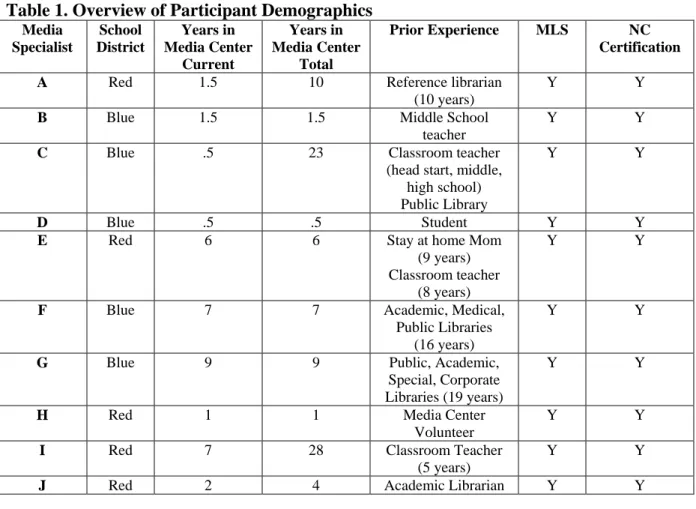
current position as well as total years spent working as a media specialist was then addressed. Though not asked directly, each participant also provided an overview of her professional background outside of school media work (See Table 1). Each interview then evolved from the overarching research question, “What are the steps taken by elementary school media specialists in the readers’ advisory interview to help second grade students select reading books for pleasure?” and incorporated parts of the guiding interview questions along the way, rather than moving in a linear progression through the questions.
Second grade students were chosen as the subject of the research question as students at this level are typically still receiving systematic, direct reading instruction in the
classroom, but are also beginning to emerge as independent readers. Meanwhile the discrepancy between reading abilities due to the speed at which reading skills are acquired can lead to vast differences in reading ability. These characteristics were deemed important due to their potential for eliciting issues in the school library media center readers’ advisory issues that may not be as prevalent at other, less transitional, grade levels.
Table 1. Overview of Participant Demographics Media Specialist School District Years in Media Center Current Years in Media Center Total
Prior Experience MLS NC Certification
A Red 1.5 10 Reference librarian
(10 years)
Y Y
B Blue 1.5 1.5 Middle School
teacher
Y Y
C Blue .5 23 Classroom teacher
(head start, middle, high school) Public Library
Y Y
D Blue .5 .5 Student Y Y
E Red 6 6 Stay at home Mom
(9 years) Classroom teacher
(8 years)
Y Y
F Blue 7 7 Academic, Medical,
Public Libraries (16 years)
Y Y
G Blue 9 9 Public, Academic,
Special, Corporate Libraries (19 years)
Y Y
H Red 1 1 Media Center
Volunteer
Y Y
I Red 7 28 Classroom Teacher
(5 years)
Y Y
Results
The results of the interviews with media specialist participants are reported below.
Common practices and themes that emerge throughout the interviews will be addressed in the following discussion section.
Media Specialist A (Red School District)
Media Specialist A reported that she begins the readers’ advisory interview with a series of questions. If she doesn’t know already, she will ask questions like,
• What have you read recently that you like? • What do you like to read about?
• Do you like to read stories or do you like information?
She notes that each question inevitably leads to more questions and the child’s interests and needs become more and more clear. She is aware that often students have something very specific in mind even if they are not answering her questions. When she encounters a student who can’t provide answers to her questions, she will start pulling books off the shelf, asking “Does this sound interesting to you?” This continued offering and
questioning typically helps media specialist and student “go places.”
without thought are the most difficult to pinpoint and may not be approached for a readers’ advisory interview.
Media Specialist A said that she does “sometimes” consider readability during the readers’ advisory interview, but it depends on the situation. Many children have no intention of reading the book by themselves; in which case they don’t have to be able to read it. How she determines readability depends on the kinds of answers received to the questions concerning what they’ve read or enjoyed reading recently. If these answers indicate that they would like to read something on their own and she doesn’t know what kind of reader they are, she uses the five finger rule. The child reads through a page in the book and holds up a finger for each word he or she doesn’t know, if he or she holds up five fingers, it is an indication to try something else. At the same time, said Media
Specialist A, “I would never deny a child a book that they really wanted just because they missed five words on a page.”
at this approach and a great reluctance to use this method for finding books. In this situation she instructed students to go down their list (of AR books) and find one they might like. Once they had identified a title, she would help them find the book, but she generally wanted students to find such books on their own. She notes that AR is not the way she finds books, nor what she cares about when it comes to finding books. She encountered some teachers who were adamant that their students be able to read the books they checked out of the library rather than anticipate that someone would read the book to the child or that the child might still benefit from the book in other ways. A few teachers would even stand a child up in front of the class and say, “Look at what he picked out. He can’t read this book.” But, luckily, it is not that way at her current school. Teachers at this school want students to come to the media center and find something pleasurable because they are already forcing them to read certain books to improve reading skills in the classroom. The teachers generally are not that concerned that kids are able to read the books they check out for recreational reading because they can typically get help at home or from a tutor.
believes in reading above and below one’s reading level. She has never taken a reading class, nor has she been a classroom teacher and she does not know what the reading level of a book is unless it’s printed in the book somewhere. She doesn’t know a number to assign to a student’s reading level either. She did note that the Red School District has recently signed a contract for a trial deal with NoveList2 and the district’s media
specialists have received preliminary training. With NoveList, if a child has a successful reading experience with a book, one can type in, for example, the terms “adventure books” and “boys” and determine appropriate books 50 lexile points above and below the lexile value of the book successfully read. She believes this system might be helpful “from time to time,” but once again reiterated that she’s afraid reading has become so drill-oriented that much of the fun has been lost.
Media Specialist A commented that there are certain developmental characteristics she will consider in the readers’ advisory interview. There are some books she might, for example, try to talk a second grade student out of due to their adult content. But she will not steer a student away or tell them they “can’t” without helping them find something else she feels would be better. She added that during her experience in the public library, it was definitely not her job to tell a child “yes” or “no,” but considers it to be a little bit more her job as an elementary school media specialist as the parents are not present to help guide them.
that this particular school is “wide open” and she has never run into trouble with parents. She has had one parent come in and show her a book his third grade student had checked out that he thought was inappropriate, but he was not seeking recourse, only a more suitable recommendation. And she agreed with his evaluation. “I hadn’t read it,” she notes, “ and it had a lot of profanities.” She respected the parent’s concern and the fact that some parents might bring such a thing to her attention, but without making an ugly scene. Media Specialist A’s main concern regarding parents during the readers’ advisory interview came into play when choosing books for Spanish speaking students. Often Spanish speaking students want to bring home a book in Spanish that they can share with their parents who cannot read English. If a Spanish speaking student approaches her, she might ask if they would like a book in Spanish to share with their parents or not. Some parents have even let her know ahead of time, through teachers, that they would like such a book so that she can preselect it.
Though NoveList may be something Media Specialist A uses in the future, her media center does not own any reference sources to which she can refer for readers’ advisory. She has a minimal budget that does not leave any room for such purchases, but she uses other students as the primary outlet when she has depleted her own knowledge of a certain subject area. If her media center does not own a particular book, she will direct children to the public library located in the same neighborhood as the school.
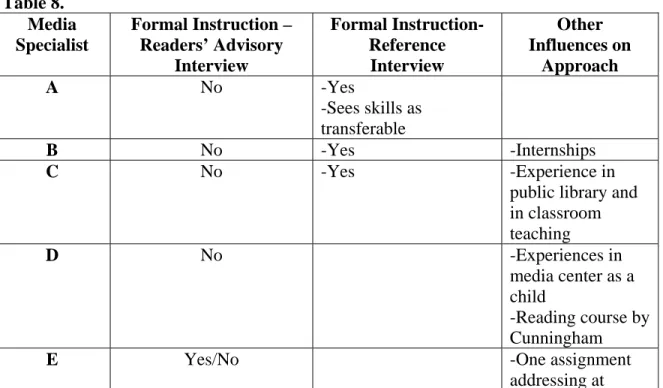
Media Specialist A received her MLS twenty five years ago and cannot remember
She does remember direct instruction in the reference interview and believes many of the same skills are transferable to readers’ advisory.
Media Specialist B (Blue School District)
The way in which Media Specialist B begins a readers’ advisory interview depends heavily on the number of children in the media center at the time. She has instituted flexible scheduling and open circulation in the media center, but because these policies were both newly instated upon her arrival a year and a half ago, teachers are still adapting. Though they can send students down individually or in small groups at any time, some still tend to bring down the entire class at one time for book checkout. With a larger group, crowd control gets in the way of individualized readers’ advisory services. She has tried to cut down on this some, by requiring that teachers come with their students if the entire class is coming to the media center. The principal has been very supportive of this requirement. Still, she finds a small group favorable for conducting readers’ advisory interviews.
Media Specialist B first asks,
• What kind of books do you like?
If this question stumps the student, she follow up with, • What is the last book you read that you liked? • Tell me a little bit about it.
Because at the second grade level she has children who are barely reading and others who are reading at quite a high level, she prefers to ask the last question, rather than “What level are you?”
Media Specialist B and her Media Assistant circulate constantly during book checkout times and ask students, “Can I help you find something?” She finds that by circulating and “hovering” even those students who initially claim that they don’t need assistance will often ask eventually. Media Specialist B has observed that students have very strong reading preferences and that she is faced only rarely with a student who does not have a specific kind of book or interest in mind.
has a hard time telling a child that he or she cannot check out a book. She believes this will change the longer she is in the school and the better she gets to know the students and their abilities.
When Media Specialist B first came to the school at the beginning of the last school year, there were times that a student would check out a book and the teacher would stand at the door and tell the child that he or she couldn’t keep it because it was above the child’s reading level. She has now instructed teachers that they need to monitor this; if level is something of importance to them then they must talk to their students before they arrive at the circulation desk for checkout. Any leveling that needs to be done is expressly the responsibility of the classroom teacher.
Media Specialist B will steer the child in a certain direction if a parent has come to her and asked her to do so. She honors parental requests that their children not check out books on particular topics. And, when she asks a student during the readers’ advisory interview whether they intend to read the book with a parent, she does not ask this just in regard to their ability to read the book independently, but also in relation to the book’s content. For example, she had a 3rd grade student come in recently who wanted to check out Deenie by Judy Blume. Because she knew the content was something a parent might question for a student at this age, she called the parent and asked if she was okay with this particular book after giving a brief rundown of the content. She notes, however, that in this situation, she had an advantage because she goes to church with the family and knew the parent well enough to call and then talk about it after it had been read. Typically, if she wonders whether a parent will approve or not, she’ll address the classroom teacher who usually knows the parents better. Then, if a recommendation is made with which the parent is not happy, the classroom teacher will “take the heat” – something for which Media Specialist B is grateful. There can also be nuances, though, as her media assistant (who is currently working toward her MLS) commented. For example, when a student recently asked for a book on explosions, she purposefully steered him toward more benign books that deal with explosions – the volcano books.
difficult when a child has a specific book in mind but cannot remember much information about it other than, for example, “a friend had a it out near Thanksgiving” or “it was about China.” Such directed readers’ advisory interviews, however, rely on a similar barrage of questioning to uncover the book for which the student is searching. Media Specialist B commented on the trends or fads that influences readers’ advisory in the school media center. Many times it becomes cool within a class to read one particular book or series of books, when this happens, her job can become as simple as directing them toward the next book by that author or in that series, or more difficult when there are not enough copies to go around and children must be enticed to try something similar.
When she finds herself momentarily stumped, Media Specialist B does not use a
Media Specialist B reported that the most limiting aspect in regards to readers’ advisory is not having read everything in the media center, but noted that she works at this by taking books home and reading them. In addition to her own knowledge of books, she values other people’s expertise. Many times she finds this through conversations with her students when following up on how they liked a particular book or not. She also tries to read genres she doesn’t personally like and visits the public library to obtain
recommended book lists to help in the construction of her own book lists.
Media Specialist B has learned to tell the children if they don’t like a book they’ve checked out to bring it back and that it will not hurt her feelings. Or she might acknowledge that she has not read a particular book, so she can only tell them what other’s say and can’t be sure. In this way, students learn to accept their own judgment and learn to give honest opinions, which will allow Media Specialist B to gauge her
successes and failures in the readers’ advisory interview better.
Media Specialist C (Blue School District)
Media Specialist C first noted that the reader’s advisory interview occurs “rapid fire.” When beginning the readers’ advisory interview, Media Specialist C first asks herself whether she knows the child or not. If she has helped him/her before and knows what suggestions she gave previously and the child has returned and said, “I really like this,” then she’s set. If she can’t remember what she recommended previously, she will ask what she recommended before. When she doesn’t know the child, she must start from scratch and must quickly determine his or her interests using questions like:
• What are you interested in?
• What kind of books do you like to read?
If she doesn’t get an answer, she might expand her question to address interests outside of reading:
• What kinds of things do you watch on TV?
• What games do you like to play? Do you have Xbox?
She commented that the greatest trouble lies in the students whose interests are way above their reading level. When a kindergartner wants to learn to play basketball or a third grader whose reading level is still low wants to read Harry Potter and the Order of the Phoenix, she strives to find something for the child that will take care of the
emotional part – (in the Harry Potter case, that all of his friends are carrying around chapter books) – to help him or her fit in. She recognizes that saving face is
Media Specialist C purposefully arranged her media center to account for such “saving face” during recreational reading recommendations. Books that she might typically consider to be transitional chapter books or easy readers are shelved within the fiction section with other chapter books. Thus if an older student is still on a lower reading level, he/she can still locate books (such as Nate the Great) on the same shelves to which she is directing other students. She adds that this is especially a concern in Blue School District where a great emphasis is placed by the community on being gifted.
Media Specialist C uses the “five finger” test (one finger for each missed word) to determine readability. Media Specialist C finds this the easiest and quickest method of determining readability during the readers’ advisory interview. Yet she also believes she is able to intuit reading ability fairly quickly through interaction with the child due to her years of experience as a classroom teacher. Typically if she is given the title of the last book the child has read independently, she can locate a book on a comparable reading level. She noted that the latest trend is the “just right book.” The “just right book” is defined as a book that the student can read or is slightly challenging. Such criteria should ensure that the child will enjoy the book. To her, if the child comes back for more, she’s done her job and that book is a “just right book.”
those books she has bought for them now, they never will. She says that the book in question (e.g. Harry Potter) is one she bought for them to read later in their elementary school career, but not now. An older student, however, who is reading below grade level, would be allowed to take out Harry Potter or any other book above reading level, in accordance with her belief in saving face and books serving needs beyond readability.
Lexiles5 are very important in Media Specialist C’s school as they’re using the Scholastic Reading Inventory (SRI) to identify which children in each class are those who need to pass the end of grade tests (EOGs). SRI gives a lexile level for each student so one can tell whether they’re reading at, below, or above grade level. “I’m finding lexiles easier to use,” she noted. In her opinion, because lexiles present a range, they do not pigeonhole readers like many companies do by ascribing a 2.5 or 7.2. Media Specialist C regards lexiles more highly than the other commercial leveling systems to which she referred. Yet, while she now utilizes lexiles in recommending books, she still believes that children have much to gain even from books they cannot read. This, she thinks, is
especially true for nonfiction where children can learn from pictures. She will always ask in such a case if there’s someone who might help them to read the book at home – in a covert manner so that it doesn’t seem like she suggested it.
She volunteered that the classroom teacher’s input into choice for recreational reading can sometimes be a burden. Although teachers know their students, they do not know the media center collection or have the same body of knowledge as the school media
teachers sometimes make impossible requests. She does not, however, find a clash with classroom teachers in regard to the recreational reading students should be taking home. The teachers want their students to have the right book, but they leave it up to her. Media Specialist C exhibits a strong desire to please the classroom teacher in regard to the books children check out. She hopes to work with students to avoid situations in which the teacher returns a student with a note reading “too easy” or “too hard.” On the flip side, teachers can be an important ally in readers’ advisory. For example, Media Specialist C recently gave a booktalk to a class in which there were a few students whose reading ability was considerably below grade level. She integrated some lower level books into the booktalks for the whole class, so that afterward she would not need to make a show of giving these particular students lower level books during the readers’ advisory interview.
But, “nothing makes me madder than teachers who don’t give kids choice,” she
explained. It is always possible that a child is capable of reading a harder book because of their high interest in the subject or they have a tutor to help them read it. Once she has located a book for a student, she asks them to explore it, to take it and sit down and see if it feels good – to read more than a paragraph to get a feel for it. She credits this
When asked if she keeps the parent in mind while conducting the readers’ advisory interview, Media Specialist C stated her philosophy on parents, “My job is to find something your child really wants to read. I will do everything in my power to find something your child wants to read. If it is for a book report or another assignment I will go with what the teacher says and their parameters. I will help your child find the right book. If you are not happy with that then please take advantage of the wonderful children’s section at the public library.” She added that she cannot be all things to all parents, but she will do all she can to make sure kids are reading what they want to read. By keeping up on what good literature is out there for children and by paying close attention to the reading level or lexile level of books, she is doing this.
coded at what appears to be the appropriate Lexile level, does not mean that everyone on an 1140 should be reading The Autobiography of Malcom X. She believes that as long as children keep reading, even if its below their reading level, they are picking up
vocabulary, syntax, and exposure to expository writing and are not regressing in reading skill. She has students who have not read Dr. Seuss because their parents skipped over it as too easy and she tries to bring them back to take a second look at Dr. Seuss and points out that much of his writing is very deep and there is much to be gained from it.
ESL students pose the greatest challenge to Media Specialist C’s readers advisory skills as she can’t always tell if she is communicating adequately, if she is helping or not. In such cases, she often utilizes the friend the student came in with to help uncover his or her interests or needs. She uses this peer influence and observation of the interaction between students with all of her readers’ advisory work.
Media Specialist C does not believe she learned how to do the readers’ advisory interview explicitly in library school coursework, but does remember coursework
reading level (including comprehension) as the core of a successful readers’ advisory interview.
Media Specialist D (Blue School District)
Media Specialist D’s school is “an AR school” so her very first question will be to ask whether the book is purely recreational or if they want an AR book. In some cases they don’t care, but since she has run into it problems many times after having gone through the process of recommending a non-AR book, she now asks first. At the same time, however, she does not see this preemptive question as contrary to her final
recommendation as there’s such a large range of AR books so that she is still able to find something fun for them to read. This question merely helps her “know how big the pond is.”
She then follows with the question, “What have you read lately that you liked?” This gives her a feel for the child’s level and tastes. If the first answer doesn’t help spur a recommendation, Media Specialist D will ask the child to name three or four of their most recent favorite books. If it is a series that they have enjoyed, she will ask if they are looking for another one in the series. Perhaps her biggest challenge has been the students who have latched on to a particular book or series, such as the Captain Underpants
Earlier this year, Media Specialist D had a student in the situation described above – she was an avid Captain Underpants fan, but none she hadn’t read yet were left in the library. Media Specialist D recommended Bunnicula, yet the classroom teacher later sent the student back to find something else with the suggestion that she could read Bunnicula
next year. While Media Specialist D was glad that the teacher said “next year” instead of telling the student directly that the book was too hard for her, she was frustrated that the teacher had gone over her head. She reported the advice of a reading expert who recently visited her school for an in-service attended by herself and most of the first grade
teachers. “Kids just need to read and it doesn’t matter what level – even if it’s too easy.” In the spirit of this sentiment, she feels that students should self-select. If they are in the mood for a challenge, they will find it. If they just want to look cool by taking out what their friends are reading, that’s fine. She also encourages students to return books if they don’t like them and not to be afraid of leaving a book unfinished.
She noted that second graders are often so eager to please that she always tries to appear as if she doesn’t care whether they like a particular book or not. If possible, she will give them a couple of choices so they don’t have to say, “No, I don’t want your book.” In a similar manner, Media Specialist D approaches students who are browsing and asks if she can help them find anything, but once she makes contact is sure to give them space if they’re not interested in her assistance immediately.
at the student’s reading level regardless of purpose. Media Specialist D finds this very difficult to fulfill at that age and refuses to enforce it. Yet she is continually frustrated when this particular teacher takes a child aside and asks them to use the five finger rule (described earlier) to determine whether or not they will be allowed to check out the book or not. Media Specialist D expressed her dismay at this practice. “We don’t do that here (in her media center),” she said. Ultimately, she would like to be able to have a self-selected reading program, but as a brand new media specialist she is still working toward this. In the meantime, she will continue not to enforce teacher rules she does not agree with when recommending books.
If in need of support, Media Specialist D relies on the OPAC, where she will look up the topic of interest with the student and then wander around with the child to the shelves to look at the books and talk about them. She feels that her knowledge of what is out there gets broader and broader every day. She does not resort to any reference source or tool, such as NoveList. If a child is having a particularly difficult time finding something, she will frequently point them to the new books. She finds that reluctant readers are
especially attracted to new books. There’s something about being one of the first people to have a book. In all, though, she just tries to spend a lot of time reading the collection and keeping up with reviews which she believes has helped her make connections between the children and good books. She does attempt to gauge successful
recommendations by following up whenever possible, yet she added that since she moved her desk away from the circulation desk she has limited interaction with the students as they check in and out.
facilitate leisurely browsing. Because of this, she has upped the number of books students can check out to four, so the odds are higher that they will find a book that they like.
Media Specialist D noted that race and language sometimes play a part in her recreational reading suggestions. She believes that all children should be exposed to a variety of authors and does not automatically presume a certain kind of book for a certain student, but if she has been given notice that a certain child is disaffected in some way, she often makes the effort to ensure the child sees a reflection of him/herself in the book she recommends. She cites one such fifth grade African American girl, a reluctant reader, to whom she recommended a number of books by African American authors, and who has now greatly expanded her reading interests. Similarly, there are a large number of dual language students in her school. For these students she will always ask if they would like an English or bilingual book or a book in their native language. Often if they want to read something with their parents at home, bilingual books are perfect and they encourage family literacy. She strongly believes that reading is reading and it doesn’t matter what language. Children should not lose the ability to read in their native language, she added.
the card catalog and determined that she had in fact checked it out the previous year. As a result, Media Specialist D never wants to assume or underestimate her student’s abilities as readers.
Another guiding influence on her approach is a reading course taken at the University of North Carolina at Chapel Hill taught by Dr. James Cunningham that emphasized self selected reading. She noted, that although she has been frustrated during her first year in the media center as far as getting the volume of traffic she’d like in the media center for instruction, it has had unanticipated benefits for readers’ advisory services and the additional time she has been able to spend working one-on-one with individual students. She feels there was not enough attention paid to reading in her coursework and that it is underestimated as part of the library science curriculum. She believes that even though everyone is concerned with Annual Yearly Progress (AYP), if children read all the time, they will do just fine.
Media Specialist E (Red School District)
assigned to a book as indicative of an individual child. She noted that while you might know the grade level assigned a particular book and the grade level of a child, you might also know that they can’t read that book. Sometimes if she sits with the child and they start reading the first page together and it becomes evident that the child cannot read the book, she will ask if there is someone at home to read it with them. If so, it’s a good choice. Reading with someone else is a very valuable experience especially since the children’s interests are often above their reading level. At the same time, after sharing books with children for so many years, she does feel that she has a good sense of which books appeal to a certain grade. Certain books may be asked for over and over again by first graders and even if the second graders are reading at the same level, for some reason developmentally it falls flat with them. She is ever mindful of their interests. For
example, as noted above, for many younger readers the distinction between a story and a true book (fiction or nonfiction) is very important and there are further considerations as to whether they will accept a book as true or not. For instance, a nonfiction book with drawings rather than photographs may not be acceptable to a younger student.
Teachers will sometimes see a child’s choice and say he or she can’t check it out because he or she can’t read it. To this, Media Specialist E shrugs, “we have to compromise and try to respect [the teacher’s opinion].” At times, students come in with specific directions from their classroom teacher, such as to get a chapter book. Media Specialist E’s school does AR and she has been trying to back away from it since she started. Though she has seen its power to motivate certain children very well, it is not her favorite program. She feels limited in her recommendations during the readers’ advisory interview if a teacher says the student must have an AR book. She prefers to let children choose whatever interests them, but she indicated that she will compromise if the teacher specifically desires that they have something they can read independently. Despite being an AR
school, Media Specialist E does not assume that a child is looking for an AR book and will not enter this factor into the equation until the child requests it. She does not catalog
AR books with point level, but has blue stickers to show an AR test exists for that book.
book can be chosen according to parameters set by the teacher, if needed, and the other can be a purely personal selection.
In regard to considering the parent during the readers’ advisory interview, Media
Specialist E notes that there are almost 900 children in her school. She tells parents that if they would prefer that their child not take out a particular book that they must let their child know their wishes. If she has been notified and notices the child checking out the book in question, she can direct them elsewhere, but ultimately it must come from the parent. It was this attitude she took when one family objected to Junie B. Jones last year. Recently she had two kindergarten boys who were very interested in the DK Eyewitness
books which they can’t read on their own, but they love the pictures so she was encouraging them to check them out. Their mother asked her to steer them in another direction, toward a book they can read independently and though she tried, they kept returning to them. Ultimately, she told the parent that she didn’t want to dissuade them and she and the parent ended up laughing about it. At the same time, she may not
immediately recommend a book that has generated a great deal of controversy, such as a book of Halloween poetry that some parents have objected to. She lets children find these books on their own.
considering. When she has run out of books in a particular interest area, she will take a few different routes. “This recently happened with a second grader,” she said. “She’s read everything on dolphins and last week she found one kept in the professional section.” When Media Specialist E runs out of new titles on dolphins, she will attempt to get her interested in another topic, but may need to show her the link on the media center’s homepage to the public library catalog. “I’ll take the child over and do a search on their catalog.” She will then ask if the child if there is someone to take him or her there. Sometimes she will find something on the Internet if she hasn’t been able to find a book related to the interest elsewhere, but usually that’s not what students are looking for. “They want something they can hold, put in their backpack, and take home.” Though she is aware of a number of reference sources designed to aid readers’ advisory, she does not use them.
She has done instruction on book selection. Often teachers will ask her to do lessons on determining readability for which she provides students with a five finger bookmark. Teachers often request this at the second grade level because these students are in a transitional period moving from easy readers to chapter books. On an individual level, she shows students how to use the OPAC to aid in book selection by pointing out features such as the reading level or book summary in the catalog record.
Media Specialist E commented on the challenge of following up on book
Though she did not receive any direct instruction on the readers’ advisory interview at the graduate program she attended, it was addressed in a class she took at a nearby
university’s graduate program, but she did not remember the details of the instruction.
Media Specialist F (Blue School District)
First, Media Specialist F asks what books the child has read and liked Depending on the kind of answer she gets, she will suggest more books in that series, or on a similar reading level. She is very careful not to use the words reading level, however. She’d rather say something like, “Let’s find something just right for you.” Sometimes she will say, “This is something a lot of children like; let’s see what you think.”
Much is intuited in regard to readability in the first few minutes. If a child says “I’ve read all the Bailey School Kids”or “I like Roald Dahl” this gives her a clue as to the child’s reading fluency. If a child makes no response or mentions something significantly below grade level, she sees this as an indicator of ability as well. An example of this is an encounter she had recently with a fourth grade child whose teacher had been
Media Specialist F’s school does not do AR or any other “canned” reading program. She knows they are using Scholastic Reading Inventory in many classrooms, but she has not worked with it. There are leveled book rooms6 in the school, but those are not under her jurisdiction. She added that there has been a district-wide initiative to create a list of “core titles” organized thematically and media specialists were asked to play a role in the creation of this document in 2001. The list was organized to provide books below, at, and above grade level that are used in particular grades. Accompanying reading level and lexile were provided. Yet, she believed, it was an attempt to do too many things at once as it also integrated character education themes into the thematic organizational scheme of the document. It was an attempt to address equity and consistency in use of materials across the school district. This list does not factor into Media Specialist F’s decisions during the reader’s advisory interview, but it does sometimes influence student requests (prompted by the classroom teacher). It has also forced her to add books she might have previously deemed inappropriate for the collection. Because the list required a certain number of books for each grade level that were considered, “below,” “at,” or “above” and books were chosen according to reading level or lexile, content was often ignored.
Media Specialist F believes that levels must be taken with a grain of salt and are
takes issue with the five finger rule used by a number of teachers in her school (and, as has been seen, by many media specialists in this study). The five finger rule, in her mind, does not consider content either. If you’re asking a child to find a book that’s challenging according to this rule, often they will get to the point of content inappropriateness. “But to say you have to find something where you don’t know all the words – that’s a problem. Adults don’t do that.”
For Media Specialist F, determination of readability during the readers’ advisory
interview depends on whether it is a private moment or not. She has found that as a result of the media center’s flexible scheduling, small groups, rather than whole classes are coming to the library for checkout. This has greatly increased her ability to offer
individualized recommendations. “When we were on a fixed schedule, they were coming in groups of 25 kids and after class you’d have seven minutes for everyone to pick something out and you’re trying to help 25 children find just the right book.” If it is a private moment, she can pull a book out and she and the child can read it together. If the child is stumbling over every word, unless he or she is absolutely taken by the book, she will ask them to look at another book.
books varies so widely, she is able to pull out different levels to gauge their ability. Zach Files books, for example, provide a lot of illustrations, have a good deal of white space, and are short – all traits that appeal to reluctant readers. A child’s reaction to a Zach Files
book suggestion will tell her a lot about the child’s ability. Sometimes she can even see a physical reaction, such as a pulling back, if the book is not at the child’s level.
Sometimes she will take into consideration whether the child plans to read the book independently or with an adult. She commented on the value of children spending quality time with parents. Because Media Specialist F’s media center doubles as a public library after school hours, she will often direct the child to pick out a book during school hours to read by him or herself with the addendum that after school mom or grandma can pick one out that they can read together. In the youngest grades, it is important to provide books that parents can read to their children, a primary impetus behind Media Specialist F’s efforts to develop the media center’s Spanish collection for dual language learners.
she will do her best to ensure that one of the three books checked out by students will be at their independent reading level.
When asked if she will approach non-approachers, Media Specialist F answered “all the time” and offered an apt metaphor for those students who will not approach her on their own for a book recommendation: “If I was in the gym I wouldn’t run quickly over to the ropes because I couldn’t possibly ever climb them.” A child who hasn’t been a successful reader will not “come bursting in” the media center. She tries to approach these students tactfully and will make an effort to recommend a book they’ve read before, a non-traditional format (e.g. a comic book), or a series book to make reading easier and less threatening.
wants her students to learn as they grow up that the library is a place where they can go and pick out whatever they want.
In regard to consideration of parental opinion during recreational reading
Specialist F really tries to stay with book recommendations that she believes are developmentally appropriate and will explain her decision to the parent. Similarly, she has a few parents who will, for example, ask why the collection includes comic books. Media Specialist F believes that reading materials, such as comic books, are a real enticement for some children. While she might tell a parent that she encourages all kinds of reading from their collection, she will not shy away from recommending such
nontraditional materials during the readers’ advisory interview.
If she is unable to locate a suitable book in the collection, she will often direct students to the suggestion box and ask that they sign their name to the request so that she may send the book in that student’s direction when it is added to the collection. In the meantime, if a child has depleted a certain subject area she will attempt to guide him/her to something similar. For example, if a child loves fiction about cats, she might suggest a nonfiction book about cats like, Koko’s Kitten, the true story of a gorilla and her kitten. Sometimes this strategy works and other times it doesn’t. When stumped, she does not typically turn to a reference source other than the OPAC due to the lack of time available. She will sporadically use NoveList or Jon Scieszka’s website, www.guysread.com. Any instruction on self selection is done on an individual basis rather than in an organized lesson. She will teach students to look at the new book shelf, where to find nonfiction versus fiction, and how to locate different genres according to their spine sticker.
before, the book may have served to bolster the student’s self esteem even if it wasn’t read for enjoyment. She frequently asks students questions such as,
• Did you like it? • Did it work?
• Do you want something else?
• Since you liked this book, do you want another like it?
Though she can’t follow up with every student she does make an effort to monitor circulation for students who have not checked out in a long time or who have been holding onto the same two books for a long period of time. In this case, she will alert the teacher.
Media Specialist F does not remember ever receiving formal instruction in the readers’ advisory interview and has developed her approach through observations of other people who are really good at it. She tries emulate the way others inspire students to be excited. She aims always to be respectful of children and to understand their desires, even when they irrationally only want the book the child ahead of them just checked out. Lastly, she added that she also considers the audio book medium when giving recreational reading suggestions. She believes strongly in an audio book’s ability to deliver content
appropriate experiences to children reading at too low a level to have had such
experiences previously with printed literature. She has even had an article published in
Media Specialist G (Blue School District)
The steps Media Specialist G takes to start a readers’ advisory interview vary depending on whether she has worked with the child previously or has no idea as to the child’s abilities and interests. If she doesn’t know the child, she first asks herself “Who is his or her teacher?” Some of the teachers in her school are very cognizant of what their students are reading. If this is a child she doesn’t know, the teacher could give valuable input as to reading level, comfort, and interests. Without such input, she will ask,
• What books have you read in the past?
• What kinds of subject areas are you interested in?
• Do you want fiction or nonfiction?
The answers to each of these questions will help her discern a pattern. And if a child likes a particular area, such as fantasy, this will suggest to her that she might use this as an entry to a related genre, such as mystery. Though she will approach students who have not approached her first and are wandering around the media center, she wishes that more time was available to do so.