Being kind to others instead of focusing on ourselves?
Enhancing mental well-being
Master Thesis
by Leonie Wieners
s1570145
Marijke Schotanus-Dijkstra Marion Spijkerman
Abstract
Mental well-being is defined as experiencing a happy and meaningful life that is embedded in a positive social environment. One possibility to promote well-being is to engage in prosocial behavior. Literature suggests that performing kind acts to others can enhance mental well-being, even more so than being kind to yourself. The current study aims to test the effects of an act of kindness intervention on mental well-being in a single blind randomized controlled trial. A total of 254 participants were randomly assigned to three different conditions: (1) the intervention group, participating in the acts of kindness
Introduction
The integral aim of positive psychology is to recognize and to establish qualities in an individual’s life that facilitate personal growth up to the achievement of a flourishing and happy being (Seligman & Csikszentmihalyi, 2014). In order to capture and to measure the broad idea of happiness and growth, the term mental well-being was introduced (Keyes, 2002; Nelson et al., 2016). By definition it consists of three components: emotional
well-being, which is defined as experiencing positive emotions such as happiness and life satisfaction, psychological well-being, described as the ability to successfully engage with a meaningful life, and well-being on a social level, defined as the ability to actively take part in a community life (Keyes, 2002;Ryan & Deci, 2001; Schotanus-Dijkstra et al., 2016).
Previous research has shown increased interest in the combination of the different components of well-being, labeling individuals that score high on all three dimensions with the term flourishers (Keyes, 2007; Seligman, 2012). Flourishers benefit not only from greater physical health and a higher life expectancy, but their cognitive capabilities have shown to be increased as well (Keyes & Simoes, 2012). This leads them to be more creative and flexible in their thinking (Huppert, 2009; Keyes & Simoes, 2012; Schotanus-Dijkstra et al., 2016). Therefore, high levels of mental well-being and flourishing have pleasant effects on the individual’s life. Well-being also leads to profits for society, for example due to increased productivity and lower healthcare costs (Hamar et al., 2015; Keyes, 2007). To ensure that more people can experience these benefits, a way needs to be found to promote flourishing in the general population.
world a better place (Nelson et al., 2016). Research has shown that also relatively small expressions of kindness have the ability to boost happiness (Chancellor, Jacobs Bao & Lyubomirsky, 2017). Acting prosocially had even higher effects on a person’s well-being than doing yourself a favor. In a study by Dunn et al. (2008), participants were given an amount of money that they had to spend by the end of the day. Some had to use it on a gift to themselves while others were asked to spend it on another person. Regardless of the amount of money spent, those participants that used the money for someone else reported higher levels of happiness afterwards than those that bought something for themselves (Dunn et al., 2008). Therefore, the aim of the current study was not only to test the effects of kindness towards others on mental well-being, but also to examine if those effects were greater than effects on mental well-being evoked by self-kindness.
An intervention that suits the aim of this study is the acts of kindness intervention. An act of kindness is defined as any type of kind behavior directed towards another person (Ouweneel, Le Blanc, & Schaufeli, 2014). Previous research has shown that by asking participants to perform kind acts for people around them their well-being could successfully be increased (Alden & Trew, 2013; Ouweneel et al., 2014; Nelson et al., 2016). In accordance with the effects of money spending mentioned before, the acts of kindness intervention had more positive effects on mental well-being when the kind acts were directed towards others instead of towards oneself (Nelson et al., 2016). Furthermore, Lyubomirsky and colleagues (2005) compared different kindness interventions in their intensity and came to the
some shortcomings. First of all, most studies make use of student samples, because they are easier to attain for scientific research (Curry et al., 2016). Hence, there is little research on the effects of the intervention in the general population. Secondly, most researchers have
measured the effects of the intervention solely in terms of subjective well-being, not taking into account effects on social or psychological well-being. The current study uses mental well-being as the primary outcome including emotional, social and psychological well-being, which enables a detailed interpretation of the effects.
In order to understand the impact of kindness on an individual’s level of mental well-being one needs to look at the working mechanisms that cause these effects. Previous research that focused on the mechanisms of kindness demonstrated that spending money on others enhances subjective happiness via changes in positive emotions (Aknin et al., 2013). Performing kind acts led people to have more opportunities to experience positive emotions, such as joy, affection and pride (Nelson et al., 2016). These emotions cannot only directly boost happiness, but they can act as a buffer that protects the individual from stress and negative emotions, leading to greater happiness and well-being in the long-term (Thoits, 2011). On top of that, prosocial behavior can improve positive relations with others. Not only can kind acts increase affection between two people, but feelings like gratitude could result in others wanting to return the favor and to act prosocially as well. Consequently, this could strengthen social ties, which has shown to have a great impact on mental well-being (Chancellor et al., 2015). Positive relations have shown to be an important factor in
In sum, the current study examined the effectiveness of the acts of kindness
intervention on participants recruited in the general Dutch population. A randomized
controlled trial was conducted to evaluate the short- and long-term effects of performing kind acts for others on emotional, social and psychological well-being. To do so, the intervention group that performed kind acts directed to others was compared to an active control group that carried out kind acts directed to themselves and a wait list control group. It was expected that the intervention group would report higher levels of emotional, social and psychological well-being at the end of the intervention than the two control groups. In addition, it was expected that the effects on well-being were maintained up to the 6-week follow-up. Also, possible working mechanisms of the intervention were investigated by testing the mediating influences of positive emotions and positive relations on mental well-being. It was
hypothesized that these two variables accounted for part of the effects of the intervention on mental well-being.
Methods Study Design
intervention, thus 6 weeks after baseline (T3). Furthermore, a follow-up was conducted 6 weeks after the intervention ended (T4).
Participants and procedure
The study was advertised in national and local newspapers and the newsletter of a popular psychology magazine. Additionally, posts on social media channels, such as facebook, brought more attention to the study. If people were interested they could go to a website on which information about the study was given and the procedure for registration was
described. After giving their informed consent, participants were directed to a screening test in order to check if they met the criteria to take part in the study.
Participants had to be 18 years or older, having access to an internet connection and a working email address and to be willing to invest the time to perform an exercise one day per week. Moreover, participants had to show no serious symptoms of depression or anxiety. Therefore, people were excluded from the study when they had high scores (> 34) on the Center for Epidemiological Studies Depression Scale (CES-D) or high scores (= > 15) on the scale for Generalized Anxiety Disorder (GAD-7). If that was the case they were advised to seek professional help. The criteria were not shared with the participants beforehand in order to avoid influencing their answers on the tests.
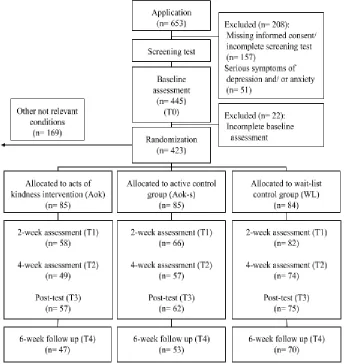
Out of 653 people that showed interest in the study, 157 individuals had to be excluded, because they did not provide informed consent or did not complete the screening questionnaire. 51 participants scored too high on depression or anxiety and 22 did not fill in
the baseline questionnaires.
The remaining 423 participants were randomly assigned to the254. After the participants received a message of their group allocation, all conditions started with the intervention simultaneously. Assessment took place between September 2017 and May 2018.
Figure 1.Design of the study and flow-chart of the participants
Randomization
MHC-SF, there was made a difference between flourishers and non-flourishers, who were allocated evenly to the three conditions as well.
Conditions
Acts of kindness group. The goal of the acts of kindness intervention was to make the participants consciously perform kind acts for others. To do so, they received the weekly instruction to think of five kind acts that they could perform on one of the next days. After the acts were performed, participants were asked to record it in an online diary. They had to describe the number of activities, what activities they did and for whom they performed them. The estimated time expense for the acts and the diary entry was 45-60 minutes per week. The instructions were send each Sunday and the diary entry had to be made by Saturday at the latest. With a maximum of two reminders throughout the week, adherence of the participants was strengthened. The total duration of the intervention was six weeks.
Active control group. Participants allocated into the active control condition received instructions to perform five acts of kindness directed to themselves per week. They were asked to record the quantity and a short description of the actions in their diary. As in the intervention group described above, they received the instructions on Sunday and maximum two reminders per week, over the period of six weeks.
Measures
Mental well-being. Mental well-being is the primary outcome of this study and is measured with the Mental Health Continuum-Short Form (MHC-SF). The MHC-SF consists of 14 items distributed over three subscales: emotional well-being (3 items), social well-being (5 items), and psychological well-being (6 items). Participants are asked to rate the frequency of experiencing different feelings in the last four weeks on a 6-point likert scale, running from 0 (“never”) to 5 (“almost always”), resulting in total mean scores 0 to 5. Higher scores indicate a high level of overall well-being. The questionnaire shows good psychometric properties (Lamers et al., 2011). In the current study, Cronbach’s alpha of the MHC-SF at baseline was α = 0.90. The single subscales emotional (α = 0.82), social (α = 0.70), and psychological well-being (α = 0.83) showed acceptable reliability as well.
Positive emotions. In order to measure positive emotions the modified Differential Emotions Scale (mDES) was used. With the help of eight items running from 1 (“not at all”) to 7 (“very intense”) participants have to report on what level they experience different positive emotions at the moment. The instrument has total scores ranging from 8 to 56 with higher scores displaying deep experience of positive emotions. The mDES shows good psychometric properties (Galanakis, Stalikas, Pezirkianidis, & Karakasidou, 2016) and reported a reliability rate of α = 0.63 at baseline.
questionnaire has total scores from 9 to 54. High scores hint at a high engagement with others in positive relations, whereas low levels indicate the lack of it. The instrument has shown good internal consistency in previous studies (Van Dierendonck, 2011) and had a Cronbach’s alpha of α = 0.80 at baseline.
Symptoms of depression and anxiety. During thescreening test symptoms of depression and anxiety were estimated with the help of the Center for Epidemiological Studies Depression Scale (CES-D) and the scale for Generalized Anxiety Disorder (GAD-7). The CES-D is validated as a comparable tool for the measurement of depressive symptoms (Smarr & Keefer, 2011). The questionnaire consists of 20 items, asking the participants to rate the frequency they experienced certain types of emotion or behavior during the last week. The items range from 0 (“rarely or none of the time”) to 3 (“most or all of the time”) with a total score from 0 to 60. Cronbach’s alpha at baseline was α = 0.62. The GAD-7 asks participants to report how often they experienced different problematic situations during the last 14 days. The seven items range from 0 (“not at all”) to 3 (“almost every day”) with a total score of 0 to 21. It reports good psychometric properties (Spitzer et al., 2006) and had a Cronbach’s alpha of α = 0.77 at baseline. High scores on the CES-D or the GAD-7 suggest that there are noticeable symptoms that might be indicative of the existence of depression or anxiety.
Statistical Analyses
coefficients were interpreted according to Cohen (1988) who suggests a distribution between small (0.1), medium (0.3) and large (0.5), which is equivalent to weak, moderate and strong correlations. Moreover, Chi-square tests and one-way ANOVAs were used to check for successful randomization at baseline for demographic as well as outcome variables between the three groups. With the help of independent t-tests and one-way ANOVAs, dropouts were compared to completers in terms of group affiliation, demographics and primary and
secondary outcomes. Drop out was defined as incomplete data on the MHC-SF at the post-test or at 6-week follow-up.
A one way analysis of covariance (ANCOVA) with Bonferroni post-hoc test was conducted to test for significant differences between group conditions on mental well-being, positive emotions and positive relations at post-test controlling for outcomes at baseline. Relevant effect sizes for between-group differences were reported with Cohen’s d. The effect sizes were calculated by subtracting the mean post-test score of the intervention group from the mean post-test score of the respective control group, divided by the pooled standard deviation [(M2 - M1) ⁄ SDpooled]. Just like the correlation coefficients, the effect sizes were interpreted using the distribution between weak (0.1), moderate (0.3) and strong (0.5) by Cohen (1988).
the multiple mediation model simultaneously. The baseline measures (T0) of the outcome variable and the mediators were used as covariates to control for baseline variance in mental well-being, positive emotions and positive relations. With the help of the PROCESS tool the regression coefficients were calculated. The a-path reports the effect of the intervention on the mediator, the b-path reports the effect of the mediator on mental well-being and the c-path reports the total effect of the intervention on mental well-being. The c’-path shows the direct effect of the intervention on mental well-being, when controlling for the mediator. The indirect effect of the intervention on well-being mediated through the mediator is reported as the product of path a and path b (a x b). When the BC 95% CI’s, which are bias corrected by a bootstrap approach with 10.000 samples, do not contain zero it can be concluded that the effect of the intervention on mental well-being is mediated through the mediator(s) in 95% of the bootstrapped samples. In the multiple mediation analysis, the indirect effects are
compared against each other. If the BC 95% CI’s of the pairwise contrasts do not contain zero, it represents a significant difference between the effects.
Results
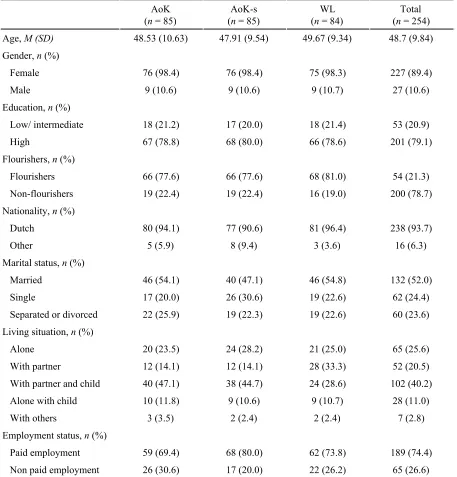
Table 1 reports the baseline characteristics of the participants in the different group conditions. The mean age of the sample was 48.7 years (SD= 9.8) and participants were predominantly female (89.4%) and higher educated (79.1%). 54 individuals (21.3%) could be categorized as flourishers. Randomization was successful as the proportion of women, higher educated individuals, and flourishers did not significantly differ between the three conditions at baseline [χ2
gender (2) = 0.00, p = 1.000; χ2education (2) = 0.06, p = 0.971; χ2flourisher (2) = 0.37, p =
nationality: χ2 (2) = 2.48, p = 0.239; marital status: χ2 (4) = 2.99, p = 0.559; living situation χ2
(8) = 15.12, p = 0.057; and employment status: χ2 (2) = 2.53, p = 0.283). Furthermore, no
[image:14.596.72.529.252.729.2]significant differences in baseline measures were found between the conditions on mental well-being (p = 0.519), positive emotions (p = 0.650) and positive relations (p = 0.743).
Table 1
Baseline characteristics of study participants
AoK (n = 85)
AoK-s (n = 85)
WL (n = 84)
Total (n = 254) Age, M (SD) 48.53 (10.63) 47.91 (9.54) 49.67 (9.34) 48.7 (9.84) Gender, n (%)
Female 76 (98.4) 76 (98.4) 75 (98.3) 227 (89.4)
Male 9 (10.6) 9 (10.6) 9 (10.7) 27 (10.6)
Education, n (%)
Low/ intermediate 18 (21.2) 17 (20.0) 18 (21.4) 53 (20.9)
High 67 (78.8) 68 (80.0) 66 (78.6) 201 (79.1)
Flourishers, n (%)
Flourishers 66 (77.6) 66 (77.6) 68 (81.0) 54 (21.3) Non-flourishers 19 (22.4) 19 (22.4) 16 (19.0) 200 (78.7) Nationality, n (%)
Dutch 80 (94.1) 77 (90.6) 81 (96.4) 238 (93.7)
Other 5 (5.9) 8 (9.4) 3 (3.6) 16 (6.3)
Marital status, n (%)
Married 46 (54.1) 40 (47.1) 46 (54.8) 132 (52.0)
Single 17 (20.0) 26 (30.6) 19 (22.6) 62 (24.4)
Separated or divorced 22 (25.9) 19 (22.3) 19 (22.6) 60 (23.6) Living situation, n (%)
Alone 20 (23.5) 24 (28.2) 21 (25.0) 65 (25.6)
With partner 12 (14.1) 12 (14.1) 28 (33.3) 52 (20.5) With partner and child 40 (47.1) 38 (44.7) 24 (28.6) 102 (40.2) Alone with child 10 (11.8) 9 (10.6) 9 (10.7) 28 (11.0)
With others 3 (3.5) 2 (2.4) 2 (2.4) 7 (2.8)
Employment status, n (%)
Paid employment 59 (69.4) 68 (80.0) 62 (73.8) 189 (74.4) Non paid employment 26 (30.6) 17 (20.0) 22 (26.2) 65 (26.6) Note: M = Scale means, SD = standard deviations
Inter-scale correlations
Table 2 shows the inter-scale correlations between the measurements at baseline. All correlation coefficients were significant with a significance level of p < 0.001. Mental well-being and its different subscales showed strong correlations among one another (r > 0.63). The correlations between mental well-being as well as its subscales on the one hand and positive emotions and positive relations on the other hand were moderate to strong (r
between 0.38 and 0.60). Positive emotions and positive relations correlated moderately with r
= 0.29.
Table 2
Inter-scale correlations at baseline
Variable 1 2 3 4 5
1. Mental well-being
2. Emotional well-being .83**
3. Social well-being .89** .63**
4. Psychological well-being .94** .71** .73** 5. Positive emotions .46** .41** .38** .44** 6. Positive relations .60** .46** .56** .57** .29** Note: N = 154, **p < 0.001
Drop out
From the 254 participants at baseline, a total of 194 participants (76.4%) completed the post-test measurement and 170 (66.9%) completed the 6-week follow-up. Drop-outs and completers did not significantly differ at the baseline measures for demographics or primary and secondary outcomes. However, dropout significantly differed across the three conditions,
likely to drop out than participants in the intervention group (p < 0.001) and marginal significant less likely to drop out than participants in the active control group (p = 0.051).
Effects on mental well-being and secondary outcomes
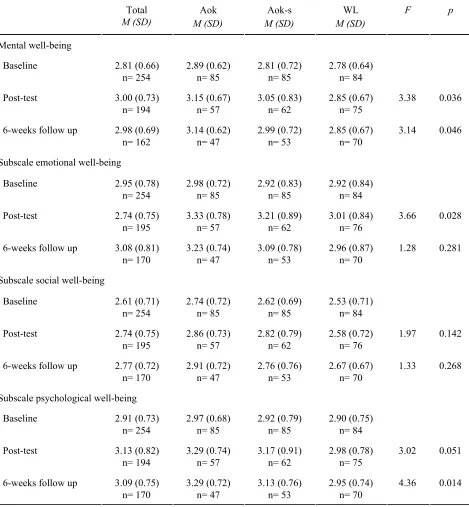
The ANCOVA reported a significant effect of the three group conditions on mental
well-being at post-test [F(2,190) = 3.38, p = 0.036] and 6-week follow-up [F(2,166) = 3.14, p
= 0.046], when controlling for mental well-being at baseline. Bonferroni post-hoc tests revealed a positive trend for higher levels of mental well-being at post-test (p = 0.062) and significantly higher levels of mental well-being at 6-week follow-up (p = 0.040) in the
intervention condition than in the wait-list control group. Effect sizes were moderate with d = 0.44 to 0.45. No differences in mental well-being were found between the intervention
condition that performed kind acts for others and the active control group that engaged in self-kindness at post-test or 6-week follow-up (see Table 3a).
The ANCOVA reported similar results for psychological well-being, with a trend for higher levels of psychological well-being at post-test (p = 0.051, d = 0.41) and significantly higher levels at 6-week follow-up (p = 0.014, d = 0.47) in the intervention condition than in the wait-list control group. No effects were found between intervention condition and active control group. Emotional well-being differed only at post-test between the intervention condition and the wait-list control group [F(2,191) = 3.66, p = 0.028] with significantly lower levels of emotional well-being in the latter (p = 0.033, d = 0.39). The level of social
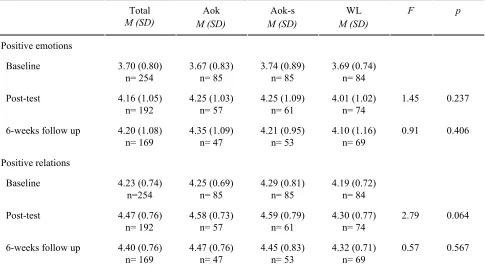
for higher levels of positive relations in the intervention condition than in the wait-list control group at post-test (p = 0.080) with a moderate effect size of d = 0.37.
Table 3a
Means and standard deviations for mental well-being and its subscales, and results of the
analysis of covariance at post-test and 6-week follow-up
Total M (SD) Aok M (SD) Aok-s M (SD) WL M (SD)
F p
Mental well-being
Baseline 2.81 (0.66) n= 254 2.89 (0.62) n= 85 2.81 (0.72) n= 85 2.78 (0.64) n= 84 Post-test 3.00 (0.73)
n= 194 3.15 (0.67) n= 57 3.05 (0.83) n= 62 2.85 (0.67) n= 75
3.38 0.036
6-weeks follow up 2.98 (0.69) n= 162 3.14 (0.62) n= 47 2.99 (0.72) n= 53 2.85 (0.67) n= 70
3.14 0.046 Subscale emotional well-being
Baseline 2.95 (0.78) n= 254 2.98 (0.72) n= 85 2.92 (0.83) n= 85 2.92 (0.84) n= 84 Post-test 2.74 (0.75)
n= 195 3.33 (0.78) n= 57 3.21 (0.89) n= 62 3.01 (0.84) n= 76
3.66 0.028 6-weeks follow up 3.08 (0.81)
n= 170 3.23 (0.74) n= 47 3.09 (0.78) n= 53 2.96 (0.87) n= 70
1.28 0.281
Subscale social well-being
Baseline 2.61 (0.71) n= 254 2.74 (0.72) n= 85 2.62 (0.69) n= 85 2.53 (0.71) n= 84 Post-test 2.74 (0.75)
n= 195 2.86 (0.73) n= 57 2.82 (0.79) n= 62 2.58 (0.72) n= 76
1.97 0.142 6-weeks follow up 2.77 (0.72)
n= 170 2.91 (0.72) n= 47 2.76 (0.76) n= 53 2.67 (0.67) n= 70
1.33 0.268
Subscale psychological well-being Baseline 2.91 (0.73)
n= 254 2.97 (0.68) n= 85 2.92 (0.79) n= 85 2.90 (0.75) n= 84 Post-test 3.13 (0.82)
n= 194 3.29 (0.74) n= 57 3.17 (0.91) n= 62 2.98 (0.78) n= 75
3.02 0.051
6-weeks follow up 3.09 (0.75) n= 170 3.29 (0.72) n= 47 3.13 (0.76) n= 53 2.95 (0.74) n= 70
4.36 0.014 Note: N = 154. M= Mean; SD= standard deviation
Table 3b
Means and standard deviations for positive emotions and positive relations, and results of the analysis of covariance at post-test and 6-week follow-up
Total M (SD) Aok M (SD) Aok-s M (SD) WL M (SD)
F p
Positive emotions
Baseline 3.70 (0.80) n= 254 3.67 (0.83) n= 85 3.74 (0.89) n= 85 3.69 (0.74) n= 84 Post-test 4.16 (1.05)
n= 192 4.25 (1.03) n= 57 4.25 (1.09) n= 61 4.01 (1.02) n= 74
1.45 0.237 6-weeks follow up 4.20 (1.08)
n= 169 4.35 (1.09) n= 47 4.21 (0.95) n= 53 4.10 (1.16) n= 69
0.91 0.406
Positive relations
Baseline 4.23 (0.74) n=254 4.25 (0.69) n= 85 4.29 (0.81) n= 85 4.19 (0.72) n= 84 Post-test 4.47 (0.76)
n= 192 4.58 (0.73) n= 57 4.59 (0.79) n= 61 4.30 (0.77) n= 74
2.79 0.064
6-weeks follow up 4.40 (0.76) n= 169 4.47 (0.76) n= 47 4.45 (0.83) n= 53 4.32 (0.71) n= 69
0.57 0.567 Note: N = 154. M= Mean; SD= standard deviation
Aok = intervention group, Aok-s = active control group, WL = wait list control group
Simple mediation
condition was still a significant predictor for mental well-being at post-test, when controlling for the effect of positive emotions and positive relations. The BC 95% CIs of the indirect effects contained zero in both models, which indicates that the effects of the intervention group versus the wait-list group on mental well-being were neither mediated by positive emotions nor by positive relations.
Table 4
Simple mediation of the effects of the intervention condition (‘Acts of kindness’) versus a
wait-list control group on mental well-being (T0–T3), mediated by positive emotions and
positive relations (T0-(T1+T2)/2) and controlled for baseline levels of the outcome variable
and the mediators (T0).
Mediators
a b
Total effect c
Direct effect c’
Indirect effect a x b (95% CI)a Positive emotions 0.53 0.18* 0.09** 0.08* 0.01 (0.007, -0.001) Positive relations 0.01 0.34** 0.08** 0.09** 0.005 (-0.009, 0.026) Note: a results for indirect effects are bias corrected by a bootstrap approach with 10.000 samples
*p < 0.05;**p < 0.01
Multiple mediation
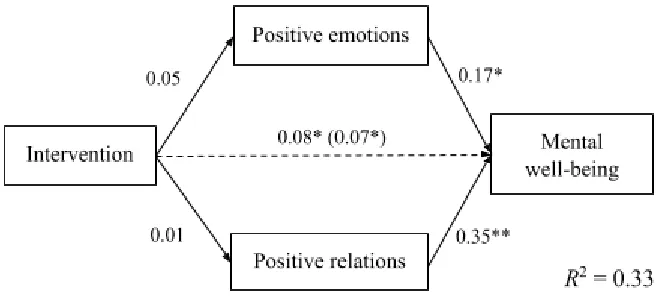
In the multiple mediation analysis, the two mediators were entered in the regression model simultaneously, as it is shown in Figure 2. The total effect (path c) was significant, as well as the direct effect (path c'). The a-paths were non-significant, reflecting that the group
contained zero. These results indicate that the effect of the intervention on mental well-being at post-test was not mediated by positive emotions nor positive relations. Altogether, the model accounted for 33% of the variance in mental well-being at post-test.
Figure 2. Multiple mediation for the relationship between the intervention group versus wait-list control group and mental well-being (T0-T3), mediated by positive relations and positive emotions (T0-(T1+T2)/2). The effects are controlled for outcome and mediator measures at baseline (T0). The total effect (c path) is given in parentheses.
*p < 0.05, **p < 0.01
Discussion
The aim of the current study was to test the effectiveness of a 6-week acts of kindness
intervention on mental well-being. Measurements at the end of the study demonstrated that the level of mental well-being for the people in the intervention group increased significantly more, than in a wait-list control group. The increase was still apparent in the 6-week
psychological well-being. The study demonstrated that the growth in mental well-being was not mediated by positive emotions or positive relations. Also, no difference in mental well-being was found between the intervention condition and the active control condition, meaning that those participants who performed kind acts for themselves had the same increase in mental well-being after the intervention as the participants performing kind acts for others.
The positive short- and long-term effects of the intervention on mental well-being that were found between the intervention condition and the wait-list control group are in
accordance with previous studies that focused on the psychological benefits of kindness interventions (Lyubomirsky et al., 2005; Tkach, 2006). However, the finding that there was no difference between kindness towards others and self-kindness contradicts previous
literature (Otake et al., 2006; Sin & Lyubomirsky, 2009). In a comparable study by Nelson et al. (2016), mental well-being was significantly more increased in the acts of kindness
The difference in characteristics between the samples might be an explanation for the unlike effects of self-kindness found in the two studies. Sin & Lyubomirsky (2009) reported in their meta analytic study that the effectiveness of interventions based on positive
psychology increases with age, maybe due to better emotional regulation or due to taking the intervention more seriously. Therefore, the age gap between the two samples might be a factor that caused the samples to react differently to self-kindness. As an example, Neff (2011) describes that self-kindness can be beneficial for psychological well-being, because it is part of showing self-compassion. Even though self-compassion is defined more as a friendly attitude towards the self, rather than specific self-focused acts, self-compassion might have been triggered when engaging in self-kindness (e.g. by taking time for oneself). If the active control group in the current study approached self-kindness more in the light of self-compassion than the group in the study by Nelson et al., (2016), it would explain the unlike increase of mental well-being. Moreover, the two samples might have reacted differently to the prosocial component of the intervention. Beforehand, it was hypothesized that prosocial behavior increases happiness (Layous et al., 2012). Performing kind acts directed to oneself might include engaging in prosocial activities (eg. drinking coffee with a friend or going shopping). This indicates that the active control group might have contained a prosocial aspect, just like the intervention condition, which led to the increase in mental well-being. Future research could give a clear answer to these speculations, by investigating if a participant’s characteristics and demographic factors influence the approach to
self-kindness and alter its effects. In conclusion, the mentioned findings support the positive effects of kindness on mental well-being and raise questions about the impacts of
Other findings, regarding the primary and secondary outcome measures are in accordance with previous studies. In the current study prosocial behavior did not lead to an increase in social well-being, just as in the study by Nelson et al. (2016), where, as in this study, psychological well-being was increased the most through the intervention. Also, participants in the intervention condition showed increases in positive relations in comparison to the wait-list control group. This finding is supported ba a study by Hutcherson, Seppala & Gross (2008), which reported that a kindness task could increase feelings of connectedness to others. During the mediation analysis it became apparent that the increase of positive
relations appeared not until the post-test measurement, indicating that the improvements in positive relationships needed time to develop. It is important to mention that, although the effect sizes for the outcomes in this study were rather small, they resonate with effect sizes for the changes in mental well-being in the aforementioned studies. Only the effect sizes found for psychological well-being were higher than those found in a meta analytic study by Bolier and colleagues (2013), which can be explained by using a wait-list control group instead of placebo or treatment as usual (Bolier, Haverman, Westerhof, et al., 2013; Sin & Lyubomirsky, 2009). Together with previous literature, the findings acknowledge the positive effects of kindness on factors related to mental well-being. Future research could aim at replicating these results in order to give further support for the use of kindness interventions.
explanations for unlike effects between the two studies are discussed above. The role of positive relations in the context of acts of kindness interventions is still little examined, making a comparison to other results impossible. However, it should be kept in mind that even though the intervention did not increase the level of positive emotions and relations, those two factors seemed to promote later well-being, indicating that both aspects could be of interest when searching for a method to increase happiness. On the one hand, future research might thus concentrate on examining the mechanisms that indeed lead to the success of the intervention. On the other hand, new aspects could be added to the concept of kindness interventions that contain ways to enhance positive emotions or positive relations, in order to boost the effectiveness.
Strengths and Limitations
The current study makes important contributions to the growing body of research focusing on positive mental health interventions. One of its positive aspects is that the study is the first of its kind that implemented an acts of kindness intervention in the general Dutch population. Previous research has shown that the replication of studies in other countries is very useful, because some concepts of positive interventions need to be adapted, before they can be used effectively in other cultures (Lyubomirsky et al., 2011). Therefore, the findings give valuable insights into the possibilities of implementing the intervention in the context of public mental health in the Netherlands. The study demonstrates that the intervention has potential to be implemented in the Dutch population, but it also reveals that more research is needed to find the optimal its use. Another strong feature is that there was not only a wait-list group
that it was very plausible for the participants that this intervention might enhance their mental well-being. This prevented the overestimation of the study’s outcomes. Moreover, a highly validated and reliable measurement instrument was used to measure mental well-being, called the MHC-SF, which facilitates comparison between studies (e.g. with Nelson et al., 2016)
Practical implications and future research
The findings of our study are relevant to the mental health care system, because they can give insights into possibilities for further research and practice. The study shows that the acts of kindness intervention is a promising tool for promoting mental well-being in the general population. Although the results made it clear that the use of the intervention can be further optimized before it is applied in public health care, there are still some practical
implementations that can be derived. First of all, the study attracted a number of people that wanted to sign up for the intervention, but had too severe signs of depression or anxiety to participate. Other kindness interventions have proven to be able to reduce depressive symptoms, suggesting that the current intervention can also be used by people with
depression or anxiety (Biegel et al., 2009; Sin & Lyubomirsky, 2009). This indicates that the intervention has a great potential audience that could benefit from its implementation. Secondly, the study proved to have positive effects on mental well-being, without the need for complicated or time-consuming instructions. As a consequence, the intervention is very flexible in its use, which makes it easy to customize it to specific needs. One could, for example, tailor the intervention to each participant’s individual preference of engaging in kind behavior or use it parallel to a therapy as additional support.
In regard to future research, the study reveals several aspects that could be examined in more detail to enhance the intervention’s effectiveness. To begin with, future research could concentrate on finding out the working mechanisms of the acts of the kindness
of these kind acts have positive influences on mental well-being. Also, it could be tested if demographic factors influence a participant’s approach to self-kindness and if that has an impact on the effect of it. Additionally, future research could then investigate through which working mechanisms the effects of self-kindness are evoked and if those differ from the working mechanism that are responsible for the effects of kindness towards others.
In conclusion it can be said, that the contribution of the present study is composed of two aspects. Firstly, by confirming previous research on positive psychology, the study supports the view of kindness interventions as valuable tool to promote well-being. Secondly, the study reveals several aspects that could be examined in more detail to optimize the
intervention’s effectiveness and to tap on its full potential.
Concluding remark
People who are seeking to increase their happiness might be tempted to think that only with big efforts they can change their life for the better. The current study reminds us that
References
Aknin, L. B., Barrington-Leigh, C. P., Dunn, E. W., Helliwell, J. F., Burns, J., Biswas Diener, R.,... Norton, M. I. (2013). Prosocial spending and well-being: Cross-cultural evidence for a psychological universal. Journal of Personality and Social Psychology, 104, 635–652. Doi: http://dx.doi.org/10.1037/a0031578
Alden, L. E., & Trew, J. L. (2013). If it makes you happy: Engaging in kind acts increases positive affect in socially anxious individuals. Emotion, 13(1), 64-75.
Doi: 10.1037/a0027761
Biegel, G. M., Brown, K. W., Shapiro, S. L., & Schubert, C. M. (2009). Mindfulness-based stress reduction for the treatment of adolescent psychiatric outpatients: A randomized clinical trial. Journal of consulting and clinical psychology, 77(5), 855. Doi:
10.1037/a0016241
Bolier, L., Haverman, M., Kramer, J., Westerhof, G. J., Riper, H., Walburg, J. A., ... & Bohlmeijer, E. (2013). An Internet-based intervention to promote mental fitness for mildly depressed adults: randomized controlled trial. Journal of medical internet research, 15(9). Doi: 10.2196/jmir.2603
Bolier, L., Haverman, M., Westerhof, G. J., Riper, H., Smit, F., & Bohlmeijer, E. (2013). Positive psychology interventions: a meta-analysis of randomized controlled studies.
BMC public health, 13(1), 119. Doi: https://doi.org/10.1186/1471-2458-13-119 Chancellor, J., A., Jacobs Bao, K., & Lyubomirsky, S. (2017). The propagation of everyday
prosociality in the workplace: The reinforcing benefits of giving, getting, and glimpsing. UC Riverside Previously Published Works. Doi: 10.1037/emo0000321 Cohen, J. (1988). Statistical power analysis for the behavioral sciences. 2nd. Routledge.
Curry, O. S., Rowland, L. A., Van Lissa, C. J., Zlotowitz, S., McAlaney, J., & Whitehouse, H. (2018). Happy to Help? A systematic review and meta-analysis of the effects of performing acts of kindness on the well-being of the actor. Journal of Experimental Social Psychology, 76, 320-329. Doi: https://doi.org/10.1016/j.jesp.2018.02.014 van Dierendonck, D. (2011). Handleiding positieve geestelijke gezondheids schaal (PGGS)
versie 05. Amsterdam: University of Amsterdam.
Dunn, E. W., Aknin, L. B., & Norton, M. I. (2008). Spending money on others promotes Happiness. Science, 319, 1687–1688. Doi: http://dx.doi.org/10.1126/science.1150952 Galanakis, M., Stalikas, A., Pezirkianidis, C., & Karakasidou, I. (2016). Reliability and
validity of the modified differential emotions scale (mDES) in a Greek sample.
Psychology, 7(1). Doi: http://dx.doi.org/10.4236/psych.2016.71012
Hamar, B., Coberley, C., Pope, J.E., & Rula, E.Y., (2015). Well-being improvement in a midsize employer: changes in well-being, productivity, health risk, and perceiver employer support after implementation of a well-being improvement strategy. Journal of Occupational and Environmental Medicine, (57)4, 367–373. Doi:
10.1097/JOM.0000000000000433
Hayes, A. F. (2012). PROCESS: A versatile computational tool for observed variable mediation, moderation, and conditional process modeling. Retrieved from http://www.afhayes.com/ public/process2012.pdf
Huppert, F. A. (2009). Psychological well-being: Evidence regarding its causes and consequences. Applied Psychology: Health and Well-Being, 1(2), 137-164. Doi: 10.1111/j.1758-0854.2009.01008.x
Keyes, C., L., M. (2007). Promoting and protecting mental health as flourishing: A
complementary strategy for improving national mental health. American Psychologist, 62, 95-108. Doi: 0.1037/0003-066X.62.2.95
Keyes, C. L. (2002). The mental health continuum: From languishing to flourishing in life.
Journal of health and social behavior, 207-222. Doi: 10.2307/3090197
Keyes, C. L., & Simoes, E. J. (2012). To flourish or not: Positive mental health and all-cause mortality. American Journal of Public Health, 102(11), 2164-2172. Doi:
10.2105/AJPH.2012.300918
Lamers, S., Westerhof, G. J., Bohlmeijer, E. T., ten Klooster, P. M., & Keyes, C. L. (2011). Evaluating the psychometric properties of the mental health continuum-short form (MHC-SF). Journal of clinical psychology, 67(1), 99-110. Doi: 10.1002/jclp.20741 Layous K., Nelson, S. K., Oberle, E., Schonert-Reichl, K. A., Lyubomirsky, S. (2012).
Kindness Counts: Prompting Prosocial Behavior in Preadolescents Boosts Peer Acceptance and Well-Being. PLoS ONE, 7(12). Doi:https://doi.org/10. 1371/ journal.pone.0051380
Lyubomirsky, S., Dickerhoof, R., Boehm, J. K., & Sheldon, K. M. (2011). Becoming happier takes both a will and a proper way: An experimental longitudinal intervention to boost well-being. Emotion, 11(2), 391. Doi: 10.1037/a0022575
Lyubomirsky, S., Sheldon, K. M., & Schkade, D. (2005). Pursuing happiness: The architecture of sustainable change. Review of General Psychology, 9(2), 111-131. Doi:10.1037/1089-2680.9.2.111
Neff, K. D. (2011). Self-compassion, self-esteem, and well-being. Social and personality psychology compass, 5(1), 1-12. Doi: 10.1111/j.1751-9004.2010.00330.x
yourself? The effects of prosocial and self-focused behavior on psychological flourishing. Emotion, 16(6), 850. Doi: 101037/emo0000178
Nelson, S. K., Della Porta, M. D., Jacobs Bao, K., Lee, H. C., Choi, I., & Lyubomirsky, S. (2015). “It’s up to you”: Experimentally manipulated autonomy support for prosocial behavior improves well-being in two cultures over six weeks. The Journal of Positive Psychology, 10, 463–476. Doi: http://dx.doi.org/10.1080/17439760.2014.983959 Otake, K., Shimai, S., Tanaka-Matsumi, J., Otsui, K., & Fredrickson, B. L. (2006). Happy
people become happier through kindness: A counting kindnesses intervention.
Journal of happiness studies, 7(3), 361-375. Doi: 10.1007/s10902-005-3650-z Ouweneel, E., Le Blanc, P. M., & Schaufeli, W. B. (2014). On being grateful and kind:
Results of two randomized controlled trials on study-related emotions and academic engagement. The Journal of psychology, 148(1), 37-60.
Doi: 10.1080/00223980.2012.742854
Ryan, R. M., & Deci, E. L. (2001). On happiness and human potentials: A review of research on hedonic and eudaimonic well-being. Annual Review of Psychology, 52, 141–166. Doi: http://dx.doi.org/10.1146/annurev.psych.52.1.141
Schotanus-Dijkstra, M., Drossaert, C. H., Pieterse, M. E., Boon, B., Walburg, J. A., &
Bohlmeijer, E. T. (2017). An early intervention to promote well-being and flourishing and reduce anxiety and depression: A randomized controlled trial. Internet
interventions, 9, 15-24. Doi: 10.1093/eurpub/ckw202
Schotanus-Dijkstra, M., Pieterse, M. E., Drossaert, C. H., Westerhof, G. J., De Graaf, R., Ten Have, M., ... & Bohlmeijer, E. T. (2016). What factors are associated with
Seligman, M. (2012). Flourish: A visionary new understanding of happiness and well-being. Simon and Schuster. ISBN: 978-5-91657-605-4
Seligman, M. E., & Csikszentmihalyi, M. (2014). Positive psychology: An introduction. In
Flow and the foundations of positive psychology, 55(1), 5-14. Doi: 10.1037//0003-066X.55.1.5
Sin, N. L., & Lyubomirsky, S. (2009). Enhancing well-being and alleviating depressive symptoms with positive psychology interventions: A practice-friendly meta-analysis.
Journal of clinical psychology, 65(5), 467-487. Doi: 10.1002/jclp.2059
Smarr, K. L., & Keefer, A. L. (2011). Measures of depression and depressive symptoms: Beck Depression Inventory-II (BDI-II), Center for Epidemiologic Studies Depression Scale (CES-D), Geriatric Depression Scale (GDS), Hospital Anxiety and Depression Scale (HADS), and Patient Health Questionnaire-9 (PHQ-9). Arthritis care & research, 63(11). Doi: https://doi.org/10.1002/acr.20556
Spitzer, R. L., Kroenke, K., Williams, J. B., & Löwe, B. (2006). A brief measure for assessing generalized anxiety disorder: the GAD-7. Archives of internal medicine,
166(10), 1092-1097. Doi:10.1001/archinte.166.10.1092
Thoits, P. A. (2011). Mechanisms linking social ties and support to physical and mental health. Journal of health and social behavior, 52(2), 145-161.
Doi: https://doi.org/10.1177/002214651039559z
Tkach, C. T. (2006). Unlocking the treasury of human kindness: Enduring improvements in mood, happiness, and self-evaluations. Dissertation Abstracts International: Section B: The Sciences and Engineering, 67(1-B), 603. Retrieved from: