http://wrap.warwick.ac.uk/
Original citation:
Beynon, Meurig (2005) Computational support for realism in virtual environments. In:
11th International Conference on Human-Computer Interaction (HCI 2005), Las Vegas,
USA, 22-27 Jul 2005
Permanent WRAP url:
http://wrap.warwick.ac.uk/61424
Copyright and reuse:
The Warwick Research Archive Portal (WRAP) makes this work by researchers of the
University of Warwick available open access under the following conditions. Copyright ©
and all moral rights to the version of the paper presented here belong to the individual
author(s) and/or other copyright owners. To the extent reasonable and practicable the
material made available in WRAP has been checked for eligibility before being made
available.
Copies of full items can be used for personal research or study, educational, or
not-for-profit purposes without prior permission or charge. Provided that the authors, title and
full bibliographic details are credited, a hyperlink and/or URL is given for the original
metadata page and the content is not changed in any way.
A note on versions:
Computational Support for Realism in Virtual Environments
Meurig Beynon
Computer Science, University of Warwick Coventry CV47AL, UK
Abstract
The notion of realism in virtual environments is explored with reference to different perspectives on computation and their practical and philosophical implications.
1
Introduction
At the Royal Opera House, London, in 1953, the well-loved British contralto Kathleen Ferrier sang Che Farò – "What is life to me without thee?" – from Gluck's Orfeo et Euridice. The poignancy of this performance derived both from her portrayal of the anguish of the fictional Orpheus at having to leave his beloved Euridice behind, and from the fact that this was to be the last performance of the singer herself, who suffered a fracture whilst on stage, and died of cancer shortly afterwards. It is not hard to imagine how each member of the audience's appreciation of Orpheus's virtual loss of Euridice was dramatically heightened by a personal sense of the pending real loss of Ferrier herself. Our present computational frameworks for giving meaning to interaction with environments have no way to deal with such conflation of virtual and real experiences, so commonplace in everyday life, but potentially so extraordinary in its implications. This paper examines the relationship between realism and computational frameworks in greater detail. This motivates an alternative approach – that of Empirical Modelling (EM) (see
http://www.dcs.warwick.ac.uk/modelling/). EM is based on developing artefacts that embody experientally-mediated patterns of agency, observation and dependency. The practical and philosophical implications of EM for realism are briefly discussed and illustrated with reference to a distributed model of railway operation in the setting of a historic accident.
2
Realism
What qualities must a virtual experience have for us to deem it to be realistic? Ferrier's performance of Gluck is a useful starting point from which to explore this issue. There are three elements of the situation that are relevant: the fiction (e.g. the story of Orfeo and Euridice), the
reality (e.g. Ferrier's own physical condition) and the realiser who experiences the association between the two (e.g. a member of the audience). We must speak of 'a member' since it is apparent that the perception of what is realistic is in essence a personal one. Consider for instance the personal quality of this testimony from the critic Neville Cardus: "At the second performance, her last, pain visibly martyred her; and it was not Orpheus alone that sang Che Farò that night but all who loved this wondrous Lancashire lass." (Cardus, 1954, p35). Being 'realistic' has to do in the first instance with two qualities of the relationship between the realiser, the fiction and the reality:
How the realiser engages with the fiction: Realism concerns the capacity of the realiser to make a connection between the fiction and the reality. This demands a special quality of the engagement of the realiser with the fiction. In listening to Che Farò, Cardus is living through the performance, and responding from moment to moment. It is interesting here to contrast the song itself, as performed by Ferrier, and appreciated by Cardus, with a computer program, as executed by a computer for a user. The song is not obliviously executed; its quality as a performance is not to be assessed by the accuracy of the end-result and the speed at which it is computed, but by the degree of engagement it provokes, and the potentially unpredictable character of its development.
How the fiction is associated with reality: The fiction is open to interpretation and reinterpretation. In engaging with the fiction, the realiser is drawing upon other observation and experience that is not explicit in the fiction. Of course, there are some respects in which Ferrier's performance is specified in Gluck's composition, but it must still be acknowledged that, as Mahler said, "what is best in music is not to be found in the notes" (Shapiro, 1977). For Cardus as listener, many experiences and observations extraneous to the specific circumstances of the drama are being simultaneously invoked, as is quite characteristic of opera. As for the bounds on what has meaning in performance, these are only loosely defined – a note that is sustained momentarily, a gesture, a memory from some other occasion that is brought to mind can all stimulate a new conjunction in the realiser's mind.
These two qualities alone refer to realism in a restricted sense that relates to the authenticity of the direct personal experience and understanding of the realiser. This perspective is not to be disparaged. That each personal perspective is highly individual and subjective is obvious, but its significance can in some respects be much greater than any amortised inter-subjective 'experience'. For Ferrier herself as a realiser of relation between the fiction and the reality, the engagement with the fiction and the association of fiction with reality has particular potency. It is she, as the performer, who discloses the fiction, and in many aspects exercises control and discretion over this disclosure. In this role, she explores the space of sense, determining what kind of musical nuance and physical gesture is possible, appropriate and meaningful. Many factors lend particular force to this negotiation of meaning. Not all the exploration will lie within the scope of preconception, though the boundary between the meaningful and the meaningless is not sharp (as in the execution of a computer program), part of the communicative power resides in the real possibility for loss of meaning, and the awareness of this possibility. Awareness of the discretionary capabilities of the performer is likewise expressive: in Ferrier’s case, a mischievous capacity for irreverence – witness the testimony of Sir John Barbirolli, the conductor at her last performance, who recalls her manner of referring to her father as 'Our Father which art in Hampstead' (Cardus, 1954, p45).
recognisable integrity, a degree of persistence, and concrete embodiment. Gluck's Che Farò is just such an artefact, with its own significance independent of the specific performance to which Cardus refers. It is impossible to circumscribe the precise embodiment in sense experience that expresses it, though we can recognise it in many forms. Cardus's Che Farò was not just the sound of the music, but the voice of Ferrier, the movements of the conductor's baton, the response of the audience, the acoustics of the auditorium, what was public knowledge about the context for this performance, and more. Vague as this characterisation may appear, it has some objectivity. We would be most unlikely to associate Che Farò with a busker playing 'Hey Jude' outside the opera house, especially when we consider that this had not been written at the time. Nor are the associations that might lend realism to Ferrier's farewell performance entirely beyond analysis. In two ways, concurrently, it could be interpreted as a realistic portrayal of grief in the face of impending and inevitable loss, in the context of something that could potentially have been avoided, and of imminent but unattainable future hope.
3
The Computational Perspective
As noted in the introduction, the conflation of virtual and real experience that is essential to realism is inaccessible to traditional computational accounts. Such accounts privilege a particular semantic connection whereby the operational meaning and significance of an executing program is formally declared, and do not address the broader issues of how its meaning is experienced. This omission, so unhelpful where the development of realism in virtual environments is concerned, is not acknowledged as a problem in the received conception of software development. The aspiration for orthodox software development is that – in order to overcome its practical shortcomings – it should be yet more of a formal science. Turski and Maibaum, for instance, assert that: "Specification building is a lot like theory construction in science. A theory is put forward to describe the system under consideration, the theory is analysed to see if it matches expectation (testing), and the theory is used to make predictions which can then be put to the test by experiment." (Turski & Maibaum, 1987, p100). They see such an approach to specification as normative, and express concern that "a very large class of applications, the so-called real-time applications, is almost entirely dominated by specifications constructed from pragmatic observations" (Turski & Maibaum, 1987, p16).
In this context, different perceptions of software development reflect wider distinctions of a practical and philosophical nature. Constructing a real-time system is clearly in some respects closer in spirit to creating a virtual environment, in so far as the requirements relate to how computer activity is connected with action in the external world, and possibly with how this action is experienced by the user. At a yet more fundamental level, the preoccupations that relate to a virtual environment belong to a different sphere from those to which building software from a scientific theory pertains. To adopt the terminology of William James's classification of human experience (James, 1890), virtual environments are first and foremost concerned with 'the world of sense' or 'life-world', and not with 'the world of science'.
and ethers of the scientific world simply kick the object's warmth and color out, they refuse to have any relations with them." (James, 1890).
The absence of relationship between James's two worlds is echoed in the sharp separation of concerns between human computer interaction and formal software development. For some, the partitioning of the computing discipline is perceived as a natural duality that separates craft from science. In the context of the theme of this paper, it is problematic – if we want to deliver the sorts of characteristics that realism demands, traditional software development techniques are, in certain crucial respects, of no help.
The approach to tackling the problem of providing computational support for realism proposed in this paper is closely linked to the philosophical problem of finding a unifying perspective on the life-world and the world of science. Within computing, this problem relates to how we should connect programs as abstract computations with program executions as meaningful interactions in the world (cf. Cantwell-Smith, 2002). If we adopt the view of the archetypal computer scientist, seeing the abstract computation behind a program as 'the scientific reality', and its informal contextualised execution as mere 'appearance', we are led to identify a paradox analogous to that cited by James in his discussion of the relationship between the appearances of the life-world, and the reality of the world of science: "Strange mutual interdependence this, in which the appearance needs the reality in order to exist, but the reality needs the appearance in order to be known!" (James, 1890).
At this point, a helpful parallel may be drawn with music, where we wish to understand how far analysis of abstract musical language can account for its emotional impact (cf. the exploration of this issue in Cooke, 1959). In this analogy, there are some strong points of similarity: we can no more specify what formal algorithms will generate realistic experiences than we can say what musical form will constitute a masterpiece, and techniques for programming or musical composition, whilst they are relevant skills, cannot of themselves determine what impact our created artefacts will have upon the user and the listener. The vital difference is that though a program may superficially resemble a song, the computer is quite unlike the singer. In our current framework for understanding computation, the option to execute an abstract program in such a way that the human interpreter can experience it as a 'real' artefact is not supported. The final section of the paper briefly describes and illustrates an approach to computing that offers prospects of integrating human and computer activity in just such a fashion, and has much affinity with William James's approach to the unification of the life-world and the world of science in his philosophic attitude of Radical Empiricism (Beynon, 2003)
.
4
Empirical Modelling and Realism
Empirical Modelling (EM) is a body of principles and tools to support an alternative approach to computer-based modelling that has much relevance to the theme of this paper. It entails model-building in which the primary emphasis is on our interaction with the life-world, and on the role of observation and experiment in learning and personal understanding in particular. For more technical background to EM as it relates to virtual environments, the interested reader is referred to Beynon., Ness & Russ, 1995.
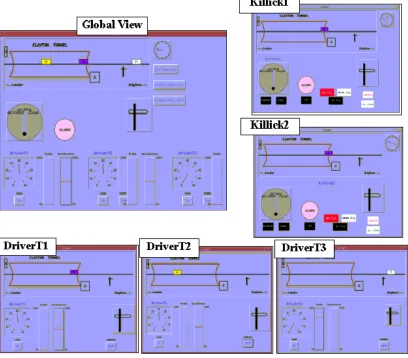
human agents involved in the accident scenario, together with a global view that purports to show the objective reality. The model from which these screenshots have been taken is a distributed model that has been adapted for use by schoolchildren by subdividing the responsibilities of the signalman Killick into two roles.
Figure 1: Screenshots from the distributed model of railway operation claytontunnelSun1999
situation. Communication between the views of the various agents is handled in the model by sending redefinitions of observables from one to another in much the way that a family of personal spreadsheets might be updated in a distributed environment through sending new values or definitions for cells.
In 'normal' execution of the model, the location and speed of the train are dependent on time, and are computed automatically from a simple model of the dynamics in which the acceleration of the train depends on the position of the brake and accelerator as determined by the driver. The most significant feature of the execution of the model is that it is constructed so that at any point the human interpreter can experience it as a 'real' artefact, and interact in much the same way as a musician who stops in rehearsal to experiment with the balance of the current chord, to adapt the local inflection of a musical phrase or to carry out an exercise that is only loosely related to what is required in performance. For instance, in the context of Figure 1, the clock can be suspended, and the configuration of observables redefined on-the-fly as if to reflect failure of the signal mechanism, the relocation of a train, or a change in Killick's perception of the status of the signal.
[image:7.595.177.399.387.580.2]By some criterion, the model in Figure 1 is not very realistic. A more informative view of Killick's environment, in the form of a virtual reality model (EMArchive: claytontunnelWoodforth2000), is depicted in Figure 2. As the discussion in section 1 indicates, mere photorealism may only be a superficial indication of realism in a model: its essence relates to how far it can help to sustain and enhance the relationship between the fiction and the reality as experienced by the realiser.
Figure 2: A virtual reality view from the signal-box from claytontunnelWoodforth1999
A most significant feature of the VR model in Figure 2 is that it was derived from the model depicted in Figure 1 by attaching new dependencies to observables such as the location of the train T1. These dependencies define the key parameters in the VRML model in Figure 2 that determine the visual image of the train, and supplement the more rudimentary visualisation in Figure 1. It is interesting to note that the representation of Killick's perception of the location of train T1 in Figure 1, though more primitive than that in Figure 2, can more readily capture the notion that this location is not his current focus of attention – 'focus of the attention' in Figure 1 can only refer to the current state of the external observer, rather than to that of the agent Killick himself. In this sense, Figure 1 is more realistic than Figure 2, and might be made yet more realistic by adding some visual representation of the invisible mental state that relates to the stage that has been reached in an ongoing protocol. For instance, it would be informative to add a state diagram that showed the stages in standard operation of the signalman's role (cf. Beynon et al, 2001), and register his change of mental state by highlighting a current state in the diagram.
From this discussion, it is clear that reflection on the EM model of railway operation directs attention away from what might at first appear to be the most significant component of the model where realism is concerned: the global view of the situation. Indeed, in witnessing a simulation of railway operation in progress, more understanding of what might have been the 'actual' circumstances of the accident emerges from observing the distributed interaction of the participants playing the roles of the railwaymen than from looking at what purports to be the objective situation. The realism lies in the realiser's engagement with the fiction, and the uncircumscribed ways in which this evokes other experiences. It is not in the first instance the constraints and the knowledge embodied in the model that are important: it is the openness to exploratory possibilities that can be conjoined within its present state. It is in this spirit that the model of Figure 2, rather than being a disjoint model based on an alternative world-view, is merely one extension of Figure 1 that co-exists with it as another possible construal of the situation. This open and extensible quality distinguishes the EM model from a simulation that might be constructed by tracing objective observation of normal sequences of behaviour of the agents, where the possibility of singular interactions and conflicts is typically seen as an evil to be avoided. Such potential for exploratory interaction and unfathomable observation is more in keeping with our experience of the real, about which we can learn, be uncertain, and be unable to articulate.
5
Conclusion
6
Acknowledgments
I thank Piet Kommers for soliciting this paper, and Karl King and Chris Roe for helpful input.
7
References
Beynon, W.M. (1999) Empirical Modelling and the Foundations of AI, Computation for Metaphors, Analogy and Agents, LNAI 1562, Springer, 322-364
Beynon, W.M. (2003) Radical Empiricism, Empirical Modelling and the nature of knowing, Proceedings of the WM2003 Workshop on Knowledge Management and Philosophy, Luzern Beynon, W.M., Ness, P.E., Russ, S.B. (1995) Worlds before and beyond words, Proc. Virtual Futures ’95, University of Warwick
Beynon, W.M., Roe, C., Ward, A., Wong, A. (2001) Interactive Situation Models for Cognitive Aspects of User-Artefact Interaction, Proc CT2001, LNAI 2117, Springer-Verlag, 2001, 356-372 Beynon, W.M., Rungrattanaubol, J., Sinclair, J.E. (2000) Formal specification from an observation-oriented perspective, Journal of Universal Computer Science, Vol. 6(4), 407-421 Beynon, W.M., Sun, P-H. (1999) Computer-mediated communication: a Distributed Empirical Modelling perspective, Proceedings of CT'99, San Francisco, August 1999.
Cantwell-Smith, B. (2002) The Foundations of Computing, in M. Scheutz (Ed), Computationalism: New Directions, MIT Press
Cardus, N. (ed) (1954) Kathleen Ferrier: a Memoir, Hamish Hamilton, London Cooke, D. (1959) The Language of Music, OUP
James, W. (1890) The Principles of Psychology (first published 1890), Dover 1955 James, W (1912) Essays in Radical Empiricism (first published 1912), Bison Books 1996 Shapiro, N (ed.) (1977) An Encyclopedia of Quotations About Music, Da Capo Press EMWeb at the url: http://www.dcs.warwick.ac.uk/modelling/