1
CULTURAL DIFFERENCES IN
TECHNICAL INSTRUCTIONS:
A Cross-cultural Comparison of the Use of Differently Structured Manual
QIAN LI
S1518356
19-01-2015
First supervisor
PROF.DR.M.D.T.DE JONG
Second supervisor
DR. J. KARREMAN
UNIVERSITY OF TWENTE
FACULTY OF BEHAVIORAL MANAGEMENT
AND SOCIAL SCIENCES
2
Table of Content
Abstract ... 3
1 Introduction ... 4
2 Literature Review ... 5
2.1 Technical Communication in China ... 5
2.2 Cultural Theories ... 7
2.3 Cultural Differences in Technical Documentation ... 8
2.3.1 Summary of Differences ... 8
2.3.2 Differences in Structure ... 9
2.3.3 Research Question ... 16
3 Methodology ... 16
3.1 Experimental Design ... 16
3.2 Artifact ... 17
3.3 Manipulations ... 17
3.4 Instrument ... 21
3.4.1 Scale Construction ... 23
3.5 Participants ... 24
3.5.1 Groups Comparability Analysis ... 25
3.6 Procedures ... 25
4 Results ... 26
4.1 Differences in Task Performance ... 26
4.2 Differences in Appreciation of Trados ... 27
4.3 Differences in Appreciation of Manual... 28
4.4 Observations ... 29
5 Conclusion and Discussion ... 30
5.1 Main Findings ... 30
5.2 Limitations and Future Research ... 31
5.3 Conclusion ... 32
References ... 32
Appendix ... 35
Appendix 1 Trados Variables ... 35
Appendix 2 Manual Variables ... 36
3
Abstract
Purpose: Research shows that technical writers from Chinese and western cultures structure documents in different ways. In this research, we conducted an experiment to find out whether there were differences when users from different cultures use differently structured technical instructions.
Method: A 2x2 experiment was conducted to test how those differences found by prior researcher influenced users’ performances and preferences. The independent variables are participants from different cultural background (Chinese and Western) and manuals designed based on different cultural structure (Chinese and Western); and the dependent variables are performance of a designed task as well as judgment of the software and manual. 80 participants were asked to use SDL Trados Studio 2014 with the designed manuals of different structures, and their performances were recorded. Then they filled out a questionnaire to indicate their opinions about the software and manual.
Results: No significant differences were found in performance and preferences when participants from different cultural background use instructions structured in
different ways. This might be due to the fact that users did not often use manuals and the structure elements found were not as important as expected.
Conclusion: Based on this study, for future researches, more structural elements can be found and analyzed, participants less influenced by other culture can be recruited, and manuals that users are more dependent on should be designed.
4
1
Introduction
With the development of information technology and globalization, the idea of a “Global Village” (Darity, 2008) raised by Marshall McLuhan has become the reality. The world is getting smaller and smaller, and products are made for international markets, no longer just for one country. Therefore, the role of cultural differences becomes increasingly important.
Cultural differences are so important that they influence almost every industry. Among them, Chinese and Western cultural differences may have the greatest impact because Chinese and western cultures are the “most distant from one another and probably influenced one another the least” (Nisbett, Peng, Choi, & Norenzayan, 2001, p. 4). So this study focuses on cultural differences between the Chinese and the western world.
Technical communication is undoubtedly influenced by the difference between Chinese and western cultures. Many issues in technical communication are caused by cultural differences. For example, some western technical communicators think that the quality of documents from Asian countries is "very poor", and those documents are difficult to understand (Barnum & Philip, 2001).
This may be due to the immaturity of this profession in those Asian countries. According to Yoshihiro Otsuka (as cited in Barnum & Philip, 2001), there are small numbers of technical writers in Asian companies, and demands exceed supplies. Besides, few universities have technical communication programs, so they can neither provide enough potential practitioners nor develop guiding theories for the industry. Among those Asian countries, the situation in mainland China may be even more critical, there are no professional associations, which can provide trainings, meetings and industry information. However, there are chapters of the Society for Technical Communication (STC) in other Asian countries (Barnum & Philip, 2001). On the other hand, it is also possible that the quality of user documentation is in fact adequate, but the criteria for good documentation are different because of cultural differences. If technical writers do not take the culture into consideration or they do not have a thorough understanding about the target culture, the documents they design may be hard for people in that culture to comprehend. Or if technical writers neglect the fact that a different culture leads to different criteria, a technical
document with good quality produced in China may fail in American or other western countries because standards differ.
Many experts have stressed the importance of cultural differences in technical communication. Ding (2011) gave lectures at two universities in China and tried to give suggestions to the curricula in the aspect of Chinese unique culture. Huining (2010) mentions that to understand technical communication instruction in
5
educational, political, and economic contexts on technical communication practices. Ulijn and St.Amant (2000) argue that if professional communicators want to achieve effective intercultural communication, they first need to figure out how cultural factors can affect professional interactions. More specifically, Huatong (as cited in Barnum & Li, 2006) points out that “cultural factors play an important role in determining the acceptability and usability of an information product ” (p.163). There are some theories that may help the technical communicator get more
understanding of the culture, such as the iceberg model proposed by French and Bell (1979), the five cultural dimensions put forward by Hofstede (2010), and the
distinction between high and low context cultures developed by Hall (1976). To some extent, they can be helpful to understand the importance and differences of culture. But they do not explain phenomena about cultural differences in technical
communication or help to immediately draw conclusions about technical
documentation. For example, how do users use technology? Do Chinese people use technology in the same way as the western people? Do they have preference
regarding the design of documents? Do they work more effectively when instructions are given in the different way? How can users be best instructed to use technology? In this study, the theoretical framework provides a summary of assumptions of earlier studies about cultural differences between Chinese and western world in technical documentation, especially in the aspect of structure. The experimental part investigates to what extent the preferences of Chinese and western users reflect the assumptions about cultural differences with respect to the structure of instructional documentation. This research may help technical communicators better understand the cultural differences and the influence on users’ behavior and perception of manuals.
2
Literature Review
2.1
Technical Communication in China
Technical communication as a new career has developed rapidly in China. Many large multinational companies such as Ericsson, Cisco Systems, Motorola, Alcatel-Lucent, and Nokia Siemens Networks have set up specialized departments to develop technical documentation. Meanwhile, local Chinese companies, such as Huawei Technologies, Haier Group, and Lenovo Group Ltd., are expanding abroad, so they need to sell the products as well as documentation to the foreign customers. The market for technical communication is big in China. Besides, Chinese culture has greatly influenced the East Asian cultural sphere, such as Japan, Korean, and
Vietnam(D. D. Ding, 2003). Therefore, it is worthwhile to focus on the current status of technical communication in China.
6
stage. In 1997, a delegation of 12 western technical communicators visited China, and found that technical communication was at the earliest stages, had not been developed as a separate profession or academic discipline, and China was hungry for technical communicators and technical communication teachers (Tegtmeier & Thompson, 1999).
Ding and Jablonski (2001) also describe the growing needs for general user
documentation. Besides, they discover some problems in the technical writing class: teachers focus on terms and expressions instead of rhetorical issues, such as
audience, purpose, information selection, and page layout, which may cause the readers confused by the documents.
Besides those western professors, more and more Chinese scholars get interested in how technical communication can be developed in China. Some researchers (such as Han, 2010; Duan & Gu, 2005; Hu, 2004) suggest to integrate technical
communication into English for Specific Purposes (ESP) at Chinese. Wang and Wang (2011) as well as Miao and Gao (2011) argue that technical writing was strongly related to scientific translation in China. What is more, Miao and Gao (2010) as well as Wang and Wang (2011) put forward that technical writing could be develped as one program under Master of Translation and Interpretation (MTI). Beside, more and more universities have offered courses related to technical communication, including some top universities, such as Peking University and Nankai University.
However, Duan and Gu (2005) pointed out that despite efforts made by those western technical communicators, they did not produce effective or long-lasting results. In addition, what Chinese scholars have done is still in the phase of exploration and attempt, with only few articles and books published, and most technical communicators do not have a related educational background. Therefore, “technical communication has yet to become a mature discipline in China” (H. Ding, 2010, p.5).
Secondly, the industry of technical communication in China needs to be improved. D. D. Ding, (2003) argued that China has a long history of Technical Writing, and he took Yi Jing as an example. Yijing is translated as A Book of Changes and it is a book of “oracles and divination” (D. D. Ding, 2003,p.3). D. D. Ding, (2003) thinks Yijing is a technical instruction manual because the book is designed to help people perform specific tasks, which is the definition of technical instructions. However, the technical writing to support technology and economy in China just emerged, no more than 20 years (Barnum & Li, 2006), and it is at the beginning of development.
7
researchers conducted studies to provide useful theories to guide practices in this industry.
Moreover, H. Ding (2010) argues that the quality of Chinese instructions produced is unsatisfactory, not to mention the English instructions. What is worse, although practical writing has developed a lot with many associations formed and journals launched, there is no professional association parallel to STC or an equivalent journal to Technical Communication in mainland China (Barnum & Li, 2006). Practitioners have no access to formal trainings or meetings. Finally, managers, practitioners, or the audience pay insufficient attention to technical communication, and no comprehensive industry standard exists to rule the industry. Therefore, “no specialized profession of technical communication exists” (H. Ding, 2010, p.4).
2.2
Cultural Theories
As mentioned above, western people may find the technical documentation produced in China hard to understand because the profession of technical
communication is undeveloped in China and the quality maybe not good; besides, cultural differences can also cause the incomprehension. Thus, this chapter introduces some cultural theories that can help to understand the differences between Chinese and western cultural.
French and Bell proposed the Iceberg Model in 1979 (as cited in Ulijn & StAmant, 2000). According to the Iceberg Model, a culture is made up of two primary parts: “a visible top that represents the facts, the technology, the price, the rationale behind things, the brain, the written contract of a negation in an explicit way and “an invisible bottom of emotions, the human relations, the unspoken and unconscious rules of behavior in an implicit way”(Ulijn & St.Amant, 2000, p. 221). The Iceberg Model shows that there are some invisible and underlying reasons for people’s behaviors and preferences, and those reasons are related to the culture. It can be deduced that a user’s behavior when using technical documentation is related to culture, and the behavior influenced by culture is much more complex and unobvious. However, just knowing that it is related to culture is not enough, the model does not discuss cultural differences, and it is too general and specific reasons cannot be concluded from it, for example, why do people from different cultural backgrounds have different preferences for manuals?
8
communication. For example, writers should provide detailed and direct information in low context countries, and fewer messages are required in high context countries. However, this theory does not take into consideration other aspects of culture, which may also give rise to different behaviors and preferences of users.
Hofstede (2010) conducted a worldwide survey about cultural differences. He collected data about cultural values from 100,000 employees in IBM around the world, 50 countries and 3 regions included. Instead of simply classifying culture into two parts, he distinguished four dimensions to differentiate and rate different
cultures, which are individualism-collectivism, uncertainty avoidance, power distance, and masculinity-femininity (Hofstede, Hofstede, 2010). This model helps us
understand the differences between two cultures in four dimensions, and present more views than the high/low context theory. However, it is static and too simple. A cultural is more complicated and dynamic than four dimensions can describe. Furthermore, when it comes to the differences in technical communication, those dimensions are too broad to be applied. For example, how technical documents should be like in a high power distance country such as China; should the style be more official and authoritative? Or whether documents designed for culture of high uncertainty avoidance should be more direct and specific?
Those theories describe the importance of culture, differences between countries, and the phenomenon in societies. But the steps seem to be pretty big if it comes to describe the differences regarding technical communication. Therefore, research should be done to study the cultural differences reflected in technical
communication, and help writers provide manuals with better usability and users conduct task with less efforts.
2.3
Cultural Differences in Technical Documentation
Many studies have been done on the cultural differences between western counties and China in the technical communication. Eight papers were found and analyzed that are targeted at cultural differences between Chinese and western countries in technical writing.
2.3.1
Summary of Differences
Differences could be mainly classified into five categories: structure, style, visual design, user behavior, and content.
Style is the tone of writing, about how to present specific document elements, and also the rules of writing. Differences regarding style found from the literature are shown in Table 12 in the Appendix 3 Cultural Differences (Style, Visual Design, User Behavior, and Content,). In general, Chinese technical writers prefer
9
Visual design in this research refers to the way how to handle all elements related to tables, figures, and layout. Differences regarding visual design found from the literature are shown in Table 13 in the Appendix. In sum, compared with western manuals, there are less page design elements and more pictures in Chinese
documents. Besides, the relationship of texts and visuals relationship is elaborative in Chinese instructions and redundant in western. Finally, the target audience of
Chinese manuals is professionals, and in the western world the target audience is general mass.
Differences regarding user behavior found from the literature are shown in Table 14 in the Appendix. Researchers found that Chinese people had a better understanding of pictures than westerners, the purpose of learning is more pragmatic, and the learning method is more dependent on relationship.
Content in this research means what should be presented and what should not (shown in Table 15).Barnum and Li (2006) found that traditional characters were used in Chinese manuals because some parts of China are still using the traditional Chinese character instead of the simplified one.
Structure is about the organization and clustering of the document, such as headings, introductions, orders, paragraphs, and links. Chinese writers were found to arrange documents in more holistic and covert way and follow nature order.
This study is focused on structural differences. First because structure is important. It is hard for readers to understand the contents without proper structure. Besides, it is easier to manipulate in experiment than style and pictures. What is more, there is more evidence in the literature for structural differences than for other differences, such as content.
2.3.2 Differences in Structure
Differences regarding structure found from the literature are shown in Table 1. The table consists of four columns, namely, “General”, “Differences”, “Sources”, and “Researches”. The meanings of each column are as follows:
“General” is the general differences.
“Differences” lists the findings referred in those selected papers.
“Source” shows the references.
10
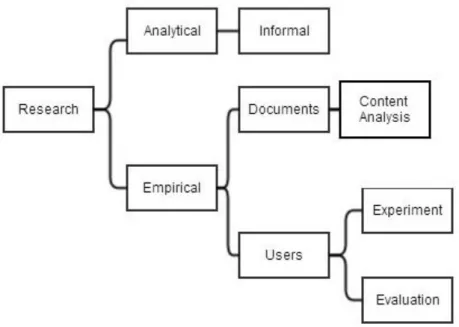
In those empirical researches, content analysis is the method used in analyzing documents, and experiments as well as evaluation are used to conduct on users.
11 Table 1
Structural Differences
General Differences Sources Type of
Study
Holistic structure in Chinese culture
Relations between parts are stressed in Chinese culture.
(D. D. Ding, 2003)
Content Analysis Rational/synthetic structure in Chinese
culture.
(Barnum & Li, 2006)
Content Analysis More contextual information in Chinese
culture.
(Q. Wang, 2000)
Content Analysis Chinese: structure based on entire
interrelation.
German: structures are individually and separately designed.
(Y. Wang & Wang, 2009) Content Analysis Yihe-prominent structure in Chinese culture
Structures less specifically defined in Chinese culture.
(Barnum & Li, 2006)
Content Analysis (Y. Wang &
Wang, 2009)
Content Analysis
Fewer structure elements in Chinese culture.
(Barnum & Li, 2006)
Content Analysis
Headings less common in Chinese culture. (Barnum & Li, 2006)
Content Analysis
Lack of topic sentences in Chinese culture. (Barnum & Li, 2006)
Content Analysis
Natural order in Chinese culture
Chinese: general to concrete German: concrete to general
(Y. Wang & Wang, 2009)
Content Analysis
Chinese: inductive order American: deductive order
(Barnum & Li, 2006)
Content Analysis Chinese: spiral organizational pattern
American: inverted pyramid organizational pattern
(Barnum & Li, 2006)
Content Analysis
Enhance understanding by rhetorical: basic to advance; familiar to unfamiliar in Chinese culture.
(Q. Wang, 2000)
Content Analysis
More chronological order in Chinese culture.
(Barnum & Li, 2006)
Content Analysis
Structures based on the chronology of operations activities in Chinese culture.
(Y. Wang & Wang, 2009)
12
Holistic Structure
Nisbett, Peng, Choi, and Norenzayan (2001) find that cognitive processes of East Asians are more holistic, and people relate individuals to the entire field; while that of westerners is more analytic, and western people focus on individual objects. The differences of thinking influence the way to structure documents. Holistic thinking patterns focuses on the context, and relationships between the object and the outside environment while analytic thinking patterns separate the object from its context, focus on attributes of the object. (Y. Wang & Wang, 2009, p. 47).
Y. Wang and Wang (2009) mentioned that to explain a system, Chinese writers arranged the structure “on the basis of an entire interrelation or context” (p.7), and Germans individually and separately structure the system as individual elements. D. D. Ding (2003) also find that Chinese writers stress relations between parts in instructions.
Besides, Wang (2000) says that a new idea is presented with more contextual information because of the holistic and relational thinking patterns, while the Americans tend to be direct.
This is consistent with the holistic view of Chinese philosophy, "the nature and man unites as one". On the other side, in the western philosophy, people emphasize more on the individual in the entity. Many natural scientists in the western countries suggest that things in the nature should be divided into different parts, and studied are conducted to the individuals.
This can also been seen in the difference between Chinese and western medicine as well as paintings. A doctor of traditional Chinese medicine diagnose the illness based on the whole organic and the relationship between the body and the external
environment (Barnum & Li, 2006), while western doctors focus on the infected or wrong part. And in Chinese painting, it is preferred to go beyond the restraints of structure and present a flowing spirit in the painting, while western paintings emphasize focal respective, layouts, shapes, and details (F. Guo, 2006).
Yihe-Prominent Structure
Barnum and Li (2006)find that the structures of Chinese documents are less specifically defined, and contain less structural elements (such as topic sentences and headings). They attribute the differences to the cultural expectation, reader responsibility, that readers are expected to read every word to understand
potentially important items, while the American documents design the structures well because it is the responsibility of the writer to understand the needs of readers (Barnum & Li, 2006). Some Chinese scholars also realized this difference, for example, Zhang (1994b) claims that the core and center of writing in Chinese is the author, but in English is the reader.
13
aruge that the different requirements of structure might be caused by the type of culture. Technical documents in a low-context culture are required to be more finely structured than those in high-contect culture (Y. Wang & Wang, 2009).
In addition, differences in strucuture may also be caused by different organizational principles in China and western countries, yihe and xinghe.
It is widely acknowledged in Chinese translation circles that Chinese is a
yihe-prominent language and English is a xinghe-prominent language, which is the most important distinction between Chinese and English (Li, 2011; Liu, 2006; Shen, 2003; Juquan Wang, 2007; T. Wang, 2010).
What is xinghe and yihe? The Linguistics Volume of Large Dictionary defines yihe as “The language unit is combined by meaning, without any specific requirements in forms.” (Xia, p.109). Liu (2006) defined yihe as “the way to connect words and sentences by meanings and logics, but not linguistic forms (including lexical and morphological means)” (p.74). For example. It rained; the plane was cancelled; I failed to visit Italy; and defines xinghe as “the way to connect words and sentences by linguistic forms” (p.74). For example, it rained, and the plane was cancelled. So I failed to visit Italy. Lian (1993) agrees with this definition, and he gives some further explanation, “Formal cohesion is the key way to connect sentences in English, while semantic coherence is the focus of connecting sentences in Chinese” (p.46). They both point out that overt signs are used in English writing and covert meanings are used in Chinese documents.
There have always been debates over the translations about yihe and xinghe. Most people translate them to hypotaxis and parataxis (such as Lian, 1993 and Liu, 2006). However, Li (2011) argues that the original meanings of hypotaxis and parataxis are “arrange under” and “arrange side by side”, and “refer to the arrangement and connection of sentence elements with regard to coordination and subordination” (p.190). Oxford Dictionarydefines hypotaxis as “The subordination of one clause to another” (“Hypotaxis,” 2014) and parataxis as “The placing of clauses or phrases one after another, without words to indicate coordination or subordination” (“Parataxis,” 2014) . Halliday et al. (2014) extend the relation of clauses to bigger structure, and they point out “parataxis is the linking of elements of equal status, and hypotaxis is the binding of elements of unequal status”(p.384). The meanings of yihe and xinghe
are more about forms and meanings, than subornation and coordination, so hypotaxis and parataxis are similar to yihe and xinghe in some ways, but cannot be equivalent translations.
Therefore, the Chinese pinyin xinghe and yihe would be used in this research, but not hypotaxis and parataxis. In this research, yihe refers to that structure is formed by meaning, while xinghe means constructions that are linked by the use of
conjunctions.
14
are used to strucutre the sentences, such as clear connections between every part and topic sentences. “The German textbooks and service manuals were more finely and detailed structured than the Chinese ones” (Y. Wang & Wang, 2009, p.9). In Chinese documents, yihe is the principle of organizaiton. It is acceptable that there is no top sentences or distinct clues, only if the meaning of each part is consistent and reflects the topic. Also, there are less elements that show the structure. Chinese writers have adapted the habit “no paragraph, no punctuation” in documents for thousands of years. People break the paragraphs and sentences by their own way of understanding. Not until the New Culture Movement (around the time of the May 4th Movement in 1919) did the use of paragraphs and punctuations to segment an article spread.
Yihe structure is also influenced by holistic thinking style. Chinese pay more attention to the smooth and consistent of the whole document, so distinct structure elements such as headings, conjunctions, or punctuations might break the harmony of the overall. For instance, “Chinese technical writers may eschew headings as disrupting the flow of the whole. (Barnum & Li, 2006, p. 152)”
Nevertheless, Chinese people have explored the document structure for thousands of years and the most famous writing pattern is “eight-legged essay”, designed by Wang Anshi. Strucuture, numbers of sentences, rhetoric means and other elements are strictly defined. This rigid and artificial structure was used for imperial
examinations for nearly 1000 years, was criticized severly in the late times, and abandoned 100 years ago. This may cause the preference for a flexible structure in the modern times. Besides, the influence of western culture is so large that many writers start to arrange the documents in more xinghe way.
Although Chinese is a yihe-prominent language, it does not mean that xinghe cannot be found in Chinese documentation. Moreover, Chinese culture has been influence by the western culture since China's reform and opening up. So it is better to say that Chinese documents are yihe dominated and xinghe mixed. And English documents are xinghe dominated and yihe mixed.
Natural Order
China is known as the nation of etiquette. Since Zhou Gong applied The Rites of Zhou
as the way to rule people more than 3,000 years ago, Chinese people have been strongly affected by etiquette and ceremonies, just as much as how religion
influences the western people. The core of The Rites of Zhou is Jing Tian Fa Zu, which means to study and apply natural laws with fear and seriousness.
15
experience and cognition.
Wang (2000) analyzes the manuals for science and small household electronic appliances, and finds that the manuals are arranged from basic to advanced, and familiar to unfamiliar. While American manuals are focused on specific task.
Both Barnum and Li (2006) as well as Wang and Wang (2009) find inductive order in Chinese documents. As Barnum and Li (2006) claim, because of synthetic/integral/ relational thinking patterns, Chinese show preference for inductive order, which leads to the spiral organizational pattern: qi-cheng-zhuan-he
(introduction-development-transition-conclusion). Because of analytical thinking patterns, Americans show preference for deductive order, which leads to inverted pyramid organizational pattern: view first, opening paragraphs-middle-conclusion. Inductive order makes the structure spiral.
Wang and Wang (2009) find that in the Chinese textbooks, an engine fuel injection system is described starting from the general information, whereas the German textbooks start from the concrete system. Similarly, Wang and Wang (2009) also discover that Chinese people search information from general to concrete, while half the German participants searched in the sequence from concrete to general. Besides, Wang and Wang (2009) find that “Chinese service manuals was from the chronology of the operations activities that users should carry out, such as
maintenance, disassembling, checking, assembling, and adjustment” (p.44), because of high context (indirect, digressive). “The German textbooks and service manuals were more finely structured with greater detail than the Chinese ones” (p.44), because of low context (direct, linear discourse). This finding is also supported by Barnum and Li (2006), and they think Chinese documents follow chronological order, starting with the introduction and ending with conclusions and suggestions.
Conclusion
In general, the Chinese technical documents are less explicitly structured while the western ones are more finely and detailedly structured. But it does not mean that Chinese document do not have structure. Instead, the structure of Chinese
16
2.3.3 Research Question
Structure plays an important part in technical documentation. Designing the
structure is an essential step before starting writing. Once the structure is fixed, few changes will be made, and it is costly to change the structure in the process of writing manuals. Besides, clear structure can help readers have a better understanding of the topic and save more time.
However, writer’s methods of structuring documents and readers’ ways of perceiving the structure vary from culture to culture. The structure of a manual seems
reasonable to readers in one culture, but may be confusing to people from the other cultures. Therefore, it’s vital to find out the structural differences caused by different cultures.
Many studies have been done to analyze the structural differences between Chinese and western cultures. The analysis in section 2.3.2 shows that structure is convert and holistic, and follows the nature order in Chinese manuals, while overt and partly, and no nature order preference in western manuals. However, all research methods of those studies are content analysis (see Table 1
Structur). They just found how the writers structured the manual, but few
experiments were conducted to test the behavior of the users. Do the users from different cultures act according to their findings? So studies are needed to examine whether those findings can be applied to users. Based on it, the research question is: To what extent do the preferences of China and Western users reflect the
assumptions about culture differences with respect to the structure of instructional documentation?
3
Methodology
3.1
Experimental Design
Based on major differences of structure found by prior researchers, an experiment was conducted to test how those differences influence users’ performances and preferences. It is a 2x2 experiment, with two independent variables and two dependent variables. The independent variables are cultural background of
participants (Chinese and westerners) and structural design of manuals (Chinese and western); and the dependent variables are performance of a designed task as well as judgment of the software and manual.
Participants were asked to finish a task (create a translation memory) in SDL Trados Studio 2014 with a given manual.
17 Table 2
Manuals
Culture Chinese English
Chinese CC EC
Western CE EE
The official Trados user manuals were re-designed based on what prior researchers have found about the structural differences between Chinese and western technical instructions. Two versions were designed, an English manual based on English culture (EE), and a Chinese manual based on Chinese culture (CC).
To eliminate the influence of different language levels. Chinese participants used manuals in Chinese, and participants from the western culture used the manual in English. Therefore, EE was translated into a Chinese manual based on English culture (CE), and CC was translated into an English manual based on Chinese culture (EC).
3.2
Artifact
Trados Studio 2014 was selected as the software participants used. Trados is a popular computer-aided translation tool, which is well designed and easy to get with a free 30-day trial version; besides, it provides English and Chinese interface
languages, and can be switched easily. The most important is that only professional translators use this tool, and for people outside the translation field, they have no idea of computer aided translation tool, not to say Trados. Therefore, most peoples’ prior knowledge of the software is at the same level.
There are official manuals of Trados in different language. The manual was designed in English by western technical communicators, and localized into other languages. The manuals used in the experiment are designed based on the official manuals.
3.3
Manipulations
First column of Table 3 shows major differences in the aspect of structure found by researches, and second column shows how those differences are manipulated in the manual.
18 Table 3
Cultural Differences (Structure)
Differences
Variables
Chinese Culture
Western Culture
Structures less specificallydefined in Chinese culture
Conjunctions Less conjunctions More conjunctions
Fewer structure elements in Chinese culture
Table of contents Lists
Abbreviations Glossary Header Footer
No table of contents Less lists
No abbreviation list No glossary No header No footer
Table of contents More lists
An abbreviation section A glossary section Header (company logo) Footer (page number)
Headings less common in Chinese culture
Sub-headings No sub-headings Sub headings
Inductive vs. deductive Document elements order
Arguments->conclusion Conclusion->argument
Lack of topic sentences in Chinese culture
Position of topic sentences (Combined with the inductive and deductive structure)
Placed at the end of the paragraph
Placed at the beginning of the paragraph
General vs. concrete Document elements order
General to concrete Concrete to general
Implicit vs explicit Description detail extent of the operation
Do not describe every required action, and more briefly.
No explanation of the document conventions.
Describe actions step by step with numeric lists.
There is a section to describe the document conventions.
During the design process, a certificated trainer of SDL Trados reviewed the manuals to make sure there were no mistakes related to the knowledge and operation of Trados. A professional translator reviewed and edited the re-designed (EE and CC) and translated versions (CE and EC) to make sure that they are completely equivalent and that there are no mistakes related to language use.
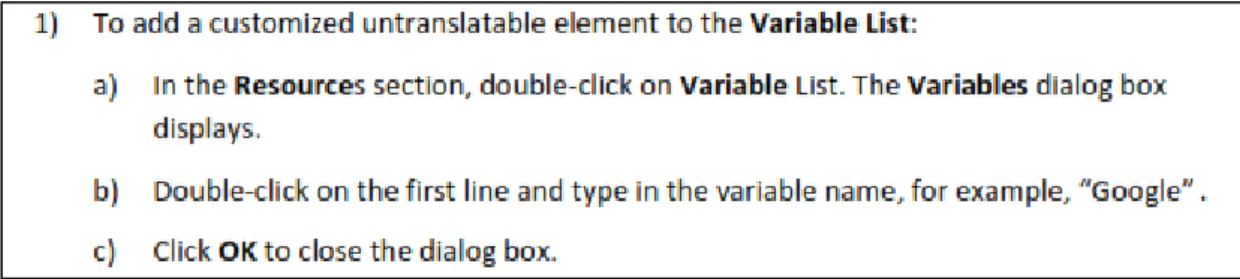
Designed Manual Examples
19
1. Subheadings
Figure 2 Western Culture (Subheadings)
Figure 3 Chinese Culture (No Subheadings)
2. Inductive vs. Deductive
Figure 4 Western Culture: Deductive (Conclusion -> Argument)
20
3. Implicit vs Explicit
Figure 6 Western Culture (Explicit with Lists)
Figure 7 Chinese Culture (Implicit without Lists)
4. General vs. Concrete
21
Figure 9 Chinese Culture (General to Concrete)
3.4
Instrument
Direct observation was used to collect data about users’ performance.
Performance includes effectiveness, efficiency, and users’ knowledge of manual. Success rates of tasks were used to measure effectiveness. There are 7 sub tasks, and for each small task, the success rate was recorded. Besides, time consumed for the task was counted to be a measurement for efficiency. The maximum time for the 7 sub tasks is 25 minutes. The attempts users tried to created translation memories was also used to measure efficiency. It can be easily figured out by the number of translation memories the user has created. Finally, users’ knowledge was measured by the correctness of knowledge and the number of the Don’t Know answers. Judgment of the software and the manual was measured by a questionnaire. The questionnaire was checked by a translator to achieve complete equivalence. After the task, participants were asked to fill in a questionnaire. The questionnaire consisted of three parts. The First part was intended to measure the usability and Usefulness of Trados. The second part was designed to measure to what extent the user understand and memorize the manual. The third part was to see the users’ judgment about the usability, language, structure, and layout of the manual. The first part has 18 questions, all are five-level Likert items, from strongly agree to strongly disagree.
Question 1 to question 12 were used to measure the usability of Trados
22
& Miller, 2009; Lewis & Sauro, 2009). Moreover, (Bangor et al., 2008)
suggest to change “cumbersome” with “awkward” because some non-native English speakers don’t understand the word. An example is as follows:
I found Trados unnecessarily complex.
9-12: are more questions about how satisfied users are when they use Trados with the given manual and the learnability of Trados. An example is as follows:
I could learn to work with Trados quickly.
Question 13 to question 18 are used to measure the Usefulness of Trados, which is how useful they think Trados is for translators. An example is as follows:
I think Trados is a useful tool for translators.
The second part of the questionnaire (19-27) is made of nine statements about the knowledge of Trados, including the description and operation of the software. Participants should judge whether those statements are true or false, or don’t know based on the memory of reading manuals. An example is as follows:
Trados is a kind of computer-aided translation tool.
The last part is to know users’ appreciation for the manual. Five-level Likert is used, from strongly agree to strongly disagree.
28-35: Usability of the manual. An example is as follows:
I am satisfied with this manual.
36-39: Language of the manual. An example is as follows:
The language of the manual is clear.
40-48: Structure and navigation of the manual. An example is as follows:
The structure of the manual is confusing.
49-52: Layout of the manual. An example is as follows:
The manual looks crowded and busy.
23
3.4.1 Scale Construction
Data collected from the questionnaire were first processed as follows:
All negative questions were recorded.
A new variable “Task correct” was created to count the number of finished tasks.
For software judgments, there new variables were created.
“Usability general”: the general usability measurements, such as satisfaction and efficiency.
“Usability complex”: how difficult the software is.
“Usefulness”: how useful the software is.
For knowledge part of the questionnaire, the values of all answers were recorded. Two new variables were created
“Dont know”: count how many times the participants answered as don’t know in the knowledge questions.
“Knowledge correct”: count the amount of correct answers.
For manual judgments, three new variable were created.
“Manual language”: opinions about the language use of the manual.
“Manual structure”: opinions about the structure of the manual.
“Manual usability”: opinions about the usability of the manual.
3.4.1.1
Trados Variables
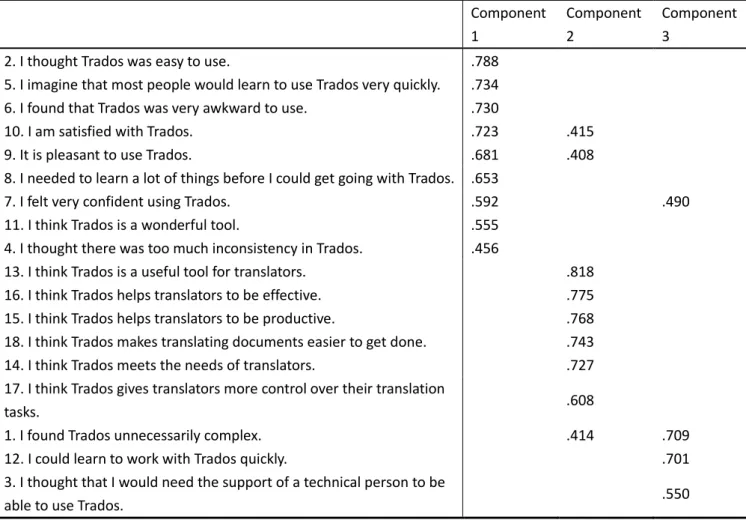
Factor analysis was done with varimax rotation, and it is in the Appendix 1. There are mainly 3 factors: Usability complex (3 items, Cronbach's Alpha: .62), Usability general (9 items, Cronbach's Alpha: .90), and USEFULLNESS (6 items, Cronbach's Alpha: .87). All the three scales are acceptable.
3.4.1.2
Manual Variables
24
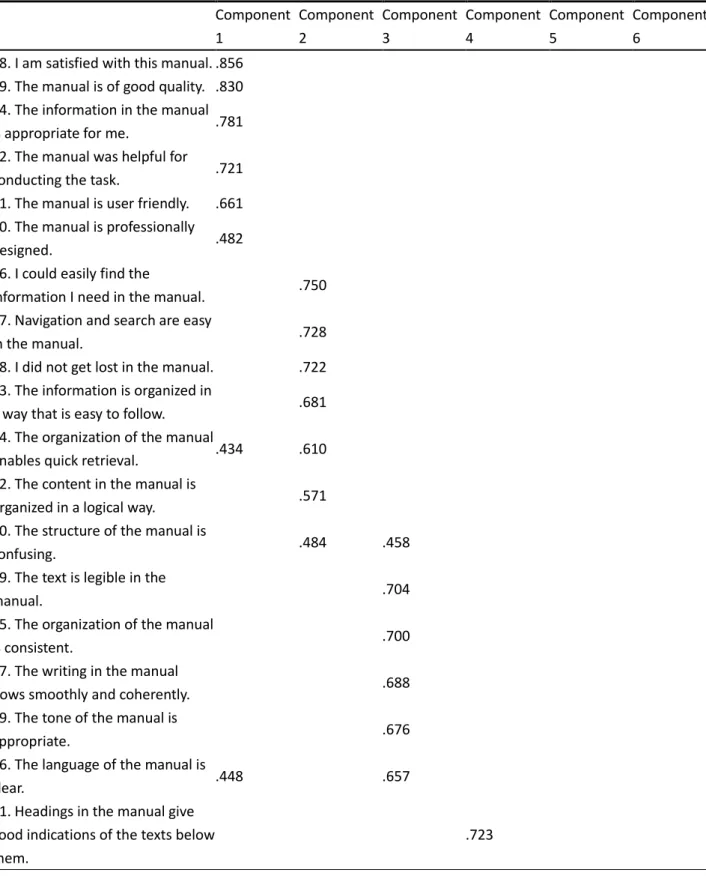
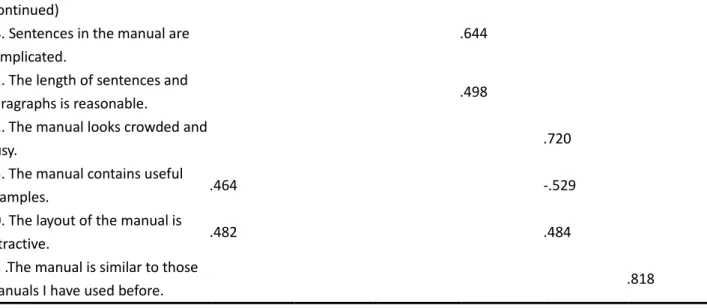
Appendix 2. As Table 10 shows, there are 6 factors. Those factors that seem to be overlapped by each other were deleted, and then there are 3 factors shown in Table 11.
Those three factors are: Manual language (3 items, Cronbach's Alpha: .73). Manual structure (5 items, Cronbach's Alpha: .86), and Manual usability (5 items, Cronbach's Alpha: .90). All the three new scales are reliable.
3.4.1.3
Reliability of knowledge questions.
Knowledge about Trados are not very reliable (9 items, Cronbach's Alpha: .529), and it seems that nothing can done to increase the reliability.
3.4.1.4
Reliability of tasks
Tasks that users need to perform are reliable (7 items, Cronbach's Alpha: .748).
3.5
Participants
40 students from western culture and 40 Chinese students at the University of Twente were recruited. Among the western participants, 18 are from Dutch, 12 from German; 3 from France, 2 from Albania, 2 from Spain, 1 from America, 1 from Italy and I from Slovakia. None of those participants have been to China. All Chinese participants are from the mainland of China. All the participants have not heard or used Trados before.
For western participants, all can read and communicate in English.
As Table 4 shows, participants of different genders, ages and from different study background (T: technical background; NT: non-technical background) were assigned randomly into 4 groups.
Table 4
Participants Distributions Chinese Participants Chinese Structure
Chinese Participants Western Structure
Western Participants Western Structure
Western Participants Chinese Structure
Female 10 10 10 10
Male 10 10 10 10
Technical 10 10 10 10
25
3.5.1 Groups Comparability Analysis
In the four groups, variables about the participant’s background are age, gender, and study background. The following sections discuss to what extend those groups are comparable.
Table 5
Participant Background Variables
Age differences were tested by using UNIANOVA. There are no differences for
nationality: F (1, 76) =.968, p=.328. There are no differences for cultural versions: F (1, 76) =.392, p=.533. Also there is no interaction effect between culture and nationality: F (1, 76) =.800, p=.128.
In conclusion, those groups are comparable when it comes to the relevant background characteristics.
3.6
Procedures
The experiment was conducted in a quiet room.
Before the start of the experiment, the researcher briefly introduced the experiment. Then the users were asked to turn off their communication devices and sign a
self-consent form. Each participant was given a piece of paper about task description. They had 1-5 minutes to read and understand the task. When they understood what they should do, a manual would be handed to them and the researcher started recording time.
During the process, the researcher could not communicate with the participant except emergence cases happen. And the researcher stopped counting the time when the users finished the task or the time exceeded 25 minutes. As soon as the participant finished the task, he/she was asked to fill in a questionnaire. If they wanted to know more about the experiment, they could leave their email addresses. After each experiment, the translation memory participant had created would be stored in different groups. Besides, all the records in Trados would be deleted to make sure the user interface was in its original status.
Chinese Participants Chinese Structure
Chinese Participants Western Structure
Western Participants Western Structure
26
4
Results
This section gives out the experiment results. Differences in user’s performance, appreciation of the software, appreciation of the manual, and some observations are described orderly.
4.1
Differences in Task Performance
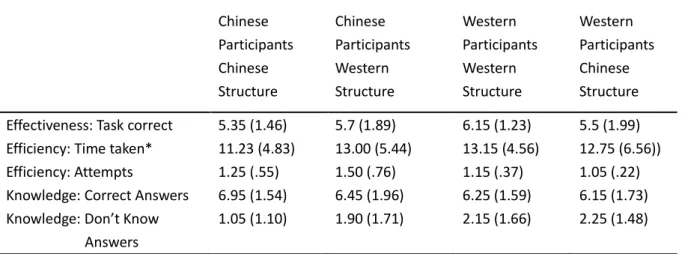
Table 6 shows the mean score and standard deviation of task performance among the four groups.
Table 6
Differences in Task Performance
Note. The data are displayed in mean (std. deviation). “Task correct” measured the number of finished correct tasks. “Time taken” measured how many minutes the users used to finish the tasks. “Attempts” measures how many times users tried to do the task. “Correct answers” measured how many answers were answers about the knowledge of the manual and software. “Don’t Know Answers” measured how many answers were asked in Don’t know by users.
When it comes to the number of task correct, there is no effect of nationality: F (1, 76) =.644, p=.425. There is no effect of cultural version: F (1, 76) =1.79, p=.185. And also there is no interaction effects between cultural and nationality: F (1, 76) =.161. p=.689.
When it comes to the time participants used to finish the task, there is no effect of nationality: F (1, 76) =.481, p=.490; no effect of cultural version: F (1, 76) =.811, p=.371; and no effect between cultural and nationality: F (1, 76) =.324, p=.571. When it comes to the times users tried to complete the tasks, there is a significant effect of nationality: F (1, 76) =5.677, p=.020. Chinese people made more attempts than westerners. However, there is no effect of cultural version: F (1, 76) =2.30, p=.134; and no effect between cultural and nationality: F (1, 76) =.422, p=.518.
Chinese Participants Chinese Structure
Chinese Participants Western Structure
Western Participants Western Structure
Western Participants Chinese Structure
Effectiveness: Task correct 5.35 (1.46) 5.7 (1.89) 6.15 (1.23) 5.5 (1.99) Efficiency: Time taken* 11.23 (4.83) 13.00 (5.44) 13.15 (4.56) 12.75 (6.56)) Efficiency: Attempts 1.25 (.55) 1.50 (.76) 1.15 (.37) 1.05 (.22) Knowledge: Correct Answers 6.95 (1.54) 6.45 (1.96) 6.25 (1.59) 6.15 (1.73) Knowledge: Don’t Know
Answers
27
When it comes to how many knowledge questions were answered correctly by the participants, there is no effect of nationality: F (1, 76) =1.71, p=.195; no effect of cultural version: F (1, 76) =.274, p=.602; and no effect between cultural and
nationality: F (1, 76) =.616, p=.435. The mean score of group who used the manual designed based on their own culture is a little bit higher than the group who used the manual based on the other culture.
If participants’ answers are DON’T KNOW, it means that users don’t read or understand the manual well. There is a significant effect of nationality: F (1, 76) =4.617, p=.035; There were more DON’T KNOW answers among western participants than in Chinese. This may be caused by the reason that English is not the native language for the western people, which lower the average level of the readability. However, there is no effect of cultural version: F (1, 76) =1.235, p=.270; and no effect between cultural and nationality: F (1, 76) =1.982, p=.163. The mean score of the group who used the manual designed on other culture is bit higher than the group used the version based on their own culture.
4.2
Differences in Appreciation of Trados
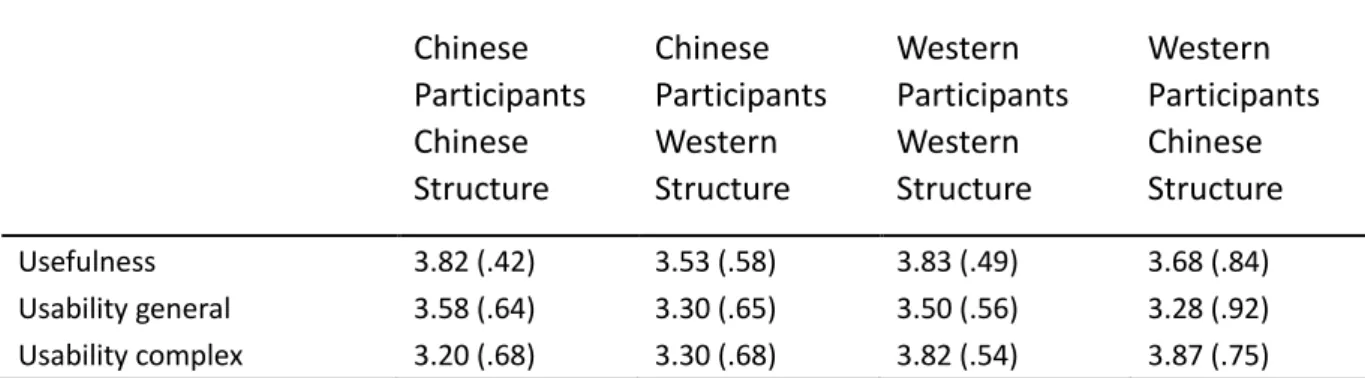
Table 7 shows the mean score and standard deviation of user’s perception of Trados among the four groups. The data are displayed in mean (std. deviation).
Table 7
Differences in Appreciation of Trados
Note: The data are displayed in mean (std. deviation). Scores were measured on a five-point scale (1= strongly disagree, 2 = disagree, 3 = neutral, 4 = agree, 5 = strongly agree). “Usefulness” measured how useful the software was. “Usability general” measured general usability measurements, such as satisfaction and efficiency. “Usability complex” measured how difficult the software was.
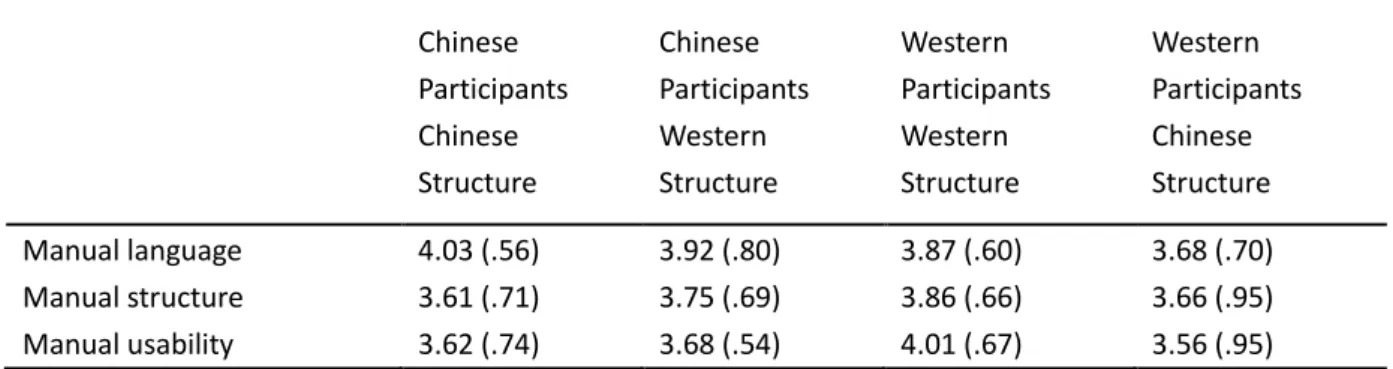
When it comes to the Usefulness of Trados, there is no effect of nationality: F (1, 76) =.381, p=.530; no effect of cultural version: F (1, 76) =.309, p=.580; and no effect between cultural and nationality: F (1, 76) =2.576, p=.113. The mean score of the group who used the manual designed based on their own culture is a little bit higher than the group who used the manual based on the other culture.
When it comes to the general usability perception of Trados, there is no effect of Chinese
Participants Chinese Structure
Chinese Participants Western Structure
Western Participants Western Structure
Western Participants Chinese Structure
28
nationality: F (1, 76) =.091, p=.763; no effect of cultural version: F (1, 76) =.031, p=.862; and no effect between cultural and nationality: F (1, 76) =2.412, p=.125. The mean score of the group who used the manual designed based on their own culture is a little bit higher than the group who used the manual based on the other culture. When it comes to the questions about the complexity of Trados (kind of usability), there is a significant effect of nationality: F (1, 76) =15.735, p<.001. Western users found it more difficult to use and learn Trados. However, there is no significant effect of cultural version: F (1, 76) =.028, p=.867; and no effect between cultural and nationality: F (1, 76) =.253, p=.617.
4.3
Differences in Appreciation of Manual
Table 8 shows the mean score and standard deviation of user’s perception of user manual among the four groups. The data are displayed in mean (std. deviation)
Table 8
Differences in Appreciation of Manual
Note: The data are displayed in mean (std. deviation). Scores were measured on a five-point scale (1= strongly disagree, 2 = disagree, 3 = neutral, 4 = agree, 5 = strongly agree). “Manual language” measured users’ judgments about the language use of the manual. “Manual structure” measured users’ opinions about the structure of the manual. “Manual usability” measured opinions about the usability of the manual.
When it comes to the language use in the manual, there is no effect of nationality: F (1, 76) =1.781, p=.186; no effect of cultural version: F (1, 76) =.049, p=.825; and no effect between cultural and nationality: F (1, 76) =1.002, p=.320. The mean score of the group who used the manual designed based on their own culture is a little bit higher than the group who used the manual based on the other culture.
When it comes to the structure of the user manual, there is no effect of nationality: F (1, 76) =.221, p=.640; no effect of cultural version: F (1, 76) =.997, p=.321; and no effect between cultural and nationality: F (1, 76) =.032, p=.861. However, the mean scores of manual designed in western culture are higher.
When it comes to the usaibility, there is no effect of nationality: F (1, 76) =.771,
Chinese Participants Chinese Structure
Chinese Participants Western Structure
Western Participants Western Structure
Western Participants Chinese Structure
29
p=.383; no effect of cultural version: F (1, 76) =2.575, p=.113; and no effect between cultural and nationality: F (1, 76) =1.541, p=.218. However, the mean scores of manual designed in western culture are higher.
4.4
Observations
During the experiment, there were other findings observed.
When given a new software, most participants, both Chinese and westerners, would like to explore the software to learn. They tried to finish the task based on their prior knowledge about software, and only used the manual only when the task was beyond their previous knowledge or tried many times by themselves but failed. When in trouble, many users tried to use the embedded help manual in the software or found the results by Google because they thought they could immediately find the answers without the need to read much irrelevant information.
When using the printed manual, some users read the manual by using their fingers pointing to the paper word by word. This might because that people are adapted to the fragmentation of information, and find it impatient to focus and difficult to read long passages. Less impatience was also proved by the fact that users were reluctant to turn pages even if there were only 3 pages, and most people skipped the
description part and read the steps or highlighted part directly.
Therefore, participants thought that to find what they need was quite important, and it can help them solve the problem with least efforts in the shortest time. So they put forward some suggestions about the printed help manual.
Firstly, information should be arranged based on task or even subtasks, and headings/subheadings exactly describe the topic of the steps.
Secondly, about those structural elements, they thought that table of content was a must, lists were helpful, more subheading were good, and glossary was less helpful. Thirdly, key words should be emphasized in different ways or put in the index. Finally, some participants said the manual was helpful only when it could help to solve problems. So they thought that the order of information (from most important to least important) should be trouble-shooting information, procedural information and conceptual information.
30
Chinese people would like to compete with each other about whether they finished the task. Western students just treated it like an experiment.
In sum, participants would like to explore new things without manual. And they preferred online manual to printed one because it is easier to navigate. Task-based topics, structural elements, highlighted key words, and trouble shootings may help them search information on printed media. Specifically, Chinese participants cared more about the results and their performances than westerners.
5
Conclusion and Discussion
5.1
Main Findings
Only two significant differences were found. The first is that when finishing the task, Chinese people made more attempts than westerns. The second one is that when asked questions about the knowledge, western participants answered more Don’t Know than Chines people.
Those two may be explained by the politeness theory. The face concept comes from Chinese culture (Oetzel et al., 2001). Brown and Levinson (1978; 1987) divided faces into positive faces and negative faces. The positive face is the need to be liked by other people and negative face is the desire to act freely without the constraint of others. In general, Chinese people cared much more about face than western people (Oetzel et al., 2001). To be specifically, people from collective culture (Chinese) emphasized positive face while people from individual culture (western) value more about negative face (Gudykunst, Ting-Toomey, & Chua, 1988; Oetzel et al., 2001). So Chinese students tried their best to finish the task, and did not want to fail in front of the participant. For the same reason, when asked questions, they preferred to guess than admit they did not know they answers, just not to lose faces.
Except the differences mentioned above, no big differences are found between the manuals of Chinese and Western cultural. It may be caused by the following reasons:
Limitation of Structure Elements Founded
The first possible reason is the limitation of the structural differences found by prior researchers.
Firstly, those finding might be outdated. All culture differences between Chinese and west are found no less than 5 years ago. The world is developing so rapidly nowadays, so what they found 5 years ago might have changed.
31
No Cross-cultural Structure Differences
The second reason for the insignificance might be that users perform similar when using instructions. This is a piece of good news for the multinational corporation, because there is no need to change anything about structure during localization. However, it is reckless to say there are no structural differences among cultures. Rather, it might be those structure elements found by prior researches do not seem to be so important. There might be other structural differences that might cause the different performances and preferences of users.
Little Time Spent on Manuals
The final possible reason for the insignificance might be that participants spent so little time reading the manual that the differences could hardly take effect. Most manipulations of structure were conducted in descriptions. But almost all the users skipped descriptions, and only read highlighted or steps, where only few
manipulations there. So users would not notice the structure elements, the order of sentences, or the relationship of each part.
Users were impatient to read all the texts. In addition, users did not use the manual so often because they thought they could solve the problem with their prior
knowledge. None of the participants has used the software before, but the
operations and interface are similar, so many could create new translation memory by clicking New. There were 2 out of 7 tasks that users could not finish without the help of manual, maybe not enough.
User spent little time on the manuals might be also because the experiment condition was stressful. During the experiment, people felt pressured and just
wanted to finish the task in the limited time. Some claimed that they would probably read the whole manual if it was not experiment.
5.2
Limitations and Future Research
There are some limitations about the number and background of participants. First all the Chinese participants are students in the Netherlands. So they might know better about western culture than the average Chinese people. And also they might have been influenced or got used to the western culture. Therefore, in the future experiment, those Chinese people who live in China and have not been abroad could be recruited. They know less about western culture, so there will be less bias.
32
Finally, the experiment was conducted in an experiment room. The users might feel stressed when in experimental environment. So the future experiment can be done in the real environment, and the users may show different performance.
5.3
Conclusion
Many researches have shown that there are some structural differences between Chinese and English technical instructions. It seems that Chinese documents are arranged in less explicit and holistic way. In addition, the sequence of elements always follow the nature order.
Those differences mentioned above are discussed only on preferences of writers, but not directly talk about the performance and preference of users. Therefore, this research conducted an experiment to find the differences between Chinese and western users when they use documents designed in different cultures.
The experiment showed that no difference between users on task performance, understanding of the manual or the judgment of the manual.
In sum, it is learnt that on the one hand, the literature on culture differences does not seem to be confirmed in the user study. On the other hand, the insights we have about structuring manual in the western world don’t seem significantly better than Chinese. It seems that the influence of culture in technical documentation is overstated.
References
Bangor, A., Kortum, P. T., & Miller, J. T. (2008). An empirical evaluation of the system usability scale. International Journal of Human–Computer Interaction, 24(6), 574–594. doi:10.1080/10447310802205776
Bangor, A., Staff, T., Kortum, P., & Miller, J. (2009). Determining what individual SUS scores mean : Adding an adjective rating scale. Journal of Usability Studies, 4(3), 114–123.
Barnum, C., & Li, H. (2006). Chinese and American technical communication: A cross-cultural comparison of differences. Technical Communication, 53(2), 143– 166.
Barnum, C., & Philip, K. (2001). Globalizing technical communication: A field report from China. Technical Communication, 48(4), 397–420.
Brown, P. (1987). Politeness: Some Universals in Language Usage. Cambridge University Press.
33
Ding, D. D. (2003). The emergence of technical communication in China—Yi Jing (I Ching) the budding of a tradition. Journal of Business and Technical
Communication, 17(3), 319–345.
Ding, D. D. (2011). When traditional Chinese culture meets a technical
communication program in a Chinese university : Report on teaching technical communication in China. Technical Communication, 58(1), 34–51.
Ding, D. D., & Jablonski, J. (2001). Challenges and opportunities: Two weeks of teaching technical communication at Suzhou University, China. Technical Communication, 48(4), 421–434.
Ding, H. (2010). Technical communication instruction in China: Localized programs and alternative models. Technical Communication Quarterly, 19(3), 300–317. doi:10.1080/10572252.2010.481528
Dragga, S. (1999). Ethical intercultural technical communication: Looking through the lens of Confucian ethics. Technical Communication Quarterly, 8(4), 365–381. doi:10.1080/10572259909364675
Fan, Y. (2000). A classification of Chinese culture. Cross Cultural Management: An International Journal, 7(2), 3–10.
French, W. L., & Bell, C. (1979). Organization development: Behavioral science interventions for organization improvement. New Jersey (NJ): Prentice Hall. Gudykunst, W. B., Ting-Toomey, S., & Chua, E. (1988). Culture and interpersonal
communication (Vol. 8). Califorlia (CA): Sage Publications, Inc.
Hall, E. T. (1977). Beyond Culture.Anchor Books. New York (NY): Anchor Books. Halliday, M., Matthiessen, C. M. I. M., & Matthiessen, C. (2014). An introduction to
functional grammar (3rd ed.). New York (NY): Routledge.
Han, Y. (2009). Putting China’s technical communication into historical context : A look at the Chinese culinary instruction genre. Technical Communication, 56(2), 99–110.
Han, Y. (2010). Integrating technical communication into China’s English major curriculum. Journal of Business and Technical Communication, 25(1), 68–94. doi:10.1177/1050651910380376
Hofstede, G. H., Hofstede, G. J., & Minkov, M. (2010). Cultures and organizations: Software of the mind (3rd ed.). New York (NY): McGraw-Hill.
Honold, P. (1999). Learning how to use a cellular phone: Comparison between German and Chinese users. Technical Communication, 46(2), 196–205.
Hu, Q. (2004). Technical writing, comprehensive discipline and scientific translation.
Chinese Science & Technology Translators Journal, 17(1), 44–46. Hypotaxis. (2014). Retrieved September 29, 2014, from
http://www.oxforddictionaries.com/definition/english/hypotaxis
Lewis, J. R., & Sauro, J. (2009). The factor structure of the system usability scale. In
Human Centered Design (pp. 94–103). Springer Berlin Heidelberg. Li, J. (2011). Xinghe vs. yihe in English-Chinese translation – Analysis from the
perspective of syntactic construction. Perspectives: Studies in Translatology,
34
Lian, S. (1993). Contrastive studies of English and Chinese (in Chinese) (2nd ed.). Beijing: Higher Education Press.
Liu, B. (2006). Comparison and translation of Chinese and English (in Chinese). (W. Zhang, Ed.) (1st ed.). Beijing: China Translation and Publishing Corporation. Miao, J., & Gao, Q. (2010). Building special programs for MTI — Concepts and
contents of technical writing (in Chinese). Chinese Translation, (2), 35–38. Nisbett, R. E., Peng, K., Choi, I., & Norenzayan, A. (2001). Culture and systems of
thought: holistic versus analytic cognition. Psychological Review, 108(2), 291– 310. doi:10.1037/0033-295X.108.2.291
Oetzel, J., Ting-Toomey, S., Masumoto, T., Yokochi, Y., Pan, X., Takai, J., & Wilcox, R. (2001). Face and facework in conflict: A cross-cultural comparison of China, Germany, Japan, and the United States. Communication Monographs, 68(3), 235–258. doi:10.1080/03637750128061
Parataxis. (2014). Retrieved September 28, 2014, from
http://www.oxforddictionaries.com/definition/english/parataxis
Shen, L. (2003). Hypotaxis and parataxis: a pragmatic perspective (in Chinese).
Journal of Foreign Languages, 2(144), 67–73.
Tegtmeier, P., & Thompson, S. (1999). China is hungry: Technical communication in the People’s Republic of China. Technical Communication, 46(1), 36–41. Ulijn, J., & StAmant, K. (2000). Mutual intercultural perception: How does it affect
technical communication? Some data from China, the Netherlands, Germany, France, and Italy. Technical Communication, 47(2), 220–237.
Wang, C., & Wang, D. (2011). Technical writing and cultivation of professional translators. Journal of PLA University of Foreign Languages, 34(2), 69–73. Wang, J. (2007). Thoughts on xinghe and yihe. Foreign Language Teaching and
Research (bimonthly), 39(6), 409–416.
Wang, J. (2009). Convergence in the rhetorical pattern of directness and indirectness in Chinese and U.S. business letters. Journal of Business and Technical
Communication, 24(1), 91–120. doi:10.1177/1050651909346933
Wang, Q. (2000). A cross-cultural comparison of the use of graphics in scientific and technical communication. Technical Communication, 47(4), 553–560.
Wang, T. (2010). Comparasion of xinghe and yihe in English-Chinese translation.
Journal of Chifeng University (Soc.Sci), 31(7), 143–144.
Wang, Y., & Wang, D. (2009). Cultural contexts in technical communication: A study of Chinese and German automobile literature. Technical Communication, 56(1), 39–50.
William A. Darity, J. (Ed). (2008). Medium is the message. In International Encyclopedia of the Social Sciences. Detroit (MI): Macmillan.
Xia, Z. (2003). yihe. In Da Ci Hai (in Chinese). Shanghai, China: Lexicographic Publishing House.
Zhang, W. (1994). Main difference between Chinese and English writing (in Chinese).
35
Appendix
Appendix 1 Trados Variables
Table 9
Trados Factors
Component 1
Component 2
Component 3
2. I thought Trados was easy to use. .788 5. I imagine that most people would learn to use Trados very quickly. .734 6. I found that Trados was very awkward to use. .730
10. I am satisfied with Trados. .723 .415
9. It is pleasant to use Trados. .681 .408
8. I needed to learn a lot of things before I could get going with Trados. .653
7. I felt very confident using Trados. .592 .490
11. I think Trados is a wonderful tool. .555 4. I thought there was too much inconsistency in Trados. .456
13. I think Trados is a useful tool for translators. .818 16. I think Trados helps translators to be effective. .775 15. I think Trados helps translators to be productive. .768 18. I think Trados makes translating documents easier to get done. .743 14. I think Trados meets the needs of translators. .727 17. I think Trados gives translators more control over their translation
tasks. .608
1. I found Trados unnecessarily complex. .414 .709
12. I could learn to work with Trados quickly. .701
3. I thought that I would need the support of a technical person to be