
Master Thesis - Roel Gijzen –July 20, 2017
Valuation of an exoskeleton based on the
capability approach
Roel Gijzen
1,2ABSTRACT
BACKGROUND
An exoskeleton helps individuals with a Spinal Cord Injury (SCI) by letting them stand up straight, it facilitates in ambulation and climbing stairs. Only a limited number of individuals have access to this device due to the lack of reimbursement policies.
OBJECTIVE
The objective of this study is to determine and valuate the capabilities an exoskeleton creates or improves and to compare it with the net cost.
DESIGN
An anonymous online survey was taken by the participants of this study. The content of the survey is self-designed and includes the EQ-5D-5L and the BFI-K. The self-designed content is based on the Nussbaum and Sen interpretation of the capability approach and a time trade-off method. The yearly cost was calculated with an annuity formula and the t-test was used for statistical t-tests.
PARTICIPANTS
109 customers of ReWalk, who bought an exoskeleton on an individual basis, received an invitation to participate in this study. We included 21 of the 23 respondents.
MAIN OUTCOME MEASURES
The main outcome measures consist of three parts; First and second, a list of capabilities an exoskeleton creates or improves and the economic value of these capabilities; Third, the net cost of the exoskeleton.
11.3 𝑏𝑖𝑙𝑙𝑖𝑜𝑛 × 0.0054% × 66.3% ≈ 45,000. Based on the 1.3 billion inhabitants in developed countries[3] and the 54 SCI cases
RESULTS
According to the participants 57.4% of the economic value of the exoskeleton consists of health-related capabilities. The capability to participate in activities comes in second (16.4%). The economic value of an exoskeleton is €9,071 per year and the net cost is €20,431 per year. Changes in the health costs are excluded due to lack of data.
CONCLUSION
The cost of an exoskeleton should be fully reimbursed if it results in a decline in health-bill of €11,360 on a yearly basis. Otherwise we should wait until the material cost (exoskeleton, crutches etc.) declines to €36,641 or the lifespan increases to 12 years.
Introduction
Individuals with a motor complete Spinal Cord Injury (SCI) have lost their ability to stand and walk. As a consequence of being confined to a wheelchair, they experience a large number of secondary health complications [1]. An exoskeleton helps these individuals by letting them stand up straight and it facilitates in ambulation and climbing stairs. Examples of reported benefits on secondary health complications are: improvement in spasticity and bowel movement regularity [1]. The United States (U.S.) Food and Drug Administration (FDA) approved the exoskeleton for home use in 2014 [2]. Nevertheless, only a few hundred individuals with a SCI worldwide have an exoskeleton, which is in sharp contrast to the 45,0001
patients in developed countries who potentially are able to use an exoskeleton.
per 1 million inhabitants in the U.S., where 66.3% have an motor (in)complete
This limited number of exoskeleton users can be explained by the cost and lack of reimbursement of exoskeletons. It is, with the cost of around €20,431 (see Appendix IV) per year, too expensive for most individuals, even in developed countries. Exoskeletons are also not reimbursed by most insurance providers. There are individual cases in Germany where the exoskeleton is fully covered [5][6][7], but only two known insurance providers, both from the U.S., stated that they issued a full coverage policy [8][9].
Reimbursement of interventions or medical products by insurance providers are normally based on the improved well-being in relation to the cost. Well-being in health economics is commonly expressed in Quality of Adjusted Life Years (QALY) when considering health-related quality of life [10]. The QALY approach however was not used by the insurance providers who reimbursed the exoskeleton. The first provider issued a coverage policy after a petition [11]. The second one started reimbursing an exoskeleton after considering ambulation in patients with SCI a medical necessity [9].
There are alternative approaches to the QALY to express the value of well-being. The UNDP (United Nations Development Program) for instance, is using the capability approach for the HDI (Human Development Index) [12]. The value of well-being is, in this approach, based on capabilities, not on the utilities a capability is able to create. Amartya Sen (the founder of the Capability Approach, who won the Nobel prize in economics with this approach [13]) often explained the importance of a capability with the following example: “even if the nutritional state of people who are fasting and starving is the same, the fact that fasting is a choice not to eat should be recognized” [14]. The challenging part of the Capability Approach is its lack of standardization: Martha Nussbaum proposed ten central capabilities [15], the UNDP is using three [12] and Sen advocates that democracy (e.g. research population), not the theorist, should construct a non-fixed list of capabilities [16]. However, all
approaches are based on a set of important capabilities. The set and value of the recognized important capabilities are personal and therefore depend on the profile of the theorist or the (research) population. The obvious capabilities (e.g. to stand, to walk and to climb stairs) could be, but are not necessarily the important ones. As an example, when Martha Nussbaum taught illiterate women to read and write, they gained the important capability to participate in politics [15].
The objective of this study is to determine and valuate the capabilities an exoskeleton creates or improves and to compare it with the net cost. The profile of the research population will be shown first and second the list of capabilities together with the economic value of these capabilities. For reimbursement policies, it is important to compare the net cost of an exoskeleton with the economic value of the capabilities it creates. This will be the third part of the study.
Methods Participants
109 customers of ReWalk, who bought an exoskeleton on an individual basis, received an invitation to participate in this study. We included 21 of the 23 respondents. 2 respondents only filled in their profile characteristics and were therefore excluded.
Procedure
Measurements:
The Profile part of the survey (see Appendix II.1 and II.2) gives an overview of the characteristics (e.g. age, gender and age at SCI onset) and personality of the participants. The personality measurement was based on the Big Five Inventory Kurzversion (BFI-K). The “Big Five” dimensions are: extraversion, agreeableness, conscientiousness, neuroticism and openness [17].
The capability part of the survey, and the first half of the functioning (see Appendix II.5), were based on the Nussbaum and Sen interpretation. The ten central Capabilities of Nussbaum [15] (see Appendix III) cover the full range of possible capabilities, a summary was used as an introduction to this part of the survey. The questions were based on Sen, who advocates that democracy (i.e. research population) should construct the list of capabilities [16]. The survey asked to give a top 5 (with a maximum of 10 extra) most important capabilities the exoskeleton creates or improved based on their importance. Each open question included two closed follow-up questions: “How much do you use/benefit of this?” and “How important is this to you?”. The second half of the functioning part (see Appendix II.7) of the survey was a closed question survey. These questions were based on tasks that an individual with a SCI probably is able to perform with an exoskeleton.
The economic value part of the survey was based on the QALY approach as this is the only standardized method allowing comparisons of different (types of) interventions, and for which a willingness-to-pay threshold has been defined in many countries. The first half was conducted with an EQ-5D-5L survey (see Appendix II.3). The second half was carried out with the time-trade-of method (see Appendix II.4). In the time-trade-of method
2𝐴 = 4*67
89(8;4)->, where A is Annuity amount, r is interest rate (yearly), PV is Present Value and n is the Number of periods (year) [18]. 3 Material cost are €90,500, Assessment cost
participants were asked to compare 10 years without an exoskeleton, with 1, 2, 3, 4, 5, 6, 7, 8, 9, 9.25, 9.5, 9.75, 10, 10.5 and 11 years with an exoskeleton. The participants were made aware that it is important for the calculations to assume that life is over after the stated amount of years and while answering the questions it is important to only consider their own well-being, without taking others such as their loved ones into account.
The cost part of the survey (see Appendix II.6) was based on direct and indirect costs. Direct costs of an exoskeleton are €20,431 per year. This was calculated (see appendix IV) with an adjusted annuity formula2, an indication of the total costs of €96,8643, at a 5 years U.S. bond interest rate of 1.8% [19] and the life expectancy of an exoskeleton of five years. Indirect costs are changes in the health bill. Changes were expected due to reported benefits on secondary health complications [1]. The survey asked to compare the year before the individual received the exoskeleton with the previous year; what is the difference in medical costs?
Analysis
The profile analysis consisted of two steps. First a summary of the characteristics was made. Second, the personality-scores were calculated by allocating the questions to the right dimension (see Appendix V) and by comparing the scores of the participants to the scores of the control group. The control group, from a German study, contains 5163 individuals from age 18 to 77, male and female (see Appendix VI) [17]. The individuals from the control group do not necessarily have a SCI. The comparison was done using a t-test with a 𝑡@8AB -distribution and a significance level of 1% (𝛼 = 0.01). This gives a critical region of −𝑐 ≥ 𝑇H ≥ 𝑐 with 𝑐 = 2.58.
The capability analysis was made by looking to the outcome of capability part of the survey and to the outcome of the functioning part. Capabilities given by the participants were first categorized. All participants were asked to include a score (from 1-5) to the given capability and to give a top 5 of most important capabilities. The score of every capability on place 1 received 5 added points, place 2 got 4, place 3 got 3, place 4 got 2 and place 5 got 1. The scores were added to the score of the relevant category. The functioning part of the survey added a maximum of 10% to the score of the category. If the average score on the function part is 5, then 10%, if it is 1, then 0% and if it is in between then the percentage was linear interpolated. The capabilities were at last indexed to make the sum of all capabilities 100 points (i.e. percent).
[image:4.595.361.564.395.664.2]The economic value analysis was made by first calculating the QALY with and without an exoskeleton and second by translating it into an economic value. The QALY of an exoskeleton was given by the participants. The QALY without an exoskeleton was calculated by cross-multiplication, using the outcome of the time-tradeoff method and the given QALY. The Zorginstituut Nederland [20] explains what the value of one additional QALY is (i.e. one life-year in perfect health), in a Dutch context, and the reasoning behind it. One QALY is worth €20.000, €50.000 or €80.000, depending of the severity of the underlying disease targeted by the interventions under consideration. The disease severity is equal to 1 − 𝑄𝐴𝐿𝑌 𝑤𝑖𝑡ℎ𝑜𝑢𝑡 𝑎𝑛 𝑒𝑥𝑜𝑠𝑘𝑒𝑙𝑒𝑡𝑜𝑛 . If it is a minimum disease severity or preventive, then €20.000 per QALY. If it is a maximum (i.e. almost 1) disease severity, then €80.000 per QALY. €50.000 per QALY if it is in between. Table 1 gives a summary of this.
4 The neurological level is the lowest segment where motor and sensory function is normal on both sides, and is the most cephalic of the sensory and motor levels determined in sensory and motor examination. See Appendix I for an overview of levels.
Table 1: Maximum cost per QALY based on the improvement in Quality of Life [20].
Disease severity (in
terms of utility loss) Maximum additional cost (€) per additional QALY
From 0.0 until 0.1 0 From 0.1 until 0.4 20.000 From 0.41 until 0.7 50.000 From 0.71 until 1 80.000
The net cost of the exoskeleton was calcuted by taking the direct cost of the exoskeleton itself and correct it with the indirect cost (savings) of the exoskeleton (i.e. medical cost).
Results
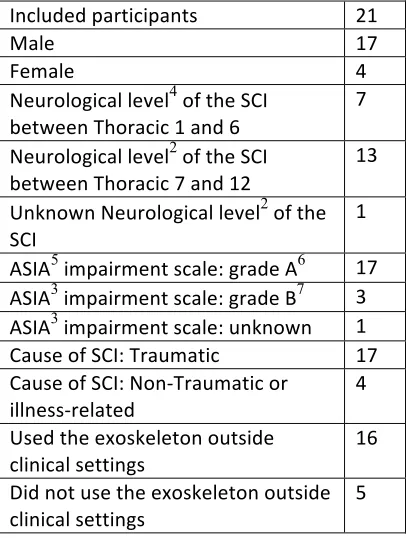
Table 2 and 3 give an overview of the characteristics of the 21 participants.
Table 2: Characteristics of study participants
Included participants 21
Male 17
Female 4
Neurological level4 of the SCI between Thoracic 1 and 6
7
Neurological level2 of the SCI between Thoracic 7 and 12
13
Unknown Neurological level2 of the SCI
1
ASIA5 impairment scale: grade A6 17 ASIA3 impairment scale: grade B7 3 ASIA3 impairment scale: unknown 1 Cause of SCI: Traumatic 17 Cause of SCI: Non-Traumatic or
illness-related
4
Used the exoskeleton outside clinical settings
16
Did not use the exoskeleton outside
clinical settings 5
5 ASIA = American Spinal Injury Association 6 A = No motor or sensory function in the lowest
sacral segment (S4-S5) [21]
Table 3: Characteristics of study participants, mean and Standard Deviation (SD)
Mean SD
Age 42.7 41.0
Age at SCI offset 35.2 14.0
Usage per week 4.0 4.1
Duration in min per usage 60.7 21.1 Experience in years 2.1 1.6 Number of training sessions 43.6 30.9 Duration in min per training
session 58.2 22.1
Table 4 shows the Sample mean and standard deviation of the personality scores of the participants and the control group. An independent t-test shows with a significance level of 1% (𝛼 = 0.01), given the critical region of – 𝑐 ≥ 𝑇H≥ 𝑐 with 𝑐 = 2.58, that the participants score above average, with a p-value of 𝑝 < 0.01, on the points Extraversion (E), Agreeableness (A), Conciseness (C) and Openness (0). They score below average, with a p-value of 𝑝 < 0.01, on the point Neurotises (N) (See appendix VII for calculations).
Table 4: Sample mean (𝑋8) and standard
deviation (𝑠8) of the profile of the
research population, with sample size 21.
Sample mean (𝑌B) and standard deviation
(𝑠B) of the profile of the control group,
with sample size 5163 (see Appendix VII).
𝑋
H,8𝑠
H,8𝑌
H,B𝑠
H,B𝑇
H,Z[\E 4.81 0.93 3.48 0.65 5.48 A 3.87 0.95 2.93 0.56 5.67 C 4.49 0.62 3.62 0.53 5.45 N 2.26 0.78 2.92 0.57 -3.98 O 4.04 0.59 3.52 0.57 3.15
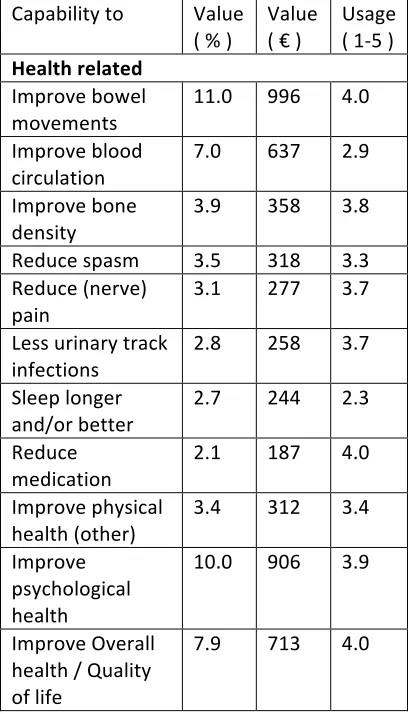
Table 5 and 6 shows that the most important capabilities an exoskeleton creates or improves are health related, 57.4% in total, with improved bowel movements as the biggest contributor (11.0%). To participate in activities comes in second (16.4%).
The average QALY of the research population (on a scale of 0 to 1) is 0.664, with a SD of 0.26. The participants also indicated that they are, on average, willing to trade in 10
[image:5.595.360.564.357.714.2]life years without an exoskeleton, for 7.3 years with an exoskeleton, with a SD of 2.23. Using the time trade-off method this means that the QALY of the research population would be 0.664 ÷ 10×7.3 = 0.483 without an exoskeleton. This is a difference of 0.181, with a disease severity of 1 − 0.483 = 0.517. The maximum additional cost per QALY for disease severity (in terms of utility loss) from 0.41 until 0.7, is €50.000. This means the increase of QALY an exoskeleton delivers, is worth a maximum of €9,071 on a yearly basis. This €9,071 is allocated to the capabilities based on its importance (see Table 5 and 6).
Table 5: The capabilities an exoskeleton creates/improves, value allocation based on its importance and the usage of this capability (1 = never, 2 = rarely, 3 = sometimes, 4 = often, 5 = very often)
Capability to Value ( % )
Value ( € )
Usage ( 1-5 ) Health related
Improve bowel
movements 11.0 996 4.0 Improve blood
circulation 7.0 637 2.9 Improve bone
density
3.9 358 3.8
Reduce spasm 3.5 318 3.3 Reduce (nerve)
pain 3.1 277 3.7
Less urinary track
infections 2.8 258 3.7 Sleep longer
and/or better
2.7 244 2.3
Reduce medication
2.1 187 4.0
Improve physical health (other)
3.4 312 3.4
Improve psychological health
10.0 906 3.9
Improve Overall health / Quality of life
Table 6: The capabilities an exoskeleton creates/improves, value allocation based on its importance and the usage of this capability (1 = never, 2 = rarely, 3 = sometimes, 4 = often, 5 = very often)
Capability to Value
( % ) Value ( € ) Usage ( 1-5 ) Not health related
Participate in activities (e.g. social, sports, cooking etc.)
16.4 1,484 3.2
Stand, walk and
climb stairs 15.1 1,365 3.8 Achieve general
goals of exercising
11.2 1,014 3.7
Improve
employability 0 0 1.6
Changes in medical bill are not included in the net cost due to lack of data. Out of the survey came that insurance companies are paying for all health-related costs and that most participants therefore do not have an overview of the costs. No changes in medical bill gave a net cost of the exoskeleton of €20,431 per year.
Discussion
Strengths and Weaknesses
[image:6.595.357.563.78.276.2]The costs of an exoskeleton (€20,431 per year) are higher than their economic value (€9,071 per year). However, this study showed that 57.4% of the value of an exoskeleton is related to health improvement. The average yearly health and living expenses that are directly attributable to the SCI, for individuals similar to the research population, are €61,521 [4]. If using an exoskeleton leads to a cost reduction of more than 18% (€11,516), making the net cost of the exoskeleton lower than the economic value, then an exoskeleton should be fully reimbursed (see Figure 1). Therefore it might be to blunt to conclude that an exoskeleton is too expensive.
Figure 1: Net Cost minus the Economic Value compared to the decline in medical cost
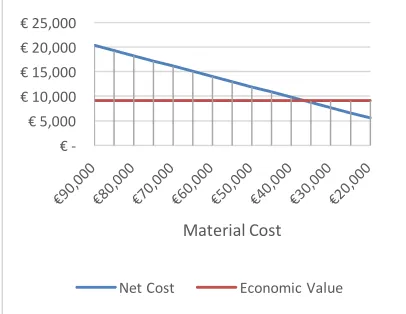
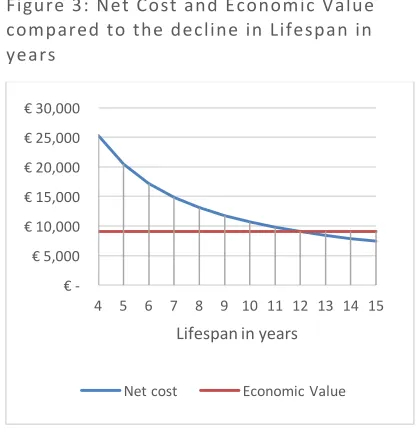
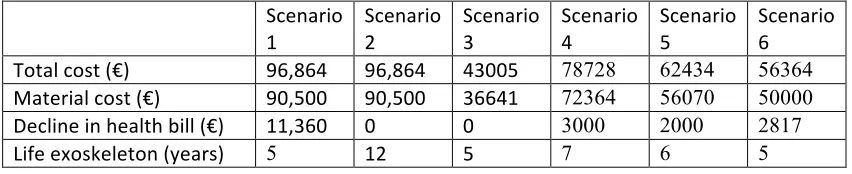
[image:6.595.359.562.603.760.2]A decline in health cost is not the only option as the net cost could also be lower in the future. There is a competitor, named SuitX, claiming that their exoskeleton will cost €35,244 [22], this only includes the price of the exoskeleton itself and is still limited by U.S. federal law to investigational use only [23], but shows a future decline in price. If the material cost (exoskeleton, crutches etc.) will decline to €36,641 (total cost are €43,005), then an exoskeleton should be reimbursed (see Figure 2). The lifespan is now 5 years, if this increases to 12 years, then an exoskeleton should also be reimbursed (see Figure 3). A combination is also possible; 7-year lifespan, a material cost of €72,364 and a decline in medical bill of €3000 or 5-year lifespan, a decline in health bill of €2817 and material cost of €50,000 for instance.
Figure 2: Net Cost and Economic Value compared to the Material cost
€ - € 5,000 € 10,000 € 15,000 € 20,000 € 25,000
Decline in medical cost
Net cost Economic Value
€ - € 5,000 € 10,000 € 15,000 € 20,000 € 25,000
Material Cost
Figure 3: Net Cost and Economic Value compared to the decline in Lifespan in years
[image:7.595.138.346.412.598.2]This study used the value of one QALY in a Dutch context. This value is different in other countries. If the value QALY increases to €112,632, then economic value increases with it to the height of the Net Cost (see Figure 4).
Figure 4: Net Cost and Economic Value compared to the value of one QALY
Restrictions
80 percent of new SCI patients are male and the average age of injury is currently 42 years [4]. 81.0% of the research population is male, the average age of the SCI onset is 35.2. Therefore, the research population is a good representation on these points. The personality is significantly different from the control group on all the tested dimension. This means that the research population is not representative on the point personality.
Further research
This study showed for a specific group of individuals with a SCI an overview of which capabilities an exoskeleton creates, how much it costs and what the value is. The value is an indication based on the QALY approach. Sen advocates a democracy that creates a list of capabilities. The value stated in table 5 is a start for a democratic process where the ‘real’ value of the capabilities can be determined. The advantage of valuing capabilities for a certain group is that it can also be used for (new) techniques, even before they are developed, to see whether it should be reimbursed or not.
This study showed that the capabilities together are worth €9,071 per year. The exoskeleton is not perfect yet, it does not replace a wheelchair, you need crutches for stabilization and feedback on the survey showed that in the U.S. exoskeletons are not allowed to be used for climbing stairs. The value of the exoskeleton will go up if it improves or when it replaces other devices. Further research is needed if it does. If an exoskeleton improves the QALY enough, then an exoskeleton should be fully reimbursed (see Figure 5).
Figure 5: Net Cost minus the Economic Value compared to the QALY with an exoskeleton
This study was unable to show the medical costs associated with exoskeleton use. Further research is needed to give an overview of these costs and thereby a better indication of the net cost of an exoskeleton.
€ - € 5,000 € 10,000 € 15,000 € 20,000 € 25,000 € 30,000
4 5 6 7 8 9 10 11 12 13 14 15
Lifespan in years
Net cost Economic Value
€ - € 5,000 € 10,000 € 15,000 € 20,000 € 25,000 € 30,000 € 35,000
Value of one QALY
Net Cost Economic Value
€ - € 5,000 € 10,000 € 15,000 € 20,000 € 25,000 € 30,000
50 60 70 80 90 100
QALY with an exoskeleton
[image:7.595.360.564.503.684.2]Conclusion
Only if the decline in the health-bill is €11,516 on a yearly basis or when insurance companies determine that the capabilities are worth more, then an exoskeleton should be fully reimbursed for individuals with a SCI. Otherwise we should wait until the material cost of the exoskeleton declines to €36,641 or the lifespan increases to 12 years. If, for instance, the decline in health bill is €2000, the lifespan increases to 6 years and the material cost declines to €56,070, then an exoskeleton should also be fully reimbursed (see appendix IV for calculations and more examples).
AUTHOR AFFILIATION
1Student, University of Twente, Enschede,
Netherlands
2Intern, Sint Maartenskliniek, Ubbergen,
Netherlands
I thank all my contributors. First of all Erik Koffijberg, Mark van Houdenhoven and Berend Roorda, who gave me guidance. Second, ReWalk, who provided me with the research population and Noël Keijsers and Rosanne Dijsseldonk, who shared their practical knowledge with me. Third, Jeroen Boon, who helped with the IT behind the online survey and Franziska Zabelt, who helped me translate the survey into German.
Contributors: The Sint Maartenskliniek
initiated the study and provided the guidance together with the University of Twente. The researchers from the Sint Maartenskliniek Noël Keijsers and Rosanne Dijsseldonk guided the survey and provided me with guidance concerning academic writing. The CEO of the Sint Maartenskliniek, Mark van
Houdenhoven, gave overall guidance together with Erik Koffijberg from the University of Twente. Erik Koffijberg is the first reviewer of this research and Berend Roorda the second. Jeroen Boon helped with the IT behind the online survey and Franziska Zabelt with translating the survey into German.
Funding: The study was funded by the author
himself. The author did not receive any income or compensation from institutions related to this study. Institutions related to this study are: University of Twente, Sint Maartenskliniek and ReWalk.
Competing interests: The author is a student
of the University of Twente and an intern at the Sint Maartenskliniek. He will receive a master’s degree after adequate completion of this study. This is not based on the outcome of this paper, only on the quality of this research (paper) and the defence.
Ethical approval: Not applicable. The
participants were approached as customers of ReWalk, not as SCI patients. Ethical approval is not applicable on a customer research.
Data sharing: No additional data is available.
As participants are assured that all data collected from this survey will be anonymous and will not be seen by anyone other than the researchers of the Sint Maartenskliniek, except in summary form.
Transparency: The lead author affirms that
the manuscript is an honest, accurate, and transparent account of the study being reported; that no important aspects of the study have been omitted; and that any discrepancies from the study as planned have been explained. No medical writer was engaged to write any part of this manuscript.
Bibliography:
[1] L. E. Miller, A. K. Zimmermann, and W. G. Herbert, “Clinical effectiveness and safety of powered exoskeleton-assisted walking in patients with spinal cord injury: systematic review with meta-analysis,”
Med. Devices Auckl. NZ, vol. 9, pp. 455– 466, 2016.
[2] “ReWalkTM Personal Exoskeleton System Cleared by FDA for Home Use,” ReWalk – More Than Walking, 20-May-2014. [Online]. Available:
http://rewalk.com/rewalk-robotics- announces-expansion-to-india-with-saimed-innovations-2-2-2-2-3-2-3/. [Accessed: 18-Apr-2017].
[3] Population Reference Bureau, “2016 WORLD POPULATION DATA SHEET.” 2016.
[4] National Spinal Cord Injury Statistics Center, “Spinal Cord Injury (SCI) Facts and Figures at a Glance.” 2016.
[5] “ReWalk Robotics Announces Reimbursement by German Social Accident Insurance Institution,” ReWalk – More Than Walking, 10-Feb-2015. [Online]. Available:
http://rewalk.com/rewalk-robotics- announces-expansion-to-india-with-saimed-innovations-2-2/. [Accessed: 17-Jul-2017].
[6] “German Social Court Ruling Deems ReWalk Exoskeleton Medically Necessary as Medical Aid for Recipient with Spinal Cord Injury,” ReWalk – More Than Walking, 04-Aug-2016. [Online]. Available: http://rewalk.com/german- social-court-ruling-deems-rewalk- exoskeleton-medically-necessary-as- medical-aid-for-recipient-with-spinal-cord-injury/. [Accessed: 17-Jul-2017]. [7] “German Social and Youth Agency
Reimburses ReWalk Robotics Exoskeleton for the First Time,” ReWalk – More Than Walking, 24-Feb-2016. [Online].
Available: http://rewalk.com/german- social-and-youth-agency-reimburses- rewalk-robotics-exoskeleton-for-the-first-time/. [Accessed: 17-Jul-2017].
[8] “U.S. Department of Veterans Affairs Purchases 28 Additional ReWalk
Exoskeleton Systems to Support National Multi-Center Trial,” ReWalk – More Than Walking, 06-Apr-2017. [Online].
Available: http://rewalk.com/u-s- department-of-veterans-affairs- purchases-28-additional-rewalk- exoskeleton-systems-to-support-national-multi-center-trial/. [Accessed: 18-Apr-2017].
[9] “Commercial Health Insurance Company Becomes First to Implement Medical Policy Finding Powered Exoskeletons Medically Necessary,” ReWalk – More
Than Walking, 09-May-2016. [Online]. Available:
http://rewalk.com/commercial-health- insurance-company-becomes-first-to- implement-medical-policy-finding- powered-exoskeletons-medically-necessary/. [Accessed: 18-Apr-2017]. [10] S. J. Whitehead and S. Ali, “Health
outcomes in economic evaluation: the QALY and utilities,” Br. Med. Bull., vol. 96, no. 1, pp. 5–21, Dec. 2010.
[11] M. Times, “va-provide-robotic-legs-paralyzed-vets,” Military Times. [Online]. Available:
http://www.militarytimes.com/story/mili tary/benefits/veterans/2015/12/17/va-
provide-robotic-legs-paralyzed-vets/77470074/. [Accessed: 18-Apr-2017].
[12] UNDP, “Human Development Index (HDI),” 04-Nov-2016. [Online]. Available: http://hdr.undp.org/en/content/human-development-index-hdi.
[13] “Amartya Sen - Facts.” [Online]. Available: http://www.nobelprize.org/nobel_prizes/ economic-sciences/laureates/1998/sen-facts.html. [Accessed: 14-Apr-2017]. [14] T. Wells, “Sen’s Capability Approach,”
Internet Encyclopedia of Philosophy. . [15] M. C. Nussbaum, Creating Capabilities.
the Belknap Press of Harvard University, 2011.
[16] A. Sen, “Capabilities, Lists, and Public Reason: Continuing the Conversation,”
Fem. Econ., vol. 10, no. 3, pp. 77–80, Nov. 2004.
[17] A. Kovaleva, C. Beierlein, C. J. Kemper, and Rammstedt, “Psychometric
properties of the BFI-K: A cross-validation study,” ResearchGate. [Online]. Available: https://www.researchgate.net/publicatio n/258918576_Psychometric_properties_ of_the_BFI-K_A_cross-validation_study. [Accessed: 14-Jun-2017].
[18] C. Dury, Management and Cost Accounting, 8th ed. Cengage Learning EMEA, 2012.
[20] Zorginstituut Nederland, “Rapport kosteneffectiviteit in de praktijk,” Zorginstituut Nederland, Diemen, Jun. 2015.
[21] J. F. Ditunno, W. Young, W. H. Donovan, and G. Creasey, “The International Standards Booklet for Neurological and Functional Classification of Spinal Cord Injury,” Spinal Cord, vol. 32, no. 2, pp. 70–80, Feb. 1994.
[22] B. Lufkin, “Anybody Can Buy This Exoskeleton For the Price of a Midrange
Sedan,” Gizmodo. [Online]. Available: http://gizmodo.com/exoskeletons-that- help-people-walk-again-are-getting-pr-1756657063. [Accessed: 06-Jul-2017]. [23] Bionics, Inc., “Phoenix,” Suit X,
Appendix I: Spinal Cord Injury levels
Appendix II: Survey – Homepage (English)
Welcome
Welcome to the exoskeleton survey
Thank you for agreeing to take part in this important survey measuring the added value of the exoskeleton. We will be gaining your personal experience in order to improve the technology adaption of the exoskeleton and other technology in the future. This survey will take 30-60 min to complete. There are 7 sections and the answers will be saved automatically every time you submitted a section and go to the next. It is therefore possible to complete the survey in parts, but it is best for the outcome to answer the whole survey at once. Up to you.
Be assured that all data collected from this survey will be anonymous and will not be seen by anyone other than the researchers of the Sint Maartenskliniek, except in summary form.
Get started »
Appendix II: Survey – Homepage (German)
Willkommen
Willkommen zu der Exoskelett-Umfrage
Vielen Dank für Ihre Bereitschaft an dieser wichtigen Umfrage teilzunehmen, welche den zusätzlichen Wert des Exoskeletts erfasst. Im Folgenden werden Ihnen verschiedene Fragen zu Ihrer eigenen Erfahrung im Umgang mit dem Exoskelett gestellt. Die Daten helfen uns die Exoskelett-Technologie, sowie andere Technologien, in Zukunft zu verbessern. Diese Umfrage wird in etwa 30-60min dauern. Es gibt 7 Teile, und nach jedem abgeschlossenen Teil werden die Antworten automatisch gespeichert, sobald Sie zum nächsten Teil übergehen. Demzufolge ist es möglich, die Umfrage in Abschnitten zu vollenden, jedoch ist es am Besten die Fragen auf einmal zu beantworten. Das ist Ihnen überlassen.
Seien Sie versichert, dass alle gesammelte Daten dieser Umfrage anonym verarbeitet werden und von niemanden den Forschern der Sint Maartenskliniek gesehen werden. Alle Daten werden anonym verarbeitet.
Appendix II.1: Survey – Section 1, Profile (English and German)
Introduction Section 1 – Profile
With this section we would like to get an insight in the profile of the research population.
Sektion 1 - Profil
In diesem Teil wollen wir einen Einblick in das Profil unserer Versuchspersonen haben.
Q1.1 Gender:
A. Male B. Female C. Other
Geschlecht: A. Männlich B. Weiblich C. Anders
Q1.2
Age: Alter:
Q1.3
Age at Spinal Cord Injury onset: Alter am Zeitpunkt der Rückenmarksverletzung:
Q1.4
The neurological level * of my Spinal Cord Injury is:
A. Between Thoracic 1 and Thoracic 6 B. Between Thoracic 7 and Thoracic 12 C. Between Lumbar 1 and Lumbar 5 D. Between Sacral 1 and Sacral 5 E. I don’t know
* The neurological level is the lowest segment where motor and sensory function is normal on both sides, and is the most cephalic of the sensory and motor levels determined in sensory and motor examination.
Die neurologische Stufe* (Läsion höhe) meiner Rückenmarksverletzung ist:
A. Zwischen Brust 1 und Brust 6 (Thorakalmark 1 und Thorakalmark 6)
B. Zwischen Brust 7 und Brust 12 (Thorakalmark 7 und Thorakalmark 12)
C. Zwischen Lende 1 und Lende 5 (Lumbalmark 1 und Lumbalmark 5) D. Zwischen Kreuzbein 1 und Kreuzbein
5 (Sacralmark 1 und Sacralmark 5) E. Ich weiß es nicht
Q1.5.1
My ASIA impairment score (AIS) is: A. AIS A: I have no motor or sensory
function in the lowest sacral segment (S4-S5).
B. AIS B: I have sensory function below neurologic level and in S4-S5, but no motor function below neurologic level.
C. AIS C: My motor function is preserved below neurologic level and more than half of the key muscle groups below neurological level cannot move against gravity. D. AIS D: My motor function is
preserved below neurologic level and at least half of the key muscle groups below neurologic level are strong enough to move against gravity.
E. AIS E: All my neurologic function (both sensory and motor function) has returned.
F. I don’t know
Mein ASIA Beeinträchtigung Ergebnis (AIS-score) ist:
A. AIS A: Ich habe weder eine motorische noch eine sensorische Funktion in meinem letzten Kreuzbein Segment (S4-S5) B. AIS B: Ich habe eine sensorische
Funktion unterhalb der
neurologischen Stufe und in S4-S5, aber keine motorische Funktion unter der neurologischen Stufe. C. AIS C: Die motorische Funktion
unter der neurologischen Stufe ist gut erhalten und mehr als die Hälfte der wichtigsten Muskelgruppen unter der neurologischen Stufe können nicht gegen die Schwerkraft bewegt werden.
D. AIS D: Die motorische Funktion unter der neurologischen Stufe ist gut erhalten und mindestens die Hälfte der wichtigsten
Muskelgruppen unter der
neurologischen Stufe können gegen die Schwerkraft bewegt werden. E. AIS E: Alle neurologischen
Funktionen (sensorisch und motorisch) sind wieder zurückgekehrt
F. Ich weiß es nicht
// If the answer on Q1.5.1 is F, then show Q1.5.2 Q1.5.2
Is the Spinal Cord Injury complete: A. Yes
B. No
* Select "Yes" if you have no voluntary anal contraction and no anal sensation.
Ist die Rückenmarksverletzung komplett*? A. Ja
B. Nein
* Wählen Sie „Ja“, wenn sie Ihre
Aftermuskeln nicht willentlich kontrahieren können und Sie auch kein Gefühl bei den Aftermuskeln besitzen.
// If the answer on Q1.5.2 is B, then show Q1.5.3 Q1.5.3
Is the Spinal Cord Injury motor incomplete *?
A. Yes B. No
Ist die motorische Funktion der Rückenmarksverletzung inkomplett*?
A. Ja B. Nein
* Select "Yes" if voluntary anal contraction OR motor function more than three levels on a given side is possible for you.
können ODER wenn die motorische Funktion über 3 Stufen auf einer Seite erhalten ist.
// If the answer on Q1.5.3 is A, then show Q1.5.4 Q1.5.4
At least half of the key muscles below the neurological level are strong enough to move against gravity?
A. Yes B. No
C. I don’t know
Zumindest die Hälfte der Muskeln unterhalb der neurologischen Stufe sind genügend stark um gegen die Schwerkraft bewegen zu können?
A. Ja B. Nein
C. Ich weiß es nicht
// If the answer on Q1.5.4 is C, then show Q1.5.5 Q1.5.5
My sensation and motor function is normal in all segments?
A. Yes B. No
Ist Ihre motorische und sensorische Funktion in allen Segmenten normal?
A. Ja B. Nein
Q1.6
What is the cause of your Spinal Cord Injury?
A. Traumatic injury
B. Non-traumatic injury OR illness C. I don’t know
Wie kamen Sie zu Ihre Rückenmarksverletzung?
A. Traumatische Verletzung
B. Nicht traumatische Verletzung ODER Krankheit
C. Ich weiß es nicht
Q1.7
Have you used the exoskeleton outside the clinical setting *?
A. Yes B. No
* Outside clinical setting is usage of the exoskeleton without physical assistance of an exoskeleton trainer, physical therapist or clinician. The exoskeleton use does not have to be completely independent, assistance from a non-clinical person (buddy) is allowed.
Haben Sie das Exoskelett außerhalb des klinischen Umfelds* genutzt?
A. Ja B. Nein
* Außerhalb des klinischen Umfelds
bedeutet, die Nutzung des Exoskeletts ohne physische Unterstützung von: Exoskelett Trainer, Physiotherapeut, Arzt oder Krankenschwester. Die Benutzung des Exoskeletts muss nicht voll sein, die Unterstützung von einer nicht-Fachkraft (Buddy) ist erlaubt.
Q1.8
What was the date of taken ownership of the exoskeleton? (Please give us your best estimation)
Q1.9
What was the starting date of the
exoskeleton training? (Please give us your best estimation)
Wann haben Sie mit der Benutzung des Exoskeletts angefangen? (Bitte schätzen Sie möglichst genau)
Q1.10
How many training sessions have you received before the first exoskeleton use outside the clinical setting? (Please give us your best estimation).
Wie viele Trainingsstunden haben sie absolviert, bevor der ersten Benutzung des Exoskeletts außerhalb des klinischen Umfelds? (Bitte schätzen Sie möglichst genau)
Q1.11
What was the average duration* of one training session in minutes? (Please give us your best estimation)
*Duration is the time you wore the exoskeleton during one training session.
Wie lange hat eine Übungseinheit* (in Minuten) durchschnittlich gedauert? (Bitte schätzen Sie möglichst genau)
*Eine Übungseinheit ist die Zeit in der Sie das Exoskelett getragen haben
Q1.12.1 .1
Do you use the exoskeleton on a weekly bases?
A. Yes B. No
Benutzen Sie das Exoskelett wöchentlich? A. Ja
B. Nein
// If the answer on Q1.12.1.1 is A, then show Q1.12.1.2 and Q1.12.1.3 Q1.12.1.2
On average, how many times do you use the
exoskeleton per week? Im Durchschnitt, wie oft nutzen Sie das Exoskelett pro Woche?
Q1.12.1.3
What is the average duration of each
exoskeleton use? (in minutes) Was ist die durschnittliche dauer von einem Exoskelett gebrauch (in Minuten)?
// If the answer on Q1.12.1.1 is B, then show Q1.12.2.1 Q1.12.2.1
Do you use the exoskeleton on a monthly bases?
A. Yes B. No
Benutzen Sie das Exoskelett monatlich? A. Ja
B. Nein
// If the answer on Q1.12.2.1 is A, then show Q1.12.2.2 and Q1.12.2.3 Q1.12.2.2
On average, how many times do you use the
exoskeleton per month? Im Durchschnitt, wie oft nutzen Sie das Exoskelett pro Monat? Q1.12.2.3
What is the average duration of each
Appendix II.2: Survey – Section 2, Personality (English and German)
Introduction
Section 2 - Personality
Here are characteristics that may or may not apply to you. For example, do you agree that you are someone who likes to spend time with others? Please indicate to which extent you agree or disagree with that statement. Note that this section applies to you as a person and can be seen
independent of the exoskeleton use.
Sektion 2 - Persönlichkeit
In wieweit treffen die folgenden Aussagen auf Sie persönlich zu? Wählen Sie dazu bitte die entsprechende Kategorie und kreuzen Sie sie rechts neben der jeweiligen Aussage an.
Participants are asked to give a score on a scale from 1 to 5, where: 1. Disagree strongly
2. Disagree a little
3. Neither agree nor disagree 4. Agree a little
5. Agree strongly
Q2.1 – Q2.21
I see myself as someone who Ich
…is sometimes shy, inhibitedR ... bin eher zurückhaltend, reserviert. …tends to find fault with othersR ... neige dazu andere zu kritisieren.
…does a thorough job ... erledige Aufgaben gründlich.
…is depressed, blue ... werde leicht deprimiert,
niedergeschlagen.
…is curious about many different things ... bin vielseitig interessiert.
…generates a lot of enthusiasm ... bin begeisterungsfähig und kann andere leicht mitreißen.
…is generally trusting ... schenke anderen leicht Vertrauen, glaube an das Gute im Menschen.
…tends to be lazyR ... bin bequem, neige zur Faulheit.
…is relaxed, handles stress wellR ... bin entspannt, lasse mich durch Stress
nicht aus der Ruhe bringen.
…is ingenious, a deep thinker ... bin tiefsinnig, denke gerne über Sachen nach.
…tends to be quietR ... bin eher der „stille Typ“, wortkarg. …can be cold and aloofR ... kann mich kalt und distanziert verhalten. …does things efficiently ... bin tüchtig und arbeite flott.
…worries a lot ... mache mir viele Sorgen.
…has an active imagination ... habe eine aktive Vorstellungskraft, bin phantasievoll.
…is outgoing, sociable ... gehe aus mir heraus, bin gesellig.
…is sometimes rude to othersR ... kann mich schroff und abweisend
anderen gegenüber verhalten.
…makes plans and follows through with
them ... mache Pläne und führe sie auch durch.
…gets nervous easily ... werde leicht nervös und unsicher.
…values artistic, aesthetic experiences ... schätze künstlerische und ästhetische Eindrücke.
Appendix II.3: Survey – Section 3, EQ-5D-5L (English and German)
Introduction
Section 3 - Quality of life
The goal of this section is to get an overview of your Quality of life TODAY. Under each heading, please tick ONE box that best describes your health TODAY.
Sektion 3 - Lebensqualität
Bitte geben Sie an, welche Aussagen Ihren heutigen Gesundheitszustand am besten beschreiben, indem Sie ein Kreuz in ein Kästchen jeder Gruppe machen.
Q3.1 Mobility
A. I have no problems in walking about.
B. I have slight problems in walking about.
C. I have moderate problems in walking about.
D. I have severe problems in walking about.
E. I am unable to walk about.
Beweglichkeit/Mobilität
A. Ich habe keine Probleme herumzugehen
B. Ich habe leichte Probleme herumzugehen
C. Ich habe mäßige Probleme herumzugehen
D. Ich habe große Probleme herumzugehen
E. Ich bin nicht in der Lage herumzugehen
Q3.2 Self-Care
A. I have no problems washing or dressing myself.
B. I have slight problems washing or dressing myself.
C. I have moderate problems washing or dressing myself.
D. I have severe problems washing or dressing myself.
E. I am unable to wash or dress myself.
Für sich selbst sorgen
A. Ich habe keine Probleme, mich selbst zu waschen oder anzuziehen B. Ich habe leichte Probleme, mich
selbst zu waschen oder anzuziehen C. Ich habe mäßige Probleme, mich
selbst zu waschen oder anzuziehen D. Ich habe große Probleme, mich
selbst zu waschen oder anzuziehen E. Ich bin nicht in der Lage, mich selbst
zu waschen oder anzuziehen
Q3.3
Usual Activities (e.g. work, study, housework, family or leisure activities)
A. I have no problems doing my usual activities.
B. I have slight problems doing my usual activities.
C. I have moderate problems doing my usual activities.
D. I have severe problems doing my usual activities.
E. I am unable to do my usual activities.
Alltägliche Tätigkeiten (z. B. Arbeit, Studium, Hausarbeit, Familien- oder
Freizeitaktivitäten)
A. Ich habe keine Probleme, meinen alltäglichen Tätigkeiten
nachzugehen
B. Ich habe leichte Probleme, meinen alltäglichen Tätigkeiten
nachzugehen
C. Ich habe mäßige Probleme, meinen alltäglichen Tätigkeiten
D. Ich habe große Probleme, meinen alltäglichen Tätigkeiten
nachzugehen
E. Ich bin nicht in der Lage, meinen alltäglichen Tätigkeiten
nachzugehen
Q3.4
Pain / Discomfort
A. I have no pain or discomfort. B. I have slight pain or discomfort. C. I have moderate pain or discomfort. D. I have severe pain or discomfort. E. I have extreme pain or discomfort.
Schmerzen/Körperliche Beschwerden A. Ich habe keine Schmerzen oder
Beschwerden
B. Ich habe leichte Schmerzen oder Beschwerden
C. Ich habe mäßige Schmerzen oder Beschwerden
D. Ich habe starke Schmerzen oder Beschwerden
E. Ich habe extreme Schmerzen oder Beschwerden
Q3.4
Anxiety / Depression
A. I am not anxious or depressed. B. I am slightly anxious or depressed. C. I am moderately anxious or
depressed.
D. I am severely anxious or depressed. E. I am extremely anxious or
depressed.
Anxiety / Depression
A. I am not anxious or depressed. B. I am slightly anxious or depressed. C. I am moderately anxious or
depressed.
D. I am severely anxious or depressed. E. I am extremely anxious or
depressed.
Q3.5 (this question includes a scale) We would like to know how good or bad your health is TODAY. This scale is numbered from 0 to 100. 100 means the best health you can imagine. 0 means the worst health you can imagine. Press on the scale to indicate how your health is TODAY.
Wir wollen herausfinden, wie gut oder schlecht Ihre Gesundheit HEUTE ist. Diese Skala ist mit Zahlen von 0 bis 100 versehen. 100 ist die beste Gesundheit, die Sie sich vorstellen können. 0 (Null) ist die
Appendix II.4: Survey – Section 4, Time trade-off (English and German)
Introduction
Section 4 - Quality of life, follow up
The goal of this section is to get an overview of your Quality of life TODAY assuming you do not have an Exoskeleton. Both options in this section contain of course fictive and unrealistic scenarios, but it is important for the calculations to assume that live is over after the stated amount of years. While answering these questions it is important to only consider your own well-being, without taking others such as your loved ones into account.
Sektion 4 - Lebensqualität, Folgen
Das Ziel dieses Teiles ist es einen Überblick Ihres JETZIGEN Lebensqualität zu
bekommen, angenommen Sie haben kein Exoskelett. Beide Möglichkeiten in diesem Teil enthalten selbstverständlich fiktive und unrealistische Szenarien, es ist aber für die Berechnungen wichtig davon auszugehen, dass das Leben nach den hier angegebenen Jahren vorbei ist. Bei der Beantwortung dieser Fragen ist es wichtig nur Ihr eigenes Wohlergehen zu betrachten, ohne anderen wie Ihre Geliebten zu berücksichtigen.
The participant needs to answer 4 out of the 16 possible questions. The first question
determines the second, the second determines the third and the third determines the fourth. A brief overview of the question:
• 8 to 10
o 4 to 10
§ 2 to 10
• 1 to 10 • 3 to 10 § 6 to 10
• 5 to 10 • 7 to 10
o 9.75 to 10
§ 9.25 to 10 • 9 to 10 • 9.5 to 10 § 10.5 to 10
• 10 to 10 • 11 to 10
Q4.1
You have a limited time to live, which option do you prefer?
A. 8 years with an exoskeleton. B. 10 years without an exoskeleton.
Sie haben nur noch eine begrenzte Zeit zu leben, welche Möglichkeit bevorzugen Sie?
A. 8 Jahre mit einem Exoskelett B. 10 Jahre ohne einem Exoskelett
// If the answer on Q4.1 is A, then show Q4.2.1 Q4.2.1
You have a limited time to live, which option do you prefer?
A. 4 years with an exoskeleton. B. 10 years without an exoskeleton.
Sie haben nur noch eine begrenzte Zeit zu leben, welche Möglichkeit bevorzugen Sie?
// If the answer on Q4.2.1 is A, then show Q4.3.1 Q4.3.1
You have a limited time to live, which option do you prefer?
A. 2 years with an exoskeleton. B. 10 years without an exoskeleton.
Sie haben nur noch eine begrenzte Zeit zu leben, welche Möglichkeit bevorzugen Sie?
A. 2 Jahre mit einem Exoskelett B. 10 Jahre ohne einem Exoskelett
// If the answer on Q4.3.1 is A, then show Q4.4.1 Q4.4.1
You have a limited time to live, which option do you prefer?
A. 1 years with an exoskeleton. B. 10 years without an exoskeleton.
Sie haben nur noch eine begrenzte Zeit zu leben, welche Möglichkeit bevorzugen Sie?
A. 1 Jahre mit einem Exoskelett B. 10 Jahre ohne einem Exoskelett
// If the answer on Q4.3.1 is B, then show Q4.4.2 Q4.4.2
You have a limited time to live, which option do you prefer?
A. 3 years with an exoskeleton. B. 10 years without an exoskeleton.
Sie haben nur noch eine begrenzte Zeit zu leben, welche Möglichkeit bevorzugen Sie?
A. 3 Jahre mit einem Exoskelett B. 10 Jahre ohne einem Exoskelett
// If the answer on Q4.2.1 is B, then show Q4.3.2 Q4.3.2
You have a limited time to live, which option do you prefer?
A. 6 years with an exoskeleton. B. 10 years without an exoskeleton.
Sie haben nur noch eine begrenzte Zeit zu leben, welche Möglichkeit bevorzugen Sie?
A. 6 Jahre mit einem Exoskelett B. 10 Jahre ohne einem Exoskelett
// If the answer on Q4.3.2 is A, then show Q4.4.3 Q4.4.3
You have a limited time to live, which option do you prefer?
A. 5 years with an exoskeleton. B. 10 years without an exoskeleton.
Sie haben nur noch eine begrenzte Zeit zu leben, welche Möglichkeit bevorzugen Sie?
A. 5 Jahre mit einem Exoskelett B. 10 Jahre ohne einem Exoskelett
// If the answer on Q4.3.2 is B, then show Q4.4.4 Q4.4.4
You have a limited time to live, which option do you prefer?
A. 7 years with an exoskeleton. B. 10 years without an exoskeleton.
Sie haben nur noch eine begrenzte Zeit zu leben, welche Möglichkeit bevorzugen Sie?
A. 7 Jahre mit einem Exoskelett C. 10 Jahre ohne einem Exoskelett
// If the answer on Q4.1 is B, then show Q4.2.2 Q4.2.2
You have a limited time to live, which option do you prefer?
A. 9.75 years with an exoskeleton. B. 10 years without an exoskeleton.
Sie haben nur noch eine begrenzte Zeit zu leben, welche Möglichkeit bevorzugen Sie?
// If the answer on Q4.2.2 is A, then show Q4.3.3 Q4.3.3
You have a limited time to live, which option do you prefer?
A. 9.25 years with an exoskeleton. B. 10 years without an exoskeleton.
Sie haben nur noch eine begrenzte Zeit zu leben, welche Möglichkeit bevorzugen Sie?
A. 9.25 Jahre mit einem Exoskelett B. 10 Jahre ohne einem Exoskelett
// If the answer on Q4.3.3 is A, then show Q4.4.5 Q4.4.5
You have a limited time to live, which option do you prefer?
A. 9 years with an exoskeleton. B. 10 years without an exoskeleton.
Sie haben nur noch eine begrenzte Zeit zu leben, welche Möglichkeit bevorzugen Sie?
A. 9 Jahre mit einem Exoskelett B. 10 Jahre ohne einem Exoskelett
// If the answer on Q4.3.3 is B, then show Q4.4.6 Q4.4.2
You have a limited time to live, which option do you prefer?
A. 9.5 years with an exoskeleton. B. 10 years without an exoskeleton.
Sie haben nur noch eine begrenzte Zeit zu leben, welche Möglichkeit bevorzugen Sie?
A. 9.5 Jahre mit einem Exoskelett B. 10 Jahre ohne einem Exoskelett
// If the answer on Q4.2.2 is B, then show Q4.3.4 Q4.3.4
You have a limited time to live, which option do you prefer?
A. 10.5 years with an exoskeleton. B. 10 years without an exoskeleton.
Sie haben nur noch eine begrenzte Zeit zu leben, welche Möglichkeit bevorzugen Sie?
A. 10.5 Jahre mit einem Exoskelett B. 10 Jahre ohne einem Exoskelett
// If the answer on Q4.3.4 is A, then show Q4.4.7 Q4.4.7
You have a limited time to live, which option do you prefer?
A. 10 years with an exoskeleton. B. 10 years without an exoskeleton.
Sie haben nur noch eine begrenzte Zeit zu leben, welche Möglichkeit bevorzugen Sie?
A. 10 Jahre mit einem Exoskelett B. 10 Jahre ohne einem Exoskelett
// If the answer on Q4.3.4 is B, then show Q4.4.8 Q4.4.8
You have a limited time to live, which option do you prefer?
A. 11 years with an exoskeleton. B. 10 years without an exoskeleton.
Sie haben nur noch eine begrenzte Zeit zu leben, welche Möglichkeit bevorzugen Sie?
Appendix II.5: Survey – Section 5, Capability approach (English and German)
Introduction
Section 5 - Capability approach
We are interested in how the exoskeleton adds value to the development of your live. Being developed is not about being, having or doing something, but being capable of being, having or doing. This is personal and you can also value capabilities that you don't use. You can value the capability to be well nourished, but still go fasting. You can value the capability to practice a religion, although you are Atheist.
A commodity (in this case the exoskeleton) can create capabilities that are obvious, but also ones that are not that apparent. Capabilities can be really practical: Being able to live a life worth living, to have a good health (could also be reproductive health), move freely and have the opportunity for sexual satisfaction. But capabilities can also be more philosophical: Being able to use senses, to imagine, think, and reason in a truly human way or to have the liberty of conscience and religious observance. It can be to be able to have self-respect, play, participate politically or to work. All kinds of options are possible.
Sektion 5 – Fähigkeiten
Wir interessieren uns dafür inwiefern das Exoskelett in der Entwicklung Ihres Lebens an Wert hinzufügt. Bei entwickelt werden handelt es sich nicht um sein, haben, oder etwas tun, sondern um die Fähigkeit zu sein, zu haben oder etwas zu tun. Dies ist recht persönlich, Sie können auch Fähigkeiten bewerten, welche Sie nicht benutzen. Sie können die Fähigkeit gut ernährt zu sein bewerten, auch wenn Sie selbst fasten. Sie können die Fähigkeit eine Religion aus zu üben bewerten, auch wenn Sie selbst Atheist sind.
Eine Ware (in diesem Fall das Exoskelett) kann Fähigkeiten schaffen die deutlich sind, aber auch solche die nicht so offensichtlich sind. Fähigkeiten können wirklich praktisch sein: Die Möglichkeit ein lebenswertes Leben zu leben, eine gute Gesundheit zu haben (könnte auch reproduktiver
Gesundheit sein), sich frei zu bewegen und die Möglichkeit für sexuelle Befriedigung. Aber Fähigkeiten können auch
philosophischer sein: so wie die Fähigkeit Sinne zu nutzen, sich etwas vorzustellen, und zu denken auf eine menschliche Weise oder die Freiheit zu Gewissenhaftigkeit und religiöse Einhaltung. Es kann sein in der Lage zu sein Selbstrespekt zu haben, zu spielen, politisch aktiv zu sein oder zu arbeiten. Alle Arten von Optionen sind möglich.
The participant is asked to name the top 5 most important capabilities the exoskeleton improved or added, with a maximum of 10 extra.
Q5.1.1 until Q5.1.15
What are capabilities the exoskeleton improved or added? We ask you to name your top 5, with space to name maximum 10 extra.
Was sind die Fähigkeiten die das Exoskelett verbessert oder hinzugefügt hat? Wir bitten Sie Ihre Top 5 zu benennen, Sie haben die Möglichkeit maximal 10 extra Fähigkeiten an zu geben.
Q5.2.1 until Q5.2.15
How much do you use/benefit of this? 1. Never
2. Rarely 3. Sometimes 4. Often 5. Very often
Wie benutzen Sie dies/ Wie profitieren Sie davon?
1. Nie 2. Selten 3. Gelegentlich 4. Oft
5. Sehr oft
Q5.3.1 up to Q5.3.15
How important is this to you? 1. Not at all important 2. Not important 3. Neutral 4. Important 5. Very important
Wie wichtig ist dies für Sie? 1. Überhaupt nicht wichtig 2. Nicht wichtig
Appendix II.6: Survey – Section 6, Time trade-off (English and German)
Introduction Section 6 - Cost
There is a possibility that the exoskeleton saves or cost money due to an increased or decreased medical bill or employability. We would like to know what the cost difference is and the reason behind it. Compare the year before you had an exoskeleton with last year.
Sektion 6 - Kosten
Es gibt die Möglichkeit, dass das Exoskelett Geld kostet oder Geld spart, je nach Höhe der klinischen Rechnung und der
Beschäftigungsfähigkeit. Wir würden gerne den Kostenunterschied und seinen Grund erfahren. Vergleichen Sie das Jahr vor der Exoskelettnutzung mit dem letzten Jahr seit der Benutzung des Exoskeletts.
Q6.1
How much FTE* did you work last year? (Please give us your best estimation)
* Working full time is equal to 1 FTE (Full Time Equivalent)
Wie viel des VZÄ* haben Sie letztes Jahr gearbeitet? (Bitte schätzen Sie möglichst genau)
* Vollzeitarbeit entspricht 1 VZÄ (Vollzeitäquivalent).
Q6.2
How much FTE* did you work the year before you got the exoskeleton? (Please give us your best estimation)
* Working full time is equal to 1 FTE (Full Time Equivalent)
Wie viel des VZÄ* haben Sie in dem Jahr vor der Exoskelettnutzung gearbeitet? (Bitte schätzen Sie möglichst genau.)
* Vollzeitarbeit entspricht 1 VZÄ (Vollzeitäquivalent).
Q6.3.1.1 until Q6.3.1.8
On which points did your medical bill increase or decrease? Compare last year with the year before you got the
exoskeleton.
Wurde ihre klinische Rechnung, verglichen mit dem Jahr vor der Exoskelettnutzung, erhöht oder erniedrigt?
Based on the answers of Q6.3.1.1 until Q6.3.1.8 the following questions are asked
Q6.3.2.1 until Q6.3.2.8 A. Increased
B. Decreased C.D. Erhöht Erniedrigt
Q6.3.3.1 until Q6.3.2.8
Amount Betrag
Q6.3.4
Appendix II.7: Survey – Section 7, Time trade-off (English and German)
Introduction
Section 7 - Functioning
We are interested in for which capabilities you use the exoskeleton. The capabilities for which you use the exoskeleton are called functionings. Please read each statement below and indicate to what extent you use the exoskeleton for each statement. Try to rate each statement as honestly and accurately as possible.
Sektion 7 - Funktion
Wir interessieren uns für welche Fähigkeiten Sie das Exoskelett nutzen. Diese Fähigkeiten nennen wir Funktionen. Bitte lesen Sie die folgenden Aussagen und geben Sie an, in welchen Ausmaß Sie das Exoskelett je nach Aussage verwenden. Versuchen Sie jede Aussage so ehrlich und genau wie möglich zu beurteilen.
Participants are asked to give a score on a scale from 1 to 5, where: 1. Never (or Not applicable)
2. Rarely 3. Sometimes 4. Often 5. Very often
1. Nie 2. Selten 3. Gelegentlich 4. Oft
5. Sehr oft
Q7.1 until Q7.6
I use the exoskeleton for the following
purpose Ich benutze das Exoskelett für folgende Tätigkeiten: To do small household chores, such as
making a cup of tea while standing Um kleinere Hausarbeiten zu machen, zB eine Tasse Tee machen im Stehen. To partly replace my wheelchair for in-home
use Um meinen Rollstuhl teilweise im Haus zu bewegen.
To do big household chores, such as hanging
the laundry to dry Um größere Hausarbeiten zu machen, zB Wäsche zum Trocknen aufhängen.
To walk in my own home Um im Haus zu gehen.
To cook while standing at the countertop Um im Stehen an der Arbeitsplatte zu Kochen.
Other, namely Sonstiges, ….
Q7.7 until Q7.11
I use the exoskeleton for the following
purpose Ich benutze das Exoskelett für folgende Tätigkeiten: To walk outside on even surfaces Um außen auf glatten Böden zu gehen. To take a walk in the park Um einen Spaziergang im Park zu machen. To go grocery shopping Um einkaufen zu gehen.
To partly replace my wheelchair for outside
use Um meinen Rollstuhl teilweise außerhalb meines Hauses zu bewegen.
Other, namely Sonstiges, ….
Q7.12 until Q7.17
I use the exoskeleton for the following
purpose Ich benutze das Exoskelett für folgende Tätigkeiten:
To go to a pub/bar Um zu einer Bar zu gehen.
To make a conversation at eye-level Um eine Konversation auf Augenhöhe zu führen.
To visit friends/family Um Familie und Freunden zu besuchen. Enabled me to spend more time with
family/friends Um mir die Fähigkeit zu geben, mehr Zeit mit Familie und Freunden zu verbringen.
Other, namely Sonstiges, ….
Q7.18 until Q7.29
I use the exoskeleton for the following
purpose Ich benutze das Exoskelett für folgende Tätigkeiten: To reduce my amount of spasm Um meine Anzahl an unkontrollierbare
Muskelzuckungen (Spasmen) zu minimieren. To spend less time and/or money on usual
health care Um weniger Zeit und/oder Geld in die Gesundheitsfürsorge zu investieren. Reduce my daily medication intake Um meine tägliche Medikamenteneinnahme
zu reduzieren.
Reduce my amount of neuropathic pain Um meine neurogenen Schmerz zu mindern.
Make me more happy Um mich glücklicher zu machen.
Reduce bladder accidents Um Blasenunfälle zu meiden.
Reduce my time to stool Um meine Stuhlgangszeit zu reduzieren. Look at the future in a bright and positive
way Um meine Zukunft in hellem und positivem Licht zu sehen. To make me feel more confident Um mich selbstsicherer zu machen.
To remain in good health Um gesund zu bleiben.
To reduce back pain Um Rückenschmerzen zu mindern.
Other, namely Sonstiges, ….
Q7.30 until Q7.34
I use the exoskeleton for the following
purpose Ich benutze das Exoskelett für folgende Tätigkeiten:
To get employed Um einen Job zu bekommen.
To do my work while standing Um meine Arbeit im Stehen zu verrichten. Call in sick less often Um mich weniger, oft wegen Krankheit,
entschuldigen zu lassen.
To be more productive while doing my job Um produktiver während meiner Arbeit zu sein.
Other, namely Sonstiges, ….
Q7.35 until Q7.38
I use the exoskeleton for the following
purpose Ich benutze das Exoskelett für folgende Tätigkeiten: To open and pass a door To open and pass a door
To make sharp curves To make sharp curves
To ascent and descent stairs To ascent and descent stairs
Appendix III: Ten Central Capabilities of Martha Nussbaum [13, page 33-34]
M. C. Nussbaum, Creating Capabilities. the Belknap Press of Harvard University, 2011.
“
1.
Life. Being able to live to the end of a human life of normal length; not dying prematurely, or before one’s life is so reduced as to be not worth living.2.
Bodily health. Being able to have good health, including reproductive health; to be adequately nourished; to have adequate shelter.3.
Bodily integrity. Being able to move freely from place to place; to be secure against violent assault, including sexual assault and domestic violence; having opportunities for sexual satisfaction and for choice in matters of reproduction.4.
Senses, imagination, and thought. Being able to use the senses, to imagine, think, and reason-and to do these things in a “truly human” way, a way informed and cultivated by an adequate education, including, but by no means limited to, literacy and basic mathematical and scientific training. Being able to use imagination and though in connection with experiencing and producing works and events of one’s own choice religious, literary, musical, and so forth. Being able to use one’s mind in ways protected by guarantees of freedom of expression with respect to both political and artistic speech, and freedom of religious exercise. Being able to have pleasurable experiences and to avoid no beneficial pain.5.
Emotions. Being able to have attachments to things and people outside ourselves.; to love those who love and care for us, to grieve at their absence; in general, to love, to grieve, to experience longing, gratitude, and justified anger. Not having one’s emotional development blighted by fear and anxiety. (Supporting this capability means supporting forms of human association that can be shown to be crucial in their development.)6.
Practical reason. Being able to form a conception of the good and to engage in critical reflection about the planning of one’s life. (This entails protection for the liberty of conscience and religious observance.)7.
Affiliation. (A) Being able to live with and towards others, to recognize and show concern for other human beings, to engage in various forms of social interaction; to be able to imagine the situation of another. (Protecting this capability means protecting institutions that constitute and nourish such forms of affiliation, and also protecting the freedom of assembly and political speech.) (B) Having the social bases of self-respect and nonhumiliation; being able to be treted as a dignified being whose worth is equal to that of others. This entails provisions of nondiscrimination on the basis of race, sex, sexual orientation, ethnicity, caste, religion, notional origin.8.
Other species. Being able to live with concern for and in relation to animals, plants, and the world of nature.9.
Play. Being able to laugh, to play, to enjoy recreational activities.10.
Control over one’s environment. (A) Political. Being able to participate effectively in political
choices that govern one’s life; having the right of political choices that govern one’s life; having the right of political participation, protections of free speech and association. (B) Material. Being able to hold property rights on an equal basis with others; having the right to seek employment on an equal basis with others; having the freedom from unwarranted search and seizure. In work, being able to work as a human being, exercising practical reason and entering into meaningful relationships of mutual recognition with other workers.
Appendix IV: Calculations cost of an Exoskeleton
Table VI: Indication of the total cost of an exoskeleton8
Component Cost ( € )
Material cost (Exoskeleton and other devices) 90,500 Training (90 hours: 10 weeks, 3 x 1.5 hours per week, 2 physiotherapist) 6,210 Assessment during an outpatient consultation (1 hour) 154
Total cost 96,864
The total cost of an Exo-Suit is €96,864. The training session and consolation is unnecessary after the first buy, so then the total cost will be €90,500. To calculate the yearly cost the following Annuity formula needs to be adjusted:
Formula I: Annuity formula [18]
𝑃𝑉 =
𝐴
𝑟
1 −
1
1 + 𝑟
c into:Formula II: Adjusted Annuity formula
𝐴 =
𝑟 ∗ 𝑃𝑉
[image:30.595.140.568.437.508.2]1 − (1 + 𝑟)
9c Where:Table VII: Annuity formula: Abbreviations, meaning and amount
Abbreviation: Meaning: Amount:
A Annuity amount
r Interest rate (yearly) 1.8% (5 years US bond rate at 19-11-2016) [19]
n Number of periods (in years) 5
This gives a yearly cost (Annuity amount) for the first 5 years and every year after respectively €20,431 and €19,089. An exoskeleton should be fully reimbursed for individuals with a SCI if the Annuity amount is the same as the yearly yields. The yearly yields includes the increase in well-being (i.e. capabilities) of €9,071 and decline in health bill, what is unknown. The
exoskeleton should be reimbursed in case of the following scenarios (formula I and II are used for calculations):
Table VIII: Example scenarios in where the exoskeleton should be reimbursed
Scenario
1 Scenario 2 Scenario 3 Scenario 4 Scenario 5 Scenario 6
Total cost (€) 96,864 96,864 43005 78728 62434 56364
Material cost (€) 90,500 90,500 36641 72364 56070 50000
Decline in health bill (€) 11,360 0 0 3000 2000 2817
Life exoskeleton (years) 5 12 5 7 6 5
![Table IX: Profile: Descriptive statistics by age and gender [17]](https://thumb-us.123doks.com/thumbv2/123dok_us/9732368.474082/31.595.141.568.532.692/table-ix-profile-descriptive-statistics-age-and-gender.webp)
