http://wrap.warwick.ac.uk/
Original citation:
Jain, Sanjay, Majumdar, Sumon and Mukand, Sharun W. (2010) Workers without borders? Culture, migration and the political limits to globalization. Working Paper. Coventry: Department of Economics, University of Warwick. (CAGE Online Working Paper Series).
Permanent WRAP url:
http://wrap.warwick.ac.uk/45535
Copyright and reuse:
The Warwick Research Archive Portal (WRAP) makes this work of researchers of the University of Warwick available open access under the following conditions. Copyright © and all moral rights to the version of the paper presented here belong to the individual author(s) and/or other copyright owners. To the extent reasonable and practicable the material made available in WRAP has been checked for eligibility before being made available.
Copies of full items can be used for personal research or study, educational, or not-for-profit purposes without prior permission or charge. Provided that the authors, title and full bibliographic details are credited, a hyperlink and/or URL is given for the original metadata page and the content is not changed in any way.
A note on versions:
The version presented here is a working paper or pre-print that may be later published elsewhere. If a published version is known of, the above WRAP url will contain details on finding it.
WORKING PAPER SERIES
Centre for Competitive Advantage in the Global Economy
Department of Economics
September 2010
No.19
Workers Without Borders:
Culture, Migration and the Political Limits to Globalization
Workers Without Borders?
Culture, Migration and the Political Limits to Globalization
Sanjay Jainy Sumon Majumdarz Sharun W. Mukandx
A u g u s t 2 0 1 0
For comments and discussions we are grateful to V. Bhaskar, Emily Blanchard, Michael Clemens, Francesco
Giovannoni, Devesh Kapur, Wilhelm Kohler, Rod Ludema, Anna Maria Mayda, John McLaren, Giovanni Peri,
Andrea Prat, Lant Pritchett, Imran Rasul, and Dani Rodrik. We are also grateful for the comments and suggestions
of seminar participants at Virginia, Munich, Maryland, William and Mary, Tuebingen, Royal Holloway, Bath,
Georgetown, George Washington, and the joint LSE-UCL seminar, and conference participants at the southeast
Asia meeting of the Econometric Society, the CESifo area conference on Global Economy, the NEUDC annual
conference, the Comparative Development conference at ISI Delhi, the American Economic Association annual
meetings, the Political Economics Workshop at Cambridge University, the Brunel CEDI workshop, and the IZA
Migration workshop in Bonn. Jain thanks the Bankard Fund for Political Economy for …nancial support. All
remaining errors are our own.
yUniversity of Cambridge; andIZA. Address: Faculty of Economics, University of Cambridge, Austin Robinson
Building, Sidgwick Avenue, Cambridge CB3 9DD U.K. Tel: +44 (0) (1223) 335-264; Fax: +44 (0) (1223) 335-475;
e-mail: [email protected]
zQueen’s University. Address: Department of Economics, Queen’s University; Kingston, ON K7L 3Y2, Canada.
Tel: +1 (613) 533-2274. E-mail: [email protected]
xUniversity of Warwick. Address: Department of Economics, University of Warwick, Coventry CV4 7AL U.K.
Abstract
This paper examines the role of cultural factors in driving the politics, size and nature
(tempo-rary versus permanent migration) of migration policy. We show that there exists a broadpolitical
failure that results in ine¢ ciently high barriers restricting the import of temporary foreign workers
and also admitting an ine¢ ciently large number of permanent migrants. Strikingly, we show that
countries that are poor at cultural assimilation are better positioned to take advantage of
tempo-rary foreign worker programs than more culturally diverse and tolerant countries. Furthermore,
relaxing restrictions in the mobility of migrant workers across employers has the potential to raise
host country welfare even though it increases migrant wages and lowers individual …rms’pro…ts.
We also demonstrate the existence of multiple equilibria: some countries have mostly temporary
migration programs and see a low degree of cultural assimilation by migrants, while other countries
rely more on permanent migrants and see much more assimilation.
Keywords: International migration, political economy, political failure, culture, assimilation,
multiple equilibria.
1
Introduction
The single international policy reform that will, arguably, yield the largest welfare gains, is an
easing of restrictions on international worker mobility.1 Indeed, given these potential bene…ts,
Rodrik (2002), Kremer and Watt (2008), Pritchett (2006), and Freeman (2006) have advocated
programs that promote greater mobility of workers across borders. Nevertheless, if the gains
really are as large as suggested, then the issue is why such extreme barriers to international worker
mobility persist. We suggest that an answer perhaps lies in the fear of the impact of such migration
on a country’s culture, religion and ethnicity. Accordingly, in this paper we take a …rst step in
dissecting the role of cultural factors in in‡uencing migration policy. We ask: how does concern
about cultural factors in‡uence the politics, as well as the size and pattern of (temporary versus
permanent) migration? We further ask why a government might fail to reap the large economic
gains from freer worker mobility, even if such a policy were to have no adverse distributional
impact and where the repatriation of these workers could be costlessly enforced. Are there simple
policy innovations that can result in higher politically sustainable levels of cross-border worker
mobility? Finally, we analyze the two-way relationship between migration policy and migrants’
cultural assimilation decisions and examine whether it throws light on the diversity across countries
(e.g. Europe and the U.S.) in their experiences with migration and cultural assimilation.
Much of the migration literature has focused on its economic and distributional consequences
(see Ottaviano and Peri (2008), Facchini and Mayda (2009) and Hanson (2008) for a survey).2 However, such distributional e¤ects are not unique to labor: they also occur with the increased
movement of goods and capital. We argue that what is distinctive about the politics of migration
is that in popular perception it has the potential to a¤ect a country’s culture and identity. We
assign a central role to the impact of cultural factors in determining the nature of immigration
policy. While voters’concerns about culture and national identity have been central elements in
the public debate surrounding immigration, there has been remarkably little work at developing
a conceptual framework to think about these issues. In this paper we take a …rst step in this
direction. A nascent empirical literature has brought attention to these issues. For instance,
Pritchett (2006) argues that “Of all the ideas that limit migration perhaps the most important is
1
For instance, Walmsley and Winters (2003) estimate that a 3% increase in labor migration would result in half
the gains associated with complete trade liberalization, and Klein and Ventura (2006) suggest that the removal of
all barriers to migration between OECD and non-OECD countries would boost world output between 92 and 172%. 2For a systematic analysis of the political economy of immigration also see Dolmas and Hu¤man (2004), Razin,
the idea that there is a national ‘culture’and that increased labor mobility threatens that culture”.
This view is echoed by Freeman (2006), according to whom “...public opinion and national policies
toward immigration seem to rest on issues well beyond gains and losses in the labor market. Some
natives worry that immigrants will present a cultural threat to their way of life and reduce social
cohesion”. Recent work by Card, Dustmann and Preston (2009) empirically demonstrates the
importance of cultural factors in determining attitudes towards immigration. Indeed they argue
that cultural factors are far more important than economic factors in driving the hostility towards
migrants.3 Accordingly, in this paper we examine systematically the impact of cultural factors not
just on thesize of migration, but also its pattern. For instance, temporary guest-worker programs
may be viewed as less threatening to a country’s culture, identity and ethnic make-up. On the
other hand, permanent migration may result in larger economic gains, but their cultural impact
is also likely to be higher.
We construct a simple dynamic political economy framework where we explore this tension
between the income gain from greater migration and the associated cultural cost.4 Our framework possesses two key features. First, the objectives of employers/…rms and the country’s citizens are
only partially aligned. While both …rms and citizens bene…t from having temporary workers …ll
any shortage in labor, the …rms would prefer to retain the more productive, experienced workers
for the long run, even if by doing so they become permanent residents. In contrast, citizens worry
about the costs of having culturally very dissimilar migrants, especially if there is the prospect of
them becoming permanent citizens. Second, government policymaking in our framework can be
in‡uenced through both lobbying and elections.5 Citizens can threaten to vote out of o¢ ce any
government that chooses a migration policy against its wishes. In contrast, …rms can lobby the
government to retain the temporary workers and make them permanent. Under these conditions
we demonstrate that there exists a broad political failure with regard to migration policy. All
parties in the country – the government, …rms and citizens, strictly prefer a larger guest worker
program and fewer permanent workers. Nevertheless, countries let in not only an ine¢ cientlysmall
number of temporary migrants but also an ine¢ ciently large number of permanent migrants. It
is worth observing that these twin ine¢ ciencies have little to do with the distributional impact
3
They argue that hostility towards immigration is driven by ‘compositional externalities’ (i.e. culture, religion
and ethnicity) associated with immigration, and suggest that such cultural factors are three to …ve times more
important than economic factors in driving hostility towards immigration.
4The dynamic structure of the model shares many features with Coate and Morris (1999).
5In a common agency framework Facchini and Willmann (2005) examine how government policymaking with
of immigration, nor any administrative costs of admitting or repatriating temporary workers.
Rather, the failure to implement immigration policies that are ‘potentially Pareto improving’, in
the terminology of Besley and Coate (1997, 1998), is solely due to the competing political interests
of …rms and citizens.
So why this political failure? The reason is that citizens worry that once admitted, these
(culturally dissimilar) temporary migrants will not remain temporary. The …rms will lobby to
retain these workers for the long run and make them permanent residents. Citizen-voters are well
aware of the government’s vulnerability to the lobbying e¤orts of the …rms. Accordingly, they aim
to limit the lobbying incentives of the …rms by restricting the number of temporary workers allowed
into the country in the …rst place, and by threatening to replace any government which breaches
that threshold. Hence, it is the citizen-voter’s recognition of a lack of inter-temporal control over
the elected government that prevents socially optimal worker movement across borders. We show
that this same concern also leads to an ine¢ ciently large number of permanent migrants allowed
into the country. However, to be complete, this argument needs to go further. In particular,
such a mechanism should also simultaneously account for the …rms’ much greater e¤ectiveness
at retaining foreign workers than at lobbying to admit them into the country in the …rst place
(see Coate and Morris (1999) for a general argument). This arises naturally in our framework,
since the introduction of a temporary worker program creates a wedge between the pre and post
migration incentive of the …rms to e¤ectively lobby the government.
Our analysis yields several insights. First, in the realm of practical policy design, our framework
suggests a simple welfare improving policy innovation that is also politically feasible. Temporary
worker migration programs in most countries typically require the ‘tying’ of guest workers with
speci…c employers (see Table 1). The question of practical policy interest is whether this
employer-guest worker ‘tying’ is in the interest of the host country. At …rst glance the answer seems a
straightforward yes –after all by restricting the mobility of the migrant worker, the domestic …rm
can pay lower wages to the migrant worker and thus extract a higher pro…t. Nevertheless, our
analysis shows that such an inference would be misleading. This is because greater mobility across
…rms results in higher wages for the worker and lower rents for the …rm, thereby reducing the
…rms’incentives to lobby intensively the politician to retain the foreign workers. Thus it makes a
higher level of temporary migration politically sustainable. Ipso facto, elimination of worker-…rm
‘tying’ will result in the country being better positioned to take advantage of the immigration
surplus by being better able to exploit productive opportunities that were going un…lled due to
somewhat paradoxically also bene…ts the host country’s overall welfare.6
Some of the largest guest-worker programs in the world exist in the Arabian Gulf States. One
puzzling aspect of these programs is that there has been a dramatic shift in the source country
for much of the migrant workforce coming into the Gulf States. Relatively easy-to-assimilate
Arab workers from Jordan and Egypt have been replaced by culturally very dissimilar migrant
workers from India and the Philippines (Jureidini, 2006). Further, this shift coincided with a
large increase in the size of these migrant programs. This …nding accords well with our second
comparative static result which demonstrates that host country welfare may be higher if it is
di¢ cult for the temporary workers to culturally assimilate. In other words, (a) it may be easier
to politically sustain a temporary migration program involving foreign workers who …nd it harder
to assimilate, and (b) countries which are good at rapid socio-cultural assimilation of foreign
workers may …nd it di¢ cult to sustain high levels of temporary migration. The reason is that it
is politically very costly for the government to let temporary migrants stay on in those countries
where they are not assimilated easily. This raises the politically sustainable level of temporary
labor migration –reducing overall ine¢ ciency –much as in the above case study.
Countries di¤er in their ability to culturally assimilate foreign migrants. For instance, countries
such as the U.S. have been perhaps more successful in assimilating their migrants than countries
in Europe, such as Germany. Are these di¤erences simply an accident of history, or are they due to
di¤erences in fundamentals, such as the degree of xenophobia? Can the nature of migration policy
itself in‡uence the migrants’ incentives to culturally assimilate? On the one hand scholars such
as Huntington (2004) have raised concerns about the scale of permanent migration, worried that
“the single most immediate and serious challenge to America’s traditional identity comes from the
immense and continuing immigration from Latin America”. In contrast, others such as Rodriguez
(2007) believe that temporary migration programs “compromise our ability to integrate immigrants
e¤ectively into the American body politic”. We explore these issues by endogenizing a migrant’s
cultural assimilation decision. Since our framework relates migration policy with the cultural
costs imposed by immigrants, and the latter is related to the migrants’ e¤orts at assimilating
with the native culture, it naturally provides an account of migration programs and assimilation
taken together. We demonstrate that there may be multiple equilibria, with countries with very
similar fundamentals being stuck with very di¤erent migration policies and being more or less
successful with cultural assimilation by their migrants. Some countries rely mainly on temporary
6Our analysis provides a framework to discuss the political sustainability of Kremer and Watt’s (2008) proposal
migration programs (with temporary migrants having a very low scope for being made permanent)
and see a relatively poor degree of assimilation by the migrants. In contrast, other countries have
temporary migration programs that are a stepping-stone towards (large) permanent migration and
are good at assimilation. This multiplicity is generated by the impact of migration programs on the
migrants’assimilation decision on the one hand, and the in‡uence of assimilation by migrants in
the native culture on the natives’choice of migration policy on the other. The precise equilibrium
that a country …nds itself in could be a result of its history with migrants in the past. The
importance of accounting for issues of cultural assimilation in deciding the cultural composition of
the immigration pool was systematically made …rst by Lazear (1999). More recently, Epstein and
Gang (2008, 2010) consider the dynamics of the assimilation decision, both by the immmigrants as
well as their native supporters, and the competing pressure of maintaining their ethnic identity to
which migrants might be subject. Konya (2007) also focuses on cultural assimilation by migrants
and its interaction with the decision to migrate in the …rst place, but taking immigration policy
as given. Our focus is on how immigration policy (temporary versus permanent) itself may be
shaped by the degree of the migrants’assimilation.
The rest of the paper is organized as follows. We describe the model in Section 2 and analyze
the equilibrium in Section 3. Various implications of the model are discussed in Section 4 and
Section 5 concludes.
2
The Benchmark Model
Labor migration a¤ects the domestic labor market, the host country culture and its politics. The
framework that we develop aims to capture these interactions in a dynamic framework. However,
having all of these features necessitates that we include them in the most parsimonious way, and
eliminate all that is not essential. With this caveat, we now describe the model.
Production and the Labor Market: Consider an in…nite period economy with many production
opportunities each period, but a shortage of quali…ed workers to take advantage of them. We
assume thatf production opportunities open up at the beginning of the game, the implementation
of each of which requires one worker. For simplicity, one could think of each of these production
opportunities as occurring in separate …rms. The country has a population comprised of iN
(native) citizen-workers, with the crucial assumption that iN < f i.e. there are fewer native
workers than required. Thus the employment of foreign workers is necessary to prevent some
economy or for a particular sector which faces a shortage of quali…ed workers. Furthermore,
we rule out distributional e¤ects by assuming not only that all natives are identical but also
that all natives own an equal share of all …rms in the economy. This ensures that distributional
consequences cannot be behind any political backlash towards foreign migrants.
We denote the world wage as w0 and assume that if a …rm is able to locate a suitable foreign
worker, this is the wage it needs to pay him/her in the initial period. It will be the case if for
ex-ample, this particular country is an attractive destination and there is competition among workers
to move here. In the absence of any other considerations, the solution for the shortage would be to
bring in v=f iN foreign workers to implement the unutilized production opportunities so long
as the wage for these workers does not exceed their output. These workers can be brought in on a
temporary or permanent basis. The distinction between the two sets of workers is that temporary
workers are to be repatriated at the end of their stint (assumed to be one period), while permanent
workers can stay inde…nitely. We describe the cultural and productivity di¤erences between these
two types of migrant workers below.
Almost by de…nition, foreign workers come from a dissimilar working environment and there
are likely to be gains in productivity as they spend more time at their new jobs and adjust to
their new environment. Furthermore, the skill-set for foreign workers may not immediately match
that of native workers and thus they may require a transition period to get themselves up to par.
We thus assume that in the …rst period of their arrival, the productivity of a foreign worker is y;
while from the next period onwards, their productivity increases toy(1 + );which is at par with native workers. Part of this increase may be …rm-speci…c, while the remaining is general. We
denote the …rm-speci…c component bysand the general part bygso that =s+g:Accordingly, the “immigration surplus” equals v:y orvy(1 + )minus the wage, depending on whether we are talking about new or experienced foreign workers.7
In the longer term (i.e. from the second period onwards) there maybe no di¤erences in the
intrinsic productivity of migrant and native workers. Nevertheless, migrant workers face
commu-nication, cultural and other social barriers that can limit their inter-…rm mobility till such time as
they completely integrate into the country’s work force. With more time spent at the workplace
and in the country (i.e. at least two periods), the migrant worker’s familiarity increases (say, due
to an increasing ability to navigate cultural and linguistic barriers) and he may be in a position
7Since it su¢ ces for our purposes, we have chosen a particularly simple way to depict the labor market and
the ‘immigration surplus’. For a more elaborate general-equilibrium model of the labor market that shares many
to seek opportunities at other …rms, albeit at a possible mobility cost, which we discuss next.
The extent of this mobility may depend on the nature of the country’s labor market, as well as
cultural and legal di¤erences in the treatment of native versus migrant workers. In particular, a
number of analysts have observed that there are di¤erences in structure between labor markets
in Europe and the United States (Blanchard, 2005), with both geographic and inter-…rm mobility
being much higher in the U.S. than in Europe (Nickell, 1997). We model this in the simplest way
by assuming that the cost for a migrant worker to move to another …rm is y ; thus from period
t= 2 onwards, the outside option for a migrant worker isy(1 +g ):Note that can be thought of as a measure of the degree of segmentation of the labor market between natives and migrants,
with = 0 representing the case where there is no di¤erence between workers in terms of their history of origin. We refer to such a labor market as beingintegrated. A higher value of re‡ects
an environment in which a migrant worker’s outside option is constrained. In such segmented
markets, given the employee’s relatively weak outside option after the …rst period, the …rm has
the potential to retain a larger part of the surplus generated by the migrant worker’s increased
productivity. can also re‡ect di¤erences in policies across countries that limit the ability of
migrant workers to move away from the employers who hired them (and brought them into the
country) in the …rst place.
From the second period onwards, since there is a …rm-speci…c as well as a general component
to the migrant worker’s productivity, we model the interaction between the …rm and the worker
in the usual manner of bilateral Nash bargaining. We denote by the bargaining strength of the
…rm, and correspondingly,1 is the bargaining strength of the worker.
Natives, Migrants and Socio-Cultural Heterogeneity: So far we have only described the economic
aspects of migration. Higher levels of migrant labor boost national income by allowing the
im-plementation of productive opportunities which would have otherwise gone abegging due to a
shortage of labor. However, migration levels also matter because they may change the country’s
sociocultural makeup. As forcefully argued by Alesina and La Ferrara (2005) and Huntington
(2004), citizens of a country care not just about their income but also the degree of sociocultural
heterogeneity in society.8 Greater ethnic and cultural diversity can a¤ect a native citizen’s welfare
in di¤erent ways. As we discuss further in section 4.2, greater sociocultural heterogeneity can
ad-versely a¤ect a native citizen through its impact on the nature of local public goods provided (see
8
For instance, Freeman (2006) suggests that “some natives worry that immigrants will present a cultural threat
to their way of life and reduce social cohesion. This view is re‡ected in the attitudes of some Europeans toward
Alesina and Spolaore, 1997). For example, natives may dislike the fact that the nature of public
education changes with greater Hispanic immigration, with resources being diverted away from,
say, classical music and towards teaching Spanish. A more straightforward way is when diversity
enters preferences directly (as in Alesina and La Ferrara, 2005). This accords with pioneering work
in social psychology by Tajfel et al. (1971) that suggests that greater ethnic heterogeneity has a
direct (and adverse) impact on the utility obtained by an individual through social interaction.9 We model this disutility in a straightforward manner, by directly assuming (section 4.2 provides
some microfoundations for this cost) that migrants impose a cultural cost on native citizens. This
cost isc0 for every worker during his presence in the country in the …rst (temporary) period and c(1+na) ifnmigrants are present beyond their …rst period in the country, where c0; c00>0. This formulation captures, in a parsimonious way, several aspects of the cultural tradeo¤s between
having temporary versus permanent migrants (i.e. those staying beyond the …rst period). Unlike
short-term workers, permanent migrants acquire voting rights and may thereby in‡uence the
allocation of scarce resources across local public goods in ways that adversely a¤ect native welfare
(e.g. resources towards bilingual education and not piano lessons).10 Permanent migrants are also more likely to be accompanied by family, which further increases their cultural ‘burden’. Thus
overall, permanent migrants may impose higher cultural costs because they arguably threaten
the nation’s “identity” and ethnic composition. Furthermore, their in‡uence on society and the
cultural burden they impose on the native citizens is likely to be greater as they increase in
number. Accordingly, we assume that the marginal cultural cost being imposed by these permanent
migrants is increasing inn:For simplicity in analysis, we assume that the cultural costc0 imposed
by temporary migrants is linear in their numbers; allowing some convexity in these costs as well
does not qualitatively change the results. While in our benchmark model we assume that the
cultural costs associated with permanent migration are higher, we relax this assumption in section
4. We do this because under some conditions it can be argued that temporary migrants have a
lower incentive to invest in cultural assimilation than permanent migrants. Accordingly, in section
4.1 we endogenize the migrant’s cultural assimilation decision.11
9See Leyens et al. (2003) for a more recent discussion. 1 0
Freeman (2006) again: “Another factor that determines attitudes toward immigration is that immigrants
even-tually become citizens and a¤ ect politics.[Emphasis added] In the United States, both political parties seek support
from the growing Hispanic community and tailor their policies on immigration to appeal to that community.” 1 1There may be positive cultural bene…ts as well from having migrants – for example, in the form of increased
diversity. Including this (e.g. in the form of negative costs over a certain range) does not change the qualitative
Thus, while permanent migrants contribute more because of their increased productivityy(1 + ) from periodt= 2onwards, they also impose cultural costs of c(1+na) as compared with that imposed by temporary migrants, namelyc0. If the permanent migrants impose lower cultural costs
as well, then the solution to the labor shortage problem is trivial, namely, to importv permanent
workers once and for all. Thus to make the problem interesting, we assume:
Assumption 1: (i)y(1 + )v c(1+va)<0; (ii)y w0 c0 >0
Assumption 1(i) ensures that, for a large enough number of permanent workers, the
socio-cultural heterogeneity costs outweigh their productivity, so that national welfare would not be
enhanced if all thevvacant slots were …lled with permanent migrants. At the same time,
assump-tion 1(ii) states that the one period surplus from hiring a temporary migrant worker is positive
even after accounting for the cultural costs he or she imposes. Thus in the absence of any other
considerations, importing migrants on a temporary basis provides a viable measure to …ll the
labor shortage and enhance national welfare. However if there is some chance that the
tempo-rary migrant workers may be retained and made permanent in the long run, then their long term
productivity gains and cultural costs will have to be taken into account.
The Migration Protocol: All temporary migrants are randomly matched with the available vacant
jobs. The number of …rms is large relative to the vacant jobs, so that the chance that any
particular …rm gets a migrant worker is small.12 Further, we assume that the government incurs
zero administrative costs in enforcing the repatriation of temporary migrants. We also assume
that all foreign workers are treated symmetrically. This implies that the government can neither
selectively tax nor repatriate a subset of these workers. Relaxing the latter assumptions does not
alter the qualitative nature of our results.
However, if the migrant worker stays for two periods or longer, then he cannot be repatriated
– the idea being that he becomes a permanent resident or citizen. Thus the tension between
voters and …rms comes at the end of the …rst period, when the repatriation of temporary migrants
is still feasible and desired by the citizenry, while …rms are interested in retaining them for their
productivity gains. The e¤ect of this tension on realized policy works through the political process,
which we detail next.
The Political Structure and Immigration Policy: At the start of each period, citizen-voters choose
a voting rule which speci…es the number of migrants (temporary and permanent) to be allowed
1 2
This allows us to focus on the …rms’e¤orts to retain their experienced workers, by ruling out the possibility of
in that period, and the associated probability of re-election of the incumbent politician for every
course of action (i.e., temporary and permanent workers) that he takes. Depending on the number
of temporary and permanent workers allowed in, and the voting rule chosen by the voters, …rms
can lobby the government –speci…cally, to retain the temporary workers at the end of the period,
so as to take advantage of the gain in productivity of these workers during their subsequent periods
of work with the …rm. At the end of the period, the incumbent politician who runs the government
decides whether to repatriate the temporary migrants, who have by then acquired one period of
‘experience’, or to allow them to be retained by their employers, thus granting them, in e¤ect,
permanent residence. The incumbent politician then faces an election.
All politicians are identical and care both about the representative citizen-voter’s utility, UN;
as well as their own rents, which consist of the ego rentsRfrom holding o¢ ce as well as any bribes
B paid to them to in‡uence their choice of policies. A politician’s payo¤ each period is given by
UP OL= (R+B) +UN (1)
where is the relative weight that he puts on his own rents. Given these preferences, both the
citizens and the lobby are in a position to in‡uence (using di¤erent instruments) government
policymaking. The lobby can o¤er the government a bribe to induce it to allow …rms with
experi-enced workers to retain them (thereby making them permanent workers, who are immune to future
repatriation). In contrast, citizen-workers exercise control on government policy by threatening
to replace the incumbent government in the upcoming elections. This political framework, which
involves a dynamic game between the lobby, the politician and the citizen-workers of the country,
is based on the structure in Coate and Morris (1999).
The timing of the game is as follows. At the beginning of each period, citizens observe the
degree of labor shortagevin the economy, and decide on the number of temporary and permanent
migrants, (nT; nP) to be let in that period. They convey this to the politician by choosing a
voting rule, which associates a probability of re-election for the politician/government with all
possible corresponding actions (in particular, vis-a-vis repatriation) taken by the politician. The
government in power chooses the number of migrant workers that …rms are allowed to bring into
the country in that period. Firms hire these workers from foreign countries at the going wage rate.
At the end of the period, the …rms’lobby decides whether, and how much, to o¤er the politician in
bribes B to implement its preferred policy of letting the experienced temporary migrant workers,
who are due for repatriation, remain in the country. The incumbent politician observes the citizens’
whether …rms are allowed to retain their experienced migrant workers. The politician can choose
either to accept the bribe and implement the lobby’s preferred policy, or refuse the bribe and
repatriate the temporary workers (with the aim of getting re-elected). The politician’s decision on
whether or not to allow …rms to retain their experienced migrant workers is observed by
citizen-voters, who then vote at the end of the period on whether to re-elect the incumbent politician,
or replace him with a randomly drawn challenger. Next period, the same cycle is repeated, with
either the re-elected politician, or the newly elected government that replaces him.
3
Equilibrium Analysis
We begin by brie‡y delineating key features of the social planner’s problem by describing the
optimal migrant mix in theabsence of any political considerations on the part of the government.
Having established the social optimum as a benchmark, we then analyze the equilibrium with
political factors at work.
3.1 The Socially Optimal Mix: Temporary versus Permanent Migrant Workers
A social planner will maximize the representative citizen’s discounted stream of utility.
Accord-ingly, the socially optimal number of temporary migrant workers mT and permanent immigrants
mP solves the following problem:
max
mT;mP
(y w0 c0)(mT +mP) +
1 [(y w0 c0)mT +fy(1 + ) wPgmP c(
mP
1 +a)]
subject to the constraint thatmT +mP v; wherewP denotes the wage that migrants will earn
once they become permanent.
To determine wP; note that for each …rm, an extra experienced worker from period t = 2
onwards yields output ofy(1 + ) each period. Since part of the worker’s increased productivity consists of general skills g which he can take to other …rms (at mobility cost ), it gives the worker an outside option of y(1 + g ) in bargaining with his current employer. Thus the worker and …rm bargain over the surplus y(1 + ) y(1 +g ): Denoting the …rm’s relative bargaining strength by ;the share of the surplus enjoyed by the …rm from having such a worker
is [y(1 + ) y(1 +g )] = y(s+ ), while the wage paid to permanent workers,wP, is given
by y(1 + ) y(s+ _).
Incorporating this in the expression above, the …rst-order condition with respect to mP is:
y(s+ )
1 +ac
0( mP
and the solution formT is that temporary migrants …ll up the rest of the shortage i.e. mT =v mP;
since the surplus they provide viz. y w0 c0 is positive by Assumption 1(ii).
Our framework emphasizes two factors that drive the socially optimal mix of temporary and
permanent migrants. The …rst is the impact of the migrant worker’s productivity and how it
evolves over time. For instance, if a worker’s productivity increases signi…cantly with time spent
in the host country, even a country that is culturally averse to migrant workers may prefer
perma-nent migrants. The other driving force is the preference that natives have for temporary versus
permanent migrant workers –the inter-temporal “cultural assimilation”e¤ect.13 Given these two e¤ects, two main possibilities arise.
(i) Corner Solutions: Permanent Immigration versus Temporary Migration: The social planner’s
optimization problem may result in a corner solution where only temporary migrants are admitted,
i.e. mT >0 and mP = 0. This is the case when the cultural costs of permanent immigration are
so high that it is not worth the increase in productivity i.e. when y(s+ ) 1+ac0(0)<0:
The reverse case, i.e. mT = 0;is also possible, where some permanent migrants are let in, while
temporary migration is not allowed. This will be the case when either the surplus from a temporary
workery w0 c0is negative, or when the enhanced productivity of a long-run permanent migrant
is enough to outweigh their (small) cultural costs i.e. if y(s+ ) 1+ac0(1+va)>0. For example, a country good at cultural assimilation, would prefer permanent migrants, even if they were of
the same productivity as temporary migrants.
(ii) Interior Solution: Both Temporary Migrants and Permanent Immigration: Alternatively, for
a wide set of parameters we may have an interior solution with both temporary and permanent
migrants i.e. mT; mP > 0. Such an outcome is possible if the cultural costs of the temporary
migrants do not outweigh their productivity bene…ts i.e. y w0 c0 > 0; and the cultural
cost of the marginal permanent immigrant is smaller than his/her long-run productivity gain i.e.
y(s+ ) 1+ac0(1+va)<0:In this case, the social optimum will consist of bringing in permanent migrants till the point where their productivity surplus is o¤set by the rising cultural cost, and
then …lling in the rest of the worker shortage using temporary migrants. Assumptions 1(i) and
(ii) precisely give rise to this possibility.
1 3Of course, a country’s ability to assimilate foreign migrants is likely to be a function of the ethnicity of the
migrant workers and the ability of the country’s society to absorb and integrate migrants into the national fabric,
and may di¤er widely across countries. In section 4.1 we endogenize the migrant’s cultural assimilation decision and
3.2 Politics and Barriers to Entry: Equilibrium Analysis
We turn next to incorporating political considerations in the migration decision. This now involves
a dynamic interaction between the decisions of the citizen-voters, the …rms and the government
(and is similar in structure to the political framework in Coate and Morris, 1999). The strategies
and timing of this interaction are as follows. At the start of any period t, given the past history
of migration policy and the resulting levels of immigration, citizen-voters choose their desired
temporary and permanent migration levels for that period,(nT t; nP t), and a voting rule t, de…ned
as a function which associates a probability of re-election of the incumbent politician with every
policy action undertaken by him. Next, the …rms which receive thenT ttemporary migrant workers
form a lobby and choose a bribing strategy twhich determines the bribeBtto o¤er the politician,
if he chooses to allow them to retain their migrant workers.14 The politician then chooses a decision function, t;by which to determine whether to take the bribe, if o¤ered, or to reject the bribe and repatriate the temporary workers. Voters observe the politician’s decision, and choose whether to
retain the incumbent or to unseat him in favor of the challenger, in accordance with their voting
rule. Next period, the same cycle begins again. An equilibrium strategy pro…le ( t; t; t) requires that each player’s strategy constitute a best response to the other players’equilibrium strategies.
We proceed below in a series of steps. For expositional simplicity, we begin by considering the
case where permanent migration does not take place. (Later we derive conditions under which this
occurs in equilibrium more generally). By ‘freezing’permanent migration, we are able to focus on
the level of temporary migration and to develop some insight for the sorts of policies that might
sustain welfare-improving (higher) levels of temporary migration. In the subsection 3.2.2 that
follows, we open up the the parameter space to consider migration regimes that entail permanent
migration as well.
3.2.1 Only temporary migrants
To understand the impact of political constraints on immigration, we …rst study the case where the
only decision is on how many temporary migrants to let in every period. Given assumption 1(ii)
that the surplus from employing them is positive, the socially optimal decision in this case would
be to …ll all thev vacancies with temporary migrants. Unfortunately, there is the possibility that
once admitted, the …rms’ lobby may bribe the government into making the temporary workers
1 4
As mentioned previously, since any one …rm has a very small probability of receiving a temporary migrant
worker, hence it has little ex-ante incentive to join a lobby to press the government to expand the temporary
permanent due to their increased productivity. This possibility and the resultant large cultural
costs may limit the extent to which citizens are willing to allow in temporary workers in the …rst
place. Since the social optimum here is rather simple and involves a rotating pool ofv(temporary)
migrants every period, the extent of ine¢ ciency can be easily detected through the deviation of
migration policy from this level.
Consider …rst the citizen’s decisions, which involves choosing a voting rule to maximize the
incentives it provides to the incumbent politician to follow the citizen’s migration preferences. Here
the primary issue under consideration is the repatriation of the temporary migrants versus their
being made permanent. Thus, the citizen’s voting rule is very simple: the incumbent government
will be re-elected if and only if all temporary workers are repatriated. A second aspect of this
decision involves the follow-up action if the government were to deviate and in fact allow the …rms
to retain the temporary workers permanently: how much migration should be allowed in the future
in that case? Since politicians care both about rents from being in o¢ ceas well as future welfare,
the strongest incentive can be provided to them by promising the worst possible outcome on both
dimensions. Since by assumption 1(ii), the welfare bene…t from bringing in temporary workers is
always positive, the worst outcome on the welfare dimension is to disallow the import of any more
workers ever after. Thus the promised (punishment) strategy following a deviation is to throw out
the incumbent government and scrap all migration programs forever. While one may view this
as the usual grim trigger strategy of repeated games, here it can be interpreted as the electorate
losing faith in the political viability of migration and choosing to scrap it.15
Given this voting rule, we need to focus only on the case where migration is still allowed.
Consider the equilibrium strategy of the incumbent politician. If o¤ered a bribe B to retain the
temporary migrants, he trades o¤ the gain from accepting the bribe versus the loss in ego-rentsR
from being voted out of o¢ ce as well as future welfare.
In any period, the incumbent politician’s payo¤ from accepting the bribe ( = 1), to retainnT
temporary workers, is
1 5It may be useful to make two points at this stage. First, instead of considering totally scrapping migration
following a deviation, one might instead consider allowing the citizens to optimally chose a new policy at every stage
following a deviation. However, this would require the entire path of choice to be worked out. It is possible to trace
out this path, starting backwards from the point where it is no longer optimal to admit any migrants. However,
it makes the analytics much less tractable without yielding any additional insights. Second, of course, ruling out
future migration programs based on job vacancies does not preclude migration for other reasons, such as asylum or
VI( = 1;nT) = [R+B] +UN(nT;0) + VN(0; nT) (3)
where UN(a; b) represents the native citizens’ welfare from having a temporary migrants and b
permanent migrants in the economy in that period. VN(0; nT) is the value function that the
politician associates with being out of power, having deviated from the voters’wishes and allowed
the nT workers to stay on. In that case, since all future migration is disallowed, (0; nT) is the
number of temporary and permanent workers in the future, and his continuation payo¤ is simply
that of the average native citizen-worker, i.e., VN(0; nT) = 11 UN(0; nT).
In contrast, the incumbent politician’s payo¤ from rejecting the bribe ( = 0) and adhering to the voters’rule equals
VI( = 0;nT) = R+UN(nT;0) + VI( = 0;nT) (4)
whereVI( = 0;nT)is the value function that the politician associates with being in power, having
complied with the voters’ wishes. If the politician continues with the policy of repatriating the
temporary migrants, then he enjoys being in o¢ ce the following period as well. Thus the total
gain to the politician from not deviating is given by solving the above equation to get:
VI( = 0;nT) =
R
1 +
UN(nT;0)
1 (5)
Therefore if the number of temporary migrants under consideration is nT;the incentive
con-straint for the politician is given by:
VI( = 0;nT) VI( = 1;nT) (6)
Substituting for theVI’s from above, a bribe-levelB will be enough to persuade the politician
to allownT experienced (temporary) workers to be retained by their employers if:
B+
1 UN(0; nT) 1 R+1 UN(nT;0) (7)
where the natives’ utility function UN incorporates both the additional income as well as the
heterogeneity-disutility from the immigrant workers. Hence we have:
UN(0; nT) = [y(1 + ) wP]nT c(
nT
1 +a)
= y(s+ )nT c(
nT
1 +a)
On the other hand, recall that the …rm lobby makes a take-it-or-leave-it o¤er to the politician
where, in exchange for a bribe B, the politician agrees to let the lobbying …rms retain their
temporary migrants. Thus we need to determine the maximum level of bribe that the …rm lobby
is willing to o¤er. For each …rm, an extra experienced worker from period t = 2 onwards yields output ofy(1 + )each period. As discussed before, such a worker’s outside option isy(1 +g ):
In the resulting bargaining between the worker and the …rm;the surplus for the …rm from having
such a worker is y(s+ ).
Hence the maximum bribe the …rm lobby will be willing to pay for retaining permanently the
nT temporary workers is:
Bmax=
1 y(s+ )nT (8)
The incentive-compatibility constraint for the politician requires that this maximum bribe-level
not be enough to persuade the politician to retain the temporary migrants i.e. incorporating it
into (7) one requires:
1 y(s+ )nT +1 [ y(s+ )nT c(
nT
1 +a)]
1 R+1 [(y w0 c0)nT] (9)
Since the gain from bringing in temporary workers is positive so long as they are not made
permanent, the optimization problem for the citizen at the beginning boils down to choosing the
maximum number of temporary migrantsnT subject to this incentive constraint. Rewriting it, we
have:
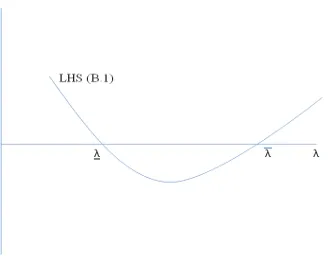
nT[(1 + ) y(s+ ) (y w0 c0)] c(
nT
1 +a) R (IC
0)
This is portrayed in …gure 1 below. It is clear from the …gure that unless the end point (i.e. at
nT =v) of the left-hand side of (IC0) lies below R;the equilibrium level of temporary migration
is lower than the social optimum. This is summarized in the proposition below.
Proposition 1 For in an intermediate range i.e. for 2( ; );if
[(1 + ) y(s+ ) (y w0 c0)]v c(
v
1 +a)> R (10)
Figure 1: The equilibrium number of temporary migrants
The basic intuition for the result is fairly straight-forward. Since …rms gain from retaining
temporary migrant workers, they lobby the politician to not repatriate the temporary migrants.
An increase in the number of temporary workers increases the resources the …rms are willing to
commit to e¤ectively lobby the government. Anticipating this, at the beginning citizens decide
on a suboptimal (low) number of temporary migrants. Put another way, the proposition suggests
that the socially optimal level of temporary labor migration is not politically feasible.
While the analysis so far has assumed that only temporary migrants are allowed in initially,
one can show (as we do in Appendix B) that there exists a range of parameters for which this
temporary-only policy is the optimal policy even if one were to impose no restrictions on permanent
migration. Intuition suggests that for this to hold, the cultural cost of permanent migration, ,
cannot be too low, otherwise obviously it would be optimal to bring in some permanent migrants.
What is less obvious is that cannot be too high, either –although permanent migrants will not
be brought in in that case, but the incentive constraint for the politician will be easy to satisfy and
there will be no ine¢ ciency in the level of temporary migration. Hence, it is for an intermediate
range of , as speci…ed in the proposition above, that the politically feasible level of temporary
migration will be ine¢ ciently low.
In fact, one can go a step further. In particular, is there the possibility ofpolitical failurein the
sense that everyone may gain from an alternate policy? We answer this question in the following
Remark 1: Under the conditions in Proposition 1, for any equilibrium level of temporary migra-tion, nT, there exists a higher level of temporary migration, n0T > nT,which Pareto-dominates the equilibrium.
In any equilibrium, the number of temporary migrants allowed in is ine¢ ciently low, in the
sense that there exist other (higher) levels of temporary migration that all parties would prefer. It
is straightforward to see that …rms would bene…t from having more temporary migrants to …ll the
availalable vacancies. For the citizens as well, higher levels of temporary migration are preferable,
since by assumption 1(ii) the gain from each extra temporary worker is positive. However, the
inability of citizen-voters to exercise intertemporal control over the politician means that these
levels are not politically sustainable.
Aspects of the above political equilibrium are best understood by examining the impact of
di¤erences in the relevant parameters of the model on the degree of ine¢ ciency. The following
corollary to Proposition 1 addresses this.
Corollary 1 Under the conditions in Proposition 1, the level of temporary migrationnT decreases with (i) economic factors: a rise in the inter-temporal productivity increasesor in the world-wage
w0;or an increase in the …rm’s bargaining power ;or in the segmentation of the labor market ;
(ii) cultural factors: a decrease in the cultural costs from permanent migration :
Proof. An increase in s; w0; or or a decrease in tends to raise the left-hand side of
(IC0). From the …gure it is then clear that this will result in a decrease innT:
The above corollary thus surprisingly suggests that lower levels of productivity and/or higher
cul-tural costs may in fact be associated with a greater amount of temporary migration. The intuition
for this result, which is intricately related to our explicit consideration of political constraints in
the determination of migration policy, is perhaps best understood by examining some striking
pol-icy implications that follow. We highlight two of them below. First, the above corollary suggests
that a potentially Pareto improving policy may involve reducing barriers to migrant labor mobility
within the host country. Second, it suggests that a country may prefer to import (temporary)
migrants from culturally dissimilar countries rather than from culturally similar countries. We
outline the argument for both of these implications of Corollary 1 below.
(i) Employer Assignment and the (im)Mobility of Guest Workers: One of the more striking aspects
of most temporary labor migration programs has been the fact that the guest workers are tied to
migration programs across the world, in countries such as the U.S., Kuwait and Switzerland.16 Clearly, such restrictions on the mobility of guest workers lower the bargaining power of the
migrant workers, and adversely a¤ects their wages. This increases the pro…ts of the host country
…rms that hire these workers. Therefore, the question of direct political (and practical) interest is
whether this employer-guest worker ‘tying’is a good thing from thehost country’s point of view.
Corollary 1(i) throws light on this issue, and suggests otherwise – encouraging greater labor
mobility is not only potentially Pareto improving, but also politically feasible. To see the argument,
suppose that when visa restrictions prevent worker mobility across …rms, the degree of worker
(im)mobility is given by ( R = 1); and if such restrictions are absent by ( R = 0), where
(1)> (0). Recall that a worker’s outside option is given by y(1 +g ( R)). This implies that
an increase in worker mobility (i.e. lower ( R)), increases their bargaining power vis-a-vis their
employing …rms. This reduces the economic rent that the …rm is able to appropriate and thereby
reduces the maximum amount the …rm lobby is willing to pay the government in order to retain
its migrant workers, i.e. Bmax( (1)) > Bmax( (0)). Ipso facto, it increases the time-consistent temporary migration level into the country, thereby increasing welfare.
Thus, it suggests that a relaxation of ‘tying’restrictions should be ‘potentially Pareto
improv-ing’ (Besley and Coate, 1998). To see this, we …rst observe that there is an obvious bene…t to
the migrant worker from a higher wage. The country’s citizens also bene…t from the increase in
national income that follows this higher level of sustainable temporary migration. Perhaps less
ob-viously, even …rms bene…t. At …rst glance, this may appear puzzling, since the amount of surplus
they can extract from the retained experienced workers is being reduced. However, the key point is
that, since in a (political) equilibrium not all vacancies are getting …lled, that surplus is not being
extracted anyway. Since the level of that temporary migration is higher than it would have been
with lower labor mobility, more of the productive surplus gets realized. Therefore, our theoretical
framework unambiguously suggests that any policy that increases guest-worker mobility within
the host country is likely to bene…t all parties, and should be made a priority.
(ii) Culture and Guest Worker programs in the Middle East: Some of the largest ongoing
tempo-rary migration programs in the world are in the Middle East –Bahrain, Kuwait, Saudi Arabia and
the UAE being prominent examples. However, during the late eighties there was an important
shift in the nature of the guest-worker programs in these countries. In particular, there was a
dramatic shift in the source countries for much of the migrant workforce, away from other Arab
1 6
While not strictly a temporary labor migration program, theH-1Bprogram in the United States assigns foreign
countries, such as Egypt, Yemen and Jordan, which had previously been the main sources from
which migrant workers were drawn.17 Instead, these rich Gulf countries chose to deliberately re-place temporary migrants of Arab origin with those of South (or South East) Asian origin. In
fact, there was a decrease in not just the share, but even in the absolute number of Arab workers.
So what accounts for this puzzling switch?
Our model suggests one possible answer. In particular, Corollary 1(ii) suggests that it is
(po-litically) much more costly (in terms of future payo¤s) to the government to provide citizenship to
culturally (dis)similar migrant workers. Thus, if the migrant workers are more culturally
dissimi-lar, the …rm lobby needs to make a larger bribe in order to successfully persuade the politician to
retain the temporary workers. Therefore, if a government is less likely to succumb to a bribe, the
sustainable level of temporary migrationnT rises with the cultural distance of the migrants. Therefore, our analysis suggests that a simple way in which the degree of ine¢ ciency can be
reduced is by replacing (culturally similar) Egyptian (low ) migrants with culturally distinct
south Asian (high ) migrants, resulting in higher levels of politically sustainable temporary
labor migration – boosting overall national income and welfare. Jureidini (2006) in his survey of
temporary migration to the Gulf States argues that this was clearly one factor that contributed to
the replacement of Arab workers with other Asians: “Arabs were more likely to stay and eventually
make demands for citizenship and political participation. Asians were considered more dependable
and less demanding and were easily expelled”.18
3.2.2 Temporary and permanent migrants
So far we have considered the case when citizens decide only on the number of temporary migrants
to be allowed into the country to meet the labor shortage v: Given that this labor shortage is
expected to last inde…nitely into the future, it may be worthwhile to …ll some of the positions with
permanent migrants and then use temporary migrants to …ll the remaining slots. In this section,
we study the implications of allowing citizens every period to choose the number of permanent
migrants to bring in along with the number of temporary ones .
1 7
The Arab share of the foreign worker population in the Arab countries of the Gulf Cooperation Council (GCC)
went down from 56 percent in 1985 to 32 percent in 2002. This decrease in the Arab share of temporary migrants
was mirrored by the rise in the share of South and South East Asian migrants over the same period. For details see
Andrezj Kapiszewski (2006). 1 8
One might be hesitant to draw wider implications, given the large di¤erences in the nature of politics in liberal
western democracies as compared to the Middle East. However, we should point out a simple modi…cation of our
IfnP(i)is the number of new permanent migrants brought in periodiandnT(i)is the number
of temporary migrants allowed in that period (and repatriated at the end of the period), the overall
national welfare is given by:
1 X
i=0
i[(y w
0 c0)nT(i) + (y w0 c0+
1 y(s+ ))nP(i)) c(
Pi
j=0nP(j)
1 +a )] (11)
As before,y w0 c0 is a temporary migrant’s contribution to national welfare net of the cultural
costs he/she imposes. It is the same for a permanent migrant during the …rst period of stay, and
changes to y(s+ ) c(
Pi
j=0nP(j)
1+a ) for subsequent periods, which takes into account the part
of the productive surplus retained by the native …rms as well as the cultural costs imposed. This
overall welfare is to be maximized subject to the government’s incentive constraint, which is now
given for each period iby:
1 [ y(s+ )nT(i)] + 1 [ y(s+ )(nT(i) +nP(i)) c(
nT +Pij=0nP(j)
1 +a )] (12)
[
1 R] +1 [fy w0 c0gnT(i) + y(s+ )nP(i) c(
Pi
j=0nP(j)
1 +a )]
This is the same as constraint (9) in the case of only temporary migrants, now taking into account
that permanent migrants are also being brought in. The important additional factor at work here
is that the addition of permanent migrants changes the marginal cost of retaining a temporary
worker permanently from 1+1ac0(0)to 1+1ac0(nT
1+a):
In the …rst-best case i.e. without the incentive constraints, the optimal would involve importing
all permanent migrants (if any) in the …rst period itself and then …lling the rest of the slots using
a rotating pool of temporary migrants. The intuition for this stems from the fact that the cultural
costs imposed by permanent migrants are the same no matter when they are imported, so that
if their productivity gains outweigh these costs, then the gains should be availed of as early as
possible. We …rst show (in the lemma below) that even in the presence of constraints to ensure
that the politician does not succumb to the …rms’ lobbying e¤orts, the structure of the solution
remains similar, i.e., the optimal still involves importing permanent migrants only in the initial
period, together with a rotating pool of temporary migrant workers. This helps to simplify analysis
of the equilibrium, which we do in proposition 2.
Lemma 1 In the presence of political constraints, the optimum will involve nP(i) = 0 for i 1
Proof: See Appendix A.
Denoting by nP the number of permanent migrants brought in in the …rst period and by nT
the number of temporary migrants every period, the overall welfare is now given by:
1
1 (y w0 c0)nT + (y w0 c0)nP +1 [ y(s+ )nP c(
nP
1 +a)] (13)
while the government’s incentive constraint is:
1 y(s+ )nT +1 [ y(s+ )(nT +nP) c(
nT +nP
1 +a )] (14)
1 R+1 [(y w0 c0)nT + y(s+ )nP c(
nP
1 +a)]
Usingl as the Lagrange multiplier on the incentive-compatibility constraint, we can write the
…rst-order condition for the problem as:
(y w0 c0) +
1 [ y(s+ ) 1 +ac
0( nP
1 +a)] = l1 +afc
0(nT +nP
1 +a ) c
0( nP
1 +a)g (15)
As c is convex, the right hand side of the above equation is negative. Since by assumption 1(ii),
y w0 c0 >0; it implies that y(s+ ) 1+ac0(1+nPa)< 0:Thus, comparing it with the social
optimum condition (2), one can easily see that the solution here will involve an excess number
of permanent migrants as compared with the social optimum. We summarize the result in the
following proposition.
Proposition 2 In a world with political constraints, the optimal mix of migrants will involve an
excess of permanent migrants as compared with the social optimum i.e. nP > mP:
The intuition for the above result is the following. Observe that the politician cares (partially)
about the welfare of the citizen voter. By increasing the number of permanent migrants, the
marginal cultural cost of admitting an extra migrant is raised. Thus the cultural impact of making
temporary migrants permanent is now bigger, and hence the incentive constraint gets tightened.
In other words, as the marginal cultural cost of immigration goes up, the politician becomes less
likely to accept the lobby’s bribe to retain the temporary migrants. Thus the permanent migrants
play a deterrent role in reducing the politician’s incentive problem with respect to temporary
migrants.
How is this level of permanent migration a¤ected by the various parameters? This is analyzed
Corollary 2 The level of permanent migration np decreases with (i) a rise in the world wage
w0; or (ii) an increase in the cultural cost of temporary migration c0. The e¤ ect of a rise in the
inter-temporal productivity increase s or or in the cultural costs on the level of permanent
migration is ambiguous.
Proof: See Appendix.
The intuition for the ambiguous comparative static results stems from the fact that permanent
migrants impact both the incentive constraint for politicians as well as the overall surplus.
In-creases in factors such as …rm-speci…c productivity s, or in market-segmentation , which raise
…rm pro…tability cause the …rms to lobby politicians much more aggressively to retain the
tempo-rary workers. As noted before, by raising the marginal cultural cost, permanent migrants help to
tighten the politician’s incentive constraint. When the incentives are more skewed, as is the case
when …rm pro…tability is higher, the incentive gain from bringing in more permanent migrants
is not as high. This calculation encourages a reduction in the number of permanent migrants
brought in whensor is high. On the other hand, by raising the lifetime surplus from permanent
migrants, an increase insor suggests an increase in their number. These e¤ects go in opposite
directions, and thus their overall impact on the number of permanent migrants depends on which
e¤ect dominates. Similarly, an increase in the cultural cost parameter positively impacts the
incentive constraint, but negatively the overall surplus. Indeed, these results can help inform the
historical trajectory of migration policy in the United States.
The Civil Rights Movement and the Shift from Temporary to Permanent Migration: Consider
the following major legislative changes that took place in 1964-65 in the United States. First, in
December 1964 the Bracero Program was formally terminated after having been in place since
1942. This was one of the largest temporary worker programs in the world, and sponsored over
4.5 million border crossings of Mexican labor to work in the farm sector in California over the
period 1942-64. Soon after, the Federal Government in the United States changed its immigration
policy, with the passage of the landmark Immigration and Nationality Act of 1965. This Act
was revolutionary in that it allowed immigration from (non-European) countries where the racial,
ethnic and cultural makeup of the country was very di¤erent from that of the citizens of the U.S.
at that point in time. Finally, around the same time, Congress passed the landmark Civil Rights
Act of 1964 and the Voting Rights Act of 1965.
Typically, these three events have been analyzed independently of each other. In contrast, our
but rather as a series of inter-related outcomes. Prior to the Immigration Act of 1965, immigration
quotas were on the basis of national-origin quotas established in 1920. In practice, as argued by
Chin (1996) there were strong racially based restrictions that prevented non-white individuals
(most pointedly from Asia) from immigrating to the U.S..19 The Civil Rights movement played a
pivotal role in changing attitudes towards, and the public tolerance of, individuals of very di¤erent
ethnic-cultural makeup from the existing population (a decline in , in the context of our model).20 Furthermore, Jenkins (1999) suggests that in the wake of Lyndon Johnson’s landslide victory,
congressional liberals simultaneously pushed to bring about an end to the Bracero program, pass
the Civil Rights Act, as well as push through the Immigration and Naturalization Act of 1965.
Indeed Wells (1996) argues that the Civil Rights Movement played an important role in the
termination of the Bracero program. While a number of explanations can be o¤ered for the
passage of each of these major pieces of legislation taken individually, taken together, it is highly
likely that the shift in popular attitudes towards individuals of a di¤erent cultural makeup also
had a major role to play in all of these policy changes. We summarize the above discussion in the
following remark.
Remark 2: There exists a su¢ ciently large decline in such that temporary migration is replaced by a permanent migration program. In particular, there exists a 1 > 2 such that nT( 1) > 0
and nP( 1) = 0 while nT( 2) = 0 and nP( 2)>0.
1 9
For example a person of Asian racial descent who was born and raised in Brazil was treated as Asian, and not
Brazilian, for the purpose of immigration. 2 0For instance, Chin (1996) argues that
“....whether or not aliens had a right to immigrate on a race-neutral basis, o¢ cials recognized
that racism in immigration was a civil rights issue because of its e¤ect on Americans. Dean Rusk for
example, observed that immigration policy had signi…cant domestic, as well as foreign e¤ects: ‘Given
the fact that we are a country of many races and national origins, that those who built this country
and developed it made decisions about opening our doors to the rest of the world, that anything which
makes it appear that we, ourselves, are discriminating in principle about particular national origins,