Direct Error Rate Minimization for Statistical Machine Translation
Tagyoung Chung∗ University of Rochester Rochester, NY 14627, USA [email protected]
Michel Galley Microsoft Research Redmond, WA 98052, USA [email protected]
Abstract
Minimum error rate training is often the pre-ferred method for optimizing parameters of statistical machine translation systems. MERT minimizes error rate by using a surrogate rep-resentation of the search space, such as N -best lists or hypergraphs, which only offer an incomplete view of the search space. In our work, we instead minimize error rate di-rectly by integrating the decoder into the min-imizer. This approach yields two benefits. First, the function being optimized is the true error rate. Second, it lets us optimize param-eters of translations systems other than stan-dard linear model features, such as distortion limit. Since integrating the decoder into the minimizer is often too slow to be practical, we also exploit statistical significance tests to ac-celerate the search by quickly discarding un-promising models. Experiments with a phrase-based system show that our approach is scal-able, and that optimizing the parameters that MERT cannot handle brings improvements to translation results.
1 Introduction
Minimum error rate training (Och, 2003) is a com-mon method for optimizing linear model parame-ters, which is an important part of building good ma-chine translation systems. MERT minimizes an arbi-trary loss function, usually an evaluation metric such as BLEU (Papineni et al., 2002) or TER (Snover et al., 2006) from a surrogate representation of the search space, such as theN-best candidate transla-tions of a development set. Much of the recent work
∗This research was conducted during the author’s
intern-ship at Microsoft Research.
on minimum error rate training focused on improv-ing the method by Och (2003). Recent efforts ex-tended MERT to work on lattices (Macherey et al., 2008) and hypergraphs (Kumar et al., 2009). Ran-dom restarts and ranRan-dom walks (Moore and Quirk, 2008) are commonly used to combat the fact the search space is highly non-convex, often with mul-tiple minima.
Several problems still remain with MERT, three of which are addressed by this work. First, theN -best error surface explored by MERT is generally not the same as the true error surface, which means that the error rate at an optimum1 of theN-best er-ror surface is not guaranteed to be any close to an optimum of the true error surface. Second, most SMT decoders make search errors, yet MERT ig-nores the fact that the error surface of an error-prone decoder differs from the one of an exact decoder (Chang and Collins, 2011). MERT calculates an en-velope from candidate translations and assumes all translations on the envelope are reachable by the de-coder, but these translations may become unreach-able due to search errors. Third, MERT is only used to tune linear model parameters, yet SMT systems have many free decoder parameters—such as distor-tion limit and beam size—that are not handled by MERT. MERT does not provide a principled way to set these parameters.
In order to overcome these issues, we explore the application of direct search methods (Wright, 1995) to SMT. To do this, we integrate the decoder and the evaluation metric inside the objective function,
1
The optimum found by MERT (Och, 2003) is generally not globally optimal. An alternative that optimizesN-best lists ex-actly is presented by Galley and Quirk (2011), and we do not discuss it further here.
which takes source sentences and a set of weights as inputs, and outputs the evaluation score (e.g., BLEU score) computed on the decoded sentences. Since it is impractical to calculate derivatives of this func-tion, we use derivative-free optimization methods such as the downhill simplex method (Nelder and Mead, 1965) and Powell’s method (Powell, 1964), which generally handle such difficult search condi-tions relatively well. This approach confers several benefits over MERT. First, the function being opti-mized is the true error rate. Second, integrating the decoder inside the objective function forces the op-timizer to account for possible search errors. Third, contrary to MERT, our approach does not require in-put parameters to be those of a linear model, so our approach can tune a broader range of features, in-cluding non-linear and hidden-state parameters (e.g., distortion limit, beam size, and weight vector ap-plied to future cost estimates).
In this paper, we make direct search reasonably fast thanks to two speedup techniques. First, we use a model selection acceleration technique called racing (Moore and Lee, 1994) in conjunction with randomization tests (Riezler and Maxwell, 2005) to avoid decoding the entire development set at each function evaluation. This approach discards the current model whenever performance on the trans-lated subset of the development data is deemed sig-nificantly worse in comparison to the current best model. Second, we store and re-use search graphs across function evaluations, which eliminates some of the redundancy of regenerating the same transla-tions in different optimization steps.
Our experiments with a strong phrase-based trans-lation system show that the direct search approach is an effective alternative to MERT. The speed of direct search is generally comparable to MERT, and trans-lation accuracy is generally superior. The non-linear and hidden-state features tuned in this work bring gains on three language pairs, with improvements ranging between 0.27 and 0.35 BLEU points.
2 Direct error rate minimization
Most current machine translation systems use a log-linear model:
p(e|f) ∝ exp X i
λihi(e, f)
wheref is a source sentence,eis a target sentence,
hi is a feature function, andλi is the weight of this feature. Given a source sentencef, finding the best target sentenceeˆaccording to the model is a search problem, which is called decoding:
ˆ
e= argmax e
exp X
i
λihi(e, f)
The target sentence eˆ is automatically evaluated against a reference translation r using any metric that is known to be relatively well correlated with human judgment, such as BLEU or TER. Let us re-fer to such error function as E ·
. Then, the process of finding the best set of weightsλˆ according to an error function E is another search:
ˆ
λ= argmin
λ
E
r; argmax e
exp X
i
λihi(e, f)
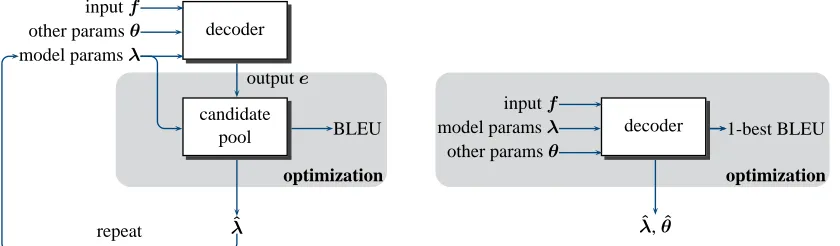
The typical MERT process solves the problem in an iterative fashion. At each stepi, it producesN-best lists by decoding with ˆλi, then uses these lists to find λiˆ +1. Och (2003) presents an efficient
multi-directional line search algorithm, which is based on the fact that the error count along each line is piece-wise constant and thus easy to optimize exactly. The process is repeated until a certain convergence crite-rion is met, or until no new candidate sentences are added to the pool. The left side of Figure 1 summa-rizes this process.
Though simple and effective, there are several lim-itations to this approach. The primary reason is that it can only tune parameters that are part of the log-linear model. Aside from having parameters from the log-linear model, decoders generally have free parameters θ that needs to be set manually, such as beam size and distortion limit. These decoder-related parameters have complex interactions with linear model parameters, thus, ideally, we would want to tune them jointly with decoder parameters such as distortion limit.
decoder
candidate pool
ˆ
λ
BLEU
optimization inputf
other paramsθ
model paramsλ
outpute
repeat
decoder
ˆ
λ,θˆ
1-best BLEU
optimization inputf
model paramsλ
[image:3.612.101.521.63.186.2]other paramsθ
Figure 1: Comparison of MERT (left) and direct search (right).
as a single function:
Φ(f, r;λ,θ) =E
r; argmax e
exp X
i
λihi(e, f)
Then, it uses an optimization method to minimize the function:
argmin
λ,θ
Φ(f, r;λ,θ)
This formulation solves the problem mentioned pre-viously, since we jointly optimize λ and θ, thus accounting for the dependencies between the two. However, there are two problems to address with di-rect error minimization. First, this approach requires the entire development set to be re-decoded every time the function is evaluated, which can be pro-hibitively expensive. To address this problem, we present several methods to speed up the search pro-cess in Section 5. Second, since the gradient of stan-dard evaluation metrics such as BLEU is not known and since methods for estimating the gradient numer-ically require too many function evaluations, we can-not use common search methods that use derivatives of a function. Therefore, we need robust derivative-free optimization methods. We discuss such opti-mization methods in Section 3.
3 Derivative-free optimization
As discussed in the previous sections, we need to rely on derivative-free optimization methods for di-rect search. We consider two such optimization methods:
Powell’s method For each iteration, Powell’s method tries to find a good direction along which the function can be minimized. This direction is deter-mined by searching along each standard base vector. Then, a line search is performed along the direction by using line search methods such as golden section search or Fibonacci search. The process is repeated until convergence. We implement the golden sec-tion search as presented by Press et al. (1992) in our experiments. Although the golden section search is only exact when the function is unimodal, we found that it works quite well in practice. More details are presented by Powell (1964).
Nelder-Mead method This approach sets up a
simplex on the search space, which is a polytope with D+ 1vertices when there are Ddimensions, and successively moves the simplex to a lower point to find a minimum of the function. The simplex is moved using different actions, which are taken when certain conditions are met. The basic idea behind these actions is to replace the worst point in the sim-plex with a new and better point, thereby moving the simplex towards a minimum. This method has the advantage of being able to deal with “bumpy” func-tions and depending on the configuration of the sim-plex at the time, it is possible to escape some local minima. This is often refer to as downhill simplex method and more details are presented by Nelder and Mead (1965).
4 Parameters
linear model parameters:
4.1 Distortion limit
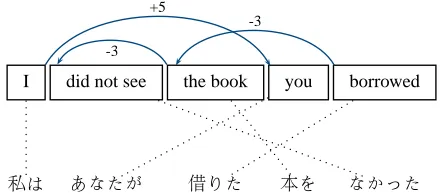
Distortion limit is one of decoder parameters that sets a limit on the number of words the decoder is allowed to skip when deciding which source phrase to translate in order to allow reordering. Fig-ure 2 shows a translation example from English to Japanese. Every word jumped over incurs a dis-tortion cost, which is usually one of the transla-tion model parameters, which thereby discourages reordering of words unless language model supports the reordering.
Since having a large distortion limit leads to slower decoding, having the smallest possible dis-tortion limit that still facilitates correct reordering would be ideal. Not only this speeds up translation, but this also leads to better translation quality by minimizing search errors. Since a larger distortion limit means there are more possible re-orderings of translations, it is prone to more search errors. In fact, there are evidences that tuning the distortion limit is beneficial in improving quality of translation by limiting search errors. Galley and Manning (2008) conduct a line search along increments of distor-tion limit and separately tune the transladistor-tion model parameters for each increment of distortion limit. The result shows significant difference in translation quality when distortion limit is tuned along with the model parameters. Separately tuning model param-eters for different distortion limit is necessary be-cause model parameters are coupled with distortion limit. A representative example: when distortion limit is zero, the distortion penalty feature can have any weight and not affect BLEU scores, but this is not the case when distortion limit is larger than zero. Tuning distortion limit in direct search in conjunc-tion with related features such linear distorconjunc-tion elim-inates the need for a line search for distortion limit.
4.2 Polynomial features
Most phrase-based decoders typically use a dis-tortion penalty feature to discourage (or maybe sometimes encourage) reordering. Whereas distor-tion limit is a hard constraint—since the decoder never considers jumps larger than the given limit— distortion penalty is a soft constraint, since it penal-izes reordering proportionally to the length of the
I did not see the book you borrowed
私は あなたが 借りた 本を なかった
+5
-3
[image:4.612.317.537.62.159.2]-3
Figure 2: Reordering in phrase-based translation. A min-imum distortion limit of five is needed to correctly trans-late this example. The source sentence is relatively sim-ple but a relatively large distortion limit is needed to ac-commodate the correct reordering due to typological dif-ference between two languages.
jump. The total distortion penalty is calculated as follows:
D(e, f) =λd X
j
|dj|pd
whereλdis the weight for distortion penalty feature, and dj is the size of the jump needed to translate thej-th phrase pair. For example, in Figure 2, the total distortion penalty feature value is 11, which is multiplied withλdto get the total distortion cost of translating the example sentence. Althoughpdis typ-ically set to one (linear), one may consider polyno-mial distortion penalty (Green et al., 2010). Green et al. (2010) show that settingpdto a higher value than one improves the translation quality, but uses a pre-determined value forpd. Instead of manually setting the value ofpd, it can be given a value tuned with di-rect search. Although we only discussed distortion penalty here, it is straightforward to tunepifor each feature hi(e, f)pi using direct error rate minimiza-tion, wherehi(e, f) is any linear model feature of the decoder.
4.3 Future cost estimates
estimate from pointxto the end of the sentence:
f(x) =g(x) +h(x)
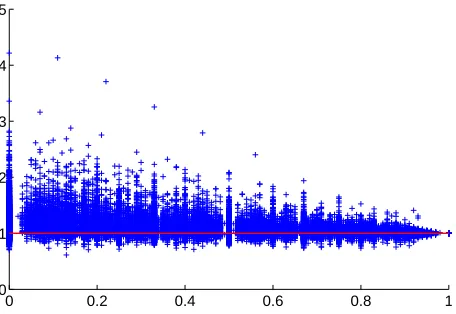
In SMT decoding, the same feature weight vec-tor is generally used when computingg(x)andh(x). However, this may not be ideal since future cost esti-mators use different heuristics depending on the fea-tures. For example, the future cost estimator (Green et al., 2010) for linear distortion always underesti-mates completion cost, which is generally deemed a good property. Unfortunately, some features have estimators that tend to overestimate completion cost, as it is the case with the language model. This prob-lem is illustrated in Figure 3. The Figure shows that the ratio between the estimated total cost and the actual total cost converges to 1.0. However, in earlier stages of translations, the estimated fu-ture cost for language model is larger than it should be, which leads to higher total estimated cost. In the A* search parlance, we are using an inadmissi-ble heuristic since the future cost is overestimated, which leads to suboptimal search. This suggests that separately tuning parameters that are involved in the future cost estimation will lead to better pruning de-cisions. This essentially doubles the number of lin-ear model parameters, since for every feature used in future cost estimation, we create a counterpart and tune its weight independently.
4.4 Search parameters
In addition to the parameters listed above, we also tune general decoder parameters that affect the search quality: beam size and parameters controlling histogram pruning and threshold pruning. While it makes sense to set these parameters automatically instead of manually, the methods we have presented thus far are not particularly fit for this type of pa-rameters. Indeed, if the sole goal is to maximize translation quality (e.g., as measured by standard BLEU), a larger beam size and less pruning is usu-ally preferable. To address this problem, we opti-mize these three parameters using a slightly different objective function. When tuning any of these three features, the goal of translation is to get the most ac-curate translation given a pre-defined time limit, so we change the objective to be a time-sensitive objec-tive function. Much akin to brevity penalty in BLEU,
0 0.2 0.4 0.6 0.8 1
[image:5.612.314.542.53.210.2]0 1 2 3 4 5
Figure 3: yaxis is ratio between estimated total cost vs. actual total cost of language model for thousands of trans-lations.1.0means the estimated total cost and the actual total cost are exactly the same, and anything higher than 1.0means the future cost has been overestimated thereby inflating the estimated total cost. Thex-axis represents how much translation has been completed. 0.1 means 10% of a sentence has been translated.
we define time penalty as:
TP ·
= (
1.0 ti ≤td
exp1−tdti ti > td
where TP ·
is a time penalty that is multiplied to BLEU, ti is the time it takes to translate devel-opment set under current parameters, and td is the desired time limit for translating the development set. With this error metric, we still optimize for the translation quality as long as the translation hap-pens within desired timetd. With the modified time-sensitive BLEU score as error metric, direct search may tune the parameters that have the speed and ac-curacy trade-off that we want.2
5 Speeding up direct search
Optimizing the true error surface is generally more computationally expensive than with any surrogate error surface, since each function evaluation usually requires decoding or re-decoding the entire devel-opment set. Since SMT tuning sets used for error
2
A disadvantage of using time in the definition ofTP` ·´
rate minimization often comprise one thousand sen-tences or more, each function evaluation can take minutes or more. However, this problem is some-what mitigated by the fact that translating in batches is highly parallelizable. Since MERT (Och, 2003) is also easily parallelizable, we need to resort to other speedup techniques to make direct search a practi-cal alternative to MERT. We now present two tech-niques that make optimization of the true error sur-face more efficient.
5.1 A racing algorithm for speeding up SMT model selection
Error rate minimization as presented in this paper can be seen as a form of model selection, which has been the focus of a lot of work in the learn-ing literature. The most popular approaches to model selection—such as minimizing cross valida-tion error—tend to be very slow in practice; there-fore, researchers have addressed the problem of ac-celerating model selection using statistical tests.
Prior to considering the SMT case, we review one of these methods in the case of leave-one-out cross validation (LOOCV). Racing for model selection (Maron and Moore, 1994; Moore and Lee, 1994) works as follows: we are given a collection of Nm models and Nd data points, and we must find the model that minimizes the meane∗
j =
1
Nd P
iej(i), where ej(i) is the classification error of modelMj on theith datapoint when trained on all datapoints except theith point. The models are evaluated con-currently, and at any given step k ∈ [1, Nd], each modelMj is associated with two pieces of informa-tion: the current estimate of its mean error rate, and the estimate of its variance. As evaluations progress, we eliminate any model that is significantly worse than any other model.3 We also note that the Rac-ing technique first randomizes the order of the data points to ensure that prefixes of the dataset are
gen-3The details of these statistical tests are not so important
here since we use different ones in the case of SMT, but we briefly summarize them as follows: Maron and Moore (1994) use a non-parametric method (Hoeffding bounds (Hoeffding, 1963)) for confidence estimation, and places confidence inter-vals on the mean value of the random variable representing ej(i). A model is discarded if its confidence interval no longer overlaps with the confidence interval of the current best model. Moore and Lee (1994) use a similar technique, but relies on Bayesian statistics instead of Hoeffding bounds.
erally representative of the entire set.
In this work, we use Racing to speed up direct search for SMT, but this requires two main adjust-ments compared to the LOOCV case. First, our models have real-valued parameters, so we cannot exhaustively evaluate the set of all models since it is infinite. Instead, we use direct search to select which models compete against each other during Racing. In the case of Powell’s method, all points of a grid along the current search direction are evaluated in parallel using Racing, before we turn to the next line search. In the case of the downhill simplex op-timizer and in the case of line searches other than grid search (e.g., golden section search), the use of Racing is more difficult because the function eval-uations requested by these optimizers have depen-dencies that generally prevent concurrent function evaluations. Since functions in downhill simplex are evaluated in sequence and not in parallel, our solu-tion is to race the current model against our current best model.4 When the evaluation of a modelM is interrupted because it is deemed significantly worse than the current best modelMˆ, the error rate ofM
on the entire development set is extrapolated from its relative performance on the decoded subset.5
The second main difference with the LOOCV case is that we do not use confidence intervals to de-termine which of two or models are best. In SMT, it is common to use either bootstrap resampling (Efron and Tibshirani, 1993; Och, 2003) or randomization tests (Noreen, 1989). In this paper, we use the ran-domization test for discarding unpromising models, since this statistical test was shown to be less likely to cause type-I errors6than bootstrap methods (Rie-zler and Maxwell, 2005). Since both kinds of statisti-cal tests involve a time-consuming sampling step, it
4Since Racing only discards suboptimal models, the current
best modelM∗is one for which we have decoded the entire
de-velopment set. Once a new modelM is evaluated, we perform at stepja significance test to determine whetherM’s transla-tion of sentences1. . . jis better or worse thanM∗translation
for the same range of sentences. IfMis significantly worse, we discard it. IfM∗is worse, we continue evaluating the
perfor-mance ofM, since we needM’s output for the full development set ifMeventually becomes the new best model.
5
For example, if error rates ofMˆ andM are respectively 10% and 11% on the subset decoded by both models andMˆ’s error on the entire set is 20%,M’s extrapolated error is 22%.
is somewhat wasteful to perform a new test after the decoding of each sentence, so we translate sentences in small batches of K sentences before performing each randomization test.7
We finally note that Racing no longer guarantees that the error function observed by the optimizer is the true error function. Racing causes some approx-imations of the error function, but the degree of ap-proximation is designed to be small in regions with low error rates, and Racing ensures that the most promising function evaluations in our progression to-wards an optimum are unaffected. In contrast, the approximation of the error function computed from
N-best lists or lattice does not share this property.8
To further speed up function evaluations in direct search, we employ a method meant to deal with mod-els that are nearly identical, a situation in which Rac-ing usually does not help much. Indeed, when two models produce very similar outputs, we often need to run the race through every sentence of the devel-opment set since none of the two models end up be-ing significantly better. A solution to this problem consists of discarding models that are nearly identi-cal to other models, where similarity between mod-els is solely measured from their outputs.9 To do this, we resort again to a randomization test: Given two modelsMa andMb, this test performs random permutations between outputs ofMaandMb, that is, it determines for each sentence of indexiwhether or not to permute the two model outputs, with proba-bilityp = 0.5. WhenMa andMb are very similar, these permutations have little effect, even when we repeat this sampling process many times. To cope with this problem, we slightly modify the
random-7
In our experiments, we set K= 50. Some other practi-cal considerations: the significance level used for discarding unpromising models isp ≤ .05. The randomization test is a sampling-based technique, for which we must specify a sample sizeR. In this paper, we useR= 5000.
8
In the case ofN-best MERT, it is not even guaranteed that we find the true error rate of our current best modelM while searching theN-best error surface. In fact, if we take the pa-rameters of our best modelM and re-decode the development set, we may get an error rate that is different from what was pre-dicted from theN-best list. With direct search and Racing, no such approximation affects our current best model.
9
Measuring model similarity only based on parameter val-ues is less effective, since features and other parameters are sometimes redundant, and two models may behave similarly while having fairly distinct parameter values.
ization test to discard one of the two nearly iden-tical models. Specifically, we compute the gap— measured in error rate—between the best random-ized output and the worst randomrandom-ized output. If this gap is lower than a pre-defined threshold, we only keep the best model.10 This adjustment to the sig-nificance test makes direct search reasonably fast, since Racing is effective during the initial steps of search (when steps tend to be relatively big, and when differences in error rate are pretty significant), and our modification to randomization tests helps while search converges towards an optimum using increasingly smaller steps.
5.2 Lattice-based decoding
We use another technique to speed up direct search by storing and re-using search graphs, which con-sist of lattices in the case of phrase-based decod-ing (Och et al., 1999) and hypergraphs in the case of hierarchical decoding (Chiang, 2005). The suc-cessive expansion of translation options in order to construct the search graph is generally done from scratch, but this can be wasteful when the same sentences are translated multiple times, as it is the case with direct search. Even when the parame-ters of the decoder change across function evalua-tions, some partial translation are likely to be con-structed multiple times, and this is more likely to happen when changes in parameters are relatively small. To overcome this inefficiency, we memoize hypotheses expansions made in all function evalu-ations, which then allows us to reuse some edges (or hyperedges) from previous iterations to construct the current graph (or hypergraph). Since feature values—including expensive features like language model score—are stored into each edge, the speedup is roughly proportional to the percentage of edges we can reuse.
A more radical way of exploiting search graphs of previous iterations is to use them as constraints in a forced decoding approach. In this framework, the decoder takes as input not only an input sentence, but also a constraining search graph. During decod-ing, it is forced to discard any translation
hypothe-10
decoder
constrained decoder
ˆ
λ,θˆ
1-best BLEU
optimization inputf
other paramsθ
model paramsλ
latticeℓ
[image:8.612.325.527.53.103.2]repeat
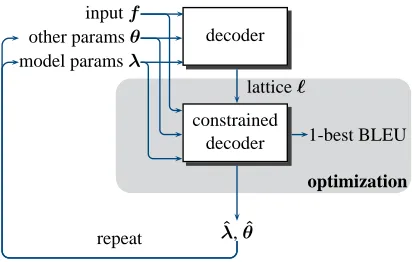
Figure 4: Lattice-constrained decoding for direct search.
ses that violate the constraining search graph. This makes the memoization method presented in the pre-vious paragraph maximally efficient, since lattice-constrained decoding has all linear model feature values already pre-computed. While this approach is similar in spirit to lattice-based MERT (Macherey et al., 2008), there is a crucial difference. The opti-mization steps in lattice MERT bypass the decoder, but the lattice-based approach presented here does not. The distinction is important when it comes to tuning non-linear and hidden state parameters of the decoder. For instance, the initial lattice may have been constructed with a distortion limit of 4, while the current model specifies a distortion limit of 2. At that stage, optimization via lattice-constrained de-coding instead of lattice-based MERT ensures that we will never select a path of the input lattice that corresponds to a distortion limit of more than 2. This is important since the error rate must reflect the fact that jumps of two or more words are not allowed.
Figure 4 shows how direct search with lattice-constrained decoding is structured. Similarly to MERT and as opposed to straight direct search, mization is repeated multiple times. Since each opti-mization in the lattice-constrained case does not re-quire recomputing any features, it usually turns into very significant gains in terms of translation speed, though it also causes a small loss of translation ac-curacy in general. The overall approach depicted in Figure 4 works as follows: a first set of lattices is generated using an initial λ0 and θ0. We then run
direct search with a decoder constrained on this set of lattices. After optimization has converged, the
op-Train MERT dev. Test
Korean-English 7.9M 1000 6000
Arabic-English 11.1M 1000 6000
Farsi-English 739K 1000 2000
Table 1: Size of bitexts in number of sentence pairs.
timalλˆ and θˆ are provided as input λ1 andθ1 to
start a new iteration of this process. Note that the constraining lattices built at each iteration are always merged with those of the previous ones, so constrain-ing lattices grow over time. The two stoppconstrain-ing crite-ria are similar to MERT: if the norm of the difference between the previous parameter vector—including λand θ—and the current vector falls below a pre-defined tolerance value, we do not continue to the next iteration. Alternatively, if a new pass of un-constrained decoding generates lattices that are sub-sumed by lattices constructed at previous iteration, we stop and do not run the next optimization step.
6 Experiments
6.1 Setup
For our experiments, we use a phrase-based transla-tion system similar to Moses (Koehn et al., 2007). Our decoder uses many of the same features as Moses, including four phrasal and lexicalized trans-lation scores, phrase penalty, word penalty, a lan-guage model score, linear distortion, and six lexical-ized reordering scores. Unless specified otherwise, the decoder’s stack size is 50, and the number of translation options per input phrase is 25.
[image:8.612.91.297.60.191.2]# Minimizer Optimized parameters Arabic Korean Farsi
1 MERT with grid search lin, DL 29.12 (14.6) 23.30 (20.8) 32.16 (11.7)
2 Direct search (simplex) lin, DL 29.07 (1.2) 23.42 (4.4) 32.22 (1.3)
3 Direct search (Powell) lin, DL 29.20 (2.3) 23.39 (5.6) 32.28 (2.1)
[image:9.612.71.542.54.140.2]4 Direct search (Powell) lin, extended, DL 29.39 (4.4) 23.61 (8.9) 32.51 (4.9) 5 Lattice-constrained (Powell) lin, extended, DL 29.27 (0.7) 23.43 (1.3) 32.42 (1.1) 6 Direct search (Powell) lin, extended, DL, search 29.31 (6.5) 23.46 (9.7) 32.62 (6.2)
Table 2: BLEU-4 scores (%) with one reference, translating into English; the numbers in parentheses are times in hours to run parameter optimization end-to-end. ‘Lin’ refers to Moses linear model features; ‘extended’ refers to non-linear and hidden state features (polynomial features, future cost); ‘DL’ refers to distortion limit; ‘search’ is the set of parameters controlling search quality (parameters controlling beam size, histogram pruning, and threshold pruning).
Our baseline system is trained for each language pair by running minimum error rate training (Och, 2003) on 1000 sentences. Each iteration of MERT utilizes 19 random starting points, plus the points of convergence at all previous iterations of MERT, and a uniform weight vector. That is, the first iteration of MERT uses 20 starting points, the second uses 21 points, etc. Since MERT is not able to directly opti-mize search parameters such as distortion limit and beam size, our baseline system uses grid search to optimize them. To make this search more tractable, we only perform the grid search for a single param-eter: the distortion limit. For each language pair, the grid search consists of repeating MERT for eight distinct distortion limits ranging from 3 to 10. The optimal distortion limits found for Korean, Arabic, and Farsi, are 8, 5, and 6, respectively.11 To ensure that the comparison with our approach is consistent, this grid search is made on the MERT dev set itself.
The next subsection contrasts the different direct search methods presented in this paper. Note that all these experiments use the speedup techniques based on statistical significance test presented in Sec-tion 5. Indeed, we found that using these techniques resulted in faster speeds without affecting the search in any significant way. Models tuned with or without significance tests often ended up identical.
6.2 Results
The main results are shown in Table 2, and are com-puted using standard BLEU-4 (Papineni et al., 2002)
11
We rerun MERT for each different distortion limit because of the dependencies between this parameter and linear model features, particularly linear distortion and lexicalized reordering scores. A linear model that is effective with a distortion limit of 4 can be suboptimal for a limit of 8.
search is forced to find parameter weights that of-fer a good balance between accuracy and speed. To make our results in row 6 as comparable as possible to row 4, we use the running time (on the develop-ment set) of row 4 as a time constraint for the model of row 6, which is to decode the entire development set at least as fast. In other words, the system of row 6 is optimized to be no slower than the system of row 4, and is otherwise penalized due to the time penalty. The effect of this is that translation speed at tuning time is almost the same, and speed of systems 4 and 6 is roughly the same at test time. A com-parison between rows 4 and 6 suggests that tuning search parameters such as beam size and without af-fecting time does not provide much gain in terms of translation quality, but the method nevertheless has one advantage: one can target a specific translation speed without having to manually tune any param-eter such as beam size, and without even having to decide which parameter to manually tune.
Times to run optimizations end-to-end are re-ported in parentheses in Table 2 and they take into account the time to run the grid search in the case of MERT. Times to decode test sets are not reported here since they are roughly the same across all mod-els. While translation accuracy with MERT and di-rect search is roughly the same when the underly-ing parameter set is the same, direct search wins in running time when it comes to optimizing search pa-rameters like distortion limit. Since each grid search runs MERT eight times, MERT is generally faster than direct search, but the difference of speed re-mains reasonable if the number of tuned parameters is the same, and direct search is rarely twice as slow.
We finally discuss the case of lattice-constrained decoding, which is shown in row 5 of Table 2. This method is not applicable when tuning parameters that affect search thoroughness (row 6), such as beam size. The reason is that lattice-constrained decoding is a form of forced decoding that siderably narrows the search space. Under a con-strained decoding setting, it appears that a large beam size seldom affects translation speed, but this is misleading and largely due to constraints cre-ated by the lattice. We thus evaluate the lattice-constrained case without tuning ‘search’ features, and find that direct search is significantly faster us-ing lattice-constrained, with only a slight
degrada-tion of transladegrada-tion quality. Lattice constraints are augmented 2-5 times before it converges.
7 Related work
The use of derivative-free optimization methods to tune machine translation parameters has been tried before. Bender et al. (2004) used the Nelder-Mead method to tune model parameters for a phrase-based translation system. However, their way of making direct search fast and practical is to set distortion limit to zero, which results in poor translation qual-ity for many language pairs. Zens et al. (2007) also use the Nelder-Mead method to tune parameters in a log-linear model to maximize expected BLEU. Zhao and Chen (2009) proposes changes to Nelder-Mead method to better fit parameter tuning in their ma-chine translation setting. They show the modifica-tion brings better search of parameters over the regu-lar Nelder-Mead method. Our work is related to the search-based structured prediction (SEARN) model of Daum´e (2006), in the sense that direct search also accounts for what happens during search (including search errors) to try to find parameters that are not only good for prediction, but for search as well.
8 Conclusion
This paper addressed the problem of minimizing er-ror rate at a corpus level. We show that a technique to directly minimize the true error rate, rather than one estimated from a surrogate representation such as anN-best list, is in fact feasible. We present two techniques that make this minimization significantly faster, to the point where this technique is a viable alternative to MERT. In the case where free param-eters of the decoder (such as distortion limit) also need to be optimized, our technique is in fact much faster. We also optimize non-linear and hidden state features that cannot be tuned using MERT, which yield improvements in translation accuracy. Experi-ments on large test sets yield gains on three language pairs, and our best configuration outperforms MERT by 0.27 to 0.35 BLEU points using a baseline system trained on large amounts of data.
Acknowledgments
References
Oliver Bender, Richard Zens, Evgeny Matusov, and Her-mann Ney. 2004. Alignment templates: the RWTH SMT system. In Proc. of the International Workshop on Spoken Language Translation, pages 79–84, Kyoto, Japan.
Yin-Wen Chang and Michael Collins. 2011. Exact de-coding of phrase-based translation models through La-grangian relaxation. In Proceedings of the 2011 Con-ference on Empirical Methods in Natural Language Processing, pages 26–37, Edinburgh, Scotland, UK., July. Association for Computational Linguistics. David Chiang. 2005. A hierarchical phrase-based model
for statistical machine translation. In Proceedings of the 43rd Annual Conference of the Association for Computational Linguistics (ACL-05), pages 263–270, Ann Arbor, MI.
Hal Daum´e, III. 2006. Practical Structured Learning Techniques for Natural Language Processing. Ph.D. thesis, University of Southern California, Los Angeles, CA, USA.
B. Efron and R. J. Tibshirani. 1993. An Introduction to the Bootstrap. Chapman & Hall, New York.
Michel Galley and Christopher D. Manning. 2008. A simple and effective hierarchical phrase reordering model. In Proceedings of the 2008 Conference on Empirical Methods in Natural Language Processing, pages 848–856, Honolulu, Hawaii, October. Associa-tion for ComputaAssocia-tional Linguistics.
Michel Galley and Chris Quirk. 2011. Optimal search for minimum error rate training. In Proceedings of the 2011 Conference on Empirical Methods in Natural Language Processing, pages 38–49, Edinburgh, Scot-land, UK., July. Association for Computational Lin-guistics.
Spence Green, Michel Galley, and Christopher D. Man-ning. 2010. Improved models of distortion cost for statistical machine translation. In Human Language Technologies: The 2010 Annual Conference of the North American Chapter of the Association for Com-putational Linguistics, pages 867–875, Los Angeles, California, June. Association for Computational Lin-guistics.
Wassily Hoeffding. 1963. Probability inequalities for sums of bounded random variables. Journal of the American Statistical Association, 58(301):13–30. Philipp Koehn, Franz Josef Och, and Daniel Marcu.
2003. Statistical phrase-based translation. In Proceed-ings of the 2003 Meeting of the North American chap-ter of the Association for Computational Linguistics (NAACL-03), Edmonton, Alberta.
Philipp Koehn, Hieu Hoang, Alexandra Birch, Chris Callison-Burch, Marcello Federico, Nicola Bertoldi,
Brooke Cowan, Wade Shen, Christine Moran, Richard Zens, Chris Dyer, Ondrej Bojar, Alexandra Constantin, and Evan Herbst. 2007. Moses: Open source toolkit for statistical machine translation. In Proceedings of ACL, Demonstration Session, pages 177–180.
Shankar Kumar, Wolfgang Macherey, Chris Dyer, and Franz Och. 2009. Efficient minimum error rate train-ing and minimum Bayes-risk decodtrain-ing for translation hypergraphs and lattices. In Proceedings of the Joint Conference of the 47th Annual Meeting of the ACL and the 4th International Joint Conference on Natural Lan-guage Processing of the AFNLP, pages 163–171, Sun-tec, Singapore, August. Association for Computational Linguistics.
Wolfgang Macherey, Franz Och, Ignacio Thayer, and Jakob Uszkoreit. 2008. Lattice-based minimum error rate training for statistical machine translation. In Pro-ceedings of the 2008 Conference on Empirical Meth-ods in Natural Language Processing, pages 725–734, Honolulu, Hawaii, October. Association for Computa-tional Linguistics.
Oded Maron and Andrew W. Moore. 1994. Hoeffding races: Accelerating model selection search for classi-fication and function approximation. In Advances in neural information processing systems 6, pages 59–66. Morgan Kaufmann.
Andrew Moore and Mary Soon Lee. 1994. Efficient algorithms for minimizing cross validation error. In W. W. Cohen and H. Hirsh, editors, Proceedings of the 11th International Confonference on Machine Learn-ing, pages 190–198. Morgan Kaufmann.
Robert C. Moore and Chris Quirk. 2008. Random restarts in minimum error rate training for statistical machine translation. In Proceedings of the 22nd In-ternational Conference on Computational Linguistics (Coling 2008), pages 585–592, Manchester, UK, Au-gust. Coling 2008 Organizing Committee.
J. A. Nelder and R. Mead. 1965. A simplex method for function minimization. Computer Journal, 7:308– 313.
Eric W. Noreen. 1989. Computer-Intensive Methods for Testing Hypotheses : An Introduction. Wiley-Interscience.
Franz Josef Och, Christoph Tillmann, Hermann Ney, and Lehrstuhl Fiir Informatik. 1999. Improved alignment models for statistical machine translation. In Proceed-ings of the Conference on Empirical Methods in Nat-ural Language Processing and Very Large Corpora, pages 20–28.
Kishore Papineni, Salim Roukos, Todd Ward, and Wei-Jing Zhu. 2002. BLEU: A method for automatic eval-uation of machine translation. In Proceedings of the 40th Annual Conference of the Association for Compu-tational Linguistics (ACL-02).
M. J. D. Powell. 1964. An efficient method for finding the minimum of a function of several variables without calculating derivatives. The Computer Journal, 7:155– 162.
William H. Press, Saul A. Teukolsky, William T. Vetter-ling, and Brian P. Flannery. 1992. Numerical recipes in C (2nd ed.): the art of scientific computing. Cam-bridge University Press, New York, NY, USA. Stefan Riezler and John T. Maxwell. 2005. On some
pitfalls in automatic evaluation and significance test-ing for MT. In Proceedtest-ings of the ACL Workshop on Intrinsic and Extrinsic Evaluation Measures for Ma-chine Translation and/or Summarization, pages 57–64, June.
Matthew Snover, Bonnie Dorr, Richard Schwartz, Linnea Micciulla, and John Makhoul. 2006. A study of trans-lation edit rate with targeted human annotation. In Pro-ceedings of Association for Machine Translation in the Americas, pages 223–231.
M H Wright. 1995. Direct search methods: Once scorned, now respectable. Numerical Analysis, 344:191–208.
Richard Zens, Sasa Hasan, and Hermann Ney. 2007. A systematic comparison of training criteria for statisti-cal machine translation. In Proceedings of the 2007 Joint Conference on Empirical Methods in Natural Language Processing and Computational Natural Lan-guage Learning (EMNLP-CoNLL), pages 524–532. Bing Zhao and Shengyuan Chen. 2009. A simplex