Bridging the Gap Between Scope-based and Event-based
Negation/Speculation Annotations: A Bridge Not Too Far
Pontus Stenetorp1 Sampo Pyysalo2,3 Tomoko Ohta2,3 Sophia Ananiadou2,3 and Jun’ichi Tsujii2,3,4
1Department of Computer Science, University of Tokyo, Tokyo, Japan
2School of Computer Science, University of Manchester, Manchester, United Kingdom 3National Centre for Text Mining, University of Manchester, Manchester, United Kingdom
4Microsoft Research Asia, Beijing, People’s Republic of China
{pontus,smp,okap}@is.s.u-tokyo.ac.jp [email protected]
Abstract
We study two approaches to the marking of extra-propositional aspects of statements in text: the task-independent cue-and-scope rep-resentation considered in the CoNLL-2010 Shared Task, and the tagged-event representa-tion applied in several recent event extracrepresenta-tion tasks. Building on shared task resources and the analyses from state-of-the-art systems rep-resenting the two broad lines of research, we identify specific points of mismatch between the two perspectives and propose ways of ad-dressing them. We demonstrate the feasibility of our approach by constructing a method that uses cue-and-scope analyses together with a small set of features motivated by data anal-ysis to predict event negation and speculation. Evaluation on BioNLP Shared Task 2011 data indicates the method to outperform the nega-tion/speculation components of state-of-the-art event extraction systems.
The system and resources introduced in this work are publicly available for research pur-poses at:https:// github.com/ ninjin/ eepura
1 Introduction
Understanding extra-propositional aspects of texts is key to deeper understanding of statements con-tained in natural language texts. Extra-propositional aspects such as the polarity of key statements have long been acknowledged to be critical for user-facing applications such as information retrieval (Friedman et al., 1994; Hersh, 1996). In recogni-tion of this need, a number of recent informarecogni-tion extraction (IE) resources involving structured repre-sentations of text statements have explicitly included
some marking of certainty and polarity (LDC, 2005; Kim et al., 2009; Saur and Pustejovsky, 2009; Kim et al., 2011a; Thompson et al., 2011).
Although extra-propositional aspects are recog-nised as important, there is no clear consensus on how to address their annotation and extraction from text. Some comparatively early efforts focused on the detection of negationcuephrases associated with specific (previously detected) terms through regu-lar expression-based rules (Chapman et al., 2001). A number of later efforts identified the scope of negation cues with phrases in constituency analy-ses in sentence structure (Huang and Lowe, 2007). Drawing in part on this work, the BioScope corpus (Vincze et al., 2008) applied a representation where both cues and their associatedscopesare marked as contiguous spans of text (Figure 1 bottom). This ap-proach was also applied in the CoNLL-2010 Shared Task (Farkas et al., 2010), in which 13 participat-ing groups proposed approaches for Task 2, which required the identification of uncertainty cues and their associated scopes in text. In the following, we will term this task-independent, linguistically-motivated approach as thecue-and-scope represen-tation (please see Vincze et al. (2008) for details re-garding the representation).
For IE efforts, more task-oriented representations are commonly applied. In an effort to formalise and drive research for extracting structured repre-sentations of statements regarding molecular biol-ogy, the ongoing series of BioNLP shared tasks have addressed biomedical Event Extraction (EE) (Kim et al., 2009; Kim et al., 2011a). The extra-propositional targets of negation and speculation
Figure 1: Example illustrating cue-and-scope and event-based negation marking. “Crossing-out” marks events as negated. PRO, THand NEGare ab-breviations for PROTEIN, THEME and NEGATION, respectively.
of extracted events were already included in the first task in the series, using a representation where events can be assigned “flags” to mark them as being negated, speculated, or both (Figure 1 upper). Due to space limitations we refer the reader to Kim et al. (2009) for a detailed explanation of the representa-tion; similar representations have been applied also in previous event extraction tasks (LDC, 2005).
There are a number of ways in which task-oriented, event-based approaches could benefit from the existing linguistically-oriented cue-and-scope methods for identifying extra-propositional aspects of text statements. However, there has been sur-prisingly little work exploring the combination of the approaches, and comparatively few methods ad-dressing the latter task in detail. Only three out of the 24 participants in the BioNLP Shared Task 2009 submitted results for the non-mandatory nega-tion/speculation task, and although negation and speculation were also considered in three main tasks for the 2011 follow-up event (Kim et al., 2011a), the trend continued, with only two participants ad-dressing the negation/speculation aspects of the task. We are aware of only two studies exploring the rela-tionship between the cue-and-scope and event-based representations: in a manual analysis of scope over-lap with tagged events, Vincze et al. (2011) identi-fied a number of issues and mismatches in annota-tion scope and criteria, which may explain in part the lack of methods combining these two lines of research. Kilicoglu and Bergler (2010) approached the problem from the opposite direction and used an existing EE system to extract cue-and-scope annota-tions in the CoNLL-2010 Shared Task.
In this work, we take a high-level perspective,
seeking to bridge the linguistically oriented work and the more application-oriented event frame-work to overcome the mismatches demonstrated by Vincze et al. (2011). Specifically, we aim to determine how cue-and-scope recognition systems can be used to produce a state-of-the-art nega-tion/speculation detection system for the EE task.
2 Resources
Several existing resources can support the investiga-tion of the relainvestiga-tionship between the linguistically-oriented and task-linguistically-oriented perspectives on nega-tion/speculation detection. In this study, we make use of the following resources.
First, we study the three BioNLP 2011 Shared Task corpora that include annotation for negation and speculation: the GE, EPI and ID main task cor-pora (Table 1). Second, we make use of support-ing analyses provided for these corpora in response to a call sent by the BioNLP Shared Task organis-ers to the developorganis-ers of third-party systems (Stene-torp et al., 2011). Specifically, we use the output of the BiographTA NeSp Scope Labeler (here re-ferred to asCLiPS-NESP) (Morante and Daelemans, 2009; Morante et al., 2010) provided by the Univer-sity of Antwerp CLiPS center. This system provides cue-and-scope analyses for negation and speculation and was demonstrated to have state-of-the-art per-formance at the relevant CoNLL-2010 Shared Task. Finally, we make use of the event analyses created by systems that participated in the BioNLP Shared Task, made available to the research community for the majority of the shared task submissions (Pyysalo et al., 2012). These analyses represent the state-of-the-art in event extraction and their capability to detect event structures as well as marking them for negation and speculation.
The above three resources present us with many opportunities to relate scope-based annotations to three highly relevant event-based corpora containing negation/speculation annotations.
3 Manual Analysis
Name Negated Events Speculated Events Negated Spans Speculated Spans Publication
EPI 103 (5.6%) 70 (3.8%) 561 1,032 Ohta et al. (2011)
GE 759 (7.4%) 623 (6.0%) 1,308 1,968 Kim et al. (2011b)
[image:3.612.91.279.171.275.2]ID 69 (3.3%) 26 (1.2%) 415 817 Pyysalo et al. (2011)
Table 1: Corpora used for our experiments along with annotation statistics for their respective training sets. The parenthesised values are the relative proportion of negated/speculated event annotations.
Occ. (Ratio) EPI ID
Covered 26 (15.03%) 52 (56.52%) Not-covered 135 (78.03%) 38 (41.30%) Error-in-gold 12 (6.94%) 2 (2.18%)
Morphological 48 (27.75%) 11 (11.96%) Hypothesis 44 (25.43%) 15 (16.30%) Ellipsis 5 (2.89%) 0 (0.00%) Argument-only 2 (1.16%) 10 (10.87%)
Table 2: Results from the Manual Data Analysis of the EPI and ID test sets.
created BioNLP Shared Task training data event an-notations, and the automatic annotations created for this data by the CLiPS-NESP system. The test data was held out and was not directly examined at any point of our study. We performed the anal-ysis specifically on the EPI and ID corpora, as the GE corpus training set texts overlap with the train-ing data for the CLiPS-NESP system (BioScope cor-pus), and results on this data would thus not reflect the performance of the system on unseen data, and a comparison of the GE and BioScope gold anno-tations was previously performed by Vincze et al. (2011).
The analysis was performed by an experienced annotator with a doctoral degree in a related field in biology, who individually examined each of the events marked as negated and speculated in the EPI and ID training corpora. For the analysis, the CLiPS-NESP system output was super-imposed onto the BioNLP Shared Task event annotations.
The annotator was asked to assign three primary flags for each event that was marked as negated or speculated:Coveredif the event trigger was covered by span(s) of the correct type with a correct cue in the cue-and-span analysis, Not-covered if not Cov-ered, and Error-in-gold if the negation/speculation flag on the event annotation was itself incorrect. We
also identified a number of additional properties that initial analysis suggested to frequently characterise instances where the coverage of the cue-and-scope system is lacking: Morphological was assigned if the negation/speculation of an event could be in-ferred only from the morphology of the word ex-pressing the event, rather than from cue words in its context (e.g. unphosphorylated, non-glycosylated);
Hypothesis for cases where speculation is marked for events stated as hyphotheses1 under
consider-ation, e.g. “We analysed the methylation status of MGMT”;Ellipsisfor cases where the modified ex-pression is elided (e.g. “A was phosphorylated but B was not”); and Argument-onlyif the CLiPS-NESP output had marked the argument of an event as negated rather than the event trigger (we use argu-ment in the sense it is used in the BioNLP Shared Tasks, for example, in Figure 1 upper, the two argu-ments of the event are “fMimR” and “fimA”).
The results of the analysis are summarised in Ta-ble 2. We find that that the system shows a clear dif-ference in coverage depending on the dataset. For the ID dataset, a majority of the annotations are cov-ered by the appropriate spans, while only a small mi-nority are covered for EPI. Instead, the EPI dataset contains a significant portion of events where extra-propositional aspects can only be distinguished by the morphology of the word expressing the event (allMorphologicalcases were negation) as well as events marked as speculated due to being expressed as hypotheses under study.
The analysis thus identified specific ways in which the applicability of negation-detection sys-tems using a span-and-scope representation could be improved for some tasks.
1
Event-based Scope-based
Negation/ speculation
detection
Event extraction
[image:4.612.70.302.57.144.2]Our system
Figure 2: An illustration of our approach.
4 Methods
We next introduce the methods we apply for as-signing negation and speculation flags to extracted events.
4.1 Approach
To focus on the extra-propositional aspects of event extraction, we only consider the assignment of the negation and speculation flags, not the extraction of the event structures that these mark. To our knowl-edge, no previous work studying this subtask in iso-lation from event extraction exists. Thus, in order to be able to relate the performance of the methods we consider to the performance of previously proposed approaches, it is necessary to base the negation and speculation detection on an event extraction analy-sis. For this reason, we construct our methods us-ing system outputs for systems participatus-ing in the BioNLP Shared Task 2011, in effect creating a nega-tion/speculation processing stage for a pipeline sys-tem where the previous stage is the completion of event analysis without negation/speculation detec-tion (Figure 2).
Our methods thus take extracted events as input and attempt to enrich the output with negation and speculation annotations. This enables us to produce a general system with the potential to be applied together with any existing event extraction system. Additionally, this allows us to directly compare our system output with that of the negation/speculation components of previously proposed monolithic sys-tems by removing the existing negation and spec-ulation output from submissions including this and recreating these annotations using our methods.
4.2 Rule-based Methods
The most straightforward way of carrying over in-formation from scope-based to event-based
annota-tions is to consider any event structure for which the word or words stating the event (i.e. the event trig-ger) is within the scope of a negation or speculation be negated or speculated (respectively). We imple-mented this simple heuristic as our initial rule-based method.
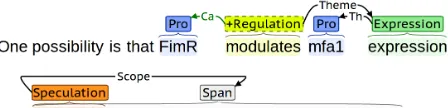
One relatively common category of cases where this heuristic fails that was identified in analysis re-lates to events that take other events as arguments. Consider, for example, the case illustrated in Fig-ure 3. The speculation span is correctly identified as covering the statement “FimR modulates mfa1 ex-pression”, and the event expressed through “mod-ulates” is identified as speculated. However, the nested event, the expression of mfa1, is not spec-ulated. To cover this case, we implemented what we refer to as theroot-heuristic, which prevents the propagation of negation/speculation marking from scopes to events that are the arguments of another event contained in the same scope. The second rule-based method we consider incorporates this addi-tional heuristic.
Preliminary development set experiments indi-cated that while the root-heuristic could improve precision, the performance of the rule-based meth-ods remained poor, in particular on the EPI dataset. The results of the manual analysis (Section 3) sug-gested this to trace in particular to two main issues, namely differences between annotation criteria be-tween BioScope and the shared task data (as noted also by Vincze et al. (2011)) and events which are negated not by external cues but by morphological alternations of the event trigger, such as “unphos-phorylated” expressing the absence of phosphory-lation. As it would have been difficult to system-atically incorporate both morphology and context into the rule-based method without compromising the generality of the approach, we opted to move to a machine learning framework for further method de-velopment. This allows us to continue to make use of the existing cue-and-scope annotations while ex-ploring the effects of other aspects of the text and maintaining generality through retraining.
4.3 Machine Learning-based Methods
mo-Feature Example Value(s)
Heuristic ROOT/NON-ROOT
Heuristic-Cue possibility Heuristic-Span One, possibility, . . .
Trigger-Text non-phosphorylated Trigger-Prefixes no, non, non-, . . .
Trigger-Preceding-Context is, that, . . .
[image:5.612.87.287.58.168.2]Trigger-Proceeding-Context mfa1, expression, . . .
Table 3: Machine learning features. The fea-tures are categorised into three groups: feafea-tures based on cue-and-scope based heuristics (top), non-contextual features derived from the event trigger (middle), and features derived from the context of the event trigger (bottom). These three feature sets are abbreviated as E, M and C, respectively.
Figure 3: Example of a speculation span containing two events, of which only one is speculated (marked by a dashed border).
tivated by the analysis of the data and to use the cue-and-scope analyses as much as possible. In par-ticular, we wanted to avoid features requiring com-putationally expensive analyses such as full pars-ing or replicatpars-ing the type of analyses performed by the CLiPS-NESP system, focusing rather on specific points where its output does not meet the needs of the event-based approach.
We introduced features representing the heuristics described in Section 4.2, marking each case as be-ing either a root or non-root event in its scope (if any). Drawing further on the cue-and-scope analy-sis, we included as features the cue word and bag-of-words features for all tokens in the scope (using sim-ple white-space tokenisation). To address the issues identified in manual analysis, we introduced features for the event trigger text as well as character-based prefixes of lengths 2 to 7 of the, intended primarily to capture morphological negation.
All features presented above are derived only
from those parts of the sentence already marked ei-ther by the event extraction or the cue-and-scope system. However, due to the differences in anno-tation guidelines for speculation annoanno-tations, we ex-pect that the scope-based system will fail to mark a significant portion of the speculation annotations. To allow the system to learn to detect these, we in-troduce a minimal set of contextual features, limited to a bag-of-words representation of the three words preceding and following the event trigger.
5 Experiments
We perform two sets of experiments, the first to eval-uate our approach on gold annotations to give a fair upper-limit to how well our negation/speculation de-tection system could perform under ideal settings, and the second to enrich the output of an event ex-traction system with negation and speculation an-notations, to evaluate real-world performance and to allow direct comparison of our methods with those incorporated in monolithic event extraction and negation/speculation detection systems.
5.1 Corpora
For our experiments we used the GE, EPI and ID corpora of the BioNLP Shared Task 2011 (Table 1). We note that while the GE training set texts overlap with the BioScope corpus used to train the CLiPS-NESP system, the GE test set does not, and thus test set results are not expected to be overfit.
We noted when performing development set experiments that training machine learning-based methods on the negation/speculation annotations of the event-annotated corpora was problematic due to the sparseness of these flags in the annotation. To address this issue, we merge the training data of the three corpora in all experiments with machine learn-ing methods.
5.2 Baseline methods
[image:5.612.74.298.295.349.2]Negation (R/P/F) EPI GE ID
H 29.23/31.67/30.40 53.92/52.84/53.38 44.00/31.88/36.97 HR 27.69/32.73/30.00 53.24/71.89/61.18 44.00/37.93/40.74
[image:6.612.148.466.189.281.2]M 47.69/20.00/28.18 43.00/25.25/31.82 46.00/26.74/33.82 ME 60.00/66.10/62.90 58.36/70.08/63.69 54.00/69.23/60.67 MC 40.00/74.29/52.00 58.36/76.34/66.15 52.00/61.90/56.52 MCE 58.46/73.08/64.96 61.77/83.03/70.84 58.00/70.73/63.74
Table 4: Results for Negation for our two heuristics and the four combinations of machine learning features.
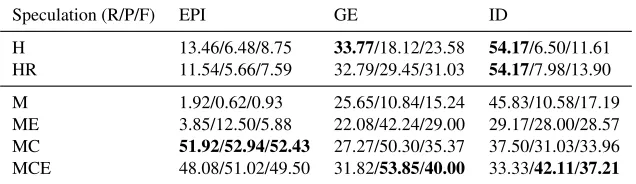
Speculation (R/P/F) EPI GE ID
H 13.46/6.48/8.75 33.77/18.12/23.58 54.17/6.50/11.61 HR 11.54/5.66/7.59 32.79/29.45/31.03 54.17/7.98/13.90
M 1.92/0.62/0.93 25.65/10.84/15.24 45.83/10.58/17.19 ME 3.85/12.50/5.88 22.08/42.24/29.00 29.17/28.00/28.57 MC 51.92/52.94/52.43 27.27/50.30/35.37 37.50/31.03/33.96 MCE 48.08/51.02/49.50 31.82/53.85/40.00 33.33/42.11/37.21
Table 5: Results for Speculation for our two heuristics and the four combinations of ML features.
by the FAUST system, which achieved the high-est performance at two of the three tasks consid-ered (Riedel et al., 2011). The UTurku system is a pipeline ML-based EE system, while the UCon-cordia system is strictly rule-based. FAUST is an ML-based model combination system incorporating information from the parser-based Stanford system (McClosky et al., 2011) and the jointly-modelled UMass system (Riedel and McCallum, 2011).
We also performed preliminary experiments for the other released submissions to the BioNLP 2011 Shared Task, but due to space limitations focus only on the three above-mentioned systems.
5.3 Evaluation criteria
We use the primary evaluation criteria of the BioNLP 2011 Shared Task (Kim et al., 2011a) to assure comparability, reporting all results using the standard precision, recall and their harmonic mean (F-score).
5.4 Methods
We apply the rule-based simple heuristic method and its root extension (Section 4.2) as well as Sup-port Vector Machines (SVM) trained with the fea-tures introduced in Section 4.3. For the SVM, we separately evaluate models based on all permuta-tions of the feature sets introduced in Table 3. In the
results tables we abbreviate the feature set names as done in Table 3 and use H for the heuristic method and R for its root extension. As our machine learn-ing component we use LIBLINEAR (Fan et al., 2008) with a L2-regularised L2-loss SVM model. We optimise the SVM regularisation parameter C
using 10-fold cross-validation on the training data. We use the training, development and test set par-tition provided by the shared task organisers. In line with standard ML methodology the test set was held out during development and was only used when carrying out the final experiments prior to submit-ting the manuscript.
6 Results and Discussion
Negation (R/P/F) EPI GE ID
UConcordia 16.92/61.11/26.51 18.43/43.44/25.88 22.00/23.91/22.92 UConcordia* 20.00/70.59/31.17 20.14/42.96/27.42 28.00/31.58/29.68
UTurku 12.31/38.10/18.60 22.87/48.85/31.15 26.00/44.83/32.91 UTurku* 43.08/48.28/45.53 21.16/38.56/27.33 26.00/41.94/32.10
[image:7.612.148.467.184.271.2]FAUST* 29.23/59.38/39.18 21.50/41.18/28.25 28.00/46.67/35.00
Table 6: Results of the Negation enrichment experiment.
Speculation (R/P/F) EPI GE ID
UConcordia 5.77/8.33/6.82 21.10/38.46/27.25 8.33/2.00/3.23 UConcordia* 1.92/4.55/2.70 12.99/29.20/17.98 8.33/2.22/3.51
UTurku 30.77/48.48/37.65 17.86/32.54/23.06 12.50/18.75/15.00 UTurku* 46.15/47.06/46.60 11.04/26.56/15.60 8.33/3.33/4.76
[image:7.612.351.502.314.370.2]FAUST* 36.54/48.72/41.76 10.39/26.50/14.93 12.50/12.50/12.50
Table 7: Results of the Speculation enrichment experiment.
(R/P/F) EPI ID
UConcordia 20.83/42.14/27.88 49.00/40.27/44.21 UConcordia* 20.83/42.94/28.05 49.20/41.78/45.19
UTurku 52.69/53.98/53.33 37.85/48.62/42.57 UTurku* 54.72/53.86/54.29 37.79/47.76/42.19
FAUST 28.88/44.51/35.03 48.03/65.97/55.59 FAUST* 31.64/45.17/37.21 49.20/64.66/55.88
Table 8: Overall scores for the EPI and ID data sets.
sparseness of useful annotations due to the differing annotation guidelines, as noted in manual analysis. The numbers from these initial experiments serve as an upper bound when we proceed to our enrichment experiments, as they do not suffer from the possibil-ity of producing false positives negation/speculation annotations for false positive event structures.
In addition to the above in preliminary experi-ments we also considered two features inspired by findings made by Vincze et al. (2011). A distance-based feature, measuring the distance in tokens be-tween the cue-word and the event trigger, and also trigger suffixes to capture some cases of morpholog-ical speculation (“induced” vs. “inducible”). How-ever, we failed to establish any consistent benefits from these features and only for the EPI dataset did the suffix features improve performance.
For the enrichment evaluation, adding
nega-F EPI GE ID
UConcordia 57.43 60.68 67.28 UTurku 81.31 66.27 55.84 FAUST 74.91 66.14 67.13
Table 9: Estimated F-score upper-bound for an ora-cle system precision assigning negation/speculation annotations to events predicted by an up-stream EE system.
tion/speculation flags to the output of event extrac-tion systems (Tables 6 and 7), our results are some-what more modest. For negation we see an improve-ment in four out of six cases, and for speculation in two out of six. Despite the fact that a major limi-tation to our approach are the false positive events that are propagated from the original EE system, we manage to improve the global score for all data sets where a global score is provided by the organisers (Table 8). We improve a full point in F-score for UTurku on EPI, but only sub-percentage for Faust on ID, the latter most likely since ID contains fewer negation and speculation annotations and the global scores are microaverages over all annotations.
[image:7.612.77.294.316.414.2]equal to that of the overall recall of the up-stream EE system and that negation/speculation annotations assigned by an oracle. What we can see is that there is still room for improvement, both for our enrichment approach and for the EE system’s inter-nal negation/speculation components, although re-call of the EE output is a limiting factor we can expect further efforts towards improving the extra-propositional aspects of the system to yield perfor-mance improvements.
7 Conclusions and Future Work
In this study, we have considered two broad lines of research on extra-propositional aspects of key statements in text, one using the task-independent, linguistically-motivated cue-and-scope representa-tion applied in the recent CoNLL-2010 Shared Task, and the other using the task-oriented flagged-event representation applied e.g. in the ACE and BioNLP Shared Task evaluations. We presented a detailed manual analysis exploring points of disagreement and evaluated in detail rule-based and machine learning-based methods joining state-of-the-art sys-tems representing the two approaches.
Our manual analysis identified a number of phe-nomena that limit the applicability of existing cue-and-scope based systems to the event extraction task, such as negation expressed through morpho-logical change of words expressing events (e.g. un-phosphorylated). To address these issues, we pro-posed a combination of heuristics and simple lexical features, carefully selected to address differences in perspective between the cue-and-scope and event-based frameworks and aiming to complement cue-and-scope analyses for creating task-oriented out-puts.
To test our approach, we created a method suit-able for use as a component of an event extraction pipeline that incorporates information from a previ-ously proposed state-of-the-art cue-and-scope based negation/speculation detection system and a mini-mal set of features in an SVM-based system that was shown to enhance and in several cases improve upon the output of existing EE systems. Experiments on the BioNLP Shared Task 2011 EPI and ID datasets demonstrated that the combined approach could im-prove the results of the best-performing systems at
the original task in 5 out of 6 cases, outperforming the highest results reported for any system for these two tasks.
There exist several potential targets for future work on improving our introduced system and to join cue-and-scope and event-based approaches. Since none of the existing EE corpora was con-structed with the aim to solely cover negation and speculation annotations and taking into account our finding that merging datasets to compensate for data sparseness is beneficial, it might be worth consid-ering other possible corpora or resources and how they can be used for training our machine learning system.
Also, it would be worthwhile to attempt to com-bine an existing EE system capable of detect-ing negation/speculation with our proposed method. Combining the two could yield an ensemble, im-proving upon an already strong system by bridging the differences in perspectives and tapping into the potential benefits of both approaches.
The system and all resources introduced in this work are publicly available for research purposes at:
https:// github.com/ ninjin/ eepura
Acknowledgements
The authors would like to thank the anonymous re-viewers for their many insightful comments and sug-gestions for improvements.
This work was funded in part by UK Biotechnol-ogy and Biological Sciences Research Council (BB-SRC) under project Automated Biological Event Ex-traction from the Literature for Drug Discovery (ref-erence number: BB/G013160/1), by the Ministry of Education, Culture, Sports, Science and Technology of Japan under the Integrated Database Project and by the Swedish Royal Academy of Sciences.
References
Jari Bj¨orne and Tapio Salakoski. 2011. Generaliz-ing Biomedical Event Extraction. InProceedings of the BioNLP 2011 Workshop Companion Volume for Shared Task, pages 183–191.
Rong-En Fan, Kai-Wei Chang, Cho-Jui Hsieh, Xiang-Rui Wang, and Chih-Jen Lin. 2008. LIBLINEAR: A Li-brary for Large Linear Classification. Journal of Ma-chine Learning Research, 9:1871–1874.
Rich´ard Farkas, Veronika Vincze, Gy¨orgy M´ora, J´anos Csirik, and Gy¨orgy Szarvas. 2010. The CoNLL-2010 Shared Task: Learning to Detect Hedges and their Scope in Natural Language Text. In Proceedings of the Fourteenth Conference on Computational Natural Language Learning, pages 1–12.
Carol Friedman, Philip O. Alderson, John H.M. Austin, James J. Cimino, and Stephen B. Johnson. 1994. A general natural-language text processor for clinical ra-diology. Journal of the American Medical Informatics Association, 1(2):161–174.
William R. Hersh. 1996. Information retrieval: a health care perspective. Springer.
Yuang Huang and Henry J. Lowe. 2007. A novel hybrid approach to automated negation detection in clinical radiology reports. Journal of the American Medical Informatics Association, 14(3):304–311.
Halil Kilicoglu and Sabine Bergler. 2010. A High-Precision Approach to Detecting Hedges and their Scopes. InProceedings of the Fourteenth Conference on Computational Natural Language Learning, pages 70–77.
Halil Kilicoglu and Sabine Bergler. 2011. Adapting a General Semantic Interpretation Approach to Biolog-ical Event Extraction. InProceedings of the BioNLP 2011 Workshop Companion Volume for Shared Task, pages 173–182.
Jin-Dong Kim, Tomoko Ohta, Sampo Pyysalo, Yoshi-nobu Kano, and Jun’ichi Tsujii. 2009. Overview of BioNLP’09 Shared Task on Event Extraction. In Pro-ceedings of the BioNLP 2009 Workshop Companion Volume for Shared Task, pages 1–9.
Jin-Dong Kim, Sampo Pyysalo, Tomoko Ohta, Robert Bossy, Ngan Nguyen, and Jun’ichi Tsujii. 2011a. Overview of BioNLP Shared Task 2011. In Proceed-ings of the BioNLP 2011 Workshop Companion Vol-ume for Shared Task, pages 1–6.
Jin-Dong Kim, Yue Wang, Toshihisa Takagi, and Aki-nori Yonezawa. 2011b. Overview of Genia Event Task in BioNLP Shared Task 2011. In Proceedings of the BioNLP 2011 Workshop Companion Volume for Shared Task, pages 7–15.
LDC. 2005. ACE (Automatic Content Extraction) En-glish Annotation Guidelines for Events. Technical re-port, Linguistic Data Consortium.
David McClosky, Mihai Surdeanu, and Christopher Man-ning. 2011. Event Extraction as Dependency Parsing for BioNLP 2011. In Proceedings of BioNLP 2011, pages 41–45.
Roser Morante and Walter Daelemans. 2009. Learn-ing the scope of hedge cues in biomedical texts. In
Proceedings of the Workshop on Current Trends in Biomedical Natural Language Processing, pages 28– 36.
Roser Morante, Vincent Van Asch, and Walter Daele-mans. 2010. Memory-based resolution of in-sentence scopes of hedge cues. In Proceedings of the Four-teenth Conference on Computational Natural Lan-guage Learning — Shared Task, CoNLL 2010: Shared Task, pages 40–47.
Tomoko Ohta, Sampo Pyysalo, and Jun’ichi Tsujii. 2011. Overview of the Epigenetics and Post-translational Modifications (EPI) task of BioNLP Shared Task 2011. InProceedings of the BioNLP 2011 Workshop Companion Volume for Shared Task, pages 16–25. Sampo Pyysalo, Tomoko Ohta, Rafal Rak, Dan
Sul-livan, Chunhong Mao, Chunxia Wang, Bruno So-bral, Jun’ichi Tsujii, and Sophia Ananiadou. 2011. Overview of the Infectious Diseases (ID) task of BioNLP Shared Task 2011. In Proceedings of the BioNLP 2011 Workshop Companion Volume for Shared Task, pages 26–35.
Sampo Pyysalo, Pontus Stenetorp, Tomoka Ohta, Jin-Dong Kim, and Sophia Ananiadou. 2012. New Re-sources and Perspectives for Biomedical Event Extrac-tion. In Proceedings of BioNLP 2012 Workshop. to appear.
Sebastian Riedel and Andrew McCallum. 2011. Robust Biomedical Event Extraction with Dual Decomposi-tion and Minimal Domain AdaptaDecomposi-tion. InProceedings of the BioNLP 2011 Workshop Companion Volume for Shared Task, pages 46–50.
Sebastian Riedel, David McClosky, Mihai Surdeanu, An-drew McCallum, and Christopher D. Manning. 2011. Model Combination for Event Extraction in BioNLP 2011. InProceedings of the BioNLP 2011 Workshop Companion Volume for Shared Task, pages 51–55. Roser Saur and James Pustejovsky. 2009.
Fact-Bank: a corpus annotated with event factuality.
Language Resources and Evaluation, 43:227–268. 10.1007/s10579-009-9089-9.
Pontus Stenetorp, Goran Topi´c, Sampo Pyysalo, Tomoko Ohta, Jin-Dong Kim, and Jun’ichi Tsujii. 2011. BioNLP Shared Task 2011: Supporting Resources. In
Proceedings of the BioNLP 2011 Workshop Compan-ion Volume for Shared Task, pages 112–120.
Paul Thompson, Raheel Nawaz, John McNaught, and Sophia Ananiadou. 2011. Enriching a biomedical event corpus with meta-knowledge annotation. BMC Bioinformatics, 12(1):393.
Bio-Scope corpus: biomedical texts annotated for uncer-tainty, negation and their scopes. BMC Bioinformat-ics, 9(Suppl 11):S9.