CMUQ@QALB-2014: An SMT-based System
for Automatic Arabic Error Correction
Serena Jeblee
1, Houda Bouamor
2, Wajdi Zaghouani
2and Kemal Oflazer
2 1Carnegie Mellon University
[email protected]
2Carnegie Mellon University in Qatar
{
hbouamor,wajdiz
}
@qatar.cmu.edu, [email protected]
Abstract
In this paper, we describe the CMUQ sys-tem we submitted to The ANLP-QALB 2014 Shared Task on Automatic Text Correction for Arabic. Our system combines rule-based linguistic techniques with statistical language modeling techniques and machine translation-based methods. Our system outperforms the baseline and reaches an F-score of 65.42% on the test set of QALB corpus. This ranks us 3rd in the competition.
1 Introduction
The business of text creation and editing represents a large market where NLP technologies might be applied naturally (Dale, 1997). Today’s users of word proces-sors get surprisingly little help in checking spelling, and a small number of them use more sophisticated tools such as grammar checkers, to provide help in en-suring that a text remains grammatically accurate after modification. For instance, in the Arabic version of Mi-crosoft Word, the spelling checker for Arabic, does not give reasonable and natural proposals for many real-word errors and even for simple probable errors (Had-dad and Yaseen, 2007).
With the increased usage of computers in the pro-cessing of natural languages comes the need for cor-recting errors introduced at different stages. Natu-ral language errors are not only made by human op-erators at the input stage but also by NLP systems that produce natural language output. Machine trans-lation (MT), or optical character recognition (OCR), often produce incorrect output riddled with odd lexi-cal choices, grammar errors, or incorrectly recognized characters. Correcting human/machine-produced er-rors, or post-editing, can be manual or automated. For morphologically and syntactically complex languages, such as Modern Standard Arabic (MSA), correcting texts automatically requires complex human and ma-chine processing which makes generation of correct candidates a challenging task.
For instance, the Automatic Arabic Text Correction Shared Task is an interesting testbed to develop and evaluate spelling correction systems for Arabic trained either on naturally occurring errors in texts written by humans (e.g., non-native speakers), or machines (e.g.,
MT output). In such tasks, participants are asked to implement a system that takes as input Modern Stan-dard Arabic texts with various spelling errors and au-tomatically correct them. In this paper, we describe the CMUQ system we developed to participate in the The First Shared Task on Automatic Text Correction for Arabic (Mohit et al., 2014). Our system combines rule-based linguistic techniques with statistical lan-guage modeling techniques and machine translation-based methods. Our system outperforms the baseline, achieves a better correction quality and reaches an F-score of 62.96% on the development set of QALB cor-pus (Zaghouani et al., 2014) and 65.42% on the test set. The remainder of this paper is organized as follows. First, we review the main previous efforts for automatic spelling correction, in Section 2. In Section 3, we de-scribe our system, which consists of several modules. We continue with our experiments on the shared task 2014 dev set (Section 4). Then, we give an analysis of our system output in Section 5. Finally, we conclude and hint towards future improvement of the system, in Section 6.
2 Related Work
Automatic error detection and correction include auto-matic spelling checking, grammar checking and post-editing. Numerous approaches (both supervised and unsupervised) have been explored to improve the flu-ency of the text and reduce the percentage of out-of-vocabulary words using NLP tools, resources, and heuristics, e.g., morphological analyzers, language models, and edit-distance measure (Kukich, 1992; Oflazer, 1996; Zribi and Ben Ahmed, 2003; Shaalan et al., 2003; Haddad and Yaseen, 2007; Hassan et al., 2008; Habash, 2008; Shaalan et al., 2010). There has been a lot of work on error correction for English (e.g., (Golding and Roth, 1999)). Other approaches learn models of correction by training on paired examples of errors and their corrections, which is the main goal of this work.
For Arabic, this issue was studied in various direc-tions and in different research work. In 2003, Shaalan et al. (2003) presented work on the specification and classification of spelling errors in Arabic. Later on, Haddad and Yaseen (2007) presented a hybrid ap-proach using morphological features and rules to fine
tune the word recognition and non-word correction method. In order to build an Arabic spelling checker, Attia et al. (2012) developed semi-automatically, a dic-tionary of 9 million fully inflected Arabic words us-ing a morphological transducer and a large corpus. They then created an error model by analyzing error types and by creating an edit distance ranker. Finally, they analyzed the level of noise in different sources of data and selected the optimal subset to train their sys-tem. Alkanhal et al. (2012) presented a stochastic ap-proach for spelling correction of Arabic text. They used a context-based system to automatically correct mis-spelled words. First of all, a list is generated with pos-sible alternatives for each misspelled word using the Damerau-Levenshtein edit distance, then the right al-ternative for each misspelled word is selected stochas-tically using a lattice search, and an n-gram method. Shaalan et al. (2012) trained a Noisy Channel Model on word-based unigrams to detect and correct spelling errors. Dahlmeier and Ng (2012a) built specialized de-coders for English grammatical error correction. More recently, (Pasha et al., 2014) created MADAMIRA, a system for morphological analysis and disambigua-tion of Arabic, this system can be used to improve the accuracy of spelling checking system especially with Hamza spelling correction.
In contrast to the approaches described above, we use a machine translation (MT) based method to train an error correction system. To the best of our knowl-edge, this is the first error correction system for Arabic using an MT approach.
3 Our System
Our system is a pipeline that consists of several dif-ferent modules. The baseline system uses a spelling checking module, and the final system uses a phrase-based statistical machine translation system. To preproces the text, we use the provided output of MADAMIRA (Pasha et al., 2014) and a rule-based correction. We then do a rule-based post-processing to fix the punctuation.
3.1 Baseline Systems
For the baseline system, we try a common spelling checking approach. We first pre-process the data us-ing the features from MADAMIRA (see Feature 14 Replacement), then we use a noisy channel model for spelling checking.
Feature 14 Replacement
The first step in the pipeline is to extract MADAMIRA’s 14th feature from the .column file and replace each word in the input text with this form. MADAMIRA uses morphological disambiguation and SVM analysis to select the most likely fully diacritized Arabic word for the input word. The 14th feature represents the undiacritized form of the most likely word. This step corrects many Hamza placement or
omission errors, which makes a good base for other correction modules.
Spelling Correction
The spelling checker is based on a noisy channel model - we use a word list and language model to determine the most probable correct Arabic word that could have generated the incorrect form that we have in the text. For detecting spelling errors we use the AraComLex word list for spelling checking (Attia et al., 2012), which contains about 9 million Arabic words.1 We
look up the word from the input sentence in this list, and attempt to correct those that are not found in the list. We also train a mapping of incorrect words and possible corrections from the edits in the training data. If the word is in this map, the list of possible correc-tions from the training data becomes the candidate list. If the word is not in the trained map, the candidate list is created by generating a list of words with common insertions, substitutions, and deletions, according to the list in (Attia et al., 2012). Each candidate is generated by performing these edits and has a weight according to the edit distance weights in the list. We then prune the candidate list by keeping only the lowest weight words, and removing candidates that are not found in the word list. The resulting sentence is scored with a 3-gram lan-guage model built with KenLM (Heafield et al., 2013) on the correct side of the training data. The top one sentence is then kept and considerd as the ”corrected” one.
This module handles spelling errors of individual words; it does not handle split/merge errors or word reordering. The spelling checker sometimes attempts to correct words that were already correct, because the list does not contain named entities or translitera-tions, and it does not contain all possible correct Arabic words. Because the spelling checker module decreased the overall performance, it is not included in our final system.
3.2 Final System Feature 14 Replacement
The first step in our final system is Feature 14 Replace-ment, as described above.
Rule-based Clitic Correction
With the resulting data, we apply a set of rules to reat-tach clitics that may have been split apart from the base word. After examining the train dataset, we realized that 95% of word merging cases involve “
ð
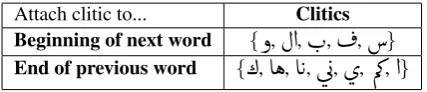
” attach-ment. When found by themselves, the clitics are at-tached to either the previous word or next word, based on whether they generally appear as prefixes or suf-fixes. The clitics handled by this module are specified in Table 2.We also remove extra characters by replacing a se-quence of 3 or more of the same character with a single
1http://sourceforge.net/projects/
Dev
Exact Match No Punct
Precision Recall F1 Precision Recall F1
Feature 14 0.7746 0.3210 0.4539 0.8100 0.5190 0.6326
Feature 14 + Spelling checker (baseline) 0.4241 0.3458 0.3810 0.4057 0.4765 0.4382
Feature 14 + Clitic Rules 0.7884 0.3642 0.4983 0.8149 0.5894 0.6841
Feature 14 + Phrase-based MT 0.7296 0.5043 0.5964 0.7797 0.6397 0.7028
Feature 14 + Clitic Rules + Phrase-based MT 0.7571 0.5389 0.6296 0.8220 0.6850 0.7473
Test
[image:3.595.73.538.61.185.2]Feature 14 + Clitic Rules + Phrase-based MT 0.7797 0.5635 0.6542 0.7438 0.6855 0.7135
Table 1: System results on the dev set (upper part) and on the test set (lower part).
Attach clitic to... Clitics Beginning of next word {
ð
,È@
,H.
,¬
,
}End of previous word {
¼
,Aë
,A K
,ú G
,ø
,Õ»
,@
}Table 2: Clitics handled by the rule-based module.
instance of that character (e.g. !!!!!!! would be replaced with !).
Statistical Phrase-based Model
We use the Moses toolkit (Koehn et al., 2007) to create a statistical phrase-based machine translation model built on the best pre-processed data, as described above. We treat this last step as a translation prob-lem, where the source language is pre-processed in-correct Arabic text, and the reference is in-correct Ara-bic. Feature 14 extraction, rule-based correction, and character de-duplication are applied to both the train and dev sets. All but the last 1,000 sentences of the train data are used at the training set for the phrase-based model, the last 1,000 sentences of the train data are used as a tuning set, and the dev set is used for testing and evaluation. We use fast align, the aligner included with the cdec decoder (Dyer et al., 2010) as the word aligner with grow-diag as the symmetrization heuristic (Och and Ney, 2003), and build a 5-gram lan-guage model from the correct Arabic training data with KenLM (Heafield et al., 2013). The system is evaluated with BLEU (Papineni et al., 2002) and then scored for precision, recall, and F1 measure against the dev set reference.
We tested several different reordering window sizes since this is not a standard translation task, so we may want shorter distance reordering. Although 7 is the de-fault size, we tested 7, 5, 4, 3, and 0, and found that a window of size 4 produces the best result according to BLEU score and F1 measure.
4 Experiments and Results
We train and evaluate our system with the train-ing and development datasets provided for the shared task and the m2Scorer (Dahlmeier and Ng, 2012b). These datasets are extracted from the QALB corpus
of human-edited Arabic text produced by native speak-ers, non-native speakers and machines (Zaghouani et al., 2014).
We conducted a small scale statistical study on the 950K tokens training set used to build our system. We realized that 306K tokens are affected by a correction action which could be a word edit, insertion, deletion, split or merge. 169K tokens were edited to correct the spelling errors and 99K tokens were inserted (mostly punctuation marks). Furthermore, there is a total of 6,7K non necessary tokens deleted and 10.6K attached tokens split and 18.2 tokens merged. Finally, there are only 427 tokens moved in the sentence and 1563 mul-tiple correction action.
We experiment with different configurations and reach the sweet spot of performance when combining the different modules.
4.1 Results
[image:3.595.75.289.230.276.2]5 Error Analysis and Discussion
When building error correction systems, minimizing the number of cases where correct words are marked as incorrect is often regarded as more important than covering a high number of errors. Therefore, a higher precision is often preferred over higher recall. In order to understand what was affecting the performance, we took a closer look at our system output and translation tables to present some samples of errors that our system makes on development set.
5.1 Out-of-vocabulary Words
This category includes words that are not seen by our system during the training which is a common problem in machine translation systems. In our system, most of out-of-vocabulary words were directly transferred un-changed from source to target. For example the word
éJËð ñÒÊ ¯@
was not corrected toéJËð ñÖÏ@
.5.2 Unnecessary Edits
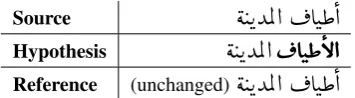
In some cases, our system made some superfluous edits such as adding the definite article in cases where it is not required such as :
Source
é JKYÖÏ@ ¬AJ£@
Hypothesis
é JKYÖÏ@
¬AJ£B@
[image:4.595.361.472.62.107.2]Reference (unchanged)
é JKYÖÏ@ ¬AJ£@
Table 3: An example of an unnecessary addition of the definite article.
5.3 Number Normalization
We observed that in some cases, the system did not nor-malize the numbers such as in the following case which requires some knowledge of the real context to under-stand that these numbers require normalization.
Source
H@ðA ªJÓ
450000Hypothesis
H@ðA ªJÓ
450000 [image:4.595.332.499.235.288.2]Reference
H@ðA ªJÓ
450Table 4: An example of number normalization.
5.4 Hamza Spelling
Even though our system corrected most of the Hamza spelling errors, we noticed that in certain cases they were not corrected, especially when the words without the Hamza were valid entries in the dictionary. These cases are not always easy to handle since only context and semantic rules can handle them.
5.5 Grammatical Errors
In our error analysis we encountered many cases of un-corrected grammatical errors. The most frequent type
Source
éJ J£ñË@ X@ð
Hypothesis
éJ J£ñË@
X@ð
ReferenceéJ J£ñË@ X@ð
Table 5: A sentence where the Hamza was not added above the Alif in the first word because both versions are valid dictionary entries.
is the case endings correction such as correcting the verbs in jussive mode when there is a prohibition par-ticle (negative imperative) like the (
B
) in the following examples :Source
ÑîEXAK@ úΫ @ñK.Qå B
Hypothesis
ÑîEXAK
@ úΫ
@ñK.Qå
B
ReferenceÑîEXAK@ úΫ àñK.Qå B
Table 6: An example of a grammatical error.
5.6 Unnecessary Word Deletion
According to the QALB annotation guidelines, ex-tra words causing semantic ambiguity in the sentence should be deleted. The decision to delete a given word is usually based on the meaning and the understanding of the human annotator, unfortunately this kind of er-rors is very hard to process and our system was not able to delete most of the unnecessary words.
[image:4.595.93.271.359.408.2]Source
Q k@ A J Ó AÒîEYK
@ Aª ð YîD J Éë
HypothesisQ k@ A J Ó
AÒîEYK
@
Aª ð YîD J Éë
ReferenceQ k@ A J Ó Aª ð YîD J Éë
Table 7: An example of word deletion.
5.7 Adding Extra Words
Our analysis revealed cases of extra words introduced to some sentences, despite the fact that the words added are coherent with the context and could even improve the overall readability of the sentence, they are uncred-ited correction since they are not included in the gold standard. For example :
Source
øPñË@ m.Ì'@ éªÖÞ H.Qå
[image:4.595.312.522.444.493.2]Hypothesis
QmÌ'@
øPñË@ m.Ì'@ éªÖÞ H.Qå
ReferenceøPñË@ m.Ì'@ éªÖÞ H.Qå
Table 8: An example of the addition of extra words.
5.8 Merge and Split Errors
[image:4.595.112.248.539.584.2] [image:4.595.321.515.635.682.2]word
YªK.Añ k
should have been split asYªK. Añ k
and the wordYK. B
should have been merged to appear as one word as inYK.B
.5.9 Dialectal Correction Errors
Dialectal words are usually converted to their Modern Standard Arabic (MSA) equivalent in the QALB cor-pus, since dialectal words are rare, our system is unable to detect and translate the dialectal words to the MSA as in the expression
áK P I.Ó
that is translated in the gold standard toáK P Q «
.6 Conclusion
We presented our CMUQ system for automatic Ara-bic text correction. Our system combines rule-based linguistic techniques with statistical language model-ing techniques and a phrase-based machine transla-tion method. We experiment with different configu-rations. Our experiments have shown that the system we submitted outperforms the baseline and we reach an F-score of 74.73% on the development set from the QALB corpus when punctuation is excluded, and 65.42% on the test set when we consider the punctu-ation errors . This placed us in the 3rd rank. We be-lieve that our system could be improved in numerous ways. In the future, we plan to finalize a current mod-ule that we are developing to deal with merge and split errors in a more specific way. We also want to focus in a deeper way on the word movement as well as punc-tuation problems, which can produce a more accurate system. We will focus as well on learning further error correction models from Arabic Wikipedia revision his-tory, as it contains natural rewritings including spelling corrections and other local text transformations.
Acknowledgements
This publication was made possible by grants NPRP-09-1140-1-177 and NPRP-4-1058- 1-168 from the Qatar National Research Fund (a member of the Qatar Foundation). The statements made herein are solely the responsibility of the authors.
References
Mohamed I. Alkanhal, Mohamed Al-Badrashiny, Man-sour M. Alghamdi, and Abdulaziz O. Al-Qabbany. 2012. Automatic Stochastic Arabic Spelling Correc-tion With Emphasis on Space InserCorrec-tions and Dele-tions. IEEE Transactions on Audio, Speech & Lan-guage Processing, 20(7):2111–2122.
Mohammed Attia, Pavel Pecina, Younes Samih, Khaled Shaalan, and Josef van Genabith. 2012. Im-proved Spelling Error Detection and Correction for Arabic. InProceedings of COLING 2012: Posters, pages 103–112, Mumbai, India.
Daniel Dahlmeier and Hwee Tou Ng. 2012a. A Beam-Search Decoder for Grammatical Error Correction. In Proceedings of the 2012 Joint Conference on Empirical Methods in Natural Language Process-ing and Computational Natural Language LearnProcess-ing, pages 568–578, Jeju Island, Korea.
Daniel Dahlmeier and Hwee Tou Ng. 2012b. Bet-ter Evaluation for Grammatical Error Correction. In NAACL HLT ’12 Proceedings of the 2012 Confer-ence of the North American Chapter of the Associ-ation for ComputAssoci-ational Linguistics: Human Lan-guage Technologies, pages 568–572.
Robert Dale. 1997. Computer Assistance in Text Cre-ation and Editing. InSurvey of the state of the art in Human Language Technology, chapter 7, pages 235–237. Cambridge University Press.
Chris Dyer, Jonathan Weese, Hendra Setiawan, Adam Lopez, Ferhan Ture, Vladimir Eidelman, Juri Gan-itkevitch, Phil Blunsom, and Philip Resnik. 2010. cdec: A Decoder, Alignment, and Learning Frame-work for Finite-state and Context-free Translation Models. In Proceedings of the ACL 2010 System Demonstrations, pages 7–12, Uppsala, Sweden. A. R. Golding and D. Roth. 1999. A Winnow Based
Approach to Context-Sensitive Spelling Correction. Machine Learning, 34(1-3):107–130.
Nizar Habash. 2008. Four Techniques for Online Han-dling of Out-of-Vocabulary Words in Arabic-English Statistical Machine Translation. InProceedings of ACL-08: HLT, Short Papers, pages 57–60, Colum-bus, Ohio.
Bassam Haddad and Mustafa Yaseen. 2007. Detection and Correction of Non-words in Arabic: a Hybrid Approach. International Journal of Computer Pro-cessing of Oriental Languages, 20(04):237–257. Ahmed Hassan, Sara Noeman, and Hany Hassan.
2008. Language Independent Text Correction using Finite State Automata. InProceedings of the Third International Joint Conference on Natural Language Processing (IJCNLP 2008), pages 913–918, Hyder-abad, India.
Kenneth Heafield, Ivan Pouzyrevsky, Jonathan H. Clark, and Philipp Koehn. 2013. Scalable Modfied Kneser-Ney Language Model Estimation. InIn Pro-ceedings of the Association for Computational Lin-guistics, Sofia, Bulgaria.
Karen Kukich. 1992. Techniques for Automatically Correcting Words in Text. ACM Computing Surveys (CSUR), 24(4):377–439.
Behrang Mohit, Alla Rozovskaya, Nizar Habash, Wa-jdi Zaghouani, and Ossama Obeid. 2014. The First QALB Shared Task on Automatic Text Correction for Arabic. InProceedings of EMNLP Workshop on Arabic Natural Language Processing, Doha, Qatar, October.
Franz Josef Och and Hermann Ney. 2003. A System-atic Comparison of Various Statistical Alignment Models. InComputational Linguistics, page 1951.
Kemal Oflazer. 1996. Error-Tolerant Finite-State Recognition with Applications to Morphological Analysis and Spelling Correction. Computational Linguistics, 22(1):73–89.
Kishore Papineni, Salim Roukos, Todd Ward, and Wei-Jing Zhu. 2002. BLEU: A Method for Automatic Evaluation of Machine Translation. In Proceed-ings of the Association for Computational Linguis-tics, Philadelphia, Pennsylvania.
Arfath Pasha, Mohamed Al-Badrashiny, Mona Diab, Ahmed El Kholy, Ramy Eskander, Nizar Habash, Manoj Pooleery, Owen Rambow, and Ryan Roth. 2014. MADAMIRA: A Fast, Comprehensive Tool for Morphological Analysis and Disambiguation of Arabic. In Proceedings of the Ninth International Conference on Language Resources and Evaluation (LREC’14), pages 1094–1101, Reykjavik, Iceland.
Khaled Shaalan, Amin Allam, and Abdallah Gomah. 2003. Towards Automatic Spell Checking for Ara-bic. In Proceedings of the 4th Conference on Lan-guage Engineering, Egyptian Society of LanLan-guage Engineering (ELSE), Cairo, Egypt.
Khaled Shaalan, Rana Aref, and Aly Fahmy. 2010. An Approach for Analyzing and Correcting Spelling Er-rors for Non-native Arabic Learners. InProceedings of The 7th International Conference on Informatics and Systems, INFOS2010, the special track on Nat-ural Language Processing and Knowledge Mining, pages 28–30, Cairo, Egypt.
Khaled Shaalan, Mohammed Attia, Pavel Pecina, Younes Samih, and Josef van Genabith. 2012. Arabic Word Generation and Modelling for Spell Checking. In Proceedings of the Eighth Inter-national Conference on Language Resources and Evaluation (LREC-2012), pages 719–725, Istanbul, Turkey.
Wajdi Zaghouani, Behrang Mohit, Nizar Habash, Os-sama Obeid, Nadi Tomeh, Alla Rozovskaya, Noura Farra, Sarah Alkuhlani, and Kemal Oflazer. 2014. Large Scale Arabic Error Annotation: Guidelines and Framework. In Proceedings of the Ninth In-ternational Conference on Language Resources and Evaluation (LREC’14), Reykjavik, Iceland.