Group consumption and product diversity: the case of
smoking bans
Renaud FOUCART∗
December 21, 2016
Abstract
I study product diversity in presence of search costs and groups of consumers. I find
that groups with heterogeneous tastes create a leverage effect on competition, so that a large
majority of firms may end up offering a product that corresponds to the taste of the
minor-ity. I illustrate this idea with the case of smoking bans in bars and restaurants. When the
first nonsmoking restaurants opened, there were few of them with little competition and high
market power on nonsmokers. By extracting a large surplus from nonsmokers, nonsmoking
restaurants became unattractive to other groups, while smoking restaurants were plenty and
competitive, attracting both smokers and mixed groups.
1
Introduction
This paper is about the impact of group consumption on the efficiency of decentralized markets in
the presence of search frictions. I show how the tastes of the majority may be underrepresented
in the market if those tastes evolve over time. I illustrate this idea with the case of smoking bans
in bars and restaurants. This case is convenient to study as it is a largely debated policy issue that
has inspired a large empirical literature. The question of a decentralized market’s efficiency in
providing product diversity when consumers buy in groups is however much more general.
Ex-amples include most social or leisure activities when decisions are taken cooperatively by groups
with heterogenous tastes, and where perfect information on the product is not available without
exerting some search effort (such as movies, theaters, holidays, etc.).
The decision to allow smoking or not can be thought of as a problem of horizontal
differentia-tion. Bars and restaurants have to take a decision that affects all consumers in the room. This paper
builds on a simple model of sequential search with horizontal diversity, by considering groups of
consumers with possibly heterogeneous preferences. Groups form randomly, search together on
the market, and can become repeat consumers of a firm they like. The model is thus one of
ran-dom search with the possibility of being faithful to a restaurant through time.1 Instead of a random
utility model in the line of Wolinsky (1986) or Anderson and Renault (1999), I consider product
diversity as a binary choice to be made by each firm, and show that this is enough for an
equilib-rium to exist that does not rely on the Diamond (1971) paradox. There are three types of groups:
smokers, nonsmokers, and mixed groups (both smokers and nonsmokers). I assume utility to be
fully transferable within groups, so that mixed groups are ex ante indifferent between smoking and
nonsmoking premises.
I show that, when the norm is to allow smoking, restaurants are competitive and accommodate
all types of customers. When the share of nonsmokers becomes high enough, some restaurants
may benefit from offering a nonsmoking environment. As there are initially few of them, they are
less competitive than the other firms and can extract more surplus from nonsmokers by specializing
in them. As nonsmoking restaurants fail to meet the expectations of groups of smokers and mixed
groups, smoking restaurants see their demand increase with the share of (specialized) nonsmoking
restaurants. This higher demand implies that the equilibrium share of nonsmoking restaurants in
the market is much lower than the share of nonsmokers in the population. This result corresponds
to the first of the stylized fact from the literature on smoking bans (which I discuss below): in most
cases, the market alone supplies very few nonsmoking premises before a ban is enforced, even
when a large majority of the population does not smoke. A smoking ban leads to an equilibrium
symmetric to the initial “all smoking” world: all firms ban smoking, are therefore competitive
and accommodate all types of customers. This implies that mixed groups, who would never have
consumed in a specialized nonsmoking restaurant, start finding them attractive.
A second largely discussed stylized fact about smoking bans is that there is no evidence that
they reduce the profitability of restaurants. The impact on bars is more contrasted, however, due
to a likely decrease in employment after the ban. I argue that this can be explained by a certain
level of substitution between bars and restaurants. If some consumers have to pick a submarket
among the two, and if restaurants are the first submarket to offer some nonsmoking environment,
bars specialize mostly in smokers and mixed groups. Because some restaurants are nonsmoking,
smokers and mixed groups prefer not to have to search and choose a bar instead. After a smoking
ban, groups become indifferent between bars and restaurants so that the number of consumers (but
not necessarily the profit) in restaurants increases, while the number of consumers and the profits
in bars decrease.
The existence of consumption by non-unitary households has been the subject of a lot of
atten-tion. One can refer to Donni and Chiappori (2011) for a recent review, and Gersbach and Haller
(2001) and Gersbach and Haller (2011) for a general equilibrium analysis. These papers mostly
fo-cus on consumption externalities, decision making within groups, other-regarding preferences and
group formation. My specification of group consumption is therefore particularly simple: within
a group, going to the restaurant is a public good valued differently by different and fully
cooper-ative members, the groups are exogenously formed, maximize a utilitarian welfare function with
identical weight, and I rule out any kind of other-regarding preferences. What I add is imperfect
information with search frictions: it is because groups of consumers bear a cost in order to acquire
information over products that the market may fail to reflect the tastes of the consumers.
While my model is based on discrete valuations, my results are consistent with what random
utility models obtain when studying different categories of goods. In particular, Yang (2013)
stud-ies a random utility environment where individual consumers want to buy a specific category and
search randomly among an imperfect sample of firms. The more demanded category is therefore
more competitive in equilibrium, as it is easier to find, giving consumers of this category higher
market power. Ex-ante indifferent consumers searching for one category of product would
there-fore make this category more competitive, and therethere-fore more popular. The difference with my
model is that I do not restrict the category a group searches for. And, indeed, at the market
equi-librium, I find that nonsmokers go alternatively to smoking and nonsmoking places. The leverage
effect of groups could be interpreted as playing a similar role on competition as the one of network
externalities in the standard setting literature (see for instance the review by Besen and Farrell,
1994).
smoking premises are seen as a negative externality on the population as a whole.2 A typical
counter argument is that bans go against the freedom of consumers and firms to maximize the
gains from trade. The objective of this paper is not to discuss this issue as a tradeoff between
health and individual freedom, but to understand the market mechanism described above.
In the next Section, I briefly summarize the relevant facts identified in the literature on smoking
bans. In Section 3, I first present the setup of the model and show how differences in tastes allow
overcoming the Diamond paradox. I then study how nonsmoking premises may arise coming from
a pure smoking world. Section 4 presents the economic impact of a smoking ban and how it can
have a differential effect on bars and restaurants. I conclude in section 5.
2
Stylized facts
A relatively large literature has focused on the question of smoking bans. Since the earlier stages, it
was mostly aimed at estimating the potential impact on the profit of firms, and used by advocates
of and opponents to the law. The main economic argument of opponents of bans has been that
if individuals and restaurant owners are rational utility maximizers, there is no justification for
introducing a law that decides on what the best choice is for individuals. This point is for instance
raised by Boyes and Marlow (1996), who argue that a smoking ban can be seen as a way for the
majority to receive an income transfer from the minority.
However, the market does not seem to naturally represent the tastes of this majority. Dunham
and Marlow (2000) analyze a survey carried out on 600 owners of restaurants randomly chosen
in the US. The data shows that only a very small number of restaurants ban smoking (100% of
their seating dedicated to nonsmoking consumers) in states where no smoking ban law has been
voted. Moreover, it seems that the share of nonsmoking seating corresponds roughly to the legal
obligations, rarely more. In the UK, Adda et al. (2012) find that more than 95% of the pubs allowed
smoking before the ban. In France, the website of the city of Paris (paris.fr) counted slightly more
than 100 restaurants or bars offering a hermetic nonsmoking environment (the city counted 12,699
restaurants and bars in 2005) the day before the ban. The existing websites trying to reference
nonsmoking restaurants in Brussels (rookvrij.be, thinkabout.be) counted slightly more than 20
nonsmoking restaurants or bars in the city (among the more than 3000 referenced by the Belgian
institute of statistics) before the smoking ban. The supply of nonsmoking restaurant seats was thus
scarce, even if those countries all appear to have a majority of nonsmokers in the adult population.3
As for the impact of a smoking ban on the profit of restaurants, among others, positive or
non significant impact has been found in El Paso Texas (Huang et al., 2004), in Massachusetts
(Bartosch and Pope, 2002), in 15 communities in California and Colorado (Glantz and Smith,
1994), in Flagstaff, Arizona (Sciacca and Ratliff, 1998), or in West Lake Hills, Texas (Huang
et al., 1995).4 Another approach has been used by Alamar and Glantz (2004). They tested the
impact of a 100% smoking law in two US States (Utah and California). They concluded that there
was a slightly positive effect on restaurants’ value. Adams and Cotti (2007), in a
difference-in-differences analysis for the entire USA, found no significant impact on employment in restaurants.
Two papers undertake separate analysis for bars and restaurants: Phelps (2006) and Adams
and Cotti (2007). The variable they study is employment in the considered sector. Both find
no significant effect of a ban in restaurants, and a negative effect of a ban in bars. Adams and
Cotti (2007, p.5) undertake a separate analysis of bars and restaurants, given that ‘Smoking seems
to be part of the bar culture and not necessarily part of the restaurant culture’. Dunham and
Marlow (2000) argue that it is more difficult to separate smokers and nonsmokers in bars, and
that nonsmokers have a lower preference for nonsmoking environment in bars. This difference
however does not explain why so few restaurants ban smoking without a ban and why the support
increases after the ban. Moreover the ‘cultural’ argument may be the consequence of the bans
and not its cause, as bans have been voted for trains, planes, and many other public places where
smoking was part of the ‘culture’. Indeed, as emphasized by Adams and Cotti (2007), bars and
restaurants are differently affected by bans, but the number of bans is also different. Many bans in
3Among surveys contemporary to the smoking bans for those countries: 20,9% of US adults are cigarette smokers (NHIS, 2005), 22% in the UK (NHS, 2007), 27% in Belgium (CRIOC, 2004) and 27% in France (INSEE, 2001)
bars are implemented when a ban is already enforced in restaurants. And many jurisdictions still
ban smoking only in restaurants. What I show in this paper is that, even with identical preference
parameters in both submarkets, a smoking ban can still have a differential effect.
3
The model
Restaurants consist in a continuum of sellers of mass 1 offering a single product in an either
smoking or nonsmoking environment, with marginal production cost of zero. Restaurants exist
in perpetuity. Consumers are a continuum of groups of mass 1 with heterogeneous preferences
towards the smoking environment.
3.1 The consumer problem
At every period, a massτ of new groups, each of them composed of two consumers, enters the
market, while each already existing group is dissolved with probabilityτ, so that there is a
steady-state continuum of mass 1 of active groups. A shareα are groups of nonsmokers (ns), µ are
mixed groups (m) and 1−µ−α are smokers (s), withα,µ and 1−α−µ >0. A group of type
i∈ {ns,m,s}has tastes described by a per-period conditional utility function (net of any search
cost) of the form
uij(pj) =v σj
i −pj, (1)
if it buys from a restaurant j with smoking policyσj ∈ {NS,S}, “non smoking” or “smoking”,
and price pj. The taste parameterv σj
i can be interpreted as a match value between the smoking policy of a restaurant and the taste of a group. When policy and taste coincide, the match value is
vNSns =vSs =V >0 ; when it does not, the value isvsNS=vSns=v∈(0,V); the average in a mixed group isvSm=vNSm =v+2V, regardless of the restaurant. The interpretation of the price is one of a “profit margin,” as restaurants choose the quality they provide together with their price. For this
reason, while consumers know the distribution of prices, they have to experience a restaurant in
order to know its individual price. I only consider symmetric equilibria in the sense that firms
setting an identical smoking policy charge the same price. In order to simplify the notation, I
The idea is that groups need to experience in order to find their “favorite” restaurant, where
they become repeat consumers. Upon entering the market, a group is first randomly matched with
a restaurant, observes its price and smoking policy, and decides whether or not to eat there. I
assume groups have an outside option normalized to zero, so that at each period a groupimatched
with a restaurant jaccepts an offer and eats there if and only if
uij(pj)≥0. (2)
Regardless of that decision, the group decides to go back to that restaurant for the next period, or to
(randomly) select a new restaurant next time, after having paid a search costs>0. One can think
of this cost as the necessary energy it takes to agree on a new restaurant within a group. While
doing so, the group knows the match values as well as the distribution of prices and smoking
policy, withγ the share of nonsmoking restaurants on the market. While I allow restaurants to
modify their price and smoking policies, I focus on equilibria wherepNS,pSandγremain constant
through time. The search decision is thus a mapping between the group typei, the match firm type
σj ∈ {NS,S}and price pj, and the state of the economy{pS,pNS,γ}. The state of the economy
is common knowledge. A group searches if the continuation value of search is higher than the
continuation value of staying at the same restaurant.
The continuation value of a group of typeisearching until it finds a nonsmoking restaurant is
W =−s+γu
NS i
τ + (1−γ)(max{0;u
S
i}+ (1−τ)W). (3)
The group bears a linear search costsfor trying a new restaurant. With probabilityγ, this restaurant
bans smoking, and the group stays there until it is dissolved, while with probability 1−γ, it allows
smoking, and the consumer either buys there or refuses the offer (as from equation (2)), before
searching again if it survives the next period (with probability 1−τ). A group prefers to search
for a nonsmoking restaurant wheneverW≥ max{0;uSi}
τ . Using expression (3), this simplifies to
uNSi ≥max{0;uSi}+τs
γ . (4)
Because of the random rate of dissolutionτ, each group knows it will meet on average a number
1
also has higher incentives to search when search costs are low and the share of restaurants with
their preferred smoking policy is high. Defining an expression symmetric to (3), one can derive
that a group prefers to search for a smoking restaurant whenever
uSi ≥max{0;uNSi }+ τs
1−γ. (5)
3.2 The restaurant problem
The objective of a restaurant j is to maximize its expected per-period profitπj. The strategy of
a restaurant is a function from a state of the economy {pS,pNS,γ} to {p,σ}, with p≥0 and
σ∈ {S,NS}.
I focus on Markovian Nash equilibria, in the sense that the strategies of restaurants only
condi-tion on the state of the economy{pS,pNS,γ}. The state of the economy is the only payoff-relevant
variable as it directly determines the search behavior of consumers and the average market share
of each type of restaurant.5 As each firm is atomless, firms best respond to the aggregate state of
the economy, not to the specific strategy of every individual firm. An equilibrium is a situation
in which no restaurant is strictly better off by modifying its strategy, so that{pS,pNS,γ}remain
constant through time. Hence, a strategy profile(pj,σj)is an equilibrium if for every restaurant j, it holds that
πj(pj,σj,pS,pNS,γ) = max
p≥0,σ∈{S,NS}πj(p,σ,pS,pNS,γ). (6)
Using (4) and (5), it is possible for a seller, choosing smoking policyσj∈ {NS,S}and
set-ting price pj, to perfectly determine her expected demand given a constant state of the economy
{pNS,pS,γ}.
I first show how, in a world with an overwhelming majority of smokers, the presence of
het-erogeneous consumers is enough for an equilibrium not driven by the Diamond paradox to exist
(and to be more realistic than the Diamond paradox). Then, I show how the transition from a world
where a majority of groups are smokers and all restaurants allow smoking to an equilibrium with
a majority of nonsmoking groups and product diversity is possible. In this equilibrium, all groups
but nonsmokers go to smoking restaurants.
3.3 Benchmark: decentralized equilibrium in a “smoking” world
The objective of this subsection is to show how consumers’ heterogeneity is sufficient for the
existence of a “low price” equilibrium, even with an overwhelming majority of smokers. I start
by assuming there is a large majority of smokers so that 1−α−µ >α, with (1−α−µ)V > max{(α+µ)(V+v)
2 ,v}. This aims at representing most industrialized countries at the end of the second world war, with for instance more than 80% of the male adult population smoking in the
UK in 1948.6
Lemma 1 A monopolistic restaurant allows smoking and sets price p=V , if (1−α−µ)V >
max{v,(1−α)v+2V}.
The formal proof is in Appendix. A monopolistic restaurant sets a single price in order to
maximize its expected profit. Hence, if extracting the full surplus of smokers while not serving
the others yields higher profit than serving all customers, the monopolist chooses a high-price
smoking environment.
Because of the presence of search costs, this monopoly price is also an equilibrium with a
continuum of players. The argument is the standard Diamond paradox. If all firms offer a price
p=V, a single firm decreasing its price is not enough to make consumers search. Hence, it can at most get surplusπ=vby lowering its price. I show in the following proposition that, because
of the heterogeneity of consumers tastes, this “Diamond equilibrium” coexists with a lower price
equilibriump=vwhen search costs are sufficiently small, and groups stay for a sufficiently large number of periods in the market.
Proposition 1 Assume all restaurants allow smoking. There exists a market equilibrium with
p=v for all restaurants, if and only if search costs are low enough (i.e, s≤ αv
(1−α)τ) and groups
are not dissolved too often (i.e,τ≤ (1−vα)V).
The formal proof is in Appendix. In this non-Diamond equilibrium, all firms offer a smoking
environment at a price sufficiently low for all groups to get positive surplus. The reason is that
a marginal price increase above the one that makes nonsmokers indifferent leads to a discreetly
smaller demand. Hence, no firm ever has an incentive to set a price slightly above the equilibrium
one. There are however two conditions for this equilibrium to hold. The first one is that there is no
discrete increase in the price that allows keeping all but the nonsmoking customers and increase
expected profit. This is the case if search costs are sufficiently low, so that all groups react to
such a price increase by searching for another restaurant the next time. The second is that groups
are not dissolved too often, so that it is not profitable for restaurants to specialize in “ripping off”
one-time consumers by extracting their entire surplus.
It is not only true that consumer heterogeneity allows for a non-Diamond equilibrium. It is also
the case that this low-price equilibrium is more robust. At the low-price equilibrium, a coordinated
change of strategy by a small number of firms setting a high price is not enough to switch to the
Diamond equilibrium. The reverse is not true. As long as a sufficiently high shareλ≥λ0of firms
are allowed to simultaneously revise their policy, they could set a price p=v together, so that consumers start searching, and those firms make higher profit than the high-price ones under the
conditions defined in Proposition 1. The continued value of staying at a high-price firm is zero.
Hence, the minimum shareλ0of “deviators” is such thatλV−τv ≥s. This rewrites:
λ ≥ sτ V−v=λ
0
. (7)
The threshold valueλ0 is getting smaller and smaller as search costs decrease.
As indoor smoking only became a concern in the early 1990s, I study the transition from a
world where all firms offer a smoking environment at low price, as described in Proposition 1.
3.4 A market for nonsmoking restaurants
The objective of this subsection is to study how, departing from a state of the world where all firms
allow smoking, the market can supply nonsmoking premises.
I assume an initial state of the world where all firms allow smoking at low price,γ =0 and pS =v, corresponding to Proposition 1. I study best responses to this state of the world when the share of nonsmoking groups unexpectedly and permanently increases. Because restaurants
profit given the new share of nonsmoking groupsα.7 The revision procedure is the following: at
every period, a shareλ (possibly very small) of the restaurants is allowed to modify (at no cost)
their price and smoking policy if it increases their expected per-period profit given the state of the
world{pS,pNS,γ}. The following Proposition shows that an equilibrium with a strictly positive
share of nonsmoking restaurants serving only nonsmoking groups exists whenαV >v, and that
this equilibrium derives from a sequence of best responses to the state of the world whereγ =0 andpS=v.
Proposition 2 There exists an equilibrium in which a shareγ∗=max{0,(1−ατ)Vα−(Vv−v)}of
restau-rants offer a nonsmoking environment at high price pNS=V , patronized by nonsmokers only,
while all other consumers search for a smoking environment, offered at price pS=v.
Nonsmok-ing groups also occasionally visit smokNonsmok-ing restaurants. This equilibrium exists whenever groups
are not dissolved too often, τ ≤ µ(1(−Vα+)vv), search costs are sufficiently low, s≤(1−γ∗)V2+τv, and the conditions of existence in Proposition 1 are fulfilled. A strictly positive share of nonsmoking
restaurantsγ>0operates in equilibrium if and only ifαV >v. This equilibrium is reached from
a sequence of firms’ best responses to a state of the world where{ps=v,γ=0}.
In such a configuration, smoking restaurants are the mainstream choice, as they set a price
sufficiently low for all types of groups to eat there. Nonsmoking restaurants are a niche product, as
they specialize in nonsmoking consumers only. Because of that, they can charge a very high price
and extract the entire surplus of the consumers with the highest valuation for their product. This
explains why the share of nonsmoking premises can be much lower than the share of nonsmoking
consumers in the population, as both mixed groups and smokers prefer to search until they find a
smoking environment. The first specific condition for this equilibrium to exist is that groups are
not dissolved too often. If it were the case, nonsmoking restaurants could benefit from setting an
intermediary price and extracting the entire surplus of one-time-only mixed groups of customers.
Such restaurants could exist for instance in touristic places with little chance that consumers return.
The second condition is that search costs are sufficiently low, and the share of smoking restaurants
sufficiently high, for mixed groups and smokers to benefit from searching.
This equilibrium is naturally reached from a sequence of firms’ best responses to a state of
the world where all firms allow smoking at low cost (as in Proposition 1). When nonsmoking
groups become an important share of the population, some restaurants benefit from offering a
specialized nonsmoking environment. By doing so, the profit of all other restaurants increases, as
nonsmoking restaurants only attract a small share of the demand. The equilibrium is reached when
nonsmoking restaurants, extracting the entire surplus of the nonsmoking groups patronizing them,
have an expected profit identical to the one of smoking restaurants.
In Proposition 2, nonsmokers sometimes buy from nonsmoking restaurants, but are indifferent
between those and the smoking ones, asuNSns =uSns=0. For this reason, this equilibrium structure is robust to advertisement of restaurants’ smoking policy. Indeed, while a restaurant cannot perfectly
advertise its quality, it can be argued that restaurants are able to clearly advertise whether they
al-low smoking or not. Assume groups could choose to bear a strictly positive search costc(possibly
very low) before entering the market, to be matched only with a certain category of restaurants.
Both smoking and mixed groups would choose to search only among smoking restaurants (as
uSs >uNSs anduSm>uNSm ). Nonsmoking groups would not pay, since they are indifferent between
the two types of restaurants. In this case, the equilibrium share of nonsmoking restaurants would
be even lower,γ∗=αα(VV−−vv), which is equivalent to the share whenτ→0. No restaurant however
has any incentive to change its price, as smoking restaurants still serve all types of customers and
nonsmoking restaurants still serve only nonsmokers.
The equilibrium described in Proposition 2 is not unique. In the online Appendix, I
charac-terize all possible equilibria. I restrict my attention here on those satisfying the following criteria:
(i) they hold when search costs become very low (i.e. s→0), (ii) they are stable in the sense
that best responses to a small perturbation inγ bring firms back to the proposed equilibrium, (iii)
they are robust to advertising of the smoking policy of restaurants and (iv) they are robust to a
(self-enforcing) coordinated deviation by a small share of restaurants. For instance, when the
“Diamond” equilibrium where every restaurant offers a nonsmoking environment at a high price
exists, it is not robust to the advertisement of the smoking policy, as even atomless firms could
increase their profit by revising their policy and allowing smoking at low price. As shown after
Proposition 1, it is not robust either to a deviation by a small shareλ of the restaurants to a lower
price when search costs are low. The said deviation is self-enforcing in the sense that coordination
is enough to sustain it without commitment.
under-lined above. The second equilibrium holds under conditions symmetric to the ones of Proposition
2, if the share of smoking groups is sufficiently high. In this equilibrium, nonsmoking restaurants
offer the low price and smoking restaurants offer the high price. It can be reached from a sequence
of best responses to a state of the world{pNS=v,γ=1}. Hence, if the consequence of a smoking
ban is that all firms offer a nonsmoking environment at a low price, repealing the smoking ban
should lead to an equilibrium where none or few firms allow smoking and specialize in smoking
groups.
Switching from a world with{pS=v,pNS=V,γ∗}, withτ andssufficiently small, to a dif-ferent equilibrium would however need a much larger coordination of restaurants. First, smoking
restaurants never increase their profit by modifying their price as long as there is a positive mass
of smoking restaurants setting a priceps=v,
πS=αv+
(1−α)v
1−γ(1−τ) =maxp≥0πj(p,σj=S,pS=v,pNS=V,γ),∀γ<1. (8) This means that as long as smoking and mixed groups search for a smoking restaurant at pricev, a
restaurant has too much to lose by increasing its price.
Second, it is never a best response for a nonsmoking restaurant to set a price different fromV
as long as smoking restaurants offer a pricev,
πNS=αV =max
p≥0πj(p,σj=NS,pS=v,pNS=V,γ),∀γ<1. (9) The third equilibrium satisfying the conditions described above involves symmetric prices,
with{pS=pNS= v+2V,γ∈(0,1)}. Both smokers and nonsmokers search until they find the right match, while mixed groups are indifferent. On the one hand, consumers benefit from higher quality
matches. On the other hand, they also face higher prices, as restaurants extract the entire surplus
of mixed groups. Reaching this equilibrium from a sequence of deviations to one of the two
others would need a coordination of all restaurants, a public intervention, or a large coordination
of consumers purposely choosing (and committing to) a search behavior not maximizing their
expected payoff.
Note that I assume utility to be fully transferable within groups. Assuming a certain degree
¯
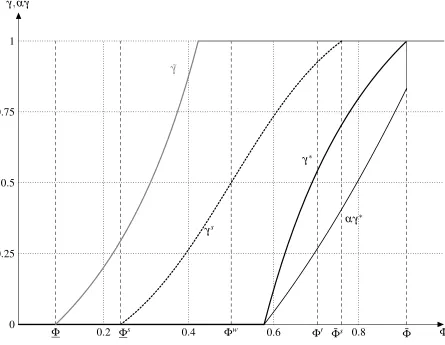
Φ Φ
γ,α γ
1
0.8 0.6
0.4
0.2 Φ
0
Φw Φ0
Φs Φ¯s
0.25 0.5 0.75
˜ γ
γs
γ∗
[image:14.596.108.553.103.448.2]α γ∗
Figure 1: Equilibrium share ofγ∗fors→0,τ=0.1,V =3 andv=1.
Proposition 2 easier to meet, because it would be more difficult for a nonsmoking restaurant to
meet the participation constraint of a mixed group. For instance, with fully non-transferable utility,
a mixed group would refuse any offer wheneverp>v.
The share of nonsmoking restaurants γ∗ resulting from Proposition 2 can be relatively low.
Figure 1 plots this supply of nonsmoking restaurants with respect to the share of nonsmokers for
parameter valuesV =3, v=1, τ =0.1 and the linear search costs sufficiently small (s→0). For simplicity, I assume that pairs of consumers are randomly composed, so that a share Φ of
nonsmokers in the population yields α =Φ2, and (1−α−µ) = (1−Φ)2. This is obviously
an arbitrary assumption as, for instance, groups may be formed by affinity (including smoking
preferences) and groups are not always composed of two people. The parameter values are
cho-sen in order for shares of nonsmokers corresponding to the actual prevalence of smoking among
adults - between 20 and 30% in most developed countries - to yield a strictly positive supply of
whenΦ≈0.58, corresponding to the smoking prevalence in the late seventies in the UK8and the
late sixties in the US.9The equilibrium share of nonsmoking restaurantγ∗does not correspond to
the share of consumers going to nonsmoking restaurants (this share is given by the curveα γ∗). As
smoking restaurants are more populated, the share of customers going to a nonsmoking restaurant
remains low even for a very low prevalence of smoking in the population.
The equilibrium described in Proposition 2 exists for all Φ<Φ¯. For any state of the world
{pS=v,pNS=V,γ>γ∗},
πj(p=v,σ=S,pS,pNS,γ) = max
p≥0,σ∈{S,NS}πj(p,σ,pS,pNS,γ), (10)
so that when there are more than the equilibrium share of nonsmoking restaurants, firms maximize
their profits by revising their smoking policy and offering a smoking environment at low price.
This corresponds to the area above the curveγ∗in Figure 1.10 Similarly, below the curve, firms
allowed to revise their policy maximize their profit by banning smoking and setting a price pNS=
V. Hence, when most consumers smoke, there exists an equilibrium where{pS=v,γ =0}and
no restaurant wants to revise its policy. If the share of nonsmokers discretely and unexpectedly
increases to a higher value, restaurants revise their policy to switch to a high price nonsmoking
restaurant untilγ=γ∗.
The vertical dashed line at ¯Φcorresponds to the point where the equilibrium does not exist
any-more given that all restaurants ban smoking. In the area to the right of this line, a strictly positive
share of nonsmoking restaurants could increase their profit by setting a low pricev, hence
converg-ing to a state of the world with{pNS=v,γ=1}. From that state of the world, smoking restaurants would only open (setting pS=V) if the share of smoking groups become very large. The share of nonsmoking restaurants in this symmetric equilibrium ˜γ is represented by the gray line. This
equilibrium does not exist if there are too few nonsmokers (low values ofΦ), corresponding to the
area to the left ofΦ. Hence, for values ofΦ∈(Φ,Φ¯), the game displays multiple equilibria satis-fying the criteria described above, while the equilibrium is unique for the most extreme values of
8Smoking prevalence in the overall population was of 45% in 1974 and 40% in 1978 according to the UK office for National Statistics General Lifestyle Survey data, http://www.ons.gov.uk, accessed September 2015.
9Smoking prevalence in the overall population was of 42.4% in 1965 and 37.4% on 1970 in the US according to the US centers for Disease Control and Prevention, www.cdc.gov, accessed September 2015.
Φ. Finally, the vertical dashed line atΦw=0.5 represents the point at which a smoking ban starts
increasing aggregate consumer welfare, as compared to the equilibrium described in Proposition 2
(see the computations in Section 4.1).
For the considered parameter values, a third equilibrium also exists (see above and online
Appendix), with pS=pNS= v+2V andγs∈(0,1). It cannot be reached from a sequence of best responses to any of the two other equilibria. It is represented by the dotted curveγs, and exists for
Φ∈(Φs,Φ¯s). For the values ofΦcomprised betweenΦ0and ¯Φs, it would yield a higher aggregate
consumer surplus than the one described in Proposition 2. This equilibrium indeed treats better
the nonsmokers at the cost of treating all the other groups worse. It does however never provide
higher consumer surplus than both the equilibrium of Proposition 2 and a smoking ban at the same
time.
The intuition behind the price structure in Proposition 2 does not derive from the particular
setup where firms price exactly at the participation constraint of a certain category of consumers.
It simply reflects the difference in the outside option consumers have if they search in the market.
Assume now that consumers also have some random preference for restaurants. If most
restau-rants allow smoking, the few first nonsmoking ones have a relatively high market power on their
nonsmoking patrons. They are aware that the supply of nonsmoking firms is low, and that
non-smoking consumers would have to search extensively for a better deal. As the supply of
nonsmok-ing premises is lower, so is competition in this sector. Nonsmoknonsmok-ing restaurants set a higher price,
which reduces the share of the customers they attract. In particular, mixed groups - ex ante
indif-ferent between smoking and nonsmoking premises - find much better deals in smoking restaurants,
as this market is more competitive. Therefore, smoking restaurants remain highly competitive and
attract most consumers, while nonsmoking restaurants become specialized in nonsmokers.
The results from this section are an attempt to answer the first stylized fact on the market for
nonsmoking restaurants: even when the number of nonsmokers is high, there may only be a scarce
supply of nonsmoking premises. Coming from a world where all restaurants allow smoking, being
among the first ones to ban smoking gives a high market power on nonsmoking consumers. This
market power increases firm’s profits when switching to a nonsmoking environment, but also the
profits of the other firms, as all groups but the purely nonsmokers search until they find a place
that allows smoking.
understand the second stylized fact.
4
On the economic impact of smoking bans
In this section, I compare the equilibrium studied in Proposition 2 to the one in the presence of a
ban. I first consider a ban in restaurants. Second, I assume that bars and restaurants are substitutes
for a fraction of the groups. I then show that this may explain the second stylized fact: restaurants
may see their profit increase after a smoking ban if the share of nonsmoking restaurants is higher
than the share of nonsmoking bars in the market equilibrium. In that case, before the ban, mixed
groups that are ex ante indifferent between bars and restaurants choose bars, in order to bear a
lower expected search cost. The behavior of mixed groups is self-fulfilling: by going to bars, they
make the bars more attractive to them. After the ban, they return to being indifferent between
bars and restaurants and therefore patronize restaurants more. This explains why bars may lose
consumers from the market being homogenized.
4.1 A smoking ban in restaurants
A law that totally bans smoking in restaurants brings us back to a world with homogenous supply
as studied in Proposition 1, but with only nonsmoking premises.
Lemma 2 In the presence of a smoking ban, a low price equilibrium{γ =1,pNS=v}exists if
and only if s≤(1−α−µ)v
(α+µ)τ andτ ≤ v
(α+µ)V.
Proof. Identical to the proof of Proposition 1, with the share of nonsmoking groupsα instead of
the share of smoking groups 1−α−µ.
For the same reason as in Section 3.3, this equilibrium coexists with a less robust “Diamond”
equilibrium where only nonsmokers are served at a high price. Assuming a smoking ban, from a
world with some nonsmoking restaurants (as described in Proposition 2) to a world with a smoking
ban and low price, we can compute the changes in welfare for different consumer types.
Proposition 3 Compared to a market equilibrium{pS=v,pNS=V,γ=γ∗}a smoking ban{pNS=
• Increases the expected surplus of a nonsmoking group by an amount∆ns=V−τv.
• Increases the expected surplus of a mixed group by an amount∆m=γ
∗(V−v+2(1−
τ)s)
2(1−γ∗(1−τ)) . • Decreases the expected surplus of a smoking group by an amount∆s=
(1−γ∗)(Vτ−v)−γ∗(1−τ)s τ(1−γ∗(1−τ)) .
The formal proof is provided in Appendix. Nonsmoking groups are unambiguously better off.
Before the ban they received zero surplus, while after the ban they get their favorite restaurant at a
low price and without searching. The mixed groups are ex ante indifferent between smoking and
nonsmoking premises. However, the smoking ban makes their life simpler, because they do not
have to search on the market. Thus, a smoking ban increases their surplus proportionally to the
loss of surplus they had by postponing their consumption and paying search costs in the presence
of two types of restaurants. Finally, smokers are worse off, but their loss also depends on how
much they had to search before the ban.
The gains from a smoking ban depend on how popular nonsmoking restaurants were before.
If there were many of them, the ban does not decrease the surplus of smokers a lot, but increases
the surplus of mixed groups. If the supply of nonsmoking restaurants was scarce, the gain in terms
of search costs for mixed groups is moderate, while the loss for smokers is high. The values of the
differentials in utility∆as a function ofα (and thereforeΦ, by assumingΦ=α2) are provided in
the proof of Proposition 3 in Appendix. Note that in the presence of advertising of smoking policy,
they converge to∆ns=−∆sand∆m=0 when the costcof searching only among a certain type of restaurants decreases.
The analysis of the impact of the smoking ban may also help understanding why the support
for smoking bans typically increases after a smoking ban has been enacted (see Gilpin et al., 2004;
Borland et al., 2006; Fong et al., 2006; Gallus et al., 2006). Before a ban, the only experience
mixed groups have of nonsmoking restaurants is either nonexistent or problematic (because it is
never profitable to go to a nonsmoking restaurant with smokers). If before a ban some nonsmokers
either expect it will become more difficult to go out with smokers or that their favourite smoking
place will offer a value for money as low as the nonsmoking places they know, they may oppose a
smoking ban ex-ante, but change their mind after observing that all consumers continue to go out
4.2 A smoking ban in bars and restaurants
The objective of this subsection is to understand the second stylized fact: why smoking bans
may have an undetermined effect on the restaurants’ profit and a negative effect on bars. Assume
that two separate submarkets coexist with a given degree of substitutability. On the supply side,
restaurants and bars are both a continuum of mass 1. On the demand side, there is a continuum of
mass 1 of consumers patronizing bars, a continuum mass 1 of consumers patronizing restaurants,
and a continuum of massΩof “good timers”, ex ante indifferent between bars and restaurants. All
groups have identical parametersα,v,V,τands. “Good timers” have to choose whether they want
to go to a bar or a restaurant before entering the market.
Assumption 1 Before entering the market, a group of “good timers” chooses the submarket that
maximizes its joint expected payoff.
In consequence, the following decision rule for “good timers” follows:
Lemma 3 Denote byγr and γb the respective shares of nonsmoking restaurants and bars, and
assume the equilibrium structure is the one described in Proposition 2. Under Assumption 1, the
respective choices of the three different groups of “good timers” are such that:
• Nonsmokers are indifferent,
• Smokers and mixed groups choose submarket i∈ {r,b}, with i determined byγi=min(γr,γb).
Proof.Nonsmokers are indifferent as their surplus is independent ofγi. Mixed groups and
smok-ing groups have an expected payoff strictly decreassmok-ing inγi.
The decision rule is such that all groups but the nonsmoking ones prefer the market with fewer
nonsmoking premises, as it decreases the expected search cost they have to bear. As a tie-breaking
rule, I assume groups choose the two markets with equal probability when indifferent. The choice
of the “good timers” has a non-neutral effect on the value ofγi. Indeed, assume restaurants were
the first ones to offer a strictly positive number of nonsmoking environments. A reason could
be that different regulations applied to them, which gave incentives to the first restaurants to ban
in the population of restaurants patrons. All “good timers” but the nonsmoking groups therefore
patronize bars and nonsmoking “good timers” randomize.
The equilibrium share of nonsmoking restaurants is strictly increasing inΩ, as it is given by
equating the expected profits of smoking and nonsmoking restaurants,
α(1+Ω
2)V =α(1+
Ω
2)v+
(1−α)v
1−γr(1−τ)
, (11)
so thatγr∗=
(αV−v)+αΩ
2 (V−v)
(1−τ)α(1+Ω
2)(V−v)
.
As all “good timers” but the nonsmoking consumers attend bars, the share of nonsmoking
groups attending restaurants is higher than their share in the population.
The share of nonsmoking bars in an equilibrium similar to Proposition 2 is determined by
equating the expected profits of smoking and nonsmoking bars,
α(1+Ω
2)V=α(1+
Ω
2)v+
(1−α)(1+Ω)v
1−γb(1−τ)
, (12)
so that γb∗ = α(1+ Ω
2)(V−v)−(1−α)(1+Ω)v
(1−τ)α(1+Ω
2)(V−v)
<γr∗, with ∂ γb∗
∂Ω <0. Because more smoking and mixed groups attend bars, the share of nonsmoking bars is lower and decreasing in the number of “good
timers.” It is not always the case that an equilibrium with a strictly positive share of nonsmoking
barsγ∗>0 exists, even when the share of nonsmokers is high enough to satisfy a strictly positive
share in Proposition (2),α>Vv. Indeed, because of the increased number of mixed and smoking
groups, the condition for some bars to supply a nonsmoking environment becomes
α(1+Ω
2)V≥(1+Ω−α
Ω
2)v, (13)
which is equivalent to
α ≥ v V
(1+Ω−αΩ2)
(1+Ω 2)
> v
V. (14)
Consider now the impact of a smoking ban affecting both bars and restaurants.11 I assume the
smoking ban is credible and announced int=0 before the entry decision of consumers in that
11Many smoking bans have been adopted first in restaurants, then in bars. In this framework this would even increase the specialization of bars, as nonsmokers would never attend them, and mixed groups are, at best (i fγb∗=0), indifferent
period (and in particular the decision of “good timers”). As in Section 4.1, I assume the impact of
a smoking ban to be an immediate shift to a state of the economy{pNS=v,γr=γb=1}. The new state of the economy modifies the search strategy of new groups entering the market, as all groups
of “good timers” are now indifferent between bars and restaurants.
The average profit of a restaurant just after a smoking ban (t=0) is
E(πr,t=0) = (1−τ)(1+
αΩ
2 )v+τ(1+
Ω
2)v. (15)
The average profit of a restaurant corresponds to the pricevpaid by the remaining (1−τ)(α2Ω)
groups who were already on the market for restaurants, and by a first generationτ(1+Ω2)of groups
in which “good-timers” are indifferent between bars and restaurants.
Similarly, the average profit of a bar becomes
E(πb,t=0) = (1−τ)(1+Ω−αΩ
2 )v+τ(1+
Ω
2)v. (16)
If the supply of nonsmoking bars is zero before the ban, it has little direct impact on bars in the first
period. However, demand evolves over time so that at every new period after the ban, all “good
timers” are indifferent between bars and restaurants. The respective expected profits of restaurants
and bars in periodtare
E(πr,t) = (1−τ)t+1(1+
αΩ
2 )v+τ t
∑
i=0
(1−τ)i(1+Ω
2)v (17)
and
E(πb,t) = (1−τ)t+1(1+Ω−
αΩ
2 )v+τ t
∑
i=0
(1−τ)i(1+Ω
2)v. (18)
Both average profits converge toE(π) = (1+Ω
2)vwhent→∞. The long run expected profits in both submarkets are identical, but the initial point and the dynamic differ. When the ban is enacted,
the number of customers in both submarkets starts to converge. Through time, the number of
consumers going to bars decreases while the number of consumers going to restaurants increases.
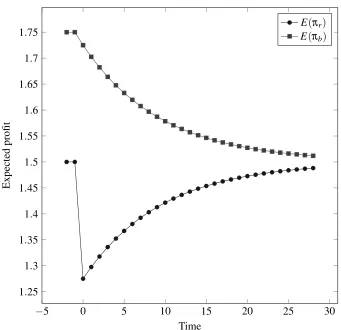
The following example shows a pattern where a smoking ban hurts bars and does not affect
−5 0 5 10 15 20 25 30 1.25
1.3 1.35 1.4 1.45 1.5 1.55 1.6 1.65 1.7 1.75
Time
Expected
profit
E(πr)
[image:22.596.144.485.93.423.2]E(πb)
Figure 2: Smoking ban and expected profits: an example.
0.1 and s sufficiently small. Assume also that, at the market equilibrium, some restaurants are
nonsmoking (γr∗>0). All “good timers” go to bars, and it is indeed an equilibrium strategy for some restaurant owners to ban smoking as
α(1+Ω
2)V >(1+α
Ω
2)v. (19)
In bars, the equilibrium share of nonsmoking premises is zero, as no bars benefit from offering
such an environment at a high price,
α(1+Ω
2)V<(1+Ω−α
Ω
2)v. (20)
Figure 2 presents the respective expected profits of bars and restaurants over time as described
5
Conclusion
This paper studies the impact of group consumption on product diversity in a dynamic model of
sequential search. I show that the presence of mixed groups creates a leverage effect of
competi-tion. This implies that new tastes may only be marginally represented in the market, even if they
represent a large share of the population. I show that this result may explain the inability of the
market to respond to the increased share of nonsmoking consumers by providing a large supply
of nonsmoking environments. This is the reason why a smoking ban, even without considering
its health consequences, may increase aggregate consumer welfare at the cost of decreasing the
welfare of smokers.
Still, if smokers have sufficiently intense preferences for a smoking environment, a world
with-out any smoking premises may not be an equilibrium withwith-out a strict enforcement. It may indeed
be a profitable deviation for some firms to start offering smoking environments, specialized in
smoking consumers. A limited provision of smoking premises does not necessary decrease
aggre-gate surplus if search costs are sufficiently low. It does, however, constitute a transfer of surplus
from consumers to restaurants, as the additional surplus of smoking consumers is extracted by
those few smoking restaurants. A smoking ban completed by a policy of limited and expensive
licenses redistributed among consumers may therefore be Pareto improving when smokers have
very intense preferences. This feature arises only if all consumers and employees are perfectly
informed utility maximizers, and the social cost of smoking is fully internalized within
Bibliography
Adams, Scott and Chad D Cotti, “The effect of smoking bans on bars and restaurants: An
analysis of changes in employment,”The BE Journal of Economic Analysis & Policy, 2007,7
(1).
Adda, Jérôme, Samuel Berlinski, and Stephen Machin, “Market regulation and firm
perfor-mance: the case of smoking bans in the United Kingdom,” Journal of Law and Economics,
2012,55(2), 365–391.
Alamar, Benjamin C and Stanton A Glantz, “Smoke-free Ordinances Increase Restaurant Profit
and Value,”Contemporary economic policy, 2004,22(4), 520–525.
Allwright, Shane, “Republic of Ireland’s indoor workplace smoking ban,”British Journal of
Gen-eral Practice, 2004,54(508), 811–812.
Anderson, Simon P and Regis Renault, “Pricing, product diversity, and search costs: A
Bertrand-Chamberlin-Diamond model,”The RAND Journal of Economics, 1999, pp. 719–735.
Bartosch, William J and Gregory C Pope, “Economic effect of restaurant smoking restrictions
on restaurant business in Massachusetts, 1992 to 1998,”Tobacco Control, 2002, 11(suppl 2),
ii38–ii42.
Besen, Stanley M and Joseph Farrell, “Choosing how to compete: Strategies and tactics in
standardization,”The Journal of Economic Perspectives, 1994, pp. 117–131.
Borland, Ron, Hua-Hie Yong, Mohammad Siahpush, Andrew Hyland, Sharon Campbell,
Gerard Hastings, K Michael Cummings, and Geoffrey T Fong, “Support for and reported
International Tobacco Control (ITC) Four Country Survey,” Tobacco control, 2006, 15 (suppl
3), iii34–iii41.
Boyes, William J and Michael L Marlow, “The public demand for smoking bans,” Public
Choice, 1996,88(1-2), 57–67.
Diamond, Peter A, “A model of price adjustment,” Journal of Economic Theory, 1971, 3 (2),
156–168.
Donni, Olivier and Pierre-André Chiappori, “Nonunitary models of household behavior: a
survey of the literature,” in “Household economic behaviors,” Springer, 2011, pp. 1–40.
Dunham, John and Michael L Marlow, “Smoking laws and their differential effects on
restau-rants, bars, and taverns,”Contemporary Economic Policy, 2000,18(3), 326–333.
and , “The economic incidence of smoking laws,”Applied Economics, 2003,35(18), 1935–
1942.
Fong, Geoffrey T, Andrew Hyland, Ron Borland, David Hammond, Gerard Hastings, Ann
McNeill, Susan Anderson, K Michael Cummings, Shane Allwright, Maurice Mulcahy
et al., “Reductions in tobacco smoke pollution and increases in support for smoke-free
pub-lic places following the implementation of comprehensive smoke-free workplace legislation in
the Republic of Ireland: findings from the ITC Ireland/UK Survey,”Tobacco control, 2006,15
(suppl 3), iii51–iii58.
Gallus, Silvano, Piergiorgio Zuccaro, Paolo Colombo, Giovanni Apolone, Roberta Pacifici,
Silvio Garattini, and C La Vecchia, “Effects of new smoking regulations in Italy,” Annals of
Oncology, 2006,17(2), 346–347.
Gersbach, Hans and Hans Haller, “Collective decisions and competitive markets,”Review of
Economic Studies, 2001, pp. 347–368.
and , “Groups, collective decisions and markets,” Journal of Economic Theory, 2011,146
(1), 275–299.
Gilpin, EA, L Lee, and JP Pierce, “Changes in population attitudes about where smoking should
Glantz, Stanton A and Lisa R Smith, “The effect of ordinances requiring smoke-free restaurants
on restaurant sales.,”American Journal of Public Health, 1994,84(7), 1081–1085.
Huang, P, AK De, and ME McCusker, “Impact of a smoking ban on restaurant and bar revenues–
El Paso, Texas, 2002.,”MMWR: Morbidity & Mortality Weekly Report, 2004,53(7), 150.
, S Tobias, Kohout S Harris M, D Satterwhite, D M. Simpson, L Winn, J Foehner, and
L Pedro, “Assessment of the impact of a 100% smoke-free ordinance on restaurant sales–West
Lake Hills, Texas, 1992-1994.,”MMWR. Morbidity and mortality weekly report, 1995,44(19),
370.
Maskin, Eric and Jean Tirole, “Markov perfect equilibrium: I. Observable actions,”Journal of
Economic Theory, 2001,100(2), 191–219.
Phelps, Ryan, “The economic impact of 100% smoking bans,”Kentucky Annual Economic Report
2006, 2006, pp. 31–34.
Sciacca, John P and Michael I Ratliff, “Prohibiting smoking in restaurants: effects on restaurant
sales,”American Journal of Health Promotion, 1998,12(3), 176–184.
Wolinsky, Asher, “True monopolistic competition as a result of imperfect information,”The
Quar-terly Journal of Economics, 1986,101(3), 493–511.
Yang, Huanxing, “Targeted search and the long tail effect,” The RAND Journal of Economics,
Appendix: formal proofs
Proof of Lemma 1.
A monopoly wants to maximize its profit and suffers no competition. As the marginal
pro-duction cost is normalized to zero, I focus on strictly positive prices. For any price p≤v, all
consumers accept the offer and stay, regardless of the smoking policy. Hence, the per-period profit
of the monopoly is
π=pτ(1+ (1−τ) + (1−τ)2+...) =p (21)
Thus, conditional on serving all types of groups, the profit maximizing price isp=v(∀p∈(0,v]). For any price p00>V, no customer accepts the offer and the profit is 0<v. For any price p0 ∈
(v+2V,V], if the restaurant allows smoking, only smoking groups accept the offer and stay, while other groups refuse the offer. The per-period profit is
π0=p0τ(1−α−µ)(1+ (1−τ) + (1−τ)2+...) = (1−α−µ)p0. (22)
Thus,∀p0∈(v+2V,V], the profit maximizing price is p0=V. Finally, the price p00∈(v,v+2V]that maximizes profit isp00=v+2V. This implies that, if(1−α−µ)V>max{v,(1−α)v+2V}, the
profit-maximizing price of a monopoly isp=V. By banning smoking, the monopoly could indeed get at mostαV <(1−α−µ)V. Finally by serving all but the nonsmoking groups, it could get at most π00= (1−α)v+2V <(1−α−µ)V
Proof of Proposition 1. I study deviations from a market structure where all firms set a price
ps=v. Denote by p−i the price distribution where all firms butichoose ps. We know by the standard Diamond argument that settingp0i<vis never a profitable deviation for a firmi. Since all groups already accept the offer and stay, and as firms are atomless so that no group will search for
this specific firm, the per-period profit for any pricep0i∈(0,v]is at mostπ(p0i|p−i) =p0i, maximum forp0i=v. I check under which conditions settingp0i>vis a profitable deviation. I exclude prices strictly aboveV, as we already know by (2) that they yield zero demand. We also know by (2)
that for anyp0i>v, a restaurant focuses on smokers and mixed groups only, as it does not meet the participation constraint of a nonsmoking group. To receive a strictly positive profit, a deviating
than to search for another restaurant or, (ii) focus on one-time-only consumers, by just meeting the
participation constraint of smokers, so that they consume once and search in the next period. The
condition for (i) is to set a price p0 such that smokers and mixed groups stay in the next period, which is
V−p0i
τ ≥
V−v
τ −s. (23)
This rewrites
p0i≤v+sτ. (24)
By setting p0i=v+sτ, the deviating firm gets a per period profit (with only smoker and mixed groups, all staying)
π(p0i|p−i) = (1−α)(v+sτ). (25)
This profit is lower than setting the same price as all other firms,pi=vif and only ifπ(p0i|p−i)≤v, which simplifies to
s≤ αv
(1−α)τ =s
0
. (26)
To meet condition (ii), it must be true that a firm setting p0i=V decreases its profit. As long as search costs are not too high, this firm gets one-time-only consumers. As it meets the participation
constraint of smokers, those accept the offer when matched with the high-price firm, but search
for another one in the next period iff
s≤V−v
τ =s
00. (27)
When (1−α)V >v, it is always true that s00 >s0, so condition (27) is not binding whenever
customers at lower price,τ(1−α)V≤v. This rewrites:
τ≤ v
(1−α)V (28)
Proof of Proposition 2. I first show that the equilibrium exists. If the equilibrium exists, a
shareγ∗ of the firms plays a strategy {σ =NS,pNS=V}, and a share 1−γ∗ plays a strategy {σ=S,pS=v}. Nonsmoking groups accept the offer from any restaurant and stay there, while all other groups refuse the nonsmoking offers and search for a smoking restaurant in the next period.
In that case, the expected per period profit of a nonsmoking restaurant is given by
πNS=τ(αV+αV(1−τ) +αV(1−τ)2+...) =αV (29)
the nonsmokers who find the restaurant by chance and then stay because it corresponds to their
preferences and cannot find better on the market. The expected per-period profit of a smoking
restaurant is given by
πS=τ(v τ +
v(1−α)γ(1−τ)
τ +
v(1−α)γ2(1−τ)2
τ +...) =αv+
(1−α)v
1−γ(1−τ), (30)
the sum of the nonsmoking consumers who find the restaurant by chance and stay, all the other
consumers who find the restaurant by chance and stay, and all the consumers who first found
a nonsmoking restaurant, and then searched. Equating the two expected profits (29) and (30)
gives the equilibrium value ofγ∗=(1−τα)Vα−(Vv−v). As the share of nonsmoking restaurants cannot
be negative, if the share of nonsmoking groups is not sufficiently high αV ≤v, the supply of
nonsmoking premises isγ∗=0. This equilibrium is locally stable in the sense that best responses to any small perturbation to the equilibrium share of nonsmoking firms would bring this share back
to equilibrium. Indeed, ifγincreases above γ∗, the profit of smoking firms becomes higher than
the profit of nonsmoking ones, which gives an incentive to some additional firms to allow smoking
(and set a price pS =v). If consumers follow the assumed search pattern, smoking restaurants have no incentive to change their price (by the same argument as in Proposition 1, and as long as
the conditions of existence in Proposition 1,s≤min{ αv
(1−α)τ,
(1−α)v
α τ }andτ≤min{ v
zero profit. It could also try to meet the participation constraint of mixed groups, and set a price
p=V+2v. This would give a per period profit of
π=αV+v
2 +
τ µ
1−γ(1−τ) V+v
2 . (31)
In this case, the nonsmokers stay in the restaurant but if the mixed groups search in the
pro-posed equilibrium, they also search when a firm strictly meets their participation constraint. The
profit in (31) is lower thanπNS=αV whenever
τ≤ α(V−v)(1−γ)
µ(V+v)−α γ(V−v). (32)
Replacingγby its equilibrium valueγ∗therefore yields
τ≤ (1−α)v
µ(v+V). (33)
A nonsmoking restaurant would never benefit either from setting a price p0=v, as it yields expected profitπNS= (α+1−γ(µ1−τ))v<πS.
For this structure to be an equilibrium, groups must follow the assumed search behaviour. The
search decision of groups is given by equations (4) and (5). AsuSm<uSs, if mixed groups search
for smoking restaurants, smoking groups also search. As mixed groups get zero surplus from
nonsmoking restaurants (they do not consume there asuNSm <0), both mixed groups and groups of
smokers search until they find a smoking restaurant whenever
s≤(1−γ∗)V+v
2τ . (34)
Since, by definition, the nonsmokers do not search for another firm (because all restaurants give
them identical surplus), the proposed structure is an equilibrium.
I then show that a sequence of best responses to an initial state of the world{γ=0,ps=v}can only lead to the proposed equilibrium. When a firm jhas the possibility to revise its policy, it does
pj =v. However, a firm can strictly increase its expected per-period profit by banning smoking if αV >v. In that case, given consumers’ search strategies it maximizes its profit by playing
{pj =V,σj =NS}, and getting profit πj =αV >v. The state of the world in the next period therefore becomes{pS=v,pNS=V,γ =λ}, with λ being the share of firms allowed to revise
their price and smoking policy at each period. Smoking restaurants can increase their profit by
revising their strategy to {p=V,σ =NS} a long asγ <γ∗, therefore leading to the proposed equilibrium.
Proof of Proposition 3.
• The ex ante expected surplus of nonsmoking groups is 0. The expected surplus after the ban
is thereforeE(Uns,ban) =V−τv =∆ns.
• The ex ante expected surplus of mixed groups is
E(Um,noban) = (1−γ)
V−v
2τ +γ(1−τ)((1−γ) V−v
2τ −s)
+γ2(1−τ)2((1−γ)V −v
2τ −s) +...
=(1−γ)
V−v
2τ −γ(1−τ)s
1−γ(1−τ) , (35)
reflecting the fact that those groups buy only after finding a smoking restaurant. The
ex-pected surplus of those groups after the ban is
E(Um,ban) =
V−v
2τ , (36)
thus the difference∆mis given by
∆m=E(Um,ban)−E(Um,noban)
=γ(V−v+2(1−τ)s)
2(1−γ(1−τ)) . (37)
In terms ofα, this rewrites by replacingγ∗by its value
∆m=
(V−v+2s(1−τ))(αV−v)
• Finally, the surplus of smoking groups after the ban is zero, but the surplus before the ban
is notV−τv, because those groups had to bear some search costs to find a good match. The surplus before the ban, equal the difference∆sis
∆s=
(1−γ)Vτ−v−γ(1−τ)s
1−γ(1−τ) . (39)
In terms ofα, this rewrites by replacingγ∗by its value
∆s=
sτ2(αV−v)−τ α sV+ (V−v)2−sv+ (1−α)v(V−v)
For online publication: characterization of the equilibria of the game
Content:
In this appendix, I characterize all possible equilibria, and check which ones satisfy the
fol-lowing criteria: (i) they hold when search costs become very low (i.e. s→0), (ii) they are stable
in the sense that best responses to a small perturbation inγbring firms back to the proposed
equi-librium, (iii) they are robust to advertising of the smoking policy of restaurants and (iv) they are
robust to a (self-enforcing) coordinated deviation by a small share of restaurants.
I start by showing that prices must either correspond exactly to a “search constraint” (a price
above which some groups prefer to search than to stay at the restaurant) or to a “participation
constraint” (a price equal to the willingness to pay of some group). The first set of candidate
equilibria corresponds to cases where both types of restaurants choose a search constraint. Two
equilibria exist for some parameters, but none is stable, robust to small search costs or to
adver-tising of the smoking policy. The second set of candidates are equilibria in which one firm chooses
a participation constraint and the other a search constraint. Two equilibria exist for some
param-eters, but none is robust to small search costs or to advertising of the smoking policy. The third
set of candidates are equilibria in which both firms choose a participation constraint. Six types of
equilibria exist for some parameters (i) ps=pns=V is not stable, not robust to a deviation by a
share of restaurants, and not robust to advertisement of smoking policy, (ii){ps=v,pns= v+2V}
(and the symmetric{pns=v,ps=v+2V}) is not robust to the advertisement of the smoking policy,
(iii) ps=pns=v is not robust to small search costs or to the advertisement of the smoking policy,
(iv){ps=V,pns=v+2V}and the symmetric{pns=V,ps=v+2V}are not robust to a deviation by a
small mass of restaurants when search costs are low. The two remaining types of equilibria satisfy
all our criteria: (v){pns=V,ps=v},{ps=V,pns=v}and (vi){ps=pns= v+2V}.
Firms are atomless and consumers have to bear a linear search cost s>0 to try a different
option. Hence, without product and consumer diversity, for a market pricep, there exists anε>0
such that a firm of typeidoes not loose any profit by setting pi= p+ε as long as p is below
the monopoly price (Diamond, 1971). In the presence of product diversity, there are however two
reasons for which a firm can loose demand from increasing price.
First, for each type of groupi∈ {s,m,ns}and each type of smoking policyσj∈ {S,NS}, there
constraint” for a group of typeiin a firm of type j,PCij. Hence, by condition (2) if a firm of type j
has strictly positive demand from groups of typei, increasing unilaterally the price frompijto any
p0=pij+ε withε>0 discreetly decreases the demand for the firm.
Second, using (4) and (5), in a symmetric equilibrium, for each type of groupi, there exists a
price
pSi =vSi −vNSi +pNSi +τs
γ , (41)
such that∀p≤pSi, groups of typeido not search for a nonsmoking restaurant when matched with
a smoking restaurant setting pricep(as we are looking for symmetric equilibria where all firms of
the same type set the same price, it is never the case that groups search for a firm of the same type
in equilibrium). I denote this value of pSi as the “search constraint” for a group of typeiin a firm
of typeS,SCiS. Similarly, there exists a price
pNSi =vNSi −vSi +pSi + τs
1−γ, (42)
such that ∀p≤ pNSi , groups of typeido not search for a smoking restaurant when matched
with a nonsmoking restaurant setting pricep. I denote this value ofpNSi as the “search constraint”
for a group of typeiin a firm of typeNS,SCiNS.
Hence, if a firm of type j∈ {S,NS}has strictly positive demand from groups of type i,
in-creasing unilaterally the price from pij=SCij to any p0=pij+ε withε >0 discreetly decreases the demand for the firm.
I can thus restrict my attention to equilibrium prices corresponding to either aPCor aSC. For
each equilibrium, I first study whether it exists under at least some parameter value, provide the
existence conditions, and check whether it survives my refinement criteria.
I first study all possible equilibria where both types of firms choose a price corresponding
to aSC.