RESEARCH ARTICLE
MICROPROPAGATION OF
Lippia nodiflora
USING SHOOT TIP AND NODAL EXPLANTS UNDER
IN VITRO
CONDITIONS
Evelyne Priya, S and Ravindhran, R*
Department of Plant Biology and Biotechnology, Loyola College, Chennai - 600 034, Tamil Nadu, India
ARTICLE INFO ABSTRACT
Lippia nodiflora (L.) (Verbenaceae) is an important medicinal plant with scanty roots. It has a
numberof medicinal properties used in treatment of diseases such as chronic indolent ulcers,
gastrointestinal and respiratory ailments and diabetes, etc. Nodes and shoot tips were used as the explants for the initiation of multiple shoots and cultured on Murashige and Skoog (MS) medium supplemented with cytokinin namely Benzyladenine (BA) and Kinetin (KIN).The maximum number of shoots were produced in BA 3.0 mg/l. An average of 14.66 ±1.30 shoots was produced from each explant. Healthy shoots were transferred to rooting medium with half and full strength MS medium supplemented with IBA and IAA at different concentrations such as 0.1, 0.5, 1.0 and 1.5 mg/l. Half strength MS medium containing IBA of 1.0 mg/l produced the maximum number of roots (10.3 ± 4.00). Rooted plants were hardened and those grown in sand: cocopith (1:1) showed good response than others.
Copy Right, IJCR, 2011, Academic Journals. All rights reserved
INTRODUCTION
Lippa nodiflora (L.) is a medicinal plant distributed in India,
south and Central American countries, and tropical African territories (Terblanche and Kornelin, 1996). They are traditionally utilized as gastrointestinal and respiratory
remedies (Morton 1981). Some of the other Lippa species
have shown antimalarial (Gasquet et al., 1993), antiviral
(Abad et al., 1995) activity. L. nodiflora possesses a number of ethanobotanical uses (Kirtikar and Basu, 1975). The plant also possesses cooling, diuretic and febrifuge properties. In unani system of medicine, the fresh plant is used to prepare a paste or poultice and applied as suppurant for boils, swollen cervical glands and chronic indolent ulcers. A bitter infusion prepared from the plant is given to children for indigestion and women after child birth. The plant is also used in the treatment of osteoarticular pains and respiratory diseases (Hooker, 1885;
Kartikar, 1918; Chopra et al., 1956). The chemical
composition of the plants includes several flavones, glycosides, alkaloids and essential oils (Basu et al., 1969; Nair
et al., 1973; Francisco et al., Forestieri et al., 1996).
Nodifloridin-A and Nodifloridin-B have also been isolated
from L. nodiflora (Singh and. Bharate, 2006). Halleridone and
Hallerone compounds from Lippia nodiflora (Ravikanth et al.,
2000) proved to have anticancer, anti-tumor, antimalarial, antifungal and cytotoxic activities (Nishino et al., 1988).
*Corresponding author: [email protected]
Recent study showed antidiabetic activity of γ- sitisterol isolated from L. nodiflora (Balamurugan et al., 2011). Due to the tremendously growing world population, increasing anthropogenic activities, and rapidly eroding natural ecosystem, the natural habitat for a great number of herbs and trees are dwindling and many of the species are facing extinction. In order to cope up with this alarming situation, the recent developments in biotechnology have come as a boon to consume and mass produce these important medicinal plants (Sharma et al., 2010). Tissue culture is a potential tool and has opened extensive areas of research for biodiversity conservation. Plant tissue culture techniques offer a viable tool for mass multiplication and germplasm conservation of medicinal plants in order to meet the needs of pharmaceutical industry (Sahoo and Chand, 1998).
MATERIALS AND METHODS
Shoot tips and nodal segments, collected from mature plants were used as explants for establishing a protocol for mass production of Lippia nodiflora plantlets. The explants were washed with running tap water for 15 to 20 minutes. They were then immersed in 5% (v/v) detergent solution (Tween 20) for 3 minutes and washed with tap water for 15 minutes, to eliminate the dust particles as well as fungal and bacterial spores found on the surface of these explants. The surface sterilization was done by treating the explants with 70% ethanol for 30 seconds and rinsed with sterile double distilled
ISSN: 0975-833X
International Journal of Current Research
Vol. 3, Issue, 09, pp.043-047, September, 2011
INTERNATIONAL JOURNAL OF CURRENT RESEARCH
Article History:
Received 28th
June, 2011 Received in revised form
27th
July, 2011
Accepted 18th
August, 2011
Published online 17th
September, 2011
Key words:
Lippia nodiflora, Micropropagation, Nodal,
Fig. 1. In vitro Multiplication of lippia nodiflora L. A - Shoot tip explant after7 days of culture on MS medium containing 3.0mg/l BAP; B - Multiple shoots formed after 2 weeks; C - multiple shoot formation after 3 weeks; D - Multiple shoots after 4 weeks; E - Shoots subcultured in MS
medium containing IBA showing root formation; F - Hardening
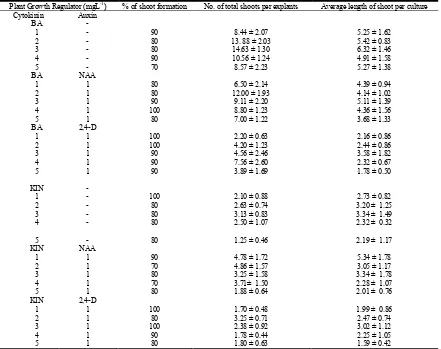
Table 1. Effect of cytokinin (BA and KIN) at different concentrations individually and in combination with auxins NAA and 2, 4-D on the multiple
shoot formation from shoot tip explants of Lippia nodiflora
Plant Growth Regulator (mgL-1
) % of shoot formation No. of total shoots per explants Average length of shoot per culture
Cytokinin Auxin
BA -
1 - 90 8.44 ± 2.07 5.25 ± 1.62
2 - 80 13. 88 ± 2.03 5.42 ± 0.83
3 - 80 14.63 ± 1.30 6.32 ± 1.46
4 - 90 10.56 ± 1.24 4.91 ± 1.58
5 - 70 8.57 ± 2.23 5.27 ± 1.38
BA NAA
1 1 80 6.50 ± 2.14 4.39 ± 0.94
2 1 80 12.00 ± 1.93 4.14 ± 1.02
3 1 90 9.11 ± 2.20 5.11 ± 1.39
4 1 100 8.80 ± 1.23 4.36 ± 1.56
5 1 80 7.00 ± 1.22 3.68 ± 1.33
BA 2,4-D
1 1 100 2.20 ± 0.63 2.16 ± 0.86
2 1 100 4.20 ± 1.23 2.44 ± 0.86
3 1 90 4.56 ± 2.46 3.58 ± 1.82
4 1 90 7.56 ± 2.60 2.32 ± 0.67
5 1 90 3.89 ± 1.69 1.78 ± 0.50
KIN -
1 - 100 2.10 ± 0.88 2.73 ± 0.82
2 - 80 2.63 ± 0.74 3.20 ± 1.25
3 - 80 3.13 ± 0.83 3.34 ± 1.49
4 - 80 2.50 ± 1.07 2.32 ± 0.32
5 - 80 1.25 ± 0.46 2.19 ± 1.17
KIN NAA
1 1 90 4.78 ± 1.72 5.34 ± 1.78
2 1 70 4.86 ± 1.57 3.05 ± 1.17
3 1 80 3.25 ± 1.58 3.34 ± 1.78
4 1 70 3.71± 1.50 2.28 ± 1.07
5 1 80 1.88 ± 0.64 2.01 ± 0.76
KIN 2,4-D
1 1 100 1.70 ± 0.48 1.99 ± 0.86
2 1 80 3.25 ± 0.71 2.47 ± 0.74
3 1 100 2.38 ± 0.92 3.02 ± 1.12
4 1 90 1.78 ± 0.44 2.25 ± 1.05
[image:2.612.88.529.408.757.2]water for 3 to 4 times. This was followed by treatment with 0.1% mercuric chloride solution for 3 minutes and thoroughly washed with double distilled water for 3 to 4 times inside the Laminar Air Flow chamber. After surface sterilization, the nodes and shoot tips (about 0.5 cm long) were placed in MS (1962) medium supplemented with various concentrations of
[image:3.612.89.529.79.433.2]Cytokinins namely BA (benzyladenine) and KIN (kinetin) 1.0 – 5.0 mg/l alone or in combination i.e. BA 1-5 mg/L and NAA 1.0 mg/l or 2, 4-D and KIN 1.0 - 5.0 mg/l and NAA 1mg/l or 2, 4-D 1.0 mg/l for multiple shoot formation. Sucrose 3% (w/v) was used as the carbon source and agar 0.8% (w/v) was used for gelling. The pH of the medium was adjusted to 5.7
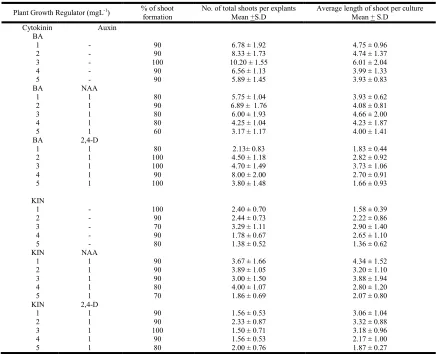
Table 2. Effect of cytokinin (BA and KIN) at different concentrations individually and in combination with auxins NAA and 2, 4-D on the multiple
shoot formation from nodal explants of Lippia nodiflora
Plant Growth Regulator (mgL-1
) % of shoot
formation
No. of total shoots per explants Mean +S.D
Average length of shoot per culture Mean + S.D
Cytokinin Auxin
BA
1 - 90 6.78 ± 1.92 4.75 ± 0.96
2 - 90 8.33 ± 1.73 4.74 ± 1.37
3 - 100 10.20 ± 1.55 6.01 ± 2.04
4 - 90 6.56 ± 1.13 3.99 ± 1.33
5 - 90 5.89 ± 1.45 3.93 ± 0.83
BA NAA
1 1 80 5.75 ± 1.04 3.93 ± 0.62
2 1 90 6.89 ± 1.76 4.08 ± 0.81
3 1 80 6.00 ± 1.93 4.66 ± 2.00
4 1 80 4.25 ± 1.04 4.23 ± 1.87
5 1 60 3.17 ± 1.17 4.00 ± 1.41
BA 2,4-D
1 1 80 2.13± 0.83 1.83 ± 0.44
2 1 100 4.50 ± 1.18 2.82 ± 0.92
3 1 100 4.70 ± 1.49 3.73 ± 1.06
4 1 90 8.00 ± 2.00 2.70 ± 0.91
5 1 100 3.80 ± 1.48 1.66 ± 0.93
KIN
1 - 100 2.40 ± 0.70 1.58 ± 0.39
2 - 90 2.44 ± 0.73 2.22 ± 0.86
3 - 70 3.29 ± 1.11 2.90 ± 1.40
4 - 90 1.78 ± 0.67 2.65 ± 1.10
5 - 80 1.38 ± 0.52 1.36 ± 0.62
KIN NAA
1 1 90 3.67 ± 1.66 4.34 ± 1.52
2 1 90 3.89 ± 1.05 3.20 ± 1.10
3 1 90 3.00 ± 1.50 3.88 ± 1.94
4 1 80 4.00 ± 1.07 2.80 ± 1.20
5 1 70 1.86 ± 0.69 2.07 ± 0.80
KIN 2,4-D
1 1 90 1.56 ± 0.53 3.06 ± 1.04
2 1 90 2.33 ± 0.87 3.32 ± 0.88
3 1 100 1.50 ± 0.71 3.18 ± 0.96
4 1 90 1.56 ± 0.53 2.17 ± 1.00
[image:3.612.112.506.460.577.2]5 1 80 2.00 ± 0.76 1.87 ± 0.27
Table 3. Effect of different concentrations of Auxins IAA and IBA on root induction
Plant growth regulators( mg/l) Full strength MS medium Half strength MS medium
IAA No. of roots per
shoot Mean +S.D
Root Length (cm) Mean +S.D
No. of roots per shoot Mean +S.D
Root Length (cm) Mean +S.D
0.1 4.3 ± 1.4 1.38±0.40 5.0 ± 1.24 2.21±0.70
0.5 6.0 ± 1.94 2.27±0.68 7.2 ± 1.9 3.08±0.34
1.0 5.6 ± 1.57 3.1±0.78 6.6 ± 2.54 4.01±0.67
1.5 5.2 ± 1.68 2.09±0.49 6.1 ± 1.28 2.45±0.29
IBA
0.1 5.2 ± 1.22 1.16±0.32 6.4 ± 1.3 1.29±0.44
0.5 6.9 ± 2.46 2.11±0.48 8.6 ± 3.8 2.39±0.32
1.0 7.9 ± 3.21 1.87±0.18 10.3± 4.0 1.81±0.49
1.5 6.4 ±1.95 1.41±0.33 7.9 ± 2.13 1.45±0.42
Table 4. Hardening of in vitro grown plants on different planting substrates for their acclimatization and establishment in natural conditions
Planting substrates No. of plants transferred No. of acclimatized plants Acclimatization percentage
Sand+soil 25 17 68
Cocopit+soil 25 23 92
Sawdust+soil 25 13 52
with NaOH before autoclaving at 121°C for 20 min. The culture was incubated at a constant temperature of 25 ± 2°C with 16 h lights (2000 lux) and 8 h darkness. After shoot initiation from nodal and shoot tip segments 2 weeks old shoots were sub cultured on MS medium supplemented with same combination for further proliferation and elongation. Elongated shoots (3-4 cm) were excised and inoculated on the rooting medium consisting of half strength and full strength MS medium. The medium was variously supplemented with auxins namely IAA and IBA at different concentrations (0.1,0.5,1.0 and 1.5mg/L). For acclimatization, the rooted shoots from one month old cultures were removed from the gelled rooting medium and washed under running water to remove traces of medium. The plantlets were transferred into paper cups with sand & soil (1:1), cocopith & soil (1:1), sawdust & soil (1:1) and sand & cocopith & sawdust (1:1:1) for hardening.
RESULTS
Multiple shoots were successfully induced from shoot tip and nodal explants of Lippia nodiflora cultured on MS medium. The shoot formation percentage ranged from 80-100%. In control (without addition of PGR) only 2 shoots emerged, whereas in those grown in presence of BA and KIN the number of shoots was high (Table 1&2). BA at concentration of 3.0 mg/l was able to induce up to 14.63 ± 1.30 (Fig. 1D) shoots when the shoot tips were used as explants and an average of 10.20 ± 1.55 shoots produced when nodal explants were used. In the presence of KIN only about 3 shoots were produced both in shoot tip and nodal explants (Table 1).
The combined effect of BA along with auxins such as NAA and 2, 4-D was also studied. Results show that maximum of 12.00 ± 1.93 (Table 1) shoots were produced when the medium contained 2.0 mg/l BA along with 1.0 mg/l NAA when shoot tips were used as explants, and a maximum of 6.89 ± 1.76 shoots were produced from the nodal explants when the medium contained 2.0 mg/l BA and 1.0 mg/l NAA (Table 2). However, a combination of 4.0 mg/l BA and 1.0 mg/l 2, 4-D was able to produce an average of 8 shoots per explant with reference to shoot tip and node (Table 1). Multiple shoot induction was minimal when medium contained KIN alone or in combination with auxins 2, 4-D and NAA (Table 1&2). The results clearly indicate that BA without supplementation of auxins was able to induce maximum number of shoots in both shoot tips and nodal
explants. The length of shoots were measured on the 4th week
and it was found that the average length of the shoots was maximum (6.32 ± 1.46) when BA was used at 3.0 mg/l in the case of shoot tip explants (Table 1). Whereas in the case of nodal explants the maximum length recorded was 6.01 ± 2.04 (Table 2). Combination of BA / KIN with NAA / 2, 4-D did not increase the shoot length. The effect of auxin on in vitro
rooting was examined using IAA and IBA. The micro shoots were separated and cultured in full and half strength MS medium supplemented with IAA and IBA at different concentrations of 0.1, 0.5, 1.0 & 1.5 mg/l. Root induction was observed within a period of two weeks. The present study showed that maximum number of roots per shoot (10.3 ± 4.00) was observed in half strength MS basal medium with 1.0 mg/l IBA (Fig.1E). Whereas 7.2 ± 1.9 roots per shoot were noted in
half strength MS medium supplemented with 0.5 mg/l IAA.
We observed that the addition of coco pith and sand (1:1) had increased the survival rate of the acclimatized plantlets. An average of 95 – 98% of the acclimatized plantlets survived after two weeks of transferring into field. After one month of transfer to field conditions the propagated plants exactly resembled the mother plants, no morphology variations were observed.
DISCUSSIONS
Clonal multiplication through various explants is
advantageous over conventional propagation method because a large number of plants can be produced within a short duration. The best effective PGR for multiple induction and
multiplication (Shoots/Node) in L. nodiflora was achieved on
MS medium containing 3.0 mg/l BA, as compared to KIN, at concentration of 2.0 mg/l. Similar response was noted in
Lippia alba at 2.0 mg/l BA (Gupta et al., 2001) and L.
junelliana (Julani et al., 1999). Kinetin produced less number
of shoots when compared to that of BA, similar results were
observed in L. alba. Kinetin has been reported as an
ineffective Cytokinin for shoot proliferation in some plants (Gupta et al., 2001), L. junelliana (Julani et al., 1999). In Vitex
negundo BA was found to be more effective than KIN in the
induction of multiple shoots from the nodal explants (Noman
et al., 2008), in Dictyospermum ovalifolium (Thoyajaksha and
Rai, 2001) and in Vitex agnus-castus BA was found to be superior to KIN in numbers of shoots produced (Balaraju et al., 2008). Some plant species can root easily without any plant growth regulators while some need the assistance of auxin for successful in vitro rooting of micro-shoots. On the
other hand, Arikat et al. (2004) reported that auxin was needed
for the rooting of Salvia fruticosa. For root induction IBA was
found to be more suitable than IAA (Table 3). Half strength MS medium supplemented with IBA 1.0 mg/l produced maximum number of roots (10.3±4.0) and in full strength maximum was observed in 1.0 mg/l (7.9 ±3.21).The effective response of IBA in rooting has been reported in other
medicinal plants such as Eclipta alba (Baskaran and
Jeyabalan, 2005), Vitex negundo (Vadawale et al., 2005),
Hemidesmus indicus (Sreekumar et al., 2000), Withania
somnifera (Vadawale et al., 2004). In Bauhinia cheilantha ,
maximum rooting was observed in IBA (Gutierrez et al 2010).
Acknowledgement
The authors thank the Loyola college management, Chennai, for the encouragement and providing the facilities for carrying out the study
REFERENCES
Abad, M.J., Sanchez, S., Bermejo, P., Villar, A., and Carrasco, L. 1995. Antiviral activity of some medicinal plants. Methods and Findings 17: (Supp. A) 108.
Arikat, N, A., Jawad, F,M., Karam, N,S. and Shibli, R.A. 2004. Micropropagation and accumulation of essential oils in wild sage (Salvia fruticosa Mill.). Scientia
Horticulturae, 100:193–202.
Balamurugan, R., Duraipandian, V.and Ignacimuthu, S. 2011. Antidiabetic activity of y- sistosterol isolated from Lippia
nodiflora L. in streptozotocin induced diabetic rats.
Balaraju, K., Agastian, P., Preetamraj, J.P., Arokiyaraj, S. and
Ignacimuthu, S. 2008. Micropropagation of vitex
agnus-castus (verbenaceae) –a valuable medicinal plant. In vitro
cell. Dev. Biol. Plant, 44 (5): 436-441.
Baskaran, P and Jayabalan, N. 2005. An efficient
micropropagation system for Eclipta alba- A valuable
medicinal herb. In vitro Cell Dev Biol., 41: 532-539.
Basu, A. K., Chakraborti, P. and Sanyal, P. K. 1969. Nodifloretin-Anew flavone from Lippi nodifloria. J. Ind.
Chem. Soc., 46, 271-272.
Chopra, R. N., Nayar, S. L. and Chopra, I. C. 1956. Glossary of Indian Medicinal Plants, Council of Scientific and Industrial Research, New Delhi, p.155.
Forestieri, A. M., Monforte, M.T., Ragusa, S., Trovato, A. and
Lauk, L.1996. Antiinflammatory, analgesic and
antipyretic activityin rodents of plant used in African medicine. Phytoth. Res., 10, 100-106.
Francisco, A., Barbaran, T., Harborne, B. J. and Self, R. 1987.
Twelve 6-oxygenated flavone sulphates from Lippia
nodiflora and L. canescens. Phytochemistry, 26,
2281-2284.
Gasquet, M., Delmas, F., Timon-David,P., Keita, A., Guindo, M., Koita, N., Diallo, D.and Doumbo, O.1993. Evaluation
in vitro and in vivo of a traditional antimalarial,
‘Malarial-5’Fitoterapia, 64, 423-426.
Gupta, S.K., Khanuja, S.P.S. and Kumar, S.2001. In vitro
micropropagation of Lippia alba Current Science 81:
206-210.
Gutierrez, I, E, M.,. Nepomuceno, C.F, Ledo, C, A,S and Santana,J.R.F.2010.Micropropagation and acclimatization
of Bauhinia cheilantha (an important medicinal
plant.African Journal of Biotechnology, Vol.10 (8),
pp.1353-1358.
Hooker, J. D.1885. The Flora British India, L. Reve and Co. 5,Henrietta Street, Covent Garden, London, Vol. IV, P. 563.
Julani, H.R. (Jr)., Koroch, A.R., Julani, H.R. and Trippi,
V.S.1999. Plant Cell Tissue Org.Cult., 59, 175-179.
Koroch, A.R., Julani, H.R. (Jr), Julani, H.R. and Trippi,
V.S.1997. Plant Cell Tissue Org.Cult., 48, 213-217.
Kirtikar, K. R.1918. The Indian Medicinal plants, Sudhindra NathBasu, M.B. Panini: Office 13 Bhuwaneswari Asrama
BahadurGang, Allahabad, Part-II, pp.986-987.
Kirtikar, K.R and Basu, B.D.1975. In: Indian medicinal plants, Vol. 3, 2nd edition, Jayeed press, New Delhi, pp: 1916.
Misˇic´ D, Grubisˇic,´ D and Konjevic´, R .2006.
Micropropagation of Salvia brachyodon through nodal
explants. Biol. Plantarum, 50:473–476
Morton.1981. Atlas of Medicinal Plants of Middle America, vol, I. Springfield, Illinois, USA pp.745-750.
Murshige, Tand Skoog, F .1962. Arevised media for rapid growth and bioassay with tobacco tissue cultures.
Physiol. Plant, 15: 473- 497.
Nair, A. G. R., Ramesh, P., Nagarajan, S. and Subramanian, S.1973.New flavone glycosides from Lippia nodifloria.
Ind. J. Chem.,2, 1316-1317.
Nishino, C., Kobayashi, K. and Fukushima, M.1988.
Halleridone, a cytotoxic constitutent from Cornus
controversa. J Nat Prod., 51: 1281-1282.
Noman, A.S.M., Islam, M. S., Siddique. and Hossain, K .2008. High frequency induction of multiple shoots from
Nodal explants of vitex negunda using silver nitrate. Int.
J, Agri. Biol., 10: 633-7.
Ravikanth, V., Ramesh, P., Diwan, P.V.and Venkateswarlu, Y
.2000. Halleridone and Hallerone from Phyla nodiflora
(L.) greene. Biochem, Syst. Ecol., 28:905-906.
Santos, M.C., Esquibel, M.A. and Dos santos.1990. Plant Cell Tissue org. Cult. 21, 75-78
Singh, I.P.and Bharate, S.B.2006. Phloroglucinol Compounds of Natural Origin, Natural Product Reports, 23, 558-591.
Sreekumar, S., Seeni. and Pushpangadan, P.2000.
Micropropagation of Hemidesmus indicus for cultivation
and production of 2-hydroxy 4-methoxy benzaldehyde,
Plant Cell Tissue Organ Cult, 62 211-218
Terblanche, F.C. and Kornelius, G. 2006. Essential oil constituents of the genus lippia (Verbinaceae) A literature review. J Ess Oil Res., 8:471-485.
Thoyajaksha . And Rai, V.R.2001. In vitro micropropagation
of Dictyospermum ovalifolium Wight, a rare and endemic
medicinal plant in Western Ghats India. Plant Cell
Biotech. Mol. Biol., 2:57-62
Vadawale, A. V., Barve, D. M. and Dave, A. M. 2005. In vitro
flowering and rapid propagation of Vitexnegunda L. - A
medicinal plant. Indian Journal of Biotechnology, Vol 5, 112-116.