DEVELOPMENT AND VALIDATION OF HPLC METHOD FOR THE SIMULTANEOUS ESTIMATION OF
PIOGLITAZONE AND
*
,1Raval Kashyap
1
Research Scholar,
Department of Pharmacy, Pacific University, Udaipur
2Head of Department, Srinivas college of Pharmacy, Mangalore
ARTICLE INFO ABSTRACT
A simple, accurate and precise High Performance Liquid Chromatographic (HPLC) method has been developed for simultaneous determination of Pioglitazone and Alogliptin
The method has been validated as per the guidelines of ICH. The separation is achieved on hypersil C
isocratic mode using
maintained at 25°C and observations are recorded at 271 nm. the range of 3.75
efficient for calibration curve o respectively.
simultaneous analysis of
Copyright © 2014 Raval Kashyap and Srinivasa. This is an open access article distributed under the Creative Commons Attribution License, which permits unrestricted use, distribution, and reproduction in any medium, provided the original work is properly cited.
INTRODUCTION
A study of the interaction of light (or other electromagnetic radiation) with matter is an important and versatile tool for the chemist. Indeed, much of our knowledge of chemical substances comes from their specific absorption or emission of light. In this experiment, we are interested in analytical procedures based on the amount of light absorbed (or transmitted) as it passes through a sample.
Lab: Intro to Spectrophotometry. Spectrophotometry 2005: E1-8) Pioglitazone is a selective, orally bioavailable inhibitor of the enzymatic activity of dipeptidylpeptidase
Chemically, Pioglitazone is prepared as a benzoate salt, which is identified as 2-({6-[(3R)-3-aminopiperidin
4-dioxo-3, 4-dihydropyrimidin- 1(2H)-yl} methyl) benzonitrile monobenzoate. Its Molecular formula & Molecular weight are C18H21N5O2•C7H6O2 & 461.51 respectively. The structural
formula is:
*Corresponding author: Raval Kashyap,
Research Scholar,Department of Pharmacy, Pacific University, Udaipur, India.
ISSN: 0975-833X
Vol. 6, Issue, 11, pp.10
Article History:
Received 16th August, 2014 Received in revised form 23rd September, 2014
Accepted 25th October, 2014
Published online 30th November,2014
Key words:
Pioglitazone, Alogliptin, Buffer pH 3.5, Methanol and validation parameter.
RESEARCH ARTICLE
DEVELOPMENT AND VALIDATION OF HPLC METHOD FOR THE SIMULTANEOUS ESTIMATION OF
PIOGLITAZONE AND ALOGLIPTIN IN BULK AND DOSAGE FORM
Raval Kashyap and
2Srinivasa, U.
Department of Pharmacy, Pacific University, Udaipur
Head of Department, Srinivas college of Pharmacy, Mangalore
ABSTRACT
A simple, accurate and precise High Performance Liquid Chromatographic (HPLC) method has been developed for simultaneous determination of Pioglitazone and Alogliptin
The method has been validated as per the guidelines of ICH. The separation is achieved on
hypersil C18, 250mm × 4.6mm, 5µ (particle size) column with flow rate 1.0 mL per minute in
isocratic mode using Buffer pH 3.5: Methanol (70:30) as mobile phase. C
maintained at 25°C and observations are recorded at 271 nm. The linearity range was found to be in the range of 3.75-18.75μg/ml for Pioglitazone and 6.25-31.25 μg/ml for
efficient for calibration curve of Pioglitazone and Alogliptin was found to be 0.9997 and 0.9993 respectively. The method is simple, accurate, reproducible and short and can be used for simultaneous analysis of Pioglitazone and Pioglitazone.
is an open access article distributed under the Creative Commons Attribution License, which permits unrestricted use, distribution, and reproduction in any medium, provided the original work is properly cited.
A study of the interaction of light (or other electromagnetic radiation) with matter is an important and versatile tool for the much of our knowledge of chemical comes from their specific absorption or emission of experiment, we are interested in analytical
procedures based on the amount of light absorbed (or transmitted) as it passes through a sample. (Chemistry 111
Lab: Intro to Spectrophotometry. Spectrophotometry 2005: Pioglitazone is a selective, orally bioavailable inhibitor peptidase-4 (DPP-4). Chemically, Pioglitazone is prepared as a benzoate salt, which aminopiperidin-1-yl]-3-methyl-2, yl} methyl) benzonitrile monobenzoate. Its Molecular formula & Molecular weight are & 461.51 respectively. The structural
Department of Pharmacy, Pacific University,
Pioglitazone benzoate is a white to off
powder, containing one asymmetric carbon in the amino piperidine moiety. It is soluble in dimethylsulfoxide, sparingly soluble in water and methanol, slightly soluble in ethanol, and very slightly soluble in octanol and isopropyl acetate. Pioglitazone is an oral antihyperglycemic agent that acts primarily by decreasing insulin
pioglitazone is prepared as hydrochloride salt, which is identified as (±)-5-[[4
phenyl] methyl]-2,4-thiazolidinedione Molecular formula & Molecular weight are C & 392.90 respectively.
The structural formula is
Pioglitazone hydrochloride is an odorless white crystalline powder that contains one asymmetric carbon in the thiazolidinedione moiety. The synthetic compound is a racemate and the two enantiomers of pioglitazone interconvert in vivo. It is soluble in N, N dimethylfor
soluble in anhydrous ethanol,
and acetonitrile, practically insoluble in water, and insoluble in ether.(OSENI: http://www.rxlist.com/oseni
to now there is no HPLC methods develop for simultaneous
International Journal of Current Research
Vol. 6, Issue, 11, pp.10201-10207, November, 2014
DEVELOPMENT AND VALIDATION OF HPLC METHOD FOR THE SIMULTANEOUS ESTIMATION OF
IN BULK AND DOSAGE FORM
Department of Pharmacy, Pacific University, Udaipur, India
Head of Department, Srinivas college of Pharmacy, Mangalore, India
A simple, accurate and precise High Performance Liquid Chromatographic (HPLC) method has been
developed for simultaneous determination of Pioglitazone and Alogliptin in bulk and dosage form.
The method has been validated as per the guidelines of ICH. The separation is achieved on BDS column with flow rate 1.0 mL per minute in as mobile phase. Column oven temperature is The linearity range was found to be in 31.25 μg/ml for Alogliptin. Correlation
co-was found to be 0.9997 and 0.9993 The method is simple, accurate, reproducible and short and can be used for
is an open access article distributed under the Creative Commons Attribution License, which permits
Pioglitazone benzoate is a white to off-white, crystalline powder, containing one asymmetric carbon in the
amino-moiety. It is soluble in dimethylsulfoxide, sparingly soluble in water and methanol, slightly soluble in ethanol, and very slightly soluble in octanol and isopropyl acetate. Pioglitazone is an oral antihyperglycemic agent that acts insulin resistance. Chemically, pioglitazone is prepared as hydrochloride salt, which is
[[4-[2-(5-ethyl-2-pyridinyl)ethoxy] thiazolidinedionemonohydrochloride. Its formula & Molecular weight are C19H20N2O3S HCl
hydrochloride is an odorless white crystalline powder that contains one asymmetric carbon in the thiazolidinedione moiety. The synthetic compound is a racemate and the two enantiomers of pioglitazone interconvert in vivo. It is soluble in N, N dimethylformamide, slightly soluble in anhydrous ethanol, very slightly soluble in acetone and acetonitrile, practically insoluble in water, and insoluble in http://www.rxlist.com/oseni-drug.htm) But up to now there is no HPLC methods develop for simultaneous
estimation Pioglitazone and Pioglitazone Analysis of the drug is important for development of drugs in their formulation and their use in therapies, for which we require standard analytical procedures. (Jajow Swapna et al., 2012; Effat et al., 2008; Vinod et al., 2011; Dhirender et al., 2011; Ramzia et al., 2012; Gadapa and Upendra, 2013; Madhukar et al., 2011; Lalit and Navpreet, 2011; Bhat et al., 2008; Sane et al., 2004; Karthik
et al., 2008; Narsimha et al., 2011; Surendra and Sravani, Ravi,
2012; Sonali et al., 2012; Ramzia et al., 2012; Srinivasulu
et al., 2010; Adukondalu et al., 2011; Pranshu 2012; Vijaya
et al., 2012) The USP has published specific guidelines for
method validation for compound evaluation. USP defines eight steps for validation: Accuracy, Precision, Specificity, Limit of detection, Limit of quantitation, Linearity and range, Robustness (Ludwig, 2007; International Conference on Harmonisation, Guidance for industry in; Q2B Validation on Analytical Procedures: Methodology, 1996).As quality control process is not static some form of validation/verification should continue till the validated procedure is in use. It should not be a concept that once the method is initially developed and validated it is forgotten.
MATERIALS AND METHODS
Chromatographic methods offer an advantage in terms of sensitivity and selectivity. These methods can be used for routine analysis of dosage forms where two or more drugs are present together. HPLC method was developed for simultaneous estimation of Pioglitazone and Alogliptin.
Selection of Mobile Phase
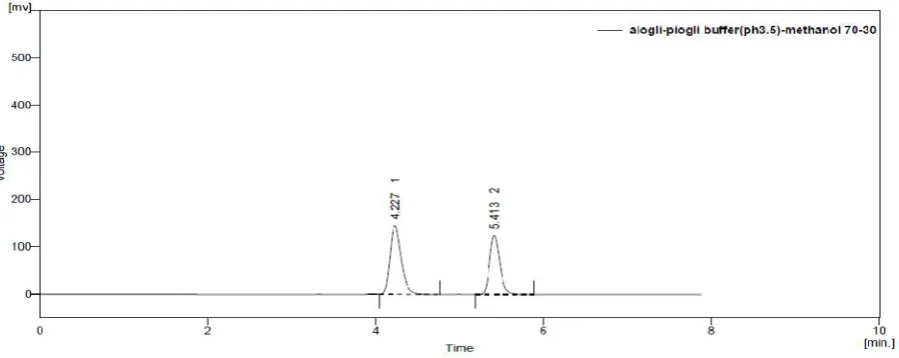
After assessing the solubility of drugs in different solvents as well on the basis of literature survey, the standard solution of Pioglitazone and Alogliptin were injected into the HPLC system by using different solvent systems. Different mobile phases were tried in order to find the best conditions for the separation of both the drugs. It was found that Buffer pH 3.5: Methanol (70:30) give satisfactory results as compared to other mobile phases. Finally, the optimal composition of the mobile phase was determined to be Buffer pH 3.5: Methanol (70:30) which show in Figure 1.
Selection of Detection Wavelength
The Detection of wavelength was done in UV SIMADZU 1800 instrument. The sensitivity of HPLC method that uses UV detection depends upon proper selection of detection wavelength. An ideal wavelength is the one that gives good response for the drugs that are to be detected. In the present study standard drug solutions of 10µg/ml Pioglitazone and 10 µg/ml Alogliptin were, therefore, prepared in solvent mixtures of mixture of Buffer pH 3.5: Methanol (70:30) This drug solution was than scanned in the UV region of 200-400 nm and the spectrum was recorded 271nm which is shown in Figure 2.
Optimized Chromatographic Conditions
The HPLC used for the method was SPD-20AT UV DETECTOR to optimize the chromatographic conditions, the effect of chromatographic variables such as mobile phase pH, flow rate, and solvent ratio were studied. The resulting chromatograms were recorded and the chromatographic parameters such as capacity factor, asymmetric factor and column efficiency were calculated. The conditions that gave the best resolution, symmetry and capacity factor were selected for estimation. Buffer preparation (pH3.5), Mobile phase: Buffer pH 3.5: Methanol (70:30) Flow rate: 1.0 mL/min, Wavelength: 271nm, Column: BDS hypersil C18, 250mm ×
4.6mm, 5µ(particle size) and Injection volume: 20 micro liter
Preparation of standard solutions
Preparation of mobile phase
700 ml of Buffer (pH 3.5) & 300ml Methanol were mixed and used as mobile phase. Use mobile phase as a diluents.
Preparation of STD Stock solution of Pioglitazone
[image:2.595.76.526.567.746.2]
Stock solution of Pioglitazone: 10mg of Pioglitazone was taken as working standard into a 100ml volumetric flask. Added 60ml mobile phase and dissolve, make up volume with mobile phase (100 μg/ml)
Figure 1. Selection of Mobile Phase
Preparation of STD Stock solution of Alogliptin
Stock solution of Alogliptin: 10mg of Alogliptin
working standard into a 100ml volumetric flask. Add 60ml mobile phase and dissolve, make up volume with mobile phase (100 μg/ml)
Calibration curve for the 3.75-18.75μg/ml 6.25-31.25μg/ml Alogliptin
Appropriate volume of aliquots from standard
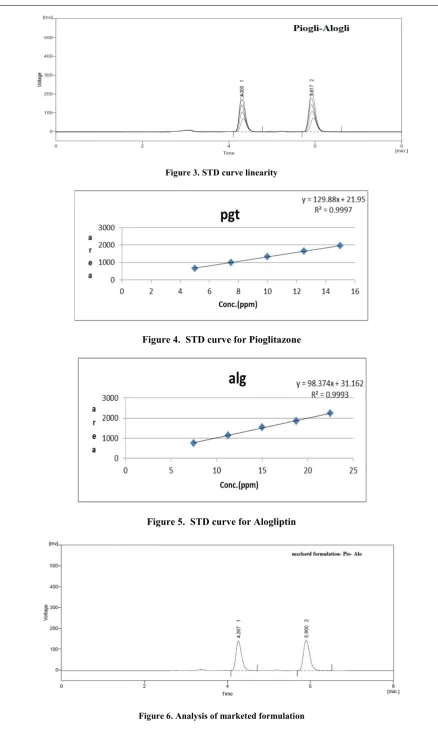
Alogliptin stock solutions were transferred to same volumetric flasks of 10 ml capacity. The volume was adjusted to the mark with mobile phase give a solution containing 3.75, 7.5,11.25,15 &18.75 μg/ml Pioglitazone and 6.25, 12.5, 18.75,25 & 31.25 μg/ml Alogliptin. Each of these mixed standard solutions was chromatographed for 10 minutes run time using mobile phase at 271nm at flow rate of 1 ml/min. The graphs were pl
[image:3.595.309.555.74.117.2]peak area vs. concentration for both the drugs. Data is recorded in Table 1 and Figure 3, 4 and 5.
Table 1. STD curve data for Alogliptin and Pioglitazone
Pioglitazone Alogliptin
Concentration (μg/ml) Concentration (μg/ml) Concentration (μg/ml)
3.75 663.593 6.25
7.5 996.688 12.5
11.25 1335.11 18.75
15 1646.079 25
18.75 1962.437 31.25
Figure 2. Detection of wavelength 271nm
Analysis of marketed formulation
Solution-1: Sample was taken equivalent to 10mg of Pioglitazone (10ml sample) into a 100ml volumetric flask. Added 60ml of mobile phase and shaked for 15 minutes to dissolve. Made up with mobile phase. Filtered this solution with 0.45micron membrane filter
Solution-diluted into a 10ml volumetric flask to get 11.25 Pioglitazone and 18.75 μg/ml Alogliptin.
The prepared sample solution was chromatographed for 10 minutes run time using mobile phase at 271nm at flow rate of 1 ml/min. From the peak area obtained in the chromatogram, the amounts of both the drugs were calculated by fitting peak area responses into the equation of the straight line representing the calibration curves for Pioglitazone and Alogliptin
shown in Table 2 and Figure 6.
Alogliptin
Alogliptin was taken as working standard into a 100ml volumetric flask. Add 60ml mobile phase and dissolve, make up volume with mobile phase
18.75μg/ml Pioglitazoneand
Appropriate volume of aliquots from standard Pioglitazone and stock solutions were transferred to same volumetric flasks of 10 ml capacity. The volume was adjusted to the mark ing 3.75, 7.5,11.25,15 and 6.25, 12.5, 18.75,25 & 31.25 Each of these mixed standard solutions was chromatographed for 10 minutes run time using mobile phase at 271nm at flow rate of 1 ml/min. The graphs were plotted for peak area vs. concentration for both the drugs. Data is recorded
Alogliptin and Pioglitazone
Alogliptin
Concentration Peak Area* (mAU*S) 760.046 1141.598 1529.179 1855.363 2247.677
Detection of wavelength 271nm
1: Sample was taken equivalent to 10mg of (10ml sample) into a 100ml volumetric flask. Added 60ml of mobile phase and shaked for 15 minutes to dissolve. Made up with mobile phase. Filtered this solution -2: solution-1 was k to get 11.25 μg/ml
The prepared sample solution was chromatographed for 10 minutes run time using mobile phase at 271nm at flow rate of 1 ml/min. From the peak area obtained in the chromatogram, the oth the drugs were calculated by fitting peak area responses into the equation of the straight line representing the Pioglitazone and Alogliptin. And result
Table 2. Analysis of marketed formulation
Drugs Label Claim
(mg)
PIOGLITAZONE 15
ALOGLIPTIN 25
Validation of proposed HPLC method
System suitability
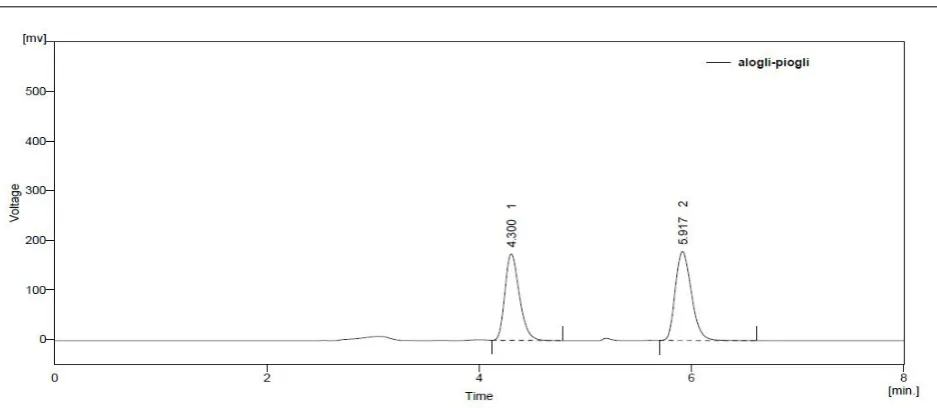
System suitability testing is an integral part of many analytical procedures. The tests are based on the concept that the equipment, electronics, analytical operations and samples to be analyzed constitute an integral system that can be evaluated as such. System suitability test parameters to be established for a particular procedure depend on the type of procedure being validated. System suitability test was carried out to verify that the analytical system is working properly to give accurate and precise results. Standard solution (15μg/ml
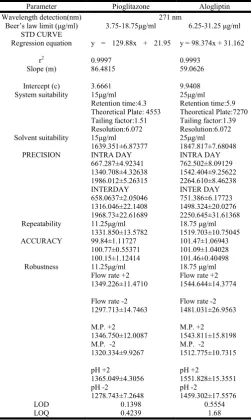
[image:3.595.41.292.311.532.2]25μg/ml Alogliptin) was injected and the chromatogram was recorded in Table 3 and Figure
Table 3. Summary of HPLC method for Pioglitazone & Alogliptin
Parameter Pioglitazone
Wavelength detection(nm) Beer’s law limit (μg/ml)
STD CURVE
3.75-18.75μg/ml
Regression equation y = 129.88x + 21.95
r2 0.9997
Slope (m) 86.4815
Intercept (c) 3.6661
System suitability 15μg/ml
Retention time:4.3 Theoretical Plate: 4553 Tailing factor:1.51 Resolution:6.072
Solvent suitability 15μg/ml
1639.351±
PRECISION INTRA DAY
667.287±4.92341 1340.708± 1986.012± INTERDAY 658.0637± 1316.046± 1968.73±22.61689
Repeatability 11.25μg/ml
1331.850±
ACCURACY 99.84±1.11727
100.77±0.55371 100.15±1.12414
Robustness 11.25μg/ml
Flow rate +2 1349.226±
Flow rate -1297.713±
M.P. +2 1346.750± M.P. -2 1320.334±
pH +2 1365.049± pH -2 1278.743±
LOD 0.1398
LOQ 0.4239
Analysis of marketed formulation
Amount Found (mg)
%
15.20 103.3
25.44 101.7
Validation of proposed HPLC method
System suitability testing is an integral part of many analytical procedures. The tests are based on the concept that the equipment, electronics, analytical operations and samples to be analyzed constitute an integral system that can be evaluated as System suitability test parameters to be established for a particular procedure depend on the type of procedure being validated. System suitability test was carried out to verify that the analytical system is working properly to give accurate and esults. Standard solution (15μg/ml Pioglitazone and ) was injected and the chromatogram was
Figure 7.
Summary of HPLC method for Pioglitazone & Alogliptin
Pioglitazone Alogliptin
271 nm
18.75μg/ml 6.25-31.25 μg/ml
y = 129.88x + 21.95 y = 98.374x + 31.162
0.9993 59.0626
9.9408
Retention time:4.3 Theoretical Plate: 4553 Tailing factor:1.51 Resolution:6.072 25μg/ml Retention time:5.9 Theoretical Plate:7270 Tailing factor:1.39 Resolution:6.072 ±6.87377 25μg/ml 1847.817±7.68048 INTRA DAY 4.92341 ±4.32638 ±5.26315 INTERDAY ±2.05046 ±22.1408 22.61689 INTRA DAY 762.502±8.09129 1542.404±9.25622 2264.610±8.46238 INTER DAY 751.386±6.17723 1498.324±20.0276 2250.645±31.61368 11.25μg/ml ±13.5782 18.75 μg/ml 1519.703±10.75045 99.84±1.11727 100.77±0.55371 100.15±1.12414 101.47±1.06943 101.09±1.04028 101.46±0.40498 11.25μg/ml
Flow rate +2 ±11.4710 -2 ±14.7463 ±12.0087 ±9.9267 ±4.3056 ±7.2648 18.75 μg/ml Flow rate +2 1544.644±14.3774
Flow rate -2 1481.031±26.9563
M.P. +2 1543.811±15.8198 M.P. -2 1512.775±10.7315
pH +2
1551.828±15.3551 pH -2
1459.302±17.5576
0.1398 0.5554
[image:3.595.308.560.331.752.2]Figure 3. STD curve linearity
[image:4.595.74.513.48.781.2]Figure 4. STD curve for Pioglitazone
Figure 5. STD curve for Alogliptin
Figure 6. Analysis of marketed formulation
[image:4.595.117.475.527.740.2]Acceptance Criteria
The % RSD for area response obtained from six replicate injections of Standard solution should be ≤ 2.0 %, Tailing factor should be ≤ 2.0, Theoretical should be ≥ 2000 and Resolution should be ≥ 2.0 in Standard solution.
Solvent suitability
Recorded in Table 3.
Linearity
The linearity of analytical method is its ability to elicit test results that are directly proportional to the concentration of analyte in sample within a given range. The range of analytical method is the interval between the upper and lower levels of analyte that have been demonstrated to be determined within a suitable level of precision, accuracy and linearity. The linearity response was determined by analyzing independent levels of concentrations in the range of 3.75-18.75μg/ml and 6.25-31.25μg/ml for Pioglitazone and Alogliptin respectively six times. Peak area of each solution was measured.
Precision
Repeatability
6 replicates of standard mixture solution having and Pioglitazone (15μg/ml) and Alogliptin (25μg/ml) were prepared and chromatograms were recorded and RSD was calculated and shown in Table 3.
Intraday precision
Standard solutions containing 3.75, 11.25 & 18.75μg/ml Pioglitazone and 6.25, 18.75 & 31.25 μg/ml Alogliptin were analyzed 3 times on the same day. Chromatogram of each sample was recorded. SD and RSD were calculated and shown in Table 3.
Interday precision
Standard solutions containing 3.75, 11.25 & 18.75μg/ml Pioglitazone and 6.25, 18.75 & 31.25 μg/ml Alogliptin were analyzed 3 times on three different days. Chromatogram of each sample was recorded. SD and RSD were calculated and shown in Table 3.
Accuracy
Accuracy is the closeness of the test results obtained by the method to the true value. Recovery studies were carried out by addition of standard drug to the pre analysed sample at 3 different concentration levels (80, 100 and 120 %) taking into consideration percentage purity of added bulk drug samples. It was determined by calculating the recovery Pioglitazone and Alogliptin by standard addition method.
Preparation of sample solution for % recovery
An accurately weighed powder was transferred to 100 ml volumetric flask; dissolved and the volume was made up to the mark using mobile phase to prepare 3.75 μg/ml & 6.25 μg/ml Pioglitazone and Alogliptin respectively. The prepared sample solution was chromatographed for 10 minutes using mobile phase at flow rate of 1 ml/min. concentration of Pioglitazone and Pioglitazoneis calculated which is known as pre-analyzed sample. In pre-analyzed sample 80, 100 and 120% of Pioglitazone and Pioglitazonewas spiked. Chromatogram of each spiked solutions was taken and total amount of drug was calculated and from which % recovery was calculated. This is shown in Table 3.
Limit of Detection (LOD) and Limit of Quantification (LOQ)
The LOD and LOQ are estimated from the set of 6 calibration curves used to determine method linearity.
[image:5.595.69.538.59.263.2]LOD = 3.3 x (SD / Slope) LOQ = 10 x (SD / Slope)
Where, SD = the standard deviation of Y- intercept of 6 calibration curves.
Slope = the mean slope of the 6 calibration curves. This is shown in Table 3.
Robustness
The robustness of an analytical method was carried out to confirm that the method remained unaffected by small but deliberate variations in method parameters and provides an indication of its reliability during normal usage. The standard solution was injected five times for each varied conditions of flow, column temperature, pH, and mobile phase ratio and chromatograms were recorded in table no. 3 Change in Conditions for Robustness like Change in flow rate, M.P. and pH.
RESULTS AND DISCUSSION
High Performance Liquid Chromatographic (HPLC) method has been developed for simultaneous determination of Pioglitazone and Alogliptin in bulk and dosage form. The linearity range was found to be in the range of 3.75-18.75μg/ml for Pioglitazone and 6.25-31.25μg/ml for Alogliptin with using mobile phase Buffer pH 3.5: Methanol (70:30).Correlation co-efficient for calibration curve Pioglitazone and Pioglitazonewas found to be 0.9997 and 0.9993 respectively. The method is Accurate and precise which be used for simultaneous analysis of Pioglitazone and Alogliptin.
Acknowledgement
The author wishes to thanks mates who helped me lot for my work. And how can I forget U.Srinivas, my guide who suggests me in all way.
REFERENCES
A K, G S, C MR, Bhat K, et al. 2008. Simultaneous determination of pioglitazone and glimepiride in bulk drug and pharmaceutical dosage form by RP-HPLC method.
Pak J Pharm Sci., 21(4): 421-5.
Adukondalu D, Malathy PS, Venkateshwar RJ, et al. 2011. Development and validation of HPLC method for
detection of Pioglitazone hydrochloride in dosage forms.
International Journal of Pharmacy and Biological
Sciences, 1(4):474-8.
Chemistry 111 Lab: Intro to Spectrophotometry. Spectrophotometry 2005: E1-8.
Dhirender S, Dwivedi SC, Ashok K. 2011. Development and Validation of a HPTLC Method for simultaneous estimation of Pioglitazone and Glimepiride in bulk and tablet dosage form. International Journal of Biomedical
and Advance Research, 2(9).
Effat S, Hassan J and Shahrooz S. 2008. Development and Validation of a Simple and Rapid HPLC Method for Determination of Pioglitazone in Human Plasma and its Application to a Pharmacokinetic Study. Journal of
Chromatographic Science, Vol. 46; 809-812.
Gadapa N, Upendra MT. 2013. RP-HPLC Analytical Method Development and Validation for Simultaneous Estimation of Three Drugs: Glimepiride, Pioglitazone, and Metformin and Its Pharmaceutical Dosage Forms. Journal of
Chemistry 8 pages.
International Conference on Harmonisation, Guidance for industry in; Q2B Validation on Analytical Procedures: Methodology. Switcherland: IFPMA, 1996: 1-8.
Jajow Swapna, Chandaka Madhu, et al. 2012. Analytical Method Development and Method Validation for the Simultaneous Estimation of Metformin hydrochloride and Pioglitazone hydrochloride in Tablet Dosage Form by RP-HPLC. Asian J. Pharm. Ana., 2(3):85-9.
Karthik, A and Subramanian, G and Rao, Mallikarjuna C and Bhat, et al. 2008. Simultaneous determination of pioglitazone and limepiride in bulk drug and pharmaceutical dosage form by RP-HPLC method. Pak. J.
Pharm. Sci., 2008; 21 (4): 421-5.
Lalit K, Navpreet K. 2011. Estimation of Pioglitazone and Glimipride in its pharmaceutical dosage form by spectrophotometric method Estimation of Pioglitazone and Glimipride in its pharmaceutical dosage form by spectrophotometric methods Scholars Research Library
Der Pharmacia Lettre., 3 (4): 276-284.
Ludwig H, Validation of Analytical Methods and Procedures; Labcompliance News, USA 2007.
Madhukar A, Naresh K, Naveen K, Sandhya N, Prasanna P. 2011. Rapid and sensitive RP-HPLC analytical method development and validation of Pioglitazone hydrochloride. Scholars Research Library Der Pharmacia Lettre, 3(3): 128-132
Narsimha RD, Shanmugasundaram P, Hemant V. 2011. Method Development and Validated of Simultaneous Estimation of Metformin Hydrochloride, Pioglitazone Hydrochloride and Glibenclamide in Pure and Tablet dosage form by Spectrophotometric Multi component Method. International Journal of ChemTech Research, 3(4); 2011-7.
OSENI: http://www.rxlist.com/oseni-drug.htm
Pranshu T, Dheeraj C, Sayantan M. 2012. Simultaneous Estimation of Metformin and Pioglitazone in Combined Dosage Form. International Journal of Pharmaceutical
and chemical Sciences, 1(3):653-8.
Ramzia IE, Ehab FE, Bassam MA. 2012. Liquid Chromatographic Determination of Alogliptin in Bulk and in its Pharmaceutical Preparation International Journal of
Biomedical Science, 8(3):215-218.
Ramzia IE, Ehab FE, Bassam MA. 2012. Liquid Chromatographic Determination of Alogliptin in Bulk and in its Pharmaceutical Preparation. International Journal
of BiomedIcal Science, 8(3): 215-18.
Sane RT, Menon, SN, Shafi I, Mandar M, Gunesh G. 2004. Simultaneous Determination of Pioglitazone and Glimepiride by High-Performance Liquid Chromatography. Springer link Chromatographia, 59(7- 8):451- 453.
Sonali DR, Patil PM, Jadhav SB, Chaudhari PD. 2012. UV Spectrophotometric Simultaneous Determination of Metformine Hydrochloride and Pioglitazone Hydrochloride in Combined Dosage Form. Asian J.
Pharm. Ana., 2 (1):5-9.
Srinivasulu D, Sastry BS, Omprakash G. 2010. Development and validation of new RP-HPLC method for determination of Pioglitazone HCL in pharmaceutical dosage forms.
International Journal of Chemistry Research, 1(1):18-20.
Surendra BB, Sravani, Ravi K. 2012. Method development and validation of simultaneous estimation of metformin and pioglitazone in bulk and pharmaceutical formulation by UPLC. International Research Journal of Pharmaceutical
and Applied Sciences, 2(4):91-6.
Vijaya KK, Nageswara RP et al. 2012. Simultaneous determination of Pioglitazone and Candesartan in human plasma by LC-MS/MS and its application to a human pharmacokinetic study. Journal of Pharmaceutical
Analysis, 2(3):167–173.
Vinod K K, Sudhakar M, Padmanabha RY, Swapna A, Rajani SV. 2012. Method development and validation for simultaneous estimation of Pioglitazone and Glimepiride in tablet dosage form by RP-HPLC and UV- Spectrophotometric method. Current Pharma Research,
2(1): 404-410.