A d-Sequence based Recursive Random Number Generator
Abhishek Parakh Louisiana State University
Introduction
Binary d-sequences were investigated for their cryptographic properties by Subhash Kak in [1,2], who also examined their application to watermarking [3], and made a proposal for their use as random number generators (RNGs) [4] in a manner analogous to the iterative squaring done in the BBS method [5,6].
In this paper we propose a new recursive technique for the use of d-sequences to generate random numbers.
Decimal Sequences
A decimal sequence is obtained when a number is represented in a decimal form in a base r and it may terminate, repeat or be aperiodic. For a certain class of decimal sequences of 1q, prime, the digits spaced half a period apart add up to
q
1
−
r , where r is the base in which the sequence is expressed.
Decimal sequences are known to have good cross- and auto-correlation properties and they can be used in applications involving pseudorandom sequences. The following section describes the properties of
decimal sequences [1,2]:
Theorem 1: Any positive number x may be expressed as a decimal in the base r
... .
... 1 1 2
2
1A A a a
A s+ (1)
where 0≤ Ai <r, 0≤ai <r, not all A and a are zero, and an infinity of the ai are less then (r−1). There exists a one-to-one correspondence between the numbers and the decimals and
... ...
2 2 1 1 1
2
1 + + + + + +
= − +
r a r a A r
A r A
x s s s (2)
That the decimal sequences of rational and irrational numbers may possibly be used to generate pseudo-random sequences is suggested by the following theorems of decimals of real numbers.
Theorem 2: Almost all decimals, in any base, contain all possible digits. The expression almost all implies that the property applies everywhere except to a set of measure zero.
Theorem 3: Almost all decimals, in any base, contain all possible sequences of any number of digits.
Theorems 2 and 3 guarantee that a decimal sequence missing any digit is exceptional.
The binary d-sequence is generated by means of the algorithm:
2 mod mod 2 )
(i p
a = i (3)
It is easy to generate d-sequences, which makes them attractive for many engineering applications.
It was shown in [2] that it is easy to find igiven bits of , therefore, d-sequences cannot be directly used in random number generator applications.
p
2
log a(i)
Kak RNG [4]
By adding together two or more different binary d-sequences (obtained using primes ), one is
able to introduce non-linearity in the generation process and the resulting sequence becomes a good candidate for use as random sequence.
1, 2, ....
p p
... 2 mod mod
2 2 mod mod
2 2 mod mod
2 )
(i = p1 ⊕ p2 ⊕ p3 ⊕
a i i i (4)
where ⊕ is the modular 2 addition and pdenotes a (ideally very large) prime number.
If the individual sequence is maximum length, then the period of the sum will be
...} ), 1 ( ), 1 ( ), 1 (
{ p1 − p2 − p3 −
lcm
where means the Least Common Multiple of aand b. Since we are dealing with only positive
integers, we say c is a least common multiple of and bif )
, (a b lcm
a
1. cis a multiple of and ; a b
2. any multiple of and is a multiple of . a b c
For randomly chosen primes we do not know if the starting number is a primitive root, therefore, the actual period would be a divisor of lcm{(p1−1),(p2 −1),(p3 −1),...}.
If we choose a seed S, which is relatively prime to eachpi, and the order of Sdoes not divide (pi −1)for alli, then the power-exponent random number generates bits according to the following algorithm:
... ...
2 mod mod
2 mod mod
) 2 (
2 mod mod
2 mod mod
) 1 (
2 mod mod
2 mod mod
) 0 (
2 4
1 4
2 2
1 2
2 1
p S
p S
a
p S
p S
a
p S p
S a
⊕ =
⊕ =
⊕ =
(5)
One may replace and by and that are products of primes. For better security, the primes
should each be congruent to as in the BBS generator [5].
1
p p2 n1 n2
) 4 (mod 3
Recursive Random Number Generator
Here, we propose a recursive RNG based on Kak RNG which is motivated by the following goals:
1. Increasing the period of sum of d-sequence not only by a factor of but
by a multiple of it.
)...} 1 ( ), 1
2. Smoothening of auto-correlation function.
The recursive formula proposed is as follows:
) 6 ( 2 mod mod ) mod ... mod mod ( ... ... 2 mod mod ) mod ... mod mod ( 2 mod mod ) mod ... mod mod ( 2 1 12 11 22 1 12 11 21 1 12 11 m k n i i i k n i i i k n i i i p p S p S p S p p S p S p S p p S p S p S + + ⊕ + + ⊕ + +
where is the seed and is a prime number and and are relatively prime to each other. The first
subscript distinguishes the loops and and second subscript is number of that element in its respective loop.
S pfg S pfg
i k
It can be clearly seen from (6) that there are two loops to be traversed during the generation of random binary numbers. The outer loop is with respect to and the inner loop is with respect to , i.e. loop i is nested within the loop .
k i
k
Algorithm:
1. Seed Sis chosen to be a primitive element of all p11,p12, …, p1n.
2. Let t =max(i) be one period of ( mod 11 mod 12 ... mod 1n).
i i i p S p S p
S + +
3. Choosep21,p22, …p2m.
4. Choose an integer and letu max(k)=u. (Note: length of sequencel=t×u.) 5. Execution of loop:
a) Setk =1.
b) Generate random numbers by running from 1 toi t. c) Ifk ≤u, increment to k k+1 and return to a). d) Else quit.
Before we derive the expression for the period of RNG, we define SeedSet.
SeedSet: It represents one period (or a subset of one period) of random numbers generated by addition of
d-sequences n. It is denoted as the set
i i i p S p S p
S mod 11 + mod 12 +... mod 1 S ={S1,S2,S3,...Sw }, where wis a number the choice of which is a part of the design of the RNG.
The length of the period
If is a primitive element of , then the period of
is .
S p11,p12,... p1n n
i i i p S p S p
S mod 11 + mod 12 +... mod 1
} ) 1 ( ... ), 1 ( ), 1 (
{ p11− p12 − p1n −
lcm
If is a not a primitive element of , then, as mentioned earlier, the period of
is a divisor of
S p11,p12,... p1n
n i i i p S p S p
S mod 11 + mod 12 +... mod 1 lcm{(p11 −1),(p12 −1),...(p1n −1)}.
Let denotes the period of and let the generated SeedSet
be . We can write,
s
P (Simodp11 +Simodp12 +...Simodp1n) }
... , , ,
{S1 S2 S3 Sw
S =
) , (
1 1 21
21 Period S p
Pp = , 1 ( 1, 22) …
22 Period S p
Pp = 1 ( 1, 2 )
2 m
p Period S p
P
m =
) , (
2 2 21
21 Period S p
… … … )
,
( 21
21w Period S p
Pp = w , Pp22w=Period(Sw,p22)…Pp2mw=Period(Sw,p2m)
where , denotes the period of d-sequence generated by seed with respect to and
varies from 1 to and ) , (Sq p2r
Period Sq p2r
q w rvaries from 1 to m.
Thus, the period of outer loop is,
)] ... , 1 ( ... ), ... , 1 ( ), ... , 1 ( [ ) ... , 1 ... , ... , 1 , ... , 1 ( 2 2 22 22 21 21 2 2 22 22 21 21 2 22 21 ... w P P lcm w P P lcm w P P lcm lcm w P P w P P w P P lcm P m m m m m p p p p p p p p p p p p p p p = =
The period of the output sequence is,
) (
2 22
21 ... number of elementsintheSeedSet S P P m p p p ×
= (7)
If the inner loop is restricted to just one term, i.e.p11, and p21 < p11, p22 < p11, p23 < p11,...p2m < p11,
then the choice of seed as a primitive root of with a SeedSet consisting of one complete period will guarantee a maximum length sequence. This happens because the SeedSet generated will contain all the numbers less than . At least one of the seeds from the SeedSet will be a primitive element of
, yielding a maximum period for all the primes.
S p11
11
p
m
p p
p21, 22,... 2
We now consider a simple subset of (6) consisting only of two terms each in inner and outer loop and verify the expression for period (7). The subset that we consider is
(8) 2 mod mod ) mod mod ( 2 mod mod ) mod mod
(Si p11 +Si p12 k p21 ⊕ Si p11+Si p12 k p22
Example 1. LetS =2, p11=3, p12 =5, p21=7, p22 =11. Since, 2 is a primitive element of and ,
. SeedSet , and therefore,
11
p p12
4 ) 4 , 2 ( = =lcm
Ps S ={4,5,5,2}
3 ) 7 , 2 ( 4 6 ) 7 , 5 ( 3 6 ) 7 , 5 ( 2 3 ) 7 , 4 ( 1 21 21 21 21 = = = = = = = = Period P Period P Period P Period P p p p p and 10 ) 11 , 2 ( 4 5 ) 11 , 5 ( 3 5 ) 11 , 5 ( 2 5 ) 11 , 4 ( 1 22 22 22 22 = = = = = = = = Period P Period P Period P Period P p p p p
Thus, [ (3,6,6,3), (5,5,5,10)] (6,10) 30
22
21 =lcm lcm lcm =lcm =
Pp p .
The final period of the output sequence is
120 4 30 )} ( { 22
21 × − = × =
=P numberof elementsintheseed set S
P p p .
Results
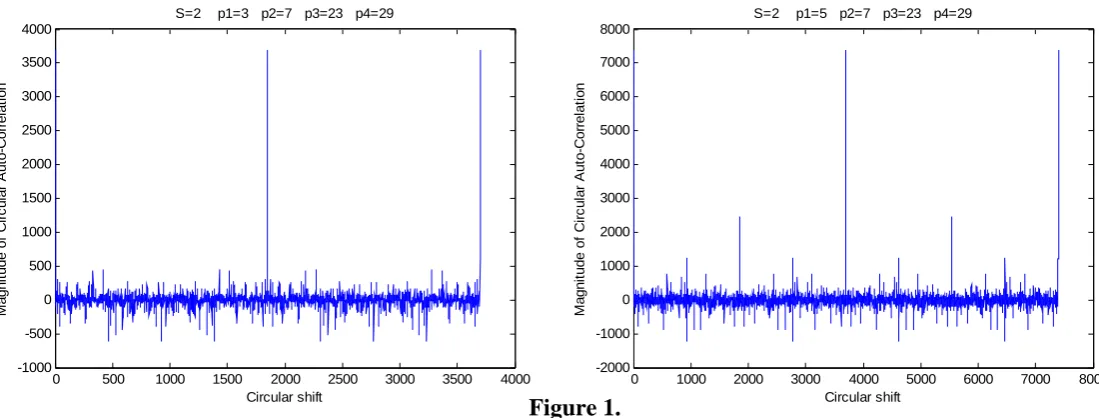
We present results for the simple case (8). Since the auto-correlation function of a random sequence is two-valued, we wish to confirm that our sequences are close to this ideal. (Note: 1. Circular and linear auto-correlations are calculated by setting the 0s (zeros) in the binary output to -1, and the functions are not normalized. 2. The notation in the graphs: p1= p11, p2= p12, p3= p21, p4= p22.)
Circular Auto-correlation
The graphs in Figure (1) show the effect of multiplication of periods. The seed S =2and primes p21=23
and are kept constant. In the left graph, and are 3 and 7, respectively, and from (8) the
period is . In the right graph, and are 5 and 7, respectively, and from (8) the period is
. 29
22 =
p p11 p12
1848 =
P p11 p12
3639 =
P
Figure 1.
0 500 1000 1500 2000 2500 3000 3500 4000
-1000 -500 0 500 1000 1500 2000 2500 3000 3500 4000
Output of Circular Auto-Correlation of Recursive RNG
S=2 p1=3 p2=7 p3=23 p4=29
Circular shift
M
a
gni
tude of
C
irc
u
lar
A
ut
o-C
or
rel
at
io
n
0 1000 2000 3000 4000 5000 6000 7000 8000
-2000 -1000 0 1000 2000 3000 4000 5000 6000 7000 8000
Output of Circular Auto-Correlation of Recursive RNG
S=2 p1=5 p2=7 p3=23 p4=29
Circular shift
M
a
gni
tude of
C
irc
u
lar
A
ut
o-C
or
rel
at
io
n
The graphs in figure (2), illustrate the smoothening effect that Recursive RNG has on the auto-correlation functions of the output random numbers.
0 1000 2000 3000 4000 5000 6000 7000
-1000 0 1000 2000 3000 4000 5000 6000 7000
Output of Circular Auto-Correlation of Recursive RNG
S=2 p1=23 p2=29 p3=43 p4=47
Circular shift
M
a
gni
tude of
C
irc
u
lar
A
ut
o-C
or
rel
at
io
n
6000
0 1000 2000 3000 4000 5000 6000 7000
-1000 0 1000 2000 3000 4000 5000
Output of Circular Auto-Correlation of Recursive RNG
S=2 p1=3 p2=7 p3=43 p4=47
Circular shift
M
a
gni
tude of
C
irc
u
lar
A
ut
o-C
or
rel
at
io
Figure 2.
It is thus observed that the choice of and are the factors that control the smoothening. Larger values of and give even better auto-correlation.
11
p p12
11
p p12
Linear Autocorrelation
The linear auto-correlation of two experimental sequences is shown in figure (3). The comparison to be made in these graphs is that for sufficiently large prime numbers not only the period is very large but its linear autocorrelation approaches ideal approximation for RNG applications.
Figure 3.
Note that for small prime numbers one complete period has been taken into consideration. However, for large prime numbers, since the period is very large, only first 40,000 binary random numbers are taken into consideration.
Conclusions
From the graphs above, it is clear that our goals of an RNG with a very large period and a good approximation to the ideal two-valued auto-correlation function were met. The period of the recursive RNG is in agreement to the theory.
The choice of and provides the user of the RNG flexibility to control the auto-correlation
function to desired characteristics. The results above are for small prime numbers, but they hold good for large prime numbers as well. We have only presented results for a subset (6), and this can be extended to more than two d-sequences in order to obtain larger periods.
11
p p12
Recursive versions of other d-sequence based RNGs described in [4] may also be developed. Another extension would be to base a recursive generator on the cubic transformation [7].
0 0.5 1 1.5 2 2.5
x 104 -2000
0 2000 4000 6000 8000 10000 12000 14000
Output of Linear Auto-Correlation of Recursive RNG
S=2 p1=23 p2=29 p3=43 p4=47
Linear shift
M
ag
ni
tude
o
f L
ine
ar
A
ut
o-C
o
rr
el
at
ion
0 1 2 3 4 5 6 7
4x 10
4
8
x 104 -0.5
0 0.5 1 1.5 2 2.5 3 3.5
Output of Linear Auto-Correlation of Recursive RNG
S=11 p1=4259 p2=8171 p3=41549 p4=13411
Linear shift
M
a
gn
it
ud
e of
Li
n
ear A
u
to
-C
o
rrel
a
ti
o
References
1. S. Kak and A. Chatterjee, 1981. On decimal sequences. IEEE Transactions on Information Theory, IT-27: 647 – 652.
2. S. Kak, 1985. Encryption and error-correction coding using d-sequences. IEEE Transactions on Computers, C-34: 803-809.
3. N. Mandhani and S. Kak. 2005. Watermarking using decimal sequences. Cryptologia, 29: 50-58; arXiv: cs.CR/0602003
4. S. Kak, 2006. A new random number generator. http://www.ece.lsu.edu/kak/RNG.pdf
5. L. Blum, M. Blum, M., and M. Shub, 1986. A simple unpredictable pseudorandom number
generator. SIAM J. Comput., 15: 364-383.
6. C. Ding, 1997. Blum-Blum-Shub generator. Electronics Letters, 33: 677.