Theory and simulation of the swelling of polymer gels
N. R. Kenkare,a)C. K. Hall,b) and S. A. Khan
Department of Chemical Engineering, Box 7905, North Carolina State University, Raleigh, North Carolina 27695-7905
共Received 18 October 1999; accepted 4 April 2000兲
A combined discontinuous molecular dynamics and Monte Carlo simulation technique is used to study the swelling of athermal, continuous-space, near-perfect, trifunctional polymer networks containing hard chains of lengths 20 and 35 immersed in an athermal hard-sphere solvent. The swelling simulations are conducted under conditions of constant pressure and chemical potential. A simple, analytical theory for gel swelling is presented in which the gel free energy is calculated as the sum of an elastic, affine-type term, and a liquidlike mixing term that is based on the generalized-Flory dimer equation of state. The theory shows good agreement with our simulation results for the gel properties at swelling equilibrium. © 2000 American Institute of Physics. 关S0021-9606共00兲50425-5兴
I. INTRODUCTION
When placed in a low molecular weight solvent, all crosslinked polymers will absorb the solvent and swell. The swelling behavior of crosslinked polymers has led to their widespread application in drug delivery, molecular separa-tion systems, biomedical devices including implants and contact lenses, and in emerging technologies such as gel-based valves and actuators, sensors, artificial muscles and display devices.1
The aim of this paper is to investigate the molecular mechanisms underlying gel swelling using carefully con-trolled computer simulations. Specifically, we use a combi-nation of molecular dynamics and Monte Carlo simulation techniques to investigate the swelling of athermal gels in athermal, monomeric solvents. We also derive an analytical, molecularly based theory for gel swelling by extending our previous work2on the pressure-volume properties of solvent-free polymer networks to the case in which solvent is present.
One of the first molecularly based approaches to gel swelling was that of Flory and Rehner,3who suggested that the change in Helmholtz free energy of a polymer gel upon swelling could be expressed as the sum of a polymer-solvent mixing free energy term, and an elastic free energy term,
⌬Aswell⫽⌬Amixing⫹⌬Aelastic, 共1兲
where ⌬Amixing is the free energy change on mixing of the
equivalent uncrosslinked polymer and solvent, and ⌬Aelastic
is the elastic free energy change due to the configurational rearranging and stretching of the crosslinked network chains during the swelling process. The elastic free energy term is considered to be completely independent of the presence and nature of the solvent except insofar as the absorption of sol-vent by the gel causes the network to expand and its chains to stretch. In the Flory–Rehner approach, the
polymer-solvent mixing free energy term is obtained from the Flory– Huggins theory,4and the elastic free energy term is obtained from the affine model for rubber elasticity.5,6 Most subse-quent theoretical work on gel swelling has been based on the Flory–Rehner development 关i.e., on Eq. 共1兲兴, although dif-ferent forms of the mixing and elastic contributions have been used.7–10
Much of the theoretical work on the swelling of crosslinked systems applies to perfect networks, i.e., net-works with constant chain length between junctions and few structural irregularities 共dangling chains, loops, or junctions of varying functionality兲. The validation of network theories is best done using model near-perfect networks with well-characterized molecular structure. Experimental efforts in this direction are, however, hampered by the difficulty asso-ciated with obtaining precise measurements of the network structure. Over the past decade, computer simulation has proved to be a uniquely useful tool in investigating the prop-erties of polymer networks since it allows the construction and investigation of near-perfect model networks with well-characterized structure.
Simulation studies of polymer networks have largely fo-cused on network dynamics, crosslinking kinetics and on PVT properties.11–18,2,19–21 Simulations of gel swelling are rare, partly because of the relatively complex simulation techniques required, and partly because gels take very long times to reach swelling equilibrium. As a result, swelling simulations require the use of efficient simulation techniques as well as large amounts of computing time.
To our knowledge, the only simulations of gel swelling are those of Escobedo and de Pablo,21,22 who conducted Monte Carlo simulations of the swelling of perfect, tet-rafunctional, athermal networks 共of chain lengths 10 to 32兲 having a diamondlike junction connectivity immersed in athermal monomeric and short-chain solvents. The thermo-dynamic properties of the solvent phase were obtained using a suitable equation of state 共for instance the Carnahan–Starling23 equation of state for monomeric sol-vents兲 and the thermodynamic properties of the gel phase
a兲Currently at Lucent Technologies, Norcross, GA. b兲Author to whom correspondence should be addressed.
404
were obtained by conducting Monte Carlo simulations at constant external chemical potential and pressure, i.e., the PT ensemble. Owing to the limitations of conventional Monte Carlo methods for simulating crosslinked systems, Escobedo and de Pablo invented a set of complex Monte Carlo moves共the ECCB, slab, and cluster moves兲for relax-ing the network and for conductrelax-ing the volume change moves necessary in the isobaric ensemble. They found that the mole fraction of the solvent in the gel increased with pressure and with network chain length, and that the gel packing fraction increased with pressure and decreased with network chain length. By conducting a set of NPT ensemble simulations of the gels as they approached equilibrium at a particular pressure, Escobedo and de Pablo found that the packing fraction of the gel always lies between that of the dry network and the bulk solvent at the same pressure. They also presented a mean-field theory for gel swelling, in which the free energy of the gel was considered to be the sum of the free energy of a reference polymer/solvent mixture, and the elastic free energy of the solvent-free network. The free en-ergy of the reference polymer/solvent mixture was obtained from an equation of state for athermal molecules introduced in a previous publication by the authors,24and the elastic free energy of the network was evaluated directly from their simulation results. The Escobedo and de Pablo theory fits their simulation results fairly well; however its semicompu-tational nature precludes its general use for predicting swell-ing equilibria. Their work in simulatswell-ing gel swellswell-ing is sig-nificant in that it presents a way to overcome the limitations of conventional Monte Carlo techniques in investigating these systems. Escobedo and de Pablo’s work represents the first successful simulation-based investigation of gel swell-ing.
Our study of gels is motivated by the paucity of simula-tion data on the swelling and structural properties of network systems, and by the need for an improved analytical theory to predict the phase equilibrium properties of polymer gels. The purpose of this paper is to describe our novel hybrid Monte Carlo molecular dynamics technique for simulating the swelling of model gels, to present data for the solvent uptake and change in volume of model trifunctional gels upon swelling, and to propose a simple theoretical model for gel swelling based on our previously derived equation of state for solvent-free networks.2
We use discontinuous molecular dynamics techniques to construct near-perfect, off-lattice, tri-functional networks of chain lengths 20 and 35. The swelling of these networks in athermal solvents is simulated by allowing the network to absorb hard-sphere solvent molecules and to expand under conditions of constant external chemical potential and sure, where the chosen external chemical potential and pres-sure correspond to the chemical potential and prespres-sure of the pure共bulk兲solvent. This procedure is akin to placing the gel in a large excess of solvent and letting it swell, and is similar to the procedure used by Escobedo and de Pablo21,22in their gel swelling simulations. In this work, the swelling of the gel is simulated using a combination of the discontinuous mo-lecular dynamics 共DMD兲 method and the PT ensemble Monte Carlo algorithm. The DMD method is used to
dis-place the solvent and gel segments in order to relax the sys-tem, and thePT Monte Carlo algorithm is used to conduct volume change and particle insertion/deletion moves which are necessary for the gel to achieve mechanical and chemical equilibrium with the bulk solvent. The thermodynamic prop-erties of the bulk solvent are assumed to remain constant throughout the swelling process, and are described by the Carnahan–Starling23equation of state for hard spheres. Our combined simulation technique is fairly efficient and allowed us to simulate gel systems containing more than 12 000 seg-ments. Another advantage of using this technique is that it can be used to simulate the swelling of networks of different functionalities and molecular weights, without the introduc-tion of complex, system-specific moves.
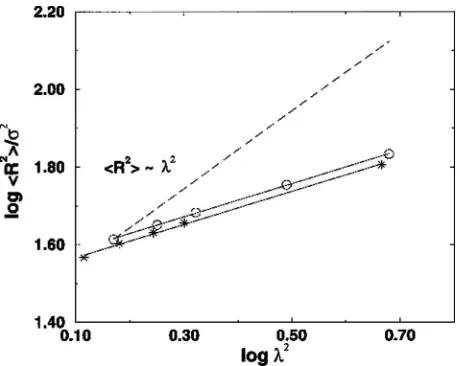
Highlights of our simulation results are as follows. We find that the solvent site fraction共defined as the ratio of the number of solvent beads to the total number of segments in the gel兲 and the gel packing fraction increase with pressure and chemical potential. The solvent site fraction also in-creases with chain length while the gel packing fraction de-creases with chain length. During the constant-pressure swelling of the gel to its equilibrium state, the gel packing fraction is always found to lie between that of the dry net-work and of the bulk solvent. These observations are all in qualitative agreement with the results from the simulations of Escobedo and de Pablo’s. Quantitatively, our results differ somewhat from those of Escobedo and de Pablo; for in-stance, the solvent site fraction in our swelled gels shows a weaker dependence on chain length than in their systems. We also examine the structural characteristics of the network chains as the gel swells, and find that the mean-squared end-to-end vectors of the chains exhibit a weaker-than-affine scaling behavior with the macroscopic swelling.
We extend our previously published theory of networks2 to the case of gel swelling. As before, the network is mod-eled as a set of interpenetrating dendrimers, where each den-drimer branch is a network chain. The free energy of the gel is taken to be the sum of a liquidlike contribution which arises from the polymer-solvent mixing interaction and an elastic contribution which arises from the change in configu-rational free energy of the chains during the volume change that accompanies swelling. The liquidlike contribution to the free energy of the dendrimer-solvent system is obtained from the Generalized Flory–Dimer equation of state for mixtures.25 The elastic free energy contribution to the free energy of the system is obtained the same way as in our previous paper. In this method we invoke an analogy be-tween a classical spring and an ideal, Gaussian network chain, obtain an equivalent ‘‘spring constant’’ and hence free energy for dendrimers composed of these chains, and calcu-late the network elastic free energy 共for the deformed and undeformed network兲as the sum of the free energies of the constituent dendrimers.
as the system moves along the constant-pressure path to swelling equilibria.
The organization of our paper is as follows. Section II describes the molecular model and the simulation techniques used for network construction and relaxation, and for gel swelling. In Sec. III, our theoretical model is described, and in Sec. IV, our simulation and theoretical results are dis-cussed. A brief summary and some further discussion are given in Sec. V.
II. MOLECULAR MODEL AND SIMULATION TECHNIQUE
In this paper, we combine the discontinuous molecular dynamics共DMD兲technique that we have used earlier to treat polymer melts26,27and networks,18,2 with thePT ensemble Monte Carlo algorithm. We begin this section by describing the molecular model for the network and solvent, and then review the DMD technique as it is applied to polymer melts. Next we outline our method for the construction, relaxation, and evaluation of the pressure-volume properties of solvent-free networks. We conclude this section by describing the technique that we have used to simulate gel swelling.
The basic unit of the polymer network is a polymer chain which we represent as a freely jointed chain of tangent hard spheres. The potential energy of interaction between any two beads共segments兲on the same or neighboring chains in the network is given by
U共r兲⫽0, r⬎,
⫽⬁, r⭐, 共2兲
where is the bead diameter. The solvent molecules are represented as hard spheres having the same diameter as the network beads. The potential energy of interaction between any two solvent beads, or between a solvent bead and a bead on a network chain is given by Eq.共2兲.
A. DMD technique, network construction andP – V properties
It is difficult to simulate a system of tangent hard sphere chains using standard molecular dynamics techniques be-cause the tangency requirement cannot be implemented di-rectly. To circumvent this problem, Rapaport28 and Bellemans29 suggested an approach in which the bond length, l, between successive segments of the tangent hard-sphere chain is not kept constant, but is instead allowed to vary freely over the range, (1⫺␦)⬍l⬍(1⫹␦) where ␦Ⰶ1. The chain then effectively becomes a collection of seg-ments connected by sliding links共the Bellemans chain兲. As ␦→0, the chain approximates the tangent-hard-sphere chain model. The relaxation of the constant bond length require-ment allows the chain segrequire-ment trajectories to be partially decoupled, resulting in linear trajectories between collisions. The system dynamics can then be treated using the discon-tinuous molecular dynamics 共DMD兲 techniques developed by Alder and Wainwright30–32 for hard sphere systems. A comprehensive description of the discontinuous molecular dynamics technique is given in the paper by Smith et al.,26,27
along with descriptions of various methods for improving the code efficiency, including neighbor lists, linked lists, binary trees, and delayed position updates.
In order to construct solvent-free tri- or tetrafunctional networks we endlink melts of linear Bellemans chains. Since it is easier to achieve near-complete extents of reaction at lower densities than at higher densities, the endlinking is conducted at an initial system packing fraction of ⫽0.3. The packing fraction is then increased to⫽0.45 by growing the segment diameter. The system packing fraction is defined to be
⫽6 Ncn3
V , 共3兲
where Nc is the number of network chains, n is the chain length and V is the volume of the simulation cell. This crosslinking method allows us to construct nearly perfect dry networks, i.e., solvent-free systems containing a very small percentage of free chains, dangling ends, loops and unsatur-ated junctions 共junctions to which only two chain ends are attached兲. Details of the crosslinking procedure are described in a previous publication.18
In this paper, we focus on two such trifunctional net-works, one containing chains of length 20 and the other con-taining chains of length 35. Each network contains 90 chains. The chain segment diameter equals 1, the Bellemans bond variation factor,␦equals 0.05, and the box length varies with the packing fraction. The structural characteristics of the net-works, displayed in Table I, are described in terms of the elastically active fraction, %elastic, the number of
trifunc-tional junctions, N3, the number of bifunctional 共
unsatur-ated兲junctions, N2, the number of dangling ends and loops, Nend and Nloop and the number of free chains, Nfree. The
elastically active fraction is an important measure of the ‘‘perfectness’’ of our networks, and is defined to be the frac-tion of the chains that are connected at both ends to juncfrac-tions with at least three independent paths to the network.33,34It is calculated in the table by subtracting the number of unsatur-ated junctions, dangling chains, and loops from the total number of network chains, and dividing by the total number of network chains. Since the elastically active fraction is close to 1 for both of the networks considered, and the num-ber of dangling chains, loops and unsaturated junctions is low, we consider these networks to be near-perfect systems. Once the networks attained their final packing fraction of 0.45, they were relaxed for 500 million collisions. Their compressibility factors were then evaluated from the Clau-sius virial theorem in the following form:
TABLE I. The network structural characteristics in terms of the chain length, n, number of chains, Nc, the total number of segments in the system,
Nt, the elastic fraction, %el, the number of trifunctional junctions, N3, the
number of unsaturated共bifunctional兲junctions, N2, the number of dangling
ends, Nend, the number of loops, Nloop,and the number of free chains, Nfree.
n Nc Nt %el N3 N2 Nend Nloop Nfree
20 90 1800 0.99 60 0 0 1 0
Znet⬅ PV NnetkBT⫽
Ncn⫺
m兺collri j•⌬vi j
3kBTte
, 共4兲
where P is the network pressure, Nnetis the number of net-work molecules共Nnet⫽1 since the network is considered to be one large molecule兲, teis the elapsed simulation time over
which the sum is calculated, kBis the Boltzmann constant, T
is the temperature, m is the mass of a network chain segment,
ri j is the vector between segment centers at a collision, and
⌬vi j is the velocity change for the colliding pair. In this
paper, the simulation results are reported in terms of the reduced pressure, P*⬅P3/kBT⫽ZnetNnet6/(Ncn).
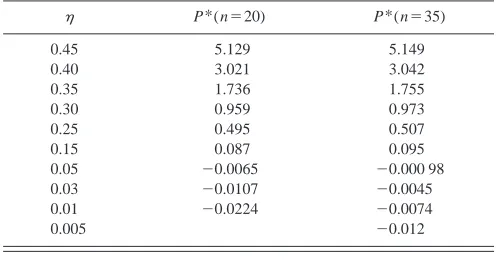
The evaluation of the pressure-volume properties of solvent-free networks is a useful intermediate step in the study of the swelling properties of solvent-containing net-works 共gels兲. The P – V properties of solvent-free trifunc-tional networks of chain lengths, n⫽20, 35, 50, and 100, were reported by us in a previous publication.2The network pressure was obtained over a range of packing fractions共i.e., volumes兲by starting with a high initial density network and expanding it to lower densities using a volume change algo-rithm that takes advantage of the variable bond-length prop-erty of the Bellemans chain. Details of this algorithm are described in Ref. 2. Employing this volume-change method, the networks were expanded from their initial packing frac-tion of 0.45 to successively lower packing fracfrac-tions of 0.35,...,0.003, and the network pressures were calculated at each packing fraction. These simulation results for the net-work pressure are reproduced in Table II and will be used in a comparison later in this paper 共cf. Sec. IV兲 with the pressure-volume behavior of gels.
B. Gel swelling
In this section we describe our combined DMD/PT en-semble Monte Carlo algorithm for simulating the swelling of athermal networks in hard-sphere solvents.
The application of modern phase equilibria computer simulation techniques 共e.g., the Gibbs ensemble method兲 to the case of gel swelling typically involves the use of two separate simulation cells, one for the bulk solvent phase and one for the gel phase. This can be reduced to the use of a single simulation cell for the gel phase alone by considering the situation in which the swelling of the gel takes place in a large excess of bulk solvent. Since the amount of bulk
sol-vent is large compared to the amount of solsol-vent taken up by the gel during swelling, the thermodynamic properties of the bulk solvent 共pressure, chemical potential, and temperature兲 can be assumed to remain constant throughout the swelling process. Therefore the bulk solvent phase need not be simu-lated since its thermodynamic properties can be obtained by using an accurate equation of state. In this paper we use the Carnahan–Starling23 equation of state for hard sphere sol-vents. The simulation of gel swelling in the bulk solvent then reduces to the simulation of the gel phase alone under con-ditions of constant external共bulk solvent兲chemical potential, pressure, and temperature, i.e., in the PT ensemble. At the start of the simulation the gel phase may contain some or no solvent. To achieve thermal, mechanical and chemical equi-librium between the gel and bulk solvent phases in thePT ensemble, the gel undergoes a number of particle displace-ment, volume-change, and solvent particle insertion/deletion moves. After a sufficient number of such moves, the gel approaches swelling equilibrium, i.e., the pressure, and the solvent chemical potential of the gel converge to stable val-ues that are equal to the bulk solvent pressure and chemical potential共the thermal equilibrium condition is trivially satis-fied in an athermal system兲.
In this paper, we have combined the DMD technique with thePT ensemble Monte Carlo algorithm in such a way that the DMD technique is used within the framework of the PT algorithm to execute the particle displacement and vol-ume change moves, while purely Monte Carlo algorithm steps are used for the particle insertion/deletion moves. Our method departs from standard phase equilibria techniques in which Monte Carlo algorithm steps are used for all three types of moves. Our motivation for developing this hybrid method is the following: since the structure of the network is highly constrained and complex, conventional Monte Carlo particle displacement and volume change moves cannot be used because they would cause bond breakage and destruc-tion of the network topology. Thus there is a need for devel-oping alternative techniques/moves for network systems. One solution to this problem is to develop a set of complex, system-specific Monte Carlo particle displacement and volume-change moves that would preserve the network to-pology, as was done by Escobedo and de Pablo.21,22 Our solution has been to simply use the DMD method共which we have employed earlier to investigate the dynamics and pressure–volume properties of networks18,2兲 to conduct the displacement and volume-change moves within the frame-work of the PT Monte Carlo algorithm. The idea of com-bining the DMD method with MC techniques is not novel— for instance a combined DMD–NPT ensemble method was used by Wilson and Allen35 to investigate liquid crystal for-mation. This is, however, the first time that such an approach has been used to study gel swelling. The advantage of our method is that is simple and yet general, so that it can be used to investigate phase equilibria in a variety of con-strained systems.
The details of our simulation technique are as follows. In order to use the DMD technique within the constant PT ensemble MC algorithm, we must assign each particle a ve-locity and calculate particle collision times, just as in a TABLE II. Simulation results共Ref. 2兲for the reduced pressure, P*of dry
trifunctional networks of chain length 20 and 35.
P*(n⫽20) P*(n⫽35)
0.45 5.129 5.149
0.40 3.021 3.042
0.35 1.736 1.755
0.30 0.959 0.973
0.25 0.495 0.507
0.15 0.087 0.095
0.05 ⫺0.0065 ⫺0.000 98
0.03 ⫺0.0107 ⫺0.0045
0.01 ⫺0.0224 ⫺0.0074
purely DMD simulation. At first glance, the simplest way to combine the DMD andPT techniques would perhaps be to replace the particle displacement moves in a regular NVT ensemble simulation with DMD events 共particle pair colli-sions or bond stretches兲. The drawback to this simple proce-dure is that the time interval between events in a DMD simu-lation is not equal 共since the simulation proceeds on an event-by-event basis兲, which in the combinedPT-DMD al-gorithm has the effect of introducing a bias which disturbs the approach of the system to equilibrium. In our simula-tions, we have avoided this bias in the following manner. The total simulation time is divided into equal time steps, which are then grouped into cycles of Nsteptime steps each.
The system is allowed to begin the DMD simulation共i.e., the particle displacement steps兲. When the simulation time is equal to the duration of a time step共or a multiple of a time step兲, a Monte Carlo move is attempted. The Monte Carlo move may be either a particle displacement 共attempted as a DMD event兲, a volume change or a particle insertion/ deletion. The move is accepted or rejected in accordance with the criteria described in the following paragraphs. After the conclusion of the move, the time lists共and particle posi-tions and velocities if necessary兲 are recalculated and the MD simulation is resumed, until the simulation time is equal to that of the next time step, when the next MC move is attempted. Thus in this procedure, a small number of addi-tional DMD particle displacement events are conducted be-tween successive MC moves. The actual number of DMD events taking place between MC moves depends on the size of the time step, i.e., if the time step is chosen to be suffi-ciently small, very few or no DMD events will occur be-tween MC moves. However, the time step must be chosen to be large enough that the system approaches equilibrium in a finite number of moves. In our simulations, between 0 and 4 DMD events occurred between MC moves. The specific type of MC move that is attempted 共i.e., particle displacement, volume change or particle insertion/deletion moves兲 is se-lected randomly, but in accordance with a preset probability that ensures that each cycle of NstepMonte Carlo moves
con-sists of Ndisp particle displacement moves, Nvol volume
change moves, and Ninsparticle insertion/deletion moves.
Starting with a dry network or with a gel containing some solvent, several million Monte Carlo moves are carried out during the slow approach of the system to equilibrium. The simulation is continued until the pressure of the gel and the solvent chemical potential converge to stable values that are approximately equal to the corresponding bulk solvent values. After the pressure and solvent chemical potential of the gel have remained stable about the corresponding bulk solvent values for several million Monte Carlo moves, the system is considered to have reached equilibrium. The equi-librium state of the gel is described by its pressure, solvent chemical potential, gel packing fraction共which indicates the magnitude of the volume change due to swelling兲, and sol-vent site fraction, which is defined as the ratio of solsol-vent segments to the total number of segments共network plus sol-vent兲 in the gel, and is a measure of the amount of solvent absorbed by the gel.
The details of the three types of simulation moves used,
i.e., the particle displacement, volume change and particle insertion/deletion moves are given below. During the particle displacement moves, the DMD procedure is utilized to dis-place the network and solvent beads, keeping the composi-tion and volume of the simulacomposi-tion cell constant. During the volume change move, a trial volume change is attempted, keeping the composition of the cell unchanged. A random number, ⑀, is chosen from the range (⫺⑀max,⑀max), and the
new box volume, Vnew, is taken to be
Vnew⫽Vold共1⫹⑀兲3, 共5兲
where Vold is the old box volume. The positions of the
con-stituent molecules must be scaled in accordance with the change in volume of the cell. In conventional constant– pressure simulations of uncrosslinked chainlike systems, the positions of the particles in the box during a volume change move can be changed by scaling the center of mass locations of each chain molecule by 共1⫹⑀兲, and moving the whole chain without altering the intramolecular positions of the segments. For crosslinked systems, this method cannot be used since it would cause the network connectivity to be broken. To get around this problem, we take advantage of the flexibility of the Bellemans bond length and simply scale the position of each segment by the factor 共1⫹⑀兲. The vol-ume change move is rejected if it results in bond breaking or overlaps between the segments. The move is accepted with a probability equal to min关1,exp(⫺⌬H/kBT)兴, where ⌬H is
given by
⌬H⫽⌬U⫹P⌬V⫺NtkBT log
冉
Vnew
Vold
冊
, 共6兲where⌬U is the change in internal energy due to the volume
change 共equal to zero or infinity for a hard-sphere system兲, ⌬V⫽Vnew⫺Vold is the change in volume of the system, and Ntis the total number of segments in the system. Thus, for a
volume change move to be accepted, ⌬U must be zero, i.e.,
after an attempted volume change, we must search through all the particles in the system to ensure that there are no overlaps or broken bonds. The quantity⑀maxis chosen so as
to produce an acceptance ratio36 of 35–50 %. Once the vol-ume change move is accepted, all the collision times in the system are recalculated and the neighbor lists are reset.
During the particle insertion/deletion move, attempts are made to insert or delete a solvent molecule from the system 共with equal probability兲, keeping the volume of the simula-tion cell constant. During a particle insersimula-tion move, a trial particle is created at a random position in the simulation cell, and the move is accepted36 with a probability equal to min关1,exp(⫺⌬C/kBT)兴where
⌬C⫽⌬U⫺⫺log
冉
VNs⫹1
冊
, 共7兲whereis the chemical potential of the bulk solvent and Ns
res-caled to ensure zero total momentum. During a particle de-letion move, a randomly chosen particle is destroyed; this move is accepted with a probability equal to min关1, exp(⫺⌬D/kBT)兴where
⌬D⫽⌬U⫹⫹log
冉
VNs
冊
. 共8兲
The particle velocities are then rescaled as before.
The gel pressure and solvent chemical potential are evaluated at regular intervals during the simulation in order to monitor the approach of the system towards equilibrium. The gel pressure is obtained by evaluating the compressibil-ity factor from the Clausius virial theorem in the following form:
Z⫽ Nt Nm
⫺m兺collri j•⌬vi j
3NmkBTte
, 共9兲
where Nt⫽Ncn⫹Ns is the total number of beads 共network
segments and solvent兲, Ns is the number of solvent beads,
and Nm⫽1⫹Ns is the total number of molecules in the
sys-tem. The reduced pressure of the system, P*, is obtained from the relation, P*⫽P3/kBT⫽Z6Nm/Nt. The
ex-cess chemical potential of the solvent in the gel is calculated using the Widom test-particle insertion method37 in which we repeatedly attempt to insert a test solvent particle at ran-dom positions in the gel. For a hard-sphere system, the ex-cess chemical potential of the solvent in the gel is simply equal to37 kBT ln(ps
ins
), where psinsis the ratio of the number of successful test solvent particle insertions to the total num-ber of attempted test solvent particle insertions. The bulk solvent pressure and chemical potential are obtained from the Carnahan-Starling equation of state for hard-spheres,23 and are given by
P3 kBT
⫽6 共1⫹⫹ 2⫺3兲
共1⫺兲3 共10兲
and
⫽ln
冉
6 冊
⫹8⫺92⫹33
共1⫺兲3 , 共11兲
where the first term on the right is the ideal contribution to the chemical potential, and the second term is the excess contribution to the chemical potential 共over the ideal兲.
The approach of the system towards equilibrium is ex-tremely slow, particularly at high densities and for large sys-tems. This is partly due to the intrinsically slow relaxation of crosslinked systems, and partly due to the technique used for the volume changes. The latter constitutes a bottleneck for large systems since the positions and collision times of all the particles have to be recalculated following a successful volume change move, and the neighbor lists and time lists have to be reset. As a result, the above volume change method becomes unsuitable for systems larger than about 12 000 segments. To give an approximate idea of the CPU time for these simulations, the generation of each simulation point 共corresponding to a particular value of pressure and chemical potential兲for our 20-mer and 35-mer networks共of 90 chains each兲 containing between 750 and 10 000 solvent
particles, required between 150 and 450 CPU hours on a cluster of DEC Alphas with CPU speeds ranging from 125 to 500 MHz.
The question arises as to whether our combined DMD–MC technique satisfies the detailed balance condition,
pipi j⫽pjpji, 共12兲
where pi and pj represent the probabilities of the system
being in state i and j, respectively, and pi j and pji represent
the transition probabilities from state i to j, and state j to i, respectively. The purely Monte Carlo based techniques for phase equilibria are known to satisfy the above condition, provided that the three types of moves 共particle displace-ments, volume changes and particle insertion/deletion兲 are carried out in a random order共although the total numbers of each type of move can be preset兲.38In our method, although the three types of moves are carried out in a random order, the necessity of incorporating the DMD method into the MC algorithm without introducing any biases associated with the unequal DMD time step has necessitated the carrying out of a few DMD particle displacement events between MC moves. These DMD events may cause the detailed balance condition关Eq.共12兲兴not to be fulfilled for the following rea-son: consider that the system is in state i, before an MC move共say, a volume change兲is attempted. The MC move is attempted, is successful in accordance with the condition stated in Eq.共6兲and the system is now in state, j. In order for the detailed balance condition 关Eq.共12兲兴 to be satisfied, the ratio of the transition probabilities, pji( j→i)/ pi j(i→j ),
must be equal to the ratio, pi/ pj, i.e., Eq.共6兲 must be the
simu-lations is such that a combined MC–MD technique such as ours has proved very useful in providing insights into the phase behavior of these systems.
III. THEORY
In this section, we extend our previously derived equa-tion of state2 for dry athermal networks to the case of network-solvent mixtures, i.e., gels. The basis for our dry network equation of state is the idea共James and Guth39兲that the free energy of a network, Anetwork(), at any packing
fraction, , can be taken to be the sum of a liquidlike con-tribution, Aliq(), which is associated with the interatomic
repulsive forces between the network monomers, and an elastic contribution, Aelastic(), which is associated with the
retractive force exerted by the network chains opposing net-work deformation, i.e.,
Anetwork共兲⫽Aliq共兲⫹Aelastic共兲. 共13兲
In our previous work,2the liquidlike contribution is given by the free energy of a dendritic reference polymer which has the same excluded volume as the network, and the elastic contribution is given by a modified version of the affine model for rubberlike elasticity.
In the case of network-solvent mixtures共gels兲, the free energy of a gel is generally calculated using an approach which is analogous to that described above for dry networks, i.e., the gel free energy, Agel共gel,x), can be evaluated as the
sum of a liquidlike contribution, Amix共gel,x), which is given
by the free energy of a reference-polymer/solvent mixture, and an elastic contribution, Aelastic共gel*,0), which has the
same form as the dry network elastic free energy contribu-tion. The liquidlike contribution to the gel free energy is a function of the gel packing fraction, gel, and the solvent
mole fraction, x, while the elastic free energy is a function of the solvent-free gel packing fraction alone,gel* , wheregel* ⬅ for the equivalent dry network共i.e., a dry network hav-ing the same number of network segments and the same volume as the gel兲. Thus the gel free energy is
Agel共gel,x)⫽Amix共gel,x)⫹Aelastic共gel*,0). 共14兲
In the following sections, the development of analytical expressions for the liquidlike and elastic contributions to the gel free energy, Amix共gel,x), and Aelastic共gel*,0), is
de-scribed. The analytical form for the gel free energy is then employed to predict the gel properties at swelling equilibria, i.e., the solvent fraction and packing fraction of the gel when it attains mechanical and chemical equilibrium in an external solvent at a given pressure and chemical potential. Since the development of the expression for the gel free energy is based on extending our equation of state for solvent-free net-works to the case of mixtures, we begin with an outline of our theory for dry networks.
A. Networks
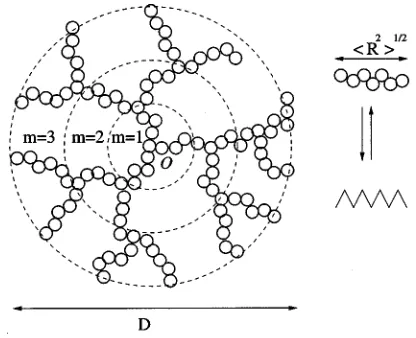
In this section, we outline our approach to calculating the elastic and liquidlike contributions to the free energy of dry networks 共details are given in Ref. 2兲. The network is modelled as a set of interpenetrating dendrimers,2 with each
branch of a dendrimer representing an ideal, Gaussian net-work chain of length n. The dendrimers have the same func-tionality, f as the network. Figure 1 is an example of a single such dendritic structure. It consists of concentric layers of branches or chains, and the total number of layers is called the rank of the network. The first layer of the dendrimer contains f chains, the second layer contains f ( f⫺1) chains, the third layer contains f ( f⫺1)2 chains, and so on. The total number of chains in a dendrimer of rank m is given by
nden⫽f
冋
共f⫺1兲m⫺1
共f⫺2兲
册
. 共15兲The elastic contribution to the network Helmholtz free energy is calculated by invoking the analogy between an ideal network chain and a classical elastic spring,40such that the spring constant of the ideal network chain is given by,
kchain⫽3kBT/
具
R0 2典
, where
具
R02典
⫽nl2 is the mean-square end-to-end distance of the ideal chain. The effective spring constant of a dendrimer molecule, kdendrimer, composed of ndenchains can be calculated in terms of the spring constantof a single chain, i.e., kdendrimer⫽kchainf ( f⫺2)关( f ⫺1)(m⫺1)/( f⫺1)m⫺1兴. The network chain-elastic spring analogy can be carried further to obtain the elastic free en-ergy of the dendrimer as, Adendrimer⫽kdendrimerD2/2, where D2
is the squared spatial dimension or diameter of the dendrimer and is given by D2⫽2m
具
R2典
, where具
R2典
is the mean-squared end-to-end distance of a dendrimer chain. When the network is deformed from an original volume V0 to a finalvolume, V⫽3V0, whereis the deformation ratio, the
den-drimers are assumed to deform affinely, that is, D2⫽2D02, where D02⫽2m2
具
R02典
denotes the mean-squared spatial di-mension of the undeformed dendrimer.The elastic component of the reduced pressure of an
f-functional dendrimer-network of rank m, can be written as2
Pelastic共兲3 kBT
⫽⫺NDAdendrimer共兲 V
⫽⫺120
n m共f⫺2兲
2
冋
共f⫺1兲共m⫺1兲
共共f⫺1兲m⫺1兲2
册冉
0冊
1/3
,
where ND is the number of dendrimers in the network, and
0 is the packing fraction of the undeformed network. To
determine 0, we must first define the undeformed state of
the network. In our simulations, we started with networks at a packing fraction of⫽0.45 and expanded them to succes-sively lower packing fractions of⫽0.35,0.25,...,0.05. Thus the network at⫽0.45 is the starting point for all expansions of the system. At this packing fraction 共i.e., ⫽0.45兲 we found that the mean-squared end-to-end distance of the net-work chains is equal to the mean-squared end-to-end dis-tance of uncrosslinked system chains at the same packing fraction共shown in Ref. 2兲. Hence the configurational entropy of the network chains at a packing fraction of 0.45 is ap-proximately the same as that of the equivalent uncrosslinked system chains at the same packing fraction. At any lower packing fraction共⬍0.45兲, the mean-squared end-to-end dis-tance of the network chains is greater than the mean-squared end-to-end distance of uncrosslinked system chains, and the configurational entropy of the network chains is lower than that of the uncrosslinked system chains at that packing frac-tion. Based on this, the network is considered to be unde-formed at the initial packing fraction of 0⫽0.45 and to be
deformed at all successive lower packing fractions. The de-formation ratio of a network at any packing fraction⭐0
can now be defined as
⫽x⫽y⫽z⫽
冋
0
册
1/3
⫽
冋
0.45册
1/3⫽
冋
VV 0册
1/3
. 共17兲
The liquidlike contribution to the network pressure,
Pliqnet, is obtained using an approach based on the generalized Flory–Dimer 共GF–D兲 theory of Hall and co-workers.41–43 To evaluate Pliqnet, we postulate that Pliqnetis equal to the pres-sure of a reference polymer having the same excluded vol-ume as the network. For our dendrimer-network model, the reference polymer is simply a fluid of f-functional dendrim-ers of rank m. The compressibility factor of the dendrimer fluid is given by2
ZGF–Dnet 共, f兲⫽
冋
vdendrimer共n,m, f兲⫺ve共1兲ve共2兲⫺ve共1兲
册
Z2共兲
⫺
冋
vdendrimer共n,m, f兲⫺ve共2兲ve共2兲⫺ve共1兲
册
Z1共兲, 共18兲
where Z1() and Z2() are the compressibility factors of fluids composed of hard sphere monomers and dimers, re-spectively, at the same packing fraction as the dendrimer fluid, vdendrimer(n,m, f ) is the excluded volume of a
den-drimer of rank m and functionality, f, and ve(1) andve(2)
are the monomer and dimer excluded volumes, where
ve(1)⫽(4/3)3 andve(2)⫽(9/4)3.
The excluded volume of the dendrimer is obtained by treating the dendrimer fluid as a set of f-functional star-centers connected by linear arms共as shown in Fig. 1兲, and is given by
vdendrimer共n,m, f兲⫽
冋
1⫹f共f⫺1兲共m⫺1兲⫺1
共f⫺2兲
册
vcenter共f兲⫹共n⫺4兲⫻
冋
f共共f⫺1兲m⫺1⫺1兲
共f⫺2兲
册
共ve共3兲⫺ve共2兲兲⫹2 f共f⫺1兲共m⫺1兲共ve共3兲⫺ve共2兲兲, 共19兲
where vcenter( f ) is the excluded volume of the star center, and ve(3)⫽9.826053 is the excluded volume of a trimer.
The excluded volume of the star center is calculated using a Monte Carlo simulation technique following that of Alejan-dro and Chapela44and Yethiraj and Hall;45for a trifunctional network ( f⫽3), vcenter(3)⫽18.01⫾0.05, and for a tet-rafunctional network ( f⫽4), vcenter(4)⫽23.06⫾0.032.
The compressibility factor of the monomer fluid, Z1(),
is obtained using the Carnahan–Starling equation of state,23
Z1共兲⫽
1⫹⫹2⫺3
共1⫺兲3 共20兲
and the compressibility factor of the dimer fluid is obtained using the Tildesley–Streett equation of state46
Z2共兲⫽
1⫹a1⫹a22⫺a33
共1⫺兲3 , 共21兲
where a1, a2, a3 are constants which take the values, a1
⫽2.456 96, a2⫽4.103 86, and a3⫽3.755 03.
The liquidlike contribution to the network pressure is obtained from the relation, Pliq
net
()/kBT⬅ZGF–D net
ND/V
⫽ZGF–Dnet (, f )(6/(3ndenn)).
The total reduced pressure of the solvent-free network is then given by the sum of the elastic pressure 关Eq.共16兲兴and the liquidlike pressure关Eq.共18兲兴
Pnetwork共兲3 kBT
⫽Pelastic共兲3 kBT
⫹Pliq net
共兲3 kBT
⫽⫺120
n m共f⫺2兲
2
冋
共f⫺1兲共m⫺1兲
共共f⫺1兲m⫺1兲2
册
⫻
冉
0冊
1/3
⫹ZGF–Dnet 共, f兲
⫻n6
冋
f共共f共⫺f⫺1兲2m兲⫺1兲册
. 共22兲B. Gel swelling
In this section, we extend our equation of state for solvent-free networks to the case of gels. Our primary objec-tive is to develop analytical expressions for the gel free en-ergy, pressure, and chemical potential which can be used to predict the extent of swelling and the solvent uptake of swelled gels in equilibrium with a bulk hard-sphere solvent. Mathematically the conditions for an athermal gel to be in swelling equilibrium with an athermal bulk solvent may be written as
Pbulk⫽Pgel, bulk
s ⫽
gel
s
, 共23兲
poten-tial, andgels represents the solvent chemical potential in the gel phase. We now develop analytical expressions for each of the terms in the above equation.
The pressure of an athermal gel 共an athermal network swelled with athermal solvent兲can be written21,22,5in a form analogous to Eq.共22兲, as the sum of an elastic contribution, and a liquidlike contribution,
Pgel共,x兲3 kBT
⫽Pelastic共*,0兲3 kBT
⫹Pmix共,x兲3 kBT
. 共24兲
The elastic contribution to the gel pressure, Pelastic(*,0), is
calculated on a solvent-free basis, and has exactly the same form as described in the preceding section for dry networks 关cf. Eq. 共16兲兴. The solvent-free packing fraction of the net-work, *, is given by*⫽ND(ndenn)3/6V, where NDis
the number of dendrimer molecules, and (ndenn) is the
num-ber of segments in each dendrimer molecule;*can also be written in terms of the solvent mole fraction and gel packing fraction as *⫽关(1⫺x)(ndenn)兴/关x⫹(1⫺x)(ndenn)兴,
where x is the solvent mole fraction in the gel.
The liquidlike contribution to the gel pressure,
Pmix(,x), is obtained from the thermodynamic properties
of a mixture of dendrimer and solvent molecules at the same packing fraction and composition as the gel, and is evaluated using a simple conformal-solution-type equation, following Honnell and Hall.25 For a mixture of ND dendrimer
mol-ecules and Ns solvent molecules having the same segment diameter, the compressibility factor of the mixture, Zmix ⬅PmixV/kBT(ND⫹Ns), is given by the mole fraction aver-age of the GF–D compressibility factors of the pure, con-stituent species evaluated at the packing fraction of the mix-ture,
Zmix共,x兲⫽xZs共兲⫹共1⫺x兲ZGF–D net
共兲, 共25兲
where Zs() is the compressibility factor of the solvent, and
ZGF–Dnet () is the compressibility factor of the dendrimer-molecule reference polymer system.
The total reduced pressure of the gel is then given by the sum of the elastic and liquidlike contributions to the pres-sure,
Pgel共,x兲]3 kBT
⫽Pelastic共*,0兲3 kBT
⫹Pmix共,x兲3 kBT
⫽⫺120
n m共f⫺2兲
2
冋
共f⫺1兲共m⫺1兲
共共f⫺1兲m⫺1兲2
册
⫻
冉
* 0冊
1/3
⫹Zmix共,x兲
6
⫻
冋
n 共f⫺2兲共f共共f⫺1兲m⫺1兲共1⫺x兲⫹x共f⫺2兲兲
册
. 共26兲The last term in the above equation is obtained from the expression Pmix⫽Zmix(ND⫹Ns)/V where ND and Ns are
rewritten in terms of the packing fraction,, and the solvent
mole fraction, x, by using the definitions
⫽(/6)3(NDndenn⫹Ns)/V and x⫽Ns/(ND⫹Ns). We
now look at how Eq.共23兲and Eq.共26兲can be used to predict the phase equilibrium properties of the swelled gel.
Since the bulk solvent in our system is a pure hard-sphere fluid, its thermodynamic properties can be obtained from the Carnahan–Starling equation of state.23The pressure of the bulk solvent is given by Eq.共20兲, evaluated at the bulk solvent packing fraction,bulk. The chemical potential of the
bulk solvent is given by Eq. 共11兲 evaluated at the bulk sol-vent packing fraction. The thermodynamic properties of the bulk phase remain unchanged as the gel swells.
To obtain the gel properties 共i.e., the packing fraction and solvent mole fraction兲at which the swelling equilibrium conditions in Eq.共23兲are satisfied, we must find how the gel phase pressure, Pgeland solvent chemical potential,gels de-pend on the packing fraction and mole fraction. The pressure of the gel phase can be obtained using Eq. 共26兲. The chemi-cal potential of the solvent in the gel phase can be evaluated if the Helmholtz free energy of the gel is known as a function of the solvent mole fraction, x, at constant V and Nk, where
Nkis the number of molecules of other共nonsolvent兲species
present:
gel
s
kBT
⫽id,gel
s
kBT
⫹ex,gel
s
kBT
⫽Aid,gel/kBT
Ns
冏
V,T,Nk
⫹Aex,gel/kBT
Ns
冏
V,T,Nk
, 共27兲
where Aid,geland Aex,gel are the ideal gas and excess
contri-butions to the gel free energy. In our system, since we have a single-component solvent, Nk is equal to the number of
dendrimer molecules, which always remains constant during the swelling process 共since the solvent is the only migrant species兲.
To calculate the solvent chemical potential, we must cal-culate the total Helmholtz free energy Aid,gel⫹Aex,gel as a
function of the solvent mole fraction, x, at constant volume,
V. From Eq.共14兲, we already know that the Helmholtz free energy of the gel, Agel(,x), is the sum of the elastic
contri-bution, Aelastic(*,0), and the liquidlike contribution Amix(,x). The liquidlike contribution to the free energy of the gel can be calculated as the sum of an ideal component,
Aid,mixand an excess component, Aex,mix. The ideal compo-nent of the Helmholtz free energy of the gel, Aid,gel, is equal to the ideal component of the liquidlike contribution to the gel free energy, Aid,mix, because the elastic contribution to
the gel free energy does not contain an ideal component, and because Aid,mix(,x) is evaluated at the same packing
frac-tion and mole fracfrac-tion as the gel. Hence, the excess Helm-holtz free energy of the gel, Aex,gel(,x) is the sum of the
excess component of the liquidlike free energy contribution,
Aex,mix(,x), and the elastic contribution, Aelastic(*,0). We
can now use our expression for Zmix共Eq. 25兲to evaluate the
Aex,mix共,x兲 共ND⫹Ns兲kBT⫽
冕
0
关Zmix共
⬘
,x兲⫺1兴 d⬘
⬘
⫽
冕
0 关共xZs共
⬘
兲⫹共1⫺x兲⫻ZGF–Dnet 共
⬘
兲兲⫺1兴d⬘
⬘
⫽x
冕
0
共Zs共
⬘
兲⫺1兲d
⬘
⬘
⫹共1⫺x兲⫻
冕
0
共ZGF–Dnet 共
⬘
兲⫺1兲d⬘
⬘
. 共28兲For a pure hard-sphere solvent, Zs(
⬘
) is given by Eq.共20兲.For ZGF–Dnet (
⬘
), we use the expression given by Eq.共18兲, and obtain an analytical expression for the excess component of the liquidlike free energyAex,mix共,x兲
共ND⫹Ns兲kBT⫽x
冋
4⫺32
共1⫺兲2
册
⫹共1⫺x兲⫻
冋
共 11⫺兲2
冉
A1⫹A2⫹A3
2
冊
⫺共1⫺1兲 共A2⫹2A3兲⫺A3ln共1⫺兲
⫺
冉
A1⫹A2⫺3A32
冊册
, 共29兲where A1, A2 and A3 are constants given by
A1⫽共a1⫺1兲Yn⫹共a1⫹3兲,
A2⫽共a2⫺1兲Yn⫹共a2⫺3兲, 共30兲 A3⫽共1⫺a3兲Yn⫹共1⫺a3兲,
and a1, a2, a3 are constants from the Tildesley–Streett
equation of state 关Eq. 共21兲兴, and Yn⫽(vdendrimer(n,m, f )
⫺ve(1))/(ve(2)⫺ve(1)). The elastic component of the
ex-cess free energy of the gel is given by2
Aelastic共*,0兲⫽3kBTm f共f⫺2兲
冋
共f⫺1兲共m⫺1兲 共f⫺1兲m⫺1
册冉
0 *
冊
2/3
. 共31兲
The chemical potential of the solvent in the gel phase is then
gel
s ⫽
Ns关Aid,mix兴V,Nk⫹
Ns关Aex,mix⫹Aelastic兴V,Nk. 共32兲 Since the elastic free energy contribution关Eq.共31兲兴depends only the volume change of the network during swelling, and is calculated on a solvent free basis, the term,Aelastic/Nsis zero under constant volume conditions. Hence Eq.共32兲 can be rewritten as
gel
s ⫽
Ns关
Aid,mix兴V,N
k⫹ Ns关
Aex,mix兴V,N
k. 共33兲
Expressing x and in terms of Ns, i.e., x⫽Ns/(Ns⫹ND),
and ⫽关Ns⫹ND(ndenn)兴/6V, the term Aex,mix can be
re-written in terms of the single variable, Ns. Taking the
de-rivative of Aid,mix 关where Aid,mix⫽kBT(Ns⫹ND)ln关(Ns
⫹ND兲/V兴⫺1] and Aex,mixwith respect to Ns then yields
gel
s ⫽
ln共s兲⫹
冋
共4⫺2兲 共1⫺兲3 ⫹
4⫺32 共1⫺兲2
册
⫹共1⫺兲 共ndenn兲
⫻
冋
共A1⫹A2⫹A3兲共1⫺兲3 ⫺
共A2⫹2A3兲
共1⫺兲2 ⫹ A3
共1⫺兲
册
, 共34兲 where s⫽Ns/V is the number density of the solvent mol-ecules in the gel, and ⫽(ndenn)x/关(1⫺x)⫹(ndenn)x兴 is the solvent site fraction.Since we now know the gel pressure and the solvent chemical potential that appear in Eq. 共23兲 in terms of the packing fraction and mole fraction, we can proceed with our phase equilibria calculations. Our aim is to calculate the value of the solvent mole fraction, x, and the gel packing fraction,, at which the gel pressure and the solvent chemi-cal potential in the gel equal the predetermined values of the bulk solvent pressure and chemical potential. This is done by adopting the method and numerical techniques of Kenkare
et al.,47 as outlined below. At predetermined values of the bulk solvent pressure, Pbulkwe iterate onat each value of x共in increments of 0.000 01兲, until we find the packing frac-tion at which the evaluated pressure, Pgel approaches Pbulk
within some tolerance␦⭐10⫺6. This gives us a curve for versus x at which Pgel equals Pbulk. In order to find out
which value of (x) satisfies the criterion, gels ⫽bulks we then use Eq.共34兲 to evaluate the solvent chemical potential as a function of x. When gels equalsbulks within some tol-erance␦1⬍10⫺3, the conditions for swelling equilibrium are
satisfied. This method is used to calculate the gel packing fractions and solvent mole fractions over a range of bulk solvent pressures.
IV. RESULTS AND DISCUSSION
In Tables III and IV we present simulation results for the thermodynamic properties of 20-mer and 35-mer trifunc-tional gels that are swelled to equilibrium in a hardsphere solvent. The tables show the reduced pressure and chemical potential of the bulk solvent phase, Pbulk,CS* andbulk,CS
s 共
cal-culated using the Carnahan–Starling23equation of state兲, and our simulation results for the reduced pressure and the sol-vent chemical potential of the gel phase, Pgel* andgels , the packing fraction of the gel phase, ⫽(Ns⫹Ncn)3/6V,
the solvent site fraction, ⫽Ns/(Ns⫹Ncn), the number of
solvent molecules in the gel, Ns, and the total number of
⫽5.0 for the 20-mer gels, and for pressures ranging from
P*⫽0.1 to P*⫽3.0 for the 35-mer gels. We were unable to obtain swelling data for the 35-mer network at pressures higher than P*⫽3.0 owing to computational limitations as-sociated with the large number of solvent molecules in the system 共the 35-mer network at P*⫽3.0 contained about 9300 solvent molecules in addition to 3150 network seg-ments兲.
Figure 2 displays the reduced pressure versus packing fraction for a pure hard-sphere fluid 共from the Carnahan– Starling equation of state23兲, a trifunctional 20-mer gel swelled to equilibrium in hard-sphere solvent 共from our simulation results, cf. Table III兲, and a solvent-free trifunc-tional 20-mer network共from our previously published2 simu-lation results, cf. Table II兲. This plot helps us to compare the magnitude and trends in the gel properties with the magni-tudes and trends in the pure solvent and network properties. The lines through the 20-mer gel and solvent-free network data show our theoretical predictions for the gel 共from Sec. III B兲and for the network关Eq.共22兲兴. We see that, at a given packing fraction, the pressure of the gel always lies between the pressures of the bulk-hard-sphere solvent and the pure network. The theoretical prediction for the gel packing frac-tion agrees very well with the simulafrac-tion data.
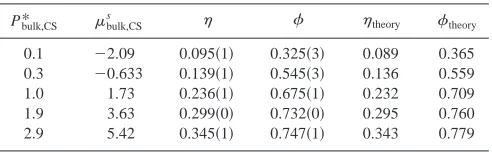
Figure 3 shows the equilibrium values for the solvent site fraction, , and the gel packing fraction, , versus re-duced gel pressure, Pgel* , for the 20-mer and 35-mer net-works. Both the solvent site fraction and the gel packing fraction are observed to increase with pressure. The solid lines show the predictions of our theory for the 20-mer net-work, and the dashed lines show the predictions of our theory for the 35-mer network. The numerical values for our predictions are shown in Tables V and VI. It is evident that the theoretical predictions for the packing fraction show ex-cellent agreement with the simulation results. The theory also shows good agreement with the solvent site fraction
data, although it overpredicts the solvent site fraction at high pressures for the 20-mer and the 35-mer networks. The rea-son for the overprediction of by our theory at high pres-sures is not completely clear; a possible explanation may be that the elastic term关Eq.共22兲兴performs poorly at high pres-sures, since the gel is highly deformed 共expanded兲 and the network chains are considerably extended. As a result the chain vector distribution may deviate significantly from the Gaussian, causing an increase in the magnitude of the elastic contribution to the network pressure, and a decrease in the overall network pressure. A similar and possibly related phe-nomenon was observed by us in our previous work on the pressure–volume behavior of dry networks; we observed that when such networks were expanded to very large deforma-tion ratios there was a sudden increase in the magnitude of the elastic component of the network pressure 共which is negative兲, and our theory 共being based on a Gaussian chain model兲was less able to accurately predict the network pres-sure. Similarly, in highly swelled gels, the magnitude of the negative elastic contribution to the network pressure may be greater than is predicted by our theory, resulting in overpre-diction of the gel pressure.
From Fig. 3 and the values in Tables III and IV, we observe that the equilibrium gel packing fraction of the 35-mer network is slightly lower than that of the 20-35-mer net-work at any given pressure, i.e., the pressure of the gel in-creases with increasing chain length at any given packing fraction. This trend is similar to that seen in dry networks and is accurately predicted by our theory. In an equivalent uncrosslinked system 共in which the system pressure is given by the mixing contribution alone兲, the pressure decreases with increasing chain length. To understand why the gel pressure should increase with increasing chain length, it is necessary to recall that the magnitude of the negative elastic contribution to the gel pressure decreases with increasing chain length at a given packing fraction关cf. Eq.共16兲兴. This is TABLE III. Equilibrium data for the 20-mer gel. Values for the bulk solvent pressure, Pbulk,CS* , and chemical
potential,bulk,CSs , calculated from the Carnahan–Starling共Ref. 23兲 共CS兲equation of state for hard spheres, and our simulation results for the gel pressure, Pgel* , solvent chemical potential, gel
s
, gel packing fraction,, solvent site fraction,, the number of solvent molecules in the gel, Ns, and the total number of segments in the gel, Nt. The values in parentheses indicate the uncertainty in the last digit; for instance a value of 4.99共4兲is equivalent to a value of 4.99⫾0.04.
Pbulk,CS* bulk,CS
s
Pgel* gel
s N
s Nt
0.1 ⫺2.09 0.105共4兲 ⫺2.05共3兲 0.106共2兲 0.286共4兲 721⫾13 2521⫾13
0.5 0.219 0.501共3兲 0.216共40兲 0.180共1兲 0.570共1兲 2386⫾10 4186⫾10
1.0 1.73 1.003共4兲 1.73共1兲 0.239共1兲 0.643共1兲 3242⫾15 5024⫾15
3.0 5.49 2.98共2兲 5.48共4兲 0.351共1兲 0.698共1兲 4160⫾20 5960⫾20
5.0 8.37 4.99共4兲 8.38共6兲 0.409共1兲 0.701共1兲 4220⫾20 6020⫾20
TABLE IV. Equilibrium data for the 35-mer gel. Notation as in Table III.
Pbulk,CS* bulk,CS
s
Pgel* gel
s N
s Nt
0.1 ⫺2.09 0.100共1兲 ⫺2.12共2兲 0.095共1兲 0.325共3兲 1517⫾20 4667⫾20
0.3 ⫺0.633 0.296 ⫺0.65 0.139共1兲 0.545共3兲 3775⫾45 6925⫾45
1.0 1.73 1.01共1兲 1.74共1兲 0.236共1兲 0.675共1兲 6542⫾30 9692⫾30
1.9 3.63 1.92 3.60 0.299共0兲 0.732共0兲 8600⫾5 11 750⫾5
because the elastic contribution to the gel pressure arises from the retractive force exerted by the chains opposing net-work deformation, which in turn is related to the ratio of the end-to-end distance of the network chains to their maximum extended length.2At a given packing fraction or deformation ratio, the ratio of the end-to-end distance of a network chain to its maximum extended length is greater for the chains in a short chain-length network than for the chains in a long chain-length network. Hence the short network chain under-goes a greater loss of configurational entropy than a long network chain at a given network deformation ratio, and ex-erts a correspondingly greater retractive force on the net-work. Thus, the magnitude of the retractive force exerted by the chains increases with decreasing chain length at a given deformation ratio. The corresponding negative elastic
contri-bution to the pressure increases in magnitude also, causing the total pressure of the gel to decrease with decreasing chain length.
From Fig. 3 and Tables III and IV, we also observe that the equilibrium value of the solvent site fraction increases with increasing chain length at a given pressure and bulk solvent chemical potential. We can understand why this is so by returning to the chemical potential equilibrium condition 关Eqs. 共23兲and共27兲兴.
bulk
s ⫽
gel
s ⫽
id,gel
s ⫹
ex,gel
s , 共35兲
whereid,gels andex,gels are the ideal and excess components of the chemical potential of the solvent in the gel. At a given value of the bulk solvent pressure and chemical potential, the solvent chemical potentials in a 20-mer and 35-mer gel at swelling equilibrium are both equal to bulks although the magnitudes of the individual ideal and excess chemical po-tential contributions are not the same. The ideal component of the solvent chemical potential is given by id,gels ⬅kBT log(s)⫽kBT log(), wheres is the number density
of the solvent molecules. The excess component of the sol-vent chemical potential is calculated using the relation ex,gel
s ⬅⫺k
BT log(s
ins), where p
s
ins is the probability of
in-serting a test solvent molecule into the gel. Now we saw earlier that at a given bulk solvent pressure or chemical po-tential, the equilibrium packing fraction of the gel decreases with increasing chain length, i.e., the packing fraction of the 20-mer gel at swelling equilibrium is higher than the packing fraction of the 35-mer network under the same conditions. Therefore we expect that it will be more difficult to insert a solvent molecule into the 20-mer gel than into the 35-mer gel at that bulk pressure or chemical potential, and therefore,
psins(20)⬍psins(35). Hence the excess solvent chemical po-tential of the 20-mer gel will be higher than that of the 35-mer gel, i.e.,ex,gels (20)⬎ex,gels (35). Since both the 20-mer FIG. 2. Reduced pressure, P*⫽P3/k
BT, versus packing fraction,, for
共1兲a pure hard-sphere fluid,共2兲a 20-mer trifunctional gel, and共3兲a 20-mer solvent-free trifunctional network. The lines through the gel and network data points represent our theoretical predictions.
FIG. 3. Simulation results for the solvent site fraction,, and the packing fraction, , of the gel versus reduced pressure, P*⫽Pgel3/k
BT for the 20-mer and 35-mer networks. The solid lines represent our theoretical pre-dictions for the 20-mer network, and the dashed lines represent our theoret-ical predictions for the 35-mer network.
TABLE V. Comparison between our simulation results and our theoretical prediction for the 20-mer gel. Simulation data for the gel packing fraction,
, and solvent site fraction,, and our theoretical predictions,theoryand theory.
Pbulk,CS* bulk,CS
s theory theory
0.1 ⫺2.09 0.106共2兲 0.286共4兲 0.102 0.283
0.5 0.219 0.180共1兲 0.570共1兲 0.180 0.551
1.0 1.73 0.239共1兲 0.643共1兲 0.237 0.634
3.0 5.49 0.351共1兲 0.698共1兲 0.349 0.716
5.0 8.37 0.409共1兲 0.701共1兲 0.405 0.745
TABLE VI. Comparison between our simulation results and our theoretical prediction for the 35-mer gel. Simulation data for the gel packing fraction,
, and solvent site fraction,, and our theoretical predictions,theoryand theory.
Pbulk,CS* bulk,CS
s theory theory
0.1 ⫺2.09 0.095共1兲 0.325共3兲 0.089 0.365
0.3 ⫺0.633 0.139共1兲 0.545共3兲 0.136 0.559
1.0 1.73 0.236共1兲 0.675共1兲 0.232 0.709
1.9 3.63 0.299共0兲 0.732共0兲 0.295 0.760