LIMITING DISTRIBUTION UNDER ASSORTATIVE MATING*
G. L. GHAI
Statistical Laboratory, Iowa State University, Ames, Iowa 50010
Manuscript received October 9, 1972
Revised copy received July 9, 1973
ABSTRACT
A multi-locus model for complete positive assortative mating is discussed.
For a two-locus model, if the gene frequencies for the two loci are different, as they are likely to be, it is shown that i n equilibrium the population is not composed of only two homozygous types, as is usually thought. The limiting distribution will have three homozygous genotypes depending upon the initial gene frequencies. If there are m-loci such that gene frequencies at all loci are different, there will be (m+l) such homozygous genotypes present in the equilibrium population, one in each phenotypic group.
SSORTATIVE mating is a form of nonrandom mating where mating is based
A
on the phenotypic properties of mates. This tendency to mate assortatively is known to occur in certain bird, mammal, and insect populations. I n human populations where homogamy prevails, conventional barriers greatly restrict the choice of a mate. Hence human parents tend to resemble one another in heritable characters, e.g., height, intelligence, etc.The simplest model of complete positive assortative mating for a single locus with complete dominance was discussed initially by
JENNINGS
(1916). These results were later extended byWENTWORTH
andREMICK
(1916) who gave a more general formula. Positive assortative mating leads to complete homozy- gosity of a population, though very slowly. In the case of a single locus with al- leles A and a and complete dominance, the frequency of Aa individuals after ngenerations of positive assortative mating is given by (e.g., LI 1955, p. 234)
where H , is the initial heterozygosity, and P A is the gene frequency of A which is
invariant over time. If there is no dominance the results are similar to those under selfing. In the limit as n -+ m,
N,
-+ 0, and AA and aa individuals occwwith frequency pa and pa, respectively.
Consider now a population segregating with respect to m loci, each with two alleles. We assume that there is no dominance at either locus, and that the effects of different loci are equal and additive. Let us define
{fEi.
.,},
n = 0,1,2,.
. .
,
to be the probability distribution of genotypes in generation n, wherei
= 0,1,2, de-* Journal Paper No. J-7399 of the Iowa Agriculture and Home Economics Experiment Station, Project 1669. Partial support provided by National Institute of Health Grant No. GM 13827.
728 G. L. G H A I
pending on the number of A genes in the genotype for the A-a locus and, likewise, for j,k,
. . .
etc. For example, for a two-locus model,fz)
willbe
the probability ofgenotype AaBB (P[AaBB] ) in generation n. The initial distribution corresponds to n=O. The frequencies in the limit as n + are defined by { f i j k . . .}. With m loci, there are (2m-I-1) phenotypic groups, and the individuals within each group mate at random.
First, we give a complete analysis of the two-locus case. W e then consider the cases of 3 and m( >3) loci. Some of the recurrence relations are obtained under the assumption of no linkage. But such an assumption is not necessary and is merely introduced for simplification. Linkage will lead to the same limiting dis- tributions, though the rate of approach will be affected.
TWO-LOCUS MODEL
Consider the case of complete positive assortative mating with respect to a character which depends upon two factors, ( A , a ) and (B,b)
.
WRIGHT (1921) dis- cussed this model with equal gene frequencies of one-half of each allele. He con- cluded that assortative mating based on the resemblance leads to a compositionof the population very different from that reached under inbreeding. With per- fect assortative mating, a two-factor population is converted ultimately into only two extreme types AABB and aabb. With inbreeding, all the four homozygous types tend equally toward fixation.
Obviously, WRIGHT’S conclusion was based on the assumption of equal gene frequencies. But this result is often quoted without mentioning this assumption (e.g., LI 1955, p. 237; CROW and
FELSENSTEIN,
1968) and without realizing that this result may not be valid in a more general situation. For example,LI
states that“. .
.
for a metric character dependent on two pairs of genes with additive and equal effects (Ch. 8, Ex. 5) complete assortative mating within each of the five phenotypes would ultimately lead to a population consisting of the two ex- treme types..
.
.”
That this result is not true in a general situation, and in par- ticular in the case of Ex. 5 (Ch. 8) ofLI,
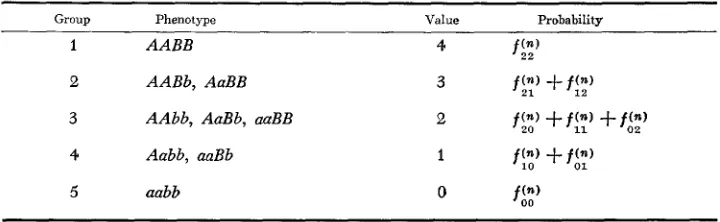
can be easily seen if one recalls that with this kind of mating system gene frequencies are invariant over time. However, as we shall show, such a result will still hold if p B = p A , not necessarily one-half.TABLE 1
Distribution of phenotypes
MULTI-LOCUS ASSORTATIVE MATING 729 There are five phenotypic groups on the basis of which assortative mating is to be made. Their distribution is given in Table 1. Within each group, individuals mate at random. Group 1 individuals have progeny of their own type; group 2
produces individuals with frequencies proportional to
[ (1/2) {f:;)
+
f ( 2 : ) } AB+
(1/2) f!;) uB+
(1/2)fg)
A b ] *and so on. Thus, one generation of assortative mating yields, for example, in the case of no linkage,
{fS'>2
mTe can write similarly the probabilities of other genotypes. We can easily show that pj;+l) = p y ) , p ( ; + I ) = p g ) ; i.e., the gene frequencies remain unchanged.
is a monotonic nondecreasing bounded sequence and therefore will converge. Let
fg)
+ f,, as n + Co. Then from the first equation in(1) we get, as n+ 00,
We note that
fG'
+
0,f g )
+
0, f$)+
0.
We can also show in a similar manner that as n + 00, f z ) .+ 0 and
fd:)
+ 0.Hence. with this system of mating, all heterozygosity will be lost ultimately. If the two loci are linked with the recombination fraction p (0 5 p 5 1/2), then the recurrence relations will be altered. For example, the first equation in ( 1 )
will become
flll. = P[Ab/aBI
and fll = f l l c
+
fllV.
Since the limit of f:;' exists, we get, as before, as n + a,
f g ) +
0 f $ ) + Ofg;
+
0fg;
+
0=>
fi1
n ) + O .We can also show similarly that
fz'
+ 0 andfgj
+ 0. Hence, again all heterozy-gosity will be lost ultimately.
730 G . L. GHAI
In the limiting case, let fz2, fzo, fO2, and foo be the frequencies of the homozygous genotypes AABB, AAbb, aaBB, and aubb respectively, such that f Zz
4-
fzo f foz ffoo = 1. There will be three phenotypic classes-(AABB), (AAbb, aaBB), and (aabb)-with the corresponding frequencies of fZ2, fzo
+
fo2, and foo. This yields in the next generation,Since the population is in equilibrium, we have
f 2 0 f 0 2 = 0
.
(3)Also, we have
f z 2 f 2 0 = P A f 2 2
+
f O 2 = P Efoz
+
foo p a f z o+
foo = pb(4)
which do not change with time. From Equations(4)
we get, if p A # pB.f 2 0 - f O ? = P A - P E $. 0 .
( 5 )
Equations (3) and
( 5 )
imply that either fZ0 = 0 or f o 2 = 0 but not both zero because f z O-
f o z # 0. This shows that, at equilibrium, only three homozygous types can be present in the population. I n addition, it also shows that the popula- tion is not composed of only two homozygous genotypes as is usually thought, because f z o and f o 2 cannot both be zero simultaneously.Now consider Equations ( 4 ) again. If p A
>
pB, then Equation (3) yields that f o 2 = 0 because f i 0>
fo2. Similarly, if p A<
pB, then fzo = 0. We can determine the frequencies of other genotypes by using Equations(4).
For example, ifp a
>
p B , then f O z = 0, f Z 2 = pB, foo = pa, and fzO = P A-
p R . Therefore, the distri-bution of phenotypes or genotypes in an equilibrium population will be inde- pendent of the initial zygotic distribution but will depend upon the initial gene frequencies. Thus, if pA # pB, this mating system will result in three homozygous genotypes in a population in equilibrium instead of the two extreme types with the frequencies as given in Table 2.
TABLE 2
Genotypic distribution in equilibrium
Frequency
AABB AAbb
auBB
MULTI-LOCUS ASSORTATIVE MATING 73
1
It can be seen that if p a = p B there will be only two extreme types with fre- quencies p a and pa.
THREE-LOCUS MODEL
It can be shown, similar to a two-locus model, that gene frequencies remain unchanged and that the population eventually becomes homozygous. Thus in the limit there will be four phenotypic groups (AABBCC)
,
(AABBcc, AAbbCC,aaBBCC)
,
( AAbbcc, aaBBcc, aabbCC),
and (aabbcc) with the corresponding fre-quencies of f Z z 2 , ( f z z o
+
f z o 2+
f 0 2 2 ) , ( f z o o+
f o z o+
f o o 2 > , and fooo adding up to unity. This yieldsf 2 2 z
+
f z z o+
fzoz+
f z o o zz P A f222+
f Z Z 0+
f O Z 2+
f O 2 0 zz pBf 2 2 2
+
f 2 o z+
fozz+
fooz = pa( 6 )
.
Also, group 1 individuals have progeny of their own type, group 2 individuals have an offspring array proportional to
( f z z o ABc
+
f z o z AbC+
f o z z aBC) and so on. Since the population is in equilibriumf z z o f 2 0 2 = 0, f 2 2 0 f 0 2 2 = 0, f202fozz = 0 (7)
f 2 0 0 f 0 2 0 = 0, f 2 0 0 f 0 0 2 = 0, f 0 2 0 f 0 0 2 = 0 * (8)
because there is no heterozygosity in equilibrium. Similarly,
We have to determine the f’s such that Equations (6) -(8) are satisfied. There are 16 possible solutions of Equations ( 7 ) and (8).
If
the gene frequencies are all different, i.e., p A # p B # pol there is a unique solution for the whole system. With- out loss of generality, let us take p A>
p B>
po. From all possible solutions of Equations ( 7 ) and ( 8 ) , the only solution which also satisfies relations (6) and the inequalities among the gene frequencies, isf z z z = pa
f 0 0 0 1
-
PAThe frequencies of other genotypes are zero. Any other solution will be inad- missible. The solution of the system for other similar inequalities among the gene frequencies can be easily obtained by permuting the subscripts properly.
The other possible relationships among the gene frequencies are of the type where some of the gene frequencies are equal, e.g.; p A = pB # pa. To be more specific, let us consider p a = pe
>
p c . Consider first the case where p a = P B 4-732 G . L. G H A I
Equations (9) for all E
>
0. I n the limit as E + 0, p A + p B and consequently wehave the distribution in equilibrium
f 2 2 2 = p C 7 f 2 2 0 = P A
-
p C 7 f 0 0 0 = 1-
P A * (10)We can similarly obtain the solution when p a = p B = p c . This shows that the limiting distribution in all cases is determined from the general solution (9) where the inequalities (>) among the gene frequencies are replaced by 2 . These results also show that the marginal distribution, in equilibrium, for a pair of loci i s the same as f o r a two-locus model.
772-LOCUS M O D E L
Following the same approach as f o r one-, two-, and three-locus models, we can easily extend the analysis to multiple loci, say m. In equilibrium, there is no heterozygosity in the population and thus there will be (m-l-1) phenotypic groups of homozygous genotypes. Since the population is in equilibrium and there is no heterozygosity, each phenotypic group can have at the most one geno- type depending upon the relations among the gene frequencies. Without loss of generality, let p A 2
pB
2
.
.
.
2 p L 2 p M . From the form of earlier solutions form = 1,2,3, it can be deduced that the limiting distribution in this case is given by
f 2 2 * * 2 2 P M
f 2 z
.
. 2 0 = p L - p M. . .
. . .
f 2 0 *
.
* 0 0 = P A - P B f O O - - . O O = 1 - P AThe frequencies of the other genotypes are zero.
The author wishes to express his appreciation to PROFESSOR OSCAR KEMPTHORNE f3r many helpful suggestions and comments. Thanks are also due to DR. W. G. HILL for going through the manuscript and for suggesting improvements in the presentation. Thanks are also due to a referee f o r some useful suggestions.
L I T E R A T U R E C I T E D
CROW, J. F. and J. FELSENSTEIN, 1968 JENNINGS, H. S., 1916
LI, C. C., 1955
WENTWORTH, E. N. and B. L. REMICK, 1916 WRIGHT, S., 1921
The effect of assortative mating on the genetic compo- The numerical results of diverse systems of breeding. Genetics 1: 53-89. sition of a population. Eugen. Quart. 15: 85-97.
Poputation Genetics. Univ. Chicago Press, Chicago, Illinois.
Some breeding properties of the generalized Systems of mating: 111. Assortative mating based on somatic resemblance. Mendelian population. Genetics 1: 608-616.
Genetics 6: 144-161.