IJEDR1403019
International Journal of Engineering Development and Research (www.ijedr.org)2997
Effects of LPG on the performance and emission
characteristics of SI engine - An Overview
1
Dheeraj Kalra,
2Dr.Veeresh Babu A,
3M. Vijay Kumar
1Student, 2Assistant Professor, 3Ph.D Research Scholar Department of Mechanical Engineering, National Institute of Technology, Warangal, India
______________________________________________________________________________________________
Abstract—IC engines are considered as major contributors to the deterioration of the environment, therefore there is an
increasing demand to go for alternative fuels for both SI and CI engine so as to maintain the ecological balance as well as reduce dependency on petroleum and socio economic aspects. The gaseous fuel such as LPG has been widely used throughout the world in SI engines as it impacts greenhouse emissions less than any other fossil fuel. Many researchers have carried out large number of studies on LPG fueled in SI engine and it was reported that the use of LPG has a significant effect on emission control and engine performance. In the studies carried out it was found that the concentration level of CO, HC and CO2 were on the lower side for LPG as compared to gasoline for the same power
output, but the concentration of Nox for the same power output was higher for LPG than gasoline. SI engine fueled with LPG resulted in a decrease in power output and volumetric efficiency as compared to gasoline and the specific fuel consumption for LPG, values slightly higher than gasoline. This paper presents a general overview about the previous research efforts into SI engine using LPG as an alternative fuel for the purpose of improving emission characteristics and engine performance.
Index Terms—LPG (Liquefied Petroleum Gas), SI engine, Engine Performance, Exhaust Emission.
________________________________________________________________________________________________________
I. INTRODUCTION
Various undesirable emissions are exhausted by the internal combustion (IC) engines which affect the environment and cause various problems such as ozone depletion, acid precipitation, global warming, respiratory hazards etc. Scientific results shows that the contribution to global anthropogenic emissions from transportation amount to 21% of CO2, 37% of Nox, 19% of volatile organic compounds (VOCs), 18% of CO and 14% of black carbon, the main source of carbonyls and VOCs result directly from incomplete combustion of fossil fuel such as vehicle exhausts and biomass burning [2]. Therefore it is very important for the researchers to arrive at the clean burning fuel to contribute in reducing the environment problems and growth of global warmi ng. In recent years in order to reduce the environmental damage of motor vehicles and meet the stringent emission regulations, clean alternative fuels such as liquefied petroleum gas (LPG), natural gas (NG) and Hydrogen (H) have been applied in the motor vehicles [1].
Liquefied Petroleum Gas (LPG or LP gas) also referred to as simply propane or butane or a mixture of propane (C3H8) and butane (C4H10), is a flammable mixture of hydrocarbon gases used as a fuel in heating appliances, cooking equipment and vehicles. LPG is prepared by refining petroleum or wet natural gas, and is almost entirely derived from fossil fuel sources, being manufactured during the refining of petroleum (crude oil), or extracted from petroleum or natural gas streams as they emerge from the ground. LPG also contains propylene and butylenes in small concentration. A powerful odorant, ethanethiol also known as ethyl mercapton (CH3CH2SH) is also added in a container, containing LPG so that leaks can be easily detected.
LPG is widely used as an alternative fuel in automobile due to its efficient combustion characteristics and low emissions. It has a higher octane rating (105-112) as compared to petrol (91-97), which enables it to use at higher compression ratio and thus improves thermal efficiency of engine. Further due to high octane number it prevents the occurrence of knock. It’s higher heating value, octane number, auto ignition temperature and wider flammability limits makes LPG a better SI engine fuel than gasoline. LPG is a gas at atmospheric pressure and normal temperatures, but it can be liquefied when moderate pressure (0.7 to 0.8 MPa) is applied or when the temperature is sufficiently reduced [3, 5, 6.]. This property makes LPG an ideal energy source for a wide range of applications, as it can be easily condensed, packaged, stored and utilised. When the pressure is released, the liquid makes up about 270 times its volume as gas, so large amounts of energy can be stored and transported compactly.
IJEDR1403019
International Journal of Engineering Development and Research (www.ijedr.org)2998
Figure 1: Greenhouse Gas emissions of various fuelsThe use of LPG as an alternative fuel for gasoline has been studied extensively in recent years. This paper represents an detailed theoretical investigation on the performance and emission characteristics of SI engine fueled with LPG at different operating parameters and operating conditions.
II. LITERATUREREVIEW
Several researchers have investigated the use of LPG in SI engine. Scientists and researchers have done numerous experimental and theoretical investigations on SI engine fueled with LPG at different operating parameters and conditions and promising results have been obtained with regard to thermal efficiency, fuel economy and exhaust emission point of view. In studies carried out it was found that at the range of lean to stoichiometric equivalence ratios, the flame propagation speed of LPG is faster than of gasoline but at rich mixture gasoline has the higher flame speed. Due to the high flame propagation speed of LPG at lean mixture, combustion characteristics of LPG are superior to that of gasoline in lean burn engines [8]. Due to its efficient combustion characteristics LPG is widely used in SI engines but the benefit of high octane number of LPG can’t be achieved in LPG converted SI engines which were originally made to run on gasoline. LPG-fuelled cars, having fuel systems converted from those of gasoline engines can’t achieve higher compression ratio and thus higher thermal efficiency as converted engines can’t take advantage of high octane number of LPG. The conversion of carburettor type SI engine to run on LPG is rather primitive as air-fuel ratio can’t be directly controlled therefore the efficiency of such engines is low and emissions due to incomplete combustion of fuel are increased.
It has been reported that the SI engine running on LPG results in decrease in power output due to low volumetric efficiency of LPG [1, 3, 6, 9.]. The reason for the decrease in the volumetric efficiency of gaseous fuel such as LPG is, at ambient temperature gaseous fuels are vapour so there will be no cooling effect on intake charge while vaporising so density of the intake mixture will be reduced and further more the decrease in volumetric efficiency is also due to larger volume of fuel in intake mixture [10]. Volumetric efficiency can be improved by using electronically controlled liquid LPG injection so that air-fuel ratio can be controlled which can improve the charging efficiency and thus, the power output [3]. LPG displaces 15 to 20% greater volume than gasoline. Thus the power output decreases by 5 to 10%. This reduction can reach upto 30% at lean operating conditions [11]. The loss of power can be gained by increasing the compression ratio and also by applying supercharger or turbocharger [6, 9, 10.]. As LPG has low flame propagation speed than gasoline, so by advancing the spark timing power output can be increased [6]. In the research carried out it has been stated that LPG as an alternative fuel can also be used to minimize the cyclic variations. Cyclic variations play a major role during lean operation as it hampers the engine performance and exhaust emissions. If the cyclic variations are large during engine operating at lean combustion limit then combustion will not be proper and it may result in misfire and increase in Hydrocarbon (HC) emissions. It has also been reported that any deviation in relative stoichiometric air-fuel ratio, results in an increase in cyclic variations because of decrease in laminar flame speed, which is highest at relative stoichiometric mixture or slightly rich mixture. Hence to overcome these shortcomings, the stoichiometric LPG fueled SI engine should be operated at lean combustion limit [11].
Effects of LPG on engine performance and exhaust emissions
Researchers have tested various numbers of methods to improve the performance of SI engine fueled with LPG. A brief review of the effect of various parameters like compression ratio, ignition timing, variable stroke length etc. is presented here. Other approaches including electronically controlled LPG injection, injection of LPG with different blends like ethanol, methane/hydrogen, water and many other tested modifications were also investigated which are presented in this paper.
IJEDR1403019
International Journal of Engineering Development and Research (www.ijedr.org)2999
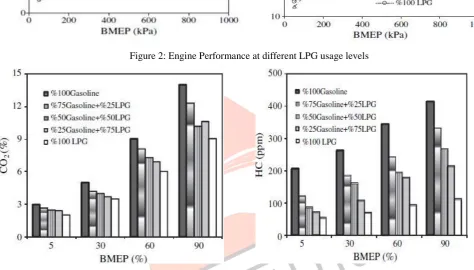
25% LPG mixture ratio. Positive results were obtained at all LPG usage levels in terms of exhaust emissions. Best results were obtained at using 100% LPG for exhaust emissions. Figure 2 and 3 shows the engine performance and exhaust emission characteristics at different LPG usage levels.Figure 2: Engine Performance at different LPG usage levels
Figure 3: Exhaust emission characteristics at different LPG usage levels
K.F. Mustafa and H.W. Gitano-Briggs [6] performed the similar experiment as [1] but at different LPG usage levels (5%, 10% and 20%). The experiments were carried out at constant engine speed (3000 rpm) but at varying values of air-fuel ratio. The result obtained showed the decrease in the power output between 20% and 41%, for 5% and 20% LPG-gasoline blends as compared to 100% gasoline. Brake specific fuel consumption (BSFC) for LPG-gasoline blends values slightly lower than that of 100% gasoline, the difference in the minimum value of BSFC were found to be 47% and 58% respectively for 5% and 20% LPG-gasoline blends. It was reported that LPG addition does not lead to significant improvement in brake thermal efficiency. The concentration levels of CO, CO2, unburnt HC and Nox were found to lower than the gasoline fueled engine.
Baris Erkus, Ali Surmen and M. Ihsan Karamangil [3] investigated the effect of electronically controlled gas phase manifold LPG injection system on the SI engine performance fueled with LPG. Experiments were carried out at 2000-4000 rpm and fixed throttle position of 25% and 45% of full opening. During the tests, carried out in the test bed, the excess air coefficient was maintained in the range of 0.95 to 1.05. The results obtained from LPG injection were compared with results obtained from gasoline and LPG carburetion. Final result implied that at 25% throttle position with the LPG injection system, the maximum improvement in the brake power achieved were 99.52% and 84.84% compared to gasoline and LPG carburetion, at 3500 rpm. While at 50% throttle position brake power of the engine was always higher with LPG injection system than with the carburetion systems at 3000 rpm and higher. Volumetric efficiency also showed an improvement with LPG injection system as compared to carburetion systems at both 25% and 50% throttle positions. Brake-specific fuel consumption (BSFC) was found to be lower with LPG injection system at both the throttle positions except at 2500 rpm for 25% throttle position.
IJEDR1403019
International Journal of Engineering Development and Research (www.ijedr.org)3000
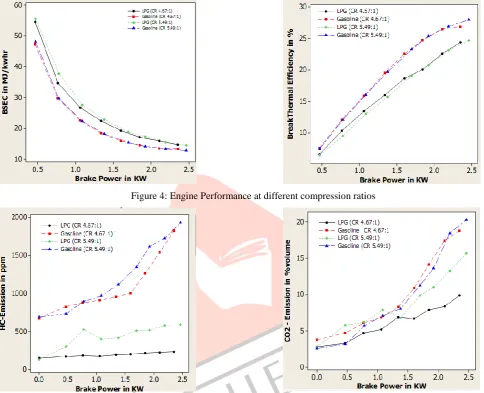
Thirumal mamidi and Dr. J.G. Suryawnshi [5] carried out the experimental investigation to evaluate the performance of a single cylinder four stroke SI engine fueled with LPG at variable loads and at various compression ratios (4.67:1 and 5.49:1), the result obtained showed an increase in mass of fuel consumption for LPG at both the compression ratios when compared to gasoline. It was evaluated that Brake specific energy consumption (BSEC) for LPG values slightly higher than gasoline due to high calorific value but the brake thermal efficiency values slightly higher for gasoline than LPG at both the compression ratios. While the concentration levels of CO, CO2 and unburnt HC were found to be lower than gasoline. Figure 4 and 5 shows the engine performance and exhaust emission characteristics at different compression ratios.
Figure 4: Engine Performance at different compression ratios
Figure 5: Exhaust emission characteristics at different compression ratios.
IJEDR1403019
International Journal of Engineering Development and Research (www.ijedr.org)3001
M. I. Sulaiman, Ayob M.R and Meran I [9] analyzed the performance of single cylinder SI engine fueled with LPG. It was concluded that power output obtained by LPG decreases to 4% as compared to unleaded petrol and specific fuel consumption (SFC) was reduced to 28.38% when engine was made to run on LPG. Similar results were obtained for Zuhdi Salhab et al. [12], it was found there was a decrease in power output of about 7% for LPG and reduction in BSFC was found to be 20%-30%. On the other hand CO, CO2 and NOx emission were found to be low in LPG mode as compared to gasoline mode but the concentration of HC was found to be high at LPG mode.Ali M. Pourkhesalian, Amir H. Shamekhi and Farhad Salimi [10] investigated the performance of a four stroke, four cylinder SI engine fueled with different alternative fuels. It was evaluated that the engine fueled with gaseous fuels resulted in and decrease in volumetric efficiency and power output, as gaseous fuels have low density as compared to gasoline. BSFC for gaseous fuels was found to be lowered because they have high heating value as compared to gasoline.
Hakan Bayraktar and Orhan Durgun [13] developed a quasi dimensional model to predict the performance of SI engine fueled with LPG, in this model the combustion chamber is divided into two zones, zone 1 contains unburned mixture and zone 2 contains burned mixture. This model solves basic governing differential equation for all the four strokes. Results obtained from the model were compared with the experimental data and was concluded that the LPG reduces the volumetric efficiency and hence the power output and LPG had an adverse effect on engine structural elements because of increase in temperature and pressure due to decrease in combustion duration as burning rate of LPG is high. On the other hand reduction in the mole fractions of CO were found to be 4-5.3% while that of NO was found to be 1-50% for varied engine speeds. Thus from the results obtained in can be concluded that LPG has an adverse effect on engine performance and fuel economy.
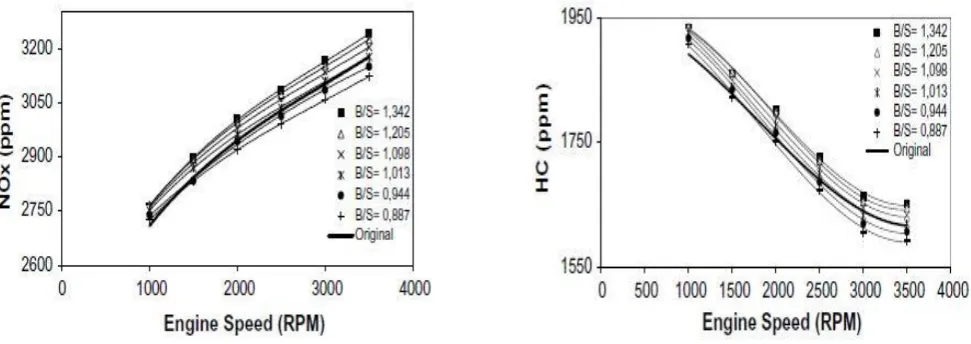
Hakan Ozcan and Jehad A.A. Yamin [14] investigated the effect of varying the stroke length of the engine, which also changed its compression ratio. A computer simulation of variable stroke length of SI engine fueled with LPG was done and the results obtained were compared with the experimental results of both constant and variable stroke lengths. It was concluded that brake power have registered an increase of about 7-54% at low speed and 7-57% at high speed for all the stroke length but BSFC have registered variations from a reduction of about 6% to an increase of about 3% at low speed and from a reduction of about 6% to an increase of about 8% at high speeds for all the stroke length. The concentration of pollutants increased from 0.65% to 2% at low speed while larger stroke lengths resulted in the reduction of pollutant level of about 1.5% at higher speed while at lower stroke length an increase of about 2% occurred. Figure 6 and 7 shows the variation of engine performance and emission characteristics for varying stroke lengths.
IJEDR1403019
International Journal of Engineering Development and Research (www.ijedr.org)3002
Figure 7: Emission characteristics at varying stroke lengths
Hakan Ozcan and M.S. Soylemez [15] investigated the effect of water injection on the performance of LPG fueled SI engine. Different water to fuel ratios by mass was used with variable engine speed and it was concluded that the specific fuel consumption decreases while the brake thermal efficiency increases. The average increase in brake thermal efficiency for a 0.5 water to fuel mass ratio is approximately 2.7% over the use of LPG in SI engine.
S. M. Lawankar, Dr L. P. Dhamande , Dr S. S. Khandare [16] evaluated the effect of change in ignition timing (10° BTDC, 20° BTDC, 30° BTDC and 40° BTDC) and compression ratios (9 , 10, 11 and 12) on NOx emissions and it was found that concentration of NOx increased at all the compression ratios due to increase in combustion temperature. It was found that engine running on LPG fuel system found to have 15-35% more NOx than gasoline. Concentration of NOx also varied with ignition timing, retarding the timing resulted in 12% decrease in concentration while advancing upto certain degree BTDC increased NOX while at further advancing concentration of NOx was found to be decreased.
GongLi a, Liguang Li, Zhimin Liu, Zhilong Li, Dongping Qiu [17] measured the real time NOx emission in order to evaluate the technique for establishing combustion occurrence. It also presents an investigation of the characteristics of real time NO emissions of the first firing cycle during cold start in a LPG SI engine to determine the optimal excess air factor of the first firing cycle. It was concluded that as the excess air coefficient is reduced at lean combustion limit, NO emissions increase quickly, then reduce quickly and then slowly. Even at high cylinder pressure and constant excess air coefficient concentration of NO was found to be high because the mixture burned more completely. NO emission can also be used to understand the combustion and misfire occurrence.
O. ARSLAN, R. KOSE and N. CEYLAN [18] did experimental investigation on 4 cylinder LPG fueled SI engine to estimate the performance and exhaust emission of engine under cold climatic conditions. It was concluded that specific fuel consumption for LPG is 22-32% more than gasoline. Concentration of CO was found to be reduced with increase in engine speed but for LPG this reduction was higher and it was accounted to be 91.9%, while the HC emissions was found to high at 1000 rpm and as the speed was increased concentration of HC reduced, concentration of HC for LPG was found to be low at all the speed when compared to gasoline. Concentration of CO2 was also accounted for LPG and it was found that at the off-load CO2 emission decreased in a percentage ranging between 13.4 and 16.7 and for on load case this vale ranges between 13.4 and 22.7 at different engine speeds.
Ashwini R.Warade, S. M. Lawankar [19] investigated the effect of using LPG- Ethanol blends in SI engine at constant speed and varying load. It was found that brake thermal efficiency was improved with the use of LPG-Ethanol blends as compared to gasoline, at 20% Ethanol brake thermal efficiency was found to maximum. CO emissions was found to be low for only 20% ethanol blend, while concentration of HC was found to be low at all the blends while concentration of NOx was found to be increased as percentage of ethanol increases.
Selahaddin Orhan Akansu, Mehmet Bayrak [20] investigated the effect of LPG, hydrogen and methane mixture (CH4/H2) in the ratio of 30:70 on the four-stroke, single cylinder SI engine. Experiments were conducted at excess air ratios between 0.8 and 1.5 and at different ignition timings (14°-35° BTDC) under a constant load of 6Nm at 1400 rpm. It was concluded that NOx emission concentration was higher for CH4/H2 than LPG. In case of excess air ratio less than 1.2, NO values were found to be low. When the ignition timing was 14° and 25° BTDC, NO values for CH4/H2 was found to be lower than LPG. Concentration of CO, CO2 and unburnt HC was found to be high for LPG than for CH4/H2. Brake thermal efficiency was found to be higher for the CH4/H2 than for LPG and it was found to be maximum at excess air ratio of 1.15 and 1.22 for CH4/H2 and LPG.
IJEDR1403019
International Journal of Engineering Development and Research (www.ijedr.org)3003
III. CONCLUSIONAn attempt has been made here to review the previous studies on LPG fueled SI engines. Various researchers have carried out a number of experimental investigations and the results of the above investigations are promising. Power output from LPG was found to be decreasing but from the above investigation it can be concluded that by power output can be increased by advancing the ignition timing, employing a electronically controlled LPG injection, by the variation in stroke length and by increasing the compression ratio. But advancing the ignition timing and increasing the compression ratio has an adverse effect on NOx. Brake thermal efficiency was found to be increased with LPG fueled SI engine. In all the cases emission characteristics were found to be improved as HC, CO and CO2 showed a reduction in concentration with LPG. Thus it can be concluded that LPG represents a good alternative fuel for gasoline and must be taken into consideration for transport purposes.
REFERENCES
[1] M. Gumus, "Effects of volumetric efficiency on the performance and emissions characteristics of a dual fueled (gasoline and LPG spark ignition engine," Fuel Processing Technology,vol. 92, pp. 1862-1867, May 2011.
[2] Cha-lee Myung, Kwanhee Choi, Juwon Kim, Yunsung Lim, Jongtae Lee, Simsoo Park, "Comparative study of regulated and unregulated toxic emissions characteristics from a spark ignition direct injection light-duty vehicle fueled with gasoline and liquid phase LPG," Energy, vol. 44, pp. 189-196, 2012.
[3] Baris Erkus, Ali Surmen, M. Ihsan Karamangil, "A comparative study of carburation and injection fuel supply methods in an LPG-fuelled SI engine," Fuel,vol. 107, p. 511–517, 2013
.
[4] Mr. Sanjay D Bisen, Mr. Yogesh R. Suple, "Performance evaluation of four stroke SI engine by direct injection of LPG," vol. 1, no. 2, ISSN: 2321-8134,10 october 2013
.
[5] Thirumal mamidi, Dr. J.G. Suryawnshi, "Investigations on S.I. Engine Using Liquefied Petroleum Gas (LPG) As an Alternative Fuel," vol. 2, no. 1, ISSN: 2248-9622, pp. 362-367, 2012.
[6] K.F. Mustafa, H.W. Gitano-Briggs,"Liquefied Petroleum Gas (LPG) as an Alternative Fuel in Spark Ignition Engine: Performance and emission characteristics," in International Conference on Energy and Environment,, Malacca, 2009. [7] Peter Anyon, " LPG - The Clean Transport Alternative: Presenting the Environmental Case,," Australian Liquefied
Petroleum Gas Association Limited, Sydney, ISBN: 0 9750843 2 1, 2003.
[8] Shankar K. S, Mohanan P, "MPFI gasoline engine combustion, performance and emission characteristics with LPG injection," Energy and Environment, vol. 2, no. 4, pp. 761-770, 2011.
[9] M. I. Sulaiman, Ayob M.R, Meran I, "Performance of Single Cylinder Spark Ignition Engine Fueled by LPG," vol. 53, pp. 579 – 585, 2013.
[10] Ali M. Pourkhesalian, Amir H. Shamekhi, Farhad Salimi, "Performance and Emission Comparison and Investigation of Alternative Fuels in SI Engines," SAE INTERNATIONAL, ISSN: 0148-719.1, 2009.
[11]M.A. Ceviz, F. Yuksel, "Cyclic variations on LPG and gasoline-fuelled lean burn SI engine," Renewable Energy ,vol. 31, pp. 1950–1960, 2005.
[12]Zuhdi Salhab, Mohammad G. Qawasmi, Hussein Amro, Mosa Zalloum, Mohammad S. Qawasmi and Nafez Sharawi, "Comparative Performance and Emission Properties of Spark-Ignition Outboard Engine Powered by Gasoline and LPG," vol. 5, no. 1, pp. 47 - 52, 2011.
[13]Hakan Bayraktar, Orhan Durgun, "Investigating the effects of LPG on spark ignition engine combustion and performance," Energy Conversion and Management, vol. 46, pp. 2317–2333, 2005.
[14]Hakan Ozcan, Jehad A.A. Yamin, "Performance and emission characteristics of LPG powered fourstroke SI engine under variable stroke length and compression ratio," Energy Conversion and Management , vol. 49, pp. 1193–1201, 2008. [15]Hakan Ozcan, M.S. Soylemez, "Thermal balance of a LPG fuelled, four stroke SI engine with water addition," Energy
Conversion and Management , vol. 47, pp. 570-581, 2006.
[16]
S. M. Lawankar, Dr L. P. Dhamande , Dr S. S. Khandare, "Experimental study of effect of ignition timing and
compression ratio on NOx emission of LPG fuelled engine," vol. 3, no. 10, 2012.
[17]Gong Li a, Liguang Li, Zhimin Liu, Zhilong Li, Dongping Qiu, "Real time NO emissions measurement during cold start in LPG SI engine," Energy Conversion and Management, vol. 48, p. 2508–2516, 2007.
[18]O. ARSLAN,1 R. KOSE,1 and N. CEYLAN, "Experimental Analysis of Consumption and Exhaust Emissions of Gasoline and LPG in Car Engines Under Cold Climatic Conditions," Energy Sources, vol. 33, p. Energy Sources, 2010. [19]Ashwini R.Warade, S. M. Lawankar, "Experimental Investigation On Use Of LPG-Ethanol Blends As A Fuel In SI
engine," vol. 2, no. 6, 2013.