© 2014, IJCSMC All Rights Reserved 99 Available Online at www.ijcsmc.com
International Journal of Computer Science and Mobile Computing
A Monthly Journal of Computer Science and Information Technology
ISSN 2320–088X
IJCSMC, Vol. 3, Issue. 10, October 2014, pg.99 – 105
RESEARCH ARTICLE
Video Forgery Detection Using
Invariance of Color Correlation
Sarah Joy, Lisha Kurian
M-Tech Student, Sree Narayana Gurukulam College of Engineering and Technology, Kerala
Asst. Prof, Sree Narayana Gurukulam College of Engineering and Technology, Kerala
[email protected], [email protected]
Abstract- Video forgery detection aims to trace a query video snip in a video file or database. It helps in detecting video copies for copyright protection and reduces storage redundancies. In this paper, we put forward an effective method based on the invariance of color correlation. The proposed technique first split each key-framework into nonoverlapping block For each block, the red, green, and blue color components are sorted according to their typical intensities, and make use of the percentage of the color correlation to build a frame feature with a minimum size. Finally, the ensuing video feature is made up of the successive frame features, which is verified to be robust beside most typical video content-preserving operations, together with geometric deformation, blurring, noise infectivity, contrast augmentation, and strong re-encoding. The investigational results show that the projected method outperforms the accessible methods in the literature, as sound as the system based on the traditional color histogram.
Index Terms— Color correlation, content-based technology, video forgery detection, histogram analysis, video sequence matching
I. INTRODUCTION
Sarah Joy et al, International Journal of Computer Science and Mobile Computing, Vol.3 Issue.10, October- 2014, pg. 99-105
© 2014, IJCSMC All Rights Reserved 100
Fig1:Four distinctive videos. (a) Foreman. (b) Tempete. (c) motor vehicle. (d)ship.
II. SYSTEMOVERVIEW
© 2014, IJCSMC All Rights Reserved 101
Fig2:Modifications done to the foreman video;
(a) Letter box. (b) Pillar box.(c) Cropping. (d) Shifting. (e) Picture insertion. (f) Video in video
A. SPLITTING OF VIDEO SEQUENCES INTO VIDEO FRAMES
Sarah Joy et al, International Journal of Computer Science and Mobile Computing, Vol.3 Issue.10, October- 2014, pg. 99-105
© 2014, IJCSMC All Rights Reserved 102
B. SORTING OF FRAMES BASED ON COLOR INTENSITIES
The key frames are sorted according to their variation in RGB values or intensities. This RGB components of each frame is calculated and frames of similar intensities are put together. There are six constraints, they are
a) Rxy ≥ Gxy ≥ Bxy
b) Rxy ≥ Bxy ≥ Gxy
c) Gxy ≥ Rxy ≥ Bxy
d) Gxy ≥ Bxy ≥ Rxy
e) Bxy ≥ Rxy ≥ Gxy
f) Bxy ≥ Gxy ≥ Rxy,where 1 ≤ x ≤ w, 1 ≤ y ≤ h
Based on these constraints the frames are sorted. These six conditions are checked for every frames. Every frames will be placed in one of these constraints. The sorted frames are then send for feature extraction.
C. FEATURE EXTRACTION
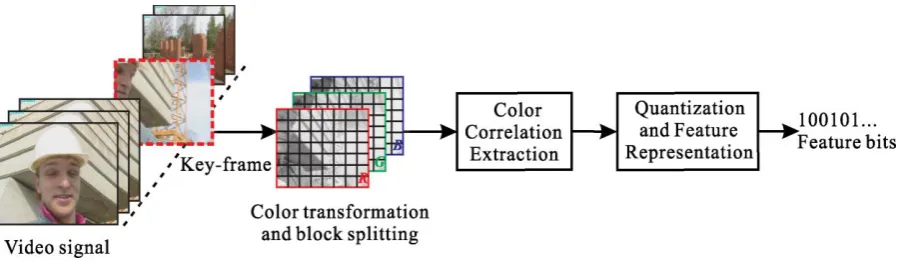
The sorted frames are screened one by one and their features are extracted .Color transformation of the various frames are noticed and they are recorded. The extracted features are represented in feature bits. This step by step process is demonstrated in Fig 1.
Fig 3:Feature extraction of a video sequence
Quantization of the color correlation is a time consuming process. This may vary according to the complexity of the video sequence. Feature bits are binary in nature. Block splitting can sometimes lead to destruction of frames.
D. PLOTING HISTOGRAMS
After extracting the features, the next step is to plot histogram based on the features. Feature bits are screened to plot the histograms. This is for the easy analysis of the video content. Using the ploted histograms one can very easily find the intensities of color components. Histogram is a pictorial graph representation of the extracted feature bits. The ploted histograms are then analysed to compare the features of various frames.
E. HISTOGRAM ANALYSIS
© 2014, IJCSMC All Rights Reserved 103
Fig4:Histograms plotting color correlation of the distinctive videos
F. FORGERY DETECTION
The proposed system detects not only the exact copies but it also analyse the modified videos. Therefore this system is highly efficient. The detection of the forged video is done with the help of color correlation algorithm that is described below.
COLOR CORRELATION ALGORITHM
Step 1:Extract the frames from video sequence.
Video V is assumed to be composed of successive N key-frames, denoted by V =_V1, V2, ・・・ , VN_, so that the features of the video can be denoted as follows.
HV =_HV1,HV2 , ・・・,HVN,where HVi denotes the color correlation feature of the video frame Vi, and i = 1, 2, ...,N.
Let Vq and Vt be two different videos with N key-frames.
Step 2: The space between the two different videos is defined as the middling of the space flanked by the corresponding key frames .
d(HVq, HVt) =N_Nk=1
d(HVq,k, HVt,k ) where HVq,k and HVt,k are the color correlation of the kth frame in the videos Vq and Vt .
Step 3:Extraction of features of each of the key frames.
_6∑
i=1H(i) = 1 0 ≤ H(i) ≤ 1 i = 1, 2, ..., 6,where H(i) is any real number. Also if there is two distinct features Hq(i)and Ht(i) then the space in between them is calculated using the following equation
d(Hq,Ht) =1/C_6∑i=1|Hq(i) − Ht(i)|.
Step 4:Plot histograms based on the color intensities of the features extracted.
The normalized histogram can be represented based on the following formula where|Pi| is the cardinality of set Pi
H(i) =|Pi|_6∑i=1|Pi|
Step 5:Detection of forged videos by analyzing the modifications done to the original video sequence. Hm(i) =3/c∑i=1 |pj|/|pi|
Sarah Joy et al, International Journal of Computer Science and Mobile Computing, Vol.3 Issue.10, October- 2014, pg. 99-105
© 2014, IJCSMC All Rights Reserved 104
III.PERFORMANCEEVALUVATION
In this experiment, the efficiency of the proposed scheme evaluate on a video dataset and over 4000 query clips with various commonly-used transformation. Here we further evaluate the performances of different schemes using the MUSCLE VCD benchmark .This publicly available benchmark provides a database and there are two different tasks. For the first task, there are totally 15 query clips, and it aims to find the corresponding near-duplicates of entire query videos in the database. For the second task, there are totally three queries that are generated as follows: six to eight short subsequences extracted from different videos in the database are inserted into a video that is not in the database.
The performance degree used for video forgery detection, which is easier to express than for localization and extraction, is the detection rate, defined as the ratio between the number of detected video key frames and all the given frames containing the modifications. Measuring the performance of frame extraction is enormously difficult and until now there has been no comparison of the different extraction methods. Instead, the performance is merely inferred from the existing results, as the feature extraction performance is closely related to the desired output. Traditionally in evaluation of video forgery detection algorithms, for a single detection file and its corresponding ground truth file, two values, recall and precision, can be calculated. They are defined as follows:
Precision=
TIME COMPLEXITY EVALUATION
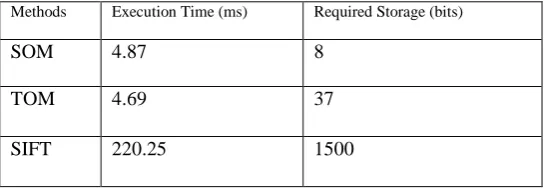
Here, we for the most part inspect the computational outlay of the feature extraction. In this experiment, we dash all the algorithms in the identical environment. It must be supposed to be renowned that there are no equivalent operations. Table summarizes the average consumed time over 5000 s record for all the algorithms to extract a frame attributes. It is evidently pragmatic that SOM(spatial ordinal measurement) and TOM(Temporal ordinal measurement) perform the fastest, and the SIFT-based approaches are the slowest. For the proposed scheme, it takes an average of 9.434 ms to achieve the feature extraction for a frame, which can convince the necessities of real-time application.
SPACE COMPLEXITY EVALUATION
SOM employs the position of standard intensities of four blocks as a feature, whose value is in the set of {1, 2, 3, 4}.Thus, each outline can be represented by 4 × 2 = 8 bits. If an analogous technique is used, we can further condense the 8 bits to (4−1)×2 = 6 bits. TOM stores the typical intensities of four blocks, thus 4 × 8 = 32 bits are needed. With quantization and compression technique, each group of five successive elements is encoded into 8 bits, thus 160 bits are required. For the SIFT-based schemes, descriptors are quantized into 200 visual terms. As described previously, our proposed scheme requires 35 bits. Based on Table, it is practical that the most excellent method, in terms of storage, is SOM, requiring the most storage.
Compared with the original version , the resulting videos would appear quite diverse from the original ones, and become very artificial after these operations. In such cases, the color correlations among the red, green, and blue components are significantly altered, meaning that the proposed feature will be unsuccessful. However, for the other 11 videos with some complex transformations, our proposed scheme can still successfully work.
Table 1: TIME AND SPACE COMPLEXITY OF THE ALGORITHM.
Methods Execution Time (ms) Required Storage (bits)
SOM 4.87 8
TOM 4.69 37
© 2014, IJCSMC All Rights Reserved 105
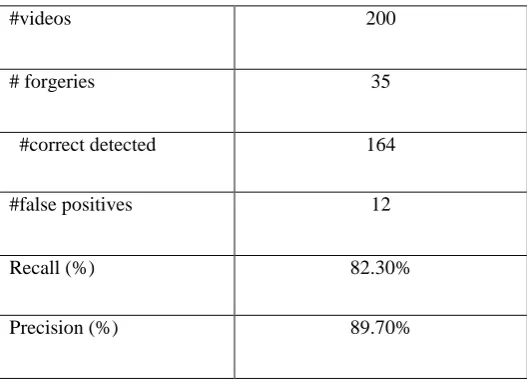
Table 2: EXPERIMENTAL RESULT OF THE ALGORITHM.
#videos 200
# forgeries 35
#correct detected 164
#false positives 12
Recall (%) 82.30%
Precision (%) 89.70%
IV.CONCLUSION
This proposed system is a new video forgery detection system that detects and recognizes forged video sequences from an original video database. In this paper Color correlation algorithm is proposed to overcome the difficulties of grouping the characters and remove false positives. The proposed system compares favorably with the existing algorithms when handling complex videos and achieves significantly enhanced performance in complex natural scenes and also blurred edited sequences.
ACKNOWLEDGEMENT
The authors would like to thank the Associate Editor and the anonymous reviewers for their valuable comments, also special thanks to Lei and Luo for their help on the Correlation method.
REFERENCES
[1] F. Hartung and M. Kutter, “Multimedia watermarking techniques,” Proc.IEEE, vol. 87, no. 7, pp. 1079– 1107, Jul. 1999.
[2] Y. Li and R. H. Deng, “Publicly verifiable ownership protection for relational databases,” in Proc. ACM Symp. Inform. Comput. Commun.Security, 2006, pp. 78–89.
[3] X. Kang, J. Huang, and W. Zeng, “Efficient general print-scanning resilient data hiding based on uniform log-polar mapping,” IEEE Trans.Inf. Forensics Security, vol. 5, no. 1, pp. 1–12, Mar. 2010.
[4] A. Joly, O. Buisson, and C. Frelicot, “Content-based copy retrieval using distortion-based probabilistic similarity search,” IEEE Trans. Multimedia,vol. 9, no. 2, pp. 293–306, Feb. 2007.
[5] E. Chang, J. Wang, C. Li, and G. Wiederhold, “RIME: A replicated image detector for the world-wide web,” Proc. SPIE Multimedia Storage Archiv. Syst., vol. 3527, pp. 58–67, Nov. 1998.
[6] C. Kim, “Content-based image copy detection,” Signal Process.: Image Commun., vol. 18, no. 3, pp. 169– 184, Mar. 2003.
[7] M.-N. Wu, C.-C. Lin, and C.-C. Chang, “Novel image copy detection with rotating tolerance,” J. Syst. Soft., vol. 80, no. 7, pp. 1057–1069,Feb. 2007.
[8] J.-H. Hsiao, C.-S. Chen, L.-F. Chien, and M.-S. Chen, “A new approach to image copy detection based on extended feature sets,” IEEE Trans.Image Process., vol. 16, no. 8, pp. 2069–2079, Aug. 2007.
[9] A. Qamra, Y. Meng, and E. Y. Chang, “Enhanced perceptual distance functions and indexing for image replica recognition,” IEEE Trans. Pattern Anal. Mach. Intell., vol. 27, no. 3, pp. 379–391,Mar. 2005.