36
International Journal in Physical and Applied Sciences http://ijmr.net.in, Email: [email protected]MACHINE LEARNING IMPLEMENTATION FOR COMMUNICATION
NETWORKS
Kishore Kunal
1, Prof (Dr) Pawan Kumar Bharti
2Department of Computer Science and Engineering
1,2
Shri Venkateshwara University, Gajraula (Uttar Pradesh)
ABSTRACT
Machine learning is a term utilized in the field of computer science that advanced from looking at structure affirmation and computational learning theory of artificial intelligence. In different fields machine learning and communications technology are combined.Communications systems produce a lot of traffic data. This work focuses on using machine learning methods and algorithms to be able to evaluate translations of technical documentation. We used pilot study to investigate on huge amount of data released in the communication system. In addition analyze the convergence areas of Machine learning and communication technology. This study also determine the large scale processing of data and traffic in recent years.The growing demand for global data traffic must be met with more flexible and scalable coherent optical communication systems. The C4.5 DT approach showed superior performance to other ML algorithms; it presents a tree based graph that helps in finding the optimal alternative as well as the best path for congestion control.
Keywords:Machine learning, communication networks, artificial intelligence, learning theory, etc.
1. INTRODUCTION
Machine learning is a term utilized in the field of computer science that advanced from looking at structure affirmation and computational learning theory of artificial intelligence. In different fields machine learning and communications technology are combined. Communications systems produce a lot of traffic data; it is altogether upgrade the plan and management of networks and communication when joined with advanced machine learning process.
Machine learning is an advancing part of computational algorithms that are planned pursue human intelligence by learning from the encompassing. It is considered as the new period of enormous data. Approaches based on machine learning have been applied effectively in different fields from computer vision, communication technology, engineering, finance and entertainment and so on.
1.1 Machine Learning
The machine learning technique as an option in contrast to the customary engineering approach for the structure of an algorithmic arrangement the traditional engineering
37
International Journal in Physical and Applied Sciences http://ijmr.net.in, Email: [email protected] examination. Based on the model, an upgraded algorithm is delivered that offers execution ensures under the suspicion that the given material science based model is a precise portrayal of reality.1.1.1 Goals of Machine Learning
The goal of machine learning is to fathom the idea of learning, and to assemble that learning capacities in computers. To be increasingly explicit, Following are five parts of the goals of Machine Learning.
To make the computers more brilliant, progressively wise.
To develop computational models of human learning system and complete computer
reproductions. The learning in this angle is likewise called cognitive displaying.
To look through new learning techniques and create general learning algorithms free of uses.
1.2 Machine learning for communication networks
In order to embody employments of regulated and directed learning, this exploration will offer commented on pointers to the writing on Machine learning for communication systems. Rather than gaining ground toward a broad, and obviously objected, review, the applications and references have been picked with the goal of speaking to enter edges concerning the use of AI in structuring issues. We focus on the idea of Machine learning for networks.
Wireless communication:Wireless communication networks are relied upon to comprehend as a rudimentary paradigm move towards intense and wise radio environments. The principle question around the job of profound learning in such communication networks isn't: regardless of whether it will be a fundamental piece of things to come networks, yet rather it is, when and how to trigger this mix.
Visual Communication: As the name depicts, it is a communication through visual guide and is portrayed as the transport of thoughts and information in structures that can be perused or viewed. It is exclusively and completely depends on vision, and it is basically given or communicated two dimensional pictures. It constituents: signs, shading, visual computerization, delineation, typography, drawing and electronic assets.
Security, security administrations and Communication: An insurance system contains two areas, the characterization instrument or encryption process for the information, and a key organization subsystem. This Recommendation depicts affirmation and key organization procedures for a security system proper for use in restricted band differing media organizations. Assurance is cultivated by the use of puzzle keys.
1.2.1 Communications system and classification of machine learning methods
38
International Journal in Physical and Applied Sciences http://ijmr.net.in, Email: [email protected] crosses, and the goal is to become familiar with a double-classifier. Solo learning: It is a set comprises of unlabelled sources of info that is, of contributions with no doled out wanted yield. For example, the information sources are again focuses in the two-dimensional plane; however no sign is given by the data about the relating wanted yield.
2. LITERATURE REVIEW
Junaid Nawaz and Syed (2019) [1] the up and coming fifth Generation (5G) of wireless networks is relied upon to lay a foundation of intelligent networks with the provision of some isolated Artificial Intelligence (AI) operations. Be that as it May, completely intelligent network orchestration and management for giving innovative services may be realized in beyond 5G (B5G) networks. To this end, we envisage that the sixth Generation (6G) of wireless networks will be driven by on-demand self-reconfiguration to guarantee a many-crease increase in the network performance and service types. The increasingly stringent performance prerequisites of developing networks may finally trigger the deployment of some intriguing new technologies, for example, large intelligent surfaces, electromagnetic-orbital angular energy, visible light communications and sans cell communications – to name a couple.
Nicholas D. Sidiropoulos et al (2019) [2]in research entitled "Machine learning in the Air" investigates the advances in processing velocity and data acquisition and storage. Machine learning is entering in each facet of our lives and transforms. Wireless communications is ubiquitous in our lives, from handheld, smart homes, and automobiles. In this research shows major promises and challenges of Machine learning in wireless communication frameworks, focusing mainly on the physical layer. It highlight the integral problem of designing physical layer techniques to enable distributed Machine learning at the wireless network edge, which further emphasizes the need to understand and connect with fundamental concepts in wireless communications.
Mirza Golan Kibriaetal (2018) [3] in research entitled "Big data analytics, Machine learning and Artificial intelligence in Next Generation Wireless networks" investigate the cutting edge wireless networks are advancing into extremely complex frameworks because of the exceptionally expanded service prerequisites, diversity in applications, devices, and networks. The network operators need to make the best utilization of the available resources, for example, control, range, as well as infrastructures. Traditional networking approaches are reactive, exclusively managed and conventional data analysis tools that have limited capability of space and time are not able anymore and cannot satisfy and serve that future complex networks regarding operation and optimization cost viably.
39
International Journal in Physical and Applied Sciences http://ijmr.net.in, Email: [email protected] Manish Bhatt (2016) [5] in this undertaking, we were asked to try different things with a real world dataset, and to investigate how machine learning algorithms can be used to discover the patterns in data. We were required to gain experience using a common data-mining and machine learning library, Weka, and were relied upon to submit a report about the dataset and the algorithms used. After playing out my preferred required tasks on a dataset, thus lies my final report.3. OBJECTIVE
To analyze the Machine learning implementation
To study the communication networks for machine learning.
4. RESEARCH METHODOLOGY
This work focuses on using machine learning methods and algorithms to be able to evaluate translations of technical documentation.
4.1 Pilot study
Pilot survey is a pre-testing study helped the scientist to maintain a strategic distance from any pointless redundancies in the timetable for the real investigation. This investigation looks to investigate on huge amount of data released in the communication system. In addition analyze the convergence areas of Machine learning and communication technology. This study also determine the large scale processing of data and traffic in recent years.
4.2 Research design
This is the descriptive and analytical research. We follow with the design of study followed with the data collection and management. After data collected, we would explore and use descriptive study.
Primary Data:Primary source is a source from where we collect first-hand information or original data on a topic. The primary data draws data straightforwardly from analytical strategies of experiments done on.
Secondary Data:We will collect secondary data from the published financial statements of the firms, newspaper and articles. This is the minor part of this research but important as well. In this part data would be collected from the internet
Sites, journals, books, published articles, records of organizations.
5. RESULT AND DISCUSSION
5.1 Machine learning implementation
40
International Journal in Physical and Applied Sciences http://ijmr.net.in, Email: [email protected] predicted values. It empowers the execution of about all algorithms of data mining capacities, for example, clustering, affiliation rules, relapse, grouping, and data pre-processing. The C4.5 DT algorithm is one of the generally utilized algorithms for prediction and characterization.Figure 1: Determination of optimal alternatives
Figure 2: Prediction margin of optimal alternatives AA: actual alternative; PA: predicted alternative
41
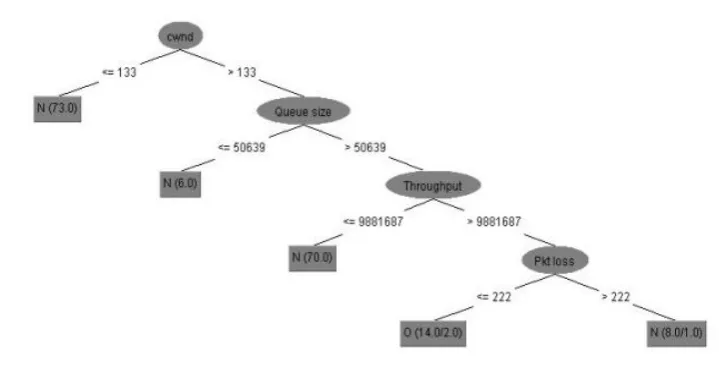
International Journal in Physical and Applied Sciences http://ijmr.net.in, Email: [email protected] Figure 3: Congestion control DT Effect of DT prediction:
The prediction idea is based on substituting a particular I-cwnd into the improved approaches. The choice of the optimal I is based on the direct of the performance factors,
Where maximum cwnd, throu, and que speak to the perfect result, notwithstanding a restricted packet loss every I speak to one of the I-alternative congestion control parameters.
Table 1DTevaluationFP:falsepositive;PRCArea:areaundertheprecision–recallcurve;ROCArea: area under the receiver operating characteristic curve; TP: truepositive
Machine Algorithm TP Rate FP Rate Precision Recall ROC Area
PRC Area
C4.5 0.924 0.205 0.927 0.924 0.889 0.915
DT RepTree 0.913 0.207 0.919 0.913 0.891 0.916
Random Tree 0.913 0.207 0.919 0.913 0.891 0.916
Clustering Simple K Means
0.891 0.018 0.939 0.891 0.937 0.923
Hierarchical Clustering
0.857 0.870 0.752 0.857 0.527 0.771
Stacking Zero + Decision Table
42
International Journal in Physical and Applied Sciences http://ijmr.net.in, Email: [email protected] The true positive (TP) rate speaks to the level of correct predictions as positive cases, and the false positive (FP) rate speaks to the level of incorrect predictions as positive instances of various chose classifiers and machine learning algorithms. Precision is the aftereffect of all correctly predicted cases partitioned by all cases. Recall or affectability is the consequence of correct predictions separated by the total positive cases.6. CONCLUSION
The growing demand for global data traffic must be met with more flexible and scalable coherent optical communication systems. The limits of such systems require better fiber channel models, complex optimization methods and consideration of entirely new approaches for transmission. The C4.5 DT approach showed superior performance to other ML algorithms; it presents a tree based graph that helps in finding the optimal alternative as well as the best path for congestion control. The DT graph is able to provide a simplified plan to visually determine non-optimal and optimal nodes based on assigned values the optimal machine learning prediction techniques on test and hardware it in a real test bed environment.
REFERENCES
[1] Syed, Junaid Nawaz, & Sharma, Shree Krishna &Wyne, Shurjeel&Patwary, Mohammad
&Asaduzzaman, Md. (2019). Quantum Machine Learning for 6G Communication Networks:
State-of-the-Art and Vision for the Future. IEEE Access. 7. 46317-46350.
10.1109/ACCESS.2019.2909490.
[2] Sidiropoulos Nicholas D, Gesbert David (2019) ,“ Machine learning in the Air”, available at:
https://www.researchgate.net/publication/336186963_Machine_Learning_in_the_Air, (visited on October 14,2019)
[3] KibriaMirzaGolanetal (2018), “Big data analytics, Machine learning and Artificial
intelligence in Next Generation Wireless networks, available
at:https://arxiv.org/pdf/1711.10089.pdf. (visited on October 12, 2019)
[4] Simeone Osvaldo, (2018), “A Very Brief Introduction to Machine Learning with Applications
to Communication Systems”, availale at: https://arxiv.org/pdf/1808.02342.pdf, (visited on October 15, 2019)
[5] Bhatt, Manish. (2016). Machine Learning Project. 10.13140/RG.2.1.3176.2800.
[6] Liakos, Konstantinos&Busato, Patrizia&Moshou, Dimitrios& Pearson, Simon &Bochtis, Dionysis. (2018). Machine Learning in Agriculture: A Review. Sensors. 18. 2674. 10.3390/s18082674
[7] Handa, Anand& Sharma, Ashu&Shukla, Sandeep. (2019). Machine learning in cybersecurity:
43
International Journal in Physical and Applied Sciences http://ijmr.net.in, Email: [email protected] [8] Galway, Leo & Charles, Darryl &Black, Michaela. (2008). Machine learning in digitalgames: A survey. Artif. Intell. Rev. 29. 123-161. 10.1007/s10462-009-9112-y.
[9] Foster, Kenneth &Koprowski, Robert &Skufca, Joseph. (2014). Machine learning, medical
diagnosis, and biomedical engineering research - commentary. Biomedical engineering online. 13. 94. 10.1186/1475-925X-13-94.
[10] Attaran, Mohsen & Deb, Promita. (2018). Machine Learning: The New 'Big Thing' for