University of South Carolina
Scholar Commons
Theses and Dissertations
2015
Two Pieces for Bassoon by Dan Welcher: a Guide
to Performance and Analysis, Including a Survey of
Welcher’s Chamber Music with Bassoon
Reed Aaron Hanna University of south carolina
Follow this and additional works at:https://scholarcommons.sc.edu/etd Part of theMusic Performance Commons
This Open Access Dissertation is brought to you by Scholar Commons. It has been accepted for inclusion in Theses and Dissertations by an authorized administrator of Scholar Commons. For more information, please [email protected].
Recommended Citation
TWO PIECES FOR BASSOON BY DAN WELCHER: A GUIDE TO PERFORMANCE AND ANALYSIS, INCLUDING A SURVEY OF WELCHER’S CHAMBER MUSIC
WITH BASSOON
By
REED AARON HANNA
Bachelor of Science
Indiana University of Pennsylvania, 2009
Master of Music
University of Nebraska—Lincoln, 2011
Submitted in Partial Fulfillment of the Requirements
For the Degree of Doctor of Musical Arts in
Music Performance
School of Music
University of South Carolina
2015
Accepted by
Michael Harley, Major Professor
Kunio Hara, Committee Member
Rebecca Nagel, Committee Member
Jennifer Parker-Harley, Committee Member
ii
iii
ACKNOWLEDGEMENTS
I would like to thank Michael Harley for his musical guidance to me as a
bassoonist, and for overseeing the creation of this document; Dan Welcher for his music
and also for his collaboration, correspondence, and for providing scores and program
notes; and USC School of Music faculty members Jennifer Parker-Harley, Kunio Hara,
and Rebecca Nagel for serving on the document committee. I would also like to thank my
iv ABSTRACT
This study is a performance guide that traces the compositional style of Dan
Welcher, a well-known composer and former principal bassoonist of the Louisville
Symphony and professor of bassoon at the University of Texas, through an examination
of two works in which the bassoon is a prominent solo instrument: Concerto da Camera
(1975) and The Wind Won’t Listen (2002). These works, a concerto and a chamber piece,
span a period of almost 30 years in Welcher’s career. The study also includes a survey of
other chamber music by Welcher involving the bassoon. It relates the two focal pieces to
the greater bassoon repertoire by examining elements of form, style, harmonic language,
and those of a programmatic nature. Suggestions for performance are included based
upon their relevance to these considerations. Also included in this document are a
v
TABLE OF CONTENTS
ACKNOWLEDGEMENTS ... iii
ABSTRACT ... iv
LIST OF FIGURES ... ix
LIST OF MUSICAL EXAMPLES ... x
CHAPTER 1: INTRODUCTION ...1
1.1 Purpose of the Study ...1
1.2 Organization and Procedure of the Study ...2
1.3 Need for the Study ...3
1.4 Limitations of the Study ...5
1.5 Survey of Related Literature ...5
CHAPTER 2: DAN WELCHER AS BASSOONIST AND COMPOSER ...8
2.1 Biographical Information...8
2.2 Welcher as Bassoonist and Composer ... 10
2.3 Survey of Welcher’s Compositional Style ... 12
2.4 An Approach to the Study of Welcher’s Music... 18
CHAPTER 3: CONCERTO DA CAMERA (1975) ... 21
3.1 An Introduction to Instrumental Concerti of Dan Welcher ... 21
vi
3.3 Survey of Related Repertoire ... 48
CHAPTER 4: THE WIND WON’T LISTEN (2002) ... 51
4.1 An Introduction to Chamber Music of Dan Welcher ... 51
4.2 Analysis of Source Material: Welcher’s Setting of a Poem by Beth Gylys ... 54
4.3 The Wind Won’t Listen: Fantasy for Bassoon and String Quartet (2002) ... 59
4.4 Survey of Related Repertoire ... 86
CHAPTER 5: SURVEY OF WELCHER’S OTHER CHAMBER MUSIC WITH BASSOON ... 90
5.1 Other Chamber Music by Dan Welcher with Bassoon ... 90
5.2 Woodwind Quintet No. 1 (1967) ... 91
5.3 Woodwind Quintet No. 2 (1977) ... 98
5.4 Listen Up! An Introduction to Melody, Harmony, Rhythm, Tone-Color and Counterpoint for Woodwind Quintet (1986) ...104
5.5 Mill Songs: Four Metamorphoses after Schubert for Oboe and Bassoon (1997) ...112
5.6 The Moerae: Fantasy for Flute, Oboe, Bassoon and Piano (2006) ...119
5.7 Two New Woodwind Quintets by Dan Welcher: Teaching the Wind to Sing (2010) and Spring Music (2015) ...126
CHAPTER 6: SUMMARY AND CONCLUSION ...130
6.1 Summary and Conclusion ...130
6.2 Recommendations for Further Research ...132
BIBLIOGRAPHY ...134
vii
APPENDIX B: DISCOGRAPHY OF PIECES INCLUDED IN
THIS STUDY ... 140
APPENDIX C: PUBLISHED PROGRAM NOTES FOR PIECES
IN THIS STUDY ... 141
APPENDIX D: PROGRAM NOTES FOR UNPUBLISHED PIECES
AND PROGRAM NOTES PROVIDED BY WELCHER ... 144
APPENDIX E: TRANSCRIPT OF PERSONAL CORRESPONDENCE
WITH DAN WELCHER ... 149
viii
LIST OF FIGURES
Figure 3.1: Form Diagram of Concerto da Camera. ... 30
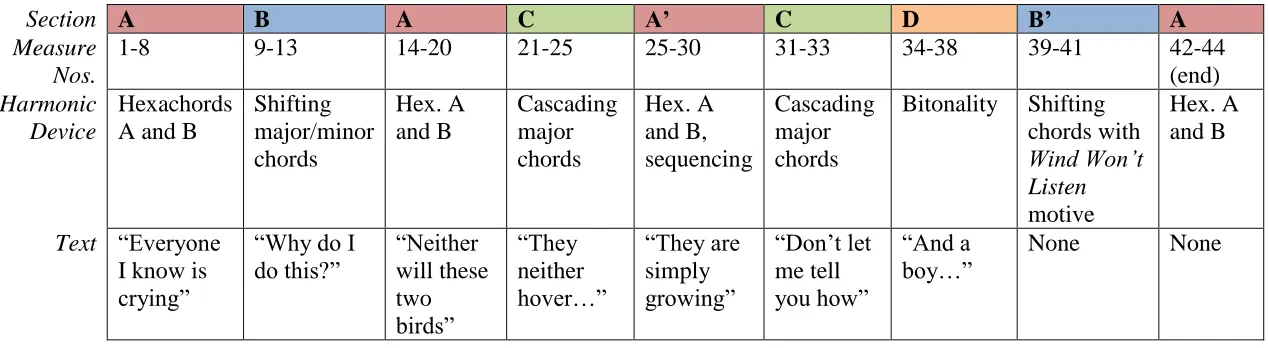
Figure 4.1: Form Diagram of Everyone is Crying (See Chapter 4.2 for detailed information on harmonic devices)... 56
Figure 4.2: Form Diagram of The Wind Won’t Listen. ... 60
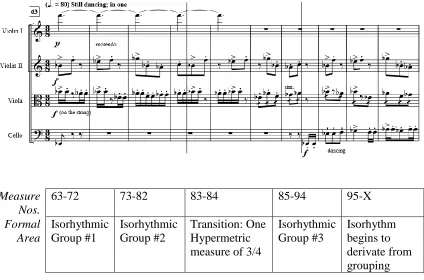
Figure 4.3: Isorhythmic Grouping as Structural Device. ... 78
Figure 5.1: Form Diagram of Woodwind Quintet No. 1, Mvts. 1 and 2. ... 93
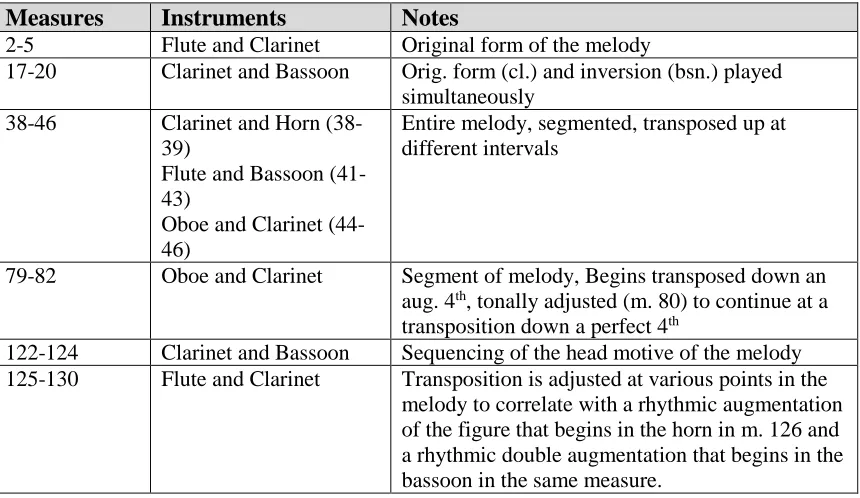
Figure 5.2: Melodic Variation Using Instrument Pairs in Movement 3. ... 97
Figure 5.3: Form Diagram of Woodwind Quintet No. 2, Mvt. 1. ...100
Figure 5.4: Form Diagram of Woodwind Quintet No. 2, Mvt. 2. ...102
Figure 5.5: Form Diagram of Listen Up! ...105
Figure 5.6: Diagram of the Melody. ...107
ix
LIST OF MUSICAL EXAMPLES
Example 3.1: Shostakovich’s Musical Signature, the D-S-C-H Motive. ... 27
Example 3.2: Head-motives in the Opening Recitative and “A” Section, mm. 1, 3. ... 33
Example 3.3: Layered Rhythmic Structure of “A” Section, mm. 16-18. ... 34
Example 3.4: Waltz Theme from “B” Section, Mvt. 1, mm. 28-38. ... 35
Example 3.5: “C” Section Theme, Mvt. 1, mm. 96-101. ... 37
Example 3.6: Unmetered Recitative Accompanied by D-S-C-H Sustain, Mvt. 1, m. 205. ... 38
Example 3.7: “A” Section of the Scherzo, Mvt. 2, mm. 1-4. ... 40
Example 3.8: Virtuosic Bassoon Writing in the Scherzo, Mvt. 2, mm. 32-35. ... 41
Example 3.9: Transition “Countown to the Cadenza,” Mvt. 2, mm. 125-130... 43
Example 3.10: Thematic Material in the Finale of Concerto da Camera, Mvt. 3, mm. 29-37. ... 44
Example 3.11: Fugue Subject from Double Fugue, Mvt. 3, mm. 76-79. ... 46
Example 4.1: Hexachord Collections from Everyone is Crying. ... 55
Example 4.2: Use of Hexachord Collections in Everyone is Crying, mm. 4-6 (non-hexachord tones shown in parentheses). ... 57
x
Example 4.4: Juxtaposition of Opening Melodies from Everyone is
Crying and The Wind Won’t Listen. ... 62
Example 4.5: Opening Measures of TheWind Won’t Listen, mm. 1-4. ... 63
Example 4.6: Opening Measures of Everyone is Crying, mm. 1-2. ... 63
Example 4.7: Motor Figure from “B” Section, mm. 33-35. ... 65
Example 4.8: Metric Duality in The Wind Won’t Listen, mm. 103-110. ... 68
Example 4.9: Wagner’s and Welcher’s Treatments of the Tristan Chord. ... 71
Example 4.10: Bassoon Cadenza in The Wind Won’t Listen, m. 188. ... 72
Example 4.11: Thematic Material Use in 2nd Movement of The Wind Won’t Listen; “Life makes itself without us” from Everyone is Crying, mm. 31-33. ... 74
Example 4.12: Rhythmic Ostinato (strings) and Thematic Material (bassoon) from Mvt. 2, Var. 1, mm. 29-32... 76
Example 4.13: Isorhythmic Grouping as Structural Device, mm. 63-72. ... 78
Example 4.14: Rhythmic Groupings, Hypermeter and Mixed-Meter in the Second Variation, mm. 83.94. ... 80
Example 4.15: Bitonality in the Climax of the Second Variation, mm. 122-131. ... 81
Example 4.16: “Why do I do this” Motive from Everyone is Crying, mm. 11-13. ... 82
Example 4.17: Ostinato and Thematic Development in Mvt. 2, mm. 163-167. ... 83
Example 4.18: “Why do I do this?” motive in violins, mm. 210-214. ... 84
Example 4.19: Variation 3 appears within Variation 1 Recapitulation, mm. 242-247. ... 87
xi
Examples 5.1 and 5.2: Instrument Pairing in Welcher’s Woodwind
Quintets, Woodwind Quintet No. 1, Mvt. 1, mm. 1-6 and mm. 24-31. ... 92
Example 5.3: Use of Instrument Pairings to Create a Wider Timbral Spectrum, Mvt. 2, mm. 13.20. (tacet instruments removed in mm. 16-20). ... 94
Example 5.4: Complex Harmonic Language, Mvt. 3, mm. 1-7... 96
Example 5.5: Motive A and [01478] Pentachord, Mvt. 1, mm. 1-9. ...100
Example 5.6: Combination of Serial and Non-Serial Technique, Mvt. 2, mm. 2-4. ...101
Example 5.7: Ground-Bass Figure from “Passacaglia,” Mvt. 3, mm. 1-5. ...102
Example 5.8: Score Image of the Melody, mm. 48-63. ...106
Example 5.9: Common-tone Chord Progressions in the Introduction to Harmony, mm. 88-100 (shown in reduced scoring). ...108
Example 5.10: An Emphatic Cadence in the Harmony Section, mm. 125-128. ...108
Example 5.11: Excerpt from Tone-Color Section, mm. 206-210. ...111
Example 5.12: Oboe and Bassoon Orchestration, Mvt. 1, mm. 25-34. ...114
Examples 5.13 and 5.14: Treatment of Source Material, Mvt. 2, mm. 5-10 and 24-27. ...116
Example 5.15: Spinning Music with Measuring Melody, mm. 34-40. ...122
Example 5.16: Cutting Music, mm. 71-75. ...123
Example 5.17: Aleatoric Writing in Teaching the Wind to Sing, m. 107. ...127
1
CHAPTER 1: INTRODUCTION
1.1 PURPOSE OF THE STUDY
The primary purpose of this study is to examine two pieces for bassoon by Dan
Welcher that, to this date, have not been analyzed and evaluated for their value to the
bassoonist as performer, pedagogue, and chamber musician. These are Concerto da
Camera (1975) for bassoon and chamber orchestra, an early composition, and The Wind
Won’t Listen (2002) for bassoon and string quartet, a more recent work. The study will
provide a resource for performers to use in their analysis and performance preparation of
these major works. Additionally, a representative sampling of chamber music involving
the bassoon including (i) small chamber ensembles and (ii) woodwind quintets will be
examined in order to highlight similar stylistic characteristics. Finally, this resource will
serve as an introductory reference material for the study of any other music by Dan
Welcher, highlighting important biographical information as well as stylistic hallmarks
that occur throughout his works. In order to effectively and comprehensively complete
this study, the following criteria must be addressed:
1. What are the hallmarks of Welcher’s style as a composer, and what stylistic
trends are displayed in the works in this study?
2. What (if any) are the programmatic constituents, large-scale formal/structural
2
technique, complex harmonic language, nonstandard formal structure, etc.) in the basic
composition of each piece? Furthermore, how do these concerns contribute to an
informed performance of Welcher’s music?
3. What is the availability of scores and recordings of each of these works? (See
also: BIBLIOGRAPHY, APPENDIX A: LIST OF WORKS BY DAN WELCHER,
APPENDIX B: DISCOGRAPHY)
4. How are each of the pieces related to the standard bassoon repertoire in the
aforementioned categories [(i) concerti, (ii) small chamber ensembles, and (iii) woodwind
quintets] with regard to composition technique, form, and instrumentation? Are there
certain qualities that make them unique?
5. What technical demands do these works provide for the bassoonist (and other
performers), and how do they affect the accessibility of each piece?
6. In addition to his career as a composer and professor of composition at the
University of Texas (UT), Welcher has worked as a professional bassoonist in the
Louisville Symphony and as the conductor of a contemporary music ensemble at UT that
he founded. In what ways are these experiences reflected in his compositions, specifically
in his writing for bassoon?
1.2 PROCEDURE OF THE STUDY
Following an overview of the career and compositional style of composer and
bassoonist Dan Welcher, this study will examine two works by the composer featuring
3
each piece will highlight individual areas of special concern for the performer, including
(but not limited to) areas of technical difficulty, overall formal structure, harmonic
structure, and related repertoire by other composers. Written nearly 30 years apart, the
works provide snapshots of Welcher’s compositional style at two different periods in his
career. A survey of other pieces of chamber music with bassoon by Dan Welcher is
included to highlight similar areas of interest to the bassoonist in Welcher’s works and to
provide further insight to the study of Concerto da Camera and The Wind Won’t Listen.
These pieces are addressed in chronological order, many filling in the gap between
Concerto da Camera and The Wind Won’t Listen, and represent the following genres: (i)
small chamber ensembles, and (ii) woodwind quintets. For each piece in this study, when
appropriate, I will provide a form diagram and employ the most appropriate method(s) of
harmonic analysis with which to specifically address concerns within the overall context
of the piece.
Correspondence with composers is an invaluable primary source for the performer
and the historian alike. In this study I contribute to previously existing correspondence
with Welcher (See Chapter 1.5) concerning his works by providing an edited transcript of
all correspondence between us as an addendum to the document. The focus of this
correspondence will primarily be information concerning Welcher’s compositional
process as it pertains to the pieces included within this study.
1.3 NEED FOR THE STUDY
This study is designed to aid bassoonists as well as those involved in the
4
by the wayside of more well-known (and so-called) “standard” repertoire, only to be later
forgotten. I believe that many, if not all, of the pieces included in this study have the
potential to be held with equal merit to those pieces already labeled as “standards” in
their respective genres. This study will provide performers and educators with a practical
resource with which to enrich their understanding of the scores and further enliven any
subsequent performances of these pieces. More frequent and more informed
performances may lead to these works being considered among the respective “standard”
repertoire, which includes 20th Century concerti with chamber orchestra of Franҫaix,
Jolivet, and Tomasi, and the often performed woodwind quintets of Paul Hindemith, Carl
Neilsen and Samuel Barber.
The duality of bassoonists who are also composers is an ongoing trend spanning
well over a century in the United States and elsewhere, many of whom are mentioned in
Michael Burns’ study of concerti by American bassoonist-composers.1 As a bassoonist
and composer myself, I have a personal interest in this trend. It is intriguing to me that so
many successful contemporary bassoonists have also been successful as composers and
within other fields in music, notably Arthur Weisberg (1931-2009), John Steinmetz (b.
1951), Mathieu Lussier (b. 1973), and of course Dan Welcher. This builds upon an earlier
tradition of the 18th and 19th centuries in which bassoonists were often composers in
addition to being performers. Early examples of this tradition are evident in the works of
Giovanni Bertoli (c. 1600-1645), Joseph Bodin de Boismortier (1689-1755), and Antoine
Dard (1715-1784). Franҫois Devienne (1753-1803), known by bassoonists for his six
sonatas, performed both as a flutist and bassoonist. Devienne was a contemporary of
5
Etienne Ozi (1754-1813), another French bassoonist-composer, and played bassoon in the
Paris Opera.2
1.4 LIMITATIONS OF THE STUDY
This study is limited to works by composer Dan Welcher that involve the bassoon
in a central or significant role. Large orchestral works, wind ensemble pieces and any
pieces by Welcher of similar scope—while equally worthy of close examination—are not
considered as a part of this study. The goal of this study is to inform the performance of
these pieces, therefore, any theoretical or formal analyses of pieces included within this
study are not intended to be extensive or exhaustive.
1.5 SURVEY OF RELATED LITERATURE
In his 1997 doctoral document, “Bassoon Concertos Written by Contemporary
Principal Bassoonists,” Michael Burns writes in detail about Welcher’s career (until
1996) and the Concerto da Camera for bassoon and chamber orchestra. Burns’ document
includes reference to the concerto’s program note as well as some interesting
correspondence between Burns and Welcher.3 Due to the nature of Burns’ study, he make
little reference to Welcher’s compositional style. Burns’ document also lists Welcher’s
entire oeuvre,4 which includes some of the pieces in this study (the first three woodwind
quintets) but lacks those which have been composed since (The Wind Won’t Listen, Mill
Songs, The Moerae). Burns also mentions the possible existence of a piece entitled
2 Ibid.
6
Pisces, a “symphony for bassoon and orchestra”.5The reader gets the impression that
Pisces was later rescinded by the composer or left incomplete, and Welcher had no
comment on the piece in Burns’ study. Two more woodwind quintets, yet unpublished,
have also been composed since Burns’ study. These are Teaching the Wind to Sing
(2010) and Spring Music (2015).
Vanessa Ferrari’s doctoral document, written 10 years after Burn’s survey, is a
smaller study of a similar nature. Ferrari examines five bassoon concerti by American
composers, including Welcher’s Concerto da Camera, but does not limit her study to
concertos by composers who are also bassoonists as Burns does. However, two of the
five pieces in Ferrari’s study meet this criterion: Welcher’s concerto and John
Steinmetz’s Concerto for Bassoon (2003). Her writing focuses on each piece’s place
within the concerto repertoire of the bassoon and includes biographical information about
each composer. Though the section about Welcher’s Concerto da Camera contains
biographical information on the composer and Ferrari’s commentary on an extensive
program note for the Concerto written by Welcher himself, it is by no means exhaustive.
An interview with Welcher concerning his compositional process, from the
impetus to compose a piece through its inception into the catalogue of works, appears in
The Muse That Sings: Composers Speak about the Creative Process, by Ann
McCutchan.6 This is an invaluable resource for research on all of the composers
interviewed in her book, and I will seek to elaborate on certain topics of this 1996
5 Burns, 45.
7
interview to provide insight into Welcher’s music to aid players in their performance
preparation and analysis.
Several studies have been written focusing on technical demands of x-instrument
within the context of the woodwind quintet literature. Most of these studies, such as
David Pierce’s 1986 dissertation “The Bassoon in the Woodwind Quintet: Performance
and Technical Demands and their Solutions,” and Lori Wooden’s 1996 dissertation
“Excerpts of Woodwind Quintet Music for Bassoon: Selections, Pedagogy, and
Practice,”7 focus specifically on bassoon technique and “difficult passages” that require
the use of special fingering patterns or similar fundamental control issues of the
instrument.8 While those studies seek to find difficult passages within the greater
repertoire, this study is structured as an examination of two pieces by Welcher and
focuses on the performance and overall interpretation of the piece by the bassoonist and
ensemble, not an orchestral excerpt-like treatment of difficult passages within the
respective pieces. It is the author’s goal to provide insight into the pieces by examining
large-scale forms, extra-musical concerns (programmatic features, source material), and
certain composition techniques used by Welcher (e.g. his blending of serial and
non-serial technique, or quoting melodies or styles of other composers and their work) to
enhance the performance.
8
CHAPTER 2: WELCHER AS BASSOONIST AND COMPOSER
“I think composers should be the best-educated, best-read, and most music-loving of musicians…we are the people who should be able to bring music across the footlights: to invent new ways of saying deep truths about life and art, to be the conduit between thought and action, to be able to induce states of pleasure, horror, arousal, tears—the whole gamut of emotions.”9
-Dan Welcher
2.1 BIOGRAPHICAL INFORMATION
Daniel Edward Welcher was born March 2nd, 1948 in Rochester, NY. He would
later attend the Eastman School of Music at the University of Rochester and the
Manhattan School of Music, primarily studying bassoon, piano, and composition. His
composition teachers were Samuel Adler, Warren Benson (Eastman) Ludmila Ulehla,
and Nicholas Flagello (Manhattan). In 1972 he became the principal bassoonist of the
Louisville Symphony Orchestra and began teaching music theory and composition at the
University of Louisville. It is during this time that he also began playing bassoon with the
Aspen Music Festival, performing next to renowned bassoonist and pedagogue Leonard
Sharrow. In 1978 Welcher became Professor of Bassoon at the University of Texas –
Austin and began performing regularly with the Austin Symphony Orchestra. It was
during this period that Welcher founded the UT New Music Ensemble. From 1980-1990
he served as Assistant Conductor of the Austin Symphony, but then left UT as well as his
position as Artist—Faculty at the Aspen Festival in 1990 to serve as
9
Composer-in-Residence of the Honolulu Symphony Orchestra, a position he would hold
through 1993. Following this residency Welcher returned to the University of Texas in a
new role as Professor of Composition and Director of the New Music Ensemble. Welcher
is an acclaimed speaker on music and “is known for making contemporary music
intelligible to lay listeners.”10 Between 1999 and 2009 he hosted a weekly radio broadcast
called “Knowing the Score” on KMFA-FM in Austin, and now hosts another weekly
broadcast on the same station, “From the Butler School of Music,” highlighting student
performances from the University of Texas – Austin.11
Pieces for concert band/wind ensemble are among Welcher’s best known works.
The most popular of these seem to be Four Places in the West (a collection of four
separate pieces for wind ensemble written over a period that spans almost twenty years:
Glacier, The Yellowstone Fires, Arches, and Zion) and Symphonies No. 3 (“Shaker Life,”
1998) and No. 4 (“American Visionary,” 2005). Welcher has written much other music,
including operas, symphonies and other pieces for orchestra, and more. It is a diverse
collection of chamber music—much of which includes woodwinds—that is the primary
interest in this study both because I am a bassoonist and because little research has been
done on those pieces to date. Welcher seems to write almost exclusively for traditionally
important chamber ensembles such as woodwind and brass quintet, string quartet, and a
quintet for clarinet and strings a la Brahms. This counters the less standard ensembles
used by many 20th Century modernist composers.
10
Welcher himself acknowledges that he has become known as “an orchestra and
band guy,”12 perhaps due to his relative success and subsequent recordings of works in
those genres. He has a passion for writing for large instrumental forces, but enjoys
writing chamber music and eagerly awaits the opportunity to write a “big opera.” He also
enjoys the other theatrical arts as well as literature and poetry. “I’m a big theatre nut,”
says Welcher when asked about his other interests and influences that may serve as
potential influences to his compositions, “and when I go to New York City, I rarely
attend concerts if I can attend plays. I’m also big on the outdoors, and on the study of
foreign cultures.”13
2.2 WELCHER AS BASSOONIST AND COMPOSER
As a bassoonist and enthusiast of Welcher’s music, I have frequently asked
myself why Welcher didn’t follow the compositional path of many other composers who
play the bassoon, a path with an output that usually utilizes the bassoon to a high
degree.14 Welcher’s response to this very question comes in the program note for The
Wind Won’t Listen: Fantasy for Bassoon and String Quartet, describing what can appear
to be a conscious avoidance of the bassoon in order to evade a very bassoon-centric
audience of critics as well as bassoonists themselves, hungry for solo repertoire and
orchestral obligato lines. Welcher writes “Perhaps I was so aware that people were
looking at me as a ‘bassoonist/composer’ that I was determined to remove that stigma.”15
12 Personal correspondence with the composer. 13 Ibid.
14 Michael Burn’s 1997 document references many bassoonists of the past and present who were also composers, beginning with Bertoloméo de Selma y Salaverde and Giovanni Bertoli in the 17th Century. See Burns, 9-32. His Appendix A in the same document provides a very comprehensive catalogue of pieces for bassoon by bassoonists. See Burns, 65-103.
11
In 1975, Welcher composed a concerto of massive breadth with a unique formal appeal
and idiomatic bassoon writing that simultaneously conveys a sense of sentimentality and
virtuosity, the Concerto da Camera. It was not until more than 25 years later that he
wrote the second piece in his oeuvre to feature the bassoon as a prominent solo
instrument, The Wind Won’t Listen. This piece is a 15-minute fantasy for bassoon and
string quartet that is very concerto-like but is essentially chamber music. The decision by
Welcher to avoid the bassoon represents an early distinction of himself as primarily a
composer (who also plays the bassoon), which is unlike most bassoonist-composers
throughout history, whose compositions often included many pieces of solo repertoire
and pedagogical materials.16 This decision is in no way meant as a denunciation of the
bassoon’s soloistic capabilities, for Welcher continues: “The Wind Won’t Listen
represents my return to the bassoon as the highly expressive, poetic soul that it is.”17
When I asked Welcher about the transition from performing to composing, he replied that
he didn’t simply stop performing, but due to the lack of practice time caused by time
devoted to composing, the frequency of his performing as a bassoonist “tapered off
gradually.”18 On bassoon playing, Welcher said to me, “I do miss performing, but I
wouldn’t have been able to keep my standards up if I had continued.”19
Welcher’s experience as a bassoonist has been influential in his writing, and this
influence can be seen in all of his chamber music including the bassoon as well as the
Concerto da Camera. Certainly, his writing for the instrument speaks to an awareness of
16 See Footnote 14.
12
the instrument’s strengths and facility that can only come from the perspective of a
player. This influence will be seen in later examinations Welcher’s music through his
evident knowledge of the versatility of the instrument in different ensembles and its
idiomatic ability to move freely and rapidly between registers. Welcher utilizes the
bassoon’s wide and malleable spectrum of tone colors, ranging from bright and intrepid
writing, as in the woodwind quintets, to sensitive, lyrical writing modeled after singing,
as in the Concerto da Camera and The Wind Won’t Listen.
2.3 SURVEY OF WELCHER’S COMPOSITIONAL STYLE
One of the most notable characteristics of Welcher’s music is a stylistic
eclecticism, a trend found throughout his entire oeuvre. Concerning Welcher’s
compositional process, it is clear that he always tries to begin with a goal of the piece’s
audience or occasion in mind, a “let the piece fit the purpose” approach. This wide
variety of styles can leave an analyst of his music who is looking for common
compositional threads perplexed at the onset. Welcher states that if he were to have to
choose one element that defines a piece of his music, it would be that each piece has a
clearly-perceptible form.20 Through this study, I have found that it is often most helpful
to begin with an analysis or diagram of the formal structure of each piece. He notes that
such a form might be his take on a well-known traditional form (such as “rondo” or
“arch” forms) but would not necessarily be named in the title, and that this preference
developed over time and may not be a characteristic of some of his earlier works like the
Concerto da Camera. He likes his pieces to have “a sense of return,” which is most often
13
seen through restatement of larger sections of musical material.21 A methodical
composer, he often retains ideas for pieces in what one might call an “idea bank” until he
finds the proper musical outlet within which he can develop the idea. Rather than
approaching a blank score with a capricious hand, these ideas are subject to planning,
diagramming, and outside research (and much trial and error at the keyboard!).22 Welcher
says in some of his earlier works he often approached composing in the latter,
stream-of-consciousness method, where he “just sat down and started writing.”23 He comments on
formal perception in his music:
“I think about Wagner and the Ring Cycle, about how someone could write something that takes twenty years to finish, and then when you sit there and hear all four of those operas in a row it’s clear that there is a complete progression from beginning to end, and it’s the same composer. Rhinegold is perhaps a little more simple, and Gotterdammerung is a step backward—but it’s the same composer, and if it wasn’t for his systematic approach and his leitmotifs those four operas could have been four wildly different styles. I like to do that too—to plan it out, to have a sense of a roadmap and sometimes leitmotifs and themes that I can cycle and will connect things together.” 24
He cites having been “profoundly moved” by certain composers: Richard Wagner,
Gustav Mahler, John Corigliano, and Benjamin Britten. The influence of many of these
composers can be seen in Welcher’s compositional style, especially when considering
formal and harmonic structure. “Mahler’s Fifth Symphony, Britten’s War Requiem and
Peter Grimes (and several of his other operas), and Corigliano’s Pied Piper Fantasy are
all pieces that have shaken me to the core. Those pieces are huge—they provide me more
21 Ibid.
22 McCutchan, 88-92. 23 McCutchan, 91.
14
with structural advice and a route to study than actual emulation.”25 The music of
Shostakovich also had a profound influence on Concerto da Camera, to be seen later.
“I’ve been told that my music often tells a story” states Welcher.26 Even if the
piece in question doesn’t have a programmatic aspect, listeners feel a sense of
programmatic unity and progression which Welcher attributes to the formal organization
of his music.27 Many of his pieces do have a program, often provided by Welcher in
program notes. In some cases the pieces simply have programmatic titles but no notes.
Welcher’s most accessible formal construct is his ability to write recognizable themes
and motives, and then use these melodic devices within formal sections that have a
distinct musical “mood” or emotional affect associated with them, often representative of
recognizable compositional styles such as dance forms and fugues. Dance forms are
particularly important in Welcher’s The Wind Won’t Listen, because they are the basis for
a set of variations in the second movement.
Traditional harmonic analysis (i.e. Roman numeral analysis) is not often the best
tool to use when examining the harmonic structure of Welcher’s music. Welcher states
that “my harmonic systems for pieces are individual entities…you have to adapt whatever
[tonality] system you’re using for your own needs, and temper the means to meet your
end.”28 Welcher feels that his choice of harmonic organizational system can help express
the mood of the piece, an aspect of the piece’s design that he often has in mind from its
inception.29 As is often the case with late 20th Century and contemporary music,
25 Ibid.
26 Ibid. 27 Ibid.
28 McCutchan, 92-93.
15
harmonic systems are not an all-inclusive schema for a piece, or even a movement of a
piece, as would be the case with the tonal framework of the common practice period, or
the serialism of Arnold Schoenberg and the Second Viennese School. Contemporary
composers frequently use varying means to express a wide range of musical ideas.
Welcher is no stranger to devices like bitonality, and he even has employed tritonality in
his Partita for Horn, Violin and Piano (1980).30 In some pieces, the system can vary even
within the separate movements/large sections. A single movement may contain elements
of tonality, atonality, bitonality, serialism, or other systems. With any harmonic system
(or combination of systems) Welcher employs, it seems as though his use of these
systems within pieces is not mutually exclusive: a piece is not “bitonal,” but “contains
instances of bitonality.” The same can be said for serial devices. In his song “Everyone is
Crying,” which became the primary inspiration for The Wind Won’t Listen, he uses two
different hexachords to define significant harmonic areas within the piece and create
continuity. Welcher specifically notes the combination of serial and non-serial technique
in pieces like his Concerto for Piano, Concerto for Violin, and many others.31 He states
that his “’tonal ear’ seems to be taking stage more and more”32 whereas earlier pieces in
his oeuvre tended toward atonality and serialism. No matter the harmony system
employed, Welcher states that his music “always has a sense of an underpinning of key”
and that there is “always a sense of ‘home’ or ‘root,’ harmonically.”33 This is an
important detail to consider when analyzing or performing Welcher’s music, as often
pitch collections will be reminiscent of tonality but will not function in his piece in the
30 Ibid.
16
same manner that they would in a more traditional tonal framework. Welcher’s music
continues to move further away from Charles Wuorinen’s serial-centric 1970’s view on
music composition, evident in the popular 1979 textbook Simple Composition. Welcher
mentions that most composers of the time ascribed to Wuorinen’s writing. “When I was
in grad school in the 1970’s, the rule of thumb was that we all had to write 12-tone music.
That was a given” states Welcher. “You could never get a grant, or a job teaching, or win
the Rome Prize if you were writing anything but 12-tone music, and for about twenty
years that was the rule.” Serialism as the pinnacle achievement in academic music has
been replaced now by things like spectral music, says Welcher, but he notes there is now
“more room for diversity of style than there used to be.”34
Another interesting point about Welcher’s initial planning and diagramming of a
piece is his awareness of the time duration of sections of music and pieces overall. He
feels that this awareness helps to “balance the proportions” of his music.35 This kind of
planning shows Welcher’s awareness of role of the audience (and the performers) of his
music, knowing when a musical idea has been completely wrung out of potential or
becomes boring to the audience.
34The opening of Charles Wuorinen’s Simple Composition reads: “Most of the Western music we know
from the past is representative of the tonal system…but while the tonal system, in anatrophied orvestigial form, is still used in popular and commercial music, and even occasionally in the backward-looking works of serious composers, it is no longer employed by serious composers of the mainstream.” Wuorinen, Simple Composition, 3.
In personal correspondence with Welcher, he noted this popular philosophy on music composition and remarked “I made a photocopy of that page, and hung it on my office door. I circled that sentence in red and over to the side I made a little thought bubble where I wrote ‘Oh yeah???’ See APPENDIX E for full correspondence.
17
Use of polyrhythmic figures and rhythmic complexity in general is a notable
characteristic of Welcher’s music, evident both in early pieces such as Concerto da
Camera and more recent ones like The Moerae (2008), a fantasy for flute, oboe, bassoon
and piano. Welcher likes this high level of rhythmic complexity in his music because it
sets his music apart from the more “forgettable” music of mid-20th Century composers
whose works were written in a more traditional tonal idiom.36 Welcher also likes to
manipulate meter and metric devices, and notably uses isorhythm in pieces, as he does
extensively in the final movement of his first symphony.37
The key to a study of Welcher’s music is an awareness of his characteristic
stylistic eclecticism. Each piece in Welcher’s oeuvre is unique, and depends upon the
parameters that he chooses to use for that particular piece. If the piece was written for
professionals or amateurs, some insight might be gained toward the level of virtuosity in
the instrumental technique or how challenging the piece may be for the ensemble to
perform because he tailors the level of difficulty to the ensemble for whom he is writing.
Welcher’s second woodwind quintet was written for the Blair Woodwind Quintet, who
would have less difficulty navigating that piece’s intricate rhythms and technical
passages than a non-professional ensemble. If the piece was written as the result of a
prestigious recognition, honorarium, or prize, as String Quartet No. 1, attention can be
called to elements of innovation and artistic license. About this piece Welcher states “As
any ambitious young composer with such a prestigious opportunity would do, I aimed
very high in this piece: it is a work of symphonic proportions, with a huge emotional
18
range.”38 Clearly the 1987 commission by the National Endowment for the Arts for the
Cleveland Quartet inspired Welcher to push his harmonic boundaries for his first string
quartet, evident in a tone-row that is not serialized but “affects rhythmic durations,
pitches, and meters, but also melodies, harmonies and colors.”39 Sometimes, the choice of
a specific harmonic language or device is simply an effort to create a certain “mood” that
reflects an extra-musical program, as in Zion or String Quartet No. 3. On Zion, Welcher
states , “I invented a ‘looping pentatonic’ scale that builds each new 5-note set on top of
the previous one, which creates a system that can provide virtually all the chromatic notes
if one goes high enough. Once I discovered this scale, I was able to use it a lot in other
pieces, like my Violin Concerto and Zion.”40 Formal structure, harmonic systems, and
extra-musical/programmatic concerns should be among the first considerations when
examining Welcher’s music, and are some of the first that will be addressed in the
analytical sections of this study.
2.4 AN APPROACH TO THE STUDY OF WELCHER’S MUSIC
Welcher states that form is a particularly important and perceptible aspect of his
music, so a diagram of the form of the Concerto da Camera and The Wind Won’t Listen
and other works will be included as an integral part of the analytical study of each piece,
and is an important place to begin each analysis. The harmonic system(s) utilized in the
piece under consideration should be identified and—when applicable—both formal and
harmonic elements must be contextualized in relation to any programmatic concerns.
38 Liner notes from Cassatt recording. 39 Ibid.
19
Often the programs in Welcher’s pieces are cause for interesting derivations from a
seemingly typical formal structure or harmonic schema.
“My second string quartet, Harbor Music, uses [arch form]” states Welcher. “I wrote the piece in three weeks. I laid out the form first: it was going to be all about this place in Sydney, Australia where the boat leaves from the dock, then goes to this location, and then back to the dock, and then another location. You can’t go from point B to point C, you always have to go back to point A first. I thought ‘this is sort of like a Rondo, but I’m going to make it into an Arch— Rondo.’ So it has this high point and comes back via circuitous route, but every time we hear the ‘da da dumm, da da dumm’ it’s a step higher and a different orchestration so that there’s a sense of heightened excitement as the piece progresses.”41
Welcher freely uses elements from any harmonic system of organization. It is
important to determine when significant elements of these systems are employed, being
careful not to cloak entire sections under the guise of “free atonality with tonal gestures.”
Often when Welcher uses serial, polytonal or other harmonic devices, he uses them as
vast extensions of an underlying implied tonal context. Frequently the connective tissue
between tonal and non-tonal sections contains harmonic collections that can function
simultaneously in multiple harmonic areas (tonal or otherwise), such as whole tone and
pentatonic collections.
Once formal structure and harmonic systems have been identified—in relation to
any programmatic elements—an area of interest is Welcher’s use of themes and motives.
Thematic consideration in analysis is especially important in Welcher’s earlier works, as
they can lack the careful formal structure of his later pieces and are guided more by
thematic development. “When I wrote the Concerto da Camera the first time I didn’t
[plan out a perceptible form]” states Welcher. “I just started out with a sense of ‘first
20
theme’ and ‘second theme’ and let things progress the way they wanted to.”42 Welcher
manipulates thematic material to suit his needs—especially when there is a programmatic
element to the piece—and often writes themes with recognizable head motives so that the
listener can immediately identify the thematic material from its onset. In highly
programmatic works, like The Moerae, themes and motives often represent different
characters or ideas and are manipulated to reflect the program. In The Moerae, specific
themes do not represent the specific characters of the three Fates, Clotho, Lachesis and
Atropos, but rather their particular duties of spinning, measuring, and cutting the thread
of life.
21
CHAPTER 3: CONCERTO DA CAMERA (1975, rev. 2006)
3.1 AN INTRODUCTION TO THE INSTRUMENTAL CONCERTI OF DAN WELCHER
Composers in the late 20th Century tend to treat the idiom of the “concerto” with a
great deal of freedom, formal and otherwise. Some utilize the old three movement
concerto form of the late 18th Century, complete with a full orchestral accompaniment
and cadenzas in all the right places. Others prefer a looser definition that includes pieces
which feature any instrument or collection of instruments in a soloist role, often with
large displays of virtuosity. Such pieces of varying instrumentation may also have a more
open-ended formal structure than more traditional concerti. Each of these depictions of
“concerto” can be seen in the bassoon repertoire since the late Baroque era, including
standards such as Vivaldi’s 39 bassoon concerti, Mozart’s Concerto in B flat Major, K.
191, Sinfonia Concertante, K. 297b, and Carl Maria von Weber’s Concerto in F and
Andante und Rondo Ongarese. The 20th Century saw no shortage of bassoon concerti,
such as Jean Franҫaix’s Concerto pour bassoon et 11 instruments à cordes, and concertos
with full orchestra by Henri Tomasi (1961), Ray Luke (1965) and Nino Rota (1977). This
short list does not even investigate the possibility for less standard ensembles, seen in
contemporary pieces such as Sofia Gubaidulina’s Concerto for the Bassoon and Low
Strings (1975), Michael Daugherty’s Dead Elvis (1993, bassoon with an ensemble a la
Stravinsky’s L’Histoire du Soldat), Philippe Hersant’s Huit Pieces for bassoon and
22
Marimba (2003), and Dana Wilson’s Avatar (2005, bassoon and chamber
winds).43 For the purpose of this study, a concerto will be defined as a piece of
considerable length featuring an instrumentalist in a soloist role with a standard, large
accompanying ensemble such as a wind ensemble, string or chamber orchestra, or full
symphony orchestra. Welcher’s output of instrumental concerti is quite substantial, with
concerti for many different instruments including clarinet, bassoon, piano, flute, timpani,
and violin. Even though some of Welcher’s chamber pieces are very concerto-like in the
way they feature a solo instrument, like the thirty-minute Quintet for Clarinet and String
Quartet (2001) and The Wind Won’t Listen, a fantasy for bassoon and string quartet
(2002), they are still chamber pieces, not conducted and with one performer on each part.
Welcher’s two pieces featuring the bassoon as a soloist mirror this established tradition of
instrumental concerti in many ways, even though one is a concerto and one is a chamber
piece. Some formal and stylistic aspects that the two pieces share are: (i) a lack of
separation between movements, (ii) a tendency toward lyrical (as opposed to virtuosic)
bassoon writing, and (iii) direct reference to other composers that involves musical
quotation.
It is unlikely that Welcher will revisit the bassoon concerto unless commissioned
to do so. He states “Every piece should have a reason…perhaps one of your sonatas is
profoundly romantic…the next might be a scientific piece…each has its own reason for
existence. Beethoven knew this better than anyone. Although he produced nine
23
symphonies, seventeen string quartets, and thirty-two piano sonatas, he managed to make
each piece unique.”44 If a new concerto is composed it will likely be written at the request
of a specific player, and their personal musical taste and strengths as a performer will be
represented in the final product. He notes “If someone commissions me to write for
bassoon, I’ll write for bassoon. It’s more external than internal, the choice of what to
write and when.”45
3.2 CONCERTO DA CAMERA FOR BASSOON AND CHAMBER ORCHESTRA (1975, rev. 2006)
Concerto da Camera (1975) for bassoon and chamber orchestra is one of
Welcher’s earliest instrumental concerti. The instrumentation of the orchestra includes
one each of flute, oboe, clarinet, horn, trumpet, piano, and one percussionist, as well as a
full string section. This instrumentation works well for bassoon because it doesn’t cause
problematic balance issues, allowing the bassoon to be heard clearly at all times without
amplification. The avoidance of other bassoon-like instrumental timbres, such as bass
clarinet, trombone, or other bassoons, is similarly beneficial. Being employed as a
bassoonist himself at the time, one might assume that Welcher composed the piece for
himself to perform. This was not the case: the concerto was written for well-known 20th
century bassoonist and pedagogue Leonard Sharrow, to whom Welcher played second
bassoon in the Aspen Music Festival.46 Sharrow premiered the concerto on September
12th, 1975 with the Louisville Symphony, conducted by Welcher, and recorded the piece
the following year on his album Leonard Sharrow Plays Works for Bassoon. Sharrow and
44 McCutchan, 94-95.
45 Personal correspondence with the composer.
24
Welcher had more of a collegial relationship than a student—teacher relationship, having
played together in the Aspen Festival. Welcher states that when he was playing in
Louisville, Sharrow was teaching at Indiana University in Bloomington. Sharrow
remarked at that time that Welcher was “pretty much a formed bassoonist now” and said
to him “you’re comfortable and you sound good so I’m going to let it alone.”47
The album booklet from Sharrow’s recording contains a lengthy program note for
the concerto written by Welcher:
Concerto da Camera began its existence as “Sonata for Bassoon and Piano” while
I was playing second bassoon in the Aspen Festival Orchestra during the summer of 1972. It was my intention to express in the piece my admiration and appreciation to Leonard Sharrow, with whom I had been privileged to work in the Orchestra for the entire season. The first and second movements were completed, in bassoon-and-piano form, during the fall of 1972.
Other projects intervened during the next two years, and the Sonata somehow metamorphosed during that time into a vague plan for a Concerto. The changes that two years can bring to one’s compositional style, however, caused the Concerto da Camera to emerge as a kind of hybrid when I finally was able to finish and orchestrate the piece in the spring of 1975. Some of the atonal harmonic language I had come to employ had to be suppressed for the completion of the work, and the orchestration, so easily arranged for a pianist’s hands when the piece was called “Sonata,” proved quite hazardous when spread out in the denser sonorities afforded by an orchestral group. Indeed, the sonority of the piano, and the flexibility of execution that instrument possesses, proved
indispensable for the Scherzo; and it was from this realization that the final orchestration sprung: quintets of winds and strings to sustain and highlight the essentially rhythmic writing; a “one-man-band” percussionist playing a score of instruments; and the aforementioned sine qua non, the piano.
The piece pays musical homage in a special way to a great composer, whose recent death makes these words necessary. Dmitri Shostakovich has always seemed to me curiously more contemporary than he is often given credit for being. Certain
psychological traits illuminate even his lesser works, especially a juxtapositioning of the serious with the banal which (as musicologists are fond of pointing out) closely aligns him with Mahler. There is also a facility in handling long melodies within a very lean texture, and the use of recitatives as expositional devices rather than cadenzas that also aligns Shostakovich with the earlier composer and which may be seen to have been assimilated into my Concerto. In any event, the unifying motive of the Concerto da
25
Camera is the ubiquitous four-note setting of Dmitri’s musical initials (D, E-flat, C and B in the German equivalent) which he used so often in his own “autobiographical” works, such as the tenth symphony and the eighth string quartet.
The Concerto da Camera is in three movements and an interlude. The first is a free sonata form with an introduction and coda, employing three unaccompanied
passages for the bassoon. The second movement, Scherzo, is a fierce display for this least fierce (shall I also say “and least virtuous”?) of instruments. It leads to a stretto of the D.S.C.H. motive which relaxes into the Interlude, a recitative for solo violin with comments by the bassoon over a pedal B-natural in the timpani. The interlude proceeds without pause into the last movement, in a slowly undulating 5/8 meter. There is considerable rhythmic development within the movement, culminating in an extensive double fugue for the orchestra in which the bassoon does not participate. At the height of the fugue, the bassoon cries out alone the three-note figure of the opening, only to be shouted down by the onrushing orchestra. In the end, it is calm that prevails, with the bassoon’s soothing melody accompanied by the pizzicato repetitions of the unifying motive, singing the piece to a gentle close.48
Sharrow’s recording received due praise and remains the only commercially
available recording of the Concerto da Camera at the time of this document’s
publication. One review compares Welcher’s concerto with the other concerto on the
recording performed by Sharrow, Ray Luke’s Concerto (1965). The reviewer writes “Ray
Luke’s concerto…speaks of a different era. In 1965, the language of music was
responding to different politics, social movements, and academic thought. Dan Welcher’s
concerto…stems from nearly a decade later, but reflects the exploratory ethos of
composers and performers of that era.”49 The program note indicates that Welcher
himself was writing mostly in an atonal idiom at the time, though he avoided employing a
great deal of atonality in the concerto because the original framework (in its original
conception as a Sonata for bassoon and piano) was evidently much less atonal.50 The
work is highly lyrical, which Welcher states is mostly due to Sharrow’s preference for
48 Liner notes from Sharrow recording.
26
playing lyrical pieces, but also due to a programmatic aspect concerning the death of
Dmitri Shostakovich, discussed below.51 Features of the lyrical style are a predominance
of broad, sustained melodies in a singing style, and a relative lack of technical virtuosity
for the sake of showcasing the performer’s abilities in that area. The virtuosity of the
performer is seen in the artistry and control of these singing lines, and in the broad palate
of tone colors and timbral nuance employed. When asked whether the title was an
allusion to historical forms (or perhaps a point of influence), he responded: “The title
Concerto da Camera really just means ‘chamber concerto,’ which implies a small
orchestra rather than a big one. Nothing more than that. As for other historical forms, I do
sometimes use forms with names like rondo, sonata-allegro, theme-and-variations, etc.,
but I’m not academic about it, and wouldn’t name these forms in the titles of the
pieces.”52 Two exceptions to this statement are the Passacaglia in Woodwind Quintet #2
and the Toccata—Finale of Listen Up!.
The Concerto da Camera is quite accessible despite the often atonal harmonic
language Welcher frequently employs, owing much to tonal references in his lyrical
writing. The work is not entirely atonal, but in keeping with the adventurous,
experimental spirit of composers of the 1960’s and 70’s is definitely far from both the
standard progressions and triadic harmony of the common practice period, and the
rigorous application of serial technique of the post-war years (50’s and 60’s) which still
held prominence in academia in the 70’s. Many sections throughout the concerto are
“key-like” and are defined by iterations of certain scalar figures, tonal/intervallic
27
collections, thematic sequences, and drones, but do not always contain the same overt
tonal underpinning as Welcher’s later works. These areas always occur in support of a
particular theme or motive, and Welcher’s ability to create distinct musical “moods” to
accompany this recognizable material is often a result of momentary tonal gestures within
a larger musical passage with mixed harmonic idioms, which helps to define an aurally
perceptible formal structure. In the concerto and other early works, harmony is often a
subsidiary tool used to embellish and transform motivic material. One such motive that is
treated in this manner throughout the piece is the D-S-C-H motive of Shostakovich,
which Welcher himself describes as “the unifying motive of the Concerto da Camera,”53
though he sometimes presents this motive subtly or as part of a larger theme (see
Example 3.1). He notes that sometimes analyses are not as helpful as they could be. “I
remember reading a review of the Concerto da Camera after the recording came out in a
well-known scholarly journal. This ten-page analysis got it wrong: they said it was all
based on B-A-C-H. I had already written program notes, and it was pretty clear what I
was doing but this author just got on his academic horse and didn’t stop. Through ten
pages he was talking about homage to Bach. Well, he got the C-H part right…”54
Example 3.1: Shostakovich’s Musical Signature, the D-S-C-H Motive.
28
The use of Shostakovich’s D-S-C-H motive is not a product of Welcher’s
fascination with the pitch collection itself, but rather (as the program note states) an
homage to the composer and his works and musical achievement. Welcher mentions with
a note of reverence that he was deeply moved by Shostakovich’s failing health (and later
death) and could not believe that he and Shostakovich were alive and composing at the
same time, one at the end of his career and the other at the beginning. He notes
Shostakovich’s skill in bassoon writing in all genres, especially in the symphonies.
Sharrow and Welcher had played Shostakovich’s Ninth Symphony together at Aspen55,
and Shostakovich’s lyrical use of the bassoon in the fourth movement is not unlike
Welcher’s own bassoon writing in Concerto da Camera, especially in the recitatives.
Shostakovich’s music was important to Welcher before he played it at Aspen. On
Shostakovich and Concerto da Camera, Welcher states:
“I was one of those people…who was pigeon-holed early on as “a guy who works in tonal music, we’ll just forget him because he doesn’t count” and the reason that
Concerto da Camera is, in the end, about Shostakovich is that I did a paper in grad school about Shostakovich’s Tenth [Symphony] and then had to stand up and defend it in front of my class. All but one person in that class said that ‘this music is meaningless because it is tonal’ and that ‘Shostakovich is going to be in the dustbin of history—you should be studying Webern.’ I like to think now that Shostakovich got the last laugh—so did Britten. These people who, when I was in grad school were made fun of, and are [now] the ones who are the most played and most likely to survive”56
Welcher revised Concerto da Camera in 2006 because he thought the piece
needed to flow better from beginning to end. He thought that some of the music seemed
to go on longer than necessary.57 Most of the changes and cuts were in the third
movement. Several of these occur around the double fugue, which in the original version
55 Ibid.
29
of the concerto was a section that the bassoon remained tacet. Welcher made the
transition into the double fugue more dramatic, cutting out some material and leading into
the fugue with a sweeping gesture. He also added several interjections of melodic
material for the bassoon during the fugue itself. Other adjustments to the piece are
minimal, and involve mostly tweaks in transition material or orchestration. The 1975
version of Concerto da Camera was used for this study to show Welcher’s original
musical material, though the 2006 version will likely be used more often in future
performances of this piece with orchestra.
The Concerto da Camera begins with an unaccompanied recitative for the
bassoon, an unusual opening for a bassoon concerto in 1972 and even to this day.58
Welcher uses recitatives to his advantage throughout, including three unaccompanied
recitatives in the first movement alone. The piece lies in a gray area between tonality and
atonality, though Welcher doesn’t utilize what Schwartz refers to as the “exploratory
ethos” of 1970’s composers,59 and it is likely that Schwartz is using this term specifically
in reference to harmonic language and the dominance of serial composition (or for some
a return to tonality), as well as free forms and experimentalism. Welcher’s Concerto
explores more radical elements of form and expression than more traditional composers
by his use of recitatives and predominantly lyrical writing for the bassoon.
58 Other bassoon concerti that begin in this manner include John William’s The Five Sacred Trees (1995) and Christopher Theofanidis’s Bassoon Concerto (2002).
30
Movement 1
Section Recit. Thematic Area A Thematic Area B Thematic Area C
Measure Nos. 1 2-27 28-74 75-96 97-127 128-151
Notes Rising third motive
Polyrhythmic figures, principal theme defined by a head motive
Waltz inspired by
Shostakovich, 3 statements of waltz theme
Organic outgrowth of waltz, 2 orch. Statements
Bsn. Takes theme, infused with DSCH
Orch. Plays C theme again, with DSCH
Section Recit. Thematic Area A’ Thematic Area B’ Recit. Coda
Measure Nos. 152-165 165-174 175-204 205 206-211 (end)
Notes Recap. of motives
“A” theme, interrupted by recit-like figures
Bassoon has new lyrical chromatic line over orch. “B” theme
Accomp. By DSCH in vibraphone
Material from head motive of opening recit. with DSCH
Movement 2 – “Scherzo”
Section A B A/B C Trans. A’ B’ Bridge Cadenza Coda
reprise Measure
Nos.
1-12 13-34 35-49
50-68
69-75 76-91 92-105
106-124
31
Interlude
Section Interlude
Measure Nos.
1-18
Notes Dodecaphonic collection with B sustain. Head motive from opening recit.
Movement 3 – “Finale”
Section A B Double Fugue Recit. Coda
Measure Nos.
1-25 26-37 38-43 44-56 57-75 76-133 134-141 142-158 159-183
Notes Primary theme in bassoon Secondary theme and PT in orchestra ST in bassoon, PT in orchestra New theme in bsn, same head motive as PT 2 statements, DSCH accomp in orch. Trans., Bsn. plays material that foreshadows double fugue DF exposition Coda of DF Recaps previous thematic material in order of appearance
Based upon PT and DSCH material
32
In some ways, Welcher’s affinity for and rhetorical capability in writing unaccompanied
passages for bassoon have the same evocative and melodic power usually found in songs,
though bassoon passages lack the additional advantage of text. These characteristics draw
an interesting parallel to ideologies within the Free Jazz subgenre of jazz during the
1960’s, where harmony was often a secondary consideration to the melodic lines of the
soloist, and where formal construction to maximize the expressive potential of the soloist
would be a natural response.60
Welcher’s choice of lyricism was a product of the performer for whom the piece
was written: Leonard Sharrow. “I also knew what kind of music [Sharrow] liked to
play—lyrical music—so the piece is mostly long soliloquies and long solo passages that
are pretty (or at least melodic) and without a whole lot of competition; the scherzo being
the one thing that goes further than that.”61
The first movement of the concerto introduces some important traits in Welcher’s
writing that are found throughout the entire concerto, and continue to be important in
later works. Welcher’s harmonic language in this piece lies on a shifting spectrum
between tonality and atonality, and he tends to state thematic material in a very clear
manner. He often uses points of imitation with memorable tonal gestures as
reinforcement of these themes, as he does with the head motive of the first theme of the
concerto (see Example 3.2). These gestures are characterized by a rising-and-falling
major third with major and minor inflection, and both hint at a tonal context though are
otherwise unrelated. Every time the head motive of a theme appears, regardless of the
60 Borgo, “Free Jazz.”
33
melodic material that follows, it usually signals the beginning of a line that is formally
important.
Example 3.2: Head-motives in the Opening Recitative and “A” Section, mm. 1, 3
Opening Recitative:
“A” Section:
Welcher’s use of recognizable head motives is paramount for underpinning the
movement’s so-called “free sonata form,” because they serve as musical gestures that
Welcher can—and does—refer back to later in the piece (see Example 3.2). The “A”
theme section, characterized by material that begins with the rising-and-falling thirds
head motive seen above, has a lot of rhythmic complexity. Welcher freely moves
between duple and triple divisions of the beat and often layers these in a polyrhythmic
structure, further increasing the importance of the recognizable head motives as an
34
(see Example 3.3). Head motives are also the most interesting and unpredictable melodic
element of the “A” section, as they are often sequenced and only occasionally develop
into free counterpoint.
Example 3.3: Layered Rhythmic Structure of “A” Section, mm. 16-18.
Performers of the Concerto da Camera will want to emphasize the head motives
in the “A” section and ensure that the dynamic balance of the ensemble is such that they
can be heard as the primary thematic material of the section, especially when developed
into more intricate contrapuntal writing. Welcher’s sparse orchestration of the chamber
orchestra helps with this delicate balance, though in a resonant hall the bass pizzicato
notes could become momentarily overpowering to the texture.
The “B” section of Concerto da Camera is a waltz inspired by the first movement
of Shostakovich’s Tenth Symphony.62 To increase thematic recognition, Wecher
frequently presents a theme in the orchestra and then follows it with a statement in the
solo part, a technique with roots in the more traditional concerto double-exposition form
of the 18th Century. The “B” section begins in this manner, with two statements of the