2077
The Study Of Pressure Derivative Of Bulk
Modulus At Extreme Compression
K.DHARMENDRAAND ARVIND MISHRA
Abstract: The present study reveals that the generalized Rydberg equation of state (EOS) with 𝑲 = 𝟓/𝟑, (i.e. the Holzapfel HO2-EOS) here 𝑲 be the infinite pressure value of first pressure derivative of bulk modulus, yields a remarkably good agreement with the Stacey reci procal 𝑲-EOS of the lower mantle and the outer core of the earth upto a pressure of nearly 330 GPa. Values of 𝑲 and 𝑲, the bulk modulus and its first order pressure derivative both at zero pressure, for the generalized Rydberg EOS with a fixed value of 𝑲 = 𝟓/𝟑 are found to be very close to the corresponding values for the Stacey EOS with 𝑲 = 2.4 and 3.0 respectively in case of the lower mantle and the outer core. The seismological data on P-K-ρ and K' are reproduced almost identically with the help of both the equation of state. It is emphasized that 𝑲 = 𝟓/𝟑 is not only a valid theoretical result obtained from the Thomas-Fermi model but also a thermodynamic requirement as found by Shanker et al. [Physics B (2006)]. We have also presented a comp arison of the results for iron at 300K, and found that the HO2 EOS is compatible with the Stacey reciprocal 𝑲-EOS.
Index Terms: Bulk modulus, Equation of state (EOS), First Pressure Derivative, Seismological data
—————————— ——————————
1.
INTRODUCTION
The equation of state (EOS) due to Vinet et al. [1], which is expressed on the Rydberg potential function [2], [3], [4], has been generalized [5], [6] so as to make it in accordance with the infinite pressure behavior of the first pressure derivative of bulk modulus 𝐾 → 𝐾 at V→0. The generalized Rydberg's EOS has been found [7] to yield results which deviate significantly from the seismological values for pressure, density and bulk modulus reported by Stacey and Davis [8]. Following the work of Stacey and Davis, the value of 𝐾 = 3.0 for the core material of the earth has been used by Singh [7] for obtaining the results from the generalized Rydberg EOS. This is in accordance with the thermodynamic constraint
𝐾 > 5/3 found by Stacey and Davis. However, in the present
study we found that the generalized Rydberg EOS with
𝐾 = 5/3 (HO2-EOS) yields good agreement with the Stacey
reciprocal 𝐾-EOS based on the seismological data of the lower mantle and the outer core of the Earth. The values of input parameter 𝐾 and 𝐾 the density 𝜌 fitted to the seismic data for the two EOS present remarkably close agreement with each other. On the basis of a result obtained from the thermodynamic formulation and the comparison with the seismic data, it is concluded that 𝐾 = 5/3 is a valid result.
2
METHOD
OF
ANALYSIS
The generalized Rydberg's EOS is written as [5]
)]
x
1
(
f
[
exp
)
x
1
(
x
K
3
P
K 1/3 1/30
'
(1)where x = V/V0 0
12
1
K
4
3
K
K
3
2
1
K
3
K
2
3
f
0'
'
0 0"
0'2
Equation (1) yield on differentiation
)]
1
(
exp[
3
)
1
(
3
)
1
(
3
1/33 / 1 3 / 1 3 / 1 3 / 1 ' 0 '
x
f
x
x
fx
x
K
x
K
K
K
(2)
3
x
)
x
1
(
3
fx
)
x
1
(
K
)
x
1
(
9
x
f
x
)
1
K
2
(
3
f
x
)
3
/
1
K
2
(
3
)
f
1
(
)
x
1
(
K
dP
dK
K
3 / 1 3 / 1 3 / 1 3 / 1 ' 3 / 1 3 / 2 2 3 / 2 ' 3 / 1 ' 3 / 1 2 ' ' (3)It should be mentioned that for
K
'=5/3, Eq. (1) becomesidentical with the Holzapfel EOS, known as HO2-EOS [9]. The
Stacey reciprocal
K
'-EOS is expressed as [10]K
P
K
K
1
K
1
K
1
' 0 ' ' 0 '
(4)which gives on integration
' K / ' 0 K ' 0
K
P
K
1
K
K
(5)and
K
P
1
K
K
K
P
K
1
ln
K
K
V
V
ln
' ' 0 ' 2 ' ' 0 0
(6)We have obtained the parameters by fitting the seismological data [8] to the generalized Rydberg EOS (Eq.1) with a fixed
value of
K
'= 5/3 for the lower mantle and the outer coreboth. The results for parameters thus obtained are compared in Table 1 with the values [5] corresponding to the Stacey
0,
K
0 andK
0'based on the generalized Rydberg EOS with
K
'= 5/3 areclose to those based on the Stacey EOS with higher values of
'
K
. The fitted parameters for the these two EOS differ from ———————————————— K. Dharmendra; Assistant Professor, Janta College Bakewar, Distt. Etawah U.P. India, Pin- 206124. E-mail:[email protected]
Arvind Mishra; Professor,Department of Applied Science and Humantities, G.L.Bajaj Institute of Technology & Management, Plot No. 2, Knowledge Park III, Greater Noida, Distt. G.B.Nagar, U.P., India, Pin-201306.
each other when we use higher value of
K
' (K
' = 3.0) inthe generalized Rydberg EOS (Table 3 of Reference [5]). Thus we have two alternative equations of state which reproduce the seismological data
(P-K-the lower mantle as well as for (P-K-the outer core with almost
0,
K
0 andK
'0 but substantially differentvalues of
K
'.Table1: Parameters obtained by fitting the seismological data [8]
Lower mantle
Parameter
Stacey reciprocal
K-prime EOS
Holzapfel HO2 EOS
ρ0 (kgm -3
) 3977.27 3976.92
0
K
(GPa) 206.09 204.0' 0
K
4.20 4.10" 0 0
K
K
-7.56 - 4.72'
K
2.40 5/3Outer Core
ρ0 (kgm -3
) 6562.56 6562.54
0
K
(GPa) 124.55 122.4' 0
K
4.96 4.95" 0 0
K
K
-9.72 -7.07'
K
3.0 5/32079
Figure 2. Results for (a) bulk modulus versus density (K-and (b) pressure versus density
(P-core of the Earth based on the two equations of state.
3 DISCUSSION
AND
CONCLUSIONS
It is worth motioning here that the generalized Rydberg's EOS
with
K
' = 5/3, i.e. the Holzapfel HO2-EOS is based on theThomas-Fermi model [9]. Stacey has seriously criticized the
Thomas-Fermi model and rejected the value 5/3 for
K
'.Recently Shanker et al. [11] have emphasized the necessity of reviewing the formulation on which the thermodynamic
constraint
K
'> 5/3 due to Stacey is based. Shanker et al. [11]have used the theory of Grüneisen parameter due to
Burakovsky and Preston [12] to demonstrate that
K
' = 5/3 isin accordance with the thermodynamic behavior of solids at
P
. It should be mentioned that the conditionK
' >5/3 has been obtained by Stacey using the following two relationships
1
K
' (7)and
6
1
2
K
'
(8)
where
be the value of Grüneisen parameter γ at P→∞.The condition (7) is a result of valid thermodynamic analysis, but Eq (8) is not a complete result as recently shown by Shanker et al. [11]. According to Stacey, Eq. (8) gives the infinite pressure limit of the general formula for the Grüneisen parameter
K
P
3
f
2
1
K
3
P
1
3
f
6
1
2
K
'(9)
where f is a parameter equal to 0 for the Slater [13], 1 for the Dugdale and MacDonald [14], and 2 for the free volume formula due to Vashchenko and Zubarev [15]. It has been shown by Shanker et al. [11] that Eq. (9) reduces to the
following expression for γ→
at P→∞, takingK
'→ 'K
andP/K→1/ '
K
,0
6
1
2
K
)
f
2
K
3
(
'
'
(10)
Eq. (10) gives two solutions, in which only one of them was considered by Stacey in the form of Eq. (8). The other solution
which yields
3
K
'
2
f
must also be considered [11]. Burakovsky and Preston [12] have found that f→5/2 atextreme compression, and therefore
K
'
5
/
3
is the result obtained from the thermodynamic analysis (Eq.10). It hasbeen shown in the present work that the HO2-EOS (
K
'=5/3)is consistent with the seismological data [8] of lower mantle and outer of the core. Not only the P-K-ρ data but also the
values of
K
' = dK/dP agree closely with the seismic data asshown in Tables 2 and 3. Thus we may conclude that
K
'=5/3is a valid result, and its rejection by Stacey [5], [8] and [10] is not justified.
Table 2: Comparison of
K
'value for the lower mantler (km) ρ(kgm-3
)
K' Stacey reciprocal
K-prime EOS
Holzapfel HO2 EOS 3480
3600 3630 3800 4000 4200 4400 4600 4800 5000 5200 5400 5600 5701
5566.89 5507.52 5492.63 5408.72 5309.63 5209.55 5108.10 5004.69 4898.69 4789.64 4676.95 4559.93 4437.64 4373.62
3.079 3.096 3.100 3.125 3.156 3.191 3.230 3.273 3.322 3.379 3.445 3.523 3.619 3.676
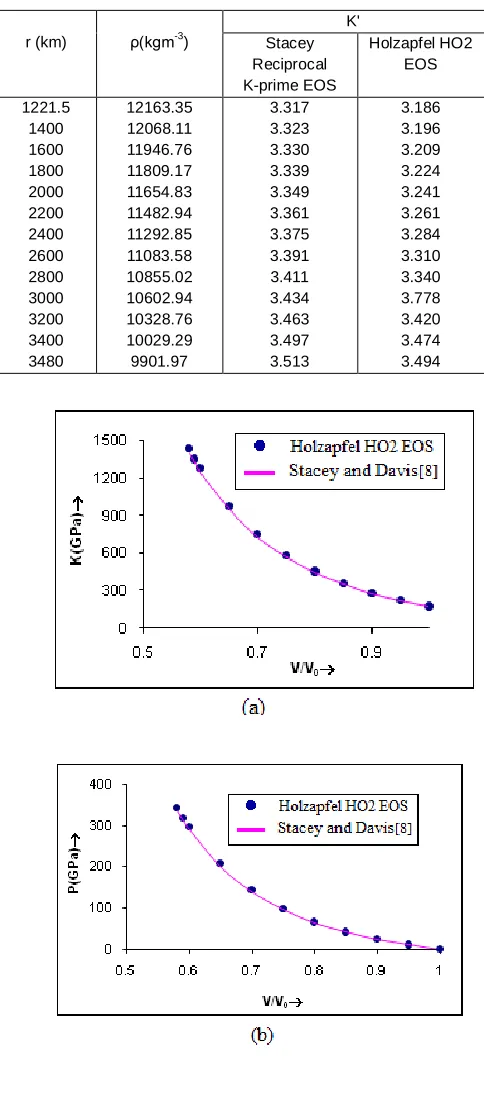
Table 3 : Comparison of K' for the Outer Core.
r (km) ρ(kgm-3
)
K' Stacey Reciprocal K-prime EOS
Holzapfel HO2 EOS 1221.5
1400 1600 1800 2000 2200 2400 2600 2800 3000 3200 3400 3480
12163.35 12068.11 11946.76 11809.17 11654.83 11482.94 11292.85 11083.58 10855.02 10602.94 10328.76 10029.29 9901.97
3.317 3.323 3.330 3.339 3.349 3.361 3.375 3.391 3.411 3.434 3.463 3.497 3.513
3.186 3.196 3.209 3.224 3.241 3.261 3.284 3.310 3.340 3.778 3.420 3.474 3.494
Figure 3 : Comparison of the results for hcp iron based on the
Holzapfel HO2 EOS and the Stacy reciprocal K'-EOS
(a) K vs V/V0 graph (b) P vs V/V0 graph (c) K' vs V/V0
graph .
Stacey and Davis [8] have demonstrated that the geophysical data provide more effective study of high pressure EOS than the laboratory data and therefore can be used for the recalibration of laboratory pressure scales. An unavoidable consequence of assuming that the properties of hexagonal close packed (hcp) iron are identical to that of core alloy under the similar conditions has been the recalibration [8] of platinum pressure scale used earlier by MaO et al [16] in laboratory measurements for hcp iron. In the present study we find that
the results obtained from the HO2 EOS (
K
'=5/3) are veryclose to those based on the Stacey's
K
'-EOS (K
'=3.0) forhcp iron (Figure 3) up to a pressure of 330 GPa which corresponds to the pressure at the inner core boundary. The most remarkable point to be mentioned here is that the same
values of input parameters viz. K0 = 170GPa and
K
0'=4.98 forhcp iron at 300K [8] are applicable in case of both the equations of state. The results obtained from the two-EOS (Figure 3) agree with each other within the uncertainties assigned to seismological data. For example KT=1377+20GPa is the core value corresponding to 300K and ICB pressure [8]. This is in agreement with the corresponding value KT =1385 GPa predicted from the HO2-EOS reinforcing the validity of
'
K
=5/3. Finally it should be emphasized thatK
'
5
/
3
is (1) a well established result based on the Thomas-Fermi model, (2) also a thermodynamic requirement [11], (3) consistent with the seismic data of the lower mantle and the core, and (4) well-matched with the shock wave data for iron and other materials as discussed at length by Shanker et al[11]. On the other hand,
K
'=3.0 and therefore γ∞ = 4/3 (Eq.8)2081
4 ACKNOWLEDGMENT
The author is thankful to Professor Jai Shanker for his valuable guidance and useful discussions.
REFERENCES
[1] P. Vinet, J. Ferrante, J.H. Rose, J.R. Smith, "J. Geophys Res.", vol. 19, pp. 9319, 1987.
[2] R.Z. Rydberg, "Phys. Rev.", vol. 73, pp. 376, 1932. [3] F.D. Stacey, B.J. Brennan, R.D. Irvine, "Geophys.
Surveys", vol. 4, pp. 189, 1981.
[4] S. Gaurav, B.S. Sharma, S.B. Sharma, S.C. Upadhyay, "Physica B", vo. 322, pp. 339, 2002.
[5] F.D. Stacey, "Rep. Prog. Phys.", vol. 68, pp. 341, 2005. [6] K. Arunesh, K. Dharmendra, "Physica B", vol. 364, pp.
111, 2005
[7] B.P. Singh, "Physica B", vol. 369, pp. 111, 2005.
[8] F.D. Stacey, P.M. Davis, "Phys. Earth Planet. Inter.", vol. 142, pp. 137, 20014.
[9] W.B. Holzapfel, "Rep. Prog. Phys.", vol. 59, pp. 29, 1996. [10]F.D. Stacey, "Geophys. J. Int.", vol. 143, pp. 621, 2000.
[11]J. Shanker, B. P. Singh & H. K. Baghel, " Physica B", vol.
387, pp. 409, 2007.
[12]L. Burakovsky, D.L. Preston, "J. Physics and Chemistry of solids" vol. 65, pp. 1581, 2004.
[13]J.C. Slater, Introduction of chemical physics, McGraw Hill, New
York, pp. 521, 1939.
[14]J.S. Dugdale, D.K.C. MacDonald, "Phys. Rev.", vol. 89, vol. 832, 1953.
[15]Y.Ya. Vaschenmko, V.N. Zubnarev, "Sov. Phys. Solid State", vol. 5, pp. 655, 1963.