U
C
L
Implementation of Enterprise Resource Planning (ERF)
and especially SAP in the Construction Industry: the case
o f Elliniki Technodomiki SA
by
George Karamolegkos
This thesis is submitted in partial fulfillment of the
requirements for the degree of Master of Science in Built
Environment from the University of London.
Bartlett School of Graduate Studies
University College London
All rights reserved
INFORMATION TO ALL U SE R S
The quality of this reproduction is d ep en d en t upon the quality of the copy subm itted.
In the unlikely even t that the author did not sen d a com plete manuscript
and there are m issing p a g e s, th e se will be noted. Also, if material had to be rem oved, a note will indicate the deletion.
uest.
ProQ uest U 6 43563
Published by ProQ uest LLC(2016). Copyright of the Dissertation is held by the Author.
All rights reserved.
This work is protected against unauthorized copying under Title 17, United S ta tes C ode. Microform Edition © ProQ uest LLC.
ProQ uest LLC
789 East E isenhow er Parkway P.O. Box 1346
The last few years many companies have adopted and implemented an ERP
system in order to manage their business needs and challenges.
Firstly, this report attempts to gain insight into ERP systems by briefly
describing the systems and their possible advantages and disadvantages o f having an
integrated ERP system, focusing more on SAP.
More specifically, the basic purpose o f this study is to investigate the impacts
o f ERP systems in organizations in the Construction Industry. It also tries to
understand the motives for the adoption of an ERP system by a construction company
and the possible consequences for taking this decision.
For these reasons, it is presented an analysis on the implementation of SAP in
EUiriki Technodomiki S.A., which is the first company in terms o f turnover in the
Greek construction market. Recommendations, derived from the analysis o f the case
study, are given. An analysis o f the operational and strategic implications o f the
implementation o f an ERP system is presented.
Study findings confirm the importance o f ERP implementation in the field of
constructions. The study findings could be of interest to managers o f these companies,
who seek to better understand the issues surrounding ERP systems implementation.
Finally, in the conclusion, further research on the topic is suggested, having
the context in which construction companies are doing business in mind.
Keywords: ERP, SAP, Integrated Information System, Implementation,
Construction Industiy, Elliniki Technodomiki.
Upon the completion o f my dissertation I would like to express my
appreciation and gratitude to all those who in various ways contributed to the
realization o f this project.
I am extremely grateful to my supervisor, Professor Graham Winch, for his
guidance and constructive comments during the preparation o f this report, and for his
valuable insight into this area of research.
I am very grateful to Professor Graham Ive for his assistance and input
towards my comprehension o f the Construction Industry.
I would also like to express my gratitude to all the individuals and
professionals who helped gathering the necessary information for my research.
In particular, I would like to mention and cordially thank Mr. Konstandinos
Papadopoulos, former member o f Elliniki Technodomiki, and Mr. Anastasios
Kallitsantsis, CEO and technical director o f Elliniki Technodomiki for their abundant
help and care during my project.
I am very grateful to the employees o f Elliniki Technodomiki and I wish to
thank them for their assistance and the provision o f background literature. In
particular I would like to cordially thank Mr. Konstandinos Neroutsos and Mr. loannis
Korohs for their continuous support and patience during the entire period o f my
project. In addition I would like to thank Periklis Papadakis, Dimitrios Darmazis,
Leonidas Mourelatos and Eleni Douka for the interviews they gave me.
Finally, my deepest gratitude goes to my family, for their continuing support
and encouragement during the preparation o f this report. They serve as the motivation
and inspiration for everything I do.
AM: Assets Management
APS: Advanced Planning and Scheduling BPI: Business Process Improvement BPR: Business Process Reengineering B2B: Business-to-Business
CASE: Computer Aided Software Engineering CEM: Construction Equipment Management. Cl: Construction Industry
CM: Cash Management CO: Controlling
CRM: Customer Relationship Management DW: Development Workbench
EC: Enterprise Controlling
ECE: Extended Collaborative Enterprise EDI: Electronic Data Interchange EFT: Electronic Fund Transfer ERP: Enterprise Resource Planning ET: Elliniki Technodomiki SA FI: Finance Management HR: Human Resources IM: Investment Management IS: Information System IT: Information Technology MM: Materials Management
MRP: Material Requirements Planning MRP II: Manufacturing Resource Planning PM: Plant Maintenance
PS: Project System QM: Quahty Management PP: Production Planning
RDMS: Relational Database Management Systems
SAP: Systems and Applications Products in Data Processing SCM: Supply Chain Management
SD: Sales and Distribution
ABSTRACT...ü ACKNOWLEDGEMENTS...üi
ACRONYMS... iv
TABLE OF CONTENTS... v
LIST OF FIGURES... vi
LIST OF TABLES... vu 1. INTRODUCTION...1
1.1. IDENTIFICATION OF RESEARCH PROBLEM... 1
1.2. PURPOSE AND OBJECTIVE OF RESEARCH... 3
1.3. LIMITATION OF SCOPE... 4
1.4. VALUE OF RESEARCH... 5
2. METHOD...6
2.1. POSSIBLE WAYS TO OBTAIN INFORMATION... 6
2.2. RESEARCH METHODOLOGY...6
3. ENTERPRISE RESOURCE PLANNING... 8
3.1. INFORMATION SYSTEMS & ERP...8
3.2. ERP HISTORY...10
3.3. ERP SYSTEMS...14
3.4. ERP IMPLEMENTATION - FOCUS ON Cl...18
3.5. ERP IMPLEMENTATION SUCCESS FACTORS - FOCUS ON CONSTRUCTION INDUSTRY... 26
3.6. ERP MARKET - ERP VENDOR RANKING... 28
4. SAP... 35
4.1. SAP... 35
4.2. SAP AND CONSTRUCTION INDUSTRY...37
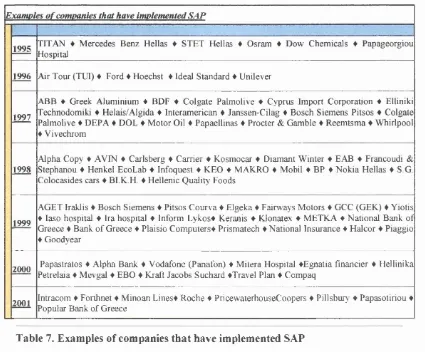
4.3 EXAMPLES OF COMPANIES THAT HAVE IMPLEMENTED SAP IN Cl 41 5. THE CASE OF ELLINIKI TECHNODOMIKI SA... 44
5.1. A GENERAL OUTLOOK OF THE COMPANY ITSELF AND ITS ACTIVITIES... 44
5.2. REASONS FOR IMPLEMENTING SAP IN ELLINIKI TECHNODOMIKI SA 46 5.2.1. REASONS FOR SEARCHING A NEW INFORMATION SYSTEM... 46
5.2.2. REASONS FOR CHOOSING SA P...47
5.3. IMPLEMENTATION PROCESS...48
5.3.1. IMPLEMENTATION PROCESS PLAN AND REENGINEERING NEEDS48 5.3.1.1. NEEDS FOR REENGINEERING BEFORE THE IMPLEMENTATION OF SAP 49 5.3.1.2.NEEDS FOR CHANGES IN STANDARD SAP... 51
5.4. PROBLEMS THAT THE COMPANY HAD SINCE NOW WITH THE IMPLEMENTATION... 51
5.4.1. GENERAL... 51
5.4.2. THE MANAGEMENT CONCERNING THE SUBCONTRACTORS... 55
5.5. HOW THE SYSTEM WORKS TODAY... 60
5.5.1. GENERAL...60
5.6.1. MODULES WHICH THE COMPANY WISHES TO DEVELOP IN THE
FUTURE... 69
5.6.2. NEW NEEDS AND EXPLOITATION OF THE NEW CAPABILITIES OF SAP AS FAR AS NEW TECHNOLOGIES ARE CONCERNED...70
6. CONCLUSIONS AND RECOMMENDATIONS... 71
REFERENCES...74
INTERVIEWS...75
INTERNET SITES...76
APPENDICES...77
APPENDK A...78
A. INTERVIEW QUESTIONS... 78
A. 1. INTERVIEW QUESTIONS FOR ELLINIKI TECHNODOMIKI, SAP TEAM...78
A.2. INTERVIEW QUESTIONS FOR ELLINIKI TECHNODOMIKI, USERS.. 80
APPENDIX B ... 81
ELLINIKI TECHNODOMIKI AND GROUP’S FINANCIAL DETAILS... 81
APPENDIX C ...88
A BRIEF DESCRIPTION OF THE PREVIOUS INFORMATION SYSTEM OF HELLINIKI TECHNODOMIKI... 88
LIST OF FIGURES
Figure 1. Comparison o f effort expended during ERP and the traditional software development life cycle...9Figure 2. Development o f Enterprise Systems...10
Figure 3. Supply Chain Management...11
Figure 4. mySAP Sypply Chain Management...12
Figure 5. Future applications o f ERP systems...12
Figure 6. Extended Enterprise System Framework...13
Figure 7. The mySAP.com E-Business Platform...13
Figure 8. ERP system’s new focus...14
Figure 9. Integration o f Information Systems...15
Figure 10. The ERP system...16
Figure 11. Stages o f traditional approach to Package Implementation...19
Figure 12. Implementation Options...21
Figure 13. Alternative Implementation Approaches...21
Figure 14. Linkages between organization size and complexity, and implementation approach used...22
Figure 15. Linkages between organization hierarchy and control, and implementation approach used...22
Figure 16. Graphic Overview o f ERP-Enabled Reengineering...24
Figure 17. BPR through ERP...24
Figure 18. The alternating activities o f Business Visioning and BPR...25
Figure 19. People issues in unsuccessful projects, ERP implementations...27
Figure 20. ERP vendors, market share...30
Figure 24. SAP R/3, DPU rating...32
Figure 25. SAP R/3, User ratings...32
Figure 26. Oracle Applications, User ratings... 33
Figure 27. Over all ratings - ERP systems for large organizations...34
Figure 28. SAP HELLAS SA turnover (D rs)... 35
Figure 29. SAP product map... 37
Figure 30. Industry-specific (IS) solutions... 38
Figure 31. SAP Engineering & Construction Solution M ap...40
Figure 32. SAP R/3 Installations by industry... 41
Figure 33. Interconnection o f the Group's buildings in Athens, Halandri, Maroussi and Thessaloniki...53
Figure 34. Example o f subcontractor’s services... 57
Figure 35. Example o f subcontractor’s services... 58
Figure 36. Example o f subcontractor’s contract... 58
Figure 37. Service entry sheet, use o f MS Office Excel... 59
Figure 38. Entry sheets, quantity survey...59
Figure 39. Example o f Purchase Order...60
Figure 40. General user menu... 62
Figure 41. Example o f Human Resources module master data...63
Figure 42. Functions o f the Work Breakdown Structure... 65
Figure 43. Example o f a Work Breakdown Structure... 65
Figure 44. Example o f WBS elements - descriptions... 66
Figure 45. WBS Element Overview in a specific project, in first stage o f the development o f the PS module... 67
Figure 46. WBS Element Overview in a specific project, in second stage o f the development o f the PS module... 68
Figure 47. Example o f report analysis o f costs... 68
Figure 48. Example o f project hierarchy graphic... 69
Figure 49. Group’s Financial results... 84
Figure 50. Turnover analysis for 2001... 84
Figure 51. Organization chart, Elliniki Technodomiki SA... 85
Figure 52. Group’s positioning in the local market... 86
Figure 53. Projects: a. Attiki Odos - Kifissias interchange / b. Motorway PATHE: Kastro-Martino-Atalanti-Tragana... 87
Figure 54. Projects: a. Olympics 2004 International Broadcasting Centre, IBC / b. Athens Olympic stadium, OAKA... 87
Figure 55. Projects: a. Dam Thysavrou Nestou / Rion - Antirion bridge... 87
LIST OF TABLES
Table 1. Main areas o f the questions o f the interviews... 7Table 2. Advantages o f the use o f ER P... 17
Table 3. Disadvantages of the use o f ERP... 17
Table 4. Implementation Approach... 20
Table 8. Examples o f companies that have implemented SAP in C l... 43
Table 9. Financial Results 2001, in million Euros... 45
Table 10. In-house Development -ER P package... 48
Table 11. ERP without Re-engineering... 51
Table 12. Participations, Elliniki Technodomiki SA... 82
Table 13. Summary financial data: Elliniki Technodomiki SA...83
Table 14. Financial Results 2001 in million Euros... 83
Table 15. Turnover o f major Greek companies...85
1. INTRODUCTION
1.1.
IDENTIFICATION OF RESEARCH PROBLEM
In today’s competitive and constantly changing business environment, the
capahihty o f reaching immediate decisions based on reliable sources and parameters
is considered as totally necessary. A modem company produces on a daily basis a
huge balk o f information that is distributed to different departments o f the company in
different geographical sites and in different systems. In this chaos o f spread data,
valuable information is hiding which could give answers to critical questions, helping
the better understanding o f the business scenery, supporting better and reliable
decisions, and improving the company’s performance. The above-mentioned need
and the attempt to satisfy it, is explained by the fact that today someone can see the
Information Technology^ in every organization and almost at every workplace. It is
responsible for the cormections between people and organizations, for the production
and quality control, security and financial records. The development and use o f the
Information Systems^ tends to become for many organizations one o f the critical
factors for surviving.
The accumulation, transformation and processing o f the information through
different and speciahzed systems for each department and activity of the company has
a high indirect cost. For that reason there is internationally a transaction in
organizations fi'om the traditional independent systems that every company uses to the
adaptation o f Enterprise Resource Planning^ packages. These apphcations are
designed to integrate and partially automate many o f the company’s business
processes.
ERP applications, in general, connect or replace the specialized software
products. In addition, by constituting a point o f concentration and collection o f
information for the entire company, they create a unified management environment.
The last few years ERP systems prevailed on an international level. The
organizations in the Construction Industry"^, in spite o f showing some delay in
comparison with other fields, could not have been an exception, so they eventually
adopted and applied ERP systems. One of the reasons is the particular characteristics
the Cl has, as well as the projects it carries out. Construction projects usually are
characterized as “off nature” and even if they look similar, they are never exactly the
same. Construction projects are “site-based”, in other words, even if they are the
same kind o f project, they are taking place in different sites. Additionally, in a new
construction project, different technologies could be implemented, and different
people, companies or organizations are involved. So, problems in managing a
construction project could arise fi'om the increased complexity o f a large or
innovating project, which demands new or special technology, and from the form and
integration o f a project coahtion, which changes in each project and affects it, because
o f human factors or different organization’s practices. Uncertainty and change could
cause problems in the management of construction projects. Additionally the
subcontracting is a main characteristic o f the construction industiy.
All reasons mentioned above make difficult the adoption o f certain business
processes, which could be incorporated in a particular ERP system. On the other hand
in small CIs, such as the Greek one, which until recently was consisted o f a big
number of small and medium size companies, the implementation of ERP apphcations
was not possible, due to their size.
However, the last few years many construction companies, on an international
level, went ahead with the implementation o f ERP systems. Initially the main
contribution came from the development o f specialized ERP packages with additional
operations for each industry, such as the Cl, by ERP vendors^. In addition, the
experience accumulated through the implementation o f these systems in the original
construction companies, helped and encouraged other companies to do the same. On
the other hand, the merging wave, which influenced strongly the last years the Greek
construction companies, created big construction groups with expansion across the
borders. This situation promotes for the future the use o f ERP systems as a basic
variable o f success. Finally after the birth of e-business and the first steps o f e-
commerce, construction companies reexamine ERP, as an additional tool to the hands
The interest in implementing and realizing the benefits o f ERP systems has
been increased in the Cl, as we have mentioned above. The adoption and
implementation o f an ERP system is considered as an important strategic decision of
the construction managers. Although this author found no bibliography for the
possible problems that a construction company faces in connection with the
implementation o f SAP, it would be unreasonable to presume that problems do not
exist. For this particular reason we believe that the managers in the Cl, in order to be
better prepared for the reception o f ERP systems, is worthwhile to try to study and
understand the advantages o f the systems as well as the possible problems they might
face during their implementation. The installation time needed for an ERP system as
well as the implementation cost are both important factors that have to be taken into
account. Significant source o f information for the above study is the experience o f the
construction companies which first adopted ERP systems.
In conclusion, construction companies can acquire a competitive advantage
with the right use o f ERP applications, which will provide them with the ability to
better manage a wide range o f business requirements. As a matter o f fact we can
easily speak about real challenges, such as supplies, the work force, project
management and the accounting complexities. This is very important in the rapidly
changing modem environment. The study, -from the side o f the construction
managers-, o f the implementation o f ERP systems in general and particularly o f SAP,
with the high global market share, is o f particular and high interest.
1.2.
PURPOSE AND OBJECTIVE OF RESEARCH
The basic purpose o f this study is to investigate the impacts o f ERP systems in
organizations in the Cl. In order to accomplish this, several objectives were pursued.
Firstly, one o f the objectives o f this research is to gain insight into ERP systems by
briefly describing the systems and their possible advantages and disadvantages of
having an integrated ERP system. Then, the research will examine in details the SAP
system, which has been selected by more than 1700 companies worldwide in the
construction industry in order to meet their industry-specific business and technology
and especially the interesting case o f implementation of SAP in Elliniki
Technodomiki SA^, a Greek construction company, which uses SAP R/3 since the
beginning o f 1997. The study o f the implementation o f SAP in ET is being carried
out in order to obtain a broad view o f issues as whether construction companies could
gain benefits and competition advantage by using ERP software, as well as whether
these apphcations enable them to manage their comprehensive business requirements
and to attempt to record certain problems and fixture needs for ET. Through this study
there will be an effort to understand the motives for the adoption o f an ERP system by
a construction company and the possible consequences for making this decision.
1.3.
LIMITATION OF SCOPE
The scope o f this research will be limited to the investigation o f ERP systems
only and not to other computer applications used by construction companies. The use
o f ERP systems by construction companies the last years has been increased. The
investments on these systems are large enough while the up to now research is really
small. For these reasons the focus o f this study on the ERP systems as far as the Cl is
concerned, has been considered as absolutely essential.
Another delimitation in this research paper is the study o f the implementation
only of SAP software in one construction company. Thus, while in the beginning
there is a detailed description focused on the characteristics o f the ERP systems, later
the research focuses on the implementation o f SAP. SAP was chosen as the ERP
system of focus because o f its high market share and because ET was the first
construction company in the Greek market to implement it. As a result, besides the
reference on the SAP choice by ET, this paper does not include an evaluation or
comparison o f ERP systems with other systems, and it is necessary to underline that
this paper is neither an advertisement nor a criticism o f any system. On the other
hand ET was chosen because as it has been mentioned before it was the first company
in the Greek market implementing SAP since 1997 in order to cover its business
The implementation of SAP in ET has not been completed yet, but the initial
objectives o f the company have been accomplished and most basic SAP modules have
been developed. Today, some other Greek construction companies have started
implementing ERP systems, following the example o f ET, but it is clear that they are
obviously on an early stage.
Clearly there is a need for further research aiming towards the implementation
o f other ERP systems as well as the study o f more construction companies. This
particular type o f research however has particular interest because of lack of a similar
previous research and it is intended to increase awareness o f the issues involved in
using ERP systems in the Cl.
1.4.
VALUE OF RESEARCH
The construction companies plan produce and maintain highly complex
products and industrial plants, based largely on customer specific requirements and
definitions, so the ERP systems can have a great influence on this process. It is hoped
that this research paper will fulfill its objectives and will succeed to explore through
the case study o f ET the apphcation and the influence of an ERP system in a
construction company. At the same time this report aspires to provide the
construction managers with a better knowledge o f the current and future situation.
Moreover it can be o f valuable guidance for employers in the Cl, when they are
forming their fiiture strategies, by providing helpful information and by collecting the
up to date experience o f SAP’S implementation in ET.
Regardless if this study succeeds in reaching its objectives, it is hoped that it
will generate interest, focus on the subject, trigger discussion and promote
constructive interaction to develop an increasing interest for finther research on this
field. Furthermore it is hoped that it will aid in identifying and suggesting other areas
2. METHOD
2.1.
POSSIBLE WAYS TO OBTAIN INFORMATION
It is required for someone in order to examine closely and understand ERP
implementation in the Cl, to first learn more about ERP systems and their
fimctionality. Thus, there is a description o f these systems in the first part o f this
report.
The written materials available are books, articles on the Internet, and
brochures fi’om the largest ERP vendors. Since ERP is relatively a new concept, there
are not books written with the intention to describe the implementation o f ERP in the
Cl. There are books describing the ERP system itself, but mostly one can acquire
information by reading recent reports, magazines and Internet articles.
Another important part for collecting information about ERP systems and SAP
is the interviews with the SAP clients. The sources o f the primary information in this
study were the interviews, which were performed in ET.
2.2.
RESEARCH METHODOLOGY
Initially a review o f published literature was the first activity undertaken.
Through this review a hst o f questions was developed to help further guide the
research. Upon completion, much was known about ERP systems and SAP, but little
was focused on their implementation in a construction company. Additional activities
were followed in order to acquire such insights. Initially information was collected
fi'om SAP AG itself concerning the implementation o f SAP in a construction
company^. In succession, a series o f interviews was administered with members o f
the IS department o f ET, who were responsible for the SAP project. Additionally
users o f SAP in different departments of the company were interviewed. Finally
members of the company gave more other information, useful elucidations and
valuable help.
Main areas of the questions of the interviews*
• Reasons for implementing an ERP system
• Choice of implementing partner
• The implementation process
• How the system works today
• The company’s ERP needs in the future
Table 1. Main areas of the questions of the interviews.
3. ENTERPRISE RESOURCE PLANNING
3.1.
INFORMATION SYSTEMS* & ERP
It is generally accepted that both the exploitation o f technology and
informatics are among the main means to create competitive advantages for a modem
company. The IS o f a company consists o f the hardware and the apphcations it
manages, in order to fonction properly both internally as well as in relation with its
chentele. In a company, one o f the main operations o f the IS is the collection,
storage, management, processing, presentation, and spreading o f information. Kale
[2000, p.23 & p.29] underlines the importance o f Information-based organizations for
the survival of the companies in the changing global competitive market, since he
considers that information is by now the fifth resource^^.
According to Dahlen & Elfsson [1999, p.5], in a company there are usually
different types of IS, which can be divided into three areas;
• Systems developed in-house
• Standard apphcation packages
• “Joint-venture”^^ systems
As Shields [2001, preface] notices, during the early years most IS were custom
developed: each organization designed, programmed, tested and implemented
financial, human resource and operational systems to meet unique organizational
requirements. Most o f these systems were developed by the organization’s in-house
IS department. However, according to Chang & Gable [2001, p.1152], lately,
organizations worldwide are moving away from developing IS in-house and are
instead implementing Enterprise Resource Planning^^ systems and other packaged
software.
“An ERP software apphcation package is a suite o f pre-engineered, ready to
implement, integrated apphcation modules, catering to ah the business functions o f an
enterprise and processing the flexibility for configuring and customizing dynamically
the dehvered functionality o f the package to suit the specific requirements o f the
"IS
The first four are manpower, materials, money and time.
enterprise. ERP enables an enterprise to operate as an integrated, enterprise wide,
process-oriented, information-driven, and real-time enterprise.” [Kale, 2000, p. 13]
One o f the main reasons companies today prefer packaged software is that
several companies can use the same software. With several users, the costs of
development, support and maintenance are shared. In addition, each client does not
have to “reinvent the wheel” as Shields [2001, p.4] notices. Many existing systems
have become so difficult and costly to maintain, inflexible and misaligned with
business strategy that firms have taken a clean slate approach towards their IT
strategy. [Davenport, 1998]
The Year 2000 problem'^ and the new common European currency have been
also major drivers for many companies to install an ERP system.
Effort
t
ERP
R equrem enis Anatys>s OevBkjpment Testing Operations
Definition arxJ and and
Design Implementation Maintenance
Time Period
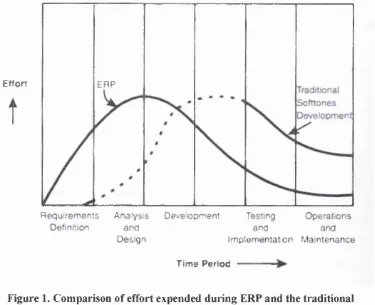
Figure 1. Comparison of effort expended during ERP and the traditional software development life cycle.
Source; [Kale, 2000, p i2]
3.2.
ERP HISTORY
The term ERP has only been widely used the last few years, but the systems
and their predecessors; MRP^^ and MRP 11^^ have been actively sold for nearly 25
years [Dahlen & Elfsson, 1996, p.6]. Light & Holland [2000, p.l 17] summarize the
literature on the concept of MRP including the calculation of quantities of materials
and the times manufacturing organizations required in order to improve operations.
Throughout the 1980’s and the early 1990’s the concept was extended to examine the
engineering and financial implications of future demand on the business and it was
renamed. Manufacturing Resource Planning or MRP II. With the development of the
standard RDMS^^ models in the 1990’s the ERPs have dominated. ERP is the latest
and most integrated development of the above-mentioned systems, defining a model
of a complete IS. ERP packages differentiate from MRP II in the technical
requirements such as the relational databases, the use of object oriented programming
languages, the CASE'^ tools, the architecture client/server as well as the open systems
architecture for easy communication.
APS
"T|
ERP O
nvei itory C ontrol System s
Figure 2. Development of Enterprise Systems
Source: [Kraemmergaard & Moller, 2000, p2]
According to Kraemmergaard & Moller [2000] the latest offspring of ERP
systems is the APS** systems. APS systems extend the scope of the ERP systems
from the enterprise to the entire supply chain and the systems are sometimes referred
as SCM*^ systems. SCM systems require the integration of vendors, distributors,
resellers and customers. They started as stand-alone systems but now they are being
integrated in the ERP packages as an APS module. Thus we see that ERP vendors
continuously develop solutions for the expansion of their systems not only with the
support of Web and e-commerce procedures but also with other additional areas such
as SCM, CRM^**, B2B^* support and virtual enterprises. Additionally we have the
intra-connection of the ERP’s with each other and their interconnection with other
applications creating “smart networks”. Therefore while the initial goal was the
completion of integration within the company through the ERP systems-as Kale
[2000, p.444] notices -“the future of ERP is closely related with the effort to
reengineer such inter-enterprise interfaces and foster closer collaborations across
multiple enterprises, that is Extended Collaborative Enterprise^^”.
< asli Khm
su n p lici
1
Maniitacturin
D istnhution
( iNomci
In fo r m a tio n Plow
Figure 3. Supply Chain Management
Source: [Dahlen & Elfsson, 1999, p44]
Advanced Planning and Scheduling.
20
Supply Chain Management
Customer Relationship Management Business-to-Business.
Measure
Supply Chain Perform ance M anagement
Supply Chain Collaboration arategize___________ Ban
\ Demand and Supply Chain Design ;
Supply Planning Supply Chain Supply Chain Pelivgr Direct
^ Procurement
Order Manufacturing ;
Fulfillment
Track Supply Chain Event M anagem ent
I Network
Inform ation Scope
Figure 4. mySAP Sypply Chain Management
Source: [SAP Corporate Profile, 2001, p26]
Knowledge M anagement
Process Management
Transaction A utom ation
ES standard equipm ent
Prehistory
Advanced décision-support
systems
Original functionality of r:S packages, with added functionality
of bolt ons
Baseline functionality of
ES databases
Business intelligence packages
Supply chain management and
integration
Autom ated ordering
Internal, Individual Internal, Integrated B usiness D om ain
Supply Chain
Management Dashboard
Executive Portal
Cross-Application Repository
Data W areltouse
Advanced Applications
Pure-Web
CRM SCM E-P Other
ERP Transactional
Backbone
Human R eso u rces Financial Distribution
M anufacturing'
Technical Infrastructure
Internet Gateways Hardware Networks DBMS Email
Figure 6. Extended Enterprise System Framework
Source: [Shields, 2000, pIO]
mvSAP Hosted Solutions
my SAP Services
mySAP Workplace
Employees
mySAP
mySAP hr
mySAP
mySAP Financials mySAP
E P rocurem ent industry CRM
mySAP Solutions niySAP
PLM Bl
Company
SAPMarkets
mySAP Technology
Figure 7. The mySAP.com E-Business Platform
3.3.
ERP SYSTEMS
Enterprise Resource Planning as a subject combines technology, business,
practices and organizational structures. “ERP system is a software solution that
addresses all the needs of an enterprise with the process view o f an organization in
order to meet the organizational goals and integrate all the functions of the enterprise”
[Kumar, 2001, p.2]. In other words it is a common term for cooperating software that
manages and coordinates much o f a company’s resources, assets and activities.
Orders, storage, purchasing, assets, vendors’ contracts, financial and human resources
are usually included in an ERP system. We can illustrate the use o f an ERP system by
the following example: When a store in Italy sells a product, data is sent
simultaneously to the finance department in London and to the manufacturing
department in Korea. Due to high cost involved, initially, only large multinational
companies and Infrastructure companies were using ERP applications. Today many
medium size companies have adopted the implementation of ERP.
The role of ERP systems is the integration of all systems and operations of a
company under a common IS, where all people interested can have access. This
system will provide all the necessary services for each department of a company in a
unified environment, through which, the exchange of information from one
department to another will be possible. This philosophy comes to replace what was
happening until recently, where each department of a company had its own
applications and its own IS.
Findnoat Human Kcsourcos . / f « raicial H um an K eao.jrces Safes & DistriDution. Mat o r a ls M -anaaem crit. sic.
Figure 8. ERP system’s new focus
IS messages IS messages
Manufacturing
• Local purchasing, invoice verification • inventory managem ent • internai sales,
shipping and billing • Profit/loss
• Capacity utilization
Head Quarters
• Information Systems: • Project Mgmt
• Inventory • Purchasing • Sales • Budget
• Cash Management
Marketing/Sales
• Sales, shipping and billing • Purchasing of
trading goods • Inventory
Managem ent • Custom er service
Figure 9. Integration of Information Systems
Source; [Kumar, 2001, p25]
A flinctional ERP system is massively complex. According to Davenport [2000, p.
299], several technical capabilities are the key to how an ERP system works,
including the following:
• Modular construction
• Client/server architecture
• Configuration
• Common central database
• Variable interfaces
An ERP system is a collection of application modules. Companies can select
among the available modules offered and install only those needed. Some of the most
common modules of an ERP system are: sales and distribution, materials
management, production and planning, finance and controlling, project system,
(- iMunXTS
S a k s ai x l
lkll\CT\ !ipplic;m un\
N.lk'' I'MvO aivl uu I' inv'l
'L'r\ K‘0 i\. |'\
Svl \ KV applKaliiiii's
A
Rcp< applkalhMis
-fr
Central daUkax’
II liman rcx'uroc nvinagomoni applkalu’is
I llUtlK Ull applKaikin'
M a i u i h K U ii m g > a p p l w a t i u n s
H a v k - " l l i v v
.him m i liaiMi am i " " I l a .I '
^ln\cni'r\ .
a p p l i c a t i o n
I .mpl'OCv
Supplied
Figure 10. The ERP system
Source: [Davenport, 1998/ Dahlen & Elfsson, 1999, p8]
Advantages of the use of ERP
• Facilitates company - wide integrated IS, covering all functional
areas.
• By using it someone can have better control of the company.
• Performs core corporate activities and increases customer service
and thereby augments corporate image.
• Organizes and optimizes the data input methodologies systematically
and avoids data redundancy.
• Cycle time reduction.
* Better financial management.
• Standardizes business processes across all constituent companies and sites, thus increasing their efficiencies.
• Faster information transactions.
• By using it suppliers and customers can have on-line communication.
• Flexibility. The systems consist of modules, which make adaptations at a later time easier.
• Transfer knowledge between industries, which guarantee innovation.
• It allows automatic introduction o f latest technologies.
Table 2. Advantages of the use of ERF
Adopted by: [Kumar, 2001, p.45/ Davenport, 2000, p.8 / Kale, 2000, p. 13 and p. 27 / Dahlen &Elfsson, 1999, p. 13]
Disadvantages of the use of ERF
• It may have high cost for installation and materialization.
• Could have long implementation periods resulting to a delay of the production procedures.
• Imposes a hierarchical “command and control” perspective on
organizations.
• Davenport [2000, p. 16], notes that ERP systems could be like cement, highly flexible in the beginning but rigid later.
• It is developed by an external vendor without the company’s knowledge.
• It has increased the need of external help from consulting firms.
• It can introduce new routines for the staff.
• It freezes the system development by the vendor.
Table 3. Disadvantages of the use of ERF
3.4.
ERP IMPLEMENTATION - FOCUS ON Cl
In general, the concept o f implementation is related to the installation o f
hardware and software. However as both Kraemmergaard & Moller [2000, p.6]
clarity, in the world o f ERP systems, the implementation is often used as a term to
describe a well-defined project spanning fi'om the choice o f the systems through the
configuration and the training until going live, where the system is becoming
operative. In the companies’ view, implementation means a continuous learning cycle
where the organizational process supported by the ERP systems is gradually aligned
with the business objectives.
Initially, one o f the reasons that there is so much discussion about the concept
o f the implementation o f an ERP system is because it is complex and can take long
time to be completed. As Davenport [2000, p. 169] claims, the implementation of an
ERP system is the most difficult part o f the project. According to Kale [2000, p.69],
the ERP project duration is dependent upon the characteristics o f the company such as
its organizational and technical readiness, as well as on the innate complexity o f the
ERP product. Additionally, cost is another factor that makes the implementation
process so important. The implementation cost is usually bigger than the cost of
buying the software itself. On the other hand as Bingi et al. [1999, p.8] indicate, the
implementation o f an ERP system needs to be prospectively managed because o f the
far-reaching changes an ERP system brings to companies. ERP systems are not mere
software systems; they affect how a business conducts itself [Chang & Gable, 2001, p.
1162]. Therefore the implementation o f an ERP system requires great attention in
order to avoid negative consequences as far as time, money and the ERP system itself
are concerned.
Implementing comprehensive IT applications like ERP systems is a
knowledge-intensive task. As such, it requires a great amount of experience from a
wide range o f people such as representatives from business departments, technical
speciahsts from the IT department and project managers within the organization to
external business and implementation consultants [Chan & Rosemann, p. 917].
According to Kumar [2001, p. 42], ERP system implementation involves:
• Project Planning
Business Process Re-engineering^^
Installation and Configuration
Project Team Training
Business Requirements Mapping to Software
Module Configuration
System Modification and Interfaces
Data Conversion
Custom Documentation
End User Training
Conference Room Pilot
Acceptance Training
Production
Post-Implementation Audit/Support
S co p in g \
and y V isio n in g \ D esig n \ B u ild \ Im p le m e n t
P la n n in g /
/
/
/
Figure 11. Stages of traditional approach to Package Implementation
Adopted by: [Shields, 2001, p34]
Implementation Approach
Phase Tasks peltyerables
Detailed D iscussions
■ Project Initialization
■ Evaluation of cu rrent p ro ce sses, b u sin ess practices, requirem ents ■ Set-Up Project Organization
■ A ccepted norm s & Conditions . Project Organization Chart ■ Identify Work Teams
Design & Customization
■ Map Organization ■ Map B usiness P ro cesses ■ Define Functions and P ro c esse s ■ ERP S/w Configuration
■ Build ERP System Modifications
■ Organization Structure ■ Design Specification ■ P ro c ess Flow Diagrams ■ Function Model
■ Configuration Recording ■ S ystem s Modification
Implementation/ P repare to Go Live
■ Create Go-Live Plan & Documentation ■ Integrate Applications
■ Test the ERP Customization ■ Train Users
■ Testing Environment report ■ Customization Test Report ■ Implementation Report
Production/ Go Live
■ Run Trial Production ■ Maintain sy stem s
■ Reconciliation R eports ■ C onversion Plan Execution
Table 4. Implementation Approach
Source: [Kumar, 2001, p43]
ERP implementation in a company is based on the choice and
parameterization of operations from a common ground. Initially, a company has the
choice to obtain a general solution, which under the right transformation incorporates
the procedures of the specific company. However, on the other hand the company can
find a solution that besides the general ground includes specific operational abilities
for a vertical market.
One of the most important issues in planning is the decision about how much
of the corporation to take on at once with your ERP implementation^^, [Davenport,
2000, p. 173]. According to O’Leary [2000, p.l51], in a full big-bang implementation,
an entire suite of ERP applications is implemented at all locations at the same time. A
phased, incremental, approach is one where modules are implemented one at a time or
in a group of modules. Phased implementations are sequential implementations that
consist of designing, developing, testing and installing different modules. The two key
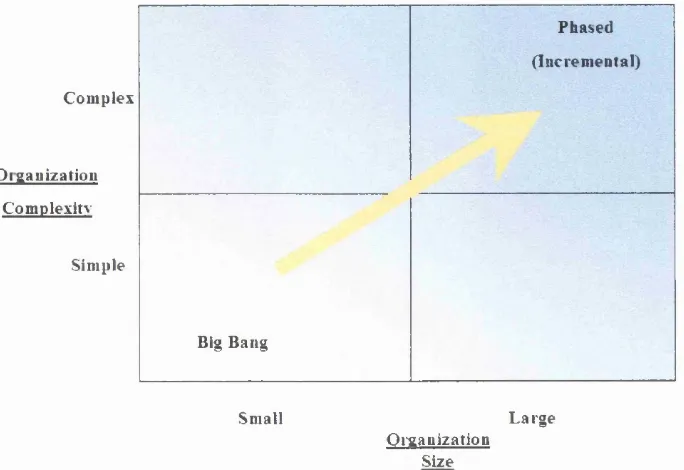
dimensions'^ that also differentiate approaches to ERP implementation are the time it
takes to implement and the amount of business change and value to which a company
aspires [Davenport, 2000, p. 14],
Broad
Scope
Narrow
Fast
Speed
Slow
Process
Phasing
Big Bang
G eographical or
Increm ental Business Unit
Phasing
Less More
Function
Figure 12. Implementation Options
Adopted by: [Davenport, 2000, p i73]
Quick Q uick
R elief A dvantage
Poor Long-Term
Im plem entation C o m p etith in e ss
Figure 13
Technical Strategic
Focus
Figure 13. Alternative Implementation Approaches
Complex
Oigauization
Complexity
Simple
Phased
(Incremental)
Big Bang
Small Large
Ofgauization Size
Figure 14. Linkages between organization size and complexity, and implementation approach used.
Adopted by: [O’Leary, 2000, p i 57]
Tall
Organization
Structure
Flat
Phased
(Incremental)
Big Bang
Loose Extent of Tight
Controls
Figure 15. Linkages between organization hierarchy and control, and implementation approach used.
As part o f implementing an ERP system, organizations have to make a
decision about the organizational reengineering that must be done and the amount o f
software customization. The decision to reengineer business processes or modify
software influences the relevance and use o f “as is” and “to be” modeling^^.
Before a company apphes an ERP system that integrates complex structures,
has to carefully examine how it operates. From the diagnostic study many times
companies are led to a Business Process Reengineering^^. A BPR is a radical and
drastic change o f business processes. In other words according to Kale [2000, p. 132],
BPR can be broadly termed as the rethinking and change o f business processes to
achieve dramatic improvements in the measures o f performance such as cost, quahty,
service and speed. According to Kraemmergaard & Moller [2000, p .ll], the
examination o f the business processes is believed to be one o f the important and
beneficial results o f the implementation o f ERP systems. The very purpose o f the
BPR is to contribute to improvement through radical changes. This also imphes that
BPR is associated with risks, costs and investments. On the other hand there is the
option o f a Business Process Improvement^*, which is simply the gradual
improvement o f procedures without a radical change. Some companies will
implement an ERP system while trying to duplicate their existing business processes.
Although implementing the ERP system will result in some improvements in this
case, will not result to a BPR [Kale 2000, p. 133].
”As is” analysis generates models o f existing processes and “to be” analysis generates models o f processes that the organization has chosen to implement.
V
es-E R f es-Enabled
R een gin eerin g Is ERP
lik ely ?
E xisting
P rocess A nalysis D esire to
Im p rove P ro cesses
E R P and P rocess C onfîguration De\'ek>p
E R
P-E nabled D esign P rinciples N o
-C onventional
R een gin eerin g
Figure 16. Graphic Overview of ERP-Enabled Reengineering
Adopted by; [Davenport, 2000, p i48]
ERP
solurion
AS IS
S T R .\T IG Y
SOLITION CHOICE
iyrE C R .\T E D r \
SO L IT IO N
-PACKAGE MODEL
BPR THROUGH ERP
\ / DESIGN . f ~ S MODEL
S \^T E M -T O BE"
LITION CONTTGlTC^nON
Figure 17. BPR through ERP
B l S C sM S S MSIOMN'G
IDENTIFVrNG CUSTOMER VALUE GAPS
C O M P E IIin E BTVÇH>IARKI>~.Ç
BUSINESS PROCESS SELECTION
IMPLEMENT RE
ENGINEERED PROCESSES CREATE PROCESS M.APS
AND ANALYZE PROCESSES
1 S N Ô V A T Î F O R "
BREAKTHROUGH IMPROVEMENT
Figure 18. The alternating activities of Business Visioning and BPR
Adopted by: [Kale, 2000, pl37]
Since no software is likely to meet all of a firm’s needs, some organizations
have chosen to substantially customize the software to meet their processes.
Customization is the creation, matching and transformation of software according to
certain standards. For an ERP solution that can mean:
• Creation of elements from the beginning
• Matching of an already existing solution to the company’s environment
• Modification of an offered solution, so that it can meet the needs of the
company.
Very often the company cannot really deal with the above procedures by
itself. Therefore a need for people is created which the market mechanism covers
with consultants. Software vendors offer technical consulting services and
Consultants’ tasks
To help and guide the ERP implementation To define and explore problems related to procedures, methods, and organization policies.________
To train the core implementation team of the company.
To provide methodology relevant to the project by using the knowledge and experience acquired by other companies.
Table 5. Consultants’ tasks
3.5.
ERP IMPLEMENTATION SUCCESS FACTORS
- FOCUS ON CONSTRUCTION INDUSTRY
Findings from the analysis of the interviews of the case study and the related
literature concerning the critical success factors of an ERP implementation can be
summarized in the following recommendations. Thus, a company and in particular a
construction company in order to implement an ERP system needs:
• Top management commitment for the project
• Clear project scope
• Allocation of appropriate budget and resources.
• Instituting a company-wide change management plan.
• To have or to develop good organizational skills.
• To have the ability to clearly map the procedures'^.
• Good knowledge of the possibilities of the system.
• Covering as many functions as possible within the scope of the ERP
implementation.
• Capability from the implementation team’s side for reliable and on time
decisions.
• Integrating the ERP system with other systems throughout the
organization.
• Training of ERP team and user members.
• The users must have flexibility in using software in general, and the
specific systems in particular.
• After the departure of the ERP vendor and the consultants a good
“deposit” of knowledge about the implementation has to be left in the
company.
• To have the necessary infrastructure and people capable to operate the
application in places far away from the central offices such as the
construction sites of construction companies.
[Kale, 2000, p. 109/Light & Holland, 2000, p.l21/Ahlin & Zupancic, 2000,
p.6/ case study of ET].
Finally, as we can see in Figure 19 where people issues in unsuccessful ERP
implementations are shown, a main barrier for ERP implementation is the resistance
towards change.
Top Ten B arriers to S u c c e ss
R esistan ce to C hange Inadequate Spon so rsh ip Unrealistic E xpectations Poor Project M anagem ent C ase for C hange Not Compelling Project Team Lacked Skills S cope Expansion/U ncertainty No C hange M anagem ent Program No Horizontal P ro c e ss View IT P ersp ectiv e Not Integrated
10 20 30 40 50 60 70 80
P ercentage of Firms
Figure 19. People issues in unsuccessful projects, ERP implementations
3.6.
ERP MARKET - ERP VENDOR RANKING
The ERP market, although new, it has been developed drastically the last few
years. As we have mentioned above, big companies on international level went ahead
and installed the ERP system because of their need for better information integration.
Other reasons that led to the rapid development of the ERP market were the
globalization o f the market, the introduction of the European common currency, Euro,
the Year 2000 problem and finally the fact that the ERP vendors are moving into
medium sized companies starting to offer industry specific solutions. Dahlen &
Elfsson [1999, p. 19], accumulating data from studies done all over the world; report
that AMR research estimates that the world market for ERP systems had a turnover
for 1998 of ten billion US dollars. Additionally, according to the same source the
world revenue growth rate for 1997 was over 60 % for the ten largest ERP vendors.
Ahlin & Zupancic mention that the ERP market is predicted to grow to fifty billion
US dollars in 2004. Finally, as Dahlen & Elfsson [1999, p. 19] underline and
according to Gartner Group, the ERP market is concentrated to the western countries
and therefore there is a great potential in other parts of the world in the coming years.
When it comes to ERP vendors, one company is dominating the world market
totally, SAP. Some other vendors are Oracle, PeopleSoft, BA AN, but SAP has
emerged as the industry leader both in terms of sales and in the number of enterprise-
class installations. SAP occupies approximately 30% of the world market. According
to Davenport [2000, p.303] in large organizations SAP, Oracle and PeopleSoft are the
market leaders, while in smaller and midsize companies the vendor market is much
more fragmented.
The table below briefly presents the five biggest ERP vendors:
Company
SAP
Oracle
Peoplesoft
JD
Edwards
Baan
Product R/3
1
Oracle L , ^
Applications One World Baan IV
Founded 1972 1980 |1987
. . . . . . 1
Country Germany USA USA USA Netherlands
1996 rankingy
ERP software 1st 2nd 3rd 4th 4th
Investment in R&D
(% revenue)
16
r
9 16 11
Growth %
1997 58 83 ,108 57 100
Growth %
1998 41 42 69 52 15
Table 6. Major five ERP vendors
Adopted by;
[Dahlen & Elfsson, 1999, p20/ Davenport, 2000, p304/ Pinkerton, 2000, p2]
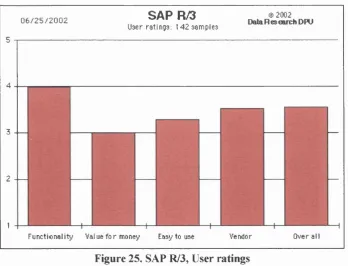
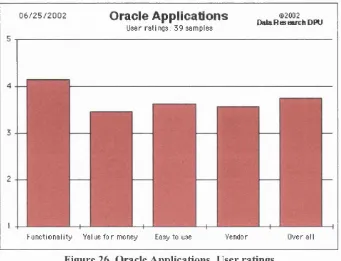
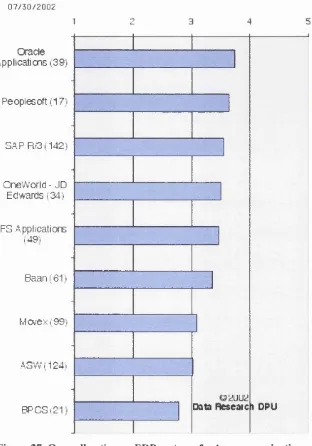
Next, we present a series of figures where one can see graphics with valuable
Intent! a
2%
Other
M arcam
3%
SAP AG
29%
PeopleSoft 6%
Source: AUR
ww w.lntomi stonv^e eh c om Sepfember '9?
J.D. Edwards Dracle-7% ApplicaÉlons
10%
Figure 20. ERP vendors, market share
Source: [AMR research, 1997, www. information week. com 1
Challengers
Ability
execute
Leaders
% SA P
JDE World
Intentia
M arcam Protean,
Oracle Mtg
SSA
Rosss^. , #% Baan
Oracle Process^» QAO
^ ^ People Soft
M arcam Prism
Platinum
^JD S OneWortd
JBA
Î'-'
Niche players Visionaries
C om pleteness of vision = C Z Z :
Figure 21. GartnerGroup ranking of ERP vendors, November 1999
Star Baby
_^Ont\wtd I ! ^ BPL-S ^
CODA
Macoi oaA^w
XOR VISMA
Baan Navisio »
Peoplesoft i
R/3
Concorde! Uuda/X
IM - CSS Prosit t pci
OVfcle
Apptlcation Scala
Movex
ASW
Cash cow DoKgie
Figure 22. Boston Matrix
Source: [Soren Janstal, DPU/ Dahlen & Elfsson, 1999, p29]
BiHtofis us
$30 $25
$20
$15 _ B __
$10 _
$5
$0 m
■■■
y y y
d 0:-t'
d I 'y t a s — Vei*:=i noustiy H e la i H H è i ’hwai-» dan-Lra a te )
d t - C o r -ne':e ib^v £ da S bell aize) 0 buppiv C " i . 'V cirt
d I'fOJuct L e-.e lo tre n : V g r:
d b u s ' r « "lelliyenLc
d t K I '- ^ a - : i 3 S H-i M'y
0 C-<M S Lusic lie ' Conticl
* h;ieva-;:ed
bouiea Oga ntzf nat en O'oup
Figure 23. License Revenues by Type of Application
SAP R/3
Data R ese ar ch DPU rating
n i l
A r c h it e c t u r e Market pos iti on Product Life CycleTotal
Figure 24. SAP R/3, DPU rating
Source: [Data research DPU, www.dpu.se, accessed 30/06/2002]
0 6 / 2 5 / 2 0 0 2
SAP R/3
User ratings: 1 4 2 s a m p le s
@ 2002
Data Research DPU
3
-2 4
F u n c tio na li ty Value f o r money Easy to use Vendor Over all
Figure 25. SAP R/3, User ratings
0 6 / 2 5 / 2 0 0 2
Oracle A pplications
User r a ti ng s : 3 9 s a m p l e s@2002
Data Research DPU
F u n c tio na li ty Value f o r money Easy to use Vendor Over all
Figure 26. Oracle Applications, User ratings
Over all ratings - ERP system s for large or gonlsatlons 0 7 / 3 0 / 2 0 0 2
Oracle Applications (39)
Peoplesoft (17)
SAP R /3 (142)
□ n ew o n d - JD Edwards (34)
IPS Applications 1491
Baan ( 61
MOv-ex (9 9 )
ASW (124)
BPCS(21
©2UU2
Data ReseatcW DPU
Figure 27. Over all ratings - ERP systems for large organizations.
4. SAP
4.1.
SAP
The name of SAP means Systems and Applications Products in Data
Processing^®. Five former IBM employees founded SAP in 1972 in the town of
Walldorf, Germany. It was the first firm to introduce a broadly functional ERP
system. SAP has two main products: R/2, which runs on mainfirames, and R/3, which
is the client/server variant of R/2, and it was introduced in 1992. The system operates
on the platforms Unix, NT and OS/400 and can use most of the established databases.
SAP was first to enter the market and thereby gained early market shares. The SAP
company today ranks fourth in the world among all software companies in general,
while it ranks internationally first, as we have already mentioned, on sales regarding
complete applications^\ Until 1999 they have been more than 21,500 installations of
SAP R/3 software in more than 22,900 clients in different production fields.
10.000,000.0001
9.000 000 000
8000.000000
7.000.000 000
6000.000000
5.000.000.000
4.000 000 0004
3.000.000.000
2.000.000.000 1 000.000 0004
0
1995 1996 1997 1998 1999 2000 2001
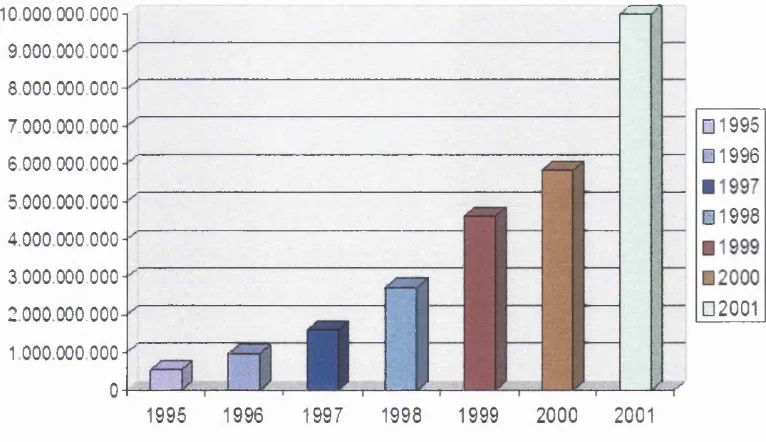
Figure 28. SAP HELLAS SA turnover (Drs)
Source; [SAP Hellas, http://www.sap, com/Greece, accessed 05/05/2002]
□ 1995 □ 1996
□ 1998
□
2001In its original German Language: “Système, Anwendungen und Programme in der Datanverarbeitung”.
The SAP HELLAS SA was founded in 1994 and its initial goals for the SAP
application were:
• The use o f Greek language
• The adaptation o f the system according to the requirements o f the
Greek legislation.
• The local support by experienced counselors.
The main characteristics o f SAP R/3 software are the following:
• Incorporates 20 years experience.
• Highly configurable.
• Multi-currency, multi-language, multi-country.
• Internet/intranet enabled.
• It is “open” with the possibility o f being connected also to non-SAP
environments.
• Uses relational database.
• Has the possibility o f different access o f the same archive, depending
on the type of user.
• Use of Windows environment fiiendly to the user.
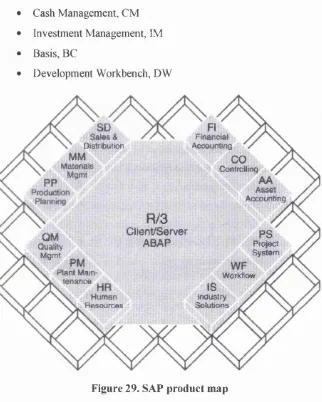
The main system consists o f particular modules, which are part o f a unique
integrated program. The modules that SAP includes are:
• Finance Management, FI
• Controlling, CO
• Sales and Distribution, SD
• Materials Management, MM
• Production Planning, PP
• Quality Management, QM
• Plant Maintenance, PM
• Human Resources, HR
• Assets Management, AM
• Project System, PS
• Enterprise Controlling, EC, EIS-MIS
• Workflow, WF
• Cash Management, CM
• Investment Management, IM
• Basis, BC
• Development Workbench, DW
5
FI
Firancial Accounting
, CO
Controlling
AA
Asset
SD
Sales & Disbibution
MM
I Materials
PP
" T ,.
,Aœounting
R/3
Client/Server 'ABAP
Workflow
IS
Industry
PS
Project System
QM ’
Quality
Mg.,
Plant Main tenance
Human
Resources Solutions
Figure 29. SAP product map
4.2.
SAP AND CONSTRUCTION INDUSTRY
Hardly any other industry includes so many complexities as Construction
Industry. Working within constraints of time, cost and feasibility firms in Cl must
meet each customer’s goals and specifications. According to SAP E&C leaflet [1999,
p. 18], SAP R/3 has been implemented in over 1700 engineering and construction
companies worldwide.
With SAP Organizations in Cl can:
• Manage the entire product life cycle from design through planning,
• Track the post-construction and service phases.
• Integrate the entire supply chain.
• Deploy it across multiple sites, companies and countries.
• Gain control over the supply chain from suppliers and subcontractors to
customers, because SAP supports a range of organizational structures.
• Leverage the Internet
• Increase customer satisfaction.
The companies in each industry field have different characteristics and
expectations; therefore ERP vendors have developed industry- specific solutions that
can meet the particular needs of specific companies and their activities. A company
that plans to implement SAP can either use the general solution of SAP and then
modify it in its procedures or it can choose a vertical industiy-specific solution. SAP
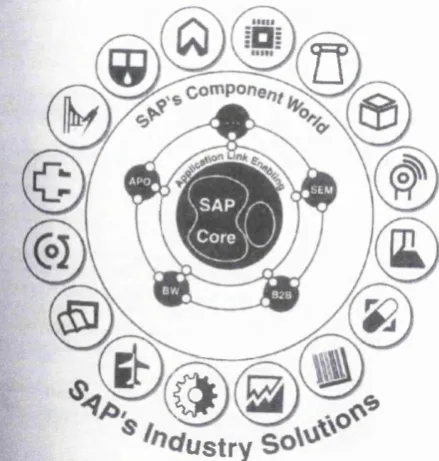
provides a great variety of industry-specific vertical solutions through “industry
solutions”, IS, which are complementary to the base R/3 solution.
3
a
#
ustry
Figure 30. Industry-specific (IS) solutions Source: [Kale, 2000, p217]
The SAP Engineering & Construction solution helps engineering and
construction companies to focus on core processes and functions. According to
![Figure 2. Development of Enterprise SystemsSource: [Kraemmergaard & Moller, 2000, p2]](https://thumb-us.123doks.com/thumbv2/123dok_us/8426219.1387537/19.595.206.405.401.562/figure-development-enterprise-systemssource-kraemmergaard-moller-p.webp)