Wireless Home Automation System using
Android
Ketan K. Lad1, Dhaval K. Patel2, Rohit B. Damor3, Khyati K. Naik4
Assistant Professor, Dept. of EE, GIDC Degree Engg. College, Navsari, Gujarat, India1234
ABSTRACT: This paper presents the overall design of Home Automation System (HAS) with wireless remote control
to increase the range of accessing equipment. Automatic systems are being preferred over manual system. Home automation will increase the work efficiency and comfort of human being in daily life. This concept provides support in order to fulfill the needs of elderly and disabled in home. Using this system we can remotely access the equipment in our house. For system design, we are using Atmega 32 microcontroller, LCD display and wireless module ESP-8266 and which is operated remotely by android smart phone. The system intended to control electrical appliances and devices in house with relatively low cost design, user-friendly interface and ease of installation.
KEYWORDS: Microcontroller, LCD, HAS, ESP-8266, Android, telenet
I.INTRODUCTION
With advancement of technology things are becoming simpler and easier for us. Automation is the use of control system and information technologies to reduce the need for human work in the production of goods and services. Automation greatly decreases the need for human sensory and mental requirements as well. Automation plays an increasingly important role in the world economy and in daily experience. Automatic systems are being preferred over manual system. Through this project we have tried to show automatic control of a house as a result of which power is saved to some extent.
Due to the advancement of wireless technology, there are several different of connections are introduced such as GSM, WIFI, ZIGBEE, and Bluetooth. Each of the connection has their own unique specifications and applications. Among the four popular wireless connections that often implemented in HAS project, wireless Esp-8266 module is being chosen to increase the range with compare to bluetooth. Android, by Google Inc. provides the platform for the
development of the mobile applications for the Android devices. There are so many android applications available in
google play store or we can design android application according to our requirement. Here, we are using telenet apk to send signal from android phone to microcontroller.
II.SYSTEM OVERVIEW
Fig. 1 Home automation system
III.COMPONENTS
Major components used in this system are microcontroller-ATMEGA32, ESP-8266(wifi module), Liquid crystal display(LCD), relay driver IC(ULN2803) and relay.
1) Microcontroller-ATMEGA32
Microcontroller is a programmable device which contains a microprocessor, memory, input-output ports etc which can be compared with the microcomputer. Microcontroller is a single chip computer. As microcontroller is a low cost programmable device. It is used in the automatic control application. Here, ATMEGA32 is used for this system. PIN diagram of this microcontroller is shown below in fig 2.
2) Wifi module(ESP8266)
ESP8266 is serial device which connects to microcontroller serially. For that AT command is used. Our mobile phone will connect to microcontroller via ESP8266. In mobile, android .apk is available for this wifi module. Using this .apk, mobile phone will connect to wifi module and we able to operate system with our smart cell phone. Here, telnet.apk is used.
IV. SOFTWARE DEVELOPMENT FOR HOME AUTOMATION SYSTEM
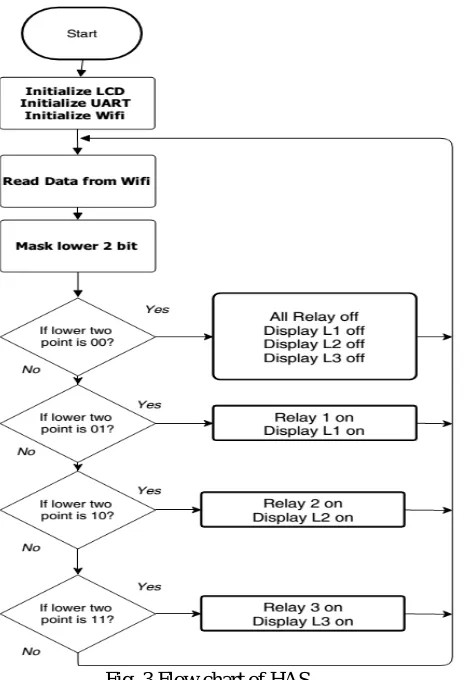
The system programming is written in C language and keil is used as a software platform. Algorithm for home automation system:
1) Start
2) Initialize LCD, UART and Wifi 3) Read data from wifi
4) If number pressed from cell phone is 0, all relays are off and displayed L1, L2 and L3 off. 5) If number pressed is 1, Relay 1 is on and displays L1 on.
6) If number pressed is 2, Relay 1 is on and displays L2 on. 7) If number pressed is 3, Relay 1 is on and displays L3 on.
IV.SIMULATION & HARDWARE
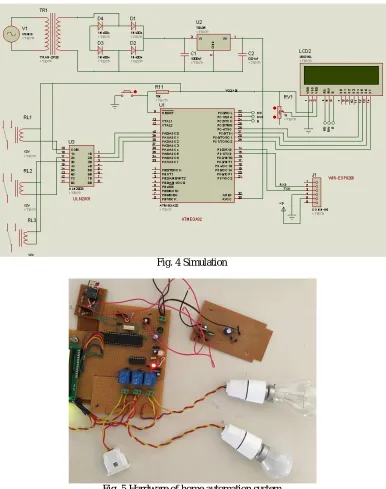
Simulation is prepared for home automation system. Here, we used ATMEGA32, LCD, three relays, power supply unit and relay driver IC-ULN2803
Fig. 4 Simulation
VI.CONCLUSION
Using this system, we can able to operate electrical appliances within 10 meter range. This system is cost effective and easy operated using smart phone. We tested it for three electrical appliances and successfully we operated all the appliances using smart phone within range. We can design this system for all the appliances used in home with some modification.
REFERENCES
[1] Inderpreet Kaur, “Microcontroller Based Home Automation System With Security,” International Journal of Advanced Computer Science and Applications, vol. 1, no. 6, pp. 60-65, Dec.2010.
[2] R.A.Ramlee, M.H.Leong, R.S.S.Singh, M.M.Ismail, M.A.Othman, H.A.Sulaiman, M.H.Misran, M.A.Meor Said, “Bluetooth Remote Home Automation System Using Android Application,” International Journal of Engineering And Science (IJES), vol. 2, issue 1, pp. 149-153, 2013. [3] Mahesh Jivani, “GSM Based Home Automation System Using App-Inventor for Android Mobile Phone,” International Journal of Advanced
Research in Electrical, Electronics and Instrumentation Engineering, vol. 3, issue 9, Sep. 2014.
[4] R. Piyare and M. Tazil, “Bluetooth Based Home Automation System using Cell Phone,” in Consumer Electronics, 2011, pp. 192-195. [5] N. Sriskanthan and Tan Karande, “Bluetooth Based Home Automation Systems,” Journal of Microprocessors and Microsystems, 2002, Vol.
26, pp. 281-289.
[6] Wijetunge S.P., Wijetunge U.S., Peiris G.R.V, Aluthgedara C.S. & Samarasinghe A.T.L.K., “Design and Implementation of a Bluetooth based General Purpose Controlling Module”, in IEEE, 2008, pp. 206-211.