International Journal of Research (IJR)
e-ISSN: 2348-6848, p- ISSN: 2348-795X Volume 2, Issue 4, April 2015Available at http://internationaljournalofresearch.org
The Implementation and Various uses of Open Source
Software’s
Author Name: - Manpreet Kaur Guide Name: - Narinder Kumar Sharma
College: - University College of Computer Applications Author Phone No: - 8728883382
Email Id: - [email protected] ABSTRACT
Open source is software developed by uncoordinated but loosely collaborating programmers, using freely distributed source code and the communications infrastructure of the Internet. Open source has a long history rooted in the Hacker Ethic. The term open source was adopted in large part because of the ambiguous nature of free software. Various categories of free and non-free software are commonly referenced, some with interchangeable meanings. Several licensing agreements have therefore been developed to formalize distribution terms. The Cathedral and the Bazaar is the most frequently cited description of the open-source development methodology, however although the paper identifies many mechanisms of successful open-source development, it does not expose the dynamics. There are literally hundreds, if not thousands, of open-source projects currently in existence.
The term Open Source is widely applied to describe some software development methodologies. This paper does not provide a judgment on the open source approach, but exposes the fact that simply stating that a project is open source does not provide a precise description of the approach used to support the project. By taking a multidisciplinary point of view, we propose a collection of characteristics that are common,
as well as some that vary among open source projects. The set of open source characteristics we found can be used as a tick-list both for analyzing and for setting up open source projects. Our tick-list also provides a starting point for understanding the many meanings of the term open source.
Keywords: -
Open Source Software; Software Process; Software Business Models; Information Systems (IS) Development
INTRODUCTION
1. INTRODUCATION
Open-source software (OSS) is computer software with its source code made available with a license in which the copyright holder provides the rights to study change and distribute the software to anyone and for any purpose. Open-source software is very often developed in a public, collaborative manner. Open-source software is the most prominent example of open-source development and often compared to (technically defined) user-generated content or (legally defined) open-content movements.
International Journal of Research (IJR)
e-ISSN: 2348-6848, p- ISSN: 2348-795X Volume 2, Issue 4, April 2015Available at http://internationaljournalofresearch.org
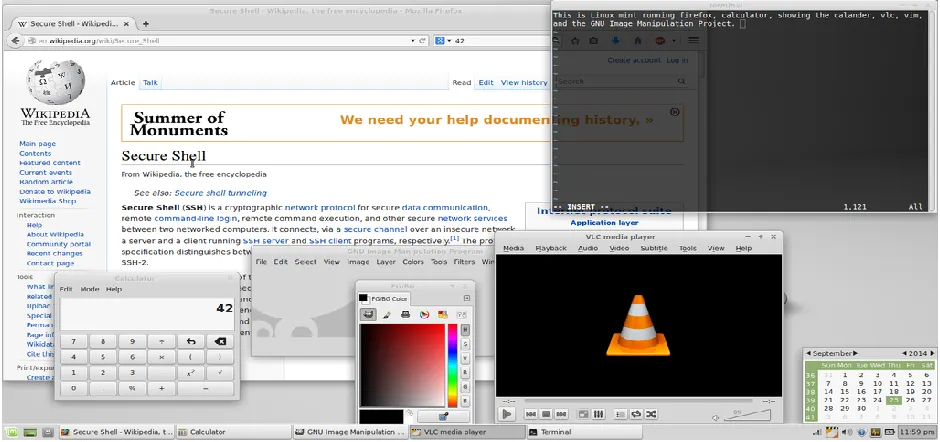
Figure 1.1: A screenshot of Linux Mint running the Xfce desktop environment, Firefox, a calculator program, the builtin calendar, Vim, GIMP, and VLC media player, all of which are open source software.
1.1 DEFINITIONS
The Open Source Initiative's (OSI) definition is
recognized as the standard or de
facto definition. Eric S. Raymond and Bruce Perens formed the organization in February 1998. With about 20 years of evidence from case histories of closed and open development already provided by the Internet, OSI continued to present the "open source" case to commercial businesses. They sought to bring a higher profile to the practical benefits of freely available source code, and wanted to bring major software businesses and other high-tech industries into open source.
OSI uses The Open Source Definition to determine whether it considers a software license open source. The definition was based on the Debian Free Software Guidelines,
written and adapted primarily by
Perens. Perens did not base his writing on the "four freedoms" of Free Software from the Free Software Foundation (FSF), which were only widely available later.
Figure 1.2: the logo of the Open Source Initiative
International Journal of Research (IJR)
e-ISSN: 2348-6848, p- ISSN: 2348-795X Volume 2, Issue 4, April 2015Available at http://internationaljournalofresearch.org
1.1.2 OPEN SOFTWARE LICENSING A license defines the rights and obligations that a licensor grants to a licensee. Open source licenses grant licensees the right to copy, modify and redistribute source code (or content). These licenses may also impose obligations (e.g., modifications to the code that are distributed must be made available in source code form, an author attribution must be placed in a program/ documentation using that open source).
Authors initially derive a right to grant a license to their work based on the legal theory that upon creation of a work the author owns the copyright in that work. What the author/licensor is granting when they grant a license to copy, modify and redistribute their work is the right to use the author's copyrights. The author still retains ownership of those copyrights; the licensee simply is allowed to use those rights, as granted in the license, so long as they maintain the obligations of the license. The author does have the option to sell/assign, versus license, their exclusive right to the copyrights to their work; whereupon the new owner/assignee controls the copyrights. The ownership of the copyright (the "rights") is separate and distinct from the ownership of the work (the "thing") – a person can own a copy of a piece of code (or a copy of a book) without the rights to copy, modify or redistribute copies of it.
When an author contributes code to an open source project (e.g., Apache.org) they do so under an explicit license (e.g., the Apache Contributor License Agreement) or an implicit license (e.g., the open source license under which the project is already licensing code). Some open source projects do not take contributed code under a license, but actually require (joint) assignment of the author's copyright in order to accept code contributions into the project (e.g., OpenOffice.org and its Joint Copyright Assignment agreement).
Placing code (or content) in the public domain is a way of waiving an author's (or owner's) copyrights in that work. No license is granted, and none is needed, to copy, modify or redistribute a work in the public domain.
Examples of free software license / open source licenses include Apache License, BSD license, GNU General Public License, GNU Lesser General Public License, MIT License, Eclipse Public License and Mozilla Public License.
The proliferation of open-source licenses is one of the few negative aspects of the open-source movement because it is often difficult to understand the legal implications of the differences between licenses. With more than 180,000 open source projects available and its more than 1400 unique licenses, the complexity of deciding how to manage
open-source usage within "closed-source"
commercial enterprises have dramatically increased. Some are home-grown while others are modeled after mainstream FOSS licenses such as Berkeley Software Distribution ("BSD"), Apache, MIT-style (Massachusetts Institute of Technology), or GNU General Public License ("GPL"). In view of this, open source practitioners are starting to use classification schemes in which FOSS licenses are grouped (typically based on the existence and obligations imposed by the copyleft provision; the strength of the copyleft provision).
International Journal of Research (IJR)
e-ISSN: 2348-6848, p- ISSN: 2348-795X Volume 2, Issue 4, April 2015Available at http://internationaljournalofresearch.org
1.1.3 CERTIFICATIONS
Certification can help to build higher user confidence. Certification could be applied to the simplest component that can be used by developers to build the simplest module to a whole software system. There have been numerous institutions involving in this area of the open source software including The International Institute of Software Technology / United Nations University. UNU/IIST is a non-profit research and education institution of The United Nations. It is currently involved in a project known as "The Global Desktop Project". This project aims to build a desktop interface that every end-user is able to understand and interact with, thus crossing the language and cultural barriers. It is drawing huge attention from parties involved in areas ranging from application development to localization. Furthermore, this project will improve developing nations' access to information systems. UNU/IIST aims to achieve this without any compromise in the quality of the software It believes a global standard can be maintained by introducing certifications and is currently organizing conferences in order to explore frontiers in the field.
Alternatively, assurance models (such as
DO178B) have already solved the
"certification" approach for software. This approach is tailorable and can be applied to OSS, but only if the requisite planning and execution, design, test and traceability artifacts are generated.
1.2 OPEN-SOURCE SOFTWARE
DEVELOPMENT
1.2.1 DEVELOPMENT MODEL
In his 1997 essay The Cathedral and the Bazaar, open-source evangelist Eric S. Raymond suggests a model for developing OSS known as the bazaar model. Raymond likens the development of software by traditional methodologies to building a
cathedral, "carefully crafted by individual wizards or small bands of mages working in splendid isolation". He suggests that all software should be developed using the bazaar style, which he described as "a great babbling bazaar of differing agendas and approaches."
In the traditional model of development, which he called the cathedral model; development takes place in a centralized way. Roles are clearly defined. Roles include people dedicated to designing (the architects), people responsible for managing the project, and people responsible for implementation. Traditional software engineering follows the cathedral model. Fred P. Brooks in his book The Mythical Man-Month advocates this model. He goes further to say that in order to preserve the architectural integrity of a system; the system design should be done by as few architects as possible.
The bazaar model, however, is different. In this model, roles are not clearly defined. Gregorio Robles suggests that software developed using the bazaar model should exhibit the following patterns:
International Journal of Research (IJR)
e-ISSN: 2348-6848, p- ISSN: 2348-795X Volume 2, Issue 4, April 2015Available at http://internationaljournalofresearch.org
Early releases
The first version of the software should be released as early as possible so as to increase one's chances of finding co-developers early.
Frequent integration
Code changes should be integrated (merged into a shared code base) as often as possible so as to avoid the overhead of fixing a large number of bugs at the end of the project life cycle. Some open source projects have nightly builds where integration is done automatically on a daily basis.
Several versions
There should be at least two versions of the software. There should be a buggier version with more features and a more stable version with fewer features. The buggy version (also called the development version) is for users who want the immediate use of the latest features, and are willing to accept the risk of using code that is not yet thoroughly tested. The users can then act as co-developers, reporting bugs and providing bug fixes.
High modularization
The general structure of the software should be modular allowing for parallel development on independent components.
Dynamic decision making structure
There is a need for a decision making structure, whether formal or informal, that makes strategic decisions depending on changing user requirements and other factors. Cf. Extreme programming.
Data suggests, however, that OSS is not quite as democratic as the bazaar model suggests. An analysis of five billion bytes of free/open source code by 31,999 developers shows that 74% of the code was written by the most active 10% of authors. The average number of authors involved in a project was 5.1, with the median at 2.
1.2.2 ADVANTAGES AND
DISADVANTAGES
Software experts and researchers on open source software have identified several advantages and disadvantages. The main advantage for business is that open source is a good way for business to achieve greater penetration of the market. Companies that offer open source software are able to establish an industry standard and, thus, gain competitive advantage. It has also helped build developer loyalty as developers feel empowered and have a sense of ownership of the end product.
Moreover, lower costs of marketing and logistical services are needed for OSS. OSS also helps companies keep abreast of technology developments. It is a good tool to promote a company's image, including its commercial products. The OSS development approach has helped produce reliable, high quality software quickly and inexpensively.
The term "open source" was originally intended to be trademark able; however, the term was deemed too descriptive, so no trademark exists. Besides, it offers the potential for a more flexible technology and quicker innovation. It is said to be more reliable since it typically has thousands of independent programmers testing and fixing bugs of the software. It is flexible because modular systems allow programmers to build custom interfaces, or add new abilities to it and it is innovative since open source programs are the product of collaboration among a large number of different programmers. The mix of divergent perspectives, corporate objectives, and personal goals speeds up innovation.
Moreover, free software can be developed in accord with purely technical requirements. It does not require thinking about commercial pressure that often degrades the quality of the
software. Commercial pressures make
International Journal of Research (IJR)
e-ISSN: 2348-6848, p- ISSN: 2348-795X Volume 2, Issue 4, April 2015Available at http://internationaljournalofresearch.org
security requirements, since such features are somewhat invisible to the customer.
It is sometimes said that the open source development process may not be well defined and the stages in the development process, such as system testing and documentation may be ignored. However this is only true for small (mostly single programmer) projects. Larger, successful projects do define and enforce at least some rules as they need them to make the teamwork possible. In the most complex projects these rules may be as strict as reviewing even minor change by two independent developers.
Not all OSS initiatives have been successful, for example SourceXchange and Eazel. Software experts and researchers who are not convinced by open source's ability to produce quality systems identify the unclear process, the late defect discovery and the lack of any empirical evidence as the most important
problems (collected data concerning
productivity and quality). It is also difficult to design a commercially sound business model
around the open source paradigm.
Consequently, only technical requirements may be satisfied and not the ones of the market. In terms of security, open source may allow hackers to know about the weaknesses or loopholes of the software more easily than closed-source software. It depends on control mechanisms in order to create effective performance of autonomous agents who participate in virtual organizations.
1.2.3 DEVELOPMENT TOOLS
In OSS development, the participants, who are mostly volunteers, are distributed among different geographic regions, so there is need for tools to aid participants to collaborate in source code development. Often, these tools are also available as OSS.
Revision control systems such as Concurrent Versions System (CVS) and later Subversion (SVN) and Git, and the GNU Compiler
Collection are examples of tools that help centrally manage the source code files and the changes to those files for a software project. These tools are themselves OSS.
Utilities that automate testing, compiling, and bug reporting help preserve stability and support of software projects that have numerous developers but no managers, quality controller, or technical support. Building systems that report compilation errors among
different platforms include Tinderbox.
Commonly used bug trackers include Bugzilla and GNATS.
Tools such as mailing lists, IRC, and instant messaging provide means of Internet communication between developers. The Web is also a core feature of all of the above systems. Some sites centralize all the features of these tools as a software development
management system, including GNU
Savannah, Source Forge, and Bounty Source.
1.2.4 PROJECTS AND ORGANIZATIONS Some of the "more prominent organizations" involved in OSS development include the Apache Software Foundation, creators of the Apache web server; the Linux Foundation, a nonprofit which as of 2012 employed Linus Torvalds, the creator of the Linux operating system kernel; the Eclipse Foundation, home of the Eclipse software development platform; the Debian Project, creators of the influential Debian GNU/Linux distribution; the Mozilla Foundation, home of the Firefox web browser;
and OW2, European-born community
developing open source middleware. New organizations tend to have a more sophisticated governance model and their membership is often formed by legal entity members.
Several open source programs have become defining entries in their space, including the GIMP image editing system; Sun's Java programming language and environment; the MySQL database system; the FreeBSD UNIX
International Journal of Research (IJR)
e-ISSN: 2348-6848, p- ISSN: 2348-795X Volume 2, Issue 4, April 2015Available at http://internationaljournalofresearch.org
productivity suite; Basecamp for project management and the Wireshark network packet sniffer and protocol analyser.
Open Source development is often performed "live and in public", using services provided for free on the Internet, such as the Launch pad and GitHub web sites.
Open Source Software Institute is a membership-based, non-profit (501 (c)(6)) organization established in 2001 that promotes the development and implementation of open source software solutions within US Federal, state and local government agencies. OSSI's efforts have focused on promoting adoption of open source software programs and policies within Federal Government and Defense and Homeland Security communities.
Open Source for America is a group created to raise awareness in the U.S. Federal Government about the benefits of open source software. Their stated goals are to encourage the government's use of open source software, participation in open source software projects, and incorporation of open source community dynamics to increase government transparency.
Mil-OSS is a group dedicated to the advancement of OSS use and creation in the military.
PROBLEM FORMULATION
Before developing research we keep following things in mind so that we can develop powerful and quality research.
3.1 PROBLEM STATEMENT
Open-source software can be sold and used in general commercially. Also, commercial open-source applications are a part of the software industry for some time. Despite that, except for Red Hat and VA Software, no other pure open-source company has gone public on the major stock markets. While commercialization or funding of open-source software projects is possible, it is considered challenging.
Since several open-source licenses stipulate that derived works must distribute their intellectual property under an open-source (copyleft) license, ISVs and VARs have to develop new legal and technical mechanisms to foster their commercial goals, as many traditional mechanisms are not directly applicable anymore.
Traditional business wisdom suggests that a company's methods, assets, and intellectual properties should remain concealed from market competitors as long as possible to maximize the profitable commercialization time of a new product. [According to whom?] Open-source software development minimizes the effectiveness of this tactic; development of the product is usually performed in view of the public, allowing competing projects or clones to incorporate new features or improvements as soon as the public code repository is updated, as permitted by most open-source licenses. Also in the computer hardware domain, a hardware producer who provides free and open software drivers reveals the knowledge about
hardware implementation details to
competitors, who might use this knowledge to catch up.
International Journal of Research (IJR)
e-ISSN: 2348-6848, p- ISSN: 2348-795X Volume 2, Issue 4, April 2015Available at http://internationaljournalofresearch.org
A variety of open-source compatible business approaches have gained prominence in recent years [according to whom?]; notable examples include dual licensing, software as a service, not charging for the software but for services, fermium, donation-based funding, and crowd funding.
The underlying objective of these business models is to harness the size and international scope of the open-source community (typically more than an order of magnitude larger than what would be achieved with closed-source models) for a sustainable commercial venture.[citation needed] The vast majority of commercial open-source companies experience a conversion ratio (as measured by the percentage of downloader‟s who buy something) well below 1%, so low-cost and highly-scalable marketing and sales functions are key to these firms' profitability.
3.2 OBJECTIVE
Software development requires much
knowledge and work. I wonder why useful software such as Mozilla and VideoLAN are made free for download. Much free software tends to be very good indeed. I'm not against free software, though. I also benefit from them. Free software is developed and given away normally with an option to donate to help with development costs.
Open source software is developed by groups of people that contribute different features and functions to an application or operating system.
Take Linux for example. There are many versions of Linux that have been contributed too over the years, but the underlying code is very similar and uses a Linux Kernel as the basis for the OS.
Free software model in the context of your question liberates the revenue model from the software product. You are no more just charging for a product, although you can still charge for the product. For example if shoe-making was open sourced. You'd not just sell shoes, but also the design blueprint for it. How
do you gain the upper hand? If you're the person with original plan, everyone down the line credits you. Buyers know who the original person who knows the stuff is. If you're one who bought the shoes and now designed your derivative, they'd sell based on whats the specialty of your derivative. You'd realize that setting up shop would require capital and it‟s somewhat true for open source software. All major successful free software has the biggest corporations FUNDING the labor towards developing them. VideoLAN doesn't exactly enjoy a prominent corp. backing, so their development on Mac had/still has come down to a crawl.
I would add an example of open source ERP. OpenERP is a comprehensive suite of business applications and has a modular approach which allows customers to start with one application and then adds other modules as they go. It‟s license free, customizable and very easy to use.
The product has gained a lot of popularity due to its no license policy and the verity of solutions it offers. To which its community can contribute to develop and improve. To know more about the line of solutions OpenERP offers, follow this link: http://bit.ly/aUeAZu.
The main objective of this research is to study the open sources and its applications used in the industry.
RESEARCH METHODOLOGY
4.1 METHODOLOGY
International Journal of Research (IJR)
e-ISSN: 2348-6848, p- ISSN: 2348-795X Volume 2, Issue 4, April 2015Available at http://internationaljournalofresearch.org
4.1.1 Plausible Promise
Raymond remarks that it would be difficult to originate a project in bazaar mode. To build a community, a program must first demonstrate plausible promise. The implementation can be crude or incomplete, but it must convince others of its potential. This is given as a necessary precondition of the bazaar, or open-source, style.
Interestingly, many COMMERCIAL
SOFTWARE companies use this approach to ship software products. Microsoft, for example, consistently ships early versions of products that are notoriously bug ridden. However as long as a product can demonstrate plausible promise, either by setting a standard or uniquely satisfying a potential need, it is not necessary for early versions to be particularly strong.
Critics suggest that the effective utilization of bazaar principles by closed source developers implies ambiguity. Specifically that the Cathedral and the Bazaar does not sufficiently
describe certain aspects of the open-source development process.
4.1.2 Release Early, Release Often
Early and frequent releases are critical to
open-source development. Improvements in
functionality are incremental, allowing for rapid evolution, and developers are "rewarded by the sight of constant improvement in their work."
Product evolution and incremental
development are not new. Mills initially proposed that any software system should be grown by incremental development (Mills, 1971). Brooks would later elaborate on this concept, suggesting that developers should grow rather than build software, adding more functions to systems as they are run, used, and tested (Brooks, 1986). Basili suggested the concept of iterative enhancement in large-scale software development (Basili and Turner, 1975), and Boehm proposed the spiral
MODEL, an evolutionary prototyping
approach incorporating risk management. Let's have a look at the general diagram in a different way to see what is running concurrently: Release Early, Release Often
International Journal of Research (IJR)
e-ISSN: 2348-6848, p- ISSN: 2348-795X Volume 2, Issue 4, April 2015Available at http://internationaljournalofresearch.org
Open source relies on the Internet to noticeably shorten the iterative cycle. Raymond notes that "it wasn‟t unknown for [Linux] to release a new kernel more than once a day." (Raymond, 1998a) Mechanisms for efficient distribution and rapid feedback make this practice effective.
However, successful application of an evolutionary approach is highly dependent on a
modular architecture. Weak modularity
compromises change impact and minimizes the effectiveness of individual contributors. In this respect, projects that do not encourage a modular architecture may not be suitable for open-source development. This contradicts Raymond‟s underlying assertion, that open source is a universally better approach.
4.1.3 Debugging is Parallelizable
Raymond emphasizes large-scale peer review as the fundamental difference underlying the cathedral and bazaar styles. The bazaar style assumes that "given a large enough beta-tester and co-developer base, almost every problem will be characterized quickly and the fix obvious to someone." Debugging requires less coordination relative to development, and thus is not subject "to the same quadratic complexity and management costs that make adding developers problematic." (Raymond, 1998a)
The basic premise is that more debuggers will contribute to a shorter test cycle without significant additional cost. In other words, "more users find more bugs because adding more users adds more ways of stressing the program." (Raymond, 1998a) However, open source is not a prerequisite for peer review. For instance, various forms of peer review are
commonly employed in SOFTWARE
ENGINEERING. The question might then become one of scale, but Microsoft practices beta-testing on a scale matched only by larger open-source projects.
Raymond continues, suggesting that debugging is even more efficient when users are co-developers, as is most often the case in
open-source projects. This is also subject to debate. Raymond notes that each tester "approaches the task of bug characterization with a slightly different perceptual set and analytical toolkit, a different angle on the problem." (Raymond, 1998a) This is characterized by the fact that developers and end-users evaluate products in very different ways. It therefore seems likely that peer review under the bazaar MODEL would be constrained by a disproportionate number of co-developers.
XPERIMENTAL RESULT
5.1 OPEN SOURCE PROFILE
There are literally hundreds, if not thousands, of open-source projects currently in existence. These projects include operating systems, programming languages, utilities, INTERNET APPLICATIONS and many more. The following projects are notable for their influence, size, and success.
5.1.1 Linux
Linux is a Unix-like operating system that runs on several platforms, including Intel processors, Motorola MC68K, and DEC Alphas (SSC, 1998). It is a superset of the POSIX specification, with SYS V and BSD extensions. Linux began as a hobby project of Linux Torvalds, a graduate student at the University of Helsinki. The project was inspired by his interest in Minix, a small UNIX system developed primarily as an educational tool by Andy Tannenbaum. Linux set out to create, in his own words, "a better Minix than Minix." In October 1991, Linux announced the first official release of Linux, version 0.02. Since then,
hundreds of PROGRAMMERS have
contributed to the ongoing improvement of the system.
International Journal of Research (IJR)
e-ISSN: 2348-6848, p- ISSN: 2348-795X Volume 2, Issue 4, April 2015Available at http://internationaljournalofresearch.org
project, Linux has relinquished control over certain areas of the kernel, such as file systems and networking, to other „trusted lieutenants." However, Linux remains the final authority on decisions related to kernel development. The kernel is under the GPL, and official versions are made available via FTP.
Arguably the most well known open-source project, Linux has quietly gained popularity in academia as well as among scientific researchers and Internet service providers. Recently, it has made commercial advances, and is currently MARKETED as the only viable alternative to Microsoft Windows NT. A study by International Data Corporation reported that Linux accounted for 17.2 % of server operating system shipments in 1998, an increase of 212% over the previous year (Shank land, 1998). The Linux kernel is typically packaged with the various other programs that comprise a UNIX
operating system. Several commercial
companies currently sell these packages as Linux distributions.
5.1.2 Apache
Apache originated in early 1995 as a series of
enhancements to the then-popular
public DOMAIN HTTP daemon developed by Rob McCool at the National Center for Supercomputing Applications, or NCSA. Rob McCool had left NCSA in mid 1994, and many Webmasters had become frustrated with a lack of further development. Some proceeded to develop their own fixes and improvements. A small group coordinated these changes in the form of patches and made the first official release of the Apache server in April 1995, hence the name A PAtCHy server. (Laurie, 1999)
The Apache Group is currently a core group of about 20 project contributors, who now focus more on business issues and security problems.
The larger user COMMUNITY
MANAGES mainstream development Apache operates as a meritocracy, in a format similar to
most open-source projects. Responsibility is based on contribution, or "the more work you have done, the more work you are allowed to do." (The Apache Group, 1999) Development is
coordinated through the new-http mailing list,
and a voting process exists for conflict resolution.
Apache has consistently ranked as the most popular Web server on the Internet (Net craft, 1999). Currently, Apache dominates the market and is more widely used than all other Web servers combined. Industry leaders such as DEC, UUNet, and Yahoo use Apache. Several
companies, including C2Net, distribute
commercial versions of Apache, EARNING MONEY FOR support services and added utilities.
5.1.3 Mozilla
Mozilla is an open-source deployment of Netscape‟s popular Web browsing suite, Netscape Communicator. Netscape‟s decision was strongly influenced by a whitepaper written by employee Frank Hecker (Hecker, 1998), which referenced the Cathedral and the Bazaar. In January 1998, Netscape announced that the source code for the next generation of Communicator would be made freely available. The first developer release of the source code was made in late March 1998.
Mozilla.org exists as a group within Netscape responsible for coordinating development. Mozilla has established an extensive web site, which includes problem reporting and version MANAGEMENT TOOLS. Discussion
forums are available through various
International Journal of Research (IJR)
e-ISSN: 2348-6848, p- ISSN: 2348-795X Volume 2, Issue 4, April 2015Available at http://internationaljournalofresearch.org
Although it has benefited from widespread media exposure, Mozilla has yet to result in a production release. It is therefore difficult to evaluate the commercial success of the project. The recent merger of AOL and Netscape has
introduced ADDITIONAL uncertainty, but
many continue to feel confident that the project will produce a next generation browser.
5.1.4 Perl and Python
Perl and Python are mature scripting languages that have achieved considerable market success. Originally developed in 1986 by Larry Wall, Perl has become the language of choice for system and network administration, as well as CGI programming. Large commercial Web sites such as Yahoo and Amazon make extensive use of Perl to provide interactive services.
Perl, which stands for Practical Extraction and Report Language, is maintained by a core group
of programmers via the perl5porters mailing
list. Larry Wall retains artistic control of the language, but a well-defined extension mechanism allows for the development of add-on modules by independent programmers.
(Wall et al, 1996)
Python was developed by Guido van Rossum at Centrum voor Wiskunde en Informatica, or CWI, in Amsterdam. It is an interactive, object-oriented language and includes interfaces to various system calls and libraries, as well as to several popular windowing systems. The Python implementation is portable and runs on most common platforms. (Lutz, 1996)
5.1.5 KDE and GNOME
KDE and GNOME are X11 based desktop environments. KDE also includes an application development framework and desktop office suite. The application framework is based on KOM/Open Parts technology, and leverages open industry standards such as the object request broker CORBA 2.0. The office suite, KOffice, consists of a spreadsheet, a
presentation tool, an organizer, and an email and news client.
GNOME, or the GNU Network Object Model Environment, is similar in many ways to KDE. However GNOME uses the gtk+ toolkit, which is also open source, whereas KDE uses Qt, a foundation library from Troll Tech that was commercially licensed until recently.
KDE and GNOME are interesting because they represent the varying commitments in the open source community to commercial markets and the free software philosophy. The KDE group and Troll Tech initially tried to incorporate Qt, a
proprietary product, into the Linux
infrastructure. This was met with mixed reactions. The prospect of a graphical desktop for Linux was so attractive that some were willing to overlook the contradictory nature of the project. However, others rejected KDE and instead supported GNOME, which was initiated as a fully open source competitor. Eventually, Troll Tech realized Qt would not be successful in the Linux market without a change in license, and a new agreement was released, defusing the conflict. GNOME continues, aiming to best KDE in terms of functionality rather than philosophy (Perens, 1999).
5.1.6 Other Open Sources
Other lesser known, but equally interesting, projects include GIMP, FreeBuilder, Samba, and Kaffe. Each of these projects follows the open source methodology, originating under the direction of an individual or small group and rapidly extending to a larger development community.
International Journal of Research (IJR)
e-ISSN: 2348-6848, p- ISSN: 2348-795X Volume 2, Issue 4, April 2015Available at http://internationaljournalofresearch.org
print servers on Microsoft Windows networks. Development is headed by Andrew Tridgell. Kaffe is a cleanroom implementation of the Java virtual machine and class libraries.
5.2 LIST OF COMMERCIAL
OPEN-SOURCE APPLICATIONS AND
SERVICES
Much of the Internet runs on open-source software tools and utilities such as Linux, Apache, MySQL, and PHP, known as the LAMP stack for web servers. Using open source appeals to software developers for three main reasons: low or no cost, access to source code they can tailor themselves, and a shared community that ensures a generally robust code base, with quick fixes for any new issues that surface.
Despite doing much business in proprietary software, some companies like Oracle Corporation and IBM participated in developing free and open-source software to deter from monopolies and take a portion of market share for them. See Commercial open-source applications for the list of current commercial open-source offerings. Netscape's actions were an example of this, and thus Mozilla Firefox has become more popular, getting market share from Internet Explorer.
Active Agenda is offered for free, but
requires all extensions to be shared back with the world community. The project sells a "Non-Reciprocal Private License" to anyone interested in keeping module extensions private.
Adobe Systems offers Flex for free, while
selling the Flash Builder IDE.
Apple Inc. offers Darwin for free, while
selling Mac OS X.
Asterisk (PBX), digital electronics hardware
controlled by open-source software
Codeweavers sells CrossOver commercially,
deriving it from the free Wine project they also back.
Canonical Ltd. offers Ubuntu for free, while
they sell commercial technical support contracts.
Cloudera's Apache Hadoop-based software.
Francisco Burzi offers PHP-Nuke for free,
but the latest version is offered commercially.
DaDaBIK, although following a
donationware approach, requires a small, minimum donation fee, to be downloaded.
IBM proprietary Linux software, where IBM
delivers database software, middleware and other software.
Ingres is offered for free, but services &
support are offered as part of a subscription. The Ingres Icebreaker Appliance is also offered as a commercial database appliance.
Id Software releases their legacy game
engines under the GPL, while retaining proprietary ownership on their latest incarnation.
Mozilla Foundation has a partnership with
Google and other companies which provides revenue for inclusion of search engines in Mozilla Firefox.
MySQL is offered for free, but with the
enterprise version includes support and additional features.
Novell offers openSUSE for free through the
openSUSE Project, while selling SUSE Linux Enterprise (SLE).
OpenSearchServer offers its community
edition on SourceForge and an enterprise edition with professional services to enterprises with a paid license
Oracle - VirtualBox is free and open-source
to anyone, but the VirtualBox extension pack can only be used for free at home, therefore requiring payment for business
Red Hat sells support subscriptions for Red
Hat Enterprise Linux (RHEL) which is an enterprise distribution periodically forked from the community-developed Fedora.
Sourcefire offers Snort for free, while selling
Sourcefire 3D.
Sun Microsystems (acquired by Oracle in
International Journal of Research (IJR)
e-ISSN: 2348-6848, p- ISSN: 2348-795X Volume 2, Issue 4, April 2015Available at http://internationaljournalofresearch.org
Untangle provides its Lite Package for free,
while selling its Standard and Premium Packages by subscription.
Zend Technologies offers Zend Server CE
and Zend Framework for free, but sells Zend Server with support and additional features.
5.3 OPEN SOURCE DEVELOPMENT
LABS
Open Source Development Labs (OSDL) was a non-profit organization supported by a global consortium tasked to "accelerate the deployment of Linux for enterprise computing." Founded in 2000, its goals included "to be the recognized center-of-gravity for the Linux industry."
On January 22, 2007, OSDL and the Free Standards Group merged to form The Linux Foundation, narrowing their respective focuses to that of promoting Linux in competition with Microsoft Windows.
5.3.1 ACTIVITIES
OSDL sponsored key industry projects, including industry initiatives to enhance Linux for use in corporate data centers, in telecommunications networks, and on desktop computers. It also:
Provided hardware resources to the free
software community and the open source community
Tested and reported on open source
software.
Employed a number of Linux
developers.
Its employees included Linus Torvalds, the first OSDL fellow, and Bryce Harrington. In 2005, Andrew "Tridge" Tridgell was the second OSDL fellow for a year.
It had data centers in Beaverton, Oregon, United States and Yokohama, Japan.
OSDL had investment backers that included: 7 funders of Computer Associates, Fujitsu, Hitachi, Ltd., Hewlett-Packard, IBM, Intel
Corporation, Nippon Electric Corporation, as well as a large collection of independent software vendors, end-user companies and educational institutions. A steering committee
composed of representatives from the
investment backers directed OSDL, which also had a significant staff of its own.
5.3.2 WORKING GROUPS
OSDL had established four Working Groups since 2002:
Mobile Linux Initiative (MLI)
Carrier Grade Linux (CGL)
Data Center Linux (DCL)
Desktop Linux (DTL)
5.4 THE GROWTH OF OPEN
SOURCE
Open source software is having a major impact on the software industry and its production processes. Many software products today contain at least some open source software components. Some commercial products are completely open source software. In some markets, for example, web servers, open source software hold a dominant market share.
Open source software today has a strong presence in industry and government. Walli et al. observe: “Organizations are saving millions of dollars on IT by using open source software. In 2004, open source software saved large companies (with annual revenue of over $1 billion) an average of $3.3 million. Medium-sized companies (between $50 million and $1 billion in annual revenue) saved an average $1.1 million. Firms with revenues under $50 million saved an average $520,000.”
International Journal of Research (IJR)
e-ISSN: 2348-6848, p- ISSN: 2348-795X Volume 2, Issue 4, April 2015Available at http://internationaljournalofresearch.org
packaged software revenues were $235 billion in 2006. Thus, open source revenue, while still small compared to the overall market (~0.7%) is not trivial any longer.
However, open source software today is part of many proprietary (closed) source products, and measuring its growth solely by packaged software revenue is likely to underestimate its size and growth by a wide margin. To measure the growth of open source we need to look at the total growth of open source projects and their source code.
Several studies have been undertaken to measure the growth and evolution of individual open source software projects. Most of these studies are exemplary, focusing on a few selected projects only. The exception is Koch‟s work, which uses a large sample (>4000 projects) to determine overall growth patterns in
open source projects, concluding that
polynomial growth patterns provide good models for these projects. Such work is mostly motivated by trying to understand how individual open source projects grow and evolve.
The work presented in this paper, in contrast, analyzes the overall growth of open source, aggregating data from more than 5000 active and popular open source projects to determine the total growth of source code and number of projects. Assuming a positive correlation between work spent on open source, its total growth in terms of code and number of projects,
and the revenue generated from it,
understanding the overall growth of open source will give us a better indication of how significant a role open source will play in the future.
Understanding overall open source growth helps more easily answer questions about, for example, future product structures (how much code of an application is likely to be open source code?), labor economics (how much and which open source skills does a company need?), and revenue (what percentage of the
software market‟s revenue will come from open source?).
The work presented in this paper shows that the total amount of open source code and the total number of projects is growing exponentially. Assuming a base of 0.7% of the market‟s revenue, exponential growth is a strong indicator that open source will be of significantly increasing commercial importance. The remainder of this paper discusses our study and validates the hypothesis of exponential growth of open source.
However, we cannot unambiguously identify situations where a developer adds redundant source code to the code base. Copy and paste is a common practice in software development, independently of whether it is internal, external, planned or opportunistic. To deal with this issue, we adopt two approaches.
1. In the first approach we ignore the copy and
paste problem and analyze the source lines of code added. The argument is that copy and paste is a reality of software development and that the copied code is part of the project. Hence, copy and paste simply needs to be accepted.
2. In the second approach we find the average
and the standard deviation for the code added over time. We ignore all commits where lines of code added is greater than average code added per commit plus three times the standard deviation. The heuristic‟s assumption is that by not considering such large commits we ignore all commits based on copy and paste.
International Journal of Research (IJR)
e-ISSN: 2348-6848, p- ISSN: 2348-795X Volume 2, Issue 4, April 2015Available at http://internationaljournalofresearch.org
We employ these two approaches to get an upper and a lower bound for the growth in source lines of code and number of projects. We can therefore say that properties like the exponential growth observed in both the upper and lower bound curve apply to the real curve as well.
5.5 ANALYSIS AND RESULTS
We first analyze growth rate and total growth in open source software code and then analyze growth rate and total growth in open source software projects.
5.5.1 Growth in source code
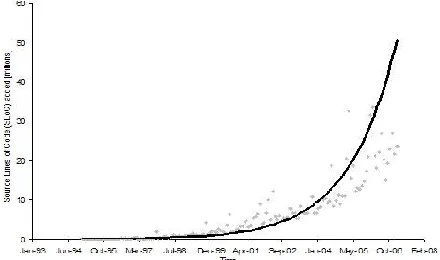
Figures 1 and 2 show plots that represent the growth in source lines of code added using Approach 1 and 2 respectively. The Y-axis shows the number of lines of code added each month and the X-axis shows the time. Each data point on the plot represents the total number of lines of code added during that month. The time frame is 1995 through 2006 for all projects. We can see an upward trend in the amount of code added over time. Both Approach 1 and 2 show a similar pattern of growth.
Figure5.1: Graph of source lines of code added [millions] (Approach 1)
Figure 5.2: Graph of source lines of code added [millions] (Approach 2)
Table shows models for the two plots. In both cases, the best fitting model is an exponential curve with an R-square value of about 0.9, giving us confidence in the validity of the claim that the amount of code added is growing exponentially.
Table 5.1: Model of source lines of code added
International Journal of Research (IJR)
e-ISSN: 2348-6848, p- ISSN: 2348-795X Volume 2, Issue 4, April 2015Available at http://internationaljournalofresearch.org
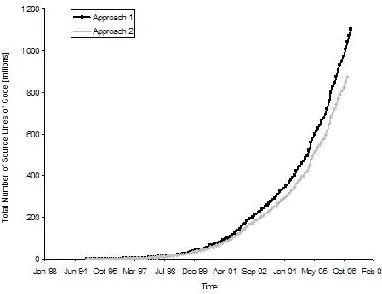
Figure 5.3: Graph of total source lines of code [millions] (both approaches)
Table 5.2: Model of total source lines of code
5.5.2 GROWTH IN OPEN SOURCE
Figure 4 shows the number of projects added over time and Table 3 shows the model and its fit with the data. For each project, there is a first occurrence of a project action (for example, the initial commit action), and that point of time is considered the birth date of the project. This is the point of time when the project is counted as added to the overall set of projects.
Figure 5.4: Graph of number of open source projects added
Table 5.3: Model of number of open source projects added
Large distributions like Debian are counted as one project. Popular projects such as GNU Emacs are counted as projects of their own, little known or obsolete packages such as the Zoo archive utility are ignored. Many of the projects that were included in a Debian distribution around 1998 are not popular enough today (as stand-alone projects) to be included in our copy of the Ohloh database. And again, we get the best fit for the resulting curve for an exponential model with an R-square value of 0.88. Figure 5 then shows the total number of projects and Table 4 shows the corresponding model and its fit with the data. Again, we get the best fit for an exponential model with an R-square value of 0.96. The doubling time is 13.9 months.
International Journal of Research (IJR)
e-ISSN: 2348-6848, p- ISSN: 2348-795X Volume 2, Issue 4, April 2015Available at http://internationaljournalofresearch.org
Table 5.4: Model of total number of open source projects
5.5.3 REVIEW OF FINDINGS
This section shows the growth of source code in open source projects as well as the growth of open source projects itself. We consistently get the best fit for the data using exponential models. The doubling time based on the exponential models is about 14 months for both the total amount of source code and the total number of projects. It should be noted that if we were to break up the data sets into separate time periods, we might find better fits for other models than the exponential model. In future work we will analyze the overall growth in distinct phases, each of which is best explained by a separate growth model.
We discuss the size and frequency of code contributions to open source projects. We can use those results to further increase our confidence in the results presented above. Specifically, the lines of code added can be assumed equal to the product of the average size of a commit in terms of source lines of code and the commit frequency. Our analysis shows that the average commit size is almost constant while the commit frequency (number of commits per week) increases exponentially between Jan 1995 to Dec 2006. This verifies our findings about the exponential growth in open source.
CONCLUSION AND FUTURE
WORK
This chapter is based upon the conclusion of what we have done so far and how the system
can be further enhanced with an increase in requirements.
6.1 CONCLUSION
Open source is software developed by
uncoordinated but loosely collaborating
programmers, using freely distributed source code and the communications infrastructure of the Internet. Open source is based on the philosophy of free software. However, open source extends this ideology slightly to present a more commercial approach that includes both a business model and development methodology. Various categories of free and non-free software are commonly, and incorrectly, referenced, including public domain, freeware, and shareware. Licensing agreements such as the GPL have been developed to formalize distribution terms. The Open Source Definition provides a framework for evaluating these licenses.
There are hundreds, if not thousands, of open-source projects currently in existence. These projects face growing challenges in terms of scalability and inherently weak tool support. However open source is a pragmatic example of software development over the Internet
The significance of open source has been continuously increasing over time. Our research validates this claim by looking at the total growth of open source. Our work shows that the additions to open source projects, the total project size (measured in source lines of code), the number of new open source projects, and the total number of open source projects are growing at an exponential rate. The total amount of source code and the total number of projects double about every 14 months.
International Journal of Research (IJR)
e-ISSN: 2348-6848, p- ISSN: 2348-795X Volume 2, Issue 4, April 2015Available at http://internationaljournalofresearch.org
REFERENCES
[1]. Mockus, A. AT&T Bell Labs. Naperville,
IL, USA “A case study of open source software development: the Apache server” Date of Conference: 4-11 June 2000, Pages 263-272, Print ISBN: 1-58113-206-9, INSPEC Accession
Number: 6734866
[2]. Joseph Feller, Brian Fitzgerald. “A
Framework Analysis of the Open Source Software Development Paradigm” Published In ICIS '00 Proceedings of the twenty first international conferences on Information System, Pages 58 - 69 Publication Date: 10 Dec
2012
[3]. Stefan Koch and Georg Schneider, “Effort, Co-Operation and Co-Ordination in an Open Source Software Project: GNOME” Date of Conference: 8 Feb. 2002, Pages: 27 – 42
[4]. Yunwen Ye, “Toward an understanding of the motivation of open source software developers” Date of Conference: 3-10 May 2003, Pages 419 - 429, Print ISBN: 0-7695-1877-X, INSPEC Accession Number: 8064388).
[5]. Godfrey, M.W; “Evolution in open source software: a case study” Publication Date: 11-14 Oct 2000, Pages 131 - 142, E-ISBN: 1063-6773, Print ISBN: 0-7695-0753-0, INSPEC Accession Number: 6771737)
[6]. Georg von Krogh. ; “Community, joining, and specialization in open source software innovation: a case study” Date of Conference: 19 June 2003, Pages 1141 – 1152
[7]. Guido Hertel, Sven Niedner; “Motivation of software developers in Open Source projects”
Date of Conference: 12 April 2003, Pages 141 – 152
[8] Georg Von Krogh; “Special issue on open
source software development” Vol 32, Issue 7, Date of Conference: July 2003, Pages 1149 – 1157
[9] Andrea Bonaccorsi, Cristina Rossi; “Why
Open Source software can succeed” Vol 32, Issue 7, and Date of Conference: July 2003, Pages 1243 – 1258
[10] Siobhán O‟Mahony; “Guarding the
commons: how community managed software projects protect their work” Vol 32, Issue 7, Date of Conference: 28 May 2003, Pages 1179 – 1198
[11] David Zeitlyn; “Gift economies in the development of open source software: anthropological reflections” Vol 32, Issue 7, Date of Conference: 10 April 2003, Pages 1287 – 1291
[12] Nikolaus Franke, Eric von Hippel; “Satisfying heterogeneous user needs via innovation toolkits: the case of Apache security software” Vol 32, Issue 7, Date of Conference: 29 May 2003, Pages 1199 – 1215
[13] Audris Mockus; “A case study of open source software development: the Apache server” ICSE '00 Proceedings of the 22nd international conference on Software, Date of Conference: 1 June 2000, Pages 263 – 272
[14] Gacek, C; “The many meanings of open source” Publication Date: 9 Aug 2004, Pages 34 - 40, Print ISBN: 0740-7459, INSPEC