Automization of Agriculture Irrigation System
Using Raspberry Pi and Android Apps
Sadolkar Nilesh Shamrao, B.E. Shinde
M.E Student (VLSI AND EMBEDDED SYSTEM), Department of Electronics and Telecommunication, SCOET,
Pune, India1
Assistant Professor, Department of Electronics and Telecommunication, SCOET, Pune, India2
ABSTRACT: The greenhouse based modern agriculture industries are the recent requirement in every part of agriculture in India. In this technology, the water level and temperature of plants are precisely controlled Due to the variable atmospheric circumstances these conditions sometimes may vary from place to place in large farmhouse, which makes very difficult to maintain the uniformity at all the places in the farmhouse manually. The atomization of agriculture system is used to control the whole farmhouse through raspberry Pi and android apps. The another think is to calculate the value of PH, Humidity and Soil condition displayed on 16X2 LCD display and android apps. It is observed that an android phone-control the Irrigation system, which could give the facilities of maintaining uniform environmental conditions are proposed. The Android Software Development Kit provides the tools and Application Programmable Interface necessary to begin developing applications on the Android platform. Mobile phones have almost become an integral part of human life serving multiple needs of humans. This application makes use of the GPRS [General Packet Radio Service] feature of mobile phone as a solution for irrigation control system.
KEYWORDS: Raspberry PI, PH, temperature, soil, humidity, water level sensor, 16X2 LCD display, android app, Arduino software.
I. INTRODUCTION
Drip irrigation is artificial method of supplying water to the roots of the plant. It is also called micro irrigation. In past few years there is a rapid growth in this system. The user communicates with the centralized unit through internet. The centralized unit communicates with the system through SMS which will be received by the IOT with the help of the smart phone. The sends this data to Raspberry Pi which is also continuously receives the data from sensors in some form of codes. After processing, this data is displayed on the LCD. Thus in short whenever the system receives the activation command from the subscriber it checks all the field conditions and gives a detailed feedback to the user and waits for another activation command to start the motor. The motor is controlled by a simple manipulation in the internal structure of the starter. The starter coil is indirectly activated by means of a transistorized relay circuit. When the motor is started, a constant monitoring on soil moisture and water level is done & once the soil moisture is reached to sufficient level the motor is automatically turned off & a massage is send to subscriber that the motor is turned off. The another think is to display the value of temperature on 16X2 LCD display. The PH sensor is used for measure the contents of water. the humidity sensor used to check the presence of water in air.
II. METHODOLOGY
Atomization of agriculture system using raspberry Pi and android apps will be made in the following steps: 1. Complete layout of the whole setup will be drawn inform of a block diagram for each node. 2. The temperature sensed by sensor is displayed on LCD
3. The soil condition is checked by moisture sensor, depending upon the soil condition & water level, water pump motor is turned on or off.
4. The motor thefting can be prevented by Raspberry Pi controller by informing the farmer by sending SMS & buzzer alarm.
6. The PH sensor checks the contents of water.
7. The status of the whole farm can be checked & updated wirelessly with help of internet using smart mobile phone android app technology.
III. SYSTEMDESIGNANDIMPLEMENTATION
A. PROPOSED AUTOMATION OF IRRIGATION SYSTEM.
Figure 1.Proposed Automation of Irrigation System.
The proposed system consists of the Wireless Sensor Network for acquiring climate data locally. In WSN various weather monitoring sensors are placed inside the field, sensors include soil moisture ,water level sensor , humidity sensor, temperature sensor. Using this information, irrigation requirement is calculated remotely at central computer and control irrigation controller module wirelessly. Wireless Senor Unit (WSU) consists of a Radio Frequency transceiver, soil moisture sensors, a microcontroller, and power sources. Several WSUs can be deployed in-field to configure as a distributed sensor network for accurate irrigation control.
Each unit is based on the microcontroller raspberry Pi that controls the ZigBee module and processes information
B. THE PROPOSED AGRICULTURE AUTOMATION SYSTEM FUNCTION
The proposed agriculture automation system function has ability to control the following components in users. 1. Temperature and Humidity
2. Soil sensor
3. Water level detector 4. Motor on/off and alarm 5. PH sensor
6. Software design 7. Android apps
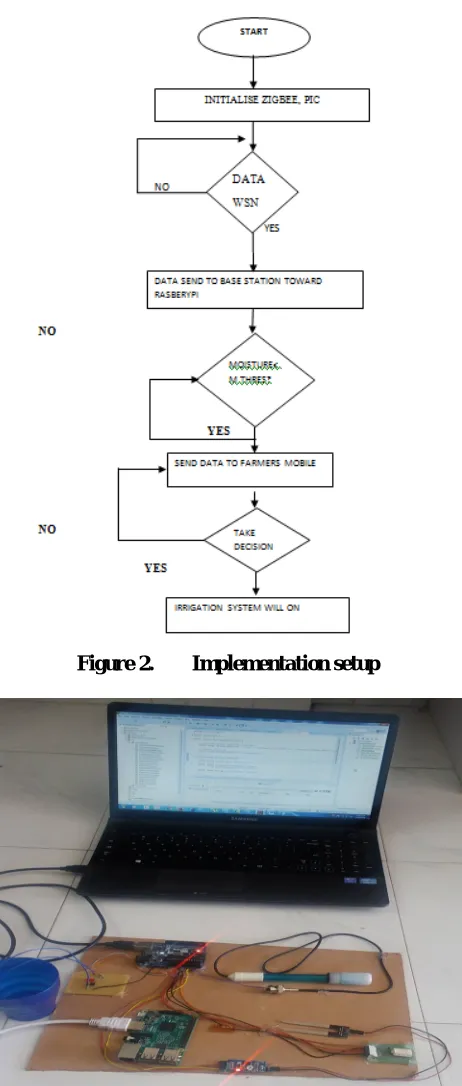
IV. IMPLEMENTATION SETUP
above information is given to the microcontroller which exchanges data with the server to provide information to the farmer.
Figure 2. Implementation setup
V. HARDWAREDESCRIPTION
1. Temperature Sensors: Temperature sensors are devices used to measure the temperature of a medium. There are two kinds of Temperature sensors contact sensors and non-contact sensors. However, the three main types are thermometers, resistance temperature detectors and thermocouples. All three of these sensors measure a physical property
(i.e. volume of a liquid, current through a wire),which changes as a function of temperature.
2. Humidity Sensor: This sensor checks the presence of water in air. The amount of water vapor in air can affect the plants growth. The presence of water vaporal so influences various physical, chemical, and biological processes.
3. Raspberry Pi controller: Raspberry Pi controller is used to control and interface the Sensors, Motor and internet. This is a low-power, high-performance controller
4. Water Level sensors: This sensor detects the level of substances that flow including liquids, slurries, granular materials and powders. Fluids and fluidized solids flow to become essentially level in their containers (or other physical boundaries) because of gravity whereas most bulk solids pile at an angle of repose to a peak. The substance to be measured can be inside a container or can be in its natural form (e.g., a river or a lake).
The level measurement can be either continuous or point values. Continuous level sensors measure level within a specified range and determine the exact amount of substance in a certain place, while point-level sensors only indicate whether the substance is above or below the sensing point. Generally the latter detect levels that are excessively high or low.
5. PH sensor: the PH sensor is used to calculate the content of water and it is displayed on LCD display.
6. Motor pump theft detector: This sensor checks the presence of the motor and if motor is absent then ARM activates the buzzer alarm and sends SMS to the farmer’s mobile.
7. Android system: Android is that it offers a unified approach to application development and their applications should be able to run on numerous different devices, as long as the devices are powered using Android. These applications written in Java programming.
VI. RESULTS
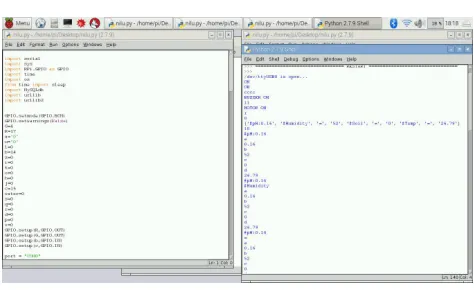
Figure 4 :- snapshot of node data received on raspberry-pi
humidity, PH, soil wetness and other conditions such as if soil is dry then automatically motor turns on and checks for water level reached at farms. If it is at maximum level then raspberry Pi automatically turns off motor to pump water, which is continuously monitored and controlled by controller.
VI. CONCLUSION
Irrigation has been the backbone of human civilization since man has started agriculture. As the generation evolved, man developed many methods of irrigation to supply water to the land. In the present scenario on conservation of water is of high importance. Present work is attempts to save the natural resources available for human kind. By continuously monitoring the status of the soil, we can control the flow of water and thereby reduce the wastage. By knowing the status of moisture and temperature through internet with the use of moisture and temperature sensors, water flow can be controlled by just sending a message from our mobile. Conservation of water and labor: Since the systems are automatic, they do not require continuous monitoring by labor. System and operational flexibility As desired, any valve can be controlled along with the pump and increases the efficiency of water use.If water is stored in tanks at irrigation lands, one can get the status of the water level, temperature sensor and moisture content in soil through SMS generator by microcontroller present at the irrigation land. The PH sensor is use to continuously finding the content of water it is used for plant growth. The proposed system is very use full for regular monitoring of farm status without visiting manually, and saves time and also use full to monitor hilly areas and remote areas, which were hard to visit manually. The system not only saves the energy consumption significantly, but also reduces a large number of inputting on the human and material resources in the management. Applying embedded technology and wireless transceiver technology using mobile to the rapid deployment system of the incident detection of emergency food storage environment without complicated connections, it enhances the system’s flexibility, small size, low cost and good effective, so it is easy to install and migrate.
REFERENCES
[1] Avinash Kumar Singh, Yashdeep Saini, Dheeraj Singh,"Cloud Computing to Control Automatic Irrigation Systems ",Volume 5, Issue 10, October-2015.www.ijarcsse.com
[2] Prof. Pranit P. Kathale, Jyoti Mankari, Payal Shire, "A Review on Monitoring and Controlling System for the Operation of Greenhouse Environment",Volume 5, Issue 4, 2015 ISSN: 2277 128X
[3] Ms. Deweshvree Rane, Prof. P. R. Indurkar, Prof. D. M. Khatri, "REVIEW PAPER BASED ON AUTOMATIC IRRIGATION SYSTEM BASED ON RF MODULE",IJAICT Volume 1, Issue 9, January 2015.
[4] Chandankumar Sahu, Pramitee Behera, “A Low Cost Smart Irrigation Control System”, IEEE Sponsored 2nd International Conference on Electronics and Communication System (ICECS 2015)
[5] Pandurang H. Tarange, Rajan G. Mevekari, Prashant A. Shinde, "Web based Automatic Irrigation System using wireless sensor network and Embedded Linux board",2015 International Conference on Circuit, Power and Computing Technologies [ICCPCT]
[6] Karan Kansara1, Vishal Zaveri1, Shreyans Shah1, Sandip Delwadkar2,"Sensor based Automated Irrigation System with IOT: A Technical Review", Karan Kansara et al, / (IJCSIT) International Journal of Computer Science and Information Technologies, Vol. 6 (6) , 2015, 5331-5333.
[7] Nagesh Kumar D.N,"ARM Based Remote Monitoring and Control System for Environmental Parameters in Greenhouse ", 978-1-4799-6085-9/15/@31.00 ©2015 IEEE.
[8] Prabha, Tanujabai J.M, S. Krupesh “Real-Time Atomization of Agricultural Environment for Social Modernization of Indian Agricultural System Using Arm 7” Vol. 3, Issue 6, June 2014
[8] Joaquín Gutiérrez, Juan Francisco Villa-Medina, Alejandra Nieto-Garibay, “Automated Irrigation System Using a Wireless Sensor Network and GPRS Module,” IEEE TRANSACTIONS ON INSTRUMENTATION AND MEASUREMENT, VOL. 63, NO. 1, JANUARY 2014.
[9] Jaypal Baviskar∗,Afshan Mulla†, Amol Baviskar‡, Shweta Ashtekar§ and Amruta Chintawar,"Real time Monitoring and Control System for Green House Based On 802.15.4 Wireless Sensor Network", 2014 Fourth International Conference on Communication Systems and Network Technologies.
[10] Chaitali R. Fule, Pranjali K. Awachat."Design and Implementation of Real Time Irrigation System using a Wireless Sensor Network",Volume 2, Issue 1, January 2014, www.ijarcsms.com
[11] Jyothipriya.A.N., Dr.T.P.Saravanabava, "Design of Embedded Systems for Drip Irrigation Automation "ISSN (Online): 2319 – 6734, ISSN (Print): 2319 – 6726 www.ijesi.org Volume 2 Issue 4 ǁ April. 2013
[12] Aji Hanggoro, Rizki Reynaldo, Mahesa Adhitya Putra,"Green House Monitoring and Controlling Using Android Mobile Application ", 978-1-4673-5785-2/13/31.00 ©2013 IEEE
[13] X. Wang, W. Yang, A. Wheaton, N. Cooley, and B. Moran, “Efficient registration of optical and IR images for automatic plant water stress assessment,” Comput. Electron. Agricult., vol. 74, no. 2, pp. 230–237, Nov. 2010.
[14] S. A. O’Shaughnessy and S. R. Evett, “Canopy temperature based system effectively schedules and controls center pivot irrigation of cotton,” Agricult. Water Manag., vol. 97, no. 9, pp. 1310–1316, Apr. 2010.