A Novel automated fare provide to the passengers
based on destination Using
LPC2148
&RFID reader and tags
1
jangala Sreelatha & 2mr.A.M.V.N. Maruthi
1
M.Tech,Dept of ECE khammam Institute of Technology & sciences.
2
Associate professor, Dept of ECE khammam Institute of Technology & sciences
Abstract
This project is design in order to provide automated fare on destination estimation in bus to the
passengers This research explores the application of archived data from Automated Data
CollectionSystems (ADCS) to transport planning with a focus on bus passenger travelbehavior,
including Origin-Destination (OD) inference, using London as a case study.It demonstrates the
feasibility and ease of applying trip-chaining to infer bus passengerOD from smart card
transactions and Automatic Vehicle Location (AVL)data and is the first known attempt to
validate the results by comparing them withmanual passenger survey data. With the inferred OD
matrices, the variations ofweekday and weekend bus route OD patterns are examined for
planning purposes.Moreover, based on the inferred OD matrices and the AVL data, alighting
times for bus passengers also can be estimated. Bus journey stages, therefore, can easily
belinked. By comparing the interchange time and the connecting bus route’s headway,it provides
a way to evaluate bus connections.In this paper we exploit the extensive farecard transaction data
for deriving useful information about transit passenger behavior, namely trip purpose or activity.
We show how the farecard datacan be used to infer trip purpose and to reveal travel patterns in
an urban area. A case studydemonstrates the process of trip purpose inference based on farecard
data from Metro Transit inthe Minneapolis-St. Paul metropolitan area.
Keywords: Keil vision IDE, LPC2148 Microcontroller, Power Supply Unit, RFID reader and
tags
1. INTRODUCTION
The Public transport system is a major
source ofincome in developing countries
like India.But, this publictransport system
faces several problems. The conductorwill
But,this new system will provide the tickets
automaticallyand deduct the fare for the
distance travelled from thepassenger’s
account.It is also used for
passengersIdentification. RFID has been an
emerging technology inrecent years.RFID
consists of two components,RFIDTag and
RFID Reader.RFID Tag contains
information’ssuch as name, address and
mobile number.RFID readerreads the above
information’s from the RFID Tag.IRsensor
is used to count the number of persons
enteringinto the bus.The location of the bus
can be identifiedby GPS.The occurrence of
accident information to thechecker and the
ticketing information to the user
istransmitted using GSM.The occurrence of
accidents issensed by vibration sensor. The
vibration sensor used hereis MEMS
Accelerometer. Using GPS log data from
vehicle- and person-trips, Wolf proposes to
use land use types atthe trip end as the
primary means to identify trip purpose. In a
more recent study, Stopher et al.collect the
address of the respondent’s home and work
place or school, the two mostfrequently used
grocery stores, and occupation, to enhance
their method of deriving trip purpose.Bohte
and Maatalso propose an innovative method
that combines GPS logs, GIStechnology and
an interactive web-based validation
application. In contrast, using transit
AFCdata, our approach to inferring trip
purpose is based on the assumption that
every transaction ismade within a sequential
trip chain. This approach is conventionally
appealing when farecarddata are analyzed.
Such an assumption on trip chaining implies
that the destination of a trip isalso the origin
of the following trip.
2. RELATED WORK
Existing system
In existing methods, for fare allocation a
conductor is needed to provide the ticket
to the passenger according to the
destination. But there may be chances of
human errors like listening errors and
getting the ticket of other than
destination, not reliable for conductor to
monitor each passenger boarding in bus,
which may lead to loss of revenues to
respective transportation departments.
Manual operation
Monitoring depends on conductor
Less Accuracy system
Loss of revenue
Proposed system
In proposed system, eliminating the
above disadvantages and having a more
provided with an RFID reader to read
multiple tags information here we are
using RFID application for four
applications
1. To provide ticketing system for
passengers
2. To update the area information
3. To update the bus stop
information
On roads with proper vicinity the tags
have been placed and whenever bus
enters into the particular area from the
tag the location will be updated and the
stop arrival is also updated automatically
through RFID then the bus is stopped and
door will be opened, here there is also
scope for replacement of conductor i.e.
passengers are provided with RFID tags
and the tags shown by passengers valid
means then only the door will be opened.
After reading ticket tags present station
and its destination station will be
calculated and automated fare will be
generated and deducted from the card.
3 IMPLEMENTATION
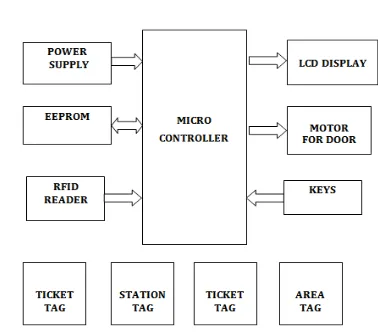
Fig 1: - Project Block Diagram
LPC2148:
The LPC2148 microcontrollers are based on
a 32/16 bit ARM7TDMI-S CPU with
real-time emulation and embedded trace support,
that combines the microcontroller with
embedded high speed flash memory ranging
from 32 kB to 512 kB. A 128-bit wide
memory interface and a unique accelerator
architecture enable 32-bit code execution at
the maximum clock rate. Forcritical code
size applications, the alternative 16-bit
Thumb mode reduces code by more than 30
% with minimal performance penalty. Due
to their tiny size and low power
consumption, LPC2148 are ideal for
applications where miniaturization is a key
requirement, such as access control and
point-of-sale. A blend of serial
communications interfaces ranging from a
UARTs, SPI, SSP to I2Cs, and on-chip
SRAM of 8 kB up to 40 kB, make these
devices very well suited for communication
gateways and protocol converters, soft
modems, voice recognition and low end
imaging, providing both large buffer size
and high processing power. Various 32-bit
timers, single or dual 10-bit ADC(s), 10-bit
DAC, PWM channels and 45 fast GPIO
lines with up to nine edge or level sensitive
external interrupt pins make these
microcontrollers particularly suitable for
industrial control and medical systems.
Power Supply
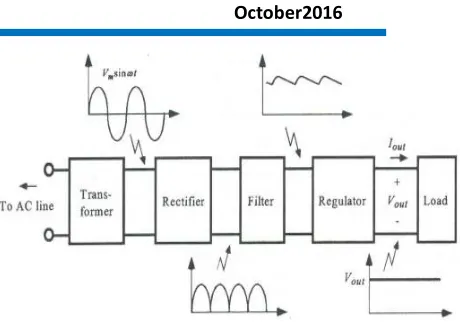
The input to the circuit is applied from the
regulated power supply. The a.c. input i.e.,
230V from the mains supply is step down by
the transformer to 12V and is fed to a
rectifier. The output obtained from the
rectifier is a pulsating d.c voltage. So in
order to get a pure d.c voltage, the output
voltage from the rectifier is fed to a filter to
remove any a.c components present even
after rectification. Now, this voltage is given
to a voltage regulator to obtain a pure
constant dc voltage. The block diagram of
regulated power supply is shown in the
figure.
Fig 2:- Components of power supply
RFID reader
An RFID reader’s function is to interrogate
RFID tags. The expedient of interrogation is
wireless and because the distance is
relatively short; line of optical discernment
between the reader and tags is not
compulsory. A reader contains an RF
module, which acts as both a transmitter and
receiver of radio frequency signals. The
transmitter consists of an oscillator to
engender the carrier frequency; a modulator
to impinge data commands upon this carrier
signal and an amplifier to boost the signal
enough to arouse the tag. The receiver has a
demodulator to extract the returned data and
additionally contains an amplifier to fortify
the signal for processing. A microprocessor
forms the control unit, which employs an
operating system and recollection to filter
and store the data. The data is now yare to
be sent to the network.
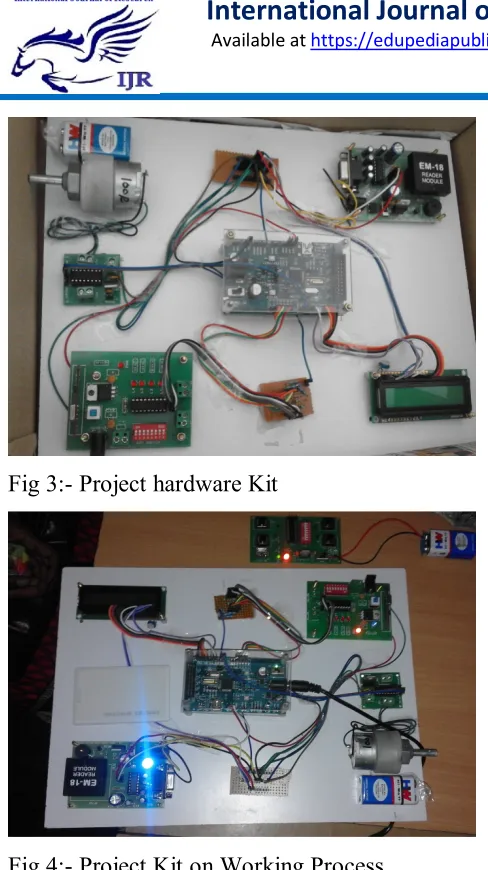
Fig 3:- Project hardware Kit
Fig 4:- Project Kit on Working Process
5 CONCLUSION
Methodology for estimating the destination
of passenger journeys from afc system
specially applicable to the case of entry only
system with a distance based structureThese
additional validation rules deal with the
number of jones or stages in travel cardThis
work introduced afc system data from the
main bus operator in port 0To estimate the
destination of journeys The future work will
focus on exogenous validation Once up to
date od survey results become available
from stcpFuture impartments methodology
include an additional validation rule based
on inter change time intervalIt is expected
that new multimodal afc systemAFC system
data will become available in the near future
6 REFERENCES
[1]. I.F. Akyildiz, T. Melodia, and K.R.
Chowdhury, ‘‘Wireless Multimedia Sensor
Networks: Applications and Testbeds,’’
Proc. IEEE, vol. 96, no. 10, pp. 1588-1605,
Oct. 2008.
[2].I.F. Akyildiz, W. Su, Y.
Sankarasubramaniam, and E. Cayirci,
‘‘Wireless Sensor Networks: A Survey,’’
Elsevier Comput. Netw.,vol. 38, no. 4, pp.
393-422, Mar. 2002.
[3].Y. Liu and S.K. Das,
‘‘Information-Intensive Wireless Sensor Networks:
Potential and Challenges,’’ IEEE Commun.
Mag., vol. 44, no. 11, pp. 142-147, Nov.
2006.
[4].RockwellRockwell Automation, Oct.
2011. [Online]. Available:
www.rockwellautomation.com.
[5]. T.T.-O. Kwok and Y.-K. Kwok,
‘‘Computation and Energy Efficient Image
Processing in Wireless Sensor Networks
Based on Reconfigurable Computing,’’ in
Proc. ICPPW, Columbus,OH, USA, Aug.
[6]. R. Kleihorst, B. Schueler, A. Danilin,
and M. Heijligers, ‘‘SmartCamera Mote
with High Performance Vision System,’’ in
Proc. Workshop DSC, Boulder, CO, USA,
Oct. 2006, pp. 1-5.
[7]. A.Munir, A. Gordon-Ross, and S.
Ranka, ‘‘Parallelized Benchmark- Driven
Performance Evaluation of SMPs and Tiled
Multi-Core Architectures for Embedded
Systems,’’ in Proc. IEEE IPCCC, Austin,
TX, USA, Dec. 2012, pp. 416-423.
[8]. ‘‘Tilera Multicore Development
Environment: ILib API Reference Manual‘‘
Tilera Official Documentation, TILERA,
Apr. 2008.
[9]. A.Y. Dogan, D. Atienza, A. Burg, I.
Loi, and L. Benini, ‘‘Power/ Performance
Exploration of Single-Core and Multi-Core
Processor Approaches for Biomedical Signal
Processing,’’ in Proc.
Workshop PATMOS, Madrid, Spain, Sept.
2011, pp. 102-111.
[10]. M. Coates, ‘‘Distributed Particle
Filters for Sensor Networks,’’ in Proc.
IEEE/ACM 3rd Int’l Symp. IPSN, Berkeley,
CA, USA, Apr. 2004, pp. 99-107.
Authors Profiles
Jangala sreelatha. B.Tech in electronics
and communication engineering with 68%
in the year of passing 2014 in MEDHA
college which is located in khammam.Now,
pursuing M.Tech in embedded system in
khammam Institute of
Technology&sciences.
Mr.A.M.V.N. Maruthi completed his
M.Tech in signal processing from
JNTUH,Hyderabad.Now , he is working as
Associate professor in khammam Institute