International Journal of Research
Available athttps://edupediapublications.org/journals
e-ISSN: 2348-6848 p-ISSN: 2348-795X Volume 04 Issue 10
September 2017
E-Learning Intermediate between Student and Lecture Based
Cloud Computing
B.Shirisha & Dr.K.Rajendra Prasad
1PG Scholar, Dept of CSE, Institute of Aeronautical Engineering, Dundigal, Hyderabad, Telangana, India. 2Professor & HOD, Dept of CSE, Institute of Aeronautical Engineering, Dundigal, Hyderabad, Telangana, India.
Abstract:
Today, information and Communication Technology (ICT) is being utilized to transform the education at an outsize scale due to the planet development created by the large proliferation of low cost computers, internet broadband property and created education content. Cloud computing, AN speedily developing information technology has brought new modification & opportunities to it trade and among the sector of education. it's envisioned that, among the near future, due to the popularity of learning on cyberspace and so the development of fine web-based learning setting, cloud computing will have a significant impact on the tutorial and learning setting, facultative the users (i.e. learners, instructors, and administrators) to perform their tasks effectively and with less value by utilizing the gettable cloud-based applications offered by the cloud service suppliers. Cloud computing is incredibly scalable, creates virtualized resources for users and might have a significant impact on the tutorial setting among the longer term. For the institutions that are below budget shortage, cloud computing could be a excellent completely different as there is not any wish of paying from currently on capital for the computers and network devices. Therefore, the target of this paper is four folds. foremost to introduce the characteristics of E-Learning and analyze the concept of cloud computing. Secondly, to introduce cloud computing to E-learning. Thirdly to elucidate the look of E-learning cloud. And lastly, the conclusions area unit drawn.
Keywords:
Architecture, Cloud Computing, E-learning, Higher Education, Traditional Learning.
I. INTRODUCTION:
E-learning services have evolved since computers were initial utilized in education. There’s a trend to maneuver towards amalgamated learning
services, where computer-based activities are a unit integrated with wise or classroom-based things. There are a unit varied approaches to E-learning. Computer-based learning (CBL) refers to the use of computers as a key a part of the tutorial setting i.e. a space where computers are used for teaching functions. Computer-based trainings(CBTs) are a unit self-paced learning activities accessible via
a laptop computer or hand-held device.
CBTs usually gift content in associate passing linear fashion, terribly like reading an online book or manual.
Fig.1 E-learning
In ancient web-based E-learning mode, system construction and maintenance area unit settled in interior of educational institutions or enterprises, that
ends in Associate in Nursing extremely heap
of problems existed, many investment needed, but whe reas not capital gains to return back, whereas not development potential and tolerance. . because of its dynamic quality and effective usage of the resources Cloud computing is turning into a gorgeous technology. it
should be utilized below circumstances where the availability of resources is impermissible.
when place next to the existed ancient IT services
providing models, cloud computing
has many edges equivalent to reduced direct
investment (i.e., software, hardware,
and accomplished workers to require care of servers
and upgrade software), reduced launching
International Journal of Research
Available athttps://edupediapublications.org/journals
e-ISSN: 2348-6848 p-ISSN: 2348-795X Volume 04 Issue 10
September 2017
performance, high accessibility, infinite quantifiability,
tremendous fault-tolerance capability,
and augmented collaboration, accessibility, and quality, allowing users to use any device, equivalent to a personal computer (PC), or a mobile, etc. Therefore, the utilization of cloud computing will have a positive impact on worth structure of all the industries victimization IT resources by lowering the complete price of possession, resulting in Associate in Nursing indirect crucial impact on business creation and so the economics performance at national levels, extending to a worldwide level.
This benefits the non-public equally as a result of the general public sectors, likewise as attention, education (and that too for E-learning) and thus the activities of state agencies. In every domain and business, cloud
computing has been attracting very
important momentum and a spotlight along of the opportunities that may influence be of Brobdingnagian benefits and empowering in some things, becauseof its flexibility and pay-per-use worth structure for organizations. at intervals the education and learning, this might be referred to as ‟E-learning as a Service” (EaaS). Thus, emergence of cloud computing opens a spanking new conceive to alotof development for E-learning [1]. but the event of cloud computing is facing many essential issues, the foremost outstanding is that the protection issue, with the growing quality of cloud computing, the importance of security show
gradual upward trend, become a
really vital suppose the event of cloud computing.
II.CLOUD COMPUTING:
Cloud Computing has become one among the most popular buzzwords within the IT space.
Several corporations and institutions are dashing to
stipulate clouds and provide cloud solutions
in various ways in which [2]. Cloud computing is Internet-based computing, where shared resources, software, and data square measure provided to computers and completely different devices on demand
[3]. It allow users to use applications whereas not, the necessity to shop for, install, or support package on their native computers or servers therefore on alter them (users) access their personal files anywhere at intervals the globe, anytime, from any internet-enabled device (i.e. phone or desktop computers or
laptops) only the user pay in line with
what amount and also
the method usually he wish services [4]. New
advances in processors have all combined to
create cloud computing a compelling
paradigm. variety of those advancements ar
virtualization technology, disk storage,
broadband web access and fast, low cost servers
[5]. one of the
foremost important featured concepts behind cloud computing is quantifiability, and so the key technology that build it possible is virtualization [2].
Virtualization breaks down the physical barriers inherent in isolated resources, and automates the management of these resources joined entity through
hypervisor technology comparable to Virtual
Machines. Cloud computing has essential impact on important areas of IT, like security, infrastructure,
investments, and extra [6]. It away to
increase capability or add capabilities on the fly, cut back enterprise IT costs & complexities whereas rising work improvement and repair delivery, permits for far more economical computing by centripetal storage, memory, method and data live whereas not finance in new infrastructure, coaching job new personnel, purchase package, or licensing new package.
[7]. So, cloud computing becomes Associate in
Nursing convertible technology
for many of companies and institutions with its dynamic quantifiability and use of virtualized
International Journal of Research
Available athttps://edupediapublications.org/journals
e-ISSN: 2348-6848 p-ISSN: 2348-795X Volume 04 Issue 10
September 2017
Advances in technology give new opportunities in enhancing teaching and learning thus cloud computing
incorporates a significant impact on the
educational atmosphere.
Fig. 2 Cloud Computing
Cloud computing is one of the new technology trends in all probability to have an enormous impact on the teaching and learning surroundings [8]. In Cloud
computing, resources is
also either externally owned (public Cloud – as
provided by Google and Amazon) or
internally owned (private Cloud). Public
Clouds offer access to external users administrative body are typically beaklike on a pay-as-you-use
basis. the non-public Cloud is made for the
access within the enterprise where the
users can utilize the ability with none charges [9]. the choice to maneuver to the cloud is not an all-or-nothing proposition. With different types of cloud offerings, user has versatile decisions regarding those services to urge inside the cloud which to remain on-the-scene. User priorities and security desires make sure the quantity of cloud capabilities to explore. There are three distinct set of services provided by the cloud:
• Infrastructure as a service (Iaas) - the potential provided to the patron to use method, storage,
networks, and different elementary computing
resources. where they are able to deploy and
run arbitrary coding system which could embrace operative systems and applications. the patron does not manage or management the underlying cloud infrastructure but has management over operative
systems, storage, deployed applications, and doubtless restricted management of select networking parts (e.g., host firewalls).
• Platform as a service (Paas) – Cloud platform services deliver a computing platform and/or service, generally intense cloud infrastructure and sustaining cloud applications[13]. It facilitates development and preparation of applications. whereas not the worth and complexity of buying and managing the underlying infrastructure (hardware (server, storage and network), and associated coding system (operating systems virtualization technology, file system) [CC]. platform provide all of the facilities required to support the full life cycle of building and delivering web applications and services entirely procurable from cyberspace [10].
•Software as a service (Saas) - the potential provided to the patron is to use the provider’s applications running on a cloud infrastructure. The applications are accessible from various shopper devices through a thin shopper interface admire a web browser (e.g., web-based email). the patron does not manage or
management the underlying cloud
infrastructure beside network, servers, operative systems, storage, or maybe individual application capabilities, with the getable exception of restricted user-specific application configuration settings
Fig. 3 Cloud Computing Services
III.CLOUD COMPUTING AND E-LEARNING:
emergence of cloud computing
International Journal of Research
Available athttps://edupediapublications.org/journals
e-ISSN: 2348-6848 p-ISSN: 2348-795X Volume 04 Issue 10
September 2017
surroundings or the investment of monumental capital and human and material resources to construct the system. These issues square measure handled by the
E-learning cloud suppliers; United Nations
agency can customize it for users. In E-learning cloud model, data storage is distributed, data management is
centralized and there is virtualization of
information services. E-leaning cloud surroundings provides large data center that has mass data storage and high-speed computation capability. Cloud computing platform offer services at intervals the range of rental, to students and lecturers. Cloud computing ensures virtualization that is in a position to reduce the number of servers required. at
intervals the cloud platform, lecturers
and administrators United Nations agency enter their requests for IT resources like server, software, storage, etc. can instantly perceive whether or not or not these resources are gettable or not. If they are gettable, request is submitted that automatically gets routed to
the cloud administrator for approval. to
substantiate that requests is also fulfilled in an
exceedingly} very short quantity of it slow,
this technique is automatic. planning and management of use of resources are necessary activities of the cloud. The prepare will offer needed capability by computing resources required to create new solutions and to satisfy application performance goals i.e. promote teaching and researching.
Fig. 4 E-learning Cloud Computing Model
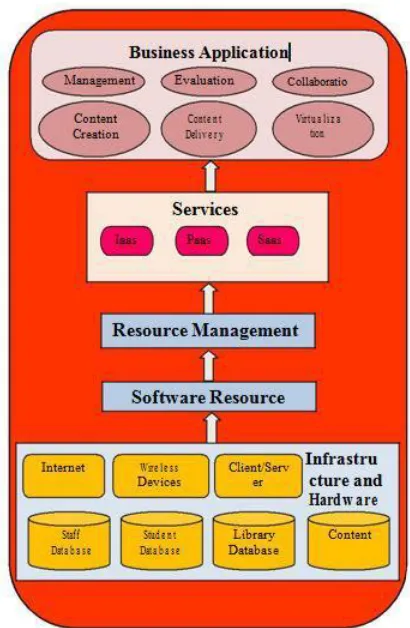
Fig. 5 E-learning Cloud Architecture
IV.CLOUD FOR E-LEARNING:
Processing Re-write Suggestions Done (Unique
Article) E-learning is associate amendment for
technology, ideas and tools, giving new
content, ideas and ways in which for education, but it cannot totally replace lecturers. the teachers will play
leading role and participate in developing
and making use of E-learning cloud which will be a migration of cloud computing technology among the
sector of E-learning and includes all
International Journal of Research
Available athttps://edupediapublications.org/journals
e-ISSN: 2348-6848 p-ISSN: 2348-795X Volume 04 Issue 10
September 2017
1) Hardware resource and infrastructure layer
Hardware resource this can be the foremost necessary layer for the general infrastructure of the system and handles the essential computing things like physical memory and mainframe. The physical host pool is expanded dynamically and memory is climbable at
any time to
feature further memory therefore on provide the uninterruptable power to the middleware services for the cloud based totally E-learning systems. Cloud Computing helps to form the hardware resources shared and accessed as information resources in secure and climbable suggests that by allowing the hardware layer to run rather like information superhighway.
Infrastructure
It is composed of knowledge infrastructure and teaching resources. information infrastructure suggests
that Internet/Intranet, wireless devices,
system software package
package, information management system,
client/server systems and thus the databases whereas the teaching resources suggests that the content in any kind that has been gathered through ancient teaching and is distributed in many departments. This layer is found at intervals the bottom level of cloud service middleware, above the hardware layer.
2)software package package resource layer
This layer consists of operative systems and thus the middleware. to provide the sorted interface for
the software package developers, many software
package solutions get combined, with the help of
middleware technology. So, software package
developer’s unit of measurement able to implant the assorted varieties of applications created for E-learning system at intervals the cloud that helps the cloud users
to use those applications through cloud.
3) Resource management layer
With the help of this layer, we tend to are ableto bring home the bacon low coupling between software package and hardware resources.
Moreover, virtualization and programming strategy of cloud computing helps in achieving the uninterrupted on-demand distribution of software package for various hardware resources.
4)Service layer
Service layer is split into three levels i.e. SaaS (Software as a service), Paas (Platform as a service), IaaS (Infrastructure as a service). These layers facilitate the cloud customer’s use the various forms of cloud resources for his or her product like package resource, hardware resource, and infrastructure
resource. In SaaS, users use package
via cyberspace whereas not the necessity to induce, install or maintain the package . They just pay a monthly fee. In Paas, users use the platform of the service provider as their IT resolution by paying fee to
them. Let’s say, databases. In Iaas, the
hardware required to run a business is provided by
cloud service suppliers and so the
purchasers merely manage their application package .
5) Business application layer
This layer chiefly consists of content
production, tutorial objectives, content delivery technology, assessment/evaluation criteria and education management half [12].This layer frames the enlargement of cluster of components for E-learning. Application layer is engaged among the mixing of teaching resources among the cloud computing model. The interactive programs unit chiefly for the
teachers, to keep with the learners and
teaching needs, built by fully utilizing
the getable information resources and so the course content and so the progress might even be updated at any time by making changes to keep with the feedback. Sharing of teaching resources embrace teaching material, teaching information (such as digital libraries, information centers), likewise as a result of the human resources.
V.BENEFITS OF E-LEARNING CLOUD
Processing Re-write Suggestions Done (Unique Article)
International Journal of Research
Available athttps://edupediapublications.org/journals
e-ISSN: 2348-6848 p-ISSN: 2348-795X Volume 04 Issue 10
September 2017
them are:
1)Reduced Costs: In E-Learning the users needn't have high end organized computers to run the applications. They’ll run the applications from their portable computer, mobiles, pill portable computer having minimum configuration with internet property through cloud. The user ought no to pay for big memory in
native machines, since the data is made and
accessed among the cloud. It’s cheaper as
organizations put together got to pay as per their usage and wish to pay only for the house they need.
(Al-Jumeily et al., 2010)
2)Improved performance: Since the cloud based E-learning applications have most of the applications and
processes in cloud, shopper machines do
not manufacture problems on performance once
they unit operational.(Rao et al., 2010)
3)Fast package updates: E-learners get updates instantly since cloud based application for E-learning runs with the cloud power and thence the software’s
get automatically updated in cloud provide.
4)Better document format compatibility: The
cloud high-powered E-learning applications do not ought to worry relating to those kinds of problems. Since some file formats and fonts do not open properly in some PCs/mobile phones, as a result of the cloud based E-learning applications open the file from cloud.
5)Benefits for lecturers and students: Cloud based E-learning permits students to need on-line courses, attend Infobahn exams, get feedback relating to the courses from instructors, and send their comes and assignments on-line to their lecturers. it's put together advantageous to lecturers as they're going
to prepare on-line tests for faculty
students, manufacture higher content.
resources through content management systems, assess the tests, homework, comes taken by students, send the feedback and communicate with students through
on-line forums.
6) Virtualization: it is the foremost very
important feature of cloud style whose goal is to vary body tasks whereas rising quantify and overall
hardware-resource utilization. Here, the
appliance activity atmosphere and physical platform is managed, financed, migrated, and backup through virtualization platform that place the hardware( at the side of servers, storage and networking equipment), comprehensive virtualization, therefore on produce a
pool of shared, distributed on-demand.
7) Fault free operation: The cloud
automatic processing system can provides
a higher quality of service by event mass storage and superior computing power. These systems sight the node failure on their own and exclude it therefore the ancient operation of the system does not get affected.
8) Provides straightforward and wider accessibility: Cloud based totally E-learning has the target to provide simple accessibility to expensive package running on high performance processors to rural students looking for at the institutions that do not have correct facilities. Brobdingnagian capital is required to
implement the
cloud style but its blessings will justify the value merely.
9) Centralized information storage: Since the
foremost a vicinity of the applications
and information is hold on into the cloud, losing a cloud shopper is no longer a significant incident. A replacement shopper is connected in no time at any moment.
VI.CONCLUSIONS:
International Journal of Research
Available athttps://edupediapublications.org/journals
e-ISSN: 2348-6848 p-ISSN: 2348-795X Volume 04 Issue 10
September 2017
Through the analysis we tend to tend to believe that, by suggests that of cloud computing mass data storage, high-speed computing capabilities, additionally as its ideal allocation and additionally the sharing mode of
resources, we tend to area unit ready
to manufacture associate E-learning application model
supported cloud computing. Cloud
computing can facilitate communities and nations
in reworking education. a whole world of
data can presently be created accessible to lecturers and students through cloud based services that will be accessed anytime, anywhere, from any device. Cloud computing helps students across the planet to amass the latest skills and training they need to
succeed in the planet knowledge society by
lowering the worth and simplifying the delivery of
educational services. Some problems appreciate
platform security, technical
standards, restrictive and different services do not appear to be resolved all the same in apply and square measure unfinished for future analysis and exploration. E-learning application model supported cloud computing will not stop its pace to proceed. as a result of the cloud computing technologies become plenty of refined and additionally the applications of cloud computing become more and more widespread, E-learning will certainly begin a replacement era of cloud computing.
REFERENCES:
1. Cloud Computing: a New Business Paradigm for Elearning. Xiao Laisheng , Wang Zhengxia
2. Bo Dong, Qinghua Zheng, et al. "An E-learning
Ecosystem Based on Cloud Computing
Infrastructure", "the Ninth IEEE International Conference on Advanced Learning Technologies", China /2009.
3. http://www.wikinvest.com,Cloud Computing.
4. http/www.salesforce.com, what is cloud computing.
5. http://code.google.com, Google App Engine
6. http://www.infoworld.com, what cloud computing really means. By Eric –Knorr and G. Gruman.
7. Thomas. P. Y. "Cloud computing: A potential paradigm for Practising the scholarship of teaching and learning", University of Botswana.
8. E. Tuncay, "Effective use of Cloud computing in educational institutions," Procedia Social
Behavioral Sciences, p. 938–942, 2010.
9. R. Buyya, C.S. Yeo & S.Venugopal, "Market-oriented Cloud computing: Vision, hype, and reality of delivering IT services as computing utilities," 10th Ieee Int. Conf. High Performance Comput. Comm., p. 5–13, 2009.
10.ANALYSIS OF SECURITY ISSUES IN CLOUD
BASED E-LEARNING Gunasekar Kumar,
Anirudh Chelikani
11.H. Xin-ping, Z. Zhi-mei , D. Jian, “Medical Informatization Based on Cloud Computing Concepts and Techniques”, Journal of Medical Informatics, 2010, Vol.31, No.3, pp.6-9.
12.Wheeler, B. and S. Waggener."Above-Campus
Services: Shaping the Promise of Cloud