ISSN (Print) : 2320 – 3765 ISSN (Online): 2278 – 8875
I
nternational
J
ournal of
A
dvanced
R
esearch in
E
lectrical,
E
lectronics and
I
nstrumentation
E
ngineering
(A High Impact Factor, Monthly, Peer Reviewed Journal)
Website: www.ijareeie.com
Vol. 7, Issue 7, July 2018
Control of Efficiency of Functioning Of the
Industrial Network by the Generalized Indicator
of Effectiveness of Electro Supply System
Nasullo Sadullaev1, Makhsum Bozorov2, Shukhrat Nematov3
Vice-rector on Science Issues, DSc, Bukhara Engineering– Technological Institute, Bukhara, Uzbekistan1 Doctorate Student, Dept .of EE, Bukhara Engineering– Technological Institute, Bukhara, Uzbekistan2 Doctorate Student, Dept. of EE, Bukhara Engineering– Technological Institute, Bukhara, Uzbekistan3
ABSTRACT. In the present paper a principle of construction of the monitoring system of efficiency of functioning of the system of electro supply on its generalized indicator of efficiency is stated. The generalized indicators characterizing the efficiency of separate functions of the system of electro supply, the value and the order of ranking of weight factors of the generalized indicators are described. The computer program is created for monitoring ofthe system realization and indicators of a power consumption of the enterprise are studied. The createdprogram can be used as a tool oftheinternal and external energy auditof the enterprises, in the structure of monitoring of a power consumption in control system energy management.
KEYWORDS: electro supply system, the efficiency indicators, the generalized indicators, Multi-criteria analysis, the monitoring system, power factor, quality factor, regulation factor.
I. INTRODUCTION
One of the main function of a "smart network" is the control of the current condition of the system of electro supplyusingquick data from measuring and the account systems received by on-line measurement mode. The modern system of electro supply (SES) is the multifunctionalautomated system characterized by multiple indicators of functioning[1]. The estimation of efficiency of the modern SES with one criterion is becoming insufficient and biased. It is necessary to develop methods of estimation of efficiency for SES of the enterprise for complex inspection of these problems based onmulticriterialanalysis and to implement them at power inspections of the enterprise [2], [3]. Thus it is necessary to develop the standard generalized indicator of SES of an industrial objectcharacterizing possibilities ofSES on ensuring of these requirements [4]. The basic problem of creation for monitoring system of efficiency of SES of the enterprise is caused by impossibility of the account of all factors and indicators defining efficiency of functioning of SES and also insufficiency of possibilities of the used mathematical apparatus for complex estimation the state of SES in current time of power consumption [5], [4].
Efficiency functioningof SES is definedbasically by efficiency of transfer and by quality of the delivered energy, by elimination of the damaged elements and abnormal operating modes of SES. For complex estimation of the state ofSES of the enterprise the interconnected indicators of efficiencygeneralize and receive the unit factor defining possibilitiesof SES on maintenance of this indicator up to its ideal value. The main requirement of a choice of the efficiency indicators is possibility of measuring of the current value for this indicator in on-line modeby devices of systems of the account and measurements ofSESand also possibility of analytical treatment and integration of this indicator with others for obtaining of the uniform indicator characterizing overall performanceofSES of the enterprise [7], [8].
II. THE THEORETICAL PART
ISSN (Print) : 2320 – 3765 ISSN (Online): 2278 – 8875
I
nternational
J
ournal of
A
dvanced
R
esearch in
E
lectrical,
E
lectronics and
I
nstrumentation
E
ngineering
(A High Impact Factor, Monthly, Peer Reviewed Journal)
Website: www.ijareeie.com
Vol. 7, Issue 7, July 2018
[10]: the effectiveness ratio of primarycircuitsof SES and the effectiveness ratio of functioning of secondary circuits of SES of the enterprise work (automatics, protection, the account and measuringand etc.). For universality all indicators are calculated in relative units.
A. BLOCK DIAGRAM
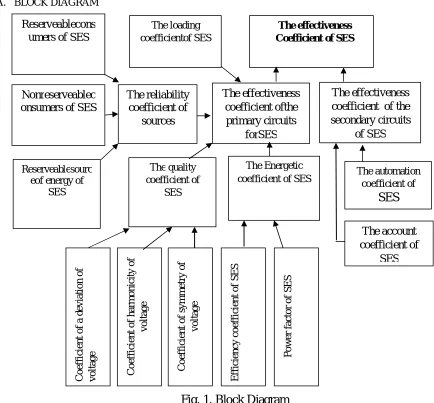
The generalized effectiveness ratio of a power part consists of four coefficients: the energetic coefficient; the quality coefficient; the coefficient of reliability of the primary circuits of SES andalso the loading factor of SES of the enterprise. The effectiveness ratio of functioning of the secondary circuitsof SES consists of two coefficients: thecoefficient of automation and the coefficient of energy account.
The generalized effectiveness ratio of SES is defined asthe sum of coefficients of the power part and the operating part of SESby the following formula
,
1
n n i i efK
K
(1)whereKiisthe effectiveness ratio of n-th possibilities of SEScharacterizingthe efficiency ofSES; αiis the weight
coefficient of possibilities ofSES; i isa number of place of the effectiveness ratio occupied in the general ranking. The quality
coefficient of SES
The effectiveness Coefficient of SES
The effectiveness coefficient ofthe primary circuits
forSES
The effectiveness coefficient of the secondary circuits
of SES
The Energetic coefficient of SES
C oe ff ic ie n t of a d e vi a ti on of vol ta ge C oe ff ic ie n t of h a rm oni c it y of vol ta ge C oe ff ic ie n t of s y m m e try of vol ta ge E ffi c ie nc y c oe ffi ci ent of S E S P ow e r fa ct or of S E S The automation coefficient of
SES
The account coefficient of SES The loading coefficientof SESFig. 1. Block Diagram
The reliability coefficient of
sources Nonreserveablec
onsumers of SES
Reserveablesourc eof energy of
SES
ISSN (Print) : 2320 – 3765 ISSN (Online): 2278 – 8875
I
nternational
J
ournal of
A
dvanced
R
esearch in
E
lectrical,
E
lectronics and
I
nstrumentation
E
ngineering
(A High Impact Factor, Monthly, Peer Reviewed Journal)
Website: www.ijareeie.com
Vol. 7, Issue 7, July 2018
Analyzing the degree of influence of the indicators characterizing modes of power consumption and efficiency of functioning of SES, groups of integrated coefficients,the order of ranking of the generalizedcoefficients and values of the weight coefficients of the generalizedcoefficients are defined. Taking into account the general number of coefficients and also that the general coefficient should not exceed1, the weight coefficient is accepted in the following values:
,
9
1
8
1
7
1
6
1
5
1
4
1
3
1
. 6 1. en qu rs au ac l
n
n ses
ef
K
К
К
K
K
K
К
n
K
where Кen is the energetic coefficientcharacterizingthe efficiency of transfer of the electric power; Кqu isthe quality
coefficientcharacterizingthe efficiency of SES on maintenance of the quality of electrical energy; Kre is the reliability
coefficient of sourceof SES, the power parts ofSEScharacterizingthe trouble-free work; Kaut is the automation factor of
SES characterizing the automation level of SES; Kac is the coefficients of the account energy characterizing the level of
the controllable (accounting) energy in SES; Кl is theloading coefficient of SES of the enterprise.
The energetic coefficient isdefined by multiplication of the energetic indicators of the power consumption, i.e.
,
en
K
K
K
where
K
is the efficiency coefficientof SES by transfer energy; Kφ is the power factorof SES of the enterprise [11].The generalizedcoefficient of quality on the exit ofSES is defined by the following formula:
1 2 sin 1
,
n
qu n n U sym
n
K
П
K
K
K
K
K
K
K
whereКsinis thecoefficient ofharmonicity, КΔU is the deviation coefficient of the voltage, Кsym isthe symmetry coefficient
of the voltage defined depending on current value of the voltage on feedersof SES. The deviation factor of the voltage is defined by counter measurements as follows
ph n av U
U
U
K
.1
,
whereUav isthe average value of deviations of the phase voltage.
The coefficientofharmonicity is defined by the following formula
ph n i f n hh син
U
U
U
U
K
. .1
1
,whereUhh is thesum of the values of higher harmonicsV; i - is the number of harmonic.
The structure of the harmonic and the operating values of the higher harmonics are defined by harmonious analyzers during power inspections [5].
The symmetry coefficient of the voltage on the exit of SES is defined by the value of the voltage of the zero or the inverse sequence as follows
f n
U
U
K
. 0 sin
1
, whereUo is the voltage of thezero (or the inverse) sequences.The reliability ofSES depends on automation of the power consumption, regulation of parameters of the electricalenergy and also information security ofSES. Thus, the reliability of electrosupply is provided by teamwork of elements of theprimary and the secondary circuits ofSES.
The reliability coefficient for the power supply ofSES,Krea.s, is defined by the following formula:
,
. . . . . . re n р re r al a р to re r al a р s reaР
Р
Р
P
P
Р
Р
P
P
K
where Pp.a is thepower of consumers of SES having automated switching on the working reserve network; Рal.r is the
ISSN (Print) : 2320 – 3765 ISSN (Online): 2278 – 8875
I
nternational
J
ournal of
A
dvanced
R
esearch in
E
lectrical,
E
lectronics and
I
nstrumentation
E
ngineering
(A High Impact Factor, Monthly, Peer Reviewed Journal)
Website: www.ijareeie.com
Vol. 7, Issue 7, July 2018
connected through reserve networks or sources; Pto is the general power consumption of the enterprise; Pn.rvis the no
reserved power consumption of the enterprise.
The generalized effectiveness ratio of functioning of the secondary circuits ofSES, consisting of the automation coefficients and the electric power accountcharacterizing an overall performance of the secondary circuits ofSES is formulated.
One of the basic results of automation ofSES is regulation of parameters of the electricalenergy in conformity with technology requirements of consumers. The basic requirement to automation of SES is the voltage regulation on nominal value and a power factor in standard value. The factor, defining the efficiency of regulation by automatic devices of SES, we define by relation of the current values of adjustable parameters of the electricalenergyby the following formula:
,
cos
cos
cos
K
U
f f n
n av n
reg
U
U
U
K
К
(10)
where∆Uav is an average deviation of the voltage on the exit ofSESby (8), Vn; cosφf is the current value of the power
factor of the power consumption; ∆cosφf is the deviation of the current value of the power factor from standard value.
Maintenance of the energy saving and energy efficiency of manufactures is impossible without the automated account and control. Therefore, the level of the account of the electric power on the enterprise is defined by coverage of consumers of the enterprise by system of the technical account of the electric power and also a share of commercial losses (not accounted) energy in general consumption of the enterprise. i.e. by the following formula
,
ka
ka ta
ac
Р
P
P
P
К
(11)where ΣPta is the total value of the current indications of counters of the system of the technical account of the electric
power, kW; ∆РΣ is the total value of technical power losses calculated based on data of the system of the technical account of the electric power, kW; ∆Рkl-is the value of commercial power losses, defined on the basis of the given
systems of the technical and commercial account system of the electric power, kW; Pka-operating value of the
indication of the counter of the commercial account of the electric power.
One of criterions of effective work ofSES of the enterprise is optimum loading of the energetic and the technological equipment [11]. Therefore, at monitoring the general loading of an electric equipment of the enterprise which is defined by the following formula also is supervised:
,
Р
1
оp
fl op l
Р
Р
К
(12)wherePop&Pflis the flowing and optimal values of the power consumption of the enterprise.
III. THE RESULTS
ISSN (Print) : 2320 – 3765 ISSN (Online): 2278 – 8875
I
nternational
J
ournal of
A
dvanced
R
esearch in
E
lectrical,
E
lectronics and
I
nstrumentation
E
ngineering
(A High Impact Factor, Monthly, Peer Reviewed Journal)
Website: www.ijareeie.com
Vol. 7, Issue 7, July 2018
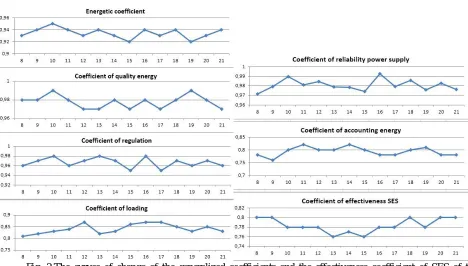
Fig. 2.The curves of change of the generalized coefficients and the effectiveness coefficient of SES of the enterprise.
IV. CONCLUSION
The developed effectiveness ratio ofSES can be used in solutions of problems at carrying out the following actions on theenergy efficiency:
- In power inspections of the enterprise [12] (internal and external energy audit); - In designing more effective systems of electro supply of industrial objects;
- In structure of monitoring of the power consumption in a control system energy of the enterprises department; - In the efficient control on an energy departmentof the enterprises providing to the Chief power engineer of the enterprise obtaining scientifically groundeddecisions in the management by the energy departmentof the enterprises.
REFERENCES
[1] Sadullaev N.N., Bozorov M.B., and NematovSN., Research of Efficiency of Functioning of System of Electro Supply of the Enterprise by Method Multi-Criterial Analysis. Journal of Electrical & Electronic Systems. Volume 7 • Issue 2.pp. 18-20.
[2] Prof. Ajay S.Wadhawe, MayuriKumarraoShirsat. Real Time Monitoring and Logging of Ration System with QR Code Scanner. IJAREEIE journal, Vol. 7, Issue 4, April 2018. pp. 2070-2081.
[3] Bergen A.R. Vital V. Power system analysis. New Jersey, USA, 2000, 619 р.
[4] Sadullaev N.N., Shoboev A.H., Nematov S.N. Monitoring of indicators of the power consumption with use of matrix model of system of electro supply of the enterprise. World wide journal of multidisciplinary research and development. WWJMRD 2017; 3(6):(India), pg 76-80.
[5] Voropay N.I., IvanovaE.Yu. Multi-criteria decision analysis techniques in electric power system expansion planning. International Journal of Electrical Power & Energy Systems. Volume 24, Issue 1, January 2002, - pp. 71-78.
[6] OzalYildirim,, Bekis Eristi, HuseyinEristi, SencerUnal, YavuzErol, YakupDemir. FPGA-based online power quality monitoring system for electrical distribution network. Measurement, 2018, 121,-pp.109–121.
[7] N.Ramesh. Power Quality Improvement of Distribution System using HCC Based FACTS Controller. IJAREEIE journal, Vol. 6, Issue 5, May 2017. Pp. 3429-3437. [8] Panwara M., Suryanarayanan S., Hovsapian R. A multi-criteria decision analysis-based approach for dispatch of electric micro grids. Electrical Power and Energy
Systems,2017, 88, -pp. 99–107.
[9] Energy Efficiency Indicators: Fundamentals on Statistics. International energy agency. Paris. 2014. 387 p.
[10] RekhaSonune ,SanketShinde, Shubham Pandey, Yogesh Pal , Rohit Nair. Variable Regulated AC Power Supply. IJAREEIE journal. Vol. 7, Issue 4, April 2018. pp 2008-2014.
[11] Prof. RajashreeBhokare , PravinChawle , VyankatChoudhari , VaibhavPawar, Smart Meter for Power Factor Enhancement in Real Time. IJAREEIE journal. Vol. 7, Issue 5, May 2018. PP. 2179-2183.