Chapter 3
Energy for Sustainable Development
Charles Kirubi
3.1 Basic Facts and Issues
~e concept of sustainable development refers to development that 'meets the needs of the present without compromising the ability of future generations to meet their own needs' (WCED, 1987). This has social, economic and environmental dimensions. The way energy is produced and used plays an essential role in all the three dimensions. Current primary energy sources areshown in Figure 3.1.The energy system today is heavily dependent on the use of fossil fuels (coal,oil and gas), which together account for 80%of global primary energy consumption (Johansson and Goldemerg, 2002).It is clear that countries differ significantly in the structure oftheir energy consumption (Figures 3.2-3.4).
Fossil fuel consumption accounts for 83%of the energy consumed in industrialized countries and 93%in the transition-economy countries, but only 70% in developing countries. In contrast biomass represents only 3.4%of primary energy used in industrialized countries, is virtually non-existent in countries in transition, and accounts for 26%of energy used in developing countries. Nuclear energy is also significant in industrialized countries (where it is the source of 11% of primary energy) and countries in transition (5%),but makes only a minor contribution in developing countries (1%). The figures also highlight the extreme inequalities in per capita use among groups of countries. Industrialized countries use 4.7 tons of oil equivalent (toe) per capita, in contrast to developing countries, which use only 0.78%toe per capita; the world average is 1.6 toe per capita.
A Guide for Tertiary Education in Kenya Others 0.5
Modern Biomass :3lI1.7 CD Hydro c::::iI2. ~
:l 6.8
0 Nuclear
III
~ TraditionalBiomass ~.4 CD
c: 20.7
w Gas
Coal .5
Oil 35.1
0 5 10 15 20 25 30 35 40 %importance
Figure. 3.1. Primary energy sources in the world (Johansson and Goldemerg, 2002)
Environment and Sustainable Development
% Distribution Others
Hydro Q)
u Biomass
.
..
::I0 II)
Nuclear ~
•
..
Q)Coal c
w
Gas
Oil
o
0.7p2.2
W
3.4I 11
II 20.3
21.1
141.3
o
10 20 30 40 50Figure 3.2. Primary energy sources in industrialized countries (Johansson and Goldemerg,
2002)
3.2 Key Issues in Energy and Sustainability
The pattern and profile of energy use prevailing today raises important questions about linkages between energy and the economy, social issues, security and above all, environmental protection.
During most of the twentieth century, primary energy supply has been cheap and abundant. However, due to limited emphasis on optimising the use of more
energy efficient end-use technologies the energy system as a whole has evolved with limited regard for optimisation. The energy system is made up of the energy
supply sector and energy end-use technologies; the object of the system is to
provide energy services. Thus, if the end-use technologies are not efficient, the
system cannot be efficient either. One of the most important economic issues related to energy has to do with the relationship between energy prices and energy use.
Energy prices influence consumer choices and behaviour. High-energy prices can lead to high-energy bills, which in turn have adverse consequences for business, employment, and social welfare.
For instance, industries in Kenya have cited high electricity tariffs as principal reasons for closure and relocation (Karekezi and Kimani, 2002). On the other hand, high energy prices can also stimulate exploration and development of additional resources, create incentives for innovation and efficiency improvements, and attract new investments. The oil crisis of the 1970s highlighted the importance of energy efficiency and ultimately contributed to a significant decoupling of
energy consumption and gross domestic product. As a result, more products can bemanufactured with less energy, and less energy is needed in general to deliver the energy services required. A major challenge, particularly for Africa will, therefore, be to find ways of meeting the growing demand for energy services to support desired economic growth without incurring the adverse consequences associated with the current patterns of energy use.
Gas Q) Coal o
..
.
:s 0 III Oil ~.
..
Q) c w Nuclear Hydro I I 143.1 126 123.8 CJ4.90
2.2 50o
20 30 4035 10
% Distribution
Figure 3.3. Primary energy sources in transition-economy countries (Johansson and
Goldemerg, 2002).
Other
Nuclear Q) c Hydro
..
.
:s 0 III Gas ~..
.
Q) Biomass c w Coal Oil0.3
0
1t;:D2.5
...{('•.f ..', y .11 .5
"", ,ft .' .',',
..
,,:;:" .,: 126
1."t: :,<0 -, s 27.E
['.'C·.>; ...fi"~"··. • ,,,,-.» :,,:,~M'..;::~, L9
10
o
5 15 20 25 30% Distribution
Figure.3.4. Primary energy sources in developing countries (Johansson and Goldemerg,
Environment and Sustainable Development
Energy use is closely linked to a wide range of social issues, including poverty
alleviation, population growth, urbanisation, and creating opportunities for
women. In addition, poverty is the overriding social consideration in Africa in
particular and other developing countries in general, and poses one of the main
threats to political stability in many countries. According to the Human
Development Report 2003 by some 1.3 billion people in the developing world live
on less than US$l per day (UNDP, 2003). Income alone, however, is an inadequate measure of the social conditions in which poor people live. The energy use patterns
of the poor - especially their reliance on traditional biomass fuels - tend to keep
them impoverished. Increased income by itself would not therefore address their
needs and concerns which include reducing physical labour for household chores, having access to safe and potable water, reducing the need to collect fuel, among others.
Worldwide, an estimated 2 billion people are without access to electricity and the
same number use traditional fuels - fuel wood, agricultural residues, dung - for
cooking and heating (UNDP and WEe, 2000). Over 100 million women spend
hours every day gathering and carrying fuel wood and water and then spend
additional hours cooking in poorly vented spaces. The traditional and inefficient
stoves and open-fire cooking devices used often lead to significant health impacts
through the generation of pollutants that expose women and children to air
pollution corresponding to smoking two packs of cigarettes a day (Johansson
and Goldemerg, 2002). The hours, women and children spend gathering fuel
significantly reduce their opportunities for education and/ or engaging in more
productive income-generating activities. Bellamy (1995) has observed that the
more time and effort a woman spend dealing with ramifications of environmental degradation such as gathering fuel-wood, the less time and effort she spends on other productive activities such as farming.
Although it is generally accepted that population growth tends to increase energy
demand, it is however, less widely understood that the availability of adequate
energy services can lower birth rates. Adequate, affordable and quality energy
services can shift the relative benefits and costs of fertility towards a lower number
of desired births in a family. An acceleration of the demographic transition to
low mortality and low fertility (as has occurred in industrialised countries) depends
on crucial developmental tasks, including improving the local environment,
educating women, and ameliorating the extreme poverty that make child labour
a necessity. All these tasks will require low-cost and quality energy services.
Providing energy services than can address the many social needs in Africa and other developing countries will require major changes in the energy systems.
Environmental degradation associated with the production and consumption of
energy today, threatens human health, quality of life, and affects ecological balance
and biodiversity. Human Disruption Index is a measure of the extent to which
human-generated activities alter the environment (UNDP & WEC, 2000). It is
also defined as the ratio of human-generated flow of a given pollutant to the
natural or baseline flow. In the case of sulphur, for example, human-generated
emissions are 2.7 times the natural baseline flow. And 85% of this disruption is a
result of fossil fuel burning (UNDP 2000)and the use of traditional forms of energy, such as biomass. Current patterns of energy generation and use threaten human
and eco-system health at every level. At the household level, solid fuel use for
cooking and heating has significant health impacts. About 2 billion premature deaths occur every year from exposure to indoor air pollution caused by burning
solid fuels in poorly ventilated spaces (Reddy, et al., 1997). The environmental
impacts of a host of energy-linked emissions - including suspended fine particles and precursors of acid deposition - contribute to air pollution and ecosystem degradation. Further, emissions of anthropogenic greenhouse gases, mostly from the production and use of energy are altering the atmosphere in ways that very likely influence the global climate.
Thus preventing further environmental damage, or even reversing it, must be an important goal of energy policy. Finding ways to meet the inevitably growing
demand for energy services without causing local,regional or global environmental
damage is a mcior challenge. Similarly, attention to energy security (the availability of energy at all times in various forms, in sufficient quantities, and at affordable prices) is critical because of the uneven distribution both of the fossil fuel resources on which most countries currently rely and of capacity to develop other resources. The energy supply could become more vulnerable over the near term due to
growing global reliance on imported oil. The potential for disruption of energy
security due to increased conflicts, sabotage, disruption of trade, and reduction
in strategic reserves are additional important considerations. Present energy
systems also provide targets for acts of terrorism. These potential threats point to
the necessity of strengthening global as wells as regional and national energy
security.
The challenge of sustainability
Although there seems to be no near-term physical limits to the world's energy supply, today's energy system is unsustainable because of equity issues as well as
environmental, economic, and geopolitical concerns that have implications far
into the future. Firstly, modern energy and electricity are not universally accessible, an inequity that has moral, political and practical dimensions in a world that is
becoming increasingly interconnected. Secondly, the current energy system is not
Environment and Sustainable Development
suffers economic hardship and insecurity due to unreliable energy supplies (UNDP
and WEe, 2000). Thirdly, negative local, regional, and global environmental
impacts of energy production and use threaten the health and well being of current and future generations. Addressing these issues is the major challenge facing
Africa in particular and the world community in general while sustainable
development remains the goal in both cases.
3.3
National incomes and Consumption of modern Energy
National income levels in sub-Saharan Africa are significantly lower than in North
Africa and South Africa. When North African countries are excluded from the
GNP per capita estimates, the region's per capita drops from US$677 to US$492
in 1999.If South Africa is excluded, the per capita drops to US$306 (Karekezi,
2002); which is less than 14% of the incomes in industrialized countries.
Sub-Saharan Africa's total GNP was less than Korea (population of 47 million) in
1999 and also less than that of Netherlands (16 million). In 1998, the total
merchandized exports of sub-Saharan African countries (mostly in the form of unprocessed commodities) was about half that of Korea.
The high levels of poverty prevalent in sub-Saharan Africa are more dramatically
reflected in the consumption of modern energy. Between 1990 and 1997, per
capita consumption of modern energy in sub-Saharan Africa has remained small
and stagnant - falling slightly from an average of 248 kg of oil equivalent (kgoe)
to 238 kgoe - about 50% of the world average. The low levels of modern energy
consumption in sub-Saharan Africa are even more striking when one considers
electricity consumption. Excluding South Africa, per capita consumption of
electricity drops from 447 to 126 kWh. There appears to be a correlation between GNP per capita and modern energy use per capita (Karekezi, 2002). The low
incomes that are found in most sub-Saharan African countries could, in
conjunction with other factors, account for the very low level of modern energy consumption. One may therefore conclude that increasing incomes is one way of increasing consumption of modern energy in sub-Saharan Africa.
According to the International Energy Agency (lEA, 2002), approximately 50% of the population in developing countries relies on biomass energy, with some regions recording higher proportions (73%in Africa). Biomass is the energy source for the poor. This is especially true for traditional biomass energy, which is often collected as a 'free' fuel (Karekezi and Kithyoma, 2002). There appears to be a correlation between poverty levels and traditional biomass use in many developing
countries. As a rule, the poorer the country, the greater the reliance on traditional
biomass resources.
3.4 Energy Services for Sustainable Rural Development
in
Africa
Indeed, lack of access to clean and affordable energy is one of the defining characteristics of poverty in sub-Saharan Africa. It iswell known that poor people tend to use biomass as their energy carrier and that in many areas there are
increasing supply shortages, which add to the burden of the women who have the primary responsibility of collecting it. However, despite the fact that roughly
2 billion people use biomass fuels (World Bank, 2000), there have been limited systematic and comprehensive attempts to analyse the energy-poverty nexus. This
can partly be explained by the fact that mainly women and children collect biomass in rural areas at zero monetary cost and so it falls outside national energy accounts. For instance, it is estimated that the informal charcoal industry in Kenya generates Ksh23 billion in gross annual revenues, which is about 72% of the 1998 total oil import bill (Eco-Forum, 2002). Yet the Ksh23 billion is not reflected in the national
energy accounts, and is therefore unregulated, untaxed and not supported. As a
consequence, decision makers are not fully aware of the significance of the use of biomass as an energy source and policies and strategies fail to fully address the
critical issues relating to its demand and supply patterns.
In Africa, lack of access to clean and affordable energy services is a core dimension
of poverty. It iscommon knowledge that poor people tend to use biomass (wood,
charcoal, animal dung, and crop residues) as their energy carrier and that in
many areas there are increasing supply shortages, which add to the burden of
women and children who have the primary responsibility of collecting it. In Kenya, for instance, the supply of accessible biomass from all the sources was
estimated at 15 million tons in 2000 - against a demand of 35 million tons, representing a deficit of 20 million tons. The deficit is projected to rise to almost 34 million tonnes by 2020 (Ministry of Energy, 2002).
The use oMbiomass by poor people has a number of serious repercussions. The fuel quality is low, burning with levels of smoke and particulates that are recognised
as having negative effects on health. The World Health Organisation (WHO)
acknowledges that use of biomass fuels leads to level of indoor air pollution many times higher than the acceptable international ambient air quality standards, exposing poor women and children on daily basis to major public health hazard (Schirnding, et al., 2001). This exposure increases the risk of important diseases including pneumonia, chronic respiratory problems and is estimated to account for substantial proportion of the global burden of diseases in developing countries.
Environment and Sustainable Development
This increases the likelihood of water borne diseases, which, in turn, reduces the ability of poor people to improve their livelihoods, not only preventing adults from working effectively but also negatively affecting children's learning. Another study has observed in extreme situations of wood fuel scarcity, some poor households begin conserving energy by altering their diets to include foods that needed less cooking and avoiding indigenous and nutritious foods such as cassava, arrow roots, maize and beans that require much more energy to cook (Kirubi, 1998). Although nearly every household in rural areas will use some form of biomass, another concern is that poor households tend to spend more time and effort searching than the households in higher income groups do.
Wealthier people are able to exercise wider choice in their energy carrier and many opt for the cleaner and more efficient energy carriers of electricity and gas (LPG or biogas). A recent study on fuel substitution carried out in urban households of Nairobi (Kenya), Kampala (Uganda) and Addis Ababa (Ethiopia) showed that, in general, higher-income households tend to use a wider range of cooking devices and associated fuels, whilst the poorer households are limited to the use of one or two types of fuel, predominantly wood fuel or kerosene. Therefore the wealthier are less exposed to the negative health and time effects and vulnerabilities linked to biomass. Wealthier people are able to afford the appliances that make use these modern energy carriers and in places where they are reliant on biomass fuels, they are able to purchase more efficient stoves.
The poorest groups already pay much more for relatively higher quality services when they are available - buying car batteries, paraffin and LPG and more efficient biomass stoves. Recent research suggests that poor families in the rural areas of Kenya, though heavily reliant on wood fuel, can spend up to one third of their disposal income on such energy services roughly US$8-12 per month while 15% of rural households in Zimbabwe use car batteries for radios and televisions and, to a lesser extent lighting (Shell Foundation, 2001). Another study estimates that a quarter of a typical family's income is spent on wood fuel and alternative energy
sources like LPG are often beyond the means of most Kenyans (Kituyi, 2002). Where they are available to the poor, the prices of these quality energy services remain very high. The price of paraffin, for instance, in rural India and South Africa can be from 2-10 times its price in cities (Shell Foundation, 2001).
Thus not only are the poor paying disproportionately high costs for the lowest quality energy services, but they also adopt higher discount rates when deciding on energy services, opting for lower first cost options rather than those based on
life-cyclecosts.Energy services, which have lower costs per unit of energy received on a life cycle costs basis may have higher upfront investment costs. The consequence for the poor is that more of their precious cash resources are used
on lower quality fuels, at lower efficiency and hence their ability to accumulate
the financial resources they need to invest in strategies for improving their
livelihoods and poverty reduction are significantly reduced. Therefore,
understanding the decision making process within households when choosing
energy services which would appear to work against sustainable livelihoods and poverty reduction is important for designing effective interventions.
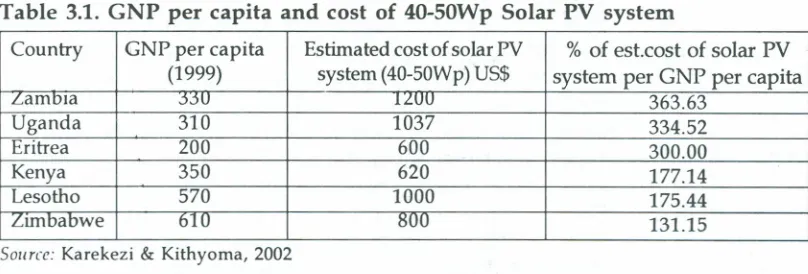
Another striking example to demonstrate that the poor are paying more for much less is to be found within the solar Photo-voltaic (PV) system for rural households
where grid connection is not an economic option. The cost of a typical low-end
PV household system is several times higher than the GNP per capita of most
sub-Saharan African countries (Table 3.1).
Table 3.1. GNP per capita and cost of 40-50Wp Solar PV system
Country GNP per capita EstimatedcostofsolarPV % of est.cost of solar PV
(1999) system(40-50Wp)US$ system per GNP per capita
z.arnnra ,j,jU lLUU
363.63
Uganda 310 1037 334.52
Eritrea 200 600 300.00
Kenya 350 620 177.14
Lesotho 570 1000 175.44
Zimbabwe blU !SUU 131.15
Source: Karekezi & Kithyoma, 2002
Even after adjusting for the differences in the standards of living, rural inhabitants
are poorer than their urban counterparts and their income flows are often less
regular. As such the most successful renewable energy technologies in rural Africa
are likely to be the ones that can generate income and facilitate the start-up of
small micro-enterprises. The stress and emphasis on equity means that rural energy
services must first and foremost promote poverty alleviation and improved living conditions for the poor, as measured by the Human Development Index (HDI). The HDI measures a country's achievements in three aspects: longevity, knowledge and decent standard of living (UNDP, 2003). Improving these aspects of human
development, and therefore the HDI, has three crucial dimensions: (i) equity based
on a marked increase in access of poor to energy services, (ii) employment, including
income generation based on strengthened endogenous self-reliance, and (iii)
environmental soundness based on sustainable use of resources.
As such the following features are essential for energy services meant to benefit the rural poor:
• Increase their access to affordable, reliable, safe and high-quality energy
• Strengthen their self-reliance and empower them
• Improve the quality of their environment, starting with the household
Environment and Sustainable Development
3.5 Strategies for Delivering Rural Energy Services
Johansson and Goldemerg, (2002)have suggested the following strategies for the delivery of rural energy services:
• The reduction of arduous human labour (especially the labour for women
and children) for domestic activities and agriculture
• Themodernisation of biomass as a modern energy source in efficient devices • The transformation of cooking into a safe, healthy, and less unpleasant
end-use activity
• Theprovision of safe water for domestic requirements • Theelectrification of all homes (not merely villages)
• Theprovision of energy for income-generating activities in households, farms and village industries
While the above strategies are comprehensive and progressive, recent thinking
emphasizes that choice in energy options is critical to meeting the needs of poor
people and that a variety of strategies and tradeoffs will be necessary, including fossil fuels (Cecelski, 2003). The Shell Foundation, under the Sustainable Energy Program, has aptly described this as the 'full-menu' approach to imply the wide range of energy technologies and devices required to deliver sustainable energy
services for the poor (Shell Foundation, 2002).Despite many efforts, rural energy
poverty is still widespread. To make a difference, new approaches and strategies
must emphasize an explicit poverty focus, decentralization and participation,
and the integration of energy efforts with other development sectors.
The above strategies pertain towhat rural energy should achieve and deliver. But
there should also be strategies that pertain tohow these energy services should be
achieved and delivered. Johansson and Goldemerg (2002) have suggested three process strategies for delivery of rural energy services, thus government facilitation and enabling support, individual initiative as far as possible through the market, and village community monitoring and control
With a few exceptions, the standard approach to the establishment of new
infrastructures has been for governments to take the initiative. This approach
often ends up with emergence of new government agencies and accompanying bureaucracies that may be plagued by red tape, delays, or even corruption. World Bank (2000) notes that corruption in the energy sector takes many forms, from petty corruption of meter reading and billing to grand corruption in the allocation of lucrative monopolies. These practices lead to weak operational and financial performance, and for the poor in particular, declining service quality or reduced
chances of ever accessing network services.
Similarly, although the market may indeed do an excellent job in allocating labour,
materials and resources; it does not, however, .have a successful record al
safeguarding equity, the environment, research and development (R&D) and
dissemination of new technologies. A number of studies have acknowledged that while electricity liberalisation has led in some cases to improved technical and financial performance in generation and transmission, these beneficial results have
been outweighed by negative environmental, social, economic impacts
(Wamukonya, 2003). There is, however, a third option, namely encouraging
individual initiative subject to local community control. It has been shown that it
is possible to realise 'Blessing of the Commons' situations (converse to the
well-known 'Tragedy of the Commons') in which the costs that an individual/
household experiences for not preserving the commons far outweighs whatever
benefits there might be in ignoring the collective interest (Johansson and
Goldemerg, 2002). The authors add that there can be a confluence of self-interest
and collective interest so that the interest of the commons is automatically advanced
when individuals pursue their private interests.
Arguably, a pragmatic example of the third option is the upcoming innovative
credit schemes facilitating the adoption of off-grid household solar PV, pico/
micro-hydro power, and energy-saving woodstoves for schools in Kenya and in other many developing countries, with inspiring results. In this arrangement, an individual makes an upfront down payment, usually 25%, either as cash and/ or in kind, towards meeting the total cost of the energy system. The balance is provided, either as soft loan or a mix of loan and grant by development partners, through NGOs, community-based organisations, savings and credit organisations (SACCOs) and/ or banks. Successful examples in Kenya include the Community Solar Energy Project in Bahati Nakuru (by SCODE), the Micro-hydropower project
in Chuka, Meru (by ITDG-EA), the Energy Saving Institutional Stoves and
Woodlots in Mt. Kenya Region (by RETAP) and the Michimikuru Solar Home
System in Meru (by SOLARNET) (Mwangi, 2002).
3.6 The Human Development
Index (HDI) - Energy Nexus
For rural energy systems or technologies to advance sustainable rural development,
the emphasis must be on energy services and not merely on energy consumption
(or supply) or on energy technology (however efficient) as an end in itself. The
focus has to be on energy services that improve the HDI (Table 3.2).The role that
energy can play in improving the HDI is not merely a matter of hope or conjecture. There is empirical basis to the relationship between HDI and energy. Strictly
speaking, the relationship must be between energy services and HDI. However,
Environment and Sustainable Development
Large improvements in HDI can be achieved with small inputs of energy (i.e.,
small improvements of energy services), making the HDI-energy (benefit-cost)
ratio very high. Similarly, even large inputs of energy (large improvements of
energy services) result only in marginal improvements in HDI, i.e., the HDI-energy
(benefit-cost) ratio is very low.
Table 3.2. Welfare improvements (HDI) for households using improved
woodstoves in Kenya and Ethiopia
Welfare improvements (HDI) Kenya Ethiopia
Increases speed of cooking 62% 69%
Reduces indoor air pollution & smoke 70% 55%
Increases safety when handling the stove 82% 83%
Increases convenience for cooking 77% 81%
Improves the taste of food 81% 60%
Is easier to clean & maintain 80% 56%
Is more durable 40% 66%
Source: Energy for Sustainable Development (2000)
The Micro-Hydropower Project in Chuka and Meru, in Kenya is another example
linking small investment to significant improvement in HDI. The project is funded
by UNDPJGEFjSGP (Kenya) and implemented by the Intermediate Technology
Development Group-East Africa (ITDG-EA) in conjunction with the Ministry of
Energy and local community (Mwangi, 2002). The project is nearly complete and
targets to generate 14kWe to provide power to 300 households within the
community where the prospects for grid connection are remote. As at May 2003,
a number of small to medium enterprises such as a barber shop, hair salon,
welding, battery charging and video entertainment were functional, employing
more than 20 people and generating direct income for their households. In Phase
Two, it is anticipated that, at night, when power demand by households and
enterprises is off, the system will be used for water pumping, resulting in further
welfare improvement and poverty alleviation for the rural community. The success
of this project has convinced the Government, which was hitherto ambivalent to
community ownership and distribution of non-grid power, to accept and support
mini-grid systems and 1000kW has been set as a ceiling that can be owned by a
community (Mwangi, 2002).This is major policy step forward in addressing rural
energy services taking into account that ITDG-EA estimates that Kenya has over
100locations with potential for such small scale power plants (lOO-lOOOkW)and
many more pico power plants (10kW).
3.7 The Energy-Gender-Poverty Nexus
The poor use energy and other scarce resources to eke out livelihood strategies. Poverty influences and determines which source of energy is chosen and used in a household. It is also one element that can enhance or detract from survival strategies of the poor. Furthermore, rural energy poverty has a gender bias.Cecelski (2003) highlights some" gendered" findings of past research on energy demand of the rural poor are as follows:
• Energy is needed for household uses, such as cooking, lighting, space heating, and other appliances; for agricultural uses, such as tilling,
irrigation, and post-harvest processing; and for rural industry uses, such as milling and mechanical energy and process heat. Energy is also an input to water supply, communications, commerce, health, education, and transportation in rural areas. Much of this energy use and production is by women.
A Guide for Tertiary Education in Kenya • Higher-income people generally use more efficientand more convenient sources of energy, such as gas and electricity, whereas poor people use less efficient and less convenient sources, such as fuel wood and human energy. In actuality,
multiple fuel use is common at all income levels and the "fuel ladder" is perhaps more accurately replaced by a "fuel pyramid" of multiple fuels for different purposes and at different times. What is important to note is that poor people have fewer energy options than do the rich, and they often pay more for them both absolutely (paying higher unit prices) and relatively (as a percentage of their income) than do the rich.Poor women nonetheless highly value and need multiple energy options to help manage their daily work and time. In Java, Indonesia, families using electricity have lower lighting expenditures and receive on average six times as much light as households using kerosene (World Bank, 2000). For cooking, the urban poor often pay more for wood and charcoal than they would for LPG, once the end-use efficiencies of the fuels are taken into account.
• The main use of inanimate energy in rural areas is for cooking and heating.
Environment and Sustainable Development
• The presence of a large number of female-headed households in many developing countries, as well as women's primary responsibility for energy procurement and management (and the invisibility of these tasks in national energy accounts), gives this energy poverty a particular gender bias. The risk of poverty is greater for women, with about one-third of rural households in developing countries being female-headed.
• Neither public nor private energy infrastructure provision is gender-neutral. Women use energy and electricity differently than men because of their different household and productive activities. For example, decisions on how and where electricity and electricity services (such as information and communication technology packages) are provided to households and communities influence women's ability to take advantage of these services.
• Women's micro-enterprises (an important factor in household income, as well as in women's welfare and empowerment) are heat-intensive (food processing), labour-intensive, and/ or light-intensive (home industries with work in evenings). Lack of adequate energy supplies - and other coordinated support-for these activities affect women's ability to operate these micro-enterprises profitably and safely.Conversely, the provision of affordable energy can be a key factor in enabling rural enterprises.
Addressing the challenges women face in the energy sector has been a concern in Africa for the last two decades or so.First, women were viewed .as the destroyers of natural resources through their harvesting of biomass for energy, then they were seen as victims of a biomass energy crisis, and more recently some view women as the saviours of natural resource management through their superior traditional knowledge. All the while, the impact of interventions in energy development have had limited positive impact on the lives of women in general.
Time and effort spent by women in their subsistence and economic chores are an indicator of quantity and quality of energy available to them. Energy poverty is associated with time burdens, drudgery and heavy workloads, poor sanitation and indoor air pollution, all leading to overall poor welfare for women and children.For example over 50% of the women and youth in rural areas in Kenya spend their time in subsistence farming, grazing cattle, fetching fuel wood and water. The time and human capital spend on these activities to meet basic necessities are the opportunity costs foregone on managing the environment (Karani, 2002).
Research indicates that reducing time burdens of women could significantly increase household cash incomes, and productivity of labour and capital. Women playa vitalrole in agricultural activities in rural areas of many countries in Africa.
They are heavily involved in cultivation, planting, harvesting and marketing of agricultural produce. Their work is highly fragmented and a high value is placed on time saving, especially during peak agricultural periods. Modern energy would therefore go a long way in enhancing the productivity of women in agricultural activities (Table 3.3).
With respect to poverty reduction, Johansson and Goldemerg (2002) argues that the improvement of HDI via income generation depends on what the income is used for. Is it used for HDI improvement? For liquor?, Gambling? Conspicuous consumption? This often depends on which gender gets the income. Women tend towards expenditures that improve the HDI of their families, particularly their children.
Table 3.3. Renewable energy technologies (RETs) applications in agriculture
RET Selected agricultural process
Photovoltaic technologies Pumping, lighting, cooling, crop processing
Solar water heaters Dairy processing & heat energy for poultry
Wind pumps Irrigation, crop processing
Biogas plants Production
Bio-fuel cookstoves Milk pasteurisation, heat energy for poultry, crop drying,
crop processing
Animal-driven vehicles Transport
Source: Karekezi &Kithyoma, 2002
The importance of bringing a gender perspective to energy policy analysis and design is still not adequately addressed, nor have the lessons for development been fully integrated by donors or national policy makers. Although many are sympathetic, gender is still commonly viewed predominantly as a peripheral rather than a central economic agenda, thus not fully integrated and accounted for in the national development plans and priorities.
3.8 Policy Measures towards Promotion of Rural Energy
Services
Level playing field for all the available and potential energy technologies
Environment and Sustainable Development
demand-driven, and prone to political interference and corruption. The other option is to allow the market to make the choice through a process of competition. Though the market option is attractive, it is only effective when there is a level playing field for the various contending technologies. This means that deliberate policies are needed to ensure that there is a level playing field for centralised supply and decentralised village-level supply, including end-use efficiency improvement. The problem is that yet-to-mature emerging rural energy technologies must not be compared on the basis of their current costs with mature conventional technologies. The place and potential of emerging technologies must be determined on the basis of their costs resulting from technological advances and organisational learning.
Sustainable development criteria
Notwithstanding the importance of the cost criterion for the choice of technology, there are other crucial sustainable development criteria as well. In particular, a technology has to be accepted by society for it to be socially sustainable. This means that there has to be social participation in the choice of technology. Special policies are required to ensure that the process of technology choice is transparent and democratic. In this process, whatever criteria can be quantified must be quantified. For the criteria that cannot be quantified today, Johansson and Goldemerg (2002)recommend that it should, as an interim measure, be represented with traffic-light colours - green for 'acceptable', red for 'not acceptable' and amber for 'uncertain' - while setting in motion a process to develop an acceptable and objective method for quantifying the criteria.
HD! improvement
As has been amply demonstrated, small investments in energy services could lead to dramatic Human Development Index improvements particularly for the low-income groups, including women. Policies are needed to promote the development and dissemination of technologies that improve HDI directly (e.g., cooking, safe water, horne electrification for lighting, space conditioning for comfort, etc.) as well as technologies that improve HDI indirectly via income generation (e.g., stationary and mobile motive power, process heating, etc.).
Implementation package of hardware plus 'software'
For each rural energy system, for example, micro-hydro-based electricity generation, it is vital to have an entire implementation package of hardware plus 'software'. Where 'software' refers to instructions, procedures, knowledge, do and don'ts, etc., necessary to utilize the hardware. The software will also enhance end-use efficiency, durability, value-for-money and cost-recovery particularly when the hardware is installed on credit. Such packages must consist of the
technology, economics, financing, management, training, institutions, etc.,
necessary for the dissemination of that system. Too often, crucial elements (e.g.,
institutional requirements) are missing in the dissemination programmes, leading
to failures. Hence policies to encourage the preparation of implementation
packages are imperative.
Subsidies
Energy services companies, both private and public, may have weak incentives to provide access to quality energy services to the poor, mainly because of low population densities, which make it costly to serve remote locations. Another constraint is the low incomes of the poor, who often use little energy compared with wealthier households. Thus the main barriers to service may be access costs,
the ability to pay for access, and related government policies such as import
restrictions and taxation. A subsidy can be used to assist poor households in
obtaining higher-quality services - either some of form of direct subsidy to the poor or, whether service networks are non-existent, incentives to business to
develop such networks. However, energy subsidies should be directed at
encouraging access to services rather than helping to cover the operating costs of providing the services. Historical precedent from industrialized countries provides
another justification for subsidy. Just as poor areas in today's industrialized
countries benefited in the past from non-market energy policies, such options
should still beavailable and justified for the African poor.
However, the success of subsidies should be assessed by the criteria ofefficacy,
sector efficiency and cost-effectiveness. Efficacy means that the subsidy reaches those
for whom it is intended, the poor (minimizing the errors of inclusion and exclusion).
Sector efficiency means that the subsidy is structured in such a way that it
encourages provision of service at least cost. Cost effectiveness means that the
subsidy achieves social goals at the lowest program cost while providing incentives to businesses to serve poor and rural populations. To achieve these three goals, decision must be made on the subsidy's target group, on its form and its level, on
the eligibility criteria for the subsidy and how to finance it.
The lessons and experience from Brazil with respect to using subsidies in promoting
LPG for cooking in households are crucial for African countries. By 1999,Brazil
had managed to achieve 99.4% adoption and use of LPG stoves by households,
thanks to carefully designed and targeted subsidies, which catalysed and bolstered
the demand and the market for LPG (Johansson and Goldemerg 2002).This almost
completely eliminated the use of fuel wood for cooking and created 300,000jobs.
It is estimated that this shift in fuels has avoided the deforestation of one million
hectares of forest per year. Among developing countries, Brazil ranks seventh in
Environment and Sustainable Development
with exception of Tunisia and Algeria, average consumption is less than lkgl
capital year. LPG has significant potential to substitute and replace biomass fuels
like charcoal and firewood used for cooking and heating. As a cooking fuel, LPG is 10 times more energy efficient than wood fuel and several thousand times less polluting (UNDP and WEC, 2000).
In Kenya, over 700,000 cylinders were in use throughout the country by March 2002 (Bess, 2002).Yet LPG remains inaccessible to most of the population due to high upfront costs as well as high tariffs and duties (18% VAT, and import duty on LPG).If the latter were removed, one industry group estimates sales of cylinders would increase by 20% and sales of gas by 18% (PlEA and EAA, 2003). Nonetheless, subsidies must not be a permanent crutch inhibiting the advancement of the technology and enterprise.
Local capacity building
The establishment and operation of rural energy services should lead to local capacity building in the matter of hard ware (technology) and 'software'
(particularly management). Policies must be put in place to promote such local capacity building at the rural level, and special attention must be given to operation and maintenance know-how as distinct from construction and design know-how.
Financing
Policies are crucial to arrange and enable financing, through innovative and flexible mechanisms (e.g., through leasing, loans, revolving funds, etc.,) for households and communities so that unacceptably high initial capital costs are converted into manageable operating costs. In Ghana, a national energy fund has been successfully utilized to finance renewable energy projects and energy efficiency activities on a sustainable basis (Karekezi, 2002). The India Renewable Energy Development Agency (IREDA) is another example of an institution deliberately set up to support and finance new and renewable energy technologies and energy efficiency in India (Rao, 2001).
Other notable examples of financing schemes include the RETAP Revolving Credit
Scheme for Schools in Kenya (Mwangi, 2002) and Photovoltaic programme in Bangladesh supported by the Grameen Bank of Bangladesh (UNDP &WEe, 2000).
African governments should use their Poverty Reduction Strategy Papers (PRSPs) and other national development frameworks as instruments and platforms for harnessing and leveraging financing from the numerous global conventions and multilateral environmental agreements such as the Kyoto Protocol (UNFCCq, the Carbon Fund (World Bank), the Millennium Development Goals (UNDP),
the Global Environmental Facility (UNDP, UNEP & World Bank), and NEPAD,
among others.
Quality standards and codes of practice
Those marketing, selling and installing energy systems and equipment should be
able to ensure and guarantee that their systems are both safe and long-lasting so
that unsuspecting consumers can receive full value for their investments.
Institutions are needed to establish and enforce minimum standards for all
entrepreneurs, including installers and equipment designers (Hankins, 1995).
Synergistic government support
In view of the noted shortcomings of the government implementation, there is
need to harness and combine the strengths of entrepreneurship, the dynamics of
markets as well as the advantages of local community involvement, for operations
independent of the government. Nevertheless, government involvement in rural
energy services is essential to provide the enabling policy environment. Above
all, parallel operations by government, for instance, the grid-based rural
electrification programmes, must not compete with, but rather complement, other
non-government rural energy initiatives. Thus policies to ensure synergistic
government support for individual and/ or community initiatives for rural energy
services are vital.
3.9 Sample Question
Heavy dependence on biomass energy is the main cause of environmental
degradation and pollution in Kenya. Discuss using relevant examples.
II Suggest asustainable energy policy for Kenya in line with the out puts of both
Rio1992 and the World Summit for Sustainable Development, Jo'burg 2002.
III Critically examine the challenges of developing and using clean energy in
Kenya.
3.10 Bibliogaphy
Bellamy,
c
.
,
1995,'Women and Environment,' Our Planet, Magazine for Sustainable Development, vol. 7,No.4, UNEP, Nairobi, pp.7-8Bess, M., 2002,'Sustainable Energy in Kenya: An Overview', Energy Alternatives
Environment and Sustainable Development
Cecelski,
E.,
2003, 'Energy, Poverty & Gender: Enabling equitable Access to ruralelectrification: current thinking on energy, poverty & gender', World Bank,
Washington, DC.
Eco-Forum, 2002, 'Hot & Dirty: Inside Kenya's 23 billion shilling charcoal industry',
Long Rains, vol. 25, No.4, ELCI, Nairobi
Energy for Sustainable Development (ESD), 2000, 'Poverty Reduction Aspects of
Successful Improved Households Stove Programmes', DFID KaR R7368,
www.esd.co.uk
Hankins, M.,1995, 'Solar Electric Systems for Africa: A guide for planning &Installing
solar Electric systems in Rural Africa', AGROTEC &Commonwealth Science
Council, UK.
Karani, P., 2002, 'Poverty and Environment: Managing the Environment to Reduce
Poverty in Eastern Africa,' Bureau of Environmental Analysis (BEA)
International, Nairobi.
Karekezi, Sand Kithyoma, W., 2002, 'Renewable rural Africa: isa PV-Ied renewable
energy strategy the right approach for providing modern energy to the rural poor of sub-Saharan Africa?' In: Energy Policy 30 (2002):1071-1086, Elsevier
Science Ltd.
Karekezi, S., 2002, 'Poverty and energtJ in Africa - A brief review'. In: Energy Policy
30 (2002): 915-919, Elsevier Science Ltd.
Karekezi, Sand Kimani, J., 2002, 'Status of power sector reform in Africa: impact on
the poor', In: Energy Policy 30 (2002):923-945, Elsevier Science Ltd.
Kirubi,
c
.
,
1998, Impact of woodfuel demand on Marsabit Forest, M.sc. Thesis,Environmental Science Department Kenyatta University
Kituyi, E., 2002, 'Lost Opportunities: Wood fuel data & policy development concerns
in Kenya', (WSSD Edition) African Centre for Technology Studies (ACTS),
Nairobi.
Ministry of Energy, 2002,'Study on Kenya's Energy demand, supply &policy strategy
for households, small-scale industries, & service establishments', Final Report,
Kamfor Company Ltd., Nairobi.
Mwangi, E., 2002, 'Community-based Alternative Energy Systems', Booklet 2,
UNDP/GEF/Small Grants Programme, Nairobi, Kenya.
Petroleum Institute of East Africa (PlEA) & Energy Alternatives Africa (EAA),
2003, Energy Sector Pre-Budget Proposals, PlEA & EAA, Nairobi
Rao, B. V., 2001, IFinancing Solar Energi] Projects', Proceedings of an International
Training Programme on Solar Energy, 07-18 January 2001, Indian Institute
of Technology, Mumbai, India.
Reddy, A.K.N., Williams, R.H., and Johansson, T., 1997, IEnergy After Rio:
Prospects & Challenges', UNDP, New York.
Schirnding, Y., Bruce, N., Smith, K., Ballard-Tremeer, G., Ezzati, M., & Lvovsky, K., 2001,'Addressing the impacts of household energy & indoor air pollution
on health of the poor - implications for policy action & interoention measures',
WHO Commission on Macroeconomic & Health (CMH working paper series, Paper No. WGS:12), Washington DC.
Shell Foundation, 2002, 'Sustainable Energy Programme (SEP)',
www.shellfoundation.org/sep
Shell Foundation, 2001,'SEP THEME: Energu Services- Innovating to deliver modern
energy services to poor communities in deuelopi ng countries',
www.shellfoundation.org/sep
United Nations Development Programme (UNDP), 2003, 'Human Development
Report 2003: Millennium Development Goals: A compact among nations to end
human poverty' UNDP, New York
UNDP, United Nations Department of Economic &Social Affairs &World Energy Council. 2000, World Energy Assessment: Energy and the challenge of
sustainability, UNDP, New York.
Wamukonya, N. (ed), 2003,'Electricity Reform: Social & Environmental Challenges',
UNEP, Risco Centre, Roskilde, Denmark.
World Commission on Environment & Development (WCED) (the Brundtland Commission), 1987,'Our Common Future' Oxford, Oxford University Press. World Energy Council & Food Agricultural Organisation (WEC/FAO) 1999,'The
Challenge of Rural Energy Poverty in Developing Countries', In Energy Policy
30 (2002): 1071-1086, Elsevier Science Ltd.
World Bank, 2000. Energy Sector Management Assistance Programme (ESMASP),