Effectual Data Collection in WSN with
Path Controlled Mobile Sinks
K.Venkatraman1, P.Manjula2, B.Sivakumar2, D.Anandan2, S.Venkatesan2
1
PG Student 2Asst.Professor Department Of Information Technology
Veltech Multitech Dr. Rangarajan Dr. Sakunthala Engineering College, Chennai
Abstract- Converge cast is a communication pattern in wireless sensor network applications where data flows from many sources to a single sink node. In this paper, we investigate how fast information can be collected from a wireless sensor network organized as tree. To address this, we consider time scheduling on a single frequency channel with the aim of minimizing the number of time slots required to complete a converge cast. We combine scheduling with transmission power control to reduce the effects of interference. Convergecast network requires proper coordination among nodes to avoid collisions. We give lower bounds on the schedule length when interference is completely eliminated and propose algorithms that achieve these bounds. The data assembly rate no longer remains limited by interference but by the topology of the routing tree. Evaluation of the impact of TMCP channel model on the schedule length is done.
Keywords: Wireless Sensor Network (WSN), Convergecast, Tree-based Multi channel Protocol (TMCP)
I INTRODUCTION
Data collection from a set of sensors to a common sink over a tree-based routing topology which is known as converge cast is a fundamental traffic pattern in wireless sensor networks. This many to one communication paradigm in which data flows from many nodes to a single node is known as convergecast. In many applications, it is crucial to provide a guarantee on the delivery time as well as increase the rate of such data collection.
Collisions and retransmissions are occurred in data collection systems. For instance, in safety and mission-critical applications where sensor nodes are deployed to detect oil/gas leak or physical damage, the actuators and controllers need to receive data from all the sensors within a specific deadline, failure of which might lead to unpredictable and catastrophic events. This falls under the category of one-shot data collection. On the other hand applications such as permafrost monitoring require periodic and fast data delivery over long periods of time which falls under the category of continuous data collection. The primary limiting factors of fast data collections are:
Interference in the wireless medium
Half-duplex transceivers on the sensor nodes Topology of the network.
II. MY CONTRIBUTION
In the existing system, fast data collection with the goal is to minimize the scheduling length for aggregated convergecast has been studied.
2.1 Augmenting the Data Collection Rate
It discuss about the fundamental question-what is the fastest rate at which we can collect a stream of aggregated data from a set of wireless sensors organized as a tree? It explores a hierarchy of techniques using realistic simulation models to address this question. To cope with interference, it then studies the impact of utilizing multiple frequency channels by introducing a simple receiver-based frequency and [2] time scheduling approach. It is found that for networks of about a hundred nodes, the use of multi-frequency scheduling can suffice to eliminate most of the interference.This paper have not explored scenarios with variable amounts of data and evaluation of the combination of schemes need to be considered.
2.2 Realistic and Efficient Multi-Channel Communications In this paper, we formulate multi-channel assignment in Wireless Sensor Networks (WSNs) as an optimization problem and show it is NP-hard. We then propose a distributed [6] Game Based Channel Assignment algorithm (GBCA).GBCA takes into account both the network topology information and transmission routing information. Simulation results are given to demonstrate that GBCA can reduce interference significantly and achieve satisfactory network performance in terms of delivery ratio, throughput, [4] and channel access delay and energy consumption. But GBCA does not consider the traffic distribution in networks. TMCP cannot adapt to dynamic changes.
2.3 Multi Channel Arrangement Algorithm for Fast Convergecast
for general disk graphs where nodes have different transmission ranges; n is the number of nodes in the network and Delta(T) is the maximum node degree on a given routing tree T. We also prove that a constant factor approximation is achievable on UDG even for unknown routing topologies so long as the maximum node degree in the tree is bounded by a constant. This paper has not explored the problem of constructing interference-optimal degree bounded trees.
2.4 Time Optimum Scheduling for Many-to-One Scheduling
They gave a general many-to-one packet scheduling algorithm for wireless networks, and then prove that it is time-optimum and [7] costs max (2N(u1)-1, N(u0
)-1) time slots, assuming each node reports one unit of data in each round. Here N(u0) is the total number
of sensors, while N(u1) denotes the number of sensors in a
sink's largest branch subtree. It is shown that this algorithm also achieves time-optimum scheduling in heterogeneous scenarios, where each sensor reports a heterogeneous amount of data in each round. This algorithm does not dynamically adjust each node’s duty-cycle with minimum control overhead due to space limit.
2.5 A Node-Centric Load Balancing Algorithm
They design a node-centric algorithm that constructs load [10] balanced tree sensor networks of asymmetric architecture. They find that their algorithm achieves routing trees that are more effectively balanced than the routing based on breadth-first search (BFS) and shortest-path obtained by Dijkstra's algorithm. But this paper assumes a static sensor network. This algorithm cannot adapt to dynamic changes.
III. PROPOSED WORK
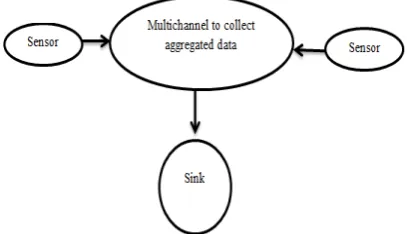
We use simulation (Ns2) to implement the proposed work. The system architecture for the proposed scheme for convergecast is shown in Figure 3.1
Fig.3.1: Touch cast in WSN
Sensor nodes are placed where we want to observe the data. These sensor nodes observe its vicinity for data. They gather the data, and sends to the sink node. In the proposed system, we are scheduling the node activities so that [3] we can acquire data fast without having concerns about collisions and interferences. There are two types of data collections: Aggregated Data Collection and Raw data
Collection. We try to reduce the schedule length and collect data through multiple channel routing. We collect data by storing data in a sensor node on the way to sink, compress it and send to sink. We also reduce the power in sensor nodes according to SINR threshold value.
IV. FUNCTIONAL MODULES
4.1 Periodic Combined Convergecast
Data combination is a commonly used technique in WSN that can eliminate redundancy and minimize the number of transmissions, thus saving energy and improving network lifetime. Aggregation can be performed in many ways, such as by suppressing duplicate messages; using data compression and packet merging techniques; or taking advantage of the correlation in [1] the sensor readings. We consider continuous monitoring applications where perfect aggregation is possible, i.e., each node is capable of aggregating all the packets received from its children as well as that generated by itself into a single packet before transmitting to its parent. The size of aggregated data transmitted by each node is constant and does not depend on the size of the raw sensor readings.
Fig.4.1: Data Combination
4.1.1 Lower bound on Scheduling Length
If all the interfering links are eliminated, the schedule length for aggregated converge cast is lower bounded by (T), where (T) is the maximum node degree in the routing tree T.
4.1.2 Assignment of Time Slots
Given that lower bound is applied to schedule length in the absence of interfering links, we need to assign nodes.
Algorithm1: BFS-TIMESLOT ASSIGNMENT 1. Input: T =(V , ET)
3. e next edge from ET in BFS order
4. Assign minimum time slot t to edge e respecting adjacency and interfering constraints
5. ET ET \{e} 6. end while
In each iteration of BFS-TIME SLOT ASSIGNMENT (lines 2-6), an edge e is chosen in the Breadth First Search (BFS)order starting from any node, and is assigned the minimum time slot that is different from all its adjacent edges respecting interfering constraints. The algorithm runs in O( |ET|^2)time and minimizes the schedule length when there are no interfering links.
4.2 Transmission Power Control
We evaluate the impact of transmission power control, multiple channels, and routing trees on the scheduling performance for both aggregated and raw-data convergecast. [11] Although the techniques of transmission power control and multi-channel scheduling have been well studied for eliminating interference in general wireless networks, their performances for bounding the completion of data collection in WSNs have not been explored in detail in the previous studies. The fundamental novelty of our approach lies in the extensive exploration of the efficiency of transmission power control and multichannel communication on achieving fast converge cast operations in WSNs. The goal is to find a TDMA schedule that can support as many transmissions as possible in every time slot. [9] It has two phases: Scheduling and Power Control that is executed at every time-slot. In each iteration, the scheduler adjusts the power levels depending on the current RSSI (Receiver Signal Strength Indicator) at the receiver and the SINR (Signal to Interference + Noise Ratio) threshold according to the iterative rule equation 1
P new = β/SINR.Pcurrent
According to this rule,if a node transmits with a power level higher than what is required by the threshold value,it should decrease its power value.If not,it should decrease its power value.
Fig.4.2: Transmission Power Control and multi channel scheduling
4.3 Combined and Raw Data Collection
4.3.1 Combined Convergecast
In Combined Convergecast, the packets are aggregated at each hop. Here, we augment their scheme with a new set of rules and grow the tree hop by hop outwards from the sink. We assume that the nodes know their minimum-hop counts to sink. Aggregated convergecast is applicable when a strong spatial correlation exists in the data or the goal is to collect summarized information such as the maximum sensor reading.
Fig. 4.3(a): Combined Convergecast
Algorirthm2: DEGREE-CONSTRAINED TREES
1. Input: G (V ,E), s, max_degree 2. T {s}
3. for all i ε V do 4. C(i) 0; HC(i) ∞1 5. end for
6. HC(s) 0 7. while |T|!=|V| do
8. Choose I’ ! ε T such that:
9. (a) (I, I’) ε E, for some i ε T with C(i) < max degree - 1
10. (b) HC(i) is minimized 11. T T U {I’}
12. HC(I’)= HC(i) + 1 13. C(i) C(i) + 1
14. if i ε V , C(i)= max_degree then 15. break
16. end if 17. end while
4.3.2 Raw Data Convergecast
problemby searching for routing trees wih an equal no: of nodes on each branch.
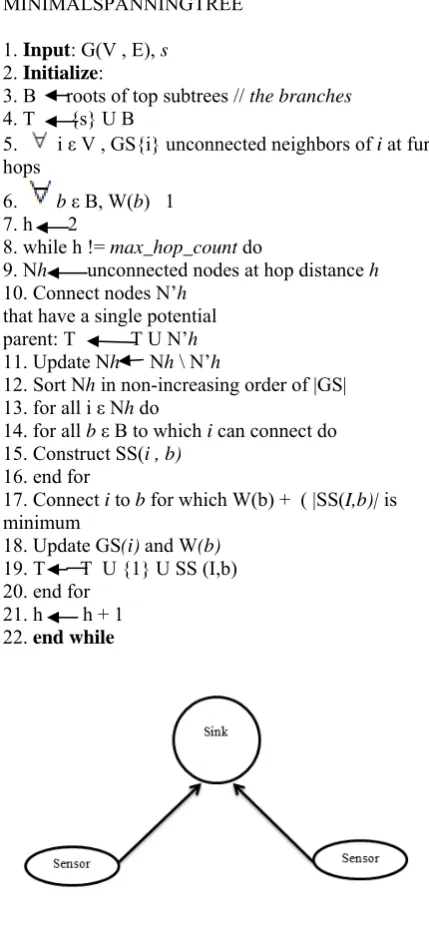
Algorithm 3: CAPACITATED-MINIMALSPANNINGTREE
1. Input: G(V , E), s 2. Initialize:
3. B roots of top subtrees // the branches 4. T {s} U B
5. i ε V , GS{i} unconnected neighbors of i at further hops
6. b ε B, W(b) 1 7. h 2
8. while h != max_hop_count do
9. Nh unconnected nodes at hop distance h 10. Connect nodes N’h
that have a single potential parent: T T U N’h 11. Update Nh Nh \ N’h
12. Sort Nh in non-increasing order of |GS| 13. for all i ε Nh do
14. for all b ε B to which i can connect do 15. Construct SS(i , b)
16. end for
17. Connect i to b for which W(b) + ( |SS(I,b)| is minimum
18. Update GS(i) and W(b) 19. T T U {1} U SS (I,b) 20. end for
21. h h + 1 22. end while
Fig.4.3 (b): Raw Data Converge cast
4.4 Tree-Based Multi-Channel Protocol
Multichannel communication is an efficient method to eliminate interference by enabling concurrent transmissions over different frequencies. TMCP is a greedy, tree-based, multi-channel protocol for data collection applications. It partitions the network into multiple sub trees and minimizes the intra tree interference by assigning different channels to the nodes residing on different branches starting from the top to the bottom of the tree.
Figure 4.4 shows a tree. This is scheduled according to TMCP for combined data collection. Here, the nodes on the left [15] most branches is assigned frequency F1, second branch is assigned frequency F2 and the last branch is assigned frequency F3 and after the channel assignments, time slots are assigned to the nodes with the BFS Time Slot Assignment
Fig.4.4: TMCP preparation
V. RESULT AND CONCLUSION
Fast converge cast is done in WSN where nodes communicate using a TDMA protocol to minimize the schedule length. In this chapter, we have surveyed TDMA-based scheduling algorithms for data collection in wireless sensor networks. It was found that while transmission power control helps in reducing the schedule length, multiple channels are more effective. Using convergecast scheduling algorithms, its showed that the lower bounds are achievable once a suitable routing scheme is used. Through simulations, it was demonstrated the reduction in the schedule length for aggregated and reduction for raw-data convergecast. In future, it will be needed to explore scenarios with variable amounts of data and implement and evaluate the combination of the schemes considered.
REFERENCES
[1] H. Dai and R. Han,(2003) “A Node-Centric Load Balancing Algorithm for Wireless Sensor Networks”, Proc. IEEE Conf. Global Telecomm. pp. 548-552.
[2] O.Durmaz Incel and B. Krishnamachari, (2008),”Enhancing the Data Collection Rate of Tree-Based Aggregation in Wireless Sensor Networks”, IEEE Comm. Soc. Conf. Sensor, Mesh and Ad Hoc Comm. and Networks (SECON ’08), pp. 569-577
[4] A.Ghosh, O.Durmaz Incel, V.A. Kumar, and B. Krishnamachari, (2009), “Multi-Channel Scheduling Algorithms for Fast Aggregated Convergecast in Sensor Networks”, IEEE Int’l Conf. Mobile Adhoc and Sensor Systems, pp. 363-372.
[5] Pantazis. N. A and D. D. Vergados, (2007) “A Survey on Power Control Issues in Wireless Sensor Networks,” IEEE Communications Surveys and Tutorials, vol. 9, no. 4, pp. 86–107,. [6] R. Rajagopalan and P. K. Varshney, (2006)“Data-Aggregation
Techniques in Sensor Networks: A Survey,” IEEE Communications Surveys and Tutorials, vol. 8, no. 4, pp. 48–63,.
[7] R. Rajagopalan and P. K. Varshney, (2006)“Data-Aggregation Techniques in Sensor Networks: A Survey,” IEEE Communications Surveys and Tutorials, vol. 8, no. 4, pp. 48–63,.
[8] W.-Z. Song, R. Huang, M. Xu, A. Ma, B. Shirazi, and R. La Husen, (2009 )“Air-dropped Sensor Network for Real-time High-fidelity Volcano Monitoring,” in ACM Mobi Sys.
[9] G. Tolle, J. Polastre, R. Szewczyk, D. Culler, N. Turner, K. Tu, S. Burgess, T. Dawson, P. Buonadonna, D. Gay, and W. Hong, “A Macro scope in the Redwoods,” in ACM SenSys, 2005.
[10] Tubaishat. M and S. Madria, (2003), “Sensor Networks: an Overview,” IEEE Potentials, vol. 22, no. 2, pp. 20–23, April/May. [11] S. Tamura, Y. Okamoto, and K. Yanashima. Zero-crossing interval
correction in tracing eye-fundus blood vessels. Pattern Recognition, 21(3):227{233, 1988.
[12] Werner Allen. G, K. Lorincz, J. Johnson, J. Lees, and M. Welsh,( 2006 ),“Fidelity and Yield in a Volcano Monitoring Sensor Network,” in USENIX OSDI,.
[13] Y. Tolias and S. Panas. A fuzzy vessel tracking algorithm for retinal images based on fuzzy clustering. IEEE Trans. on Medical Imaging, 17(2):263{273, April 1988.
[14] Y. Wu, J.A. Stankovic, T. He and S. Lin, (2008), “Realistic and Efficient Multi-Channel Communications in Wireless Sensor Networks”, IEEE INFOCOM, pp.1193-1201.