Review
Recent Developments in Solar Energy-Harvesting
Technologies for Building Integration and
Distributed Energy Generation
Mikhail Vasiliev *, Mohammad Nur-E-Alam, and Kamal Alameh
Electron Science Research Institute (ESRI), School of Science, Edith Cowan University, 270 Joondalup Dr, 6027, WA, Australia
* Correspondence: [email protected]
Abstract: We present a review of the current state of the field for a rapidly evolving group of technologies related to solar energy harvesting in built environments. In particular, we focus on recent achievements in enabling the widespread distributed generation of electric energy assisted by energy capture in semi-transparent or even optically clear glazing systems and building wall areas. Whilst concentrating on the cutting-edge recent results achieved in the integration of traditional photovoltaic device types into novel concentrator-type windows and glazings, we compare the main performance characteristics reported with these achievable using more conventional (opaque or semi-transparent) solar cell technologies. A critical overview of the current status and future application potential of multiple existing and emergent energy harvesting technologies for building integration is provided.
Keywords: renewables; energy saving and generation; built environments; transparent concentrators; luminescent concentrators; solar windows; advanced glazings; photovoltaics
1. Introduction
Worldwide annual energy consumption is projected to exceed 700 quadrillion British thermal units (Btu) by 2040, with the energy generation contributions from fuels other than coal (mainly renewables) being on the increase currently [1]. Around 22.7 billion tons of anthracite coal fuel is needed to be burnt to release the Joule equivalent of this annual energy consumption thermally. At the same time, the combustion of fossil fuels remains among the main concerns identified in relation to the past and current global warming and environmental pollution trends [2–4]. In light of this, the development of various types of energy-saving approaches and novel energy generation technologies is of increasing importance today, especially in the building and construction sectors, where a substantial fraction of the total energy generated worldwide is being used. In the US and also the EU, buildings now account for over 40% of the total energy consumption [5]. At present, the technologies for on-site distributed renewable energy generation in built environments experience rapid advances, yet their widespread utilisation is still years away from being commonplace, except for the now-ubiquitous deployment of conventional photovoltaics (PV) on residential building roofs. Building-integrated PV (BIPV) technologies, in a variety of their possible implementations, are widely expected to play a large (and growing) role in near-future construction practices, complementing the now-mature energy-saving construction technologies. A recent report by the European Commission [6] specifies a new societal mission that could be called “creating the Internet of Electricity.” This new term means achieving the fundamental transformation of the power system based on widespread and distributed use of renewables, integrating the energy storage, transmission, dispatchment, and through the smart usage of energy consumption. This “Internet of Electricity” is now seen as a fundamental step towards the full integration and decarbonisation of the entire energy system.
2 of 23
Energy-efficient buildings, construction materials, windows, and vehicles are gaining significant attention and increasing importance today [7–13]. The on-site generation of renewable energy coupled with using energy-efficient construction materials and energy-saving appliances forms a viable, future-proof approach to building the infrastructure and vehicles of tomorrow, in practically all geographic regions. The concept of a zero-energy building (ZEB) was first mentioned in 2000 and became a mainstream idea already in 2006 [14]. Technologies for enabling widespread heating and also cooling-related energy savings in buildings through reducing the thermal emittance of glass surfaces have a much longer history, dating back to at least the early 1970’s [15, 16]. Since then, a large number of research works have been dedicated to achieving continually improved control over the various performance aspects of modern energy-efficient coatings and window glazings, such as their visible-range light transmission (VLT), solar heat gain coefficient (SHGC), thermal insulation performance (U-value), and the ability to control window tint actively or passively; excellent reviews of key developments in these areas are now available [17, 18]. Among the more novel, recently-developed approaches to preventing the overheating of building surfaces is the use of coatings for “passive radiative cooling,” which force the re-emission of the absorbed thermal energy within the atmospheric infrared transparency window between 8-13 m, thus utilizing the vacuum of space as heat sink [10, 11]. In recent years, the now-traditional spectrally-selective metal-dielectric low-emissivity coatings have found an additional niche application area, serving as components of novel energy-harvesting photovoltaic solar windows [19-21], whilst at the same time maintaining their energy-saving functionality. Multiple BIPV-based solar and solar-thermal energy harvesting approaches now form the foundations for a diverse group of mature, industry-ready technologies, with their application areas and markets growing rapidly [22-25]. At the same time, most semi-transparent, and especially the highly-transparent BIPV product types, are only beginning to fill their potentially widespread, yet still niche-type, application areas, and are at present widely considered as “disruptive technologies”, due to their relatively short history of development and commercialisation [26].
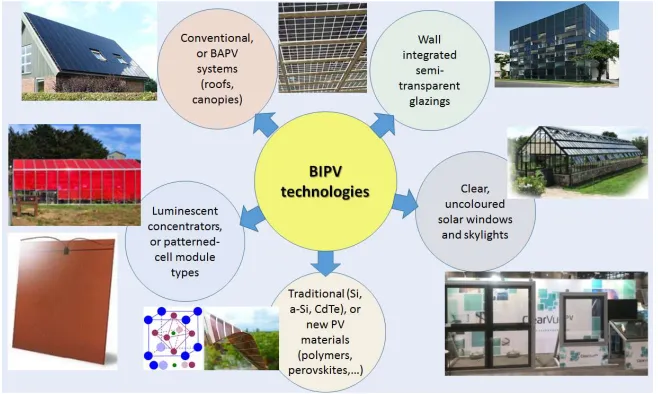
Comprehensive reports and reviews on the types of modern BIPV installations, their economics, performance, and current industry trends are available from [27-30]. Large-scale installations of semi-transparent BIPV module types in building facades still remain much more rare than conventional BIPV roofs, canopies, façades, and wall coverages, whether colour-adjusted or conventional. Figure 1 provides a graphical summary of the broad range of the building-applied PV (BAPV) and also BIPV technologies, materials, modules, and application types, which are either in common use at present, or beginning to appear on the market.
Energy generation (or energy harvesting) has not traditionally been associated with building walls, windows, or any glazing products, until (perhaps) the current decade. Various approaches to the incorporation of photovoltaic (PV) systems into building envelopes have started being explored actively in the last several years, leading to a significant growth in this new field of building-integrated photovoltaics. Historically, the building-building-integrated solar energy harvesting installations started as façade- and wall-integrated conventional (Si, CdTe, or CuIn(Ga)Se2) PV modules occupying the building envelope areas other than roof surfaces, and continued towards the development of semi-transparent, glass-integrated PV window systems using patterned amorphous-silicon modules, perovskite-based, or dye-sensitised solar cells, e.g. [26, 30-35].
More recently, the field of luminescent solar concentrators (LSCs, [36-38]) has started showing the clear signs of a “renaissance” [39-42]. There has also been a significant progress demonstrated in the development of semi-transparent organic, polymer-type, and also perovskite-based solar cells and organic materials-based transparent LSC [43-46], driven by the opportunities to capture the growing markets in both the distributed electricity generation and in advanced construction [6, 19, 20, 31]. Until present, practically no installation-ready solar windows using transparent organic solar cells or LSC have been marketed as industry standards-compliant building material products.
Windows and glazing systems, despite being a practically ancient technology at its core, are now starting to be viewed and recognised as being the renewable energy platform and resource of the near future [26, 47]. This potential for enabling extremely widespread energy harvesting at the point of use is practically unparalleled, considering the entire history of industrial energy generation, and is expected to develop hand-in-hand with the growing use of transparent heat-regulating (THR) coatings for energy-saving applications. Expanding the worldwide energy generation facilities into the almost-uncharted, yet vast territory of glass and windows will require significant time, research efforts, broad-based investments, and long-term strategic thinking on behalf of the governments and private companies. This is due to the fundamental and crucial ways, in which the energy industry differs from all other industries, which has been underscored in a recent publication [48] by the Breakthrough Energy Coalition, authored by B. Gates. The field of distributed, building-based energy generation and the era of the “Internet of Electricity” are both in their infancy today, with major new developments and discoveries still waiting to happen. Despite the intrinsic challenge of generating appreciable amounts of electric energy from sunlight using energy-capturing components which themselves require substantial visible transparency, a significant progress has been demonstrated in BIPV technologies in recent years. The main aim of this present work has been to highlight the important recent developments in the approaches, materials, structures, and systems dedicated to making the widespread distributed renewable energy generation in built environments a reality.
2. Main technologies for integrating energy harvesting surfaces into building envelopes
4 of 23
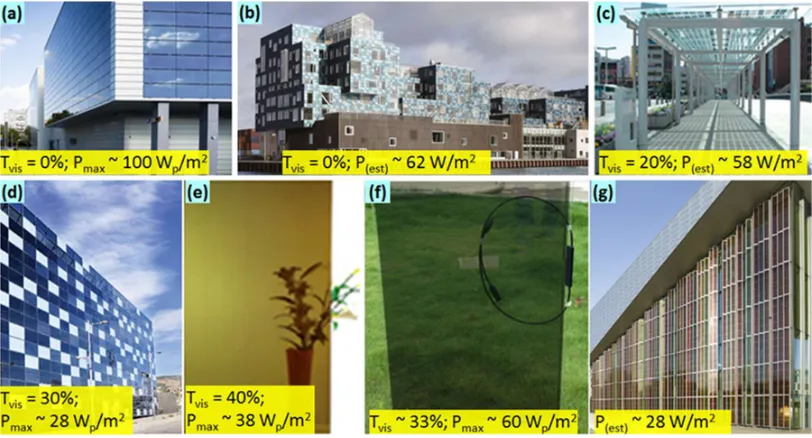
yearly energy output per building footprint area (compared to the horizontal orientation), at least for the urban locations in moderate latitudes. This is because of factors such as the accumulation rates of surface contaminants, wind-assisted cooling effects, Sun altitude angles being well away from zenith for most of the day, and the ground albedo or building-wall reflections providing an additional diffused radiation background, easily interceptible by the wall-mounted PV. At the same time, the overall architectural design of buildings should ideally account for the site-specific and climate-specific energy-harvesting performance optimization of wall-mounted PV arrays or windows, for example by installing these systems on one or two of the most suitable building walls only. Figure 2 provides a system-level graphical outlook and main performance comparisons for most of the BIPV technology types commercialized so far.
Figure 2. Conventional (BAPV), colour-optimized, and semitransparent commercially available BIPV technologies at a glance. The average transparency-related and energy-related figures of performance have either been estimated from the published data, or taken from the relevant product specifications. (a) Avancis PowerMax Skala CuInSe2 panels [50]; (b) Multilayer-coated, colour-optimized BIPV facade by EPFL and Emirates Insolaire [27, 28, 33]; (c) AGC Sunjoule product [51]; (d) Onyx Solar a-Si high-transparency BIPV panels [52]; (e) Hanergy BIPV panels using a-Si [53]; (f) High-transparency CdTe BIPV panels [35]; (g) Solaronix BIPV façade based on semi-transparent dye-sensitized solar cells [34, 54]; the methodology used for making the estimates of electric output has been described in [55].
The standardized peak-rated electric power outputs per unit active PV area, shown as Pmax or Wp/m2 data within parts of Figure 2, have been obtained from the published manufacturer’s specifications, in which the optimum (peak-output) geometric orientations and tilt angles were presumed, except for Figure 2(a). The Pmax figure shown in Figure 2(a) was obtained from Avancis, Inc. published product specifications by also accounting for the vertical Sun-facing panel orientation, using the flux reduction factor of 0.7. The estimated figures for the electric output per unit active area of custom-installed BIPV (Fig. 2(b, c, and g)) have been obtained using the published data for the yearly energy outputs, the total areas of installed PV, and the location-specific weather-dependent insolation data, using the methodology described in [55]. Therefore, these estimates of the maximum expected electric power output per unit active area are not standardized with respect to either the incident solar spectrum, or cell surface temperatures.
of electricity per year (and meeting over half of the school's energy needs) [27, 33]. These PV panels covered a total area of 6048 square meters, making it one of the largest BIPV installations in Denmark [28]. It is possible to derive a figure of performance of about 62 W/m2 for the maximum expected electric output generation capacity, by using these reported data on the predicted annual energy generation, the energy-converting area installed within the façade (6048 m2), and by approximating the other parameters (e.g., assuming the peak-equivalent sunshine-hours per sunny day at the installation location is around 4 hours, and 200 sunny days per year). The annual number of sunny days is approximated here by using the figures from the average monthly distribution of rainy days for this location, which is accessible from a range of online weather-related data sources. The multilayer coatings, which provided the apparent colour adjustment by reflecting the blue-green parts of spectrum, have therefore reduced the electric performance somewhat, compared to an optimally-oriented CuInSe2 (CIS) facade. However, this 62 W/m2 figure has been obtained from a real, feature-rich architectural installation in Northern Europe, in which a significant fraction of active PV area hasn’t been oriented optimally, and also experienced partial geometric shading. This shows the significant practical application potential of colour-adjusted BIPV technologies, at least for the non-transparent installations. Similar performance in energy harvesting (~ 58 W/m2) has been estimated from a horizontally-mounted semitransparent BIPV using monocrystalline silicon cell technology ([51], Figure 2(c)), as well as documented in [35] (~ 60 Wp/m2) for a peak-oriented CdTe-based semitransparent (Tvis ~ 33%) non-concentrating BIPV module, likely from the product range of Xiamen Solar First Energy Technology Co., Ltd. (Xiamen, China) - judging by the close matching of the academically- and commercially-published electrical specifications ([35] vs [56]).
It is interesting to compare the current energy-harvesting performance in the available semitransparent BIPV products with both the PV efficiency records achieved so far in small-size luminescent concentrators, and the theoretical limits of efficiency predicted for the highly-transparent concentrator-type BIPV, and also the highly-transparent organic solar-cell modules. The current efficiency record for a 5cm × 5cm LSC using organic luminophores and edge-mounted GaAs cells stands at 7.1% [57], corresponding theoretically to 71 Wp/m2. However, the scaling of electric power output cannot be linear with increasing concentrator area, for multiple reasons including the relevant loss mechanisms [58], and other considerations related to the thermodynamics of light concentration and light transport phenomena, discussed in subsequent sections. The assessments of the performance limits in highly transparent area-distributed PV and also in concentrators have been made in [59] and in [55], pointing to a theoretical possibility of generating up to about 57 Wp/m2 in systems of 70% colour-unbiased transparency. This theory-limit performance was calculated presuming the use of CIS solar cells of wide spectral responsivity bandwidth, at 25 °C cell temperature, 12.2% PV module efficiency, for the peak geometric orientation and tilt of idealized concentrator panels (with AM1.5G, 1000 W/m2 irradiation.) The practically-achieved, literature-reported clear solar window performance in factory-assembled glass-based windows is now close to 50% of its theoretical limit [55]. At the same time, the best power conversion efficiency (PCE) reported recently in transparent organic photovoltaics was 9.77% at 32% transparency, according to [60]. The authors of [61] also reported achieving 4.00% PCE at 64% transparency in polymer solar cells produced by solution processing; other recently-demonstrated combinations of PCE and visible-range transparency in organic solar cells were summarized recently in [44]. To the best of our knowledge, no installation-ready or standards-compliant BIPV systems with academically published specifications and using transparent polymers-based solar cells (or transparent organic luminophores) are currently available on the market. Significant and ongoing product development efforts are being undertaken at Ubiquitous Energy (USA), aimed at commercialization of transparent organics-based solar windows, with some groundbreaking material development results reported within the supplemetary material dataset of [44], e.g. achieving PCE of 5.20% at Tvis = 52%.
6 of 23
skylights from Velux (Denmark) [62], and an emergent range of solar windows, curtain wall and solar skylight products marketed by ClearVue Technologies (Perth, Australia), which have passed the various industry standard compliance tests in 2018. The relevant technical details and the performance-related description of ClearVue solar window prototypes are available from [55], and their core technology fundamentals and the history of development were reported in [19] and [20]. Other solar window manufacturers e.g. Physee (The Netherlands) [63], or GlassToPower [64] do not appear to publish the technical details (in particular, PV I-V curve datasets) related to their current product specifications.
Even though we are still in the very beginnings of the era marked by the widespread use of transparent (or clear) solar windows, the range and scale of their potential applications is recognised to be enormous (summarized graphically in Figure 3.) The necessity of developing the new, windows-based distributed generation networks to future-proof the urban areas, power the Internet of Things (IOT) revolution, and reduce the reliance on fossil fuels has also been widely recognised [26]. This is further confirmed by the ongoing research, development, and investments momentum now continuing in this area and all related materials science areas worldwide [30-32, 39-48].
Figure 3. Highly transparent solar windows and their application areas. The solar window prototypes shown installed into an off-grid bus stop in Melbourne (Australia) have been described in [55]; other solar windows shown in the right-hand side of the image are current products from ClearVue Technologies, showcased at Greenbuild Expo in Chicago, USA, in November 2018. .
Due to the renewed attention to the next-generation photovoltaics now being paid by the multiple research groups, public institutions, and private companies worldwide, it is currently widely expected that new types of technologies, functional materials, and products will continue to be developed. The next sections of the present review will focus in more technical detail on the major results and developments demonstrated in recent years in the areas related to both the direct area-based solar energy converters, and also the concentrator-type solar windows.
3. Principal results in semi-transparent PV module development, new functional materials for solar concentrators, and current trends in transparent window-type energy harvesters
with the principal results demonstrated in the area of semi-transparent PV energy harvesters from all main technological categories.
3.1. Recent developments in semitransparent non-concentrating BIPV technologies.
Semitransparent non-concentrating BIPV technologies are defined not only by their degree of visible-range transparency, but also by their capability of enabling immediate photovoltaic energy conversion process, localized at any arbitrary region of light-ray incidence onto their active device areas. On the other hand, in concentrator-type semitransparent PV, the PV conversion is engineered to typically take place at the active (non-transparent) solar-cell areas placed at (or near) the edges of light-capturing semitransparent or clear aperture areas. These aperture areas serve to re-direct the incident light rays towards PV cells, and may contain materials providing partial light-trapping functionality, and/or light-harvesting structures that assist waveguiding-type propagation. Therefore, the major defining difference between these two main device categories is in the light propagation path-length within the devices, between the points of ray incidence and the location(s) where the PV conversion takes place. Both technological approaches possess their unique advantages and disadvantages, which are related to the ways in which the fundamental problem of balancing the overall energy-conversion efficiency and the degree of device transparency is addressed. The common metrics-related parameters used to evaluate the performance of semitransparent non-concentrating PV (or their suitability for any particular application area) include the visible light transmission (VLT), and power conversion efficiency (PCE) at standard test conditions (STC). The STC in PV metrology refer to using the standardized solar spectrum for device irradiation (AM1.5G spectral distribution, with 1000 W/m2 in radiation flux density), and making PV current-voltage characteristic measurements whilst keeping the solar cell surface temperatures at 25 °C. If detailed PCE characterization metrology results aren’t available, other published product specifications or performance-related data can often be used to derive or estimate the maximum output power rating per unit active area. Table 1 summarizes the main performance parameters achieved using non-concentrating semitransparent PV technologies in recent years.
Table 1. Performance summary (transparency, materials, and efficiency-related data) for main non-concentrating semi-transparent solar cell technologies and BIPV products with significant visible transmission.
Technology Ref./Year R&D Sample or
Product
VLT PCE or Pmax
(est.) Materials/Details
Dye-sensitized
solar cells [65] / 2007 sample ~60% @ 550 nm 9.2% Screen-printed TiO 2 films
Dye-sensitized solar cells (Solaronix)
[34,54] /
2014 product N/A ~28 W/m
2,
vert. Evaluated from the available published data
Transparent PV
solar cells [66] / 2011 sample >65% (1.3±0.1) Organic material-based, harvesting near-IR only Transparent
polymer SC [61] / 2012 sample 64% 4.00% Solution technology processing Semi-transparent
organic SC [60] / 2017 sample 32% 9.77% Organics (dithienocyclopentathie no[3,2-b]thiophene) Perovskite SC [67] / 2015 sample ~77% @
8 of 23
electrode; for use in tandem cells.
Single-junction semitransparent perovskite SC
[68]/2014 sample 1) 29% 2) 22%
1) 6.4% 2) 7.3%
Methylammonium lead iodide perovskite (CH3NH3PbI3) Colloidal
Quantum Dot SC [69] / 2016 sample 24.1% (ave.) 5.4% PbS colloidal QDs
BAPV
glass-integrated PV
roof (AGC
Sunjoule)
[51] /
2015 product clear glass ~20% of area
~58 W/m2,
horiz. Mono-Si cells, separated laterally within glass
Hanergy BIPV
panels [53] / 2018 product 40% (ave.) 3.8% Amorphous silicon Onyx Solar BIPV
panels [52] / 2018 product 30% (ave.) 2.8% Amorphous silicon Solar First Energy
Technology Co., Ltd.
[35] /
2018 product ~33% 6% CdTe semitransparent BIPV modules
Polysolar BIPV [70] /
2018 product 50% (ave.) W~55.5 p/m2 (5.55%)
CdTe PS-CT-40 BIPV modules (1200 x 600 x 7 mm)
Stability-enhanced perovskite SC
[71] /2018 sample N/A Up to
20.2%
SnO2 electron transport layer replacing TiO2. T80 operational lifetime of 625 h.
1 VLT: visible light transmission, either spectrally averaged or related to a transmission peak at a specified wavelength. PCE: power conversion efficiency; Pmax is rated (or estimated) maximum electric output power per unit active module area.
A number of industrialized, product-level semitransparent PV module manufacturing technologies have been established, based on patterning the non-transparent active PV material area to ensure transparency. Systems using either amorphous silicon or cadmium telluride are becoming increasingly common, even though their (spectrally averaged) visible-range light transmission does not exceed 40-50%. Up to date, none of the commercially available patterned-layer energy-generating modules employing inorganic PV materials feature colour-neutral clear appearance or uniform transmission characteristics across their aperture areas.
commercialization prospects within the scope of near-future years, rather than today. Due to the potentially vast future application areas of perovskite-based semitransparent BIPV, significant research efforts are continuing in the materials science areas related to optimizing the chemistry and module structure of perovskite-based devices, to ensure improved environmental stability and performance. Methylammonium lead iodide (MAPbI3) based perovskite systems were recently shown [74] to possess intrinsic environmental stability limitations due to chemical chain reactions involving iodine vapour. The authors of [74] also hold a view that it is imperative to develop other types of perovskite material systems to achieve long-term stable solar cells, and work in this area is also ongoing in multiple research groups. Noteably, efforts aimed at reducing the perovskite toxicity caused by the presence of lead and also removing the hysteresis in current-voltage characteristics have been reported [75-76].
Another rapidly developing category of semitransparent BIPV technologies possessing strong potential for future applications uses polymer-based organic materials, which can provide remarkable visible transparency simultaneously with high power conversion efficiency [60, 61, 66]. In this area, efforts to up-scale the solar cell sample sizes and ensure the long-term environmentally stable operation and commercially-applicable system packaging are currently ongoing, with product-level devices widely expected to be demonstrated in the near future.
3.2. Progress in semitransparent concentrator-type solar window technologies.
Table 2. Performance summary for main recently-reported concentrator-type semi-transparent LSC devices and solar window technologies.
Technology Ref./Year R&D Sample or Product
VLT PCE
or Pmax
Concentrator performance parameters
Materials/Details
5 cm × 5 cm LSC, non-transparent (using >97% diffuse backside reflector)
[57] / 2008 sample < 3% 7.1% G = 2.5; P ≈ 0.246; Copt ≈ 0.616
Lumogen F Red305 and Fluorescence Yellow CRS040; 4 GaAs cells at edges. Highest LSC efficiency to date.
Quantum-dot LSC, 10 cm × 10 cm
[42] / 2018 sample 43.7% 2.18% P ≈ 0.198;
opt = 8.1%
CuInS2/ZnS QDs and poly-Si cells (Si = 11%); PCE = 2.94%, if backside reflector is used. Tandem Quantum-dot
LSC, 15.2 cm × 15.2 cm
[83] / 2018 sample ~30% 3.1% P ≈ 0.11; CuInSe2/ZnS QDs; high-efficiency GaAs cells.
Quantum-dot LSC, 12 cm × 12 cm
[84] /
2017 sample 70% N/A
opt = 2.85% Si QDs.
50 cm × 50cm × 6cm LSC [85] /
2015 sample est.at peak ~40% 1.26% G = 20.83; P ≈ 0.057;
Copt ≈ 1.187
Sc-Si (22% eff.) cells at edges. Organic dyes (DTB, DPA).
163 cm × 63 cm LSC panels for greenhouse applications
[80] /
2016 product N/A (red colored)
3.4% P ≈ 0.17; Mono-Si cells (20%eff.) at back surface (13.9% area coverage, straight lines pattern). Lumogen Red 305.
163 cm × 63 cm LSC panels for greenhouse applications
[80] /
2016 product N/A (red colored)
3.8% P ≈ 0.19; Mono-Si cells (20%eff.) at back surface (13.9% area coverage, criss-crossed pattern). Lumogen Red 305.
“Leaf Roof”-type 110 cm
× 0.5 cm LSC [81] / 2017 sample N/A (multi-colored)
5.8% P ≈ 0.258; Si cells (22.5% eff.) Multiple backside cells; Lumogen Red 305 mixed with other Lumogen pigments.
100 cm × 75 cm clear glass windows of hybrid concentrator type
[55] /
2018 product > 65% (T direct)
≈ 70% (Ttotal)
~25Wp/m2
conc. ≈ 1.425%
total ≈ 2.5%
G = 4.25; P ≈ 0.116; Copt ≈ 0.492
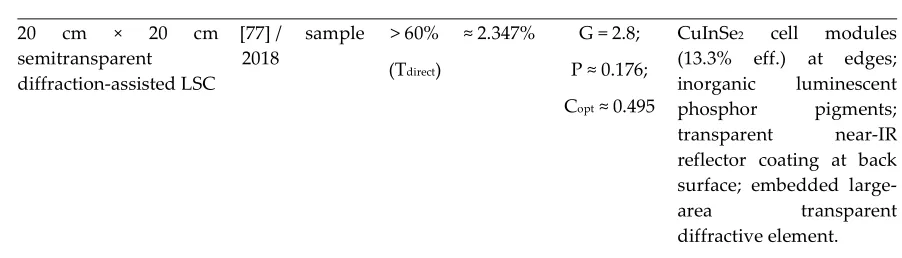
20 cm × 20 cm semitransparent diffraction-assisted LSC
[77] /
2018 sample > 60% (Tdirect) ≈ 2.347% P ≈ 0.176; G = 2.8;
Copt ≈ 0.495
CuInSe2 cell modules (13.3% eff.) at edges; inorganic luminescent phosphor pigments; transparent near-IR reflector coating at back surface; embedded
large-area transparent
diffractive element.
1VLT: visible light transmission, either spectrally averaged or related to a transmission peak at a specified wavelength. PCE: power conversion efficiency; Pmax is rated (or estimated) maximum electric output power per unit active module area. G: geometric gain; P is photon collection probability, and Copt is optical power concentration factor; detailed definitions for these quantities are available from [82]. The figure for conc. from Ref. 55 has been evaluated accounting for the concentrator-related contribution to the total system PCE of near 2.5%.
The optical power efficiency of LSC, or other types of concentrating semi-transparent PV energy harvesters (which utilize physical mechanisms other than TIR-guided luminescence, e.g. diffractive optics), is itself a product of multiple efficiency factors, each relating to a particular physical process harnessed for re-routing the incident photons towards the solar cell surfaces. For “classical” luminescent concentrator systems, opt can be represented in terms of the contributions of all physical phenomena taking place within the concentrator volume, in the following way [37, 38] (Eq. 1):
opt = (1 – R) · PTIR · abs · PLQY · Stokes · host · TIR · self, (1) where R is the reflectivity of the front surface of the luminescent waveguide, PTIR is the probability of total internal reflection governed by the difference between the refractive indices of waveguiding material and outside air, abs is the fraction of the incident solar energy absorbed by the luminophore(s), PLQYis the photoluminescence quantum yield of the luminophore(s) used, Stokes is the efficiency factor characterizing the energy losses due to heat generation during the absorption and emission events (Stokes shift loss), hostis the transport efficiency of the waveguide, TIRis the reflection efficiency of the waveguide determined by the smoothness of the waveguide surface, and
3 of 23
visible-range transmission near 70% has been shown in [55] to approach about 50% of the corresponding theory-limit system PCE, accounting for the degree of transparency and the type of solar cells used.
Equation (1) provides a useful physics-based insight into the ways in which the achievable LSC system efficiencies can continue to be improved in the future, considering that a significant scope exists for engineering new application-specific luminescent materials, optical coatings, and the internal structure of concentrator waveguides. Of special importance is the photoluminescence quantum yield of luminophores, which can potentially approach 100% in organic dyes, or even (technically) exceed 100% in “quantum qutting” inorganic phosphor types, which can emit two photons at a lower energy after single higher-energy photon excitation events. Many materials from this category can also exhibit very large Stokes shift values, thus practically eliminating the self-absorption losses. It has been predicted by the authors of [87], back in 2014, that inorganic nanocrystals with high Stokes' shift and consequently low self-absorption cross section would be suitable candidates for use in highly efficient LSCs, provided that their quantum efficiency can be increased to values approaching that of dyes, which would then lead to device efficiency values beyond 10%. This prediction will likely soon be demonstrated, at least in systems of low visible transparency, in small sample sizes, and using the efficiency GaAs, or multijunction record-performer cells.
Multiple developments in the materials science of advanced luminescent materials for LSC-type applications and solar window devices have been reported in the recent literature and reviews, e.g. [88-98]. The authors of [88] review the current state of the field in luminescent nanometrials for LSC, and graphically represent the photon collection mechanisms and the various loss effects as “photon destination map”, which illustrates through modelling that the “escape cone losses” related to multiple total internal reflections and the associated processes, can be in practice as high as 42%, in a system where theoretically-evaluated escape-cone loss would have been near 25%. The role of reabsorption in total photon energy losses is emphasized, thus elucidating the need to design luminescent materials with minimized self-absorption.
At present, a strong research focus and momentum are directed at the development of advanced semiconductor nanocrystals and quantum dot (QD) materials, to enable strong reductions in self-absorption losses simultaneously with improved self-absorption efficiency in the near-infrared range, and to ensure greater environmental stability and light-fastness of luminophores [83, 84, 88-93]. Some drawbacks of inorganic QDs have been discussed in [91], in particular their susceptibility to deactivation by oxygen, often small Stokes shifts, and limited quantum efficiency, together with toxicity due to using materials such as lead or cadmium. Organic dyes from the BASF Lumogen product range are still the mainstream LSC materials [91], and efforts at optimizing their concentrations and mixes are ongoing [89].
Activities aimed at achieving greater light concentration efficiency in more transparent and, importantly, larger-scale LSC devices, are also ongoing [94-97]. The authors of [95] analyzed the QD-based LSCs and their maximum attainable practical concentration limits, as well as system scalability-related issues. There is currently a renewed interest in the use of upconverter-type luminophores, which were recently again demonstrated to assist obtaining improved concentrator efficiencies, achieving ~27% in PCE improvement with upconverters of only ~4% quantum yield [98].
special emphasis on the structure-related photon-deflecting components (eg diffractive elements), working in synergy with advanced luminescent materials.
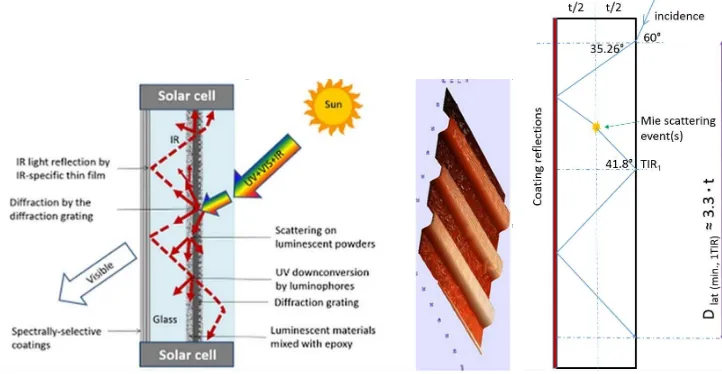
The application potential, role, and purpose of embedding the light-ray deflecting microstructures into the LSC-type waveguides of solar windows is illustrated in Figure 4. Detailed analysis of the potential of diffractive and scattering optics for improving the photon collection probability at solar cells has been reported in [20] and [77]. The roles of spectrally-selective backside-reflector coatings and especially the waveguiding panel thickness in ensuring the capability of longer-range transport of the incident photons within waveguides, even in the presence of significant scattering, is also illustrated in Figure 4.
Figure 4. Semitransparent hybrid concentrator-type PV windows utilising physical mechanisms other than luminescence for inducing waveguiding-type propagation towards edge-mounted solar cells. Diffractive grating-assisted ray deflection and Mie scattering processes at inorganic fluorescent pigment particles are useful for improving the photon collection probability at solar cell surfaces. Highly transparent micro-scale diffraction gratings designed for use in solar windows have been reported recently [20, 77]. The drawing in the right-hand side of figure illustrates the minimum lateral displacement of photons incident at 60° angle, and travelling within a coating-assisted concentrator structure, after only a single TIR event, enabled by internal ray deflection. The minimum internal lateral displacement of partially-trapped photons incident at this angle is shown to be more than triple the system thickness dimension.
5 of 23
propagating within arbitrary light-scattering media. The main finding reported was that, regardless of the location of the points of ray incidence, the system microstructure, or the angle of incidence, the mean photon propagation path-length inside the scattering medium is only governed by the system’s outer boundaries geometry. This invariance imposes fundamental limitations on the internal path lengths achievable within any realistic LSC containing inorganic pigments and/or waveguide surface or volume structure imperfections. Parameters in the Eq.(1) such as host and TIR are affected substantially by these waveguide imperfections, which are present invariably in realistic devices, especially in larger-scale concentrators containing multiple interfaces, where the internal propagation path lengths start to exceed the device thickness by several times, for the majority of incident photons. A particularly important result reported in [104] in relation to the theoretically-evaluated system-invariant mean value of the internal photon propagation path-length (Stheor) in systems containing scattering centres (in a simplified case of a single glass-air interface) is described by
<Stheor> = (4 ·V / ) · (n22 / n12), (2) where V / is the system’s volume-to-surface ratio, and n1 and n2 are the refractive indices of the outer and of the scattering regions, respectively. Therefore, in the case of rectangular slab-type waveguides representing the flat glass-based realistic inorganic pigment-containing LSC systems, this V / ratio represents the system thickness, and the mean partially-trapped photon path-length is then within several times the thickness, regardless of the details of internal microstructure. Noteably, this mean internal path length invariance has been shown to apply also to the scattering process strength. Structured systems with multiple glass-air interfaces have been shown to provide mean photon path lengths somewhat in excess of that predicted by Eq.(2), due to the increased probability of multiple internal reflections. Regardless of these fundamental limitations, collecting efficiently the photons at concentrator system edges, from the areas of incidence onto glass located within the range of several times the system thickness remains a valid option, which has been demonstrated graphically in [77], in the presence of strong scattering at micron-scale luminophore pigment particles. The relevance of scattering as a short-range photon collection mechanism in LSC has also been reported in [19, 20], and discussed in [78, 95].
The performance limits of luminescent solar concentrators with quantum dots in a selective-reflector-based optical cavity have been evaluated in [105], where the dependency of the optical concentration on the geometric gain has also been studied. It has been reported that the best optical concentration factor performance is achievable in systems with geometric gain of up to about 30, with further up-scaling of the device collection areas leading to diminishing returns in performance [105]. The analysis of optical losses in CuInS2-based nanocrystal LSC, in terms of balancing the absorption versus scattering has been reported in [106], where the estimates for the achievable optical efficiency are provided. Overall, the findings on efficiency limits and the limiting factors in LSC performance reported in multiple recent literature sources, in conjunction with the thermodynamic limitations applicable to solar concentrators, mean that further research efforts aimed at maximizing the photon collection probability over the areas of solar window aperture closest to the solar-cell locations, are necessary.
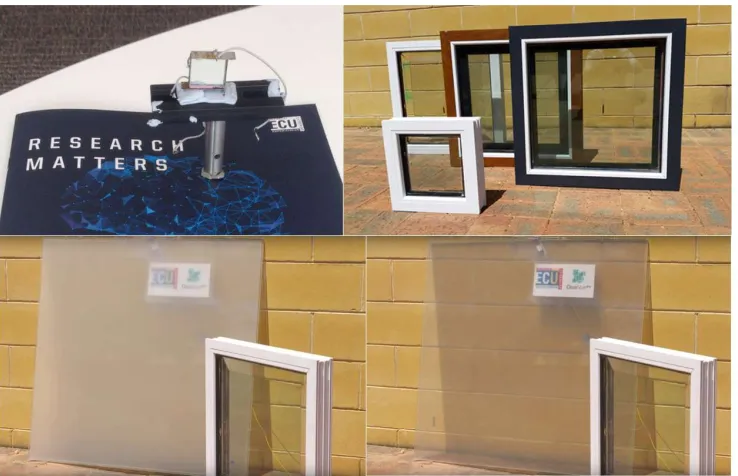
Figure 5. Transparency-controlled, self-powering PDLC-integrated “smart” solar window demonstration at Edith Cowan University (ECU) in Oct. 2014. A 200mm × 200mm hybrid concentrator-type solar window used four parallel-connected edge-mounted CuInSe2 modules of size 198mm x 25mm, the electric output of which was sufficient to control the embedded PDLC layer transparency within a broad transparency range [107]. .
A significant attention from multiple research groups has been directed during the recent years towards the development and demonstration of multiple window-integrated active transparency control technologies. Among these, noteable developments took place recently in the area of incorporating the photothermally switchable perovskites into window glazings [111], leading potentially to achieving substantial energy savings in buildings due to the glass transparency responding to the surface temperature changes, simultaneously with the strong energy generation potential provided by perovskite-based solar cell systems. Thermochromic and also dichroic materials-based approaches to controlling the glazing system transparency and/or apparent color in response to illumination level changes are also gaining momentum, as well as the emergent field of smart windows overall [112-115].
7 of 23
Figure 6. Solar window prototypes and demonstration experiments aimed at the visualisation of energy generation and use conducted at Edith Cowan University (ECU), Joondalup Campus (Perth, Australia), in 2016. A highly transparent framed BIPV window prototype of glass panel dimensions 500mm × 500mm was used to actively change the transparency state of a glass-integrated polymer-dispersed liquid crystal (PDLC) panel of 1m2 area [47]. .
Earliest (2011) all-inorganic high-transparency (> 90%) LSC prototypes integrated with Si cells (Fig. 6, top left) used a single luminophore-loaded 0.5mm interlayer connecting two 3mm-thick quartz plates. One of these plates was coated by a spectrally-selective multilayer optical coating which reflected practically all solar near-IR light at wavelengths above 720 nm. The visible red coloration over the bottom-side solar cell surface was due to this coating reflecting a part of visible far-red spectrum towards the cell. Later transparent solar window prototypes developed at ECU in subsequent years used various solar cell configurations and types, as well as internal micro- and macrostructures for improving the photon collection probability at solar cell surfaces, some of which are yet unpublished.
An area of organic materials-based BIPV and transparent solar windows development is undergoing rapid development currently, and new performance records are being demonstrated continually in the power conversion efficiency, thus offering a potentially strong competition to inorganics-based concentrator-type devices and other semitransparent BIPV. Very recently, new efficiency record was demonstrated (PCE up to 12.25%, in small-area devices), achieved by tuning of the chemical structure of organic photoactive materials. This is the highest certified efficiency of organic solar cells reported to date [116, 117], however, the degree of device transparency has not been explicitly specified. It is widely expected at present that the optical transparency, sample size, and environmental stability properties in transparent organic cells and future BIPV systems will continue to show improvements.
application of smart interconnected (5G) devices present demanding energy use requirements, which can be addressed by widespread BIPV generation.
4. Conclusions and Outlook
The practical integration of advanced solar energy-harvesting technologies into the various elements of urban landscapes, including the building windows, is rapidly becoming a mainstream trend. Substantial advances have been reported in the recent years both in the laboratory trials, and also in commercial demonstrations of the various semi-transparent solar cell types and solar window devices. A wide range of established semi-transparent PV and BIPV technologies exists currently, providing the architects and building designers with multiple choices regarding the balance between the system aesthetics, degree of transparency (or coloration type), and the power generating capacity. Multiple next-generation transparent solar-cell technologies, including dye-sensitized solar cells, patterned solar panels, organic polymer-based, and perovskite-based systems remain in active stages of development, and continue to demonstrate new milestones in efficiency. Highly transparent, and color-unbiased concentrator-type solar window systems are only beginning to make their entry into industry-wide acceptance, now providing a previously unavailable combination of up to 70% in total visible light transmission and power conversion efficiency near 2.5%, based on systems demonstrated in 2017.
Despite the fundamental trade-offs between the required control over the visual appearance, degree of transparency and the power generating capacity intrinsic to the design of advanced BIPV, their strong potential for transforming urban landscapes and providing substantial distributed generation capacity is certain. Developments in the materials science of advanced luminophores, coupled with novel designs of LSC-type semitransparent concentrator structures add continually to the possibilities of obtaining increased power conversion efficiencies. At the same time, substantial energy-saving potential also exists, provided by solar windows, which can also control the solar heat gain in buildings and the associated thermal insulation properties. The new trends in the local utilization of the energy generated in the distributed way by the building components include using advanced windows with active transparency control, which can contribute substantially to both the personnel comfort and climate control-related energy savings. It is currently expected that multiple commercial building-based trials of the latest transparent BIPV technologies will soon be conducted, uncovering their true practical applications potential.
Supplementary Materials: Video S1: ECU-ClearVue power generating window prototypes 2016.mp4. Author Contributions: All authors (M. V., M. N. A., and K. A.) have contributed to the conceptualization of this review article and data collection; M. V. analyzed the data and prepared the manuscript; all authors discussed the data, graphics, and the presentation; M. N. A. contributed substantially to the data curation and the original draft preparation; M. V. and K. A. further reviewed and edited the manuscript.
Funding: This research was funded by the Australian Research Council (grants LP130100130 and LP160101589) and Edith Cowan University.
Conflicts of Interest: The authors declare no conflict of interest. The funders had no role in the design of the study; in the collection, analyses, or interpretation of data; in the writing of the manuscript, or in the decision to publish the results.
References
1. L. Capuano, International Energy Outlook 2018 (IEO2018), published by the US Energy Information administration.
2. Chu, S.; Majumdar, A. Opportunities and challenges for a sustainable energy future. Nature2012, 488, 294– 303.
9 of 23
4. Poizot P.; Dolhem, F. Clean energy new deal for a sustainable world: from non-CO2 generating energy sources to greener electrochemical storage devices. Energy Environ. Sci.2011, 4, 2003–2019.
5. Cao, X.; Xilei, D. and Liu, J. Building energy-consumption status worldwide and the state-of-the-art technologies for zero-energy buildings during the past decade. Energy and Buildings2016, 128, 198-213. 6. Final Report of the High-Level Panel of the European Decarbonisation Pathways Initiative. 2018, published
by the European Commission, ISBN 978-92-79-96827-3, doi:10.2777/636.
7. Long, L.; Ye, H. How to be smart and energy efficient: a general discussion on thermochromic windows. Sci. Rep. 2014, 4, 6427.
8. Gao, Y.; Luo, H.; Zhang, Z.; Kang, L.; Chen, Z.; Du, J.; et al. Nanoceramic VO2 thermochromic smart glass: a review on progress in solution processing. Nano Energy2012, 1, 221–246.
9. Llordes, A., Garcia, G., Gazquez, J., Milliron, D. J. Tunable near-infrared and visible-light transmittance in nanocrystal-in-glass composites. Nature2013, 500, 323–326.
10. Raman, A.P., Anoma, M.A., Zhu, L., Rephaeli, E., Fan, S. Passive radiative cooling below ambient air temperature under direct sunlight. Nature2014, 515, 540–544.
11. Fu, Y.; Yang, J.; Su, Y. S.; Du, W.; Ma, Y. G. Daytime passive radiative cooler using porous alumina. Solar Energy Materials and Solar Cells2019, 191, 50–54.
12. Wang, J., Zhang, L., Yu, L., Jiao, Z., Xie, H., Lou, X.W., et al. A bi-functional device for self-powered electrochromic window and self-rechargeable transparent battery applications. Nat. Commun. 2014, 5, 4921. 13. Wang, S., Liu, M., Kong, L., Long, Y., Jiang, X., Yu, A. Recent progress in VO2 smart coatings: strategies to
improve the thermochromic properties. Prog. Mater. Sci.2016, 81, 1–54.
14. Torcellini, P., Pless, S., Deru, M., and Crawley, D. (2006) Zero Energy Buildings: A Critical Look at the Definition. National Renewable Energy Laboratory and Department of Energy, US.
15. Groth, R., Reichelt, W. Gold coated glass in the building industry. Gold Bulletin1974, 7(3), 62-68. 16. Lampert, C. M. Heat mirror coatings for energy conserving windows. Solar Energy Materials1981, 6(1),
1-41.
17. Dalapati, G. K., Kushwaha, A. K., Sharma, M., Suresh, V., Shannigrahi, S., Zhuk, S., and Masudy-Panah, S. Transparent heat regulating (THR) materials and coatings for energy saving window applications: Impact of materials design, micro-structural, and interface quality on the THR performance. Prog. Mater. Sci. 2018, 95, 42-131.
18. Rezaei, S.D., Shannigrahi, S. Ramakrishna, S. A review of conventional, advanced, and smart glazing technologies and materials for improving indoor environment. Sol. Energy Mater. Sol. Cells2017, 159, 26– 51.
19. Alghamedi, R., Vasiliev, M., Nur-E-Alam, M., and Alameh, K. Spectrally-Selective All-Inorganic Scattering Luminophores For Solar Energy-Harvesting Clear Glass Windows. Sci. Rep. 2014, 4, 6632.
20. Vasiliev, M., Alghamedi, R., Nur-E-Alam, M., and Alameh, K. Photonic microstructures for energy-generating clear glass and net-zero energy buildings. Sci. Rep. 2016, 6, 31831.
21. Rosenberg, V., Vasiliev, M., Alameh, K. (2017) A Spectrally Selective Luminescence Concentrator Panel with a Photovoltaic cell. Patent EP 2 726 920 B1.
22. Jelle, B. P.; Breivik, C. The path to the building integrated photovoltaics of tomorrow. Energy Procedia2012, 20, 78 – 87.
23. Debbarma, M.; Sudhakar, K.; Baredar, P. Comparison of BIPV and BIPVT: A review. Resource-Efficient Technologies2017, 3, 263-271.
24. Biyik, E.; Araz, M.; Hepbasli,A.; Shahrestani, M.; Yao, R.; Shao, L.; Essah, E.; Oliveira, A. C.; del Caño, T.; Rico, E.; Lechón, J. L.; Andrade, L.; Mendes, A.; Atlı, Y. B. A key review of building integrated photovoltaic (BIPV) systems. Engineering Science and Technology, an International Journal2017, 20, 833-858.
25. Tripathy, M.; Sadhu, P. K.; Panda, S. K. A critical review on building integrated photovoltaic products and their applications. Ren. Sust. En. Rev. 2016, 61, 451–465.
28. Building Integrated Photovoltaics: Product Overview for Solar Building Skins, Status Report 2017. Available Online https://www.seac.cc/wp-content/uploads/2017/11/171102_SUPSI_BIPV.pdf (Accessed 26 November 2018).
29. Attoye, D. E.; Aoul, K. A. T.; Hassan, A. A Review on Building Integrated Photovoltaic Façade Customization Potentials. Sustainability 2017, 9, 2287; doi:10.3390/su9122287.
30. Cornaro, C., Basciano, G., Puggioni, V.A., Pierro, M. Energy Saving Assessment of Semi-Transparent Photovoltaic Modules Integrated into NZEB. Buildings2017, 7, 9.
31. Shin, D. H. and Choi, S.-H. Recent Studies of Semitransparent Solar Cells. Coatings 2018, 8, 329; doi:10.3390/coatings8100329.
32. Lee, K.-T., Guo, L. J., and Park, H. J. Neutral- and Multi-Colored Semitransparent Perovskite Solar Cells. Molecules2016, 21, 475; doi:10.3390/molecules21040475.
33. The school with the largest solar facade in the world. Available online: https://phys.org/news/2017-02-school-largest-solar-facade-world.html (accessed on 26 November 2018).
34. Available online: https://www.forumforthefuture.org/greenfutures/articles/massive-solar-façade-swiss-convention-centre (accessed on 2 May 2018).
35. Barman, S.; Chowdhury, A.; Mathur, S.; Mathur, J. Assessment of the efficiency of window integrated CdTe based semitransparent photovoltaic module. Sustainable Cities and Society2018, 37, 250–262.
36. Weber, W.H.; Lambe, J. Luminescent greenhouse collector for solar radiation. Appl. Opt. 1976, 15, 2299– 2300.
37. Goetzberger, A.; Greube, W. Solar-energy conversion with fluorescent collectors. Appl. Phys.1977, 14, 123– 139.
38. Debije, M.G.; Verbunt, P.P.C. Thirty Years of Luminescent Solar Concentrator Research: Solar Energy for the Built Environment. Adv. Energy Mater. 2012, 2, 12–35.
39. Mazzaro, R., and Vomiero, A. The Renaissance of Luminescent Solar Concentrators: The Role of Inorganic Nanomaterials. Adv. Energy Mater. 2018, 1801903.
40. Reinders, A., Kishore, R., Slooff, L., and Eggink, W. Luminescent solar concentrator photovoltaic designs. Jpn. J. Appl. Phys. 2018, 57, 08RD10.
41. Meinardi, F.; Colombo, A.; A. Velizhanin, K. A.; Roberto Simonutti, R.; Lorenzon, M.; Beverina, L.; Viswanatha, R.; Klimov, V. I.; and Brovelli, S. Large-area luminescent solar concentrators based on ‘Stokes-shift-engineered’ nanocrystals in a mass-polymerized PMMA matrix. Nature Photonics2014, 8, 392-399. 42. Bergren, M. R.; Makarov, N. S.; Ramasamy, K.; Jackson, A.; Guglielmetti, R.; McDaniel, H.
High-Performance CuInS2 Quantum Dot Laminated Glass Luminescent Solar Concentrators for Windows. ACS Energy Lett. 2018, 3, 520−525.
43. Zhao, Y.; Meek, G. A.; Levine, B. G.; Lunt, R. R. Near-Infrared Harvesting Transparent Luminescent Solar Concentrators Adv. Optical Mater. 2014, 2, 606–611.
44. Traverse, C. J., Pandey, R., Barr, M. C., and Lunt, R. R. Emergence of highly transparent photovoltaics for distributed applications. Nature Energy2017, 2, 849-860.
45. Organics:---Materials and EnergyWorld Scientific Handbook of Organic Optoelectronic Devices, pp. 445-499 (2018) CHAPTER 11: Transparent Photovoltaics.
46. Husain, A. A. F.; Hasan, W. Z. W.; Shafie, S.; Hamidon, M. N.; Pandey, S. S. A review of transparent solar photovoltaic technologies. Renew. Sust. En. Rev. 2018, 94, 779–791.
47. Dalapati, G. K. and Sharma, M. 2019 Heat Regulating Materials for Energy Savings and Generation: Materials Design, Process and Implementation. CWP Publishing, Australia, in press. Online reference: https://centralwestpublishing.com/specialty-materials/.
48. Gates, B. (2015) Energy Innovation – Why We Need It and How to Get It. Published by Breakthrough
Energy Coalition, Available online at
https://www.google.com/url?sa=t&rct=j&q=&esrc=s&source=web&cd=1&cad=rja&uact=8&ved=2ahUKEw jQjvmfiaPeAhVWdCsKHVsMCbQQFjAAegQICRAC&url=https%3A%2F%2Fwww.gatesnotes.com%2F~ %2Fmedia%2FFiles%2FEnergy%2FEnergy_Innovation_Nov_30_2015.pdf%3Fla%3Den&usg=AOvVaw1V ZwJaefqQT1p4Qrm-UzYm
11 of 23
50. Avancis PowerMax Skala datasheet, Available online: https://www.avancis.de/en/products/powermaxr-skala-40/ (accessed on 5 December 2018).
51. Sunjoule Product Brochure by Asahi Glass Corp., p. 11. Available online: http://www.agc-solar.com/agc-solar-products/bipv.html (accessed on 5 December 2018).
52. Onyx Solar Amorphous Silicon PV Glass Specifications - high transparency. Available online: https://www.onyxsolar.com/product-services/technical-specifications (accessed on 5 December 2018). 53. Hanergy Product Manual 141129 Section 1.3.1 (2018), p. 11. Available online:
https://www.slideshare.net/RonaldKranenberg/hanergyproductbrochure141129 (accessed on 5 December 2018).
54. Solaronix Solar Cells brochure, Available online: http://solaronix.com/solarcells/ (accessed on 11 December 2018).
55. Vasiliev, M.; Alameh, K.; Nur-E-Alam, M. Spectrally-Selective Energy-Harvesting Solar Windows for Public Infrastructure Applications. Appl. Sci.2018, 8(6), 849; https://doi.org/10.3390/app8060849.
56. CdTe-based semitransparent BIPV products from Xiamen Solar First Energy Technology Co., Ltd., Available online: https://www.alibaba.com/product-detail/High-Transparent-Asi-frameless-CdTe-48W_60541808069.html (accessed on 11 December 2018).
57. Slooff, L. H.; Bende, E. E.; Burgers, A. R.; Budel, T.; Pravettoni, M.; Kenny, R. P.; E. D. Dunlop, E. D.; Büchtemann, A. A luminescent solar concentrator with 7.1% power conversion efficiency. Phys. Stat. Sol. (RRL)2008, 2, 257–259.
58. Tummeltshammer, C.; Taylor, A.; Kenyon, A. J.; Papakonstantinou, I. Losses in luminescent solar concentrators unveiled. Solar Energy Materials & Solar Cells2016, 144, 40–47.
59. Yang, C.; Lunt, R.R. Limits of visibly transparent luminescent solar concentrators. Adv. Opt. Mater.2017, 5, 1600851.
60. Wang, W.; Yan, C.; Lau, T.-K.; Wang, J.; Liu, K.; Fan, Y.; Lu, X.; Zhan, X. Fused Hexacyclic Nonfullerene Acceptor with Strong Near-Infrared Absorption for Semitransparent Organic Solar Cells with 9.77% Efficiency. Adv. Mater. 2017, 29, 1701308.
61. Chen, C.-C.; Dou, L.; Rui Zhu, R.; Chung, C.-H.; Song, T.-B.; Zheng, Y. B.; Hawks, S.; Li, G.; Weiss, P. S.; Yang, Y. Visibly Transparent Polymer Solar Cells Produced by Solution Processing. ACS Nano2012, 6, 8, 7185–7190.
62. Available online: https://www.justritestore.com.au/home/buy-velux-skylights-roof-windows-and-sun- tunnels-online/velux-skylights-for-sale-online/velux-skylights-openable-skylight/velux-skylights-solar-
powered-skylight-vss/velux-550-x-700mm-solar-opening-skylight/?gclid=EAIaIQobChMIydnS96qX3wIV1g0rCh3ZFgy2EAQYASABEgJEgfD_BwE (accessed on 11 December 2018).
63. Physee PowerWindow products, Available online: https://www.physee.eu/products (accessed on 11 December 2018).
64. GlassToPower Technology description, Available online: http://www.glasstopower.com/la-tecnologia-en/ (accessed on 12 December 2018).
65. Ito, S.; Chen, P.; Comte, P.; Nazeeruddin, M. K.; Liska, P.; Péchy, P.; Grätzel, M. Fabrication of Screen-Printing Pastes From TiO2 Powders for Dye-Sensitised Solar Cells. Prog. Photovolt: Res. Appl.2007, 15, 603– 612.
66. Lunt, R. R.; Bulovic, V. Transparent, near-infrared organic photovoltaic solar cells for window and energy-scavenging applications.Appl. Phys. Lett.2011, 98, 113305.
67. Bailie, C.D.; Christoforo, M. G.; Mailoa, J. P.; Bowring, A. R.; Unger, E. L.; Nguyen, W. H.; Burschka, J.; Pellet, N.; Lee, J. Z.; Grätzel, M.; Noufi, R.; Buonassisi, T.; Salleo, A.; McGehee, M. D. Semi-transparent perovskite solar cells for tandems with silicon and CIGS. Energy Environ. Sci.2015, 8, 956–63.
68. Roldán-Carmona, C.; Malinkiewicz, O.; Betancur, R.; Longo, G.; Momblona, C.; Jaramillo, F.; Camacho, L.; Bolink, H. J. High efficiency single-junction semitransparent perovskite solar cells.Energy Environ. Sci.2014, 7, 2968-2973.
69. Zhang , X.; Hägglund, C.; Johansson, M. B.; Sveinbjörnsson, K.; Johansson, E. M. J. Fine Tuned Nanolayered Metal/Metal Oxide Electrode for Semitransparent Colloidal Quantum Dot Solar Cells. Adv. Funct. Mater. 2016, 26, 1921–1929.
71. Qiu, L.; Liu, Z.; Ono, L. K.; Jiang, Y.; Son, D.-Y.; Hawash, Z.; He, S.; Qi, Y. Scalable Fabrication of Stable High Efficiency Perovskite Solar Cells and Modules Utilizing Room Temperature Sputtered SnO2 Electron Transport Layer. Adv. Funct. Mater. 2018, 1806779.
72. Oxford PV sets world record for perovskite solar cell. Available online: https://www.oxfordpv.com/news/oxford-pv-sets-world-record-perovskite-solar-cell (accessed on 24 January 2019).
73. Researchers show world-record 20.9% perovskite cell, new SSG process increasing stability. Available online: https://www.pv-magazine.com/2018/07/05/researchers-show-world-record-20-9-perovskite-cell-new-ssg-process-increasing-stability/ (accessed on 24 January 2019).
74. Wang, S.; Jiang, Y.; Juarez-Perez, E.-J.; Ono, L. K.; Qi, Y. Accelerated degradation of methylammonium lead iodide perovskites induced by exposure to iodine vapour. Nature Energy 2016, 2, 16195.
75. Soleimanioun, N.; Rani, M.; Sharma, S.; Kumar, A.; Tripathi, S. K. Binary metal zinc-lead perovskite built-in air ambient: Towards lead-less and stable perovskite materials. Solar Energy Materials and Solar Cells 2019, 191, 339–344.
76. Yan, X.; Hu, S.; Zhang, Y.; Li, H.; Sheng, C. Methylammonium acetate as an additive to improve performance and eliminate J-V hysteresis in 2D homologous organic-inorganic perovskite solar cells. Solar Energy Materials and Solar Cells 2019, 191, 283–289.
77. Vasiliev, M.; Alameh, K.; Badshah, M. A.; Kim, S.-M.; Nur-E-Alam, M. Semi-Transparent Energy-Harvesting Solar Concentrator Windows Employing Infrared Transmission-Enhanced Glass and Large-Area Microstructured Diffractive Elements. Photonics2018, 5(3), 25; doi:10.3390/photonics5030025. 78. Liu, H.; Li, S.; Chen, W.; Wang, D.; Li, C.; Wu, D.; Hao, J.; Zhou, Z.; Wang, X.; Wang, K. Scattering enhanced
quantum dots based luminescent solar concentrators by silica microparticles. Solar Energy Materials and Solar Cells 2018, 179, 380–385.
79. Leow, S. W.; Corrado, C.; Osborn, M.; Isaacson, M.; Alers, G.; Carter, S. A. Analyzing luminescent solar concentrators with front-facing photovoltaic cells using weighted Monte Carlo ray tracing. J. Appl. Phys. 2013, 113, 214510.
80. Corrado, C.; Leow, S. W.; Osborn, M.; Carbone, I.; Hellier, K.; Short, M.; Alers, G.; Carter, S. A. Power generation study of luminescent solar concentrator greenhouse. J. Renew. Sust. En. 2016, 8, 043502, doi: 10.1063/1.4958735.
81. Reinders, A.; Debije, M. G.; Rosemann, A. Measured Efficiency of a Luminescent Solar Concentrator PV Module Called Leaf Roof. IEEE J. Photovoltaics 2017, 7(6), 1663-1666.
82. Desmet, L.; Ras, A.J.M.; de Boer, D.K.G.; Debije, M.G. Monocrystalline silicon photovoltaic luminescent solar concentrator with 4.2% power conversion efficiency. Opt. Lett. 2012, 37, 3087–3089.
83. Wu, K.; Li, H.; Klimov, V. I. Tandem luminescent solar concentrators based on engineered quantum dots. Nature Photonics2018, 12, 105–110.
84. Meinardi, F.; Ehrenberg, S.; Dhamo, L.; Carulli, F.; Mauri, M.; Bruni, F.; Simonutti, R.; Kortshagen, U.; Brovelli, S. Highly efficient luminescent solar concentrators based on earth-abundant indirect-bandgap silicon quantum dots. Nature Photonics2017, 11, 1–10. DOI: 10.1038/nphoton.2017.5.
85. Aste, N.; Tagliabue, L. C.; Del Pero, C.; Testa, D.; Fusco, R. Performance analysis of a large-area luminescent solar concentrator module. Renewable Energy2015, 76, 330-337.
86. Xu, L.; Yao, Y.; Bronstein, N. D.; Li, L.; Alivisatos, A. P.; Nuzzo, R. G. Enhanced Photon Collection in Luminescent Solar Concentrators with Distributed Bragg Reflectors. ACS Photonics, 2016, 3, 278−285. 87. Van Sark, W. G. J. H. M. Will luminescent solar concentrators surpass the 10% device efficiency limit?SPIE
Newsroom 2014, 9178, 1. DOI: 10.1117/2.1201409.005622.
88. Moraitisa, P.; Schroppb, R. E. I.; van Sark, W.G.J.H.M. Nanoparticles for Luminescent Solar Concentrators - A review. Optical Materials2018, 84, 636–645.
89. Krumera, Z.; van Sark, W. G. J. H. M.; Schroppc, R. E. I.; de Mello Donegá, C. Compensation of self-absorption losses in luminescent solar concentrators by increasing luminophore concentration. Solar Energy Materials and Solar Cells2017, 167, 133–139.
90. Zhao, Y.; Lunt, R.R. Transparent luminescent solar concentrators for large-area solar windows enabled by massive stokes-shift nanocluster phosphors. Adv. Energy Mater. 2013, 3, 1143–1148.
91. Debije, M.; Semiconductor solution. Nature Photonics2017, 11, 143-144.
13 of 23
93. Erickson, C. S.; Bradshaw, L. R.; McDowall, S.; Gilbertson, J. D.; Gamelin, D. R.; Patrick, D. L. Zero-Reabsorption Doped-Nanocrystal Luminescent Solar Concentrators. ACS Nano2014, 8(4), 3461-3467. 94. Li, H.; Wu, K.; Lim, J.; Song, H.-J.; Klimov, V.I. Doctor-blade deposition of quantum dots onto standard
window glass for low-loss large-area luminescent solar concentrators. Nat. Energy2016, 16157.
95. Klimov, V. I.; Baker, T. A.; Lim, J.; Velizhanin, K. A.; McDaniel, H. Quality Factor of Luminescent Solar Concentrators and Practical Concentration Limits Attainable with Semiconductor Quantum Dots. ACS Photonics2016, 3, 1138−1148.
96. Zhao, H.; Zhou, Y.; Benettia, D.; Ma, D.; Rosei, F. Perovskite quantum dots integrated in large-area luminescent solar concentrators. Nano Energy 2017, 37, 214–223.
97. Gong, X.; Ma, W.; Li, Y.; Zhong, L.; Li, W.; Zhao, X. Fabrication of high-performance luminescent solar concentrators using N-doped carbon dots/PMMA mixed matrix slab. Organic Electronics2018, 63, 237–243. 98. Ha, S.-J.; Kang, J.-H.; Choi, D. H.; Nam, S. K.; Reichmanis, E.; Moon, J. H. Upconversion-Assisted
Dual-Band Luminescent Solar Concentrator Coupled for High Power Conversion Efficiency Photovoltaic Systems. ACS Photonics2018, 5, 3621−3627.
99. Connell, R.; Ferry, V. E.; Integrating Photonics with Luminescent Solar Concentrators: Optical Transport in the Presence of Photonic Mirrors. J. Phys. Chem. C2016, 120, 20991−20997.
100. Liu, X.; Wu, Y.; Hou, X.; Liu, H. Investigation of the Optical Performance of a Novel Planar Static PV Concentrator with Lambertian Rear Reflectors. Buildings2017, 7, 88; doi:10.3390/buildings7040088. 101. Rau, U.; Paetzold, U. W.; Kirchartz, T. Thermodynamics of light management in photovoltaic devices. Phys.
Rev. B2014, 90, 035211.
102. Shatz, N.; Bortz, J.; Winston, R. Thermodynamic efficiency of solar concentrators. Optics Express 2010, 18(S1), A5-A16.
103. E. Yablonovitch, Thermodynamics of the fluorescent planar concentrator. J. Opt. Soc. Am.1980, 70(11), 1362–1363.
104. Savo, R.; Pierrat, R.; Najar, U.; Carminati, R.; Rotter, S.; Gigan, S. Observation of mean path length invariance in light-scattering media. Science2017, 358, 765–768.
105. Song, H.-J.; Jeong, B. G.; Lim, J.; Lee, D. C.; Wan Ki Bae, W. K.; Klimov, V. I. Performance Limits of Luminescent Solar Concentrators Tested with Seed/Quantum-Well Quantum Dots in a Selective-Reflector-Based Optical Cavity. Nano Lett. 2018, 18, 395−404.
106. Sumner, R.; Eiselt, S.; Kilburn, T. B.; Erickson, C.; Carlson, B.; Gamelin, D. R.; McDowall, S.; Patrick, D. L. Analysis of Optical Losses in High-Efficiency CuInS2-Based Nanocrystal Luminescent Solar Concentrators: Balancing Absorption versus Scattering. J. Phys. Chem. C2017, 121, 3252−3260.
107. Vasiliev, M.; Alameh, K.; Rosenberg, V. A device for generating electric energy. 2016 Patent Appl. US20160204297A1.
108. Mateen, F.; Oh, H.; Jung, W.; Lee, S. Y.; Kikuchi, H.; Hong, S.-K.; Polymer dispersed liquid crystal device with integrated luminescent solar concentrator. Liquid Crystals2018, 45(4), 498–506.
109. Sol, J. A. H. P.; Timmermans, G. H.; van Breugel, A. J.; Schenning, A. P. H. J.; Debije, M. G. Multistate Luminescent Solar Concentrator “Smart” Windows. Adv. Energy Mater. 2018, 8, 1702922.
110. Fernandes, M.; Freitas, V.; Pereira, S.; Leones, R.; Silva, M. M.; Carlos, L. D.; Fortunato, E.; Rute A. S. Ferreira, R. A. S.; Rego, R.; Bermudez, V. Z.; Luminescent Electrochromic Devices for Smart Windows of Energy-Efficient Buildings. Energies2018, 11, 3513; doi:10.3390/en11123513.
111. Wheeler, L. M.; Moore, D. T.; Ihly, R.; Stanton, N. J.; Miller, E. M.; Tenent, R. C.; Blackburn, J. L.; Neale, N. R. Switchable photovoltaic windows enabled by reversible photothermal complex dissociation from methylammonium lead iodide. Nature Commun. 2017, 8, 1722.
112. Zhou, J.; Gao, Y.; Zhang, Z.; Luo, H.; Cao, C.; Chen, Z.; Dai, L.; Liu, X. VO2 thermochromic smart window for energy savings and generation. Sci. Rep.2013, 3, 3029.
113. Garshasbi, S.; Santamouris, M. Using advanced thermochromic technologies in the built environment: Recent development and potential to decrease the energy consumption and fight urban overheating. Solar Energy Materials and Solar Cells2019, 191, 21–32.
114. Casini, M. Active dynamic windows for buildings: A review. Renew. En. 2018, 119, 923-934.
116. Fan, B.; Du, X.; Liu, F.; Zhong, W.; Ying, L.; Xie, R.; Tang, X.; An, K.; Xin, J.; Li, N.; Ma, W.; Brabec, C. J.; Huang, F.; Cao, Y. Fine-tuning of the chemical structure of photoactive materials for highly efficient organic photovoltaics. Nature Energy2018, 3, 1051-1058.
![Figure 3. Highly transparent solar windows and their application areas. The solar window prototypes shown installed into an off-grid bus stop in Melbourne (Australia) have been described in [55]; other solar windows shown in the right-hand side of the imag](https://thumb-us.123doks.com/thumbv2/123dok_us/8006135.1330353/6.612.110.502.270.457/figure-transparent-application-prototypes-installed-melbourne-australia-described.webp)