Predicting Responses to Microblog Posts
Yoav Artzi∗
Computer Science & Engineering University of Washington
Seattle, WA, USA
Patrick Pantel, Michael Gamon Microsoft Research One Microsoft Way Redmond, WA, USA
{ppantel,mgamon}@microsoft.com
Abstract
Microblogging networks serve as vehicles for reaching and influencing users. Predicting whether a message will elicit a user response opens the possibility of maximizing the viral-ity, reach and effectiveness of messages and ad campaigns on these networks. We propose a discriminative model for predicting the like-lihood of a response or a retweet on the Twit-ter network. The approach uses features de-rived from various sources, such as the lan-guage used in the tweet, the user’s social net-work and history. The feature design process leverages aggregate statistics over the entire social network to balance sparsity and infor-mativeness. We use real-world tweets to train models and empirically show that they are ca-pable of generating accurate predictions for a large number of tweets.
1 Introduction
Microblogging networks are increasingly evolving into broadcasting networks with strong social as-pects. The most popular network today, Twitter, re-ported routing 200 million tweets (status posts) per day in mid-2011. As the network is increasingly used as a channel for reaching out and marketing to its users, content generators aim to maximize the impact of their messages, an inherently challeng-ing task. However, unlike for conventionally pro-duced news, Twitter’s public network allows one to observe how messages are reaching and influencing users. One such direct measure of impact are mes-sage responses.
∗
This work was conducted at Microsoft Research.
In this work, we describe methods to predict if a given tweet will elicit a response. Twitter provides two methods to respond to messages: replies and retweets (re-posting of a message to one’s follow-ers). Responses thus serve both as a measure of dis-tribution and as a way to increase it. Being able to predict responses is valuable for any content gener-ator, including advertisers and celebrities, who use Twitter to increase their exposure and maintain their brand. Furthermore, this prediction ability can be used for ranking, allowing the creation of better op-timized news feeds.
To predict if a tweet will receive a response prior to its posting we use features of the individual tweet together with features aggregated over the entire so-cial network. These features, in combination with historical activity, are used to train a prediction model.
2 Related Work
The public nature of Twitter and the unique char-acteristics of its content have made it an attractive research topic over recent years. Related work can be divided into several types:
how users react to events on social media. There also has been extensive work on modeling conver-sational interactions on Twitter (Honeycutt and Her-ring, 2009; Boyd et al., 2010; Ritter et al., 2010; Danescu-Niculescu-Mizil et al., 2011). Our work builds on these findings to predict response behavior on a large scale.
Mining Twitter Social media has been used to de-tect events (Sakaki et al., 2010; Popescu and Pennac-chiotti, 2010; Popescu et al., 2011), and even predict their outcomes (Asur and Huberman, 2010; Culotta, 2010). Similarly to this line of work, we mine the social network for event prediction. In contrast, our focus is on predicting events within the network.
Response Prediction There has been significant work addressing the task of response prediction in news articles (Tsagkias et al., 2009; Tsagkias et al., 2010) and blogs (Yano et al., 2009; Yano and Smith, 2010; Balasubramanyan et al., 2011). The task of predicting responses in social networks has been in-vestigated previously: Hong et al. (2011) focused on predicting responses for highly popular items, Rowe et al. (2011) targeted the prediction of conversations and their length and Suh et al. (2010) and Petrovic et al. (2011) predicted retweets. In contrast, our work targets tweets regardless of their popularity and at-tempts to predict both replies and retweets. Further-more, we present a scalable method to use linguistic lexical features in discriminative models by leverag-ing global network statistics. A related task to ours is that of response generation, as explored by Ritter et al. (2011). Our work complements their approach by allowing to detect when the generation of a re-sponse is appropriate. Lastly, the task of predicting the spread of hashtags in microblogging networks (Tsur and Rappoport, 2012) is also closely related to our work and both approaches supplement each other as measures of impact.
Ranking in News Feeds Different approaches were suggested for ranking items in social media (Das Sarma et al., 2010; Lakkaraju et al., 2011). Our work provides an important signal, which can be in-corporated into any ranking approach.
3 Response Prediction on Twitter
Our goal is to learn a functionf that maps a tweet
xto a binary valuey ∈ {0,1}, whereyindicates if
xwill receive a response. In this work we make no distinction between different kinds of responses.
In addition tox, we assume access to a social net-workS, which we view as a directed graphhU, Ei. The set of verticesU represents the set of users. For eachu0, u00 ∈ U, hu0, u00i ∈ E if and only if there exists afollowingrelationship fromu0tou00.
For the purpose of defining features we denotext as the text of the tweetxandxu ∈U the user who postedx. For training we assume access to a set of
nlabeled examples{hxi, yii : i = 1. . . n}, where the label indicates whether the tweet has received a response or not.
3.1 Features
For prediction we represent a given tweetxusing six feature families:
Historical Features Historical behavior is often strong evidence of future trends. To account for this information, we compute the following features: ra-tio of tweets by xu that received a reply, ratio of tweets byxuthat were retweeted and ratio of tweets byxuthat received both a reply and retweet.
Social Features The immediate audience of a user
xu is his followers. Therefore, incorporating social features into our model is likely to contribute to its prediction ability. For a user xu ∈ U we include features for the number of followers (indegree inS), the number of usersxufollows (outdegree inS) and the ratio between the two.
Aggregate Lexical Features To detect lexical items that trigger certain response behavior we de-fine features for all bigrams and hashtags in our set of tweets. To avoid sparsity and maintain a manage-able feature space we compress the features using the labels: for each lexical iteml we define Rl to be the set of tweets that includeland received a re-sponse, andNl to be the set of tweets that containl and received no response. We then define the inte-gernto be the rounding of|Nl|
|Rl|to the nearest integer.
We use this process separately for bigrams and hash-tags, creating separate sets of aggregate features.
Local Content Features We introduce 45 features to capture how the content ofxtinfluences response behavior, including features such as the number of stop words and the percentage of English words. In addition we include features specific to Twitter, such as the number of hash tags and user references.
Posting Features Past analysis of Twitter showed that posting time influences response potential (Pear Analytics, 2009). To examine temporal influences, we include features to account for the user’s local time and day of the week whenxwas created.
Sentiment Features To measure how sentiment influences response behavior we define features that count the number of positive and negative sentiment words inxt. To detect sentiment words we use a pro-prietary Microsoft lexicon of 7K positive and nega-tive terms.
4 Evaluation
4.1 Learning Algorithm
We experimented with two different learning al-gorithms: Multiple Additive Regression-Trees (MART) (Wu et al., 2008) and a maximum entropy classifier (Berger et al., 1996). Both provide fast classification, a natural requirement for large-scale real-time tasks.
4.2 Dataset
[image:3.612.315.526.65.153.2]In our evaluation we focus on English tweets only. Since we use local posting time in our features, we filtered users whose profile did not contain location information. To collect Tweeter messages we used the entire public feed of Twitter (often referred to as the Twitter Firehose). We randomly sampled 943K tweets from one week of data. We allowed an ex-tra week for responses, giving a response window of two weeks. The majority of tweets in our set (90%) received no response. We used 750K tweets for training and 188K for evaluation. A separate data set served as a development set. For the computation of aggregate lexical features we used 186M tweets from the same week, resulting in 14M bigrams and 400K hash tags. To compute historical features, we sampled 2B tweets from the previous three months.
Figure 1: Precision-recall curves for predicting that a tweet will get a response. The marked area highlights the area of the curve we focus on in our evaluation.
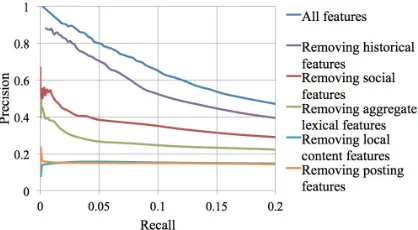
Figure 2: Precision-recall curves with increasing number of features removed for the marked area in Figure 1. For each curve we removed one additional feature set from the one above it.
4.3 Results
Our evaluation focuses on precision-recall curves for predicting that a given tweet will get a response. The curves were generated by varying the confi-dence measure threshold, which both classifiers pro-vided. As can be seen in Figure 1, MART outper-forms the maximum entropy model. We can also see that it is hard to predict response behavior for most tweets, but for a large subset we can provide a rela-tively accurate prediction (highlighted in Figure 1). The rest of our analysis focuses on this subset and on results based on MART.
[image:3.612.315.524.205.320.2]lo-cal content features further decreases performance. At this point, removing posting time features is not influential. Following the removal of posting time features, the model includes only sentiment features.
5 Discussion and Conclusion
The first trend seen by removing features is that local content matters less, or at least is more complex to capture and use for response prediction. Despite the influence of chronological trends on posting behav-ior on Twitter (Pear Analytics, 2009), we were un-able to show influence of posting time on response prediction. Historical features were the most promi-nent in our experiments. Second were social fea-tures, showing that developing one’s network is crit-ical for impact. The third most prominent set of fea-tures, aggregate lexical feafea-tures, shows that users are sensitive to certain expressions and terms that tend to trigger responses.
The natural path for future work is to improve per-formance using new features. These may include clique-specific language features, more properties of the user’s social network, mentions of named enti-ties and topics of tweets. Another direction is to dis-tinguish between replies and retweets and to predict the number of responses and the length of conversa-tions that a tweet may generate. There is also po-tential in learning models for the prediction of other measures of impact, such as hashtag adoption and inclusion in “favorites” lists.
Acknowledgments
We would like to thank Alan Ritter, Bill Dolan, Chris Brocket and Luke Zettlemoyer for their sug-gestions and comments. We wish to thank Chris Quirk and Qiang Wu for providing us with access to their learning software. Thanks to the reviewers for the helpful comments.
References
S. Asur and B.A. Huberman. 2010. Predicting the future with social media. InProceedings of the International Conference on Web Intelligence and Intelligent Agent Technology.
E. Bakshy, J. M. Hofman, W. A. Mason, and D. J. Watts. 2011. Everyone’s an influencer: quantifying influence
on twitter. InPeoceedings of the ACM International Conference on Web Search and Data Mining.
R. Balasubramanyan, W.W. Cohen, D. Pierce, and D.P. Redlawsk. 2011. What pushes their buttons? predict-ing comment polarity from the content of political blog posts. InProceedings of the Workshop on Language in Social Media.
Adam L. Berger, Vincent J. Della Pietra, and Stephen A. Della Pietra. 1996. A maximum entropy approach to natural language processing. Computational Linguis-tics.
D. Boyd, S. Golder, and G. Lotan. 2010. Tweet, tweet, retweet: Conversational aspects of retweeting on twit-ter. InProceedings of the International Conference on System Sciences.
M. Cha, H. Haddadi, F. Benevenuto, and K.P. Gummadi. 2010. Measuring user influence in twitter: The million follower fallacy. InProceedings of the International AAAI Conference on Weblogs and Social Media. A. Culotta. 2010. Towards detecting influenza epidemics
by analyzing twitter messages. InProceedings of the Workshop on Social Media Analytics.
C. Danescu-Niculescu-Mizil, M. Gamon, and S. Dumais. 2011. Mark my words!: linguistic style accommoda-tion in social media. In Proceedings of the Interna-tional Conference on World Wide Web.
A. Das Sarma, A. Das Sarma, S. Gollapudi, and R. Pan-igrahy. 2010. Ranking mechanisms in twitter-like fo-rums. InProceedings of the ACM International Con-ference on Web Search and Data Mining.
C. Honeycutt and S.C. Herring. 2009. Beyond mi-croblogging: Conversation and collaboration via twit-ter. InProceedings of the International Conference on System Sciences.
L. Hong, O. Dan, and B. D. Davison. 2011. Predict-ing popular messages in twitter. InProceedings of the International Conference on World Wide Web. H. Lakkaraju, A. Rai, and S. Merugu. 2011. Smart
news feeds for social networks using scalable joint la-tent factor models. InProceedings of the International Conference on World Wide Web.
Pear Analytics. 2009. Twitter study.
S. Petrovic, M. Osborne, and V. Lavrenko. 2011. Rt to win! predicting message propagation in twitter. In
Proceedings of the International AAAI Conference on Weblogs and Social Media.
A.M. Popescu and A. Jain. 2011. Understanding the functions of business accounts on twitter. In Proceed-ings of the International Conference on World Wide Web.
A.M. Popescu and M. Pennacchiotti. 2011. Dancing with the stars, nba games, politics: An exploration of twitter users response to events. InProceedings of the International AAAI Conference on Weblogs and Social Media.
A.M. Popescu, M. Pennacchiotti, and D. Paranjpe. 2011. Extracting events and event descriptions from twit-ter. In Proceedings of the International Conference on World Wide Web.
Y. Qu, C. Huang, P. Zhang, and J. Zhang. 2011. Mi-croblogging after a major disaster in china: a case study of the 2010 yushu earthquake. InProceedings of the ACM Conference on Computer Supported Co-operative Work.
A. Ritter, C. Cherry, and B. Dolan. 2010. Unsupervised modeling of twitter conversations. InProceedings of the Annual Conference of the North American Chapter of the Association for Computational Linguistics. A. Ritter, C. Cherry, and B. Dolan. 2011. Data-driven
response generation in social media. InProceedings of the Conference on Empirical Methods in Natural Language Processing.
D. Romero, W. Galuba, S. Asur, and B. Huberman. 2011. Influence and passivity in social media. Machine Learning and Knowledge Discovery in Databases, pages 18–33.
M. Rowe, S. Angeletou, and H. Alani. 2011. Predicting discussions on the social semantic web. In Proceed-ings of the Extended Semantic Web Conference. T. Sakaki, M. Okazaki, and Y. Matsuo. 2010.
Earth-quake shakes twitter users: real-time event detection by social sensors. InProceedings of the International Conference on World Wide Web.
B. Suh, L. Hong, P. Pirolli, and E. H. Chi. 2010. Want to be retweeted? large scale analytics on factors impact-ing retweet in twitter network. InProceedings of the IEEE International Conference on Social Computing. M. Tsagkias, W. Weerkamp, and M. De Rijke. 2009.
Predicting the volume of comments on online news stories. InProceedings of the ACM Conference on In-formation and Knowledge Management.
M. Tsagkias, W. Weerkamp, and M. De Rijke. 2010. News comments: Exploring, modeling, and online prediction. Advances in Information Retrieval, pages 191–203.
O. Tsur and A. Rappoport. 2012. What’s in a hash-tag?: content based prediction of the spread of ideas in microblogging communities. InProceedings of the ACM International Conference on Web Search and Data Mining.
Q. Wu, C.J.C. Burges, K.M. Svore, and J. Gao. 2008. Ranking, boosting, and model adaptation. Tecnical Report, MSR-TR-2008-109.
S. Wu, J.M. Hofman, W.A. Mason, and D.J. Watts. 2011. Who says what to whom on twitter. InProceedings of the International Conference on World Wide Web. T. Yano and N.A. Smith. 2010. Whats worthy of
com-ment? content and comment volume in political blogs.
Proceedings of the International AAAI Conference on Weblogs and Social Media.