Urdu Word Segmentation
Nadir Durrani Sarmad Hussain
Institute for NLP Center for Research in Urdu Language Processing Universität Stuttgart National University of Computer and Emerging Sciences
[email protected] [email protected]
Abstract
Word Segmentation is the foremost obligatory task in almost all the NLP applications where the initial phase requires tokenization of input into words. Urdu is amongst the Asian languages that face word segmenta-tion challenge. However, unlike other Asian languages, word segmentation in Urdu not only has space omission errors but also space insertion errors. This paper dis-cusses how orthographic and linguistic features in Urdu trigger these two problems. It also discusses the work that has been done to tokenize input text. We employ a hybrid solution that performs an n-gram ranking on top of rule based maximum matching heuristic. Our best technique gives an error detection of 85.8% and over-all accuracy of 95.8%. Further issues and possible fu-ture directions are also discussed.
1 Introduction
All language processing applications require input text to be tokenized into words for further processing. Languages like English normally use white spaces or punctuation marks to identify word boundaries, though with some complications, e.g. the word “e.g.” uses a period in between and thus the period does not indicate a word boundary. However, many Asian languages like Thai, Khmer, Lao and Dzongkha do not have word boundaries and thus do not use white space to consistently mark word endings. This makes the process of tokenization of input into words for such languages very challenging.
Urdu is spoken by more than 100 million people, mostly in Pakistan and India1. It is an Indo-Aryan language, written using Arabic script from right to left, and Nastalique writing style (Hussain, 2003).
1
Ethnologue.com
http://www.ethnologue.com/14/show_language.asp?code=UR D
Nastalique is a cursive writing system, which also does not have a concept of space. Thus, though space is used in typing the language, it serves other purposes, as discussed later in this paper. This en-tails that space cannot be used as a reliable delimi-ter for words. Therefore, Urdu shares the word segmentation challenge for language processing, like other Asian languages.
This paper explains the problem of word segmen-tation in Urdu. It gives details of work done to investigate linguistic typology of words and moti-vation of using space in Urdu. The paper then presents an algorithm developed to automatically process the input to produce consistent word seg-mentation, and finally discusses the results and future directions.
2 Urdu Writing System
Urdu is written in cursive Arabic script. Characters in general join with the neighbors within a word and in doing so acquire different shapes. Logically, a character can acquire up to four shapes, i.e. ini-tial, medial, final position in a connected sequence or an isolated form. The characters having this four-way shaping are known as joiners. However, another set of characters only join with characters before them but do not join with character after them, and are termed as non-joiners. The non-joiners only have final and isolated forms. For example Arabic Letter Farsi Yeh ی is a joiner and has four shapes ﯾ, ي, ی and ی respectively and Arabic letter Dal د is a non-joiner and has two forms د and د only. The shape that these characters acquire depends upon the context.
Table 1 lists the orthographic rules that Urdu cha-racters follow. For example, the table shows that in the middle of a word, if the character is a non-joiner, it acquires final shape when following a
joiner and isolated shape when following a non-joiner. This joining behavior results in formation of multiple connected portions within a word, each called a ligature.
Table 1: Orthographic Rules for Urdu
The concept of space as a word boundary marker is not present in Urdu writing. As an Urdu learner, a person is not taught to leave a space between words, but only to generate correct shaping while writing. Thus, the concept of space is only learnt later on when the person learns how to use a com-puter. However, space is introduced as a tool to control the correct letter shaping and not to consis-tently separate words. For example, the native speaker learns to insert a space within the word
دنم ترورض (“needy”) to generate the correct shape
of ت. Without space it appears as دنمترورض which is visually incorrect. On contrary, the user finds it unnecessary to insert a space between the two words زکرمودرا (“Urdu Center”), because the cor-rect shaping is produced automatically as the first word ends with a non-joiner. Therefore زکرمودرا
andزکرم ودرا look identical.
Though space character is not present in Urdu, with increasing usage of computer it is now being used, both to generate correct shaping (as dis-cussed above) and also to separate words (a habit being carried over to Urdu from English literate computer users). This makes space an unreliable cue for word boundary. The problem is further ob-fuscated by the lack of a clear definition of a work in Urdu in some contexts. The next section dis-cusses these issues.
3 Segmentation Issues in Urdu Text
The segmentation challenges can be divided into two categories, challenges caused due to joiner and non-joiner characters.
3.1 Space Omission
As discussed, for words ending with non-joiners correct shaping is generated even when space is not typed and thus, many times a user omits the space. Though there is no visible implication, from the perspective of computational processing not typing a space merges current word with the next word. Figure 1 below illustrates an example, where the phrase has eight words (or tokens) each ending with a non-joiner and thus the whole phrase can be written without a space and is still visibly same and equally readable.
اﮩک ﮯن رگوڈ ريش دمحا ردص ﮯک ﮯلفاق
(a)
اﮩکﮯنرگوڈريشدمحاردصﮯکﮯلفاق
(b)
Figure 1: All Words Ending with Non-Joiners (a) with Spaces, (b) without Spaces between Words
(“Troop Leader Ahmed Sher Dogar Said”)
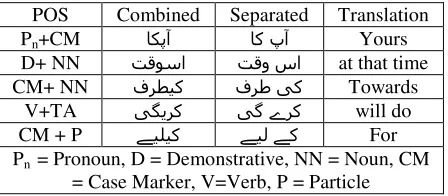
Another frequent set of space omissions are caused due to variation in the definition of a word in Urdu. There are certain function words in Urdu which may be combined with other function words and content words by some writers but may be written separately by others. Shape variation may also occur in some of these cases, but is overlooked by the writers. Table 2 gives some examples of such cases. Though the merged form is not considered correct diction, it is still frequently used and thus has to be handled. It is not considered spelling error but a writing variation.
POS Combined Separated Translation
Pn+CM اکپآ اک پآ Yours
D+ NN تقوسا تقو سا at that time
CM+ NN فرطيک فرط یک Towards
V+TA یگﯾرک یگ ےرک will do
CM + P ﮯيليک ﮯيل ﮯک For
[image:2.612.316.540.502.600.2]Pn = Pronoun, D = Demonstrative, NN = Noun, CM = Case Marker, V=Verb, P = Particle
Table 2: Multiple Words Written in Connected Form Causing Shaping Changes
Due to reasonable frequency of such cases, these may be considered as acceptable alternatives, and thus Urdu word segmentation system would need to deal with both forms and consider them equiva-lent. This process is productively applicable and
Word J-Shape Example NJ-Shape Example
Start I دجسم Is لاجد
Middle
M after J هرمن F after J ردنب
I after NJ ابمد Is after J ردان
End
F after J مجع F after J دنب
Is after NJ ماک Is after NJ در J = Joiners, NJ = Non-Joiners
not limited to a few pre-determined cases. Addi-tional complication in the process arises from the fact that in some cases (last two cases in Table 2) the spellings also change when two words are writ-ten in combined form, due to the way these charac-ters are encoded. Urdu considers ی and ے both logically same characters at a certain level, though with different shapes to indicated different vowels (Hussain, 2004). In combined form they render the same shape. However, Unicode terms ے as a non-joiner with no medial shape. Thus, the Urdu writ-ers use ی to generate the medial position of ے in combined form.
3.2 Space Insertion
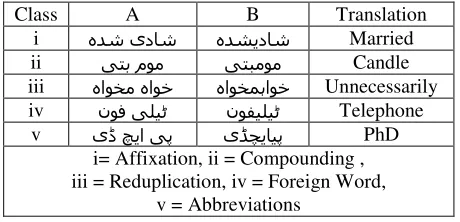
When multiple morphemes are juxtaposed within a word, many of them tend to retain their shaping as separate ligatures. If ending characters are joiners, space is usually inserted by writers to prevent them from joining and thus to retain the separate ligature identity. This causes an extra space within a word. Though this creates the visually acceptable form, it creates two tokens from a single word in the con-text of its processing. If the writers do not type a space between these two morphemes within a word they would join and create a visually incorrect shape. Such examples are common in Urdu2. Few of these cases are given in Table 3.
Class A B Translation
i هدش یداش هدشﯾداش Married
ii یتب موم یتبموم Candle
iii هاوخم هاوخ هاوخمﮨاوخ Unnecessarily
iv نوف یليﭨ نوفيليﭨ Telephone
v یڈ چﯾا یپ یﮉچﯾايپ PhD
i= Affixation, ii = Compounding , iii = Reduplication, iv = Foreign Word,
v = Abbreviations
Table 3: (A) Separated Form (Correct Shaping, but Two Tokens), (B) Combined Form (Erroneous
Shaping, with one Token)
As categorized in Table 3, the space insertion problem is caused due to multiple reasons. Data analyzed shows that space is inserted (i) to keep affixes separate from the stem, (ii) in some cases,
2
Though Unicode recommends using Zero Width Non-Joiner character in these context, this is not generally known by Urdu typists and thus not practiced; Further, this character is not available on most Urdu keyboards.
to keep two words compounded together from vi-sually merging, (iii) to keep reduplicated words from combining, (iv) to enhance readability of some foreign words written in Urdu, and (v) to keep English letters separate and readable when English abbreviations are transliterated.
3.3 Extent of Segmentation Issues in Urdu
In an earlier work on Urdu spell checking (Naseem and Hussain, 2007) report that a significant number of spelling errors3 are due to irregular use of space, as discussed above. The study does a spelling check of an Urdu corpus. The errors reported by the spelling checker are manually analyzed. A to-tal of 975 errors are found and of which 736 errors were due to irregular use of space (75.5%) and 239 errors are non-space-related errors (24.5%). Of the space related errors, majority of errors (672 or 70% of total errors) are due to space omission and 53 errors (5%) were due to space insertion. Thus irre-gular use of space causes an extremely high per-centage of all errors and has to be addressed for all language processing applications for Urdu.
A study of Urdu words was also conducted as part of the current work. Text was used from popular Urdu online news sites (www.bbc.co.uk/urdu and http://search.jang.com.pk/). A data of 5,000 words from both corpora was observed and space inser-tion and omission cases were counted. These counts are given in Table 4. Counts for Space In-sertion are sub-divided into the four categories identified earlier.
Problem BBC Jang Total
Space Omission 373 563 936
Space Insertion
Affixation 298 467 765
Reduplication 52 76 128
Compounding 133 218 351
Abbreviation 263 199 462
[image:3.612.71.301.434.545.2]Total 1119 1523 2642
Table 4: Space Omission and Insertion Counts from Online BBC and Jang Urdu News Websites
The data shows that a significantly high percentage of errors related to space, with significant errors
3
[image:3.612.316.539.498.597.2]related to both omission and insertion. Within in-sertion errors, affixation, compounding and ab-breviation related errors are more significant (because reduplication is a less frequent phenome-non).
In summary, the space related errors are significant and must be addressed as a precursor to any signif-icant language and speech processing of the lan-guage
3.4 Ambiguity in Defining Urdu Word
Another confounding factor in this context it that there is no clear agreement on word boundaries of Urdu in some cases.
Compound words are hard to categorize as single or multiple words. Urdu forms compounds in three ways: (i) by placing two words together, e.g.
پاب ںام (“parents”, literally “father mother”), (ii) by putting a combining mark between them4, e.g.
مظعا رﯾزو (“prime minister”), and (iii) by putting the conjunction و between two words, e.g. و مظن
ﻂبض(“Discipline”).
Similarly certain cases of reduplication are also considered a single word by a native speaker, e.g.
رفرف (“fluently”) and ربارب (“equal”), while others are not, e.g. ہتسﮨآ ہتسﮨآ (“slowly”). There are also cases which are ambiguous, as there is no agree-ment even within native speakers.
Moreover, certain function words, normally case markers, postpositions and auxiliaries, may be written joined with other words in context or sepa-rately. The words like ﮯيلﮯک may also be written in joined form ﮯيليک, and the different forms may be perceived as multiple or single words respec-tively.
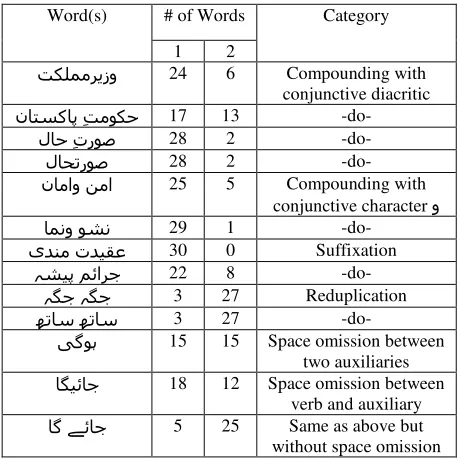
This is demonstrated by the results of a study done with 30 native speakers of Urdu (including univer-sity students, language researchers and language teachers). The subjects were asked to mark wheth-er they considwheth-ered some text a single word or a sequence of two words. Some relevant results are given in Table 5. The table indicates that for the types of phenomena in Table 4, the native speakers
4
The diacritics (called zer-e-izafat or hamza-e-izafat) are op-tional, and are not written in the example given.
do not always agree on the word boundary, that certain cases are very ambiguous, and that writing with or without space also changes the perception of where the word boundary should lie.
Word(s) # of Words Category
1 2
تکلممرﯾزو 24 6 Compounding with
conjunctive diacritic
ناتسکاپ ِتموکح 17 13 -do-
لاح ِتروص 28 2 -do-
لاحتروص 28 2 -do-
ناماو نما 25 5 Compounding with
conjunctive character و
امنو وشن 29 1 -do-
یدنم تديقع 30 0 Suffixation
ہشيپ مئارج 22 8 -do-
ہگج ہگج 3 27 Reduplication
ھتاس ھتاس 3 27 -do-
یگوﮨ 15 15 Space omission between two auxiliaries
اگيئاج 18 12 Space omission between verb and auxiliary
اگ ﮯئاج 5 25 Same as above but
[image:4.612.312.542.122.351.2]without space omission
Table 5: Survey on Word Definition
As the word boundary is ambiguously perceived, it is not always clear when to mark it. To develop a more consistent solution, the current work tags the different levels of boundaries, and it is left up to the application provider using the output to decide which tags to translate to word level boundaries. Free morphemes are placed and identified at first level. At second level we identify strings that are clearly lexicalized as a single word. Compounds, reduplication and abbreviations are dealt at third level.
4 Summary of Existing Techniques
Thus, shorter word sequences are never generated, even where they are intended.
Maximum matching is another rule based tech-nique that was proposed to solve the shortcomings of longest matching. It generates all possible seg-mentations out of a given sequence of characters using dynamic programming. It then selects the best segmentation based on some heuristics. Most popularly used heuristic selects the segmentation with minimum number of words. This heuristic fails when alternatives have same number of words. Some additional heuristics are then often applied, including longest match (Sornlertlamva-nich, 1995). Many variants of maximum matching have been applied (Liang, 1986; Li et al., 1991; Gu and Mao, 1994; Nie et al., 1994).
There is a third category of rule based techniques, which also use additional linguistic information for generating intermediate solutions which are then eventually mapped onto words. For example, rule based techniques have also been applied to lan-guages like Thai and Lao to determine syllables, before syllables are eventually mapped onto words, e.g. see (Phissamy et al., 2007).
There has been an increasing application of statis-tical methods, including n-grams, to solve word segmentation. These techniques are based at let-ters, syllables and words, and use contextual in-formation to resolve segmentation ambiguities, e.g. (Aroonmanakul, 2002; Krawtrakul et al., 1997). The limitation of statistical methods is that they only use immediate context and long distance de-pendencies cannot be directly handled. Also the performance is based on training corpus. Neverthe-less, statistical methods are considered to be very effective to solve segmentation ambiguities.
Finally, another class of segmentation techniques applies several types of features, e.g. Winnow and RIPPER algorithms (Meknavin et al., 1997; Blum 1997). The idea is to learn several sources of fea-tures that characterize the context in which each word tends to occur. Then these features are com-bined to remove the segmentation ambiguities (Charoenpornsawat and Kijsirikul 1998).
5 Segmentation Model for Urdu
Although many other languages share the same problem of word boundary identification for lan-guage processing, Urdu problem is unique due to its cursive script and its irregular use of space to create proper shaping. Though other languages only have space omission challenge, Urdu has both omission and insertion problems further confound-ing the issue.
We employ a combination of techniques to inves-tigate an effective algorithm to achieve Urdu seg-mentation. These techniques are incorporated based on knowledge of Urdu linguistic and writing system specific information for effective segmen-tation. For space omission problem a rule based maximum matching technique is used to generate all the possible segmentations. The resulting possi-bilities are ranked using three different heuristics, namely min-word, unigram and bigram techniques.
For space insertion, we first sub-classify the prob-lem based on linguistic information, and then use different techniques for the different cases. Space insertion between affixes is done by extracting all possible affixes from Urdu corpus. Some affixes in Urdu are also free morphemes so it is important to identify in segmentation process whether or not they are part of preceding or following word. For example کان is also a free morpheme (“nose”) and a suffix that makes adjective from noun, e.g. in
word کان رطخ(“dangerous”). This is done based
on the part of speech information of the words in the context.
Reduplication is handled using edit distance algo-rithm. In Urdu the reduplicated morpheme is either the same or a single edit-distance from the base morpheme, e.g. رفرف has same string repeated, ربارب has one insertion, and کاھﭨ کيھﭨ has one substitu-tion. Thus, if a string is less than two edits from its neighbor it is an instance of reduplication5. As the examples suggest, the reduplication may not only be limited to word initial position and may also occur word medially. However, if the length of base word is less than four, it is further to avoid function words (case markers, postpositions,
5
iliaries, etc.) from being mistakenly identified as a case of reduplication, e.g. ايگ ايک (“was done”) has two words with a single edit distance but is not a reduplicated sequence.
Urdu does not abbreviate strings, but abbreviations from English are frequently transliterated into Ur-du. This sequence can be effectively recognized by developing a simple finite automaton. The automa-ton treats marks all such co-occurring morphemes because they are likely to be an English abbrevia-tion transliterated into Urdu, e.g. یڈ چﯾا یپ (“PhD”). If such morphemes are preceding proper names then these are not combined as they are more likely to be the initials of an abbreviated name, e.g. رکاش یڈ نﯾا(“N. D. Shakir”). This ap-proach confuses the morpheme ﮯک (genitive case marker) of Urdu with the transliteration of English letter “k”. If we write دعب ﮯک یڈ چﯾا یپ (“after PhD”), it is interpreted as “P H D K after”. This has to be explicitly handled.
As classification of compounds into one or two word sequences is unclear, unambiguous cases are explicitly handled via lexical look-up. An initial lexicon of 1850 compound words has been devel-oped for the system based on a corpus of Urdu. Common foreign words are also included in this list.
5.1 Algorithm
The segmentation process starts with pre-processing, which involves removing diacritics (as they are optionally used in Urdu and not consi-dered in the current algorithm because they are frequently incorrectly marked by users6) and nor-malizing the input text to remove encoding ambi-guities7. Input is then tokenized based on space and punctuation characters in the input stream. As has been discussed, space does not necessarily in-dicate word boundary. However presence of space does imply word or morpheme boundary in many
6
The word ٰیلعا is written with the super-script Alef placed on Lam and Yay characters. The latter variation is correct but the former incorrect variation is also common in the corpus.
7
Unicode provides multiple codes for a few letters, and both composed and decomposed forms for others. These have to be mapped onto same underlying encoding sequence for further processing. See
http://www.crulp.org/software/langproc/urdunormalization.ht m for details.
cases, which can still be useful. The tokenization process gives what we call an Orthographic Word (OW). OW is used instead of “word” because one OW may eventually give multiple words and mul-tiple OWs may combine to give a single word. Keeping space related information also keeps the extent of problem to be solved within a reasonable computational complexity. For example input string ینارد ناخ ردان (the name of the first author) with spaces giving three OWs, creates 2 x 1 x 7 = 14 possible segmentations when sent separately to the maximum matching module (space omission error removal - see Figure 2). However, if we re-move the spaces from the input and send input as a single OW یناردناخردان to maximum matching process, we get 77 possible segmentations. This number grows exponentially with the length of input sentence. Throwing away space character means we are losing important information so we keep that intact to our use.
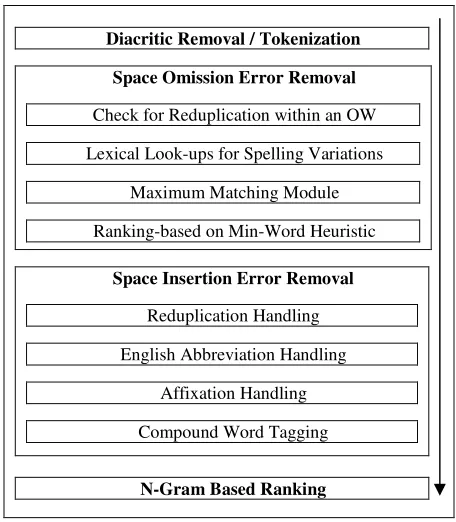
After pre-processing a series of modules further process the input string and convert the OWs into a sequence of words. This is summarized in Figure 2 and explained below.
The reduplication identification module employs single edit distance algorithm to see if adjacent morphemes are at single edit-distance of each oth-er. If the edit distance is less than two, then the reduplication is identified and marked.
Diacritic Removal / Tokenization
Space Omission Error Removal
Check for Reduplication within an OW
Lexical Look-ups for Spelling Variations
Maximum Matching Module
Ranking-based on Min-Word Heuristic
Space Insertion Error Removal
Reduplication Handling
English Abbreviation Handling
Affixation Handling
Compound Word Tagging
[image:7.612.70.298.134.395.2]N-Gram Based Ranking
Figure 2: Urdu Word Segmentation Process
For example the module will correctly recognize consecutively occurring OWs لاوھب and لااھب as a case of reduplication. Reduplication is also ap-plied earlier in space omission error module as there may also be a case of reduplication within a single OW. This module handles such cases, by dividing words in halves and identifying possible reduplications. Thus, if the words are written without space, e.g. لااھبلاوھب (innocent) they are still identified and tagged as reduplicated words
لاوھب and لااھب.
This list of words is then fed into an automaton which recognizes the sequence of abbreviations generated by transliterating English letters.
A complete affix list is compiled, and in the next stage the short listed word sequences are processed through a process which looks through this list to determine if any of the OWs may be combined. Part of speech information of stem is also used to confirm if OWs can be merged.
Urdu compounds are finally identified. This is done by using a compound list generated through the corpus. As compounding is arbitrary, where speakers are not certain in many cases that a se-quence of morphemes form a single compound or not, the segmentation process leaves this level to the discretion of the user. Whichever compounds are listed in a compound lexicon are treated as a single compound word. Those not listed are not tagged as compounds. User may enhance this list arbitrarily. The lexicon is initialized with a list of non-controversial compound, as verified from pub-lished dictionaries.
Eventually, all the segmentations are re-ranked. We used three different re-ranking methods name-ly minimum-word heuristic, unigram and bi-gram based sequence probabilities, comparative analysis.
Based on the segmentation process, the output se-quence contains the following tagging. As dis-cussed earlier, the word segmentation may be defined based on this tagging by the individual application using this process.
Phenomenon Tags Examples Word <W></W> <W>نلاعا</W>
Root <R></R> <W><R>ترورض</R> <S>دنم</S></W> Suffix <S></S> <W><R>تريح</R>
<S>زيگنا</S></W> Prefix <P></P> <W><P>دب</P>
<R>یبﯾذﮩت</R></W> XY
Com-pounds
<C1></C1> <C1><W>ءاشنا</W> <W>ﷲ</W></C1> X-e-Y
Com-pounds
<C2></C2> <C2><W>رﯾزو</W> <W>یلعا</W></C2> X-o-Y
Com-pounds
<C3></C3> <C3><W>درگ</W> <W>و</W> <W>حاون</W></C3> Reduplication <Rd></Rd> <Rd><W>کيھﭨ</W> <W>کاھﭨ</W></Rd> Abbreviations <A></A> <A><W>یپ</W>
[image:7.612.314.542.375.589.2]<W>یس</W> </A>
Figure 3: Urdu Word Segmentation Tag Set
6 Results
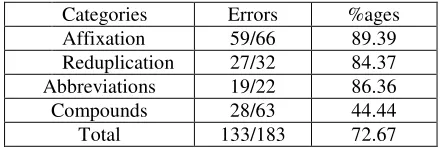
The algorithm was tested on a very small, manual-ly segmented corpus of 2367 words. The corpus we selected contained 404 segmentation errors with 221 cases of space omissions and 183 cases of space insertions. In space insertion category there were 66 cases of affixation, 63 cases of compound-ing, 32 cases of reduplication and 22 cases of ab-breviations. The results for all three techniques are shown below:
Categories Errors %ages
Affixation 59/66 89.39
Reduplication 27/32 84.37
Abbreviations 19/22 86.36
Compounds 28/63 44.44
Total 133/183 72.67
Table 6: Percentages of Number of Errors Detected in Different Categories of Space Insertion Error
There were 221 cases of space omission errors where multiple words were written in a continuum. Given below is a table that shows how many of these were correctly identified by each of the used techniques. Clearly, statistical techniques outper-form a simple minimum number of words heuris-tic. Bigrams are likely to produce better results if the training corpus is improved. Our training cor-pus contained manually segmented 70K words. The bigram probabilities are obtained using SRILM-Toolkit (Stolcke, 2002).
Categories Errors %ages
Maximum Matching 186/221 84.16
Unigram 214/221 96.83
[image:8.612.315.538.137.188.2]Bigram 209/221 94.5
Table 7: %age of No. of Errors Detected in Space Omission with Different Ranking Techniques
Following table gives cumulative results for cor-rectly identified space omission and insertion er-rors.
Categories Errors %ages
Maximum Matching 323/404 79.95
Unigram 347/404 85.8
Bigram 339/404 83.9
Table 8: %age of No. of Errors Detected Cumula-tively
Final table counts total number of words (redupli-cation, compounds and abbreviations cases are in-clusive) in test corpus and total number of correctly identified words after running the entire segmentation process.
Categories Detected %ages
Maximum Matching 2209/2367 93.3
Unigram 2269/2367 95.8
Bigram 2266/2367 95.7
Table 9: Percentage of Correctly Detected Words
7 Future Work
This work presents a preliminary effort on word segmentation problem in Urdu. It is a multi-dimensional problem. Each dimension requires a deeper study and analysis. Each sub-problem has been touched in this work and a basic solution for all has been devised. However to improve on re-sults each of these modules require a separate analysis and study. Statistics is only used in rank-ing of segmentations. In future work bi-gram sta-tistics can be used to merge morphemes. More data can be tagged to find out joining probabilities for the affixes that occur as free morpheme. Such analysis will reveal whether an affix is more in-clined towards joining or occurs freely more fre-quently. Similarly a corpus can be tagged on compounds. For each morpheme its probability to occur in compound can be calculated. If two or more morphemes with higher compounding proba-bilities co-occur they can be joined together. Simi-larly corpus can be tagged for abbreviations.
Ranking of segmentations and affix merging can be improved if POS tags are also involved with bigram probabilities. Use of POS tags with n-gram technique is proven to be very helpful in solving unknown word problems. Our model does not ex-plicitly handle unknown words. Currently the max-imum matching module splits an unknown OW into smaller Urdu morphemes. For example
فوکنيسيلوک(Kolesnikov) is erroneously split into
ف،وک،نيس،یلوک. More serious problems occur in
[image:8.612.75.296.210.285.2]References
Andreas, S. 2002. SRILM - an extensible language modeling toolkit. In Intl. Conf. Spoken Language Processing, Denver, Colorado.
Aroonmanakul, W. 2002. Collocation and Thai Word Segmentation. In proceeding of SNLPOrien-tal COCOSDA.
Blum, A. 1997. Empirical Support for Winnow and Weighted-Majority Algorithm: Results on a Ca-lendar Scheduling Domain, Machine Learning, 26:5-23.
Charoenpornsawat, P., Kijsirikul, B. 1998. Fea-ture-Based Thai Unknown Word Boundary Identi-fication Using Winnow. In Proceedings of the 1998 IEEE Asia-Pacific Conference on Circuits and Systems(APCCAS’98).
Gu, P. and Mao, Y. 1994. The adjacent matching algorithm of Chinese automatic word segmentation and its implementation in the QHFY Chinese-English system. In International Conference on Chinese Computing, Singapore.
Hussain, S. 2003. www. LICT4D . asia / Fonts / Nafees_Nastalique. In the Proceedings of 12th AMIC Annual Conference on E-Worlds: Govern-ments, Business and Civil Society, Asian Media Information Center, Singapore. Also available at http://www.crulp.org/Publication/papers/2003/ww w.LICT4D.asia.pdf.
Hussain, S. 2004. Letter to Sound Rules for Urdu Text to Speech System. In the Proceedings of Workshop on Computational Approaches to Arabic Script-based Languages, COLING 2004, Geneva, Switzerland, 2004.
Krawtrakul, A., Thumkanon. C., Poovorawan. Y. and Suktarachan. M. 1997. Automatic Thai Un-known Word Recognition. In Proceedings of the natural language Processing Pacific Rim Sympo-sium.
Li, B.Y., S. Lin, C.F. Sun, and M.S. Sun. 1991. A maximum-matching word segmentation algorithm using corpus tags for disambiguation. In
ROCLING IV, pages: 135-146, Taipei. ROCLING
Liang, N. 1986. A written Chinese automatic seg-mentation system-CDWS. In Journal of Chinese Information Processing, 1(1):44-52.
Meknavin. S., Charenpornsawat. P. and Kijsirikul. B. 1997. Feature-based Thai Words Segmentation. NLPRS, Incorporating SNLP.
Naseem, T., Hussain, S. 2007. Spelling Error Trends in Urdu. In the Proceedings of Conference on Language Technology (CLT07), University of Peshawar, Pakistan.
Nie, J., Jin W., and Hannan, M. 1994. A hybrid approach to unknown word detection and segmen-tation of Chinese. In International Conference on Chinese Computing, Singapore.
Phissamay, P., Dalolay,V., Chanhsililath, C., Sili-masak, O. Hussain, S., and Durrani, N. 2007. Syl-labification of Lao Script for Line Breaking. In
PAN Localization Working Papers 2004-2007. .
Poowarawan, Y., 1986. Dictionary-based Thai Syl-lable Separation. In Proceedings of the Ninth Elec-tronics Engineering Conference
Rarunrom, S., 1991. Dictionary-based Thai Word Separation. Senior Project Report.
Sornlertlamvanich, V. 1995. Word Segmentation for Thai in a Machine Translation System (in Thai), Papers on Natural Language Processing, NECTEC, Thailand