doi:10.1155/2008/267460
Research Article
A Practical, Hardware Friendly MMSE Detector for
MIMO-OFDM-Based Systems
Hun Seok Kim,1Weijun Zhu,2Jatin Bhatia,2Karim Mohammed,1Anish Shah,1and Babak Daneshrad1
1Wireless Integrated Systems Research (WISR) Group, Electrical Engineering Department, University of California,
Los Angeles, CA 90095, USA
2Silvus Communication Systems Inc., 10990 Wilshire Blvd, Suite 440, Los Angeles, CA 90064, USA
Correspondence should be addressed to Hun Seok Kim,[email protected]
Received 27 July 2007; Revised 7 December 2007; Accepted 19 February 2008
Recommended by Huaiyu Dai
Design and implementation of a highly optimized MIMO (multiple-input multiple-output) detector requires cooptimization of the algorithm with the underlying hardware architecture. Special attention must be paid to application requirements such as throughput, latency, and resource constraints. In this work, we focus on a highly optimized matrix inversion free 4×4 MMSE (minimum mean square error) MIMO detector implementation. The work has resulted in a real-time field-programmable gate array-based implementation (FPGA-) on a Xilinx Virtex-2 6000 using only 9003 logic slices, 66 multipliers, and 24 Block RAMs (less than 33% of the overall resources of this part). The design delivers over 420 Mbps sustained throughput with a small 2.77-microsecond latency. The designed 4×4 linear MMSE MIMO detector is capable of complying with the proposed IEEE 802.11n standard.
Copyright © 2008 Hun Seok Kim et al. This is an open access article distributed under the Creative Commons Attribution License, which permits unrestricted use, distribution, and reproduction in any medium, provided the original work is properly cited.
1. INTRODUCTION
Since the early work of Foschini, Gans, Teletar, and Paulraj [1–4] almost a decade ago, thousands of papers have been published in the area of MIMO-based information theory, algorithms, codes, medium access control (MAC), and so on. By and large these works have been theoretical/simulation-based and have focused on the algorithms and protocols that deliver superior bit error rate (BER) for a given signal-to-noise power ratio (SNR). Little attention has been paid to the actual implementation of such algorithms in real-time systems that look to deliver 100’s of million bits per second (Mbps) and possibly Gbps (Giga-bps) sustained throughput to an end user or application. To better focus our efforts and make our research results more relevant with mainstream MIMO systems, we decided to set the following specifications for our MIMO detec-tor.
(1) Throughput: ability to process a minimum of 14.4 M (million) 4 × 4 channel instances per second. It is equivalent to 345.6 Mbps when using 64QAM (quadrature-amplitude-modulation).
(2) Latency: the entire detector latency should be below 4μs. This is an important consideration in systems that require fast physical layer turn around time in order to maintain overall system efficiency at the MAC.
(3) Hardware complexity: the design should be such that it could easily fit onto a low-end FPGA (i.e., Xilinx Virtex-2 3000) or occupy no more than 40% of the resources of a high-end FPGA.
The hardware complexity needs to be bounded so that the MIMO detector could be integrated with the rest of the system. In our design, we made the decision that the MIMO detector complexity should not be greater than the rest of the system and that the entire 802.11n compliant 4 × 4 MIMO transceiver must fit onto a single Virtex-2 8000 FPGA [6]. This translates to an upper bound of 40% resource utilization for the MIMO detector in a single high-end FPGA. With the above requirements in mind, our literature search revealed 4 classes of solutions. These included stand alone matrix inversion ASICs (application-specific integrated circuit), maximum likelihood- (ML-) based detectors, V-BLAST- (vertical Bell laboratories layered space-time architecture-) based detectors, and linear MMSE detectors.
A number of ASIC-based matrix inversion ICs were reported in the past decades [7,8], when stand alone signal processing ASICs were common place. In today’s world of SoC’s (system of a chip), the solutions exemplified by these references are no longer relevant, as these solutions invariably miss the latency, throughput, and size require-ments of our desired solution. A more recent body of work is more explicitly focused on the implementation of the recently developed MIMO detector algorithms. These can be classified as ML-based detectors [9–12], V-BLAST-type detectors [13–16], and MMSE-based detectors [17–20]. These solutions, although interesting in concept, still fail to meet the stringent latency and throughput requirements of a practical system such as 802.11n.
The class of FPGA- or ASIC-based ML detectors for MIMO systems is exemplified in the works reported in [9– 12]. Whereas [9] focuses on an exhaustive search optimal ML algorithm, the work in [10–12] focuses on the implemen-tation of suboptimal ML solutions. The work reported in [9,11,12] achieves throughputs that are lower than 60 Mbps (equivalently 3.75 M channel instances per second with 16QAM). The implementation results for [10] show that the throughput of the design is not guaranteed to be constant since the design is based on a nondeterministic tree search. Although this chip delivers 170 Mbps average throughput at an SNR of 20 dB, its throughput is highly dependent on the channel condition and the minimum required throughput is not guaranteed. In addition, the design in [10] is incapable of supporting 64QAM. Finally, with the exception of [9], the ML MIMO detectors reported in [10–12] require extra hard-ware resources for QR decomposition as a preprocessing step. The QR decomposition block has comparable algorithmic complexity to an entire linear MMSE MIMO detector.
V-BLAST MIMO detection algorithms had been believed to be promising solutions due to their lower complexity compared to ML-based algorithms and their higher perfor-mance relative to linear MMSE algorithms in hard detection [13]. A novel Square-Root algorithm was introduced in [14] for reduced complexity V-BLAST detection and was later implemented on FPGA [15] and ASIC [16] platforms. However, the implementation results in [15,16] show that throughputs of the designed V-BLAST detectors are 0.125 M and 1.56 M channel instances per second, respectively, which are much lower than our requirement of 14.4 M channel
instances per second. Furthermore, recent studies on output detectors revealed that the performance of the soft-output V-BLAST detector is inferior to soft-soft-output linear MMSE detectors in systems that employ bit interleaved coded modulation (BICM) [21].
Prior work on linear MMSE MIMO detectors [17–20] has shown that these algorithms have significantly lower complexity than ML algorithms and their performance in MIMO-BICM systems is quite comparable to ML algorithms especially when the number of antennas or the constellation size is large [21].
The most computationally intensive part of a linear MMSE MIMO detector is the matrix inversion operation. Hence, the majority of the previous work had approached the linear MMSE detection problem by focusing on efficient matrix inversion techniques. An MMSE detector based on QR decomposition via CORDIC- (coordinate rota-tion digital computer-) based Givens rotarota-tions is studied and implemented in [17]. Similarly, square-root-free SGR (squared Givens rotation) algorithm-based MMSE detectors are reported in the literature [17, 19]. A linear MMSE detector using the Sherman-Morrison formula, a special case of the matrix inversion lemma, is given in [18]. In [20], an FPGA implementation of a QR-RLS- (Recursive Least Square) based linear MMSE MIMO detector is reported. However, every linear MMSE detector designed in [17–20] fails to satisfy the design requirements outlined above. Each design suffers from either excessive hardware resource usage [17,18] or exorbitant latency [20] to invert multiple channel matrices. Moreover, none of these implementations is able to provide a matrix inversion throughput higher than 7 M channel instances per second.
Based on the results of the literature search and our early work, it was clear that the MMSE-based solutions were good candidates for achieving the target requirements. At the conclusion of our work, a real-time FPGA implementation of the MIMO detector was realized on a Xilinx Virtex-2 FPGA and was integrated into an end-to-end MIMO-OFDM testbed [6]. The resulting 4×4 MIMO detector uses 9003 logic slices, 66 multipliers, and 24 Block RAMs (less than 33% of the overall resources of this part). The design delivers over 420 Mbps sustained throughput, with a small 2.77μs latency.
Soft bit decision
Soft bit decision
Soft bit decision
Deinterleaver + stream deparser
FEC decoder
Bit stream
Linear MMSE MIMO detector
FFT
FFT FFT
. . .
. . . y2
y1
y4
y1,n1 y2,n2
y4,n4
Channel estimation
Noise estimation
H N0
Figure1: Receiver block diagram.
combined with Square-Root linear MMSE detection was selected and its hardware architecture is described in Section 5. The implementation results on Xilinx Virtex-2 and Virtex-4 FPGAs are presented in Sections6and7concludes the paper.
2. SYSTEM DESCRIPTION AND LINEAR MMSE MIMO DETECTION
We consider a linear MMSE MIMO detector a part of an entire 802.11n compliant 4×4 MIMO OFDM transceiver [6].Figure 1corresponds to the receiver block diagram.
We denote N as the number of transmit and receive antennas. For each subcarrier, we denote theN×1 received vector as y which is given in (1). Where s is the N ×1 transmitted symbol vector,His theN×Nchannel matrix, andnis theN×1 additive white Gaussian noise vector with covariance matrixN0·I;
y=Hs+n. (1) In this paper, we focus on the MIMO detector block in Figure 1which produces the linear MMSE solution y, the estimate of the transmitted symbol vectors, and the effective, post detection, noise variance vectorn.yandnare given by (2) and (3) [4,22]:
y=H∗H+N
0·I
−1·
H∗y=WMMSE·y, (2)
n=diagEy−sy−s∗
=diagN0·
H∗H+N0·I
−1 ,
(3)
where (·)∗ is a conjugate-transpose operation and diag (·) represents the mapping of the diagonal components of a matrix to a column vector.
It is worth noting that as part of an entire MIMO system, the MIMO detector output will feed into a soft decision FEC (forward error correction) decoder, which in turn needs to calculate the log likelihood ratios (LLRs). The LLR calculations [21,23] need thenestimates which will be provided by the proposed MIMO detector block. Note that
n output from the MIMO detector is required only when the soft decision metric is used for FEC decoding. In our system, the linear MMSE detector providesykandnkto the
100 200 300 400 500 600 700 800 900 1000 1100
Slic
es
14 15 16 17 18 19 20 21 22
Precision
Complexity ratio=(silces for a CORDIC/slices for a multiplier)∗100
CORDIC Multiplier
Multiplier versus CORDIC complexity
Figure2: Hardware Complexity of a CORDIC or Multiplier.
kth soft bit decision computation block (seeFigure 1), where y=y
1 · · · yN T
andn=n1 · · · nN T
.
3. A COMPREHENSIVE MEASURE OF ALGORITHMIC COMPLEXITY
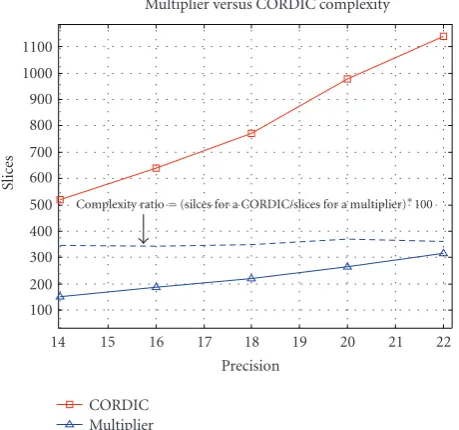
Figure 2clearly shows that the hardware complexity of a CORDIC operator or a multiplier is linearly proportional to its bit precision and the slice count ratio between two operators can be approximated as a constant within a wide precision range (14 ∼ 22 bits). We propose a more comprehensive metric for measuring the complexity of an algorithm. The new metric is defined in (4) and is termed the “adjusted operation counts”. It takes into account the bit precision of the operator, the relative complexity of the operator, and naturally the number of operations. We will adopt this metric throughout the paper;
Adjusted Operation Counts=
M
m=1 αm
b1
m+b2m
b0
, (4)
whereMis the total number of operations,b0is a normal-ization factor,bi
mis the bit precision of theith input operand of the mth operation and αm is the relative complexity coefficient of themth operation.
Normalizing our operations to 16-bit precision multipli-cations, we letb0 = 32 (corresponding to two 16-bit preci-sion operands) and setαm = 1 when themth operation is a multiplication. When comparing multiplier and CORDIC operations in FPGA implementation, we will assume that for the same precision, the CORDIC operation has 3.5 times higher hardware complexity than the multiplication as Figure 2indicates (αm = 3.5 for a CORDIC). In this vein, a 24-bit precision multiplication is regarded as 1.5 effective operations (1.5 inadjusted operation counts) while a 24-bit precision CORDIC operation is counted as 5.25 inadjusted operation counts.
4. LINEAR MMSE DETECTION ALGORITHM COMPARISON
All the MMSE detector implementations reported in the literature [17–20] use a Squared MMSE formulation of the MIMO detector problem with an explicit matrix inversion of (H∗H+N0·I)−1. Of these, [17,19,20] use QR decomposi-tion to solve the matrix inversion problem.
A QR decomposition-based Squared MMSE formulation is given in (5)–(8):
AS=H∗H+N0·I, (5) QR decomposition:AS=QSRS=⇒A−1S =R−1S Q∗S, (6)
y=R−1
S Q∗SH∗y=WMMSE·y, (7) n=diagN
0·R−1S Q∗S
. (8)
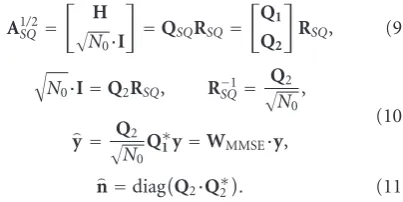
The Square-Root MMSE formulation (9)–(11) [14,22] exploits the structure of the compound matrix √HN0I in order to eliminate the need for matrix inversion. It also significantly reduces the precision requirements of the system, as will be seen in later sections. The Square-Root MMSE formulation was first introduced in [14] where it was used in the implementation of V-BLAST-type detectors [16,22]. Its application to the linear MMSE MIMO detector
has hitherto been unexplored and is one of the contributions of the present work;
A1SQ/2=
H
N0·I
=QSQRSQ=
Q1
Q2
RSQ, (9)
N0·I=Q2RSQ, R−1SQ=
Q2
N0 ,
y=Q2 N0
Q∗1y=WMMSE·y,
(10)
n=diagQ2·Q∗2
. (11)
One interesting fact about the Square-Root formulation is that bothRSQandQ2are upper triangular matrices. In later section, we will exploit this property to help us reduce the number of hardware multipliers.
In order to come up with the best implementation, we carried out a side by side comparison of four alternative linear MMSE detection algorithms and chose the one with the lowest adjusted operations count metric. These four alternatives are
(1) Squared MMSE formulation with QR decomposition using Givens rotations,
(2) Squared MMSE with QR decomposition using mod-ified Gram-Schmidt orthogonalization,
(3) Square-Root MMSE with QR decomposition using Givens rotations,
(4) Square-Root MMSE with QR decomposition using modified Gram-Schmidt orthogonalization.
A Givens rotation [24] can be efficiently implemented in hardware by using a CORDIC operator. Meanwhile, the Gram-Schmidt orthogonalization approach for QR decomposition was motivated by the presence of dedicated multipliers on the target FPGA, which could provide for a better balance in the utilization of the part. An overview of these techniques can be found in [17,24].
4.1. Numerical stability analysis and algorithm complexity assessment
10−3 10−2 10−1 100
PE
R
28 29 30 31 32 33 34 35 36
SNR Floating point
Fixed point, Square-Root, Gram-Schmidt Fixed point, Squared, Gram-Schmidt Fixed point, Square-Root, Givens Fixed point, Squared, Givens
Figure 3: PER Performance of fixed point algorithms, 4 ×4 64 QAM.
MCS (Modulation and Coding Scheme) 29 in the 802.11n specification. This particular configuration requires higher SNR than most other modulation and coding schemes in the 802.11n standard and as such will be more sensitive to the quantization noise and stability issues that plague finite precision systems.
The required bit precisions for the four alternative detec-tor algorithms are presented in Table 1. The bit precisions were determined through a Monte-Carlo-based study that plotted the packet error rate (PER) for the end to end system with the aim of finding the required signal precision that resulted in aprecision lossof less than 0.5 dB. We define preci-sion lossas the difference in SNR required to achieve 1% PER when using floating point precision and when using fixed point precision. The required bit precision for each interme-diate matrix (e.g.,R−1S inTable 1) was obtained in isolation assuming that all other matrices were represented with float-ing point. After we obtained the required bit precisions for all intermediate matrices, they were combined and fine-tuned together via incremental precision modifications until we achieve the targetprecision loss. The PER curves inFigure 3 show the fixed point design performance of our system where all matrices and corresponding arithmetic operations are represented with finite bit precisions specified inTable 1. In general, more bit precisions are required to operate at higher SNRs where numerical stability issues become critical due to the higher condition number of the matrixH∗H+N0·I.
It is worth noting that the required bit precisions for modified Gram-Schmidt QR decomposition are higher than those for the Givens rotation-based QR in both the Squared and the Square-Root MMSE detection cases. The better numerical stability of Givens rotation comes from its unitary transformation property which preserves the
200 400 600 800 1000 1200 1400
Oper
ations
2 2.5 3 3.5 4 4.5 5
N
Squared Gram-Schmidt Squared Givens
Square-Root Gram-Schmidt Square-Root Givens
Figure4: Operation count for each algorithm.
magnitude. However, in the Square-Root MMSE formula-tion, the difference of the required bit precision between Gram-Schmidt and Givens rotation-based methods becomes smaller. This is because of the structure of the Square-Root algorithm. That is, the lower half rows of the matrix
A1SQ/2 in the Square-Root algorithm have very small values at high SNR and become the main impediments for the Givens rotation method in computing accurate rotation angles. On the contrary, the same problem is not critical in the Gram-Schmidt method since its QSQ computation is based on an entire column vector rather than only two components of the column vector. Moreover, we observe that the bit precision requirement of the modified Gram-Schmidt QR decomposition method is significantly relaxed in Square-Root detection since neither RSQ nor R−1SQ is involved in the detection process. In the following section, we will introduce a dynamic scaling technique which will further improve the numerical stability of modified Gram-Schmidt QR decomposition in Square-Root MMSE detec-tions.
Table1: Required bit precisions.
Fixed point computation Squared MMSE algorithm Square-Root MMSE algorithm Gram-Schmidt QR-based Givens QR-based Gram-Schmidt QR-based Givens QR- based
H,N0I (input) 14 14
AsorA1SQ/2 14 19 16
QSorQSQ 25 15 19 16
RSorRSQ 27 17 21 18
R−1
S 20 Not required
A−1
S =R−S1Q∗S 20 Not required
1
N0Q2 Not required 14
WMMSE 16 14
n=diagN0·A−1
S
=diagQ2Q∗2
16 14
Table2: Operation counts for computingWMMSEandn.
Real value input operations Squared MMSE Square-Root MMSE
Gram-Schmidt QR Givens rotation QR Gram-Schmidt QR Givens rotation QR
Multiplications 21
2 N
3+ 7N2−1 2N
15 2N
3+ 6N2−1 2N
11 2N
3+ 5N2+5 2N
3 2N
3+7 2N
2
Divisions N N N+1 1
Square roots N 0 N+1 1
CORDIC operations 0 5
2N 3+3
2N
2−2N 0 3N3+ 7N2−N−1
Combining the bit precisions inTable 1and the opera-tion counts for each algorithm inTable 2, we can compute theadjusted operation countsfor all algorithms. Inadjusted operation counts computation (4), we set αm = 0 for additions (the relative hardware complexity of an addition is 0) because they take much lower resources in FPGAs than multiplications or CORDIC operations. Furthermore, since all algorithms require a small number (less thanN+ 2) of divisions and square-root operations, a single time-shared divider and square-root operator will be sufficient for each algorithm when N is reasonably small (i.e., less than 6). Consequently, the hardware complexity involved in division and square-root operations will be assumed to be the same for all MMSE detection algorithms. Therefore, in this work, we compute adjusted operation countsby only considering multiplications (αm = 1) and CORDIC operations (αm = 3.5). The adjusted operation counts for a 4 × 4 MIMO detector are shown in Table 3. It is seen that the Square-Root MMSE detection algorithms require significantly less hardware resources than their Squared MMSE counterparts.
4.2. Algorithm enhancement: dynamic scaling technique
It is well known that the modified Gram-Schmidt QR decomposition has an advantage in numerical stability when compared to the original Gram-Schmidt algorithm [24]. In addition, we have found that this algorithm when used in a Square-Root MMSE detector can be made even more
efficient by exploiting the fact that theRSQ matrix, which results from the QR decomposition, does not contribute to the MMSE solution. Essentially, we can apply any processing toA1SQ/2as long asQSQremains unchanged, even if it does not preserveRSQ. As we can see from (12), dynamic scaling of the
ith column,vi, with an arbitrary constantcihas the property of preserving theQSQmatrix but not necessarilyRSQ:
A1SQ/2=
v1 v2 · · · vN
=QSQ·RSQ=
u1 u2 · · · uN
·RSQ
=⇒A1SQ/2=c1v1 c2v2 · · · cNvN
=QSQ·RSQ
=u1 u2 · · · uN·RSQ.
(12)
Table3: Adjusted operation counts for computingWMMSEand
n(4×4 detector).
Squared MMSE Square-Root MMSE
Givens rotation QR-based Gram-Schmidt QR-based Givens rotation QR-based Gram-Schmidt QR-based
Adjusted operation counts 1150.50 872.50 780.84 488.44
(a)A1SQ/2=
H
N0·I
= v1 v2 · · · vN
(b) for i=1 toN (c) for j=itoN
(d) while (max{|R(ν1,j)|,|I(ν1,j)|,. . .,|I(ν2N,j)|}<2L)
(e) vj:=2vj
(f) while (max{|R(ν1,j)|,|I(ν1,j)|,. . .,|I(ν2N,j)|}>2U)
(g) vj:=vj/2
(h) end
(i) rii:= vi,ui:= vi
vi
(j) for j=i+ 1 toN (k) ri j:=u∗i·vj
(l) vj:=vj−ri j·ui
(m) end (n) end
Algorithm 1: The modified and scaled Gram-Schmidt QR decomposition (vi = [ν1,i · · · ν2N,i]T, R(·) andI(·) stand for real and
imaginary parts of a complex number, respectively,QSQ=[u1 · · · uN],LandUare predefined lower and upper bounds).
10−3 10−2 10−1 100
PE
R
28 29 30 31 32 33 34 35 36
SNR Floating point
With dynamic scaling, fixed point: 14-bit Q, 16-bit R With dynamic scaling, fixed point: 12-bit Q, 14-bit R No dynamic scaling, fixed point: 14-bit Q, 16-bit R No dynamic scaling, fixed point: 18-bit Q, 20-bit R No dynamic scaling, fixed point: 19-bit Q, 21-bit R
Figure5: Impact of dynamic scaling on Gram-Schmidt QR.
can activate the full dynamic range all the time. Dynamic scaling also preventsrii(namely,vj) from becoming a very large number and consequently the dynamic range of 1/vj
can be controlled such that it does not exceed the desired precision. This improves the numerical stability of vi/vi, while maintaining low bit precision.
The dynamic scaling technique is unique to Square-Root MMSE detection. The preprocessing such as (12) cannot be applied to Squared MMSE detection since its solution depends on both RS and QS of the QR decomposition process. Hence, this type of dynamic scaling technique had not been exploited in previous works [17–20], which were based on the Squared MMSE formulation.
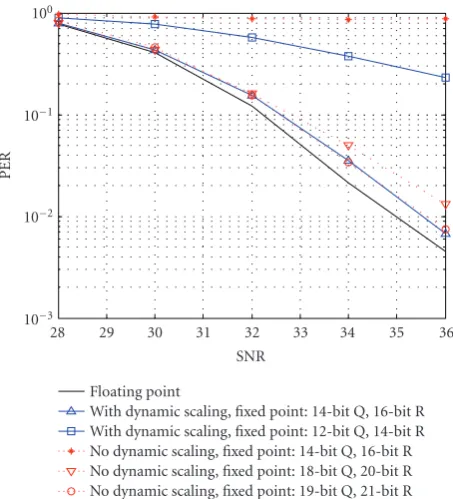
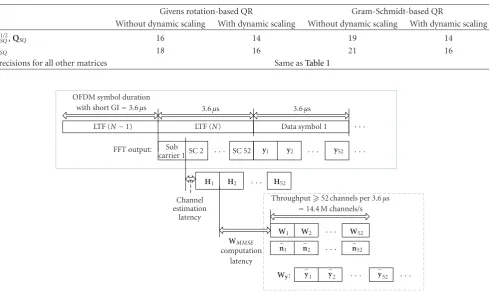
The impact of recursive dynamic scaling on a modified Gram-Schmidt QR-based Square-Root MIMO detection algorithm is shown in Figure 5andTable 4. On average, 5 bits of precision is saved in the fixed point QR decomposition which makes the modified Gram-Schmidt QR-based Square-Root algorithm more hardware friendly. Note that a similar technique can be applied to Givens rotation-based QR decomposition in Square-Root MMSE detection. However, the impact of the dynamic scaling on a Givens rotation QR-based Square-Root algorithm is not as significant (see Table 4) due to the already well-behaved numerical prop-erties of that algorithm. As Table 4 shows, the proposed dynamic scaling technique enhances the numerical stability of the modified Gram-Schmidt QR decomposition to a level that is comparable to the unitary transform-based QR.
Table4: Required bit precisions of QR decomposition for Square-Root detection.
Givens rotation-based QR Gram-Schmidt-based QR
Without dynamic scaling With dynamic scaling Without dynamic scaling With dynamic scaling
A1/2
SQ,QSQ 16 14 19 14
RSQ 18 16 21 16
Precisions for all other matrices Same asTable 1
OFDM symbol duration with short GI=3.6μs
Throughput52 channels per 3.6μs
=14.4 M channels/s
3.6μs 3.6μs
LTF (N−1) LTF (N) Data symbol 1 · · ·
· · · · · ·
· · ·
· · · · · ·
· · · · · ·
· · ·
FFT output: Sub
carrier 1 SC 2 SC 52 y1 y2 y52
H1 H2 H52
Channel estimation
latency
WMMSE
computation latency
W1 W2 W52
n1 n2 n52
Wy:
y1 y2 y52
Figure6: MIMO detection interface timing.
compared to Squared MMSE detection. In addition, the proposed dynamic scaling technique provides nearly 20% additional saving in hardware complexity for the Gram-Schmidt QR-based Square-Root MIMO detector.
Remark that when one considers hardware implementa-tion on an FPGA, multiplicaimplementa-tion-intensive methods such as the modified Gram-Schmidt QR decomposition are usually more desirable than a CORDIC-intensive Givens rotation QR algorithm because (a) dedicated multipliers are available in FPGAs without extra cost, whereas CORDIC operators would consume significant number of FPGA slices (see Figure 2); (b) the latency of a pipelined CORDIC operator is linearly proportional to its bit precision while a dedicated multiplier on an FPGA has a single-clock latency. Based on the complexity assessment in this section and the fact that we target an FPGA implementation where a number of dedicated multipliers are available, we select the modified Gram-Schmidt QR decomposition combined with Square-Root MMSE MIMO detection as the algorithm for our hardware implementation. Dynamic scaling technique is also applied to the hardware design in order to reduce its bit precision requirement of the design.
5. HARDWARE IMPLEMENTATION ON FPGAs
The exploration of the algorithmic space in the prior sections led us to an algorithmic solution with the smallestadjusted operation count for a given performance. In this section,
we continue to optimize the design by making tradeoffs and enhancements at the hardware architecture level. The primary tradeoffs made at this level are (i) time-sharing of multiplier resources; (ii) maximizing hardware utilization by exploiting the sparsity of some matrices; and (iii) an efficient implementation of the dynamic scaling procedure. These three techniques are elaborated in this section where the performance gain for each is clearly discussed. The result is an FPGA-based implementation that not only meets the requirements for this work, but is also quite superior to other detectors appearing in the recent literature.
5.1. MIMO detector overview and interface
For each subcarrier, the inputs to the MIMO detector are the
N ×N channel matrixH and the N×1 receive vectory. Figure 6shows the interface timing diagram of the MIMO detector for our IEEE 802.11n test case. This test case corresponds to a 4×4 MIMO OFDM system with 52 data subcarriers and an OFDM symbol duration of 3.6μs.
Table5: Adjusted operation counts for computingWMMSEand
n(4×4 MMSE detection).
Squared MMSE Square-Root MMSE
Givens rotation QR-based
Gram-Schmidt
QR-based Givens rotation QR-based Gram-Schmidt QR-based Dynamic scaling Without dynamic With dynamic Without dynamic With dynamic
not available scaling scaling scaling scaling Adjusted operation counts 1150.50 872.50 780.84 743.46 488.44 397.81
Table6: Place and route report.
Target FPGA Slices Number of real multipliers BRAMs
xc2v6000 (speed grade-6) 9,003 out of 33792 66 24
xc4vlx160 (speed grade-12) 7,932 out of 67854
Target FPGA Supportable operating clock frequency (fclk) Latency (clocks) Data throughputWMMSE,nandy, xc2v6000 (speed grade-6) 140 MHz
388 fclk/8 (instances per second) xc4vlx160 (speed grade-12) 160 MHz
and the effective noise power vector n within 4μs. This is per our design requirements. Figure 6shows the timing diagram for this sequence of events. As soon as theWMMSE matrix and the received vector y for the first subcarrier become available, the MMSE detection output vectorywill be generated by the MIMO detector. The WMMSE,n, and y computation throughput of the detector must be greater than or equal to 14.4 M instances per second which is the rate at which the y vectors and the channel estimates are presented to the MIMO detector. Otherwise, the detector will incur additional latency.
5.2. Multiplier sharing architecture
In our test case, a new 4×4 channel estimation matrixHis presented to the detector at the maximum rate ofφ=14.4 M instances per second. A fully pipelined detector must provide
WMMSE,n, andyevery 69.4 ns (=1/φ) without the need for a FIFO and unnecessary latency. Generally, the input/output rate φ is much lower than the maximum operating clock frequency of the hardware. We define the multiplier time sharing order(γ) in (13):
multiplier time sharing order (γ)
=Operating Clock Freq.in MHz
φ .
(13)
For our FGPA implementation, the multiplier time sharing order is 8 implying that the minimum operating clock frequency is 115.2 (=8×φ) MHz and a single multiplier processes 8 sets of inputs within a 14.4 MHz cycle. This specific multiplier time sharing order is naturally coupled with the size of the compound matrixA1SQ/2 for the Square-Root MIMO detector.
For the 4×4 Square-Root MIMO detection,A1SQ/2is an 8×4 matrix and each step in the modified Gram-Schmidt QR decomposition takes an 8×1 column vector of A1SQ/2 as the input. Assuming that the matrix A1SQ/2 is dense, the norm square computation steps (v2) and projection vector
computation steps (u∗·v or rii·u) each require 8 complex multiplications. As a result, if the multiplier can run at a clock frequency of 115.2 MHz, the same multiplier can be shared within a single operation step (v2
, u∗·v, or
rii·u) producing the output at the rate of 14.4 M instances per second. With this multiplier sharing architecture, the squared Euclidean norm (v2
) and the v vector update (v := v−(u∗v)·u) operations require only 2 and 6 real multipliers, respectively.
Figures7and8show the overall architecture of the fully pipelined 4×4 MIMO detector with the proposed multiplier sharing architecture. The square-root and division operator inFigure 7are instantiated by using Xilinx Coregen blocks [26].
5.3. Multiplier saving techniques
The modified and scaled Gram-Schmidt QR decomposition circuit inFigure 7does not make use of the sparsity of the
A1SQ/2matrix. Since the lower half ofA1SQ/2is sparse (Q2is upper triangular), the multipliers in thev2and thev−(u∗v)·u computation are not active all the time. This can be exploited to save multipliers when the orthogonalization is performed on the columns of A1SQ/2. InFigure 9, real multipliers in the
v12 computation are active (shaded rectangles) during only 5 out of 8 clock cycles, and complex multipliers in the
u∗1vjcomputation have 4inactiveslots (unshaded rectangles) out of 8. Meanwhile, only 5 complex multiplications are required to compute (u∗1vj)·u1 and the 5th component of
u1is a real number. Therefore, (u∗1vj)·u1,1∼(u∗1vj)·u1,4can be computed using theinactivecycles of the multipliers for
u∗1vj computation, while (u∗1vj)·u1,5 can use the inactive slots in thev12 computation. This technique provides a saving of 17% in the required multiplier resources for the QR decomposition circuit.
Table7: Resource usage comparison.
Computation Slices Multiplier BRAM Note
This work
Q2
N0
6487 (Virtex2) 45 15 Corresponds to complexity of (H∗H+N0·I)−1
WMMSE 7679(Virtex2) 58 19 Includes 1/
N0·Q2computation
[17] WMMSE 16865(Virtex2) 44 101
[18] α·(H∗H+N0·I)−1 4446(Virtex2) 101 N/A αscaling will require additional multipliers and dividers. [19] (H∗H+N0·I)−1 86% of Virtex2(1) N/A N/A
[20] (H∗H+N0·I)−1 9117 (Virtex4) 22 9 (1)
The exact slice count is not available since its FPGA part name is not given.
Table8: Throughput and latency comparison.
Output Max. throughput (million instances per second) fclk Latency
This work WMMSE,y,n
17.50 140 MHz
388 clks
20.00 160 MHz
[17] WMMSE N/A N/A 3000 clks
[18] α·(H∗H+N0·I)−1 6.75(2) 108 MHz 64 clks
[19] (H∗H+N0·I)−1 6.25(2) 100 MHz 350 clks
[20] (H∗H+N0·I)−1 0.13(3) 115 MHz 933 clks
(2)
The throughput is not specified in the reference. However, it can be computed from its architecture. (3)
This is a floating point design.
v1
v1
v2
v3
v4
v(2)3
v(3)4 v(2)4
v(3)4 v(2)4
v(2)3
v(1)2
v3(1)
v4(1) v(1)2
Scale
S
cale
Scale
S
cale
Scale
Scale
Scale
S
cale
Scale
Scale
v2
v2
v2
v2
N0
√
D D
D D
D
D D
D D
D
D Delay chain or RAM Dynamic scaling
Scale
v−(u∗v)·u
v−(u∗v)·u v−(u∗v)·u v−(u∗v)·u v−(u∗v)·u
v−(u∗v)·u
1
v1 1
v(1) 2 1
v(2) 3 1
v(3) 4
1
N0
u1
u2
u3
u4
u1
u3
u2 1/x
Table9: QR decomposition engine comparison.
QR engine output Throughput (million inst/s) Gate count Gate count per throughput Note
This work Q1,Q2,RSQ 17.50 (Virtex2 FPGA, 0.120μm) 157k(4) 8.97 k per M inst/s
RSQcan be obtained
by scaling each row ofRSQ.
[16] Q1,RSQ 1.56 (0.25μm ASIC) 54k 34.62 k per M inst/s RSQis sorted based
on column norms (4)
Estimated gate count from Xilinx ISE9.1 report. The QR engine was mapped, placed, and routed in isolation.
Matrix-matrix multiplication Construct
Q1,Q2
Matrix-vector multiplication
RAM RAM D
D D
u1
u2
u3
u4
Q2
Q∗1
Q2
N0 Q2
N0
Q∗1
1/N0
y
y
n
diag(Q2Q∗2)
Figure8: MMSE solution computation.
(u∗1v4)·u1 (u∗1v3)·u1 (u∗1v2)·u1
u∗1v4
u∗1v3
u∗1v2
u1:=v1/v1 2 real multipliers 3 complex multipliers
=9 real multipliers
3 complex multipliers
=9 real multipliers we can save these multipliers
1/v1: division
v12: sqrt
v12 real multipliers
Time
Active input to operator Idle input to operator
Figure9: Vector orthogonalization schedule (ν1).
Q2, 4 diagonal components are real and the remaining 6 are complex. Hence, when we compute diag (Q2Q∗2), 2 real multipliers are sufficient withγ=8 time sharing. Similarly, 1/N0·Q2(scalar-matrix) multiplication and 1/
N0Q2·Q∗1 (matrix-matrix) multiplication can be implemented with 2 and 13 real multipliers, respectively. It is worth noting that on average, our design with multiplier sharing/saving achieves 93% multiplier utilization (active time over total
time), which is 30% higher than the hardware utilization reported in [19].
5.4. Implementation of dynamic scaling
As shown in Figure 7, the QR decomposition procedure requires 10 identical dynamic scaling units. Thus, it is impor-tant to implement this function in a hardware optimized fashion. The input of the dynamic scaling circuit is an 8×1 vector v which corresponds to a column vector of the compound matrix A1SQ/2. We implemented a pipelined dynamic scaling circuit where each component of the column vectorvis fed sequentially as input.Figure 10depicts the overall structure of the dynamic scaling circuit. The scaling is performed in two steps. First, absolute values of the real and imaginary parts of the input vector (all 8 elements of the vector) are bitwise ORed and stored in a register calledaccumulated OR. By looking at the most significant nonzero bit position of the accumulated OR register, one can verify whether the largest absolute value ofv is within the predefined range (14). Second, if the most significant nonzero bit position of theaccumulated ORregister is out of bound, the input signals are shifted based on the position of the most significant nonzero bit of the accumulated OR register. A brute-force approach for performing this most significant nonzero bit search and barrel shift is given in the pseudocode ofAlgorithm 2where the bit precision forvis 14, the lower boundLis 11, and the upper bound is inactive (i.e.,U=14);
2L≤maxrealν1,. . .,realν2 N,
imagν1,. . .,imagν2N≤2U. (14)
v real[13 : 0]
v imag[13 : 0] “00· · ·0”
prev acced OR [13 : 0]
abs v re [13 : 0]
abs v im [13 : 0] ABS()
ABS()
OR Logic
next acced OR [13 : 0]
accumulated OR [13 : 0]
Find the nonzero
MSB + barrel shift
scaled v re[13 : 0] scaled v re[13 : 0]
· · ·
Figure10: Dynamic scaling circuit.
prev acced OR[13] abc v re[13] abc v im[13]
prev acced OR[12] abc v re[12] abc v im[12]
next acced OR[13]
next acced OR[12]
prev acced OR[13] abc v re[13] abc v im[13]
prev acced OR[12]
abc v re[12] abc v im[12]
prev acced OR[11]
abc v re[11] abc v im[11]
next acced OR[13]
next acced OR[12]
next acced OR[11]
. . . .
. .
(a) OR Logic for brute-force search (b) OR Logic for binary search
Figure11: OR Logic modification.
if (accumulated OR (13 : 11)>0) then 0 bit shift;
elsif (accumulated OR (10)=“1”) then 1 bit shift;
. . . . . . . .
elsif (accumulated OR(5)=“1”) then 6 bit shift;
else 7 bit shift; end if;
Algorithm2: Brute-force search and barrel shift.
The deeply nested if-else statements can be avoided by using a binary search procedure. For the binary search, theOR logic inFigure 10 needs to be slightly modified from the simple
bitwise OR shown inFigure 11(a) to the modifiedOR logic shown inFigure 11(b). The modified OR logic performs a nonzero-bit propagating, bitwise ORoperation: once the first nonzero most significant bit is found, the remaining less sig-nificant bits from that position all become “1” regardless of other inputs. The modified OR logic allows us to use binary search, which is shown in the pseudocode ofAlgorithm 3.
if (accumulated OR(8)=“1”) then if (accumulated OR(10)=“1”) then
if (accumulated OR(11)=“1”) then 0-bit shift; else 1-bit shift;
end if; else
if (accumulated OR(9)=“1”) then 2-bit shift; else 3-bit shift;
end if; end if; else
if (accumulated OR(6)=“1”) then
if (accumulated OR(7)=“1”) then 4-bit shift; else 5-bit shift;
end if; else
if (accumulated OR(5)=“1”) then 6-bit shift; else 7-bit shift;
end if; end if; end if;
Algorithm3: Binary search and barrel shift.
2 dedicated multipliers. In other words, the number of hardware multipliers required for the Gram-Schmidt-based QR decomposition would have doubled if the proposed dynamic scaling technique was not applied. Hence, we can see that the dynamic scaling results in saving of 40 dedicated multipliers in the FPGA at the cost of 1450 additional logic slices.
6. FPGA IMPLEMENTATION RESULTS
The 4×4 MMSE MIMO detector design was successfully synthesized, placed, routed, and verified on both a Xilinx Virtex-2 and a Virtex-4 series part. These chips have a number of dedicated hardware multipliers and two-port block RAMs.Table 6shows the implementation result of the IEEE 802.11n compatible MIMO detector including resource utilization from the place and route report.
The latency of the implemented detector is 2.77μs when the operating clock frequency (fclk) is 140 MHz, which is shorter than a single OFDM symbol in the IEEE 802.11n draft proposal [5]. The computation throughput forWMMSE,
n, andy is fclk/8 instances per second, which implies that our target throughput of 14.4 M instances per second can be met by using any fclkhigher than 115.2 MHz. Assuming a 140 MHz clock, the implemented detector is able to compute 52 (the number of data subcarriers)WMMSEmatrices within 2.77μs and provide a data throughput of 420 Mbps for a 64QAM 4×4 MIMO system.
Tables7and8show the resource usage, throughput, and latency results for this work and some prior work in the area. It is worth noting that none of [17–20] in Tables7and 8 is designed to produce a complete MMSE solution
con-sisting of both y andnneeded for soft-decision decoding. Additionally, [18–20] only compute (H∗H+N0·I)−1rather than WMMSE = (H∗H+N0·I)−1·H∗ = 1/
N0·Q2Q∗1. For comparison purposes, we specified the resource usage of our design for computing 1/N0·Q2, which corresponds to (H∗H+N0·I)−1in Squared MMSE detection (compare (2) and (10)).Table 7 shows that our design utilizes 50% and 29% fewer slices than [17,20], respectively, while the number of multipliers used in our design is only 45% of those in [18]. Meanwhile, the throughput of our design is at least 3 times higher than [18–20] as shown inTable 8. The throughput of [17] is not given but its latency is too high to meet the latency requirements of a commercial system such as 802.11n.
Finally, we compare our QR decomposition engine (on a Xilinx Virtex2) with an ASIC design in [16] which implements complex CORDIC-based QR decomposition on a 0.25μm technology. The QR engine in [16] is designed for a Square-Root MMSE V-BLAST-type detector and is similar to the CORDIC-based QR decomposition for the Square-Root MMSE algorithm discussed in this work. However, it is worth noting that [16] does not computeQ2while it computesRSQ explicitly as only RSQ is required in a successive canceling-based MIMO detector. Table 9 shows the throughput and (estimated) gate counts for QR decomposition engines in this work and the ASIC design reported in [16]. For comparison purposes, we assume that for a given design, an FPGA fabricated in 0.12μm technology (Virtex2) provides comparable speed (throughput) as an ASIC implemented in 0.25μm. By using gate count per throughput in Table 9 as the comparison metric, we observe that our design achieves significant gain over [16].
In summary, four main techniques which together form the major contribution of this work are responsible for this performance gain. They are (a) definition and adoption of a unified metric for simultaneous comparison of algorithmic complexity and numerical stability; (b) the combination of a modified Gram-Schmidt QR decomposition algorithm with Square-Root linear MMSE detection resulting in a matrix inversion free implementation; (c) a dynamic scaling algorithm that enhances numerical stability; and (d) an aggressive time-shared VLSI architecture. The above tech-niques are quite general and are readily applicable to any MMSE-based MIMO detector implementation.
7. CONCLUSION
REFERENCES
[1] G. J. Foschini and M. J. Gans, “On limits of wireless com-munications in a fading environment when using multiple antennas,”Wireless Personal Communications, vol. 6, no. 3, pp. 311–335, 1998.
[2] I. Telatar, “Capacity of multi-antenna Gaussian channels,” European Transactions on Telecommunications, vol. 10, no. 6, pp. 585–595, 1999.
[3] A. J. Paulraj and C. B. Papadias, “Space-time processing for wireless communications,”IEEE Signal Processing Magazine, vol. 14, no. 6, pp. 49–83, 1997.
[4] A. J. Paulraj, D. A. Gore, R. U. Nabar, and H. B¨olcskei, “An overview of MIMO communications—a key to gigabit wireless,”Proceedings of the IEEE, vol. 92, no. 2, pp. 198–217, 2004.
[5] IEEE TGn Working Group, “Joint Proposal: High through-put extension to the 802.11 Standard,” http://www.ieee802. org/11/.
[6] J. Chen, W. Zhu, B. Daneshrad, et al., “A real time 4×4 MIMO-OFDM SDR for wireless networking research,” in Proceedings of the 15th European Signal Processing Conference (EUSIPCO ’07), Pozna ´n, Poland, September 2007.
[7] C. M. Rader, “MUSE-a systolic array for adaptive nulling with 64 degrees of freedom, using Givens transformations and wafer scale integration,” inProceedings of the International Conference on Application Specific Array Processors, pp. 277– 291, Berkeley, Calif, USA, August 1992.
[8] K. Raghunath and K. Parhi, “A 100 MHz pipelined RLS adaptive filter,” inProceedings of IEEE International Conference on Acoustics, Speech, and Signal Processing (ICASSP ’95), vol. 5, pp. 3187–3190, Detroit, Mich, USA, May 1995.
[9] A. Burg, N. Felber, and W. Fichtner, “A 50 Mbps 4 ×4 maximum likelihood decoder for input multiple-output systems with QPSK modulation,” in Proceedings of the 10th IEEE International Conference on Electronics, Circuits and Systems (ICECS ’03), vol. 1, pp. 332–335, Sharjah, UAE, December 2003.
[10] A. Burg, M. Borgmann, M. Wenk, M. Zellweger, W. Fichtner, and H. B¨olcskei, “VLSI implementation of MIMO detection using the sphere decoding algorithm,”IEEE Journal of Solid-State Circuits, vol. 40, no. 7, pp. 1566–1576, 2005.
[11] Z. Guo and P. Nilsson, “A VLSI architecture of the Schnorr-Euchner decoder for MIMO systems,” in Proceedings of the 6th IEEE Circuits and Systems Symposium on Emerging Technologies: Frontiers of Mobile and Wireless Communication, vol. 1, pp. 65–68, Shanghai, China, May-June 2004.
[12] K.-W. Wong, C.-Y. Tsui, R. S.-K. Cheng, and W.-H. Mow, “A VLSI architecture of a K-best lattice decoding algorithm for MIMO channels,” in Proceedings of IEEE International Symposium on Circuits and Systems (ISCAS ’02), vol. 3, pp. 273–276, Phoenix, Ariz, USA, May 2002.
[13] P. W. Wolniansky, G. J. Foschini, G. D. Golden, and R. A. Valenzuela, “V-BLAST: an architecture for realizing very high data rates over the rich-scattering wireless channel,” in Proceedings of the URSI International Symposium on Signals, Systems, and Electronics (ISSSE ’98), pp. 295–300, Pisa, Italy, September-October 1998.
[14] B. Hassibi, “An efficient square-root algorithm for BLAST,” inProceedings of IEEE International Conference on Acoustics, Speech and Signal Processing (ICASSP ’00), vol. 2, pp. 737–740, Istanbul, Turkey, June 2000.
[15] Z. Guo and P. Nilsson, “A low-complexity VLSI architecture for square root MIMO detection,” in Proceedings of the
IASTED International Conference on Circuits, Signals, and Systems (CSS ’03), pp. 304–309, Cancun, Mexico, May 2003. [16] P. Luethi, A. Burg, S. Haene, D. Perels, N. Felber, and W.
Fichtner, “VLSI implementation of a high-speed iterative sorted MMSE QR decomposition,” in Proceedings of IEEE International Symposium on Circuits and Systems (ISCAS ’07), pp. 1421–1424, New Orleans, La, USA, May 2007.
[17] M. Myllyl¨a, J.-M. Hintikka, J. R. Cavallaro, M. Juntti, M. Limingoja, and A. Byman, “Complexity analysis of MMSE detector architectures for MIMO OFDM systems,” in Proceed-ings of the 39th Asilomar Conference on Signals, Systems and Computers, pp. 75–81, Pacific Grove, Calif, USA, October-November 2005.
[18] I. LaRoche and S. Roy, “An efficient regular matrix inversion circuit architecture for MIMO processing,” in Proceedings of IEEE International Symposium on Circuits and Systems (ISCAS ’06), pp. 4819–4822, Island of Kos, Greece, May 2006. [19] F. Edman and V. ¨Owall, “A scalable pipelined complex valued matrix inversion architecture,” inProceedings of IEEE International Symposium on Circuits and Systems (ISCAS ’05), vol. 5, pp. 4489–4492, Kobe, Japan, May 2005.
[20] M. Karkooti, J. R. Cavallaro, and C. Dick, “FPGA imple-mentation of matrix inversion using QRD-RLS algorithm,” in Proceedings of the 39th Asilomar Conference on Signals, Systems and Computers, pp. 1625–1629, Pacific Grove, Calif, USA, October-November 2005.
[21] I. B. Collings, M. R. G. Butler, and M. R. McKay, “Low complexity receiver design for MIMO bit-interleaved coded modulation,” in Proceedings of the 8th IEEE International Symposium on Spread Spectrum Techniques and Applications (ISSSTA ’04), pp. 12–16, Sydney, Australia, August-September 2004.
[22] R. B¨ohnke, D. W¨ubben, V. K¨uhn, and K.-D. Kammeyer, “Reduced complexity MMSE detection for BLAST archi-tectures,” in Proceedings of IEEE Global Telecommunications Conference (GLOBECOM ’03), vol. 4, pp. 2258–2262, San Francisco, Calif, USA, December 2003.
[23] F. Tosato and P. Bisaglia, “Simplified soft-output demapper for binary interleaved COFDM with application to HIPER-LAN/2,” inProceedings of IEEE International Conference on Communications (ICC ’02), vol. 2, pp. 664–668, New York, NY, USA, April-May 2002.
[24] G. H. Golub and C. F. Van Loan,Matrix Computations, Johns Hopkins University Press, Baltimore, Md, USA, 3rd edition, 1996.
[25] IEEE TGn Working Group, “TGn Channel Models,” http:// www.ieee802.org/11/.