Parallel Copy Move Image Forgery Detection Using
Lexicographic Sorting Algorithm
Vikas ShivapujeP 1
P
Department of ISE
BMS College of Engineering Bangalore
ABSTARCT
The use of digital camera has increased now a days, due to available advanced software, digital images which are usually took by digital camera has been done forgery by using these advanced software’s, it’s very difficult for individual to judge whether it is original image or forgery image and we have to able to detect this, in order to produce in court of law as proof of crime, but task of finding marks of altering in digital picture is thought-provoking work ,a copy move picture is ended by hiding the picture behind an entity or by totaling some minutiae general forgery applies several tasks, such as jpeg compression, and addition of noise to unique image formerly pasting, In the existing methods the feature extraction and the lexicographic sorting are done in sequential environment which is time consuming, but in this paper the proposed algorithm shows that the feature extraction and lexicographic sorting are done in the parallel environment which decreases execution time and this paper shows operational procedure of copy move image counterfeit constructed on likeness and relationship between original image fragments and glued one inside similar picture.
KEYWORD: image forgery, parallel environment, sequential environment, copy move detection
1. INTRODUCTION
Digital image plays a very important role in the different technologies and fields, Powerful digital media editing tools such as digital cameras ,computers and cloning in Photoshop and sophisticated image processing software are making it possible to produce a best quality forgery images, There are three common techniques in digital image forgery: 1.Copy paste: copy paste image forgery is also known as image splicing, in image splicing we use original images with extra images for creating new altered image, this method works on totaling certain portion of other images to original image, so that the forgery will conceal original contented of image. 2.copy-move: copy move image forgery is also known as image cloning, in this a particular and definite portion of picture is copied and shifted into another portion of similar picture so that forgeries will conceal certain portion of similar image. 3. Image retouching: this is a method which works on altering digital picture by making changes in its feature characteristics deprived of creating visible changes of contented of digital image. This paper mainly focuses on the definite kind of counterfeit, i.e. copy move counterfeit detection.
2. LITERATURE REVIEW
The availability of today’s powerful image processing software such as Photoshop, XnView, ProShow Gold, makes it very stress-free to generate counterfeit image from original image, from previous few years arena of digital counterfeits has arisen to spot various forms of altering, the most common technique of tempering the digital images is to copy and paste portions of image to hide an individual or thing in the scene [1].
Another technique which can automatically identify and pinpoint copied areas in an image, workings by applying principal component analysis on minor static dimension picture blocks to produce compact dimension depiction is stout to slight differences in picture due to preservative noise or loss density; copied areas are then spotted by lexicographic arranging of image blocks. This technique effectively detect counterfeits and has counted its compassion to JPEG compression and additive noise ,the detection even possible in the presence of significant amounts of corrupting noise[2]. In this paper ,first, classification of image counterfeit finding technique is conferred and two vital technique for pixel centered counterfeit recognition are debated, first method has copy move forgery lower computational difficulty but outcome is not exact on other hand second procedure is difficult but exact ,main drawback of second method is that it is not capable to detect small clichéd areas, suggested method in this paper will cover the disadvantage of
both method and may be strong to several kinds of copy move processing[3].
This paper emphasis on recognition of a exceptional kind of digital counterfeit. This paper investigated problem of spotting the copy move image counterfeit and terms an effective and consistent recognition process; the process may fruitfully spot counterfeit portion and even once copied part is improved to combine it with background and when counterfeit picture is saved in a loss arrangement, i.e. JPEG, presentation of projected technique is validated on numerous counterfeit images [4].
Blind copy move image counterfeit recognition system by means of dyadic wavelet transform, DyWT is shift invariant and hence further appropriate than discrete wavelet transform for data study. Involvement picture is first approximated into LL(Low, Low)1 and detail HH(High, High)1 sub bands, then we split LL1 and HH (High, High) 1 sub bands into intersecting lumps and measure resemblance between imitative area and moved blocks from LL (Low, Low) 1 sub band should be high, and that of HH (High, High)! Sub band must be squat due to noise discrepancy in moved block, we sort pairs of blocks created on high resemblance using HH (High, High) 1 Sub band, we obtain corresponding pairs from sorted list as copied and moved blocks, and outcomes show efficiency of the projected technique over viable techniques using DWT and LL (Low, Low) 1 or HH (High, High) 1 sub bands simply [5].
The various procedures for handling and spotting counterfeit in digital images have rising in recent times, this is because of
obtainability of up to date editing software’s and refined digital cameras which are helping in duplications of areas for counterfeiters where portion of image is glued to a new position to cover unwanted objects, general forger put on some tasks such as filtering resizing rotation JPEG density and noise totaling to original image before passing, and it makes hard to spot copy move counterfeit, hence counterfeit detectors should be vigorous to all handlings And up to date editing software , this paper highpoints present issues in counterfeit recognition methods and all their proportional examination[6].
3. Proposed System: Parallel Copy Move Image Forgery Detection Using Lexicographic Sorting Algorithm:
FLOW DIAGRAM:
Fig1: Flow Diagram for Parallel Copy Move Forgery Detection Using Lexicographic Sorting Algorithm
4. ALGORITHM:
1.The process initiates from converting color image I into gray sclae , if it is color image. 2 An image I of dimension m x n divide into (m-b+1) x(n-b+1)overlapping blocks of b x b,where b is block size, which is usually of square matrix, a vector of dimension(bP
2
P
+2) are used to represent the blocks,in which the last two vector location are used to store the block location (x,y) of the image,and then a matrix is created using vectors of blocks.
3. Then for every block DWT is calculated. 4.Apply SVD for feature extraction of exclusively single significane feature vector. 5.The matrix constructed is then lexicographically sorted using radix sort in parallel manner,as the similar regions will very close to each other in the sorted list,and hence same regions can be easily identified,the complexity of radix sort for each pass over k numbers (bP
2
P
) is o(256+k). 6.blocks which are identical are plotted on image using position.
5. EXPERIMENTAL RESULTS:
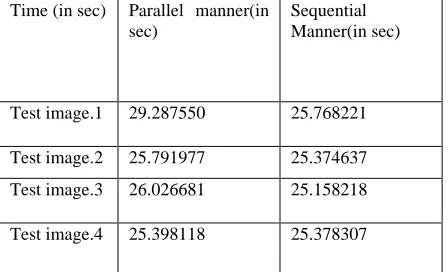
In experiment we have taken four images for testing purpose, in which two are color images and two are gray scaled images, and these test images are shown in figure2, TestImage1, Testimage2, Testimage3, Testimage4, result is shown in Output Image1, OutputImage2, OutputImage3,
Output Image4, first we performed the experiment using sequential lexicographic sorting, then in parallel lexicographic sorting method, and the simulation result and Performance of both sequential and parallel schemes were analyzed.in fig 2, the red Block Shows the copied region and the green block shows moved region
Time (in sec) Parallel manner(in sec)
Sequential Manner(in sec)
Test image.1 29.287550 25.768221
Test image.2 25.791977 25.374637
Test image.3 26.026681 25.158218
Test image.4 25.398118 25.378307
Table 1: Execution Time Of Test Images In Parallel Manner And In Sequential Manner
6. CONCLUSION
This paper show that the copy move forgery detection in parallel environment has reduced the execution time and also this method can be able to detect the forgery in color images and this method given the results with high accuracy and robustness.
REFERENCE
1) Salam A.Thajeel And Ghazali Bin Sulong” State Of The Art Of Copy Move Forgery Detection Technique: A Review” international journal of computer science issues-2013
2) A.c.popscu and h.farid “Exposing Digital Forgery Images By Detecting Duplicated Image Regions”
3) Ms.P.G Gomase, Ms.N.R Wankhade” Advanced Digital Image Forgery Detection: A Review” International Conference On Advances In Engineering &Technology-2014
4) Kusam, Pawanesh Abrol And Devanand“ Digital Tampering Detection Techniques: A Review “International Journal Of
Information Technology Ghulam muhmmad ,muhmmad hussain and George babis ”Blind Copy Move Image Forgery Detection Using Dyadic Undecimated Wavelet Transform” Tehseen Shahid,Atif Bin Mansoor”Copy
5) Salam A.Thajeel And Ghazali Bin Sulong” State Of The Art Of Copy Move Forgery Detection Technique: A Review” international journal of computer science issues-2013
6) A.c.popscu and h.farid “Exposing Digital Forgery Images by Detecting Duplicated Image Regions”.
7) Salam A.Thajeel And Ghazali Bin Sulong” State Of The Art Of Copy Move Forgery Detection Technique: A Review” international journal of computer science issues-2013
8) A.c.popscu and h.farid “Exposing Digital Forgery Images By Detecting Duplicated Image Regions”
9) Ms.P.G Gomase, Ms.N.R Wankhade” Advanced Digital Image Forgery Detection: A Review” International Conference On Advances In Engineering &Technology-2014
10) Kusam, Pawanesh Abrol And Devanand“ Digital Tampering Detection Techniques: A Review “International Journal Of Information Technology
11) Ghulam muhmmad, muhmmad hussain and George babis”Blind Copy
Move Image Forgery Detection Using Dyadic Undecimated Wavelet Transform” Tehseen Shahid,Atif Bin Mansoor”Copy Move Image Forgery Detection Algorithm For Digital Images And A New Accuracy Metric”.
12) Tushant A Kohale ,P.R.Lakhe, Dr.S.D.Chede” Detection Of Post operated Copy Move Image Forgery by Integrating Block Based and Feature Based Method “International Journal of Advanced Research in Computer Science and Software Engineering-2014
AUTHOR PROFILE
Vikas Shivapuje is pursuing M.Tech in Computer Network Engineering at BMS College of Engineering, Bangalore; his area of interest is image forensic