Blockchain Protocol
Cencen Wan, Shuyang Tang, Yuncong Zhang, Chen Pan, Zhiqiang Liu⋆⋆, Yu Long⋆⋆, Zhen Liu⋆⋆, Yu Yu⋆⋆
Department of Computer Science and Engineering, Shanghai Jiao Tong University, China
{ilu_zq, longyu, liuzhen}@sjtu.edu.cn, [email protected]
Abstract. Proof of Work (PoW), a fundamental blockchain protocol, has been widely applied and thoroughly testified in various decentral-ized cryptocurrencies, due to its intriguing merits including trustwor-thy sustainability, robustness against Sybil attack, delicate incentive-compatibility, and openness to any participant. Meanwhile, PoW-powered blockchains still suffer from poor efficiency, potential selfish mining, to-be-optimized fairness and extreme inconvenience of protocol upgrading. Therefore, it is of great interest to design new PoW-driven blockchain protocol to address or relieve the above issues so as to make it more applicable and feasible. To do so, we present Goshawk, a novel hybrid consensus protocol, in which a two-layer chain structure with two-level PoW mining strategy and a ticket-voting mechanism are elaborately com-bined. We show that this newly-proposed protocol has the merits of high efficiency, strong robustness against “51%” attack of computation power, as well as good flexibility for future protocol updating. As far as we know, Goshawk is the first blockchain protocol with these three key properties. Last but not the least, this scheme has been implemented and deployed in the testnet of the public blockchain project Hcash1 for months, and has demonstrated its stability and high efficiency with such real-world test.
Keywords: Blockchain, Consensus Protocol, Proof of Work, Ticket-voting Mechanism, Hybrid Consensus
1 Introduction
To date, Bitcoin [27] and a variety of other cryptocurrencies have drawn much attention from researchers and fintech industry. Their attractive innovations show great promise of fundamental change in payments, economics and politics around the world [28,39]. Recently, cryptocurrencies’ global market capitaliza-tions have reached more than $250 billions [5]. The blockchain technique, which is the underlying technique of various decentralized cryptocurrencies, is an in-genious combination of multiple technologies such as peer-to-peer network, con-sensus protocol over a distributed network, cryptographic schemes, and so on.
This technique provides a decentralized way to securely manage ledgers, which is fundamental for building trust in our social and economic activities.
Proof of Work (PoW), which relies on computational puzzles (a.k.a. moder-ately hard functions) introduced by Dwork and Naor[12], is a blockchain pro-tocol used to maintain the consistency of distributed ledger in a decentralized setting so as to prevent fraud and double-spending attacks. So far it has been implemented in 250 cryptocurrencies or more such as Bitcoin, Ethereum, and so on, serving as the underlying blockchain protocol. PoW has amazing features including trustworthy sustainability, robustness against Sybil attack, delicate incentive-compatibility, and openness to any participant (i.e., participants could join and leave dynamically), though it still needs to be improved in the following aspects:
– Efficiency.The transaction throughput of PoW-driven blockchain does not scale well. For instance, Bitcoin supports very limited transaction through-put (say, up to 7 transactions per second [2]), while the demand from prac-tical applications is much higher (MasterCard and VISA are reported to process 1200 to 56000 transactions per second).
– Fairness. PoW-based blockchains have been criticized for the potential of centralization of computation power [28]. Even a minor enhancement in fair-ness is welcome, since it provides fewer incentives for miners to join forces to enjoy the advantage of mining in a larger pool. This mitigates the cen-tralization of the mining power, thus improving the security property of blockchains.
– Robustness.It is known that in PoW protocol, selfish mining attack [15,13,29] allows that adversaries deviating from the protocol may gain a disproportion-ate share of reward, much more than they deserve. Besides, PoW protocol is intrinsically subject to “51%” attack of computation power.
– Flexibility.In practice, it is extremely difficult to fulfill blockchain protocol evolution. For example, modification to scale up existing protocol is a raging debate in the Bitcoin community [18,6,17,31].
classical Byzantine consensus protocol [25], which leads to throughput scaling. The key idea in this approach is to partition the network into smaller commit-tees, each of which processes a disjoint set of transactions. Each committee has a reasonably small number of members so they can run a classical Byzantine con-sensus protocol to decide their agreed set of transactions in parallel. The fourth approach is to perform transactions off the chain, such as lightening network[32], raiden network [1], and so on [11,26,21]. These works allow for extensive payment networks where transactions can be performed efficiently and scalably without trusted middlemen, especially targeting on fast micropayments. Moreover, Eyal et al. proposed Bitcoin-NG [14], a scalable blockchain protocol, by introducing a two-layer chain structure which consists of keyblocks and microblocks. Bitcoin-NG boosts transaction throughput by decoupling PoW protocol into two planes: leader election and transaction serialization. Once a miner generates a keyblock by solving the computational puzzle, he is elected as a potential leader and en-titled to serialize transactions into microblocks unilaterally until a new leader is chosen. Although the above approaches provide some interesting ideas for improving PoW protocol, they mainly focus on the efficiency issue related to PoW.
On the other hand, alternative blockchain protocols have been introduced to replace PoW. Among them the most promising ones may be the Proof of Stake (PoS) [34,23] and its variants such as Snow White [7], Ouroboros [22], Ouroboros Praos [10] and Algorand [20]. PoS protocol grants the right of gener-ating blocks to stakeholders instead of miners with computational power. Specif-ically, in PoS protocol, rather than miners investing computational resources in order to participate in the leader election (i.e., block generation) process, they instead run a process that randomly selects one of them proportionally to the stake that each possesses according to the current blockchain ledger. The ratio-nale behind PoS is that stakeholders are motivated to maintain the consistency and security of blockchain, since the value of their stake will shrink when these properties are compromised. Although PoS protocol owns intriguing potential, its practicality, applicability and robustness still need to be examined exten-sively via a mass of public blockchains implementing PoS as their underlying protocol before it is widely admitted. Another interesting direction is to adopt DAG(Directed Acyclic Graph)-based framework instead of blockchain structure to acquire high throughput by exploiting the high concurrency nature of DAG structure [9,24,33]. However, to date, there has not been any rigorous security guarantee for DAG-based distributed ledger technology, thus the security of this technology needs to be investigated further.
1.1 Our Contribution
In this work, we propose Goshawk, the first brand-new candidate of PoW-powered blockchain protocol with high efficiency, strong robustness, as well as good flexibility. Goshawk is actually a hybrid consensus protocol, in which a two-layer chain structure with two-level PoW mining strategy and a ticket-voting mechanism are combined delicately. More specifically, we adopt the two-layer chain structure (i.e., keyblocks/microblocks) given in Bitcoin-NG, and further improve it by introducing two-level PoW mining strategy (i.e., keyblocks and microblocks with two different mining difficulties, respectively). This guaran-tees the high throughput of our scheme, while obviating the vulnerability to the attack of microblock swamping in Bitcoin-NG. Furthermore, we borrow the idea of the ticket-voting approach presented in DASH[3] and Decred[4], and refine this idea by formalizing it into a more rigorous mechanism, then we com-bine this mechanism with the above chain structure elaborately to attain strong security and good flexibility. Security analysis of our scheme shows that it is incentive-compatibility, and robust against selfish mining and “51%” attack of computation power. Besides, we demonstrate that our scheme also allows good flexibility for future protocol updating effectively. At last, this scheme has been implemented and deployed in the testnet of the public blockchain project Hcash for months, and has demonstrated its good stability and promising scalability with such real-world test. This also suggests the interesting potential that our scheme could be employed in next-generation cryptocurrencies.
1.2 Paper Organization
The remainder of the paper is organized as follows. Sec.2 presents Goshawk, a novel hybrid consensus protocol. Then we analyze the security of this protocol in Sec.3. Further, we introduce a two-phase upgrade process to demonstrate the flexibility of Goshawk in Sec.4. The protocol evaluation and performance test of Goshawk in a real-world setting are shown in Sec.5. Finally, we conclude our work in Sec.6.
2 The Goshawk Protocol
The Goshawk protocol extends the Bitcoin-NG scheme, which significantly im-proves the scalability of Bitcoin by introducing a two-layer chain structure con-sisting of keyblocks and microblocks, while avoiding the microblock swamping attack in Bitcoin-NG2. Besides, Goshawk adopts ticket-voting mechanism
elab-orately to achieve strong security and good flexibility. Tab. 1 presents some of the notations used in this section.
2 Considering the cheap and quick generation of microblocks, a leader can swamp the system with
Notation Description
D The confirmations required for tickets maturity E The maximum number of tickets per keyblock F The price adjustment function
L System optimal size of ticket pool
N The number of tickets selected by each keyblock P The Ticket price
P The function mapping keyblock toN tickets
R The initial key height of the ticket-voting mechanism S Total amount of stakes
T The average keyblock generation interval
TP The ticket pool
Table 1.Table of Notations
2.1 Two-level Mining Mechanism
Similar to the idea of subchains [38,35], we propose a two-level mining mecha-nism, in which we set two levels of difficulty for computation puzzle, to address the microblock swamping attack on Bitcoin-NG. Solving the puzzle with low difficulty allows a miner to generate a microblock. While if the solution simul-taneously meets the requirement of higher difficulty, the resulting block is a
keyblock. The ratio of mining difficulty between keyblock and microblock is set to bem. If the average keyblock generation interval isT, then the average mi-croblock generation interval ist=T /m.
Afork happens when multiple blocks follow the same parent. In that case, we say the blockchain has more than one branches. We define main chain as the branch containing the most keyblocks. If there are more than one branches that satisfy the condition above, a miner will select one of them randomly as the main chain. This is called the longest keyblock chain rule. We define theheight
of a block (either keyblock or microblock) as the number of blocks preceding it and the key height of a block as the number of keyblocks preceding it, in the same branch.
Definition1 presents the structure of the block in our scheme.
Definition 1 (Block Structure I). We define a block, denoted by B, as the following tuple
B= (Htip,B, Htip,K, h, k,{tx}, n)
where
– Htip,B is the hash of previous block (either keyblock or microblock);
– Htip,K is the hash of previous keyblock;
– his the block height; – kis the key height;
– {tx} is the transaction set contained in the block; – nis the nonce found by the miner.
B is a valid keyblock ifHash(B)≤TK, whereTK is the threshold of computation
puzzle for keyblock;B is a valid microblock if TK <Hash(B)≤TM, where TM
We denote the block being mined by minerP asBtemp. LetHtemp=Hash( Btemp). MinerPincrementsnstarting from0, untilHtemp≤TM. IfHtemp ≤TK,
P broadcasts Btemp as a new keyblockKnew, otherwise P broadcast Btemp as
a new microblockMnew. Other participants determine whether a received block
is a keyblock or microblock depending on its hash value, and update their main chain according to the longest keyblock chain rule. It can be easily inferred that in our two-level mining mechanism, for miners mining both keyblocks and microblocks, no additional computation power needs to be consumed compared with miners only mining keyblocks.
Fork. Since mining microblock is relatively easy, microblock forks frequently. However, once a new keyblock is created, all honest nodes will follow the chain with the most keyblocks and such forks vanish. The new scheme will also ex-perience keyblock forks, which happens rarer than microblocks. The duration of such a fork may be long and the fork finally dissolved in several keyblock confirmations. Though the works for microblocks contribute nothing to the se-lection of branches, it is hard enough for spaming. According to the common prefix property described in [16], we declare a block is stable if we prune all of the blocks after it in the main chain, the probability that the resulting pruned chain will not be mutual prefix of other honest miners’ main chain is less than a security parameter2−λ.
2.2 Ticket-voting Mechanism
In our scheme, we refine the idea of ticket-voting approach given in DASH and Decred to make it more applicable by formalizing it into a more rigorous mech-anism. The core idea is stakeholders purchase ticket by locking their stakes to proportionally obtain rights for a future vote. The ticket structure is presented in Definition2 and vote structure is presented in Definition3.
Definition 2 (Ticket Structure). We define ticket a special transaction, de-noted by tk, as the following tuple
tk= (⟨Hash(tx), i, sig⟩,⟨P, pk⟩)
where
– ⟨Hash(tx), i, sig⟩ is the input of ticket;
– txis a transaction as the source of funding for ticket purchasing ;
– iis the order of output intx. The amount of stakes in this output must larger thanP;
– sig is the signature used to verify input;
– ⟨P, pk⟩is the output of the ticket which will lock P stakes for ticket purchas-ing;
– P is a certain amount (called ticket price) of stakes locked for purchasing ticket;
Only tickets contained in keyblocks are considered valid. The number of tickets contained in each keyblock is limited toE such that no one can spam tickets into blockchain.
Definition 3 (Vote Structure).We define vote a special transaction, denoted by vt, as the following tuple
vt= (⟨Hash(tk), sig⟩,⟨V, pk⟩)
where
– ⟨Hash(tk), sig⟩is the input of vote; – tk is the ticket for voting;
– ⟨V, pk⟩is the output of the vote which will refund the locked stakes; – V is a specific amount of rewards.
Ticket Pool. A ticket is considered mature, denoted by mtk, if the keyblock containing it gets at least D confirmations, i.e., it becomes stable. If a mature ticket was spent on voting, we denote it by stk. We call the set of all unspent mature tickets the ticket pool, denoted by TP, i.e, TP= {mtk} \ {stk}. Since tickets inTPare stable, the sets ofTPin different branches with the same key height are exactly the same.
Validation Rule. A keyblock is considered valid only if a majority (more than half) of its votes are collected by its successive keyblock. We stipulate that miners can only mine after a validated keyblock (or a microblock preceded by a validated keyblock) by collecting votes as a validation proof for this keyblock, which is called the validation rule. If a keyblock is not validated by majority votes, miners would ignore this keyblock.
The ticket-voting mechanism is divided into the following four steps. – Participants purchase tickets which will be added to the ticket pool afterD
confirmations.
– Each latest keyblock is mapped intoNrandom tickets fromTPvia a function P which is defined in Definition4.
– Owners of selected tickets issuevotes, if the corresponding keyblock is valid. – Miners collect votes and select mining strategies according to the validation
rule.
Definition 4 (Mapping Function).We define a mapping function
P(TP,Hash(K)) ={tkj}j∈[N] = argmax tk1,···,tkN∈TP
{N ∑
i=1
Hash(Hash(tki)⊕Hash(K)) }
whereK is a keyblock.
Ticket Price Adjustment Function. Ticket price is automatically adjusted by the functionF(|TP|, P, L)which takes as input the size ofTP, current ticket pricePand a parameterL. The initial ticket price is set as a system parameter.F returns a new priceP′which increases exponentially compared toP if|TP|> L, while decreases when|TP|< L. Therefore, when|TP|> L, users are reluctant to purchase tickets, while if|TP|< Lusers are more willing to. In this way, the size ofTPfluctuates aroundL, thus on average each ticket waits time(L/N+D)×T
before it is chosen.
A stakeholder with apfraction of total stakes gains a disproportionate ad-vantage by engaging in ticket purchasing if others do not devote all their stakes into tickets. To reduce such advantage, L should be large enough such that
L×P ≈S/f, whereS is the total amount of stakes andf is a constant greater than 1. A stakeholder who holds β fraction of the tickets in TP has a proba-bility of M(N, β)to reach majority in the chosen tickets of a keyblock, where
M(N, β) =∑Ni=⌊N/2⌋+1(Ni)βi(1−β)N−i.
On startup, PoW is the only consensus protocol because ticket pool is empty at the beginning of the chain. The ticket-voting mechanism begin at key height
R which is selected such thatR=L/E+D.
2.3 Goshawk: Hybrid Consensus Scheme
By delicately combining the improved two-layer blockchain structure with the ticket-voting mechanism mentioned above, we construct a novel hybrid consensus scheme, Goshawk. The new block structure is presented in Definition 5. Definition 5 (Block Structure II). We define a block, denoted byB, as the following tuple
B= (Htip,B, Htip,K, h, k,{tx},{tk},{vt}, n)
whereHtip,B,Htip,K,h,k,{tx},nare as in Definition 1.
Compared to the mining process described in Section2.1, in this combined scheme, the miner P needs to take the following additional steps.
– In addition to the transaction{tx},Btemp also contains a set of ticket
pur-chasing transactions{tk}, which were collected and stored locally byP sim-ilar to ordinary transactions.
– P collects at least⌊N/2⌋+ 1votes for the previous keyblock (whose hash is
Htip,K), and put this set of votes{vt}intoBtemp. IfP fails to collect enough
votes forHtip,K, it abandons this keyblock and continue to mine after the previous keyblock.
– The{tk} and {vt} will be ignored if Btemp turns out to be a microblock,
since they are only valid in keyblocks.
When a newly generated keyblockKnewis broadcast, those stakeholders
cho-sen by this keyblock check this keyblock, issuing and broadcasting votes if it is valid. Other miners collect these votes and switch to mine afterKnew as soon as
the votes satisfy the majority rule. The mining process is described in Algorithm
Incentive Mechanism. Block reward is divided into two parts, a ratio w to keyblock miners, the rest to the voters, therefore each voter earns(1−w)/Nof the block reward. Block rewards are spendable only after the containing keyblock is followed byD keyblocks. To encourage keyblock miners to collect as many votes as they can, the actual block reward a miner earned is based on how many votes it collects. For example, if M votes are collected, (1−w)M/N is the precise reward. If a voter misses to vote, it also misses the reward. Microblock miners share the transaction fees, which is split into three parts, where 60% is given to the miner whose block (either keyblock or microblock) contains the transaction, 30% to the next block and 10% to the next keyblock.
Algorithm 1Mining process in Goshawk 1: procedureMining
2: loop:
3: Btemp←Htip,B∥Htip,K∥h∥k∥n∥{tx}∥{tk}∥{vt} 4: if Hash(Btemp)≤TK then
5: Knew←Btemp 6: P broadcastKnew
7: else if Hash(Btemp)≤TM then 8: Mnew←Btemp
9: P broadcastMnew 10: end if
11: if P recievedKnewandReceiveMajorityVotesOf(Knew) 12: andIsTipOfMainChain(Knew)then
13: Htip,B←Hash(Knew) 14: Htip,K←Hash(Knew) 15: h←GetHeightOf(Knew) + 1 16: k←GetKeyHeightOf(Knew) + 1 17: else if P recievedMnew
18: andReceiveMajorityVotesOf(GetPreviousKeyBlockOf(Mnew)) 19: andIsTipOfMainChain(Mnew)then
20: Htip,B←Hash(Mnew)
21: Htip,K←Hash(GetPreviousKeyBlockOf(Mnew)) 22: h←GetHeightOf(Mnew) + 1
23: k←GetKeyHeightOf(Mnew) 24: end if
25: n←n+ 1
26: gotoloop. 27: end procedure
3 Security Analysis
Add Select Vote Ticket Pool
Transactions
Transactions Ticket Purchase Ordinary
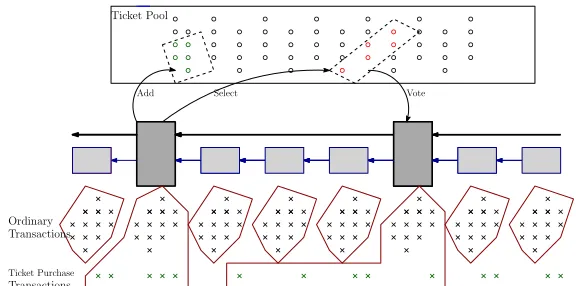
Fig. 1.The structure of Goshawk. The tickets are denoted by dots, the transactions are denoted by cross marks, the keyblocks are denoted by big rectangles, and the microblocks are denoted by small rectangles. A keyblock contains transactions and add tickets into ticket pool. Meanwhile, a keyblock pseudo-randomly selects tickets which will be removed from ticket pool. Chosen stakeholders vote for keyblock to validate it and votes will be contained by the next keyblock.
3.1 Incentive Compatibility
We show that our Goshawk scheme is incentive-compatible (i.e. each participant benefits nothing from deviating from the protocol) under the assumption that all participants are rational.
Strategy of rational participants. In this part, we show that all rational participants obey the mining rule. That is, rational participants always mine on the latest validated block. In another word, any participant gains no marginal revenue by deviating from the rule above (i.e. the Nash equilibrium of Goshawk). The latest valid block can be a keyblock or a microblock, in the following, we will discuss the rational strategies for each case respectively. Tab.2presents some of the notations used subsequently.
Notation Description
a The fraction of transaction fee included in one block for the current block owner
b The fraction of transaction fee included in one block for the next block owner
B The block reward for a keyblock
c The fraction of transaction fee included in one block for the next keyblock owner
F Total transaction fees included in one block
m The difficulty ratio, i.e. the ratio of difficulties of mining a key-block and mining a microkey-block
q The probability for one miner to generate the next block, and this block is keyblock
ΣFprev
Fpm Fpk Fnow
A E
B C D
Fig. 2.Mining Strategy in Case 1.
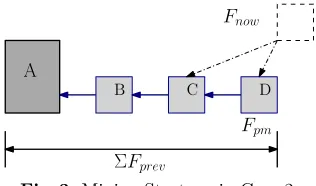
Case 1. A keyblock as the latest valid block. As shown in Fig.2, when the latest valid block is a keyblock, one participant may mine after the latest keyblock (blockE), or after the previous microblock (blockD) to reach a higher revenue. We compare the expected revenues with two strategies above and prove that following the longest keyblock rule (i.e. mining after blockE) is the ratio-nal choice. In the following discussion, we use q to denote the probability of one participant’s generating the next block and the block is keyblock, then its probability for her to generate the next block and the block is a microblock is (m−1)q. Also, we assume each keyblock contains block reward B, and each block (keyblock or microblock) contains the same amount of transaction feeF. For distinction, we denote the transaction fee in a microblock by Fpm, the fee
in a keyblock by Fpk, and the fee in the block currently being mined by Fnow.
Moreover, ΣFprev (ideally ΣFprev ≈ mF) denotes the sum of all transaction
fees included from the previous keyblock (block A in Fig. 2) to the previous microblock (blockD).
Mining a keyblock Mining a microblock Block E (a+c)×Fpk+b×Fnow+B a×Fpk+b×Fnow
Block D c×ΣFprev+a×Fpm+b× Fnow+B
a×Fpk+b×Fnow
Table 3.Revenues Following BlockE orD.
Hence, the expected revenue following the right block (blockE) is
R=q×((a+c)×Fpk+b×Fnow+B) + (m−1)q×(a×Fpk+b×Fnow)
=q×((a+c)×F+b×F+B) + (m−1)q×(a×F+b×F)
= ((1−c)×m+c)q×F+q×B.
to this, the expected revenue via mining after blockD is
R′< 1
2 ×q×(c×ΣFprev+a×Fpm+b×Fnow+B)
+1
2 ×(m−1)q×(a×Fpk+b×Fnow)
= 0.5mq×F×(a+b) + 0.5q×c×ΣFprev+ 0.5q×B.
Obviously,ΣFprevis related to the number of microblocks between two
key-blocks. Let X be a random variable which denotes the number of microblocks between two keyblocks. Then,Xfollows a geometric distribution with parameter
m. Thus, we have:P(X=k) = m1(1−m1)k−1.For a given parameterθ, we can get:
P1:=
∞
∑
k=θ
P(X =k) =
∞
∑
k=θ 1
m(1−
1
m)
k−1= (1− 1
m)
θ×m−1
This probability P1 increases in m, and we have limm→∞P1 = e−θ. Thus, we get P1 < e−θ. If we set parameter θ = 5, the probability that there are 5m microblocks between two keyblocks is under0.62%, which is small. According to above analysis,ΣFprev≤5mF, (ideallyΣFprev≈mF). Thus,
R′ <0.5mq×F×(a+b) + 0.5q×c×ΣFprev+ 0.5q×B
<0.5mq×F×(1 + 4c) + 0.5q×B.
LettingR > R′, we get1
2(1+4c)<1−cand hencec < 1
6. In our implementation, we selecta= 0.3, b= 0.6, c= 0.1. Then, the expected revenue following the right block (blockE) is
R≈((1−c)×m+c)q×F+q×B = (0.9m+ 0.1)q×F+q×B.
And the expected revenue via mining after blockD is
R′<0.5mq×F×(1 + 4c) + 0.5q×B≈0.7mq×F+ 0.5q×B.
ObviouslyR′< R, which leads to the conclusion that the rational strategy is to follow the right blockE.
Case 2. A microblock as the latest valid block. In the second case (as shown in Fig.3), one miner may mine a block followingCorD. However, all the revenues received by followingCcan also be received by followingD. Moreover, the miner will lost transaction fees of block D, if it mines after block C and successfully finds a keyblock. For this reason, rational participants always mine after the latest block in this case.
3.2 Robustness
ΣFprev
Fpm Fnow
A
B C D
Fig. 3.Mining Strategy in Case 2.
In this part, microblocks are not considered since they have nothing to do with the forks of the main chain. Therefore, we directly use “block” in place of “keyblock” when no ambiguity exists. In a purely PoW-based cryptocurrency like Bitcoin, the probability of one participant’s undermining the system is roughly same as the fraction of its computation power among all participants. This is the fault-tolerance property of PoW. However, in a hybrid scenario, the description of the fault-tolerance property is more sophisticated. To begin with, we propose a definition.
Definition 6 (φ-fault-tolerance). For a binary functionφ: [0,1]×[0,1]→ [0,1], a cryptocurrency scheme achieves φ-fault-tolerance, if and only if for any adversary withαfraction of total computation power andβfraction of total stake, its probability of successfully proposing an invalid block should be no greater than
φ(α, β).
From this definition, we can formally analyze the fault-tolerance of our newly proposed Goshawk consensus scheme.
Theorem 1 (Fault-tolerance of Goshawk). Goshawk achieve an
αγ(β)
1−α−γ(β)+2αγ(β)-fault-tolerance, whereγ(β) = ∑N
i=xN/2y+1 (N
i )
βi(1−β)N−i,N
is number of tickets each block selects.
Proof. Sinceφ(α, β)is an upper-bound of adversary’s advantage, we can assume that all malicious computation power and stakes are held by one single adversary. By the definition of fault-tolerance, the adversary with computation power of rateαand stake of rateβ tries to mine an invalid block and proposes this block (i.e. the malicious block is voted by most corresponding ticket voters, since honest voters will not vote to invalid blocks, this equals to having at least half voters controlled by this adversary). Also, the adversary does not vote on all blocks generated by honest parties.
For simplicity, we define the following three events.
– EA: A keyblock is found by the adversary, and more than half of its corre-sponding tickets are controlled by the adversary.
– EB: A keyblock is found by the adversary, while more than half of its cor-responding tickets are at hands of honest parties.
From here, we can calculate the upper-bound of adversary’s chance of propos-ing an invalid block. Obviously,
φ(α, β) =
∞
∑
i=1
(Pr[EB∨EC])i−1Pr[EA] =
∞
∑
i=1
(α(1−γ) + (1−α)γ)i−1αγ
= αγ
1−α−γ+ 2αγ
whereγ is the probability that most corresponding tickets regarding to one block is held by the adversary:γ(β) =∑Ni=xN/2y+1(Ni)βi(1−β)N−i.
We can observe that whenγ = 1, the adversary can successfully deny any blocks not proposed by herself, and henceφ(β) = 1. On the contrary, whenγ= 0, any adversary block is denied by honest participants, and therefore φ(β) = 0. These are satisfied in case ofφ(α, β) =1−α−γ(β)+2αγ(β)αγ(β) .
For any adversary withαfraction of total computation power andβ fraction of total stake, to perform a “51%” attack , it should at least attainφ(α, β)> 1
2. That is, αγ
1−α−γ+2αγ > 1
2 ⇐⇒ α > 1−γ. Assuming that β = 20%, N = 5, thenγ≈6%, and the adversary must have over1−γ≈94%total computation power to successfully launch a “51%” attack.
Selfish Mining Resistance. In a purely PoW-based cryptocurrency system, the selfish mining can be relatively easily performed by continuously mining in a separated environment, and is thereby hard to notice, and hard to pre-vent. For instance, an adversary with more than 1/3 total hash rate (instead of1/2) can launch the selfish mining attack. However, in Goshawk, a block has to be validated by corresponding voters. That is to say, to secretly mining a continuous sequence of blocks, a block is only “useful” when its correspond-ing tickets are mostly held by itself. Formally, to prevent adversary’s launch-ing the selfish minlaunch-ing attack, instead of purely PoW-based cryptocurrencies’
α < 13 (see explanation in [15]), we have an upper boundφ(α, β)< 13. That is, αγ
1−α−γ+2αγ < 1
3 ⇐⇒ α < 1−γ
1+γ. Supposingβ = 20%, N = 5, then γ≈6%, and the adversary has to attain 1−γ
1+γ ≈89%overall computation power to launch the selfish mining attack.
4 Flexibility of Protocol Upgrade
Algorithm 2two-phase upgrade process 1: procedureUpgrade
2: isVote←0
3: voteBegin←0
4: expire←3
5: loop:
6: if keyHeight modW = 0andMeetUpgradeRequirement()then 7: voteBegin←1
8: end if
9: if voteBegin= 1andisVote= 0andTicketIsSelected()then 10: VoteForUpgrade()
11: isVote= 1
12: end if
13: if keyHeight modW = 0andvoteBegin= 1then 14: if VoteFailed()then returnfalse
15: else if VotePassed()then
16: ActiveUpgradeAfterNextRCI()returnfalse
17: else
18: if expire>0then 19: expire←expire−1
20: isVote= 0
21: else returnfalse 22: end if
23: end if 24: end if 25: gotoloop. 26: end procedure
the Bitcoin community and is not well settled yet. The reason why hardfork changes are difficult to implement is that stakeholders can not participate fairly in the protocol upgrade events which is usually determined by a small group of powerful parties such as core developers, wealthy participants and influen-tial organizations. If some participants refuse to upgrade, a permanent fork will emerge.
Inspired by DASH and Decred, we introduce a two-phase upgrade process to grant decision-making power to each stakeholder via ticket-voting mechanism, activating the hardfork changes if the protocol upgrade wins the voting. We denote every W keyblock intervals by a Rule Change Interval (RCI). The two-phase upgrade process is described in Algorithm 2.
must have the latest vote version. Once upgrade threshold is met, the voting is scheduled to begin from the first keyblock of the next RCI.
Second Phase. The second phase is the actual voting. There are at most
W×N votes cast during a single RCI. The final keyblock of the RCI tallies the votes within the RCI, and determines outcomes prior to the next keyblock being mined. Possible outcomes are as follows:
– If the number of votes fail to meet the Yes (or No) majority threshold (i.e.,
zpercent of votes are Yes� (or No)), the voting process keeps on for the next RCI.
– If the number of votes reach the Yes majority threshold, the voting process exits and the hardfork changes will activate after next RCI (the next RCI is set aside for unupgraded users to upgrade).
– If the number of votes reach the No majority threshold, the voting process exits and the hardfork changes will never activate.
– If the voting process never reaches the majority vote threshold inZrounds of RCI, the voting process expires and the hardfork changes will never activate.
With the design of the two-phase upgrade process, stakeholders fairly par-ticipate in the protocol upgrade. Successful hardfork changes, which obtain the majority of votes, smoothly accomplish activation and implementation, while failed changes would naturally be buried. The upgrade for the benefit of the majority achieves healthy evolution of the blockchain ecology.
5 Protocol Evaluation and Performance Test
Implementation. This scheme has been implemented by Hcash. The source code of Hcash can be found in Github3. We deployed a global network (the
testnet) to test our code of Hcash. The testnet was maintained for three months, during which we have simulated various possible attacks and a pressure test on this network. Results show that our scheme is practical and robust within all scenarios under our considerations.
The Testnet. The testnet was deployed and maintained from September29th to December21st of 2017. The block size was set to be2MBand keyblocks were generated every 5 minutes. The difficulty of mining a microblock was 1
32 that of keyblock, i.e., TM/TK = 32 (except for the pressure test, where the block size and TM/TK were variables). The expected volume of the ticket pool was 40960 tickets. Each keyblock was voted by 5 randomly selected tickets, adding at most 20 new tickets into the ticket pool. Each ticket became mature after the generation of 128 new keyblocks.
We deployed 9 nodes as DNSSeeds via cloud services provided by Alibaba
and Amazon4, located in Beijing, San Francisco, Shanghai, Shenzhen, Sidney,
3 https://github.com/HcashOrg/hcashd
Fig. 4.Deceleration of Chain Growth under Different Percentage of Malfunction Voters
Singapore, and Tokyo, respectively. In particular, 25 nodes were physically de-ployed in Shanghai to constitute the network. Moreover, during the test period of three months, hundreds of nodes were detected to join and leave the network dynamically from over ten countries worldwide. In another word, the testnet had experienced complex conditions, hence its robustness has been thoroughly tested.
Malfunction of Voters. As described in our protocol, each keyblock is vali-dated by certain voters, each corresponding to one randomly selected element of the ticket pool. In practice, a certain fraction of selected voters might be malfunction nodes, who fail to broadcast its vote due to either a breakdown or malicious purposes. In this case, some keyblock may not be validated by enough votes and hence the growth rate of the chain is reduced. To simulate this, we randomly had certain voters withhold their votes. As a result of our simulations, Fig.4shows the deceleration rate of chain growth (the resultant growth rate of keyblocks over the rate without malfunction) varying according to different per-centages of malfunction voters. Obviously, such a malfunction affects the chain grow rate to only a minor extent even if20% voters fall into a malfunction.
Blockchain Keyblock Interval Block Size Microblock Interval Transaction Size Throughtput(TPS)
Bitcoin 10 min 1 MB • – 250 B ◦ 7 •
Ethereum 15 s – – – 25 ⋆
Decred 5 min 0.384 MB • – 250 B ◦ 5 • Goshawk 5 min 2 MB • 18.75 s 250 B ◦ 270 ⋆ Goshawk 5 min 8 MB • 9.38 s 250 B ◦ 1550 ⋆
Table 4.Throughput Comparison where values marked by•stand for upper bounds,◦for lower bounds,⋆for measurements.
of transactions. This test proceeded for four days, and the results are compared with Bitcoin, Ethereum and Decred as shown in Tab.4.
6 Conclusion
Past experience has proven that PoW fits for various permission-less blockchains very well as a powerful distributed agreement protocol, though it still needs to be improved in the aspects of efficiency, fairness, robustness and flexibility. Consequently, many attempts have been made to address or mitigate the issues related to PoW, while the current state of art focuses on the solutions to one or a few parts of the issues and is still far from satisfactory.
In this paper, we proposed Goshawk, the first novel PoW-driven blockchain protocol with high efficiency, strong robustness, as well as good flexibility. Goshawk is actually a hybrid consensus protocol, in which a two-layer chain structure with two-level PoW mining strategy and a ticket-voting mechanism are com-bined delicately. More specifically, we adopted the two-layer chain structure (i.e., keyblocks/microblocks) given in Bitcoin-NG, and further improved it by introducing two-level PoW mining strategy (i.e., keyblocks and microblocks with two different mining difficulties, respectively). This guarantees the high through-put of our scheme, while obviating the vulnerability to the attack of microblock swamping in Bitcoin-NG. Furthermore, we borrowed the idea of ticket-voting approach presented in DASH and Decred, and refined this idea by formalizing it into a more rigorous mechanism, then we combined this mechanism with the above chain structure elaborately to attain strong security and good flexibility. Security analysis of our scheme showed that it is incentive-compatibility, and robust against selfish mining and “51%” attack of computation power. Besides, a two-phase upgrade process was introduced to demonstrate good flexibility of our scheme in protocol upgrading. Finally, our scheme offered good stability and promising scalability in the real-world testnet of the public blockchain project Hcash and suggested strong usability in next-generation cryptocurrencies.
References
1. Raiden network. http://raiden.network/.
2. Scalability. Bitcoin wiki, 2015. https://en.bitcoin.it/wiki/Scalability. 3. Dash official documentation. Dash Core Group, Inc., 2017. https://docs.dash.
org.
4. Decred documentation. Decred Technology website, 2017. https://docs.decred. org/.
5. Cryptocurrency market capitalizations, retrieved Apr.2018. https: //coinmarketcap.com/.
6. G. Andresen. Bitcoin improvement proposal 101, 2015. https://github.com/ bitcoin/bips/blob/master/bip-0101.mediawiki.
8. H.-H. Buerger. Ethereum White Paper, 2016. https://github.com/ethereum/ wiki/wiki/White-Paper.
9. A. Churyumov. Byteball: A decentralized system for storage and transfer of value, 2016. https://byteball.org/Byteball.pdf.
10. B. David, G. Peter, A. Kiayias, and A. Russell. Ouroboros Praos- An adaptively-secure, semi-synchronous proof-of-stake protocol. IOHK paper, 2017.
11. C. Decker and R. Wattenhofer. A fast and scalable payment network with bitcoin duplex micropayment channels. In A. Pelc and A. A. Schwarzmann, editors, Sta-bilization, Safety, and Security of Distributed Systems, pages 3–18, Cham, 2015. Springer International Publishing.
12. C. Dwork and M. Naor. Pricing via processing or combatting junk mail. In E. F. Brickell, editor,Advances in Cryptology — CRYPTO’ 92, pages 139–147, Berlin, Heidelberg, 1993. Springer Berlin Heidelberg.
13. I. Eyal. The miner’s dilemma. InProceedings - IEEE Symposium on Security and Privacy, volume 2015-July, pages 89–103, 2015.
14. I. Eyal, A. E. Gencer, E. G. Sirer, and R. van Renesse. Bitcoin-NG: A Scalable Blockchain Protocol. Inusenix, 2015.
15. I. Eyal and E. G. Sirer. Majority is not enough: Bitcoin mining is vulnerable. In
Lecture Notes in Computer Science (including subseries Lecture Notes in Artificial Intelligence and Lecture Notes in Bioinformatics), volume 8437, pages 436–454, 2014.
16. J. Garay, A. Kiayias, and N. Leonardos. The Bitcoin backbone protocol: Analysis and applications. InLecture Notes in Computer Science (including subseries Lec-ture Notes in Artificial Intelligence and LecLec-ture Notes in Bioinformatics), volume 9057, pages 281–310, 2015.
17. J. Garzik. Bitcoin improvement proposal 102, 2015. https://github.com/ bitcoin/bips/blob/master/bip-0102.mediawiki.
18. J. Garzik. Making decentralized economic policy, 2015. http://gtf.org/garzik/ bitcoin/BIP100-blocksizechangeproposal.pdf.
19. A. Gervais, G. O. Karame, K. Wüst, V. Glykantzis, H. Ritzdorf, and S. Capkun. On the Security and Performance of Proof of Work Blockchains. InProceedings of the 2016 ACM SIGSAC Conference on Computer and Communications Security -CCS’16, pages 3–16, 2016.
20. Y. Gilad, R. Hemo, S. Micali, G. Vlachos, and N. Zeldovich. Algorand: Scaling byzantine agreements for cryptocurrencies. InProceedings of the 26th Symposium
on Operating Systems Principles, SOSP ’17, pages 51–68, New York, NY, USA,
2017. ACM.
21. R. Khalil and A. Gervais. Revive: Rebalancing off-blockchain payment networks.
InProceedings of the 2017 ACM SIGSAC Conference on Computer and
Commu-nications Security, CCS ’17, pages 439–453, New York, NY, USA, 2017. ACM. 22. A. Kiayias, A. Russell, B. David, and R. Oliynykov. Ouroboros: A provably
se-cure proof-of-stake blockchain protocol. In Lecture Notes in Computer Science (including subseries Lecture Notes in Artificial Intelligence and Lecture Notes in Bioinformatics), volume 10401 LNCS, pages 357–388, 2017.
23. S. King and S. Nadal. PPCoin: Peer-to-Peer Crypto-Currency with Proof-of-Stake.
Ppcoin.Org, 2012.
24. S. D. Lerner. Dagcoin: A cryptocurrency without blocks, 2015.https://bitslog. files.wordpress.com/2015/09/dagcoin-v41.pdf.
Conference on Computer and Communications Security, CCS ’16, pages 17–30, New York, NY, USA, 2016. ACM.
26. A. Miller, I. Bentov, R. Kumaresan, and P. McCorry. Sprites: Payment channels that go faster than lightning. CoRR, abs/1702.05812, 2017.
27. S. Nakamoto. Bitcoin: A Peer-to-Peer Electronic Cash System.Www.Bitcoin.Org, page 9, 2008.
28. A. Narayanan, J. Bonneau, E. Felten, A. Miller, and S. Goldfeder. Bitcoin and Cryptocurrency Technologies Introduction to the book. 2016.
29. K. Nayak, S. Kumar, A. Miller, and E. Shi. Stubborn mining: Generalizing selfish mining and combining with an eclipse attack. InProceedings - 2016 IEEE European
Symposium on Security and Privacy, EURO S and P 2016, pages 305–320, 2016.
30. R. Pass and E. Shi. Rethinking large-scale consensus. In2017 IEEE 30th Computer
Security Foundations Symposium (CSF), pages 115–129, Aug 2017.
31. M. E. Peck. Adam back says the bitcoin fork is a coup, 2015. http://spectrum. ieee.org/tech-talk/computing/networks/the-bitcoin-for-is-a-coup. 32. J. Poon and T. Dryja. The Bitcoin Lightning Network: Scalable Off-Chain Instant
Payments. Technical Report (draft), page 59, 2016.https://lightning.network/ lightning-network-paper.pdf.
33. S. Popov. The tangle, 2016.https://www.iotatoken.com/IOTA_Whitepaper.pdf. 34. QuantumMechanic. Proof of Stake Instead of Proof of Work. GitHub, 2011. 35. P. R. Rizun. Subchains: A Technique to Scale Bitcoin and Improve the User
Experience. Ledger, 1:38–52, 2016.
36. A. Sapirshtein, Y. Sompolinsky, and A. Zohar. Optimal selfish mining strategies in bitcoin. InLecture Notes in Computer Science (including subseries Lecture Notes in Artificial Intelligence and Lecture Notes in Bioinformatics), volume 9603 LNCS, pages 515–532, 2017.
37. Y. Sompolinsky and A. Zohar. Accelerating Bitcoin’s Transaction Processing. Fast Money Grows on Trees, Not Chains. IACR Cryptology ePrint Archive, 881:1–31, 2013.
38. TierNolan. Decoupling transactions and pow, 2013. https://bitcointalk.org/ index.php?topic=179598.0.