
Updatable Encryption
with Post-Compromise Security
?Anja Lehmann and Bj¨orn Tackmann??
Abstract. An updatable encryption scheme allows to periodically ro-tate the encryption key and move already existing ciphertexts from the old to the new key. These ciphertext updates are done with the help of a so-called update token and can be performed by an untrusted party, as the update never decrypts the data. Updatable encryption is partic-ularly useful in settings where encrypted data is outsourced, e.g., stored on a cloud server. The data owner can produce an update token, and the cloud server can update the ciphertexts.
We provide a comprehensive treatment ofciphertext-independentschemes, where a single token is used to update all ciphertexts. We show that the existing ciphertext-independent schemes and models by Boneh et al. (CRYPTO’13) and Everspaugh et al. (CRYPTO’17) do not guaran-tee thepost-compromise security one would intuitively expect from key rotation. In fact, the simple scheme recently proposed by Everspaugh et al. allows to recover the current key upon corruption of a single old key. Surprisingly, none of the models so far reflects the timely aspect of key rotation which makes it hard to graspwhenan adversary is allowed to corrupt keys. We propose strong security models that clearly capture post-compromise and forward security under adaptive attacks. We then analyze various existing schemes and show that none of them is secure in this strong model, but we formulate the additional constraints that suffice to prove their security in a relaxed version of our model. Finally, we propose a new updatable encryption scheme that achieves our strong notions while being (at least) as efficient as the existing solutions.
1
Introduction
In data storage, key rotation refers to the process of (periodically) exchanging the cryptographic key material that is used to protect the data. Key rotation is considered good practice as it hedges against the impact of cryptographic keys being compromised over time. For instance, the Payment Card Industry Data Security Standard (PCI DSS) [23], which specifies how credit card data must be stored in encrypted form mandates key rotation, meaning that encrypted data must regularly be moved from an old to a fresh key. Many cloud storage providers
?
An extended abstract of this work appears at Eurocrypt 2018. This is the full and updated version. A summary of the changes made in the update is given at the end of the introduction.
?? Contact:[email protected](Hasso-Plattner-Institut) and[email protected]
that implement data-at-rest encryption, such as Google and Amazon, employ a similar feature [14]. The trivial approach to update an existing ciphertext towards a new key is to decrypt the ciphertext and re-encrypt the underlying plaintext from scratch using the fresh key. Implementing this approach for secure cloud storage applications where the data owner outsources his data in encrypted form to a potentially untrusted host is not trivial, though: Either the owner has to download, re-encrypt and upload all ciphertexts, which makes outsourcing impractical, or the encryption keys have to be sent to the host, violating security.
Updatable Encryption. A better solution for updating ciphertexts has been pro-posed by Boneh et al. [9]: in what they call anupdatable encryption scheme, the data owner can produce a short update token that allows the host to re-encrypt the data himself, while preserving the security of the encryption, i.e., the token allows to migrate ciphertexts from an old to a new key, but does not give the host an advantage in breaking the confidentiality of the protected data. Boneh et al. also proposed a construction (BLMR) based on key-homomorphic PRFs, which essentially is a symmetric proxy re-encryption scheme (PRE) where one sequentially re-encrypts data from one epoch to the next.
While being somewhat similar in spirit, PRE and updatable encryption do have different security requirements: PRE schemes often keep parts of the cipher-texts static throughout re-encryption, as there is no need to make a re-encrypted ciphertexts independent from the original ciphertext it was derived from. In up-datable encryption, however, the goal should be that an updated ciphertext is as secure as a fresh encryption; in particular, it should look like an indepen-dently computed ciphertext even given previous ones. Thus, any scheme that produces linkable ciphertexts, such as the original BLMR construction, cannot guarantee such a security notion capturing post-compromise security of updated ciphertexts.
Ciphertext-Independence vs. Ciphertext-Dependence. In the full version of their paper, Boneh et al. [8] provide security notions for updatable encryption, which aim to cover the desired indistinguishability of updated ciphertexts. To sat-isfy that notion, they have to remove the linkability from the BLMR scheme, which they achieve by moving to the setting of ciphertext-dependent updates. In ciphertext-dependent schemes, the owner no longer produces a single token that can updateall ciphertexts, but produces a dedicated token for each cipher-text. Therefore, the owner has to download all outsourced ciphertexts, compute a specific token for every ciphertext, and send all tokens back to the host.
of decrypting ciphertexts that have not been upgraded yet, whereas keeping the old key too long makes an attack at that time more lucrative—the adversary obtains two keys at the same time. In a ciphertext-independent scheme, the old key can and should be deleted immediately after the token has been derived.
In a recent work [14], Everspaugh et al. provide a systematic treatment for such ciphertext-dependent schemes and observe that computing the token often does not require access to the full ciphertext, but only to a short ciphertext header, which allows to moderately improve the efficiency of this approach. Ev-erspaugh et al. also show that the security notions from [8] do not cover the desired property of post-compromise security of updated ciphertexts. They pro-vide two new security notions and propose schemes that can provably satisfy them. As a side-result, they also propose a security definition for ciphertext-independent schemes and suggest a simple xor-based scheme (XOR-KEM) for this setting.
Ambiguity of Security Models. Interestingly, both previous works phrase the al-gorithms and security models for updatable encryption in the flavor of normal proxy re-encryption. That leads to a mismatch of how the scheme is used and modeled—in practice, an updatable encryption scheme is used in a clear sequen-tial setting, updating ciphertexts as the key progresses. The security model offers more and unrealistic flexibility, though: it allows to rotate keys and ciphertexts acrossarbitrary epochs, jumping back in forth in time. This flexibility gives the adversary more power than he has in reality and, most importantly, makes the security that is captured by the model hard to grasp, as it is not clearwhenthe adversary is allowed to corrupt keys.
Non-intuitive security definitions increase the risk that proofs are flawed or that schemes are unintentionally used outside the security model. And in fact, the way that Everspaugh et al. [14] define security for (ciphertext-independent) schemes is ambiguous, and only the weaker interpretation of their model allows their schemeXOR-KEMto be proven secure. However, this weaker interpretation does not guarantee any confidentialityafter a secret key got compromised, as it allows key corruption only after the challenge epoch. Thus, an updatable scheme that is secure only in such a weak model does not provide the intuitive security one would expect from key rotation: namely that after migrating to the new key, the old one becomes useless and no longer of value to the adversary. To the contrary, all previous keys still require strong protection or secure deletion.
useless after rotation, practitioners can be misled to reduce the safety measures for “expired” keys, which in turn makes key compromises more likely. For the example of Everspaugh et al.’s simple XOR-KEM scheme [14], a compromised old key allows to fully recover the fresh key.
This leaves open the important question how to design a ciphertext-indepen-dent scheme that achieves post-compromise security, capturing the full spirit of updatable encryption and key rotation.
Our Contributions. In this work we provide a comprehensive treatment for
ciphertext-independentupdatable encryption schemes that have clear advantages in efficiency and ease-of-deployment over the ciphertext-dependent solutions. We model updatable encryption and its security in the natural sequential manner that is inherent in key rotation, avoiding the ambiguity of previous works, and clearly capturing all desired security properties. We also analyze the (in)security of a number of existing schemes and finally propose a construction that provably satisfies our strong security notions.
Strong Security Models. We define updatable encryption in its natural form where keys and ciphertexts sequentially evolve over time epochs. To capture security, we allow the adversary toadaptivelycorrupt secret keys, update tokens and ciphertexts in any combination of epochs as long as this does not allow him to trivially decrypt a challenge ciphertext. In our first notion,indistiguishability of encryptions(IND-ENC), such a challenge ciphertext will be a fresh encryption
Cd of one of two messagesm0, m1 under the current epoch key, and the task of
the adversary is to guess the bitd. This is the standard CPA game adapted to the updatable encryption and adaptive corruption setting. Our second notion,
indistiguishability of updates(IND-UPD), returns as a challenge the re-encryption
Cd0 of a ciphertext eitherC0orC1, and an adversary again has to guess the bitd.
In the ciphertext-independent setting, capturing the information that the ad-versary can infer from a certain amount of corrupted tokens, keys and ciphertexts is a delicate matter, as, e.g., an update token allows the adversary to moveany
ciphertext from one epoch to the next. We observe that all existing constructions leak more information than necessary. Instead of hard-coding the behavior of the known schemes into the security model, we propose a set of leakage profiles, and define both the optimal and currently achievable leakage.
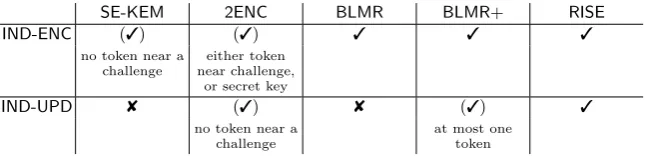
SE-KEM 2ENC BLMR BLMR+ RISE
IND-ENC (3) (3) 3 3 3
no token near a challenge
either token near challenge,
or secret key
IND-UPD 8 (3) 8 (3) 3
no token near a challenge
at most one token
Table 1.Overview of results in this work. (Corruption of secret keys in challenge epochs is forbidden by theIND-ENCandIND-UPDdefinitions. The symbol (3) denotes that a schemes requires additional constraints on the tokens that can be corrupted to achieve the security notion.)
Provably Secure Constructions. We further analyze several schemes according to the new definitions (Sec. 5), the results are summarized in Table 1. First, we consider a simple construction (called2ENC) that is purely based on symmetric primitives. Unfortunately, the scheme cannot satisfy our strong security notions. Yet, instead of simply labeling this real-world solution as insecure, we formulate the additional constraints on the adversarial behavior that suffice to prove its security in relaxed versions of our IND-ENCandIND-UPDmodels.
We then turn our attention to less efficient but more secure schemes, starting with the BLMR construction by Boneh et al. [9] that uses key-homomorphic PRFs. We show that the originalBLMRscheme does satisfy ourIND-ENCnotion but notIND-UPD, and also propose a slight modificationBLMR+ that improves the latter and achieves a weak form of update indistinguishability. WhileBLMR seems to be a purely symmetric solution on the first glance, any instantiation of the underlying key-homomorphic PRFs so far requires modular exponentiations or is built from lattices. The same holds for the recent ciphertext-dependent construction by Everspaugh et al. [14] that also relies on key-homomorphic PRFs and suggests a discrete-logarithm based instantiation.
Acknowledging that secure updatable encryption schemes seem to inherently require techniques from the public-key world, we then build a scheme that omits the intermediate abstraction of using key-homomorphic PRFs which allows us to take full advantage of the underlying group operations. Our construction (RISE, for Re-randomizable ciphertext-Independent Symmetric Elgamal) can be seen as the classic ElGamal-based proxy encryption scheme combined with a fresh re-randomization upon each re-encryption. We prove that this scheme fully achieves both of our strong security definitions.
Ciphertext Independent
Encryption Token Derivation
Update ofn
Ciphertexts
BLMR’ [8] 2 exp. 2nsym. 2nexp.
ReCrypt[14] 2 exp. 2nexp. 2nexp.
BLMR[9] 3 2 exp. 2 exp. 2nexp.
BLMR+ (this work) 3 2 exp. 2 exp. 2nexp.
RISE(this work) 3 2 exp. 1 exp. 2nexp.
Table 2.Comparison of computational efficiency measured by the most expensive op-erations for short (one-block) ciphertexts (exponentiation, symmetric cryptography).2
Note that the ciphertext-dependentBLMR’ variant of [8] is unlikely to have a security proof [14], and BLMRand BLMR+ achieve significantly weaker security thanRISE. (SE-KEMand2ENCare omitted here as they are purely symmetric solutions.)
that shall be updated, whereas our scheme requires the owner to compute only a single exponentiation for the update of all ciphertexts.
In Appendix A, we additionally analyze a “hybrid-encryption” schemeSE-KEM that is widely used in practical data-at-rest protection, where the encrypted plaintext is stored together with the encryption key wrapped under an epoch key. The scheme provides rather weak guarantees when viewed as an updatable encryption scheme, but may still be useful in certain scenarios due to the efficient key update.
Other Related Work. Beyond the previous work on updatable encryption [8, 9, 14] that we already discussed above, the most closely related line of work is on (symmetric) proxy re-encryption (PRE) [2, 3, 6, 7, 11, 16, 19–21]. Notably, the recent work of Berners-Lee [6] builds on the work of Everspaugh et al. [14] and views the concept of ciphertext-dependent updates as a desirable security feature of PRE in general, as it reduces the freedom of a possibly untrusted proxy. The recent work of Myers and Shull [21] studies hybrid PRE schemes aiming at efficient solutions for key rotation and access revocation. As stressed before, however, while being similar in the sense that PRE allows a proxy to move ciphertexts from one key to another, the desired security guarantees have subtle differences and the security property of IND-UPD that is crucial for updatable encryption is neither covered nor needed by PRE.
which is related to the long-standing problem of constructing efficient PRE’s that are uni-directional, multi-hop and collusion-resistant.
In the context of tokenization, which is the process of consistently replacing sensitive elements, such as credit card numbers, with non-sensitive surrogate val-ues, the feature of key rotation has recently been studied by Cachin et al. [10]. Their schemes are inherently deterministic, and thus their results are not applica-ble to the proapplica-blem of probabilistic encryption, but we follow their formalization of modeling key rotation in a strictly sequential manner.
Finally, a recent paper of Ananth et al. [1] provides a broader perspective on updatable cryptography, but targets generic and rather complex schemes with techniques such as randomized encodings. The definitions in their work have linkability hardcoded, as randomness has to remain the same across updates, which is in contrast to our goal of achieving efficient unlinkable schemes for the specific case of updatable encryption.
Changes w.r.t. the Eurocrypt’18 Version. In this updated version we cor-rect two misconceptions present in our original paper:
First, we stress that — contrary to our original claims — the notion of IND-ENCdoes capture post-compromise security, i.e., it covers CPA-type secu-rity both for fresh and updated ciphertexts. In fact, the motivating counterexam-ple for the insufficiency ofIND-ENCwe gave in Section 3.4 of theEurocrypt’18 version was incorrect. While we still believe that the strongerIND-UPDsecurity notion is what one expects from updatable encryption and key rotation, it is not as crucial as initially claimed. In fact,IND-ENCalready captures the most essential security properties and is sufficient for applications where linkability of ciphertexts across epochs does not leak sensitive information.
Second, our security proofs had subtle issues in hybrid arguments we made. The proof of IND-ENC forRISE used key privacy to simplify subsequent steps; this part of the proof was incorrect. We modified the remaining parts and use a different hybrid argument, the result remains the same. The hybrid argument in theIND-ENCproof for BLMRhad a flaw in sampling the epoch for embedding the challenge; the sampling was slightly different in subsequent hybrids. The new hybrid argument we make for RISE only works for schemes with random-ized updates and is, therefore, not applicable toBLMR. Our modified proof for BLMR only holds in a static corruption model where the adversary announces the corruptions at the beginning of each epoch.
2
Preliminaries
Symmetric Encryption. A symmetric encryption scheme SE consists of a key spaceKand three polynomial-time algorithmsSE.kgen,SE.enc,SE.decsatisfying the following conditions:
2 The computation of the key-homomorphic PRF requires 2 exponentiations—one for
SE.kgen: The probabilistic key generation algorithm takes as input a security parameter and produces an encryption keyk∈ K. That is,k←r SE.kgen(λ). SE.enc: The probabilistic encryption algorithm takes a keyk∈ Kand a message
m∈ Mand returns a ciphertextC, written asC←r SE.enc(k, m).
SE.dec: The deterministic decryption algorithmSE.dectakes a keyk∈ Kand a ciphertextCto return a message (M ∪ {⊥})3m←SE.dec(k, C)
For correctness we require that for any keyk∈ K, any messagem∈ Mand any ciphertextC←r SE.enc(k, m), we havem←SE.dec(k, C).
Chosen-Plaintext Security. The IND-CPA security of a symmetric encryption scheme SE is defined through the following gameGameIND-CPA(A) with adver-sary A. Initially, choose b ← {r 0,1} and k ←r SE.kgen(λ). Run adversary A with oracle Oenc(m), which computes C
r
←SE.enc(k, m) and returns C. When A outputs two messages m0, m1 with |m0| =|m1| and a state state, compute
˜
C←r SE.enc(k, mb) and runA( ˜C,state), again with access to oracleOenc. When
A outputs a bit ˜b, the game is won if b = ˜b. The IND-CPA advantage of A is defined as |2 Pr[GameIND-CPA(A) won]−1|, andSE is calledIND-CPA-secure if for all efficient adversaries Athe advantage is negligible inλ.
Decisional Diffie-Hellman Assumption. Our final construction requires a group (G, g, p) as input whereGdenotes a cyclic groupG=hgiof orderpin which the
Decisional Diffie-Hellman (DDH) problem is hard w.r.t.λ, i.e.,pis aλ-bit prime. More precisely, a group (G, g, p) satisfies the DDH assumption if for any efficient
adversaryAthe probabilityPr[A(G, p, g, ga, gb, gab)]−Pr[A(G, p, g, ga, gb, gc)] is negligible in λ, where the probability is over the random choice of p, g, the random choices ofa, b, c∈Zp, andA’s coin tosses.
3
Formalizing Updatable Encryption
We now present our formalization of updatable encryption and its desired secu-rity features, and discuss how our secusecu-rity model captures these properties.
An updatable encryption scheme contains algorithms for a dataowner and a
host. The owner encrypts data using theUE.encalgorithm, and then outsources the ciphertexts to the host. To this end, the data owner initially runs an algo-rithm UE.setup to create an encryption key. The encryption key evolves with
epochs, and the data is encrypted with respect to a specific epoch e, starting with e = 0. When moving from epoch e to epoche+ 1, the owner invokes an algorithm UE.nextto generate the key materialke+1 for the new epoch and an
update token ∆e+1. The owner then sends ∆e+1 to the host, deletes ke and
∆e+1 immediately, and uses ke+1 for encryption from now on. After receiving
∆e+1, the host first deletes∆eand then uses an algorithmUE.updto update all previously received ciphertexts from epochetoe+ 1, using∆e+1. Hence, during
delete the token when all ciphertexts are updated, but as this is hard to model in the security game, we assume the token to be available throughout the full epoch.)
Definition 1 (Updatable Encryption).An updatable encryption schemeUE
for message space M consists of a set of polynomial-time algorithmsUE.setup,
UE.next,UE.enc,UE.dec, andUE.updsatisfying the following conditions:
UE.setup: The algorithmUE.setupis a probabilistic algorithm run by the owner. On input a security parameterλ, it returns a secret keyk0
r
←UE.setup(λ).
UE.next: This probabilistic algorithm is also run by the owner. On input a secret keyke for epoch e, it outputs a new secret keyke+1 and an update token
∆e+1 for epoche+ 1. That is, (ke+1, ∆e+1)
r
←UE.next(ke).
UE.enc: This probabilistic algorithm is run by the owner, on input a message
m∈ Mand keykeof some epochereturns a ciphertextCe r
←UE.enc(ke, m). UE.dec: This deterministic algorithm is run by the owner, on input a ciphertext
Ce and keyke of some epochereturns{m0/⊥} ←UE.dec(ke, Ce).
UE.upd: This either probabilistic or deterministic algorithm is run by the host. On input a ciphertextCefrom epocheand the update token∆e+1, it returns
the updated ciphertextCe+1←UE.upd(∆e+1, Ce).
Correctness. The correctness condition of an updatable encryption scheme en-sures that an update of a valid ciphertextCefrom epocheto e+ 1 leads again to a valid ciphertextCe+1that can be decrypted under the new epoch keyke+1.
More precisely, we require that for any m ∈ M, for any k0
r
← UE.setup(λ), for any sequence of key/update token pairs (k1, ∆1), . . . ,(ke, ∆e) generated as (kj, ∆j)
r
←UE.next(kj−1) for j = 1, . . . , ethrough repeated applications of the
key-evolution algorithm, and for any Ci r
← UE.enc(ki, m) with i ∈ {0, . . . , e} it holds that m = UE.dec(ke, Ce) where Ce for e > i is recursively obtained throughCj
r
←UE.upd(∆j, Cj−1) forj=i+ 1, . . . , e.
3.1 Security Properties
The main goal of updatable encryption is twofold: First, it should enable efficient updates by a potentially corrupt host, i.e., the update procedure and compromise of the update tokens must not reduce the standard security of the encryption. Second, the core purpose of key rotation is to reduce the risk and impact of key exposures, i.e., confidentiality should be preserved or even re-gained in the presence of temporary key compromises, which can be split into forward and post-compromise security. Furthermore, we aim for security against adaptive and retroactive corruptions, modeling that any key or token from a current or previous epoch can become compromised.
Forward Security: An adversary compromising a secret key in some epoche∗
does not gain any advantage in decrypting ciphertexts he obtained in epochs
e < e∗ before that compromise.
Post-Compromise Security: An adversary compromising a secret key in some epoche∗does not gain any advantage in decrypting ciphertexts he obtained in epochse > e∗ after that compromise.
Adaptive Security: An adversary can adaptively corrupt keys and tokens of the current epoch and all previous ones.
Given that updatable encryption schemes can produce ciphertexts in two ways—either via a direct encryption or an update of a previous ciphertext—we require that the above properties must hold for both settings. This inspires our split into two indistinguishability-based security notions, one capturing security of direct encryptions (IND-ENC) and one ruling out attacks against updated ciphertexts (IND-UPD). Both security notions are defined through experiments run between a challenger and an adversary A. Depending on the notion, the adversary may issue queries to different oracles, defined in the next section. At a high level,Ais allowed to adaptively corrupt arbitrary choices of secret keys and update tokens, as long as they do not allow him to trivially decrypt the challenge ciphertext.
The Importance of Post-Compromise Security. We have formalized updatable encryption in the strict sequential setting it will be used in, and in particular modeled key derivation of a new keyke+1as a sequential update (ke+1, ∆e+1)
r ← UE.next(ke) of the old keyke. Previous works [9, 14] instead model key rotation by generating fresh keys via a dedicatedke+1
r
←UE.kgen(λ) algorithm at each epoch and deriving the token as∆e+1
r
←UE.next(ke, ke+1).
One impact of our sequential model is that post-compromise security be-comes much more essential, as this property intuitively ensures that new keys are independent of the old ones (which is directly ensured in the previous for-malization where keys where generated independently). Without requiring post-compromise security,UE.next(ke) could generate the new key by hashing the old one:ke+1←H(ke). IfHis modeled as a random oracle, this has no impact for
standard or forward security, but any scheme with such a key update loses all security in the post-compromise setting. An adversary compromising a single secret key ke can derive all future keys himself.
In fact, this restriction to passive attacks allows us to be more generous when it comes to legitimate queries towards corrupted epochs, as we can distin-guish challenge from non-challenge ciphertexts and only prohibit the ones that allow trivial wins. Interestingly, Everspaugh et al. [14] use a similar approach in their stronger CCA-like security notion for ciphertext-dependent schemes where they are able to recognize whether a ciphertext is derived from the challenge and prevent these from being updated towards a corrupt key. They are able to recognize challenge ciphertexts as all keys are generated honestly, i.e., they are known to the challenger, and updates are required to bedeterministic. The latter allows the challenger to trivially keep track of the challenge ciphertext, but it also makes misuse of the schemes more likely: if a scheme is implemented with probabilistic updates—which intuitively seems to only increase security—then one steps outside of the model and loses all security guarantees. In our model, we allow updates to be probabilistic, and in fact, the security of our strongest construction crucially relies on the re-randomization of updated ciphertexts.
3.2 Definition of Oracles
During the interaction with the challenger in the security definitions, the adver-sary may access oracles forencryption, for moving the key to thenext epoch, for
corrupting the token or secret key, and forupdating ciphertexts into the current epoch. In the following description, the oracles may access the state of the chal-lenger during the experiment. The chalchal-lenger initializes aUEscheme with global state (ke, ∆e,S, e) wherek0←UE.setup(λ),∆0← ⊥, ande←0, andSconsists
of initially empty setsL,L˜,C,KandT. Furthermore, let ˜edenote the challenge epoch, andeend denote the final epoch in the game.
The setsL,L˜,C,KandT are used to keep track of the generated and updated ciphertexts, and the epochs in whichAcorrupted a secret key or token, or learned a challenge-ciphertext:
L List of non-challenge ciphertexts (Ce, e) produced by calls to theOencorOupdoracle.
Oupdonly updates ciphertexts contained inL. ˜
L List of updated versions of the challenge ciphertext. ˜L gets initialized with the challenge ciphertext ( ˜C,e˜). Any call to theOnext oracle automatically updates the challenge ciphertext into the new epoch, whichAcan fetch via aOupd˜Ccall.
C List of all epochsein whichAlearned an updated version of the challenge ciphertext.
K List of all epochsein whichAcorrupted the secret keyke. T List of all epochsein whichAcorrupted the update token∆e.
Fig. 1.Summary of lists maintained by the challenger.
Oenc(m): On input a message m ∈ M, compute C
r
Onext: When triggered, this oracle updates the secret key, produces a new
up-date value as (ke+1, ∆e+1)
r
← UE.next(ke), and updates the global state to (ke+1, ∆e+1,S, e+ 1). If the challenge query was already made, this call
will also update the challenge ciphertext into the new epoch, i.e., it runs ˜
Ce+1
r
←UE.upd(∆e+1,C˜e) for ( ˜Ce, e)∈L˜and sets ˜L ∪ {( ˜Ce+1, e+ 1)}.
Oupd(Ce−1): On input a ciphertext Ce−1, check that (Ce−1, e−1) ∈ L(i.e., it
is an honestly generated ciphertext of the previous epoche−1), compute
Ce r
←UE.upd(∆e, Ce−1), add (Ce, e) to the listLand outputCetoA. Ocorrupt({token,key}, e∗): This oracle models adaptive corruption of the host and
owner keys, respectively. The adversary can request a key or update token from the current or any of the previous epochs.
– Upon inputtoken,e∗≤e, the oracle returns∆e∗, i.e., the update token
is leaked. Calling the oracle in this mode setsT ← T ∪ {e∗}.
– Upon input key, e∗ ≤ e, the oracle returns ke∗, i.e., the secret key is
leaked. Calling the oracle in this mode setsK ← K ∪ {e∗}.
Oupd˜C: Returns the current challenge ciphertext ˜Cefrom ˜L. Note that the chal-lenge ciphertext gets updated to the new epoch by theOnextoracle, whenever
a new key gets generated. Calling this oracle setsC ← C ∪ {e}.
Fine-grained corruption modeling. Note that in the case of key-corruption in an epoche∗, the oracleOcorrupt(key, e∗) only reveals the secret keyke∗, but not the
update token of the epoch. This assumes erasure of the token as an ephemeral value on the owner side. If the adversary also wants to learn the token, he can make a dedicated query for token-corruption in the same epoch. This allows to capture more fine-grained corruption settings.
Moreover, we have chosen to give the adversary a dedicated challenge-update oracleOupd˜Cthat simply returns the updated challenge ciphertext of the current epoch, i.e., it does not require knowledge of the challenge ciphertext from the previous epoch. This gives the adversary more power compared with the defini-tion in earlier models [9, 14]: Therein, an adversary wanting to know an updated version of the challenge ciphertext for some epoch e0 >e˜(with ˜e denoting the challenge epoch) had to make update queries inall epochs from ˜e toe0, which in turn is only allowed if A has not corrupted any secret key between ˜e and
e0. Consequently, A could not receive an updated challenge ciphertext after a single key corruption, which we consider too restrictive. Therefore, we internally update the challenge ciphertext with every key rotation and allow the adversary to selectively receive an updated version at every epoch of his choice. Thus, in every epoch after ˜e, the adversary Acan choose whether he wants to learn the secret key or an updated version of the challenge ciphertext.
3.3 “Leakage” Profiles
keys:
token:
challenge:
e−3 e−2 e−1 e e+ 1 e+ 2 e+ 3
ke−3 ke−2 ke−1 ke ke+1 ke+2 ke+3
∆e−2 ∆e−1 ∆e ∆e+1 ∆e+2 ∆e+3
˜
Ce−3 C˜e−2 C˜e−1 C˜e C˜e+1 C˜e+2 C˜e+3
epoch:
Fig. 2.Example of direct and indirect knowledge of an adversary. The boxed values denoteA’s directly received information as captured inK,T andC, whereas the circled ones denote the inferable values for a scheme with token-inference and bi-directional updates of ciphertexts and keys.
keys, tokens and updated challenge ciphertexts. For instance, if the adversary knows a challenge ciphertext ˜C from epoch ˜e and an update token for epoch ˜
e+ 1, he can derive an updated version of ˜C himself, which is not captured in the setCthat only reflects the challenge ciphertexts thatAhas directly received from the challenger. This inference of updated ciphertexts via an update token is clearly inherent in ciphertext-independent schemes.
Practical schemes often enable the adversary to derive even more information, e.g., a token might allow not only to update but also to “downgrade” a ciphertext into the previous epoch, i.e., the updates are bi-directional, or even allow to update and downgrade a secret key via a token. While these features are present in all current solutions, we do not see a reason why they should be inherent in updatable encryption in general. Thus, we model different inference options outside of the game by defining extended sets T∗, C∗ and K∗ that capture the
information an adversary can infer from the directly learned tokens, ciphertexts or keys. In the security games defined in the next section, we will require the intersection of the extended sets of known challenge ciphertexts C∗ and known
secret keysK∗ to be empty, i.e., there must not exist a single epoch where the adversary knows both the secret key and the (updated) challenge. We give an example of such direct and inferable information in Figure 2.
Note that such inference is less an issue for ciphertext-dependent schemes where the owner has to a derive a dedicated token for each ciphertext. This naturally limits the power of the token to the ciphertext it was derived for, and prevents the adversary from using the token outside of its original purpose.
Capturing Key Updates. In many schemes (in fact all the ones we will consider), an update token does not only allow to update ciphertexts, but also the secret key itself. That is, if an adversary has learned a keykeof epocheand the update token ∆e+1 of the following epoch, then he can also derive the new
key ke+1. If that is the only possible derivation, we call this an uni-directional
key update. If in addition also key downgrades are possible, i.e., a keykecan be derived fromke+1 and∆e+1, we call thisbi-directional key updates.
property, though [2, 3, 11, 16, 19,20], indicating that preventing keys to be updat-able in a more flexible setting is a challenging property.
For defining uni- and bi-directional key updates we use the information con-tained inKandT to derive the inferable information. Recall thatKdenotes the set of epochs in which the adversary has obtained the secret key. The sets K∗
uni
andK∗
bi are then defined via the recursive predicatecorrupt-key as follows:
Uni-directional key updates:
K∗
uni ← {e∈ {0, . . . , eend} |corrupt-key(e) =true}
andtrue←corrupt-key(e) iff:
(e∈ K) ∨ (corrupt-key(e−1)∧e∈ T)
Bi-directional key updates:
Kbi∗ ← {e∈ {0, . . . , eend} |corrupt-key(e) =true}
andtrue←corrupt-key(e) iff:
(e∈ K) ∨ (corrupt-key(e−1)∧e∈ T) ∨(corrupt-key(e+ 1)∧e+ 1∈ T)
Capturing Token Inference from Subsequent Secret Keys. The second indirect knowledge we model is the derivation of an update token from two sub-sequent secret keys. This is possible in all existing schemes where a token∆e+1is
deterministically derived from the keys ke andke+1. In fact, all previous
defini-tions explicitly model the token computation as an algorithm that receives both keys as input, instead of using an algorithm that updates the key and produces an update token at the same time. While the former is clearly a necessary de-sign choice for proxy re-encryption, it is less so for updatable encryption where keys are generated in a strictly sequential order. Yet, if such token inference is possible, we define an extended setT∗ that contains all update tokens that the
adversary has either obtained directly or derived himself from corrupted keys. More, precisely, for schemes with token-inference, the adversary can derive from any two subsequent keyskeandke+1 the update token∆e+1 from epoche
toe+ 1. We capture this by definingT∗via the setsT of corrupted token epochs
andK∗ denoting the extended set of corrupted key epochs as defined above.
T∗← {e∈ {0, . . . , e
end} |(e∈ T) ∨ (e∈ K∗∧e−1∈ K∗)}
On a first glance it might look like we could run into a definitional loop between inferred tokens and keys, as the extended set T∗ based on K∗ could
now also impact the definition ofK∗ (which we build fromT). This is not the
case though: the additional epochs e that will be contained in T∗ are epochs
where the adversary already knewke andke−1. Thus the additional tokens ∆e wheree∈ T∗\T would have no impact on a (re-definition) ofK∗ as all inferable
keys from∆eare already inK∗.
the set C∗ containing all challenge-equal epochs. Informally, a challenge-equal
epoch is every epoch in which the adversary knows a current version of the challenge ciphertext. This can be either obtained via a direct call to the challenge-ciphertext oracleOupd˜C, or by the adversary computing it himself via a (sequence of) updates. We have to distinguish between two cases, depending on whether the updates are uni- or bi-directional. In schemes with uni-directional updates, an update token∆e can only move ciphertexts from epoch e−1 into epoche, but not vice versa. Note that uni-directional updates are by definition possible in all ciphertext-independent schemes. A scheme where a token∆e also allows to downgrade ciphertexts from epoch etoe−1, is calledbi-directional.
Clearly, for security, uni-directional schemes are desirable, as the bi-direc-tional property does not provide addibi-direc-tional useful features but only allows the adversary to trivially derive more information. However, bi-directional schemes are easier to build, as this is related to the problem of designing uni-directional and multi-hop proxy re-encryption schemes, for which a first (compact) lattice-based solution was proposed only recently [24].
In both cases, we defineC∗
uni andCbi∗ by using the information contained inC,
T∗and ˜eto derive the inferable information. Recall that ˜edenotes the challenge
epoch, C denotes the set of epochs in which the adversary has obtained an updated version of the ciphertext (via Oupd˜C), and T∗ is the augmented set
of tokens known to the adversary. The sets C∗
uni and Cbi∗ of all challenge-equal
ciphertexts are then defined via the recursive predicatechallenge-equalas follows:
Uni-directional ciphertext updates:
C∗
uni← {e∈ {0, . . . , eend} |challenge-equal(e) =true}
andtrue←challenge-equal(e) iff:
(e= ˜e) ∨ (e∈ C) ∨ (challenge-equal(e−1)∧e∈ T∗)
Bi-directional ciphertext updates:
C∗
bi← {e∈ {0, . . . , eend} |challenge-equal(e) =true}
andtrue←challenge-equal(e) iff: (e= ˜e) ∨ (e∈ C)
∨(challenge-equal(e−1)∧e∈ T∗)
∨(challenge-equal(e+ 1)∧e+ 1∈ T∗)
Optimal Leakage. The optimal leakage, capturing only the inference mini-mally necessary to perform ciphertext-independent updates would beT∗ =T,
K∗ = K and C∗ = C∗
uni. That is, there is no token inference, keys cannot be
updated via a token and ciphertext updates are only uni-directional. All our schemes have leakage (T∗,C∗
bi,Kbi∗), and we leave it as an interesting open
prob-lem whether efficient schemes with less leakage exist. Interestingly, the extended set of corrupted tokens T∗ does not give the adversary more power in our
3.4 Security Notions for Updatable Encryption
We are now ready to formally define the security notions for updatable encryp-tion schemes in the remainder of this secencryp-tion. We propose two indistinguisha-bility-based notions—the first capturing the security of fresh and updated en-cryptions in the presence of key evolutions and adaptive corruptions, and the second capturing an additional unlinkability property ensuring that an updated ciphertext cannot be linked to its old version.
Adaptive Encryption Indistinguishability (IND-ENC). OurIND-ENC no-tion ensures that ciphertexts obtained from theUE.encalgorithm do not reveal any information about the underlying plaintexts even whenAadaptively com-promises a number of keys and tokens before and after the challenge epoch. Thus this definition captures forward and post-compromise security.
Definition 2 (IND-ENC). An updatable encryption scheme UE is said to be
IND-ENC-secure if for all probabilistic polynomial-time adversaries A it holds that |Pr[ExpINDA,UE-ENC(λ) = 1]−1/2| ≤(λ)for some negligible function.
ExperimentExpINDA,UE-ENC(λ):
k0
r
←UE.setup(λ)
e←0; ˜e← ⊥; L ← ∅ //these variables are updated by the oracles
(m0, m1,state)
r
← AOenc,Onext,Oupd,Ocorrupt(λ)
proceed only if|m0|=|m1|
˜
e←e; d← {r 0,1} ˜
C←r UE.enc(k˜e, md), L ← {˜ ( ˜C,e˜)}
d0← Ar Oenc,Onext,Oupd,Ocorrupt,Oupd˜C( ˜C,state)
return1 ifd0=dand the following condition holds:
Ahas not learnedke∗ in anychallenge-equal epoche∗, i.e., letC∗ denote
the set of allchallenge-equal epochs andK∗ the set of epochs in whichA
learned the secret key, then it must hold thatC∗∩ K∗=∅
This experiment follows the typical IND-CPA definition, but additionally grants the adversary access to theOnext,Oupd,Ocorrupt andOupd˜Coracles defined
in Section 3.2. To exclude trivial wins, we require that Ahas not learned the secret key in any challenge-equal epoch. Recall that a “challenge-equal” epoch is every epoch in which the adversary knows a current version of the challenge ci-phertext. This can be either obtained via a direct call to the challenge-ciphertext oracle or by the adversary computing it himself via a (sequence of) updates. The exact set of challenge-equal epochs (C∗) and secret keys that are known to the
adversary (K∗) depends on the leakage profile, which has to specified when
prov-ing IND-ENC security. For all schemes proven secure in this work, the leakage profile is the one defined in Section 3.3.
theOupd˜Coracle that returns updated versions of the challenge ciphertext at re-quested epochs. While the adversary is not allowed to also corrupt the secret key in such epochs, he can do so before and after.
The risk of linkability (not covered by IND-ENC). TheIND-ENC property does capture the most essential features of updatable encryption, but there are subtle attacks that remain outside of the model. The above definition does not request updates to look like fresh ciphertexts, and in particular does not require them to beunlinkable across epochs. In fact, the original scheme by Boneh et al. [9], that satisfies (a static version of)IND-ENCsecurity, keeps part of the ciphertexts static among all epochs, and allows for trivial linkage.
While linkability among ciphertexts does not necessarily leak information about the underlying plaintexts, it can leak substantial information when con-sidered in context: Lets assume we use anIND-ENCsecure scheme with linkable updates, and consider its applied in a medical context to protect sensitive pa-tient information. Lets further assume the adversary gains early access to the database and all keys, e.g., being an inside attacker. Clearly, all patient informa-tion gained at that moment has lost its security protecinforma-tion. However, once the adversary is outside of the system, and keys and ciphertexts have been refreshed, one would expect to have fully recovered from that breach. With linkable updates however, the adversary can exploit the information he compromised earlier when gaining access to anotherencrypted copy of the, by then updated and extended, patient database. He can tell which patients from the earlier breach are still in the database (being an indication for continued treatment) and infer a patient’s health status by the amount of new ciphertexts that have gotten added to her record. If encryption is applied on an attribute level, i.e., encrypting individual attributes such as “pregnant: yes/no”, “HIV: yes/no”, then the linkability of their encrypted versions even allows the adversary to learn about the patients’ current health status.
None of that violates the security properties ofIND-ENC — which captures the confidentiality for ciphertexts that have never been corrupted — but it does contradict the intuitive security guarantees one might expect from updatable en-cryption: namely that after the update, all previously compromised information becomes useless to the attacker.
We therefore also propose a second definition that captures this intuition and requiresunlinkability of updates.
Definition 3 (IND-UPD). An updatable encryption scheme UE is said to be
IND-UPD-secure if for all probabilistic polynomial-time adversaries A it holds that |Pr[ExpINDA,UE-UPD(λ) = 1]−1/2| ≤(λ)for some negligible function.
ExperimentExpINDA,UE-UPD(λ):
k0
r
←UE.setup(λ)
e←0; ˜e← ⊥; L ← ∅ //these variables are updated by the oracles
(C0, C1,state)
r
← AOenc,Onext,Oupd,Ocorrupt(λ)
proceed only if (C0,e˜−1)∈ Land (C1,e˜−1)∈ Land|C0|=|C1|
˜
e←e; d← {r 0,1} ˜
C←r UE.upd(∆˜e, Cd), L ← {˜ ( ˜C,˜e)}
d0← Ar Oenc,Onext,Oupd,Ocorrupt,Oupd˜C( ˜C,state)
return1 ifd0 =dand all of the following conditions hold 1)Ahas not learned∆˜e, i.e., ˜e /∈ T∗
2)Ahas not learnedke∗ in anychallenge-equal epoche∗, i.e., letC∗ denote
the set of allchallenge-equal epochs andK∗ the set of epochs in whichA
learned the secret key, then it must hold thatC∗∩ K∗=∅
3) ifUE.updis deterministic, thenAhas neither queriedOupd(C0)
norOupd(C1) in epoch ˜e
This experiment is similar toIND-ENC, but instead of requiring a fresh en-cryption to be indistinguishable, we let the adversary provide two ciphertexts
C0 andC1 and return the update ˜C of one of them. The task of the adversary
is to guess which ciphertext got updated. Note that the adversary is allowed to corrupt the secret keyk˜e−1, i.e., from right before the challenge epoch. Similar as
in IND-ENC we exclude trivial wins where the adversary learned the secret key of a challenge-equal epoch. Moreover, if the update algorithm is deterministic, A is also not allowed to update any of the two challenge ciphertexts into the challenge epoch himself.
4
Comparison with Existing Models
We now compare our security notion with the definition proposed by Everspaugh et al. [14], which in turn builds upon the work by Boneh et al. [8]. We also discuss the XOR-KEM scheme that was claimed to be a secure ciphertext-independent scheme [14]. Note that, for ciphertext-independent schemes, only the property of encryption indistinguishability (UP-IND-BI in [14]) was previously defined but not the additional update indistinguishability, and thus our comparison focuses onIND-ENC.
the latter asstrongUP-IND-BImodel. We stress that neitherweakUP-IND-BInor strongUP-IND-BI used in our comparison is the verbatim definition presented in [14]. Both are adaptions of the UP-IND-BI model to the sequential setting that we use in our work and in which updatable schemes are naturally used. This adaptation revealed an ambiguity in the UP-IND-BI model w.r.t. whether it allows key corruptions before the challenge.
One reason for the ambiguity is that theXOR-KEMscheme, which is claimed secure, is secure only in theweakUP-IND-BImodel, but not instrongUP-IND-BI: we show that it loses all security if the adversary can corrupt an old key, which is allowed in the stronger model, as well as in ourIND-ENCgame.
Overall we show the following:
Theorem 1. IND-ENC =⇒ weakUP-IND-BI,IND-ENC⇐⇒6 strongUP-IND-BI.
4.1 weakUP-IND-BI vs.strongUP-IND-BI
The key reason for the ambiguity of the security definition by Everspaugh et al. [14] is that the security game does not convey the notion of epochs and thus it is not clear when the adversary is allowed to corrupt secret keys. The definition considers static corruptions, and assumes a known threshold t that separates honest from corrupted keys. That is, all keysk1, . . . , ktare assumed to be uncorrupted, whereas the keyskt+1, . . . , kκ are considered corrupted and are given to the adversary. Jumping ahead, the security notion then allows challenge queries for all keyski wherei≤tand disallows any update or token corruption queries towards a corrupt keykj, i.e., wherej > t.
One interpretation is that the thresholdtstrictly separates honest from cor-rupt epochs, i.e., the uncorcor-rupted keysk1, . . . , ktbelong to the firstt epochs in which the adversary can request the challenge. We call this the weakUP-IND-BI model, as all corrupted keyskt+1, . . . , kκmust occur after the challenge epoch(s). The second interpretation is that k1, . . . , kt merely refer to some t honest keys, but not necessarily to the firstt epochs. That is, the corrupt keys could belong to arbitrary epochs, and key compromises before the challenge epoch(s) would be allowed. We call this thestrongUP-IND-BImodel.
Honest vs. Adversarial Ciphertexts. TheweakUP-IND-BI and strongUP-IND-BI definitions do not distinguish between challenge and non-challenge ciphertexts in the responses to the update oracle, and allow Oupd to be called with
ar-bitrary ciphertexts. Thus, in contrast to our definition that only allows up-dates of honestly generated ciphertexts, the oracle Oupd(Ce) omits the check
The weakUP-IND-BIModel. We follow the original definition by Everspaugh et al. [14] (in its weaker sense) and adopt it to our notation. As our scheme is strictly sequential, we cannot give the adversary all corrupted keyskt+1, . . . , kκ already at the beginning of the game, but rather let A corrupt them via the Ocorrupt(key,·) oracle. Further, we consider a single challenge query in some epoch
˜
e≤t, whereas [14] granted the adversary a dedicated left-or-right oracle for all keys beforet.
ExperimentExpweakUPA,UE -IND-BI(λ):
k0
r
←UE.setup(λ)
e←0; ˜e← ⊥ //these variables are updated by the oracles
(m0, m1,state)
r
← AOenc,Onext,Oupd,Ocorrupt(λ)
proceed only if ˜e≤tand|m0|=|m1|
˜
e←e; d← {r 0,1} ˜
C←r UE.enc(k˜e, md)
d0← Ar Oenc,Onext,Oupd,Ocorrupt( ˜C,state)
return1 ifd0=dand the following condition holds: 1) no queryOcorrupt(key, e0) was made wheree0 < t+ 1
2) no queryOcorrupt(token, t+ 1) was made in epocht+ 1
3) no queryOupd(·) was made in epocht+ 1
The winning condition requires thatA does not learn the update token to-wards the first corrupted epoch et+1, nor makes any update query in et+1, as
both would enable the adversary to update the challenge ciphertext into a cor-rupted epoch.
This weaker interpretation does not guarantee any confidentiality after a secret key got compromised, as it allows key corruption only after the challenge epoch. Thus, an updatable scheme that is secure only in the weakUP-IND-BI model does not provide the intuitive security one would expect from key rotation: namely that after migrating to the new key, the old one becomes useless and no longer of value to the adversary. To the contrary, all previous keys still require strong protection or secure deletion.
The strongUP-IND-BI Model. In the stronger interpretation,Acan corrupt a set of arbitrary epochs, i.e., also before he makes the challenge query, but has to commit to them upfront. Whereas Everspaugh et al. [14] hand the adver-sary all keys already at the beginning, we letA retrieve them sequentially via the Ocorrupt(key,·) oracle in all epochs that he announced as corrupted in the
ExperimentExpstrongUPA,UE -IND-BI(λ):
k0
r
←UE.setup(λ)
e←0; ˜e← ⊥ //these variables are updated by the oracles
(K∗,state) r ← A(λ) (m0, m1,state)
r
← AOenc,Onext,Oupd,Ocorrupt(state)
proceed only if ˜e /∈ K∗ and|m
0|=|m1|
˜
e←e; d← {r 0,1} ˜
C←r UE.enc(ke˜, md)
d0 ← Ar Oenc,Onext,Oupd,Ocorrupt( ˜C,state)
return1 ifd0 =dand the following condition holds: 1) no queryOcorrupt(key, e) was made wheree /∈ K∗
2) no queryOcorrupt(token, e0) was made wheree0 ∈ K∗ or e0−1∈ K∗
3) no queryOupd(·) was made in an epoch e00wheree00∈ K∗
The second winning condition forbids the adversary to receive any token that is connected to an epoch whereAknows the secret key. This can be seen as the bi-directionality of key updates hard-coded in the experiment, which is captured in our IND-ENCdefinition via the definition ofK∗
bi. The third condition forbids
any ciphertext updates towards a corrupted epoch.
4.2 Insecurity of XOR-KEM in the strongUP-IND-BI and IND-ENC
Model
Everspaugh et al. [14] proposed a simple construction, termedXOR-KEM, as a secure ciphertext-independent updatable encryption scheme. We now show that this scheme is neither secure in the stronger interpretation of their model nor in ourIND-ENCdefinition.
The XOR-KEM scheme relies on a standard symmetric encryption scheme SE which it uses in a simple hybrid construction. Therein, every message gets encrypted under a fresh key x and x gets xor’d under the epoch key ke. For updating a ciphertext, only the part depending onkegets updated via the token
∆e+1←(ke⊕ke+1).
XOR-KEM.setup(λ): returnk0
r
←SE.kgen(λ) XOR-KEM.next(ke): ke+1
r
←SE.kgen(λ),∆e+1←(ke⊕ke+1), return (ke+1, ∆e+1)
XOR-KEM.enc(ke, m): x r
←SE.kgen(λ), returnCe←((ke⊕x),SE.enc(x, m)) XOR-KEM.upd(∆e+1, Ce): parseCe= (C1, C2), returnCe+1←((C1⊕∆e+1), C2)
XOR-KEM.dec(ke, Ce): parseCe= (C1, C2), returnSE.dec(ke⊕C1, C2)
and also makes a standard encryption query Oenc(m) receiving a ciphertext
Ce= ((ke⊕x),SE.enc(x, m)). The adversary then computesx←Ce1⊕ke, where
Ce1 denotes the first part (ke⊕x) of the ciphertext. Then, in all epochs from
e to ˜e, the adversary requests an updated version ofCe viaOupd(·). Note that
strongUP-IND-BI forbids updates onlytowards but not from a corrupt key, and thus these queries are legitimate. Finally, in the challenge epoch ˜e, A uses the updated (non-challenge) ciphertextC˜e= ((k˜e⊕x),SE.enc(x, m)) and its previ-ously computedxto derive the secret keyk˜eof the challenge epoch. Clearly, he can now trivially win thestrongUP-IND-BIgame, and did not violate any of the winning restrictions. The same attack applies in ourIND-ENC game.
In theweakUP-IND-BI game, however, this attack is not possible, asAdoes not see a secret key before the challenge epoch, and is also not allowed to update any ciphertext into a corrupt epoch (i.e., he cannot perform the same attack by updating a non-challenge ciphertext into a corrupt epoch after ˜e).
Weakening thestrongUP-IND-BIModel. A tempting easy “fix” would be to forbid
anyupdates from a corrupted epoch into an honest epoch in thestrongUP-IND-BI model. This would allow theXOR-KEMscheme to be proven secure, and at the same time preserveA’s capability of corrupting keys before the challenge epoch. However, this “fix” would significantly weaken the guaranteed security, as it essentially disallows the adversary to see any updated ciphertexts after an at-tack. For instance, the following attack would be excluded by the model: Assume the adversary at some epochecorrupts the secret keykeandone ciphertextCe from a large set of outsourced ciphertexts. Then, the key gets rotated intoke+1
and all ciphertexts get re-encrypted to the new key. In that new epoch e+ 1, the adversary learns neither ke+1 nor the update token, but steals all
cipher-texts from the database. Intuitively, confidentiality of these updated ciphercipher-texts should be guaranteed, as the adversary never compromised the key and all ci-phertexts in the same epoch. This attack would not be covered by the model though, and theXOR-KEMscheme becomes entirely insecure if such an attack happens, as it allows the adversary to decrypt all re-encrypted ciphertexts even though he never corruptedke+1.
4.3 IND-ENCvs. strongUP-IND-BI(and weakUP-IND-BI)
XOR-KEM serves as a separating example between theweakUP-IND-BI and the two stronger strongUP-IND-BI, IND-ENC models, and both models are in fact strictly stronger thanweakUP-IND-BI. Such a strict relation does not exist be-tween strongUP-IND-BI and IND-ENC though: we show that both models are incomparable.
updatable encryption scheme in both models. We then derive a scheme UE0 that remains secure in thestrongUP-IND-BI model but loses all security in our IND-ENC game. In addition to UE we use a standard CPA secure encryption schemeSE= (SE.kgen,SE.enc,SE.dec), such that both share the same key space K from which they sample uniformly random keys.
We now derive a scheme UE0 where we let the token ∆e+1 contain an
en-cryption Ckey of the old keyke under the new key ke+1. That is, an adversary
knowing ke+1 and seeing the token towards the corrupted epoch can
immedi-ately learn the old key as well. We further include this encrypted keyCkey of the token in every updated ciphertext, as otherwise we would only get a separation forIND-ENCwithno key-updates (which in turn seems to be hard to realize).
UE0.setup(λ): as UE.setup(λ) UE0.next(ke): (ke+1, ∆e+1)
r
←UE.next(ke),Ckey r
←SE.enc(ke+1, ke),
set∆0
e+1←(∆e+1, Ckey), return (ke+1, ∆0e+1)
UE0.enc(ke0, m): returnCe r
←(UE.enc(ke, m),⊥)
UE0.upd(∆0e+1, Ce0): parse∆e0+1= (∆e+1, Ckey), andCe0 = (Ce, Ce),
Ce+1
r
←UE.upd(∆e+1, Ce), returnCe0+1←(Ce+1, Ckey) UE0.dec(ke0, Ce0): parseCe0 = (Ce, Ckey), returnUE.dec(ke, Ce)
In the strongUP-IND-BI game, this change cannot increase A’s advantage as he is not allowed to see any token towards a corrupt epoch e∗, nor make any updates towardse∗. In all other epochs,Ckey is an encryption under a key unknown to the adversary. However, in theIND-ENCgame, Acan corrupt the secret key ke˜+1 in the epoch after he makes the challenge query, and update an
arbitrary non-challenge ciphertext from ˜e to ˜e+ 1 using theOupd oracle. From
there he extractsCkey, decryptsk˜eand can now trivially win theIND-ENCgame as he knows the secret key of the challenge epoch. Note that the adversary does not have to make a Ocorrupt(token,˜e) query which would be prohibited if the
scheme allows uni- or bidirectional key updates.
Separating Example II (IND-ENC =6⇒ strongUP-IND-BI). Our model is not strictly stronger than strongUP-IND-BI, due to fact that we are more restrictive for ciphertexts that can be updated. Whereas we only allow honestly generated ciphertexts Ce to be updated (which is enforced by Oupd checking
whether Ce∈ L),strongUP-IND-BI is more generous and returns the update of
any ciphertext (as they aim forauthenticated encryption). This can be exploited to turn a secure scheme UE into UE00 that is secure in our IND-ENC model, but insecure according to strongUP-IND-BI. The idea is to modify the update algorithm, such that it returns the update token when it gets invoked with a special ciphertext, that would never occur for an honest encryption.
More precisely, the schemeUE0 derived fromUE works as follows:
UE00.setup(λ), UE00.next(ke): as UE.setup(λ) andUE.next(ke) UE00.enc(ke, m): Ce
r
UE00.upd(∆e+1, Ce0): parseCe0 ←(b||Ce), ifb= 0 then return (0||Ce+1) withCe+1
r
←UE.upd(∆e+1, Ce),
ifb= 1 then return∆e+1
UE00.dec(ke, Ce0): parseCe0 = (b||Ce), returnUE.dec(ke, Ce)
In our IND-ENC definition UE00 is secure if UE is, as the Oupd oracle can
only be invoked with ciphertexts that were generated by the Oenc oracle and
thus always have the leading 0 bit for which UE00 andUE behave identical. An adversary in the strongUP-IND-BImodel can easily win though:Acorrupts the secret keyk˜e−1, i.e., right before the challenge epoch ˜e and in ˜ethen makes an
update queryOupd(1||Ce) for some arbitrary ciphertextCeupon whichAlearns
∆˜e. If the UE scheme allows to update k˜e−1 with ∆e˜to ke˜, thenA knows the
secret key of the challenge epoch and can simply decrypt the challenge ciphertext ˜
C. Note thatAdid not violate the winning conditions ofstrongUP-IND-BIas it learned∆e˜without having to queryOcorrupt(token,˜e), which would be forbidden.
IND-ENC =⇒ weakUP-IND-BI. One might wonder whether the previous exam-ple can also be used to show thatweakUP-IND-BIcan be stronger thanIND-ENC. This is not the case though. Recall that inweakUP-IND-BIthere is a clear split
t that separates honest and from corrupt epochs, and it must hold that ˜e ≤t, i.e., adversary is not allowed to corrupt any key before the challenge epoch ˜e. Considering the same adversary in our IND-ENC game allows Ato get all up-date tokens until epoch et. Knowing all tokens ∆1, . . . , ∆t, A can simply run
the update algorithm himself where he can clearly invoke it on ciphertexts of his choice. Thus, any adversaryA winning in theweakUP-IND-BIgame can be turned into an adversaryA0 that has the same advantage in ourIND-ENCgame.
4.4 IND-UPDvs. UP-REENC
OurIND-UPDdefinition is similar in spirit to the re-encryption indistinguisha-bility notion UP-REENC by Everspaugh et al. [14], which captures unlinka-bility of updates as well. However, the UP-REENC notion was only proposed for ciphertext-dependent schemes. Note that the difference between ciphertext-dependent and inciphertext-dependent schemes has a significant impact on the achievable security: a single update token in the ciphertext-independent setting has much more functionality than in ciphertext-dependent schemes, which in turn gives the adversary more power when he compromises such tokens. Thus, no ciphertext-independent scheme can satisfy theUP-REENCdefinition. OurIND-UPD defini-tion formalizes this extra power in ciphertext-independent schemes in a way that carefully excludes trivial wins but still captures strong post-compromise guaran-tees. The aspect thatIND-UPDallows adaptive corruptions, whereasUP-REENC only considers static ones, makes both definitions incomparable.
5
Constructions
(IND-UPD). First, we analyze the simple double-encryption construction that is purely based on symmetric primitives (Section 5.1). Unfortunately, the scheme cannot satisfy our strong security notions. We formulate the additional con-straints on the adversarial behavior that suffices to prove its security in relaxed versions of ourIND-ENCandIND-UPDmodels.
We then proceed to less efficient but more secure schemes, starting with the BLMR construction by Boneh et al. [9] based on key-homomorphic PRFs (Section 5.2). We show that the original BLMR scheme satisfies IND-ENC but notIND-UPD, and also propose a slight modificationBLMR+ that improves the latter and achieves a weak form of update indistinguishability.
In Section 5.3, we introduce a new ElGamal-based schemeRISE and show that it fully achieves both of our strong security definitions. While proposing a “public-key solution” for a symmetric key primitive might appear counter-intuitive at first, we stress that the efficiency is roughly comparable to that of BLMRunder known instantiations for the key-homomorphic PRF (same number of exponentiations). Also, taking advantage of the underlying group operations allows us to get fullIND-UPDsecurity.
All of our schemes allow to infer token from two subsequent keys and bi-directional updates of the ciphertexts and keys. Thus, all theorems are with respect to the leakage profile (T∗,K∗
bi,Cbi∗) as defined in Section 3.3.
In the Appendix A, we additionally describe and analyze a symmetric KEM constructionSE-KEM, which is widely used in practice since it does not require an (expensive) re-encryption of the payload data upon key rotation. This scheme is, however, better suited for deployment within the cloud infrastructure, because it requires the encryption keys to be sent to the host performing the re-encryption. Furthermore, the fact that the data is not re-encrypted makes ciphertexts fully linkable. We therefore show only basic encryption security and under a weak adversary model.
5.1 Double Encryption (2ENC)
An approach that is based only on symmetric encryption is to first encrypt the plaintext under an “inner key,” and subsequently encrypt the resulting cipher-text under a second, “outer key.” In each epoch, the outer key is changed, and the ciphertext is updated by decrypting the outer encryption and re-encrypting under the new key. This scheme has been proposed by Ivan and Dodis [17] as symmetric uni-directional proxy re-encryption.3 It has also appeared in other contexts, such as so-called “over-encryption” for access revocation in cloud stor-age systems [4]. More formally, this scheme can be phrased as an updatable encryption scheme2ENCas follows.
2ENC.setup(λ): ko
0
r
←SE.kgen(λ),ki r
←SE.kgen(λ), returnk0←(k0o, ki)
3 It is uni-directional in a proxy re-encryption scheme; the proxy removes the outer
2ENC.next(ke): parseke= (keo, ki), createkeo+1
r
←SE.kgen(λ),
∆e+1←(keo, k o
e+1),ke+1←(koe+1, k
i),
return (ke+1, ∆e+1)
2ENC.enc(ke, m): parseke= (koe, ki)←ke, returnCe←SE.enc(keo,SE.enc(ki, m)) 2ENC.upd(∆e+1, Ce): parse∆e+1= (koe, keo+1),
returnCe+1←SE.enc(koe+1,SE.dec(koe, Ce))
2ENC.dec(ke, Ce): parseke= (koe, ki), returnSE.dec(keo,SE.dec(ki, C))
Clearly this scheme does not achieve our desiredIND-ENCsecurity: A cipher-text can be decrypted if an adversary sees the secret key ofsome epoch and one of the tokens relating to the epoch where he learned the ciphertext. However, we show that this is the only additional attack, i.e., if the adversary never sees such a combination of tokens and keys, then the scheme is secure, which is formalized by the following theorem.
Theorem 2 (2ENCis weaklyIND-ENCsecure).LetSEbe anIND-CPA-secure encryption scheme, then 2ENCis (weakly) IND-ENC-secure if the following ad-ditional condition holds: If A makes any query to Ocorrupt(key,·), then, for any challenge-equal epoch e ∈ C∗, A must not call O
corrupt(token,·) for epochs e or
e+ 1.
The proof of this theorem turns out to be surprisingly subtle and is provided in Appendix B.1. As intuitively expected, it consists of two reductions to the IND-CPAsecurity ofSE, but the reduction for the outer encryption part is com-plicated by the fact that A may call either Ocorrupt or Oupd˜C adaptively and in
multiple epochs. Instead of guessing all epochs, which would lead to a large loss in tightness, we devise a specific hybrid argument and formalize the intuition that only epochs with a query toOupd˜C can helpAin gaining advantage.
It is also easy to see that the double encryption scheme is not IND-UPD secure: The inner ciphertext remains static and an adversary seeing tokens that allow him to unwrap the outer encryption can trivially link ciphertexts across epochs. But we again show that this is the only attack, i.e., 2ENCachieves a weak form of IND-UPD security if the adversary is restricted to learn at most one update token ∆e for an epoch e for which he also obtained the challenge ciphertext in epochseor e−1.
Theorem 3 (2ENCis weaklyIND-UPDsecure).LetSEbe anIND-CPA-secure encryption scheme, then 2ENCis (weakly) IND-UPD-secure if the following ad-ditional condition holds: For any challenge-equal epoch e∈ C∗,Amust not call
Ocorrupt(token,·)for epochse ore+ 1.
The proof follows along the lines of that for Theorem 2, with the main dif-ference that we have to distinguish between the cases where the single special queryOcorrupt(token, e) occurs before or after the challenge epoch ˜e. The proof is
5.2 Schemes from Key-Homomorphic PRFs (BLMR and BLMR+)
Boneh et al. [9] proposed an updatable encryption scheme based on key-homo-morphic pseudorandom functions, to which we will refer to asBLMR-scheme. We first recall the notion of key-homomorphic PRFs and then present theBLMRand our improvedBLMR+ scheme.
Definition 4 (Key-homomorphic PRF [8]). Consider an efficiently com-putable function F: K × X → Y such that (K,⊕) and (Y,⊗) are both groups. We say thatFis a key-homomorphic PRF if the following properties hold:
1. Fis a secure pseudorandom function.
2. For everyk1, k2∈ K, and every x∈ X:F(k1, x)⊗F(k2, x) =F((k1⊕k2), x)
A simple example of a secure key-homomorphic PRF is the functionF(k, x) = H(x)k whereY =
Gis an additive group in which the DDH assumption holds,
andHis a random oracle [22].
Based on such a key-homomorphic PRF F, the BLMR construction is de-scribed as the following scheme:
BLMR.setup(λ): computek0
r
←F.kgen(λ), returnk0
BLMR.next(ke): ke+1
r
←F.kgen(λ), return (ke+1,(ke⊕ke+1))
BLMR.enc(ke, m): N r
← X, return ((F(ke, N)⊗m), N)
BLMR.dec(ke, Ce): parseCe= (C1, N), returnm←C1⊗F(ke, N). BLMR.upd(∆e+1, Ce): parseCe= (C1, N), return ((C1⊗F(∆e+1, N)), N)
The subsequent theorem shows thatBLMRis IND-ENC-secure with respect tostaticadversaries that choose the corruptions at the beginning of each epoch. This is formalized by adding a parameter to oracle UE.next that determines whether the adversary will request the token and/or the ciphertext or key in the new epoch. The adversary is additionally restricted by the same conditions as in the adaptive case. This type of corruption modeling originates from a recent paper by Jarecki, Krawczyk, and Resch [18].
Theorem 4 (BLMR is IND-ENC-secure). Let F be a key-homomorphic PRF where F.kgen(λ) returns uniformly random elements from K, then BLMR is
IND-ENC-secure against static adversaries that choose corruptions at the begin-ning of each epoch.
![Table 2. Comparison of computational efficiency measured by the most expensive op-erations for short (one-block) ciphertexts (exponentiation, symmetric cryptography).2Note that the ciphertext-dependent BLMR’ variant of [8] is unlikely to have a securityproof [14], and BLMR and BLMR+ achieve significantly weaker security than RISE.(SE-KEM and 2ENC are omitted here as they are purely symmetric solutions.)](https://thumb-us.123doks.com/thumbv2/123dok_us/7986781.1325259/6.439.59.379.60.143/comparison-computational-ciphertexts-exponentiation-cryptography-ciphertext-securityproof-signicantly.webp)

