Consolidating Inner Product Masking
Josep Balasch1, Sebastian Faust2,3, Benedikt Gierlichs1, Clara Paglialonga2,3, Fran¸cois-Xavier Standaert4
1
imec-COSIC KU Leuven, Belgium 2
Ruhr-Universit¨at Bochum, Germany 3 Technische Universit¨at Darmstadt, Germany 4
Universit catholique de Louvain, ICTEAM/ELEN/Crypto Group, Belgium {josep.balasch,benedikt.gierlichs}@esat.kuleuven.be,
{sebastian.faust,clara.paglialonga}@rub.de [email protected]
Abstract. Masking schemes are a prominent countermeasure to defeat power analysis attacks. One of their core ingredient is the encoding func-tion. Due to its simplicity and comparably low complexity overheads, many masking schemes are based on a Boolean encoding. Yet, several recent works have proposed masking schemes that are based on alterna-tive encoding functions. One such example is the inner product masking scheme that has been brought towards practice by recent research. In this work, we improve the practicality of the inner product masking scheme on multiple frontiers. On the conceptual level, we propose new algo-rithms that are significantly more efficient and have reduced randomness requirements, but remain secure in thet-probing model of Ishai, Sahai and Wagner (CRYPTO’03). On the practical level, we provide new imple-mentation results. By exploiting several engineering tricks and combining them with our more efficient algorithms, we are able to reduce execution time by nearly 60% compared to earlier works. We complete our study by providing novel insights into the strength of the inner product masking using both the information theoretic evaluation framework of Standaert, Malkin and Yung (EUROCRYPT’09) and experimental analyses with an ARM microcontroller.
1
Introduction
attempt to learn information about the intermediate values that are produced by a cryptographic algorithm during its evaluation, a masking scheme conceals these values by hiding them with randomness.
Masking schemes have two important ingredients: a randomized encoding function and a method to securely compute with these encodings without re-vealing sensitive information. The most common masking scheme is Boolean masking [12, 33], which uses a very simple additiven-out-of-nsecret sharing as its encoding function. More concretely, to encode a bit b we sample uniformly at random bits (b1, . . . , bn) such thatPibi=b(where the sum is in the binary field). The basic security property that is guaranteed by the encoding function is that if the adversary only learns up to n−1 of the shares then nothing is revealed about the secret b. The main challenge in developing secure masking schemes has been in lifting the security properties guaranteed by the encoding function to the level of the entire masked computation. To this end, we usually define masked operations for field addition and field multiplication, and show ways to compose them securely.
The most standard security property that we want from a masking scheme is to resist t-probing attacks. To analyze whether a masking scheme is secure against t-probing attacks we can carry out a security analysis in the so-called
t-probing model – introduced in the seminal work of Ishai, Sahai and Wag-ner [33]. In the t-probing model the adversary is allowed to learn up tot inter-mediate values of the computation, which shall not reveal anything about the sensitive information, and in particular nothing about the secret key used by a masked cryptographic algorithm. In the last years, there has been a flourishing literature surrounding the topic of designing better masking schemes, including many exciting works on efficiency improvements [11, 14, 16, 38, 43], stronger se-curity guarantees [18, 22, 40, 42] and even fully automated verification of masking schemes [5, 6] – to just name a few.
As mentioned previously, the core ingredient of any masking scheme is its encoding function. We can only hope to design secure masking schemes if we start with a strong encoding function at first place. Hence, it is natural to ask what security guarantees can be offered by our encoding functions and to what extent these security properties can be lifted to the level of the masked computation. Besides the Boolean masking which is secure in thet-probing model, several other encoding functions which can be used for masking schemes have been introduced in the past. This includes besides Boolean masking, the affine masking [24], the polynomial masking [29, 41] and the inner product masking [20, 2, 1]. Each of these masking functions offers different trade-offs in terms of efficiency and what security guarantees it can offer.
and providing several novel insights. Our contributions can be summarized as follows.
New algorithms with t–SNI security property. On a conceptual level we pro-pose simplified algorithms for the multiplication operation protected with inner product masking. In contrast to the schemes from [2, 1] they are resembling the schemes originally proposed by Ishai et al. [33] (and hence more efficient and easier to implement than the schemes in [1]), but work with the inner product encoding function. We prove that our new algorithms satisfy the property of
t-strong non-interference (t–SNI) introduced by Barthe et al. [6, 5], and hence can safely be used for larger composed computation. An additional contribution is that we provide a new secure multiplication algorithm – we call it IPMult(2)L
shown in Algorithm 7 – that can result in better efficiency when composed with certain other masked operations. Concretely, when we want to compose a linear functiong() with a multiplication, then either we can useIPMult(1)L and require an additional refreshing operation at the output ofg(), or we use our new algo-rithmIPMult(2)L that eliminates the need for the additional refreshing. This can save at leastO(n2) in randomness.
New implementation results. We leverage on the proposed algorithms for the multiplication operation to build new software implementations of AES-128 for embedded AVR architectures. Compared to earlier works [1], we are able to reduce the execution times by nearly a factor 60% (for 2 shares) and 55% (for 3 shares). The improvements stem not only from a decrease in complexity of the new algorithms, but also from an observation that enables the tabulation of the AES affine transformation. We additionally provide various flavors of AES-128 implementations protected with Boolean masking, using different addition chains that have been proposed to compute the field inversion. Our performance evaluation allow us to quantify the current gap between Boolean and IP masking schemes in terms of execution time as well as non-volatile storage.
Information theoretic evaluation. We continue our investigations with a com-prehensive information theoretic evaluation of the inner product encoding. Com-pared to the previous works of Balasch et al., we consider the mutual information between a sensitive variable and the leakage of its inner product shares for an extended range of noises, for linear and non-linear leakage functions and for dif-ferent values of the public vector of the encoding. Thanks to these evaluations, we refine the understanding of the theoretical pros and cons of such masking schemes compared to the mainstream Boolean masking. In particular, we put forward interesting properties of inner product masking regarding “security or-der amplification” in the spirit of [9, 32, 10] and security against transition-based leakages [15, 3]. We also highlight that these interesting properties are quite highly implementation-dependent.
techniques on measurements collected from protected AES-128 routines run-ning on an ARM Cortex-M4 processor. Our results reveal the unequivocal pres-ence of leakage (univariate, first-order) in the first-order Boolean masked im-plementation. In contrast the first-order inner product masked implementation shows significantly less evidence of leakage (with the same number of measure-ments). Combined with the previous proofs and performance evaluations, these results therefore establish inner product masking as an interesting alternative to Boolean masking, with good properties for composability, slight performance overheads and significantly less evidence of leakage.
2
Notation
In the following we denote byKa field of characteristic 2. We denote with upper-case letters the elements of the fieldK and with bold notation that one in the K-vector spaces. The field multiplication is represented by the dot · while the standard inner product overKis denoted ashX,Yi=P
iXi·Yi, whereXi and
Yi are the components of the vectorsX andY.
The symbolδi,j corresponds to the element 0 wheni=j and 1 otherwise.
3
New Algorithm
Our new multiplication scheme is based on the inner product construction of Dziembowski and Faust [21] and constitute an improvement to the works [2] and [1]. The encoding of a variable S ∈ K consists of a vector S ∈ Kn such that S =hL,Si, whereL is a fixed but random non-zero parameter with first component L1= 1 .
The algorithms for initialization and masking are depicted in the IPSetupand
IPMask procedures. The subroutine rand(K) samples an element uniformly at
random from the field K. The algorithms for addition and refreshing are kept
Algorithm 1Setup the masking scheme:L←IPSetupn(K) Input:field descriptionK
Output:random vectorL L1= 1;
fori= 2 tondo Li←rand(K \ {0}); end for
the same as in [1], while a new multiplication schemeIPMult(1) is proposed in Algorithm 3. The schemes achieves security order t = n−1 in the t-probing model.
Algorithm 2Masking a variable:S ←IPMaskL(S)
Input:variableS∈ K
Output:vectorSsuch thatS=hL,Si fori= 2 tondo
Si←rand(K); end for
S1=S+Pni=2Li·Si;
with a symmetric matrix of random elements, in order to compute the shares of the output in a secure way. In particular we design these two matrices (T and
U0 in the algorithm) to be consistent with our different masking model.
Algorithm 3Multiply masked values:C ←IPMult(1)L (A,B) Input:vectorsAandB of lengthn
Output:vectorCsuch thathL,Ci=hL,Ai · hL,Bi . Computation of the matrixT
fori= 1 tondo forj= 1 tondo
Ti,j=Ai·Bj·Lj; end for
end for
. Computation of the matricesU andU0 fori= 1 tondo
Ui,i0 = 0;
forj= 1 tondo if i < jthen
Ui,j0 ←rand(K); end if
if i > jthen Ui,j0 =−U
0 j,i; end if
Ui,j=Ui,j0 ·δi,jL −1 i ; end for
end for
. Computation of the matrixV V =T+U;
. Computation of the output vectorC fori= 1 tondo
Ci=P
jVi,j; end for
Lemma 1. For anyL,A,B∈ Kn andC=IPMult(1)
L (A,B), we have
hL,Ci=hL,Ai · hL,Bi.
Proof. It holds:
hL,Ci=X i
Li·Ci= X
i
Li X
j
Vi,j= X
i
Li X
j
(Ti,j+Ui,j)
=X
i
Li X
j
(AiBjLj+Ui,j0 L
−1 i ) =
X
i
Li X
j
AiBjLj+ X
i,j
Ui,j0
=X
i
LiAi X
j
BjLj =hL,AihL,Bi
u t
3.1 Security proof
We analyze the security of our new multiplication scheme in thet-probing model, introduced in the seminal work of Ishai et al. [33], in which the adversary is allowed to learn up tot intermediate values that are produced during the com-putation. In particular we prove our algorithm to be secure also when composed with other gadgets in more complex circuits, by proving the stronger property oft–Strong Non-Interference (t–SNI) defined by Barthe et al. in [5] and recalled in the following.
Definition 1 (t–Strong Non-Interferent).An algorithmAist–Strong Non-Interferent (t–SNI) if and only if for any set oft1 probes on intermediate
vari-ables and every set oft2probes on output shares such thatt1+t2≤t, the totality
of the probes can be simulated by onlyt1 shares of each input.
In a few words the property requires not only that an adversary can simulate
d < t probes withdinputs, like in the classical t-probing model, but also that the number of input shares needed in the simulation are independent from the number of probes on the output shares.
The following lemma shows thet–SNIsecurity ofIPMult(1)L .
Lemma 2. The algorithmIPMult(1)L ist–SNI witht=n−1.
Proof. LetΩ= (I,O) be a set oftobservations respectively on the internal and on the output wires, where|I|=t1and in particulart1+|O| ≤t. We construct a perfect simulator of the adversary’s probes, which makes use of at most t1 shares of the secretsAandB.
Let w1, . . . , wt be the probed wires. We classify the internal wires in the following groups:
(4) Ci,j, which represents the value ofCi at iterationi, jof the lastforloop.
We define two sets of indicesI andJ such that|I| ≤t1,|J| ≤t1 and the values of the wires wh with h = 1, . . . , t can be perfectly simulated given only the knowledge of (Ai)i∈I and (Bi)i∈J. The sets are constructed as follows.
– InitiallyI andJ are empty.
– For every wire as in the groups (1), (2) and (4), additoI and toJ. – For every wire as in the group (3) ifi /∈IadditoIand ifj /∈J addj toJ.
Since the adversary is allowed to make at most t1 internal probes, we have |I| ≤t1and|J| ≤t1.
We now show how the simulator behaves, by starting to consider the internal observed wires.
1. For each observation as in the group (1), by definition ofI andJ the simu-lator has access toAi, Biand then the values are perfectly simulated. 2. For each observation as in the group (2), we distinguish two possible cases:
– Ifi ∈I, J and j /∈J, the simulator assigns a random and independent value to Ui,j0 : if i < j this is what would happen in the real algorithm, otherwise since j /∈J the element Ui,j0 will never enter into the compu-tation of anywh (otherwisej would be inJ).
– If i ∈ I, J and j ∈ J, the valuesUi,j0 and Uj,i0 can be computed as in the actual circuit: one of them (say Uj,i0 ) is assigned to a random and independent value and the otherUi,j0 to −Ui,j0 .
The valueUi,jis computed using the simulatedUi,j0 and the public valueLi. 3. For each observation as in the group (3), by definition of the sets I and J
and for the previous points, the simulator has access toAi, Aj, Bi, Bj, to the public value Lj and Ui,j, Ui,j0 can be simulated. ThereforeAi·Bj, Ti,j and
Vi,j can be computed as in the real algorithm.
4. For each observation as in the group (4), by definition i∈I, J. At first we assign a random value to every summandVik, withk≤jandk /∈J, entering in the computation of any observedCi,j. Then if one of the addendsVikwith
k ≤j composingCi,j has been probed, since by definition k ∈ J, we can simulate it as in Step 3. OtherwiseVik has been previously assigned at the beginning of the current Step 4.
We now simulate the output wiresCi. We have to take into account the following cases.
1. If the attacker has already observed some intermediate values of the output shareCi, we note that eachCidepends on the random values in theithrow of the matrixU0, i.e.U0
0 U10,2 U10,3 . . . U10,n −U10,2 0 U20,3 . . . U20,n −U10,3 −U20,3 0 . . . U30,n
. .
. ... ... . .. ... −U10,n −U
0 2,n −U
0
3,n . . . 0
C1 C2
Cn
Since eachCidepends on n−1 random values and the adversary may have probed at mostn−2 of that, then independently of the intermediate elements probed, at least one of theUi,l0 doesn’t enter into the computation of Ci,j and soCi can be simulated as a random value.
2. If all the partial sums have been observed, we can use the values previously simulated and add them according to the algorithm. Finally it remains to simulate aCiwhen no partial sumCi,j has been observed. By definition, at least one of theUi,l0 involved in the computation of Ci is not used in any other observed wire. Therefore we can assign a random value toCi.
u t
4
Application to AES Sbox
Since IPMult(1)L is proved to be t–SNI, it can be securely composed with other
t–SNI or affine gadgets. In the following we analyze more in detail the algo-rithm for the exponentiation to the power 254 in GF(28), which constitutes the non-linear part of the AES Sbox. We consider Rivain and Prouff’s algo-rithm from [43, 17]. We recall the squaring routineIPSquareLand the refreshing scheme from [1]. We give in particular at–SNIrefreshingSecIPRefreshL, which
essentially consists in the execution of IPRefreshL n times. In [1] the authors
already remarked that such a scheme ensures security even if composed with other gadgets, but no formal proof was provided. In the following we formally analyze the security of the algorithm, by giving the proof oft–SNI.
Algorithm 4Square masked variable:Y ←IPSquareL(X) Input:vectorX
Output:vectorY such thathL,Yi=hL,Xi·hL,Xi fori= 1 tondo
Algorithm 5Refresh vector:X0←IPRefreshL(X)
Input:vectorX
Output:vectorX0such thathL,Xi=hL,X0i (A2,· · ·An)←rand(Kn−1)
A1←Pni=2Ai·Li; X0=X+A;
Algorithm 6Refresh vector:Y ←SecIPRefreshL(X)
Input:vectorX
Output:vectorY such thathL,Xi=hL,Yi Y0=X;
fori= 1 tondo
Yi=IPRefreshL(Yi−1); end for
Y =Yn;
Lemma 3. The algorithmSecIPRefreshL ist–SNIwith t=n−1.
Proof. LetΩ= (I,O) be a set oftobservations respectively on the internal and on the output wires, where|I|=t1and in particulart1+|O| ≤t. We point out the existence of a perfect simulator of the adversary’s probes, which makes use of at mostt1 shares of the secretX.
The internal wireswhare classified as follows: (1) Xi
(2) Ai,j, which is the componentiof the vectorAin thejth IPRefresh
L
(3) Yi,j=Xi+P j
k=1Ai,k, which is the componentiofY in thejthIPRefreshL
We define a set of indices I such that|I| ≤t1 as follows: for every observation as in the group (1), (2) or (3) additoI.
Now we construct a simulator that makes use only of (Xi)i∈I.
– For each observation as in the group (1),i ∈I and then by definition ofI
the simulator has access to the value ofXi.
– For each observation as in the group (2), Ai,j can be sample uniformly at random. Indeed, this is what happens in the real execution of the algorithm for the sharesAi,j withi= 2, . . . , n. Otherwise, since we have at mostn−1 probes, the adversary’s view ofA1,j is also uniformly random.
– For each observation as in the group (3),Xican be perfectly simulated,Ai,j can be sampled as in the real execution of the algorithm, and then all the partial sumsYi,j can be computed.
A1,1 A1,2 . . . A1,n−1 P n−1 k=1A1,kLi
L−1 n
A2,1 A2,2 . . . A2,n−1 P n−1 k=1A1,kLi
L−1 n
. .
. ... ... ...
An,1 An,2 . . . An,n−1 Pn−k=11A1,kLi
L−n1
Y1,n Y2,n
Yn,n
Now, since the adversary can have just othern−2 observations, there exists at least one non-observed random bit and we can simulate Yi,n as a uniform and independent random value. Moreover, if all the partial sums have been observed, we can use the values previously simulated and add them according to the algorithm. Otherwise, if no partial sum has been probed, since the random values involved in the computation ofY1,n, . . . , Yi−1,n, Yi+1,n, . . . , Yn,nare picked at random independently from that one ofYi,n, we can again simulateYi,n as a uniform and independent random value, completing the proof. ut
Now, considering that the multiplication gadget IPMult(1)L and the refreshing
SecIPRefreshL are both t–SNIand since the exponentiations .2, .4 and .16 are
linear functions in GF(28), we can claim that the entire algorithm for the com-putation of.254 ist–SNI, according to the arguments in [5].
4.1 A more efficient scheme
We underline that for achieving (n−1)th-order security the masked inputs A and B of IPMult(1)L must be mutually independent. If this is not the case, a refreshing of one of the factors is needed before processing the multiplication.
In this section we present an extended multiplication scheme IPMult(2)L , il-lustrated in Algorithm 7, which can securely receive in input two values of the formAandg(A), wheregis a linear function. Thanks to this property, in case of mutual dependence of the inputs the refreshing is no longer needed and we can save on the number of random bits. The main idea of the new algorithm is to introduce a vector u sampled at random at the beginning of the execution and used to internally refresh the shares of the secrets.
The correctness of IPMult(2)L is again quite simple and we leave it to the reader.
Lemma 4. For anyL,A∈ Kn andC=IPMult(2)
L (A, g(A)), we have
hL,Ci=hL,Ai · hL, g(A)i.
Lemma 5 provides the security analysis ofIPMult(2)L .
Lemma 5. Letgbe a linear function overK. The algorithmIPMult(2)L (A, g(A))
Algorithm 7Multiply dependent masked values:C ←IPMult(2)L (A, g(A)) Input:vectorAof lengthn
Output: vector C satisfying hL,Ci = hL,Ai · hL, g(A)i, for g linear func-tion
. Sampling at random of the vectoru fori= 1 tondo
ui←rand(K); end for
. Computation of the matrixA0 fori= 1 tondo
forj= 1 tondo A0i,j=Ai+δi,juj; end for
end for
. Computation of the vectorB0 fori= 1 tondo
Bi0=g(Ai)·ui·Li; end for
. Computation of the matrixT fori= 1 tondo
forj= 1 tondo Ti,j=A0i,j·g(Aj)·Lj; end for
end for
. Computation of the matricesU andU0 fori= 1 tondo
forj= 1 tondo if i < jthen
Ui,j0 ←rand(K); end if
if i > jthen Ui,j0 =−U
0 ji; end if
Ui,j=Ui,j0 ·δi,jL −1 i ; end for
end for
. Computation of the matrixV fori= 1 tondo
forj= 1 tondo
Vi,j= (Ti,j+Ui,j)−δi,jBj0; end for
end for
. Computation of the output vectorC fori= 1 tondo
Ci=P
Proof. LetΩ= (I,O) be a set oftobservations respectively on the internal and on the output wires, where|I|=t1and in particulart1+|O| ≤t. We point out the existence of a perfect simulator of the adversary’s probes, which makes use of at mostt1 shares of the secretA.
Let w1, . . . , wt be the probed wires. We classify the internal wires in the following groups:
(1) Ai, g(Ai), g(Ai)·ui, Bi0, ui (2) Ui,j, Ui,j0
(3) A0i,j, A0i,j·g(Aj), Ti,j, Ti,j+Ui,j, Vi,j
(4) Ci,j, which represents the value ofCi at iterationi, jof the lastfor
We now define the set of indices I with |I| ≤ t1 such that the wires wh can be perfectly simulated given only the knowledge of (Ai)i∈I. The procedure for constructing the set is the following:
– InitiallyI is empty.
– For every wire as in the groups (1), (2) and (4), additoI.
– For every wire as in the group (3), ifi /∈IadditoI and ifi∈Iaddj toI.
Since the adversary is allowed to make at most t1 internal probes, we have that |I| ≤t1.
In the simulation phase, at first we assign a random value to everyuientering in the computation of any observed wh. Then the simulation for any internal wireswh proceeds as follows.
1. For each observation in category (1), then i ∈ I and by definition we can directly compute fromAi, ui and the public valueLi.
2. For each observation in category (2), then i ∈ I and we distinguish two possible cases:
– If j /∈ I, then we can assign a random and independent value toUi,j0 . Indeed if i < j this is what would happen in the real execution of the algorithm and ifi > j, since j /∈I, Ui,j0 will never be used in the com-putation of other observed values. We compute Ui,j usingUi,j0 and the public valueLi.
– If j ∈ I, the values Ui,j0 and Uj,i0 can be computed as in the actual circuit: we assign one of them (say Uj,i0 ) to a random and independent value and the otherUi,j0 to −Ui,j0 . We compute Ui,j usingUi,j0 and the public valueLi.
3. For each observation in category (3), then i ∈ I and we distinguish two possible cases:
– Ifj /∈I, then we can assign a random and independent value towh. In-deed, sincej /∈I, one of the values composingwhhas not been observed (otherwise by constructionjwould be inI) and for the same reason also any of the wh does not enter in the expression of any other observed wire.
4. For each observation as in the group (4), by definitioni∈I. At first we assign a random value to every summandVik, withk ≤j and k /∈I, entering in the computation of any observedCi,j. Then if one of the addendsVik with
k ≤ j composing Ci,j has been probed, since by definition k ∈ I, we can simulate it as in Step 3. OtherwiseVik has been previously assigned at the beginning of the current Step 4.
As for the probed output wires, we distinguish the following cases.
1. If the attacker has already observed some intermediate values ofCi, using a similar argument to the one in the proof of Lemma 2, we point out thatCi can be simulated as a random value.
2. If all the partial sums have been observed, we can use the values previously simulated and add them according to the algorithm. Finally, when no partial sumCi,j has been observed, again as before, by definition at least one of the
Ui,l0 involved in the computation ofCi is not used in any other observed wire and then we can assign toCi a random value.
u t
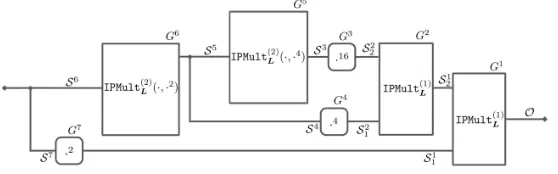
We can now exploit this new scheme in the .254 algorithm, by eliminating the first two refreshing and substituting the first two multiplications with our
IPMult(2)L (·,·2) and IPMult(2)
L (·,·4), while using in the rest the IPMult
(1)
L . In
particular, according to the squaring routine in Algorithm 4, we point out that in IPMult(2)L (·,·2) the shares g(Ai) correspond to the products A2
i ·Li and in
IPMult(2)L (·,·4) the sharesg(A
i) correspond to the productsA4i·Li·Li·Li. The implementation of the gadget .254 is depicted in Figure 1 and in Lemma 6 we prove that it ist–SNI, using the techniques presented in [5].
Fig. 1.Gadget.254which makes use ofIPMult(1)L andIPMult(2)L
Lemma 6. Gadget.254, shown in Figure 1, ist–SNI.
P7 i=1|I
i|+|O| ≤t. In the following we construct a simulator which makes use of at mostP7i=1|Ii|shares of the secret, by simulating each gadget in turn.
Gadget G1 Since IPMult(1)
L is t–SNI and |I
1∪ O| ≤ t, then there exist two sets of indices S1
1,S21 such that|S11| ≤ |I1|,|S21| ≤ |I1| and the gadget can be perfectly simulated from its input shares corresponding to the indices inS1 1 andS1
2.
GadgetG2 Since IPMult(1)L ist–SNIand|I2∪ S1 2| ≤ |I
1|+|I2| ≤t, then there exist two sets of indices S2
1,S 2
2 such that|S 2 1| ≤ |I
2|, |S2 2| ≤ |I
2| and the gadget can be perfectly simulated from its input shares corresponding to the indices inS2
1 andS22.
Gadget G3 Since .16 is affine, there exists a set of indices S3 such that |S3| ≤ |I3|+|S2
2| and the gadget can be perfectly simulated from its input shares corresponding to the indices inS3.
Gadget G4 Since .4 is affine, there exists a set of indices S4 such that |S4| ≤ |I4|+|S2
1| and the gadget can be perfectly simulated from its input shares corresponding to the indices inS4.
GadgetG5 SinceIPMult(2)
L ist–SNIand|I
5∪ S3| ≤ |I5|+|I3|+|I2| ≤t, then there exists a set of indicesS5such that|S5| ≤ |I5|and the gadget can be perfectly simulated from its input shares corresponding to the indices inS5.
GadgetG6 Since IPMult(2)
L ist–SNIand|I
6∪ S5| ≤ |I6|+|I5| ≤t, then there exists a set of indices S6 such that |S6| ≤ |I6| and the gadget can be perfectly simulated from its input shares corresponding to the indices inS6.
Gadget G7 Since .2 is affine, there exists a set of indices S7 such that |S7| ≤ |I7|+|S1
1| ≤ |I
7|+|I1| and the gadget can be perfectly simulated from its input shares corresponding to the indices inS7.
Each of the previous steps guarantee the existence of a simulator for the respective gadgets. The composition of them allows us to construct a simulator of the entire circuit which usesS6∪ S7 shares of the input. Since|S6∪ S7| ≤ |I7|+|I1|+|I6| ≤P7
i=1|I
i|we can conclude that the gadget.254 ist–SNI. u t
The advantage of the use of IPMult(2)L mostly consists in amortizing the ran-domness complexity. Indeed the new scheme requires only n (for the vector
u) plus n(n2−1) (for the matrix U) random bits, while the previous one uses a larger amount of randomness, corresponding ton2(for theSecIPRefresh
L) plus
n(n−1)
2 (for theIPMult (1)
L ) bits. We summarize in Table 1 the complexities of the
#additions #multiplications #random bits
IPMult(1)L 2n2 3n2 n(n−2 1)
IPMult(2)L 4n2 3n2+ 2n n(n+1)
2
SecIPRefreshL 2n2−n 2n n2
IPMult(1)L andSecIPRefreshL
4n2−n 3n2+ 2n n(3n−2 1) Algorithm 5 in [17] 4n(n−1) − n(n−1)
Algorithm 3 in [8] 4n(n−1) 1
4(n−1)(7n+ 3) (nodd) 1
4n(7n−6) (neven)
n(n−1)
Table 1.Complexity ofIPMult(1)L andIPMult
(2)
L and comparison with the
multiplica-tion algorithms of [17] and [8]
A more detailed performance analysis is provided in the next section.
5
Performance evaluations
In this section we analyze the performance of our improved IP masking construc-tion. Following the lines in [2, 1], we opt to protect a software implementation of AES-128 encryption for AVR architectures. We develop protected implemen-tations using either our new multiplication algorithm IPMult(1)L alone, or in combination withIPMult(2)L . In order to compare performances, we also develop protected instances of AES-128 with Boolean masking. All our implementations have a constant-flow of operations and share the same underlying blocks. In particular, we uselog-alog tables for field multiplication and look-up tables to implement raisings to a power. The most challenging operation to protect is the nonlinear SubBytestransformation, which is also the bottleneck of our imple-mentations. Similar to earlier work, we take advantage of the algebraic structure of the AES and computeSubBytesas the composition of a power functionx254 and an affine transformation. The remaining operations are straightforward to protect and are thus omitted in what follows.
Implementation of the power function.Rivain and Prouff proposed in [43] an algorithm to compute the inversion in F82 as x254 using an addition chain with only 4 multiplications. We select this algorithm for our implementations protected with IP masking. Recall that to ensure t–SNI it is necessary to exe-cute theSecIPRefreshLalgorithm when using only IPMult
(1)
L , but this can be
omitted when using alsoIPMult(2)L as depicted in Figure 1.
and thus achieves significant performance gains. Note that further optimizations are possible by combining [31] with recent techniques, e.g. the common shares approach proposed by Coron et al. [16] or the multiplication gadget put forward by Bela¨ıd et al. [8]. We expect however the gains to be relatively small (see re-sults in [16]), and therefore have a limited impact for the purposes of comparison.
Implementation of the affine transformation.Securing the affine transfor-mation using Boolean masking can be done in a highly efficient way by applying it to every input share separately, that is, by computingAx1+. . .+Axn+b. Hence, each share xi of xis only involved in one matrix-vector multiplication, which in practice can be tabulated. Unfortunately, such an approach is not di-rectly applicable to IP masking, since the sharing ofxconsists of two vectors L
andR with eachnelements inF82. The affine transformation can be computed through a polynomial evaluation over F82, which is known to perform rather poorly when compared to Boolean masking (see [2, 1]).
In this work we note that sinceLis fixed it is possible to change the represen-tation ofAdepending on the valuesLi. More precisely, we definenmatricesAi
and compute the affine transformation asA1x1+. . .+Anxn+b. The matrices
Ai need only to be pre-computed once, at initialization time. GivenLi∈F82 we first construct an 8×8 matrixMi over Z2. Notice that Li is represented by a polynomiala0+a1·x+. . .+a7·x7, where{1, x, . . . , x7}form the basis ofF82. The
j-th column ofMi corresponds to the coefficients of the polynomialLi×xj−1. Given the matrix Mi as described above, we can then compute Ai=A×Mi
by simple matrix multiplication, and take advantage of tabulation in the imple-mentation. In contrast to Boolean masking, the memory requirements of this tabulation increase linearly with the number of shares. However, the overheads remain reasonable for practical values ofn.
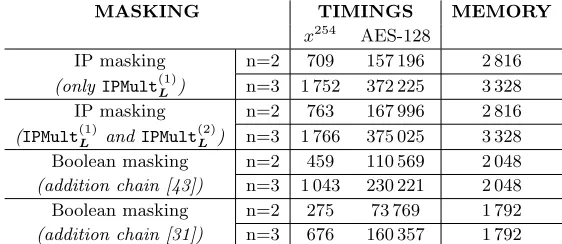
Implementation results. We have developed assembly implementations for
cost of more non-volatile storage. Thanks to this, we are able to decrease the gap between Boolean and IP masking implementations to slightly more than a factor 2. Our results also verify that the addition chain from [31] is currently the fastest method to protect AES implementations with higher-order Boolean masking. We leave as open work whether a similar algorithm as in [17] to efficiently evaluate functions of the formx·g(x) can be devised for IP masking.
MASKING TIMINGS MEMORY
x254 AES-128
IP masking n=2 709 157 196 2 816
(onlyIPMult(1)L ) n=3 1 752 372 225 3 328
IP masking n=2 763 167 996 2 816
(IPMult(1)L andIPMult(2)L ) n=3 1 766 375 025 3 328 Boolean masking n=2 459 110 569 2 048
(addition chain [43]) n=3 1 043 230 221 2 048 Boolean masking n=2 275 73 769 1 792
(addition chain [31]) n=3 676 160 357 1 792
Table 2.Performance evaluation of protected AES-128 implementations on AVR archi-tectures (optimized in assembly code). Timings in clock cycles, memory requirements in bytes.
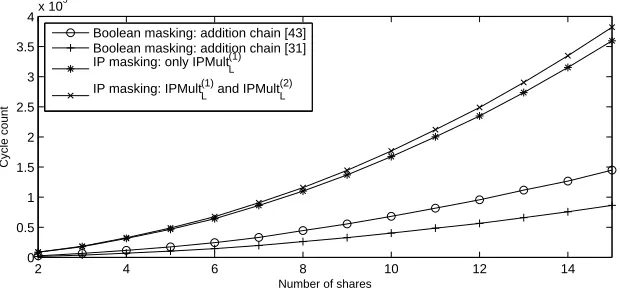
Lastly, we illustrate in Figure 2 the performance trend of our implementations for larger values of n. Cycle counts correspond in this case to a single SBox operation. Note that the results for n= 2,3 are significantly higher than those provided in Table 5, the reason being that the implementations are now written in C language (and are thus less optimized than their assembly counterparts). Note also that the gap between Boolean and IP masking protected versions increases almost to a factor 4. This is because we do not take advantage of the tabulation of the field multiplications with elements Li and L−i 1, since the memory requirements would grow considerably for non-small values ofn. In spite of this, we observe that the performance gap between Boolean and IP masking protected implementations remains constant as the number of shares increases.
6
Information theoretic evaluation
2 4 6 8 10 12 14 0
0.5 1 1.5 2 2.5 3 3.5
4x 10
5
Number of shares
Cycle count
Boolean masking: addition chain [43] Boolean masking: addition chain [31] IP masking: only IPMultL(1)
IP masking: IPMultL(1) and IPMultL(2)
Fig. 2.Performance evaluation of protected AES Sbox implementations on AVR ar-chitectures (in C code) for increasing number of shares.
2]. In this respect, and despite the encoding of our consolidated inner product masking schemes has not changed compared to the latter two references, we aim to improve their results in three important directions:
– Extended noise range.In [1, 2], the mutual information of the inner product encoding was evaluated for a Hamming weight leakage function and noise variances up to 4. While this is sufficient to discuss the positive impact of the increased algebraic complexity of inner product masking for low noise levels, it is not sufficient to exhibit the security order (which corresponds to the lowest key-dependent statistical moment of the leakage distribution minus one [7], and is reflected by the slope of the information theoretic curves for high noise levels). Therefore, we generalize the improved numerical integration techniques from [19] to inner product encodings and compute the mutual information metric for noise variances up to 1000 (which allows us to exhibit and discuss security orders).
– Other (public)Lvalues.In [1, 2], the inner product encoding was evaluated based on a single value of the public L. However, it was recently shown in [47] that for linear leakage functions (such as the Hamming weight leakage function), an appropriate choice ofL may improve the security order of an implementation. In other words, it was shown that security in the bounded moment model (as recently formalized in [7]) can be higher than the probing security order in this case. Therefore, we evaluate the mutual information for different L vectors for our 8-bit targets (rather than 4-bit S-boxes in [47], which is again made possible by our exploitation of improved numerical integration techniques).
complement our results by evaluating the information leakage of the inner product encoding for non-linear leakage functions.
Building on our experimental observations, we also highlight other interesting implementation properties of the inner product encoding (regarding the risk of transition-based leakages [15, 3]) in Section 6.3. And we conclude the section by discussing general (theoretical) limitations of both the security order amplifica-tion and these implementaamplifica-tion properties.
6.1 Linear (e.g., Hamming weight) leakages
We first analyze the information leakage of the inner product encoding of Algo-rithm 2 forn= 2 shares and a Hamming weight leakage function. More precisely, we consider a target intermediate secret variable A ∈ GF(28) that is encoded as A =A1+L2·A2 such that A= [A1, A2]. The adversary is given the leak-age (next denoted with the variableOfor observation, to avoid confusion with the L values) corresponding to these two shares. That is, O = [O1, O2] with
O1 =HW(A1)N1, O2 =HW(A2)N2, HWthe Hamming weight function,
N1, N2 two normally distributed (independent) noise random variables and the addition in the reals (in contrast with the group addition +). The mutual information betweenAand the observationOis expressed as:
MI(A;O) = H[A]X a∈A
Pr[a]× X a2∈A
Pr[a2]× X
o∈O2
f[o|a]×log2Pr[a|o], (1)
wheref[o|a] is the conditional Probability Density Function (PDF) of the obser-vationogiven the secreta, which is computed as a sum of normal PDFs (denoted asN) evaluated for all the (unknown) random shares:f[o|a] =P
a2∈AN[o|a, a2]· Pr[a2]. The conditional probability Pr[a|o] is obtained via Bayes’ law: Pr[a|o] =
f[o|a]
P
a∗ ∈Af[o|a∗] where thea
∗ notation is used for the secretacandidates.
The result of our information theoretic analysis for Hamming weight leak-ages, for vectorsL2= 17,5,7 and noise variances between 10−2 and 103is given in Figure 3, where we additionally report the leakage of an unprotected A(i.e., for which the adversary can observe O=HW(A)N) and of a Boolan encod-ing (which is a special case of inner product encodencod-ing such thatL1 =L2 = 1) for illustration. For low noise levels, we reach the same conclusions as previous works [1, 2]. Namely, the increased algebraic complexity of inner product mask-ing allows significantly lower leakages than Boolean maskmask-ing. Intuitively, this is simply explained by the fact that knowing one bit of each share directly leads to one bit of secret in Boolean masking, while it only leads to a (smaller) bias on the secret variable distribution in inner product masking.
−2 −1 0 1 2 3 −8
−7 −6 −5 −4 −3 −2 −1 0 1
log10(noise variance)
log
10
(mutual information)
Hamming weight leakage function
unprotected Boolean masking IP masking, L2=17
IP masking, L2=5
IP masking, L2=7
Fig. 3.Information theoretic evaluation of an inner product encoding.
show that by tuning the publicL2 value of the inner product encoding, we can reach much better results. Namely, the slope of the information theoretic curves can be reduced to−3 (which corresponds to a security order 2 in the bounded moment model) and even −4 (which corresponds to a security order 3 in the bounded moment model), despite the first-order security of this encoding in the probing model (proved in Section 3.1) has not changed.
The reason for this phenomenon has been given in a recent CARDIS 2016 paper [47] and is simply summarized by observing that the multiplication in GF(28) that is performed by the inner product encoding can be represented as a multiplication with an 8×8 matrix inGF(2). Roughly, depending on the num-ber of linearly independent lines in this matrix, and assuming that the leakage function will only mix the bits of the encoding linearly (which is the case for the Hamming weight leakage function), the multiplication will XOR more shares together, implying a higher security order in the bounded moment model. And this “security order amplification” is limited to a slope of−4 (which corresponds to the attack exploiting the multiplication of the squares of all the shares).
6.2 Non-linear (e.g., random) leakages
In view of the previous positive observations obtained for the inner product encoding in the context of linear (e.g., Hamming weight) leakages, a natural next step is to investigate the consequences of a deviation from this assumption. For this purpose, we study an alternative scenario where the Hamming weight leakages are replaced by a random leakage functionGwith similar output range {0,1, . . . ,8}, such that the adversary now observesO1=G(A1)N1 andO2=
The result of our information theoretic analysis for random leakages, vectors
L2 = 17,5,7 and noise variances between 10−2 and 103 is given in Figure 3, where we again report the leakage of an unprotected A and a Boolean encod-ing. Our observations are twofold. First, for large noise levels the security order
−2 −1 0 1 2 3
−8 −7 −6 −5 −4 −3 −2 −1 0 1
log
10(noise variance)
log
10
(mutual information)
random leakage function, |L|=9
unprotected Boolean masking IP masking, L
2=17
IP masking, L
2=5
IP masking, L2=7
Fig. 4.Information theoretic evaluation of an inner product encoding.
amplification vanishes and all the information theoretic curves corresponding to
d= 2 shares have slope−2, as predicted by the proofs in the probing model. This is expected in view of the explanation based on the 8×8 matrix inGF(2) given in the previous section and actually corresponds to conclusions made in [32] for low entropy masking schemes. That is, because of the non-linear leakage function, the GF(2) shares that are mixed thanks to the inner product encoding are ac-tually recombined which reduces the security order. So as in this previous work, the reduction of the security order actually depends on the degree of the leakage function. But in contrast with low entropy masking schemes, the security cannot collapse below what is guaranteed by the security order in the probing model.
Second and more surprisingly, we see that a non-linear leakage function also has a negative impact for the interest of the inner product encoding in the low noise region. This is explained by the fact that by making the leakage function non-linear, we compensate the low algebraic complexity of the Boolean encoding (so the distance between Boolean and inner product encodings vanishes).
6.3 Transition-based leakages
In general, any masking scheme provides security guarantees under the condi-tion that the leakages of each share are sufficiently noisy and independent. Yet, ensuring the independence condition usually turns out to be very challenging both in hardware and software implementations. In particular in the latter case, so-called transition-based leakages can be devastating. For illustration, let us consider a Boolean encoding such thatA=A1+A2. In case of transition-based leakages, the adversary will not only receive noisy versions ofA1andA2but also of their distance. For example, in the quite standard case of Hamming distance leakages, the adversary will receiveHW([A1] + [A2])N=HW(A)N, which annihilates the impact of the the secret sharing. Such transition-based leakages frequently happen in microcontrollers when the same register is used to consec-utively store two shares of the same sensitive variable (which typically causes a reduction of the security order by a factor 2 [3]).
Interestingly, we can easily show that inner product masking provides im-proved tolerance against transition-based leakages. Taking again the example of an encoding A=A1+L2·A2, the Hamming distance between the two shares
A1 and A2 (where A1 = A+L2·A2) equals HW([A+L2·A2] + [A2]). Since for uniformly distributed A2 and any L2 6= 1, we have that A2 +A2·L2 is also uniformly distributed, this distance does not leak any information onA. Of course, and as in the previous section, this nice property only holds for certain combinations of shares (such as the group operation + in our example).
6.4 Limitations: a negative result
The previous sections showed that the inner product encodings offer interesting features for security order amplification and security against transition-based leakages in case the physical leakages are “kind” (e.g., linear functions, transi-tions based on a group operation). Independent of whether this condition holds in practice, which we discuss in the next section, one may first wonder whether these properties are maintained beyond the inner product encoding. Unfortu-nately, we answer to this question negatively. More precisely, we show that when-ever non-linear operations are performed (such as multiplications), the security order of the inner product encoding gets back to the one of Boolean masking (and therefore is also divided by two in case transitions are observed).
Concretely, and assuming we want to multiply two shared secrets A =
A1 +L2·A2 and B = B1+L2 ·B2, a minimum requirement is to compute the cross products Ai·Bj. So for example, an adversary can observe the pair of leakages (A1, A2·B2) which depends on A. Defining a function FB2(A2) =
A2 ·B2, and assuming a (linear) Hamming weight leakage function HW, we see that the adversary obtains two leakage samples O1 = HW(A1)N1 and
So whenever the implementation has to perform secure multiplications with inner product masking, we are in fact in a situation similar to the non-linear leakages of Section 6.2. A similar observation holds for the result of Section 6.3 regarding transition-based leakages. Taking exactly the previous example, observing the Hamming distance between A1 and FB2(A2) directly halves the security order, just as for the Boolean encodings in [3].
One natural scope for further research is to look for new solutions in order to maintain the security order guarantees even for non-linear operations (e.g., thanks to a different sequence of operations or additional refreshings). Never-theless, even with the current algorithm and non perfectly linear leakages, inner product masking should reduce the number and informativeness of the key-dependent tuples of leakage samples in a protected implementation, which is not captured by the notion of (probing or bounded moment) security order. So over-all, the improved theoretical understanding allowed by our investigations calls for a the concrete evaluation of an inner product masked AES. The next section makes a step in this direction, and discusses how these potential advantages translate into practice for a 32-bit ARM microcontroller.
7
Empirical Side-Channel Leakage Evaluation
In order to further complement the analysis we provide concrete results of empir-ical side-channel leakage evaluations for both Boolean masking with two shares and IP masking with n = 2 (L1 = 1, L2 = 7). Security proofs are valid only for the assumed and possibly idealized (e.g. simplified) leakage model, but real device leakage behaviour can be complex and hard to model. For instance, tran-sition leakages are known to be difficult to deal with when moving from theory to practice. Similarly, the information theoretic analysis based on simulations is of course valid only for the simulated leakage behavior, and its results strongly vary for different leakage behaviours as we have shown, and it is limited to the encoding function.
We therefore assess and compare the leakage behavior of our implementations in practice with real measurements of our code running on a physical platform to round off our analysis. This evaluation allows us to reason about the leakage under typical conditions and without making modeling assumptions. Note also that this practical evaluation covers both the encoding as well as computation in the masked domain.
We use generic code that follows the guidelines of the masking algorithms pro-vided in this paper but leave freedom to the compiler to perform register/memory allocations, optimizations, etc. The implementations are hence neither hand-optimized for the target platform nor adapted to its specific leakage behavior. The security of the implementations therefore depends in part on the compiler tool-chain.
The presence of the RNG is the main motivation for using this platform rather than an AVR. We have ported our generic (coded in C language) protected im-plementations of AES-128 using the addition chain from [43] to this platform using arm-none-eabi-gcc (v4.8.4) and verified that they run in constant time independent of the input values. Power measurements are obtained in a contact-less fashion by placing a Langer RF-B 3-2 h-field (magnetic field) probe over a decoupling capacitor near the chip package, similar to [4]. The antenna output signal is amplified with a Langer PA-303 30 dB amplifier before we sample it with a Tektronix DPO 7254c oscilloscope and transfer it to a computer for anal-ysis. We use a trigger signal generated from within the Nucleo board prior to each encryption routine to synchronize the power measurements.
Each power measurement comprises 500 000 samples that cover a time win-dow of 4 ms. During this time the Boolean masked implementation executes slightly more than eight rounds of AES while the IP masking protected imple-mentation executes about 2.5 rounds of AES.The timing difference of roughly a factor of four is in line with the data shown in Figure 2. The time period covered by the measurements is a tradeoff between the amount of measurement data we need to handle on the one hand (shorter measurements give less data) and the complexity of the executed code on the other hand (we do not want to use a too simple toy example; two rounds of AES give full diffusion).
We use state-of-the-art leakage assessment techniques [28, 13, 37] to evaluate the leakage behavior of our masked implementations. Note that such an evalu-ation is independent of any adversarial strategy and hence it is not a security evaluation, i.e. it is not about testing resistance to certain attacks. Leakage as-sessment is a convenient tool to assess leakage regardless whether it is exploitable by a certain adversary.
In practice the most widely used methodology in the literature is Test Vector Leakage Assessment, first introduced in [28], and in particular the non-specific fixed versus random test. See for instance [44] for details. In brief, this particular test checks if the distribution of the measured side-channel leakage depends on the data processed by the device. If not, we can strongly ascertain that no adversary will be able to exploit the measurements to recover secret data.
To perform the test we collect two sets of measurements. For the first set we used a fixed input plaintext and we denote this setSf ixed. For the second set the input plaintexts are drawn at random from uniform. We denote this setSrandom. Note that we obtain the measurements for both sets randomly interleaved (by flipping a coin before each measurement) to avoid time-dependent external and internal influences on the test result. The AES encryption key is fixed for all measurements.
We then compute Welch’s (two-tailed) t-test:
t=qµ(Sf ixed)−µ(Srandom)
σ2(Sf ixed)
#Sf ixed +
σ2(S
random)
#Srandom
, (2)
population (or from populations with the same mean). Thenull hypothesisis that the samples in both sets were drawn from populations with the same mean. In our context, this means that the masking is effective. The alternative hypothesis is that the samples in both sets were drawn from populations with different means. In our context, this means that the masking is not effective. A threshold for the t-score of±4.5 is typically applied in the literature (corresponding roughly to a 99.999% confidence) to determine if the null hypothesis is rejected and the implementation is considered to leak. However, our primary intention is a relative comparison of the leakage of the different masked implementations.
7.1 RNG deactivated
We first evaluate both implementations with the RNG deactivated (all random numbers are zero).
Fig. 5.t-test results for Boolean masking (top) and IP masking (bottom) with RNG deactivated; each based on 10 000 measurements. The red lines mark the±4.5 thresh-old.
As expected both implementations leak significantly. The repetitive patterns in the plots of the t-scores allow to recognize the rounds of AES as areas with high t-scores, interleaved by the key scheduling which does not leak in this test because the key is fixed. However, already in this scenario with deactivated RNG we can observe that the implementation protected with IP masking shows less evidence of leakage (lower t-scores).
7.2 RNG activated
Next we repeat the evaluation with activated RNG.
Fig. 6.t-test results for Boolean masking (top) and IP masking (bottom) with RNG activated; each based on 1 million measurements. The red lines mark the±4.5 thresh-old.
In this scenario we expect both implementations to leak less and we take more measurements (1 million from each implementation). Figure 6 shows the results for Boolean masking (top) and IP masking (bottom).
Boolean masking, and is not deemed to leak for this number of measurements (a few t-scores slightly exceed the threshold but this is expected given that we have 500 000 t-scores and 99.999% confidence).
So based on these experiments and results, we can conclude that as expected from our theoretical investigations, IP masking allows reducing both the number of leaking samples in the implementation (which is assumably due to the better resistance to transition-based leakages) and the informativeness of these leaking samples (which is assumably due to the quite linear nature of our target leakage function). We insist that we make no claims on the fact that our IP masking im-plementation is first-order secure. We only conclude that it shows significantly less evidence of leakage than our Boolean masking implementation. (Admit-tedly, first-order information should theoretically appear with larger number of measurements). So these results at least show that the more complex algebraic structure of the inner product encoding brings an interesting alternative (trade-off) to Boolean masking with slight performance overheads compensated by less evidence of leakage in practice. We leave the careful investigation of the concrete leakages of the IP masking with advanced statistical tools (e.g., higher-order and multivariate attacks) as an interesting scope for further research.
8
Conclusions
Overall, the results in this paper complete the theoretical and practical under-standing of inner product masking. First, we proposed new (simplified) mul-tiplication algorithms that are conceptually close to the standard proposal of Ishai et al. [33], and have good properties for composability. Second we showed that these simplified algorithms allow better performance than reported in the previous works on inner product masking of the AES [1, 2]. Third, we extended previous information theoretic evaluations in order to discuss the pros and cons of inner product masking in idealized implementations, and confronted these evaluations with first empirical experiments.
Acknowledgments.Benedikt Gierlichs is a Postdoctoral Fellow of the Fund for Scientific Research - Flanders (FWO). Sebastian Faust and Clara Paglialonga are partially funded by the Emmy Noether Program FA 1320/1-1 of the German Research Foundation (DFG). Franois-Xavier Standaert is a senior research asso-ciate of the Belgian Fund for Scientific Research (FNRS-F.R.S.). This work has been funded in parts by the European Commission through the CHIST-ERA project SECODE and the ERC project 724725 (acronym SWORD) and by the Research Council KU Leuven: C16/15/058 and Cathedral ERC Advanced Grant 695305.
References
2. Josep Balasch, Sebastian Faust, Benedikt Gierlichs, and Ingrid Verbauwhede. The-ory and practice of a leakage resilient masking scheme. InInternational Conference on the Theory and Application of Cryptology and Information Security, pages 758– 775. Springer, 2012.
3. Josep Balasch, Benedikt Gierlichs, Vincent Grosso, Oscar Reparaz, and Fran¸ cois-Xavier Standaert. On the cost of lazy engineering for masked software implemen-tations. In Marc Joye and Amir Moradi, editors,CARDIS 2014, volume 8968 of
LNCS, pages 64–81. Springer, 2014.
4. Josep Balasch, Benedikt Gierlichs, Oscar Reparaz, and Ingrid Verbauwhede. DPA, Bitslicing and Masking at 1 GHz. InCHES 2015, pages 599–619, 2015.
5. Gilles Barthe, Sonia Bela¨ıd, Fran¸cois Dupressoir, Pierre-Alain Fouque, and Ben-jamin Gr´egoire. Compositional verification of higher-order masking: Application to a verifying masking compiler.IACR Cryptology ePrint Archive, 2015:506, 2015. 6. Gilles Barthe, Sonia Bela¨ıd, Fran¸cois Dupressoir, Pierre-Alain Fouque, Benjamin Gr´egoire, and Pierre-Yves Strub. Verified proofs of higher-order masking. In
EUROCRYPT 2015, pages 457–485, 2015.
7. Gilles Barthe, Fran¸cois Dupressoir, Sebastian Faust, Benjamin Gr´egoire, Fran¸ cois-Xavier Standaert, and Pierre-Yves Strub. Parallel implementations of masking schemes and the bounded moment leakage model. Cryptology ePrint Archive, Report 2016/912, 2016. http://eprint.iacr.org/2016/912.
8. Sonia Bela¨ıd, Fabrice Benhamouda, Alain Passel`egue, Emmanuel Prouff, Adrian Thillard, and Damien Vergnaud. Randomness complexity of private circuits for multiplication. In Marc Fischlin and Jean-S´ebastien Coron, editors,EUROCRYPT 2016, volume 9666 ofLNCS, pages 616–648. Springer, 2016.
9. Claude Carlet, Jean-Luc Danger, Sylvain Guilley, and Houssem Maghrebi. Leak-age squeezing of order two. In Steven D. Galbraith and Mridul Nandi, editors,
INDOCRYPT 2012, volume 7668 of LNCS, pages 120–139. Springer, 2012. 10. Claude Carlet, Jean-Luc Danger, Sylvain Guilley, and Houssem Maghrebi.
Leak-age squeezing: Optimal implementation and security evaluation. J. Mathematical Cryptology, 8(3):249–295, 2014.
11. Claude Carlet, Emmanuel Prouff, Matthieu Rivain, and Thomas Roche. Algebraic decomposition for probing security. InCRYPTO 2015, pages 742–763, 2015. 12. Suresh Chari, Charanjit S. Jutla, Josyula R. Rao, and Pankaj Rohatgi. Towards
sound approaches to counteract power-analysis attacks. In CRYPTO’99, pages 398–412, 1999.
13. Jeremy Cooper, Elke DeMulder, Gilbert Goodwill, Joshua Jaffe, Gary Ken-worthy, and Pankaj Rohatgi. Test Vector Leakage Assessment (TVLA) methodology in practice. International Cryptographic Module Confer-ence, 2013. http://icmc-2013.org/wp/wp-content/uploads/2013/09/ goodwillkenworthtestvector.pdf.
14. Jean-S´ebastien Coron. Higher order masking of look-up tables. In EUROCRYPT 2014, pages 441–458, 2014.
17. Jean-S´ebastien Coron, Emmanuel Prouff, Matthieu Rivain, and Thomas Roche. Higher-order side channel security and mask refreshing. In Shiho Moriai, editor,
FSE 2013, volume 8424 ofLNCS, pages 410–424. Springer, 2013.
18. Alexandre Duc, Stefan Dziembowski, and Sebastian Faust. Unifying leakage mod-els: From probing attacks to noisy leakage. In Phong Q. Nguyen and Elisabeth Os-wald, editors,EUROCRYPT 2014, volume 8441 ofLNCS, pages 423–440. Springer, 2014.
19. Alexandre Duc, Sebastian Faust, and Fran¸cois-Xavier Standaert. Making masking security proofs concrete - or how to evaluate the security of any leaking device. In Elisabeth Oswald and Marc Fischlin, editors,EUROCRYPT 2015, Proceedings, Part I, volume 9056 ofLNCS, pages 401–429. Springer, 2015.
20. Stefan Dziembowski and Sebastian Faust. Leakage-resilient circuits without com-putational assumptions. InTCC 2012, pages 230–247, 2012.
21. Stefan Dziembowski and Sebastian Faust. Leakage-resilient circuits without com-putational assumptions. In Theory of Cryptography Conference, pages 230–247. Springer, 2012.
22. Stefan Dziembowski, Sebastian Faust, and Maciej Skorski. Noisy leakage revisited. InEUROCRYPT 2015, pages 159–188, 2015.
23. Thomas Eisenbarth, Timo Kasper, Amir Moradi, Christof Paar, Mahmoud Salma-sizadeh, and Mohammad T. Manzuri Shalmani. On the power of power analysis in the real world: A complete break of the keeloqcode hopping scheme. InCRYPTO 2008, pages 203–220, 2008.
24. Guillaume Fumaroli, Ange Martinelli, Emmanuel Prouff, and Matthieu Rivain. Affine masking against higher-order side channel analysis. In Alex Biryukov, Guang Gong, and Douglas R. Stinson, editors,SAC 2010, volume 6544 ofLNCS, pages 262–280. Springer, 2010.
25. Daniel Genkin, Itamar Pipman, and Eran Tromer. Get your hands off my lap-top: physical side-channel key-extraction attacks on pcs - extended version. J. Cryptographic Engineering, 5(2):95–112, 2015.
26. Shafi Goldwasser and Guy N. Rothblum. How to compute in the presence of leakage. InFOCS 2012, pages 31–40, 2012.
27. Jovan Dj. Golic and Christophe Tymen. Multiplicative masking and power analysis of AES. In Burton S. Kaliski Jr., C¸ etin Kaya Ko¸c, and Christof Paar, editors,CHES 2002, volume 2523 ofLNCS, pages 198–212. Springer, 2002.
28. Gilbert Goodwill, Benjamin Jun, Josh Jaffe, and Pankaj Rohatgi. A testing methodology for side channel resistance validation. NIST non-invasive attack testing workshop, 2011. http://csrc.nist.gov/news\_events/ non-invasive-attack-testing-workshop/papers/08\_Goodwill.pdf.
29. Louis Goubin and Ange Martinelli. Protecting AES with shamir’s secret sharing scheme. In Preneel and Takagi [39], pages 79–94.
30. Louis Goubin and Jacques Patarin. DES and differential power analysis (the ”du-plication” method). InCHES’99, pages 158–172, 1999.
31. Vincent Grosso, Emmanuel Prouff, and Fran¸cois-Xavier Standaert. Efficient masked s-boxes processing - A step forward -. In David Pointcheval and Damien Vergnaud, editors,AFRICACRYPT 2014, volume 8469 ofLNCS, pages 251–266. Springer, 2014.
32. Vincent Grosso, Fran¸cois-Xavier Standaert, and Emmanuel Prouff. Low entropy masking schemes, revisited. In Aur´elien Francillon and Pankaj Rohatgi, editors,
33. Yuval Ishai, Amit Sahai, and David Wagner. Private circuits: Securing hardware against probing attacks. In Dan Boneh, editor, CRYPTO 2003, volume 2729 of
LNCS, pages 463–481. Springer, 2003.
34. Paul C. Kocher. Timing attacks on implementations of Diffie-Hellman, RSA, DSS, and other systems. InCRYPTO’96, pages 104–113, 1996.
35. Paul C. Kocher, Joshua Jaffe, and Benjamin Jun. Differential power analysis. In
CRYPTO’99, pages 388–397, 1999.
36. Stefan Mangard, Elisabeth Oswald, and Thomas Popp. Power Analysis Attacks: Revealing the Secrets of Smart Cards (Advances in Information Security). Springer-Verlag New York, Inc., Secaucus, NJ, USA, 2007.
37. Luke Mather, Elisabeth Oswald, Joe Bandenburg, and Marcin W´ojcik. Does My Device Leak Information? An a priori Statistical Power Analysis of Leakage Detec-tion Tests. In Kazue Sako and Palash Sarkar, editors,ASIACRYPT 2013, volume 8269 ofLNCS, pages 486–505. Springer, 2013.
38. Svetla Nikova, Christian Rechberger, and Vincent Rijmen. Threshold implemen-tations against side-channel attacks and glitches. InICICS 2006, pages 529–545, 2006.
39. Bart Preneel and Tsuyoshi Takagi, editors. CHES 2011, volume 6917 of LNCS. Springer, 2011.
40. Emmanuel Prouff and Matthieu Rivain. Masking against side-channel attacks: A formal security proof. InEUROCRYPT 2013, pages 142–159, 2013.
41. Emmanuel Prouff and Thomas Roche. Higher-order glitches free implementation of the AES using secure multi-party computation protocols. In Preneel and Takagi [39], pages 63–78.
42. Oscar Reparaz, Beg¨ul Bilgin, Svetla Nikova, Benedikt Gierlichs, and Ingrid Ver-bauwhede. Consolidating masking schemes. In CRYPTO 2015, pages 764–783, 2015.
43. Matthieu Rivain and Emmanuel Prouff. Provably secure higher-order masking of AES. In Stefan Mangard and Fran¸cois-Xavier Standaert, editors,CHES 2010, volume 6225 ofLNCS, pages 413–427. Springer, 2010.
44. Tobias Schneider and Amir Moradi. Leakage assessment methodology - A clear roadmap for side-channel evaluations. In Tim G¨uneysu and Helena Handschuh, editors,CHES 2015, volume 9293 ofLNCS, pages 495–513. Springer, 2015. 45. Fran¸cois-Xavier Standaert, Tal Malkin, and Moti Yung. A unified framework for
the analysis of side-channel key recovery attacks. In Antoine Joux, editor, EURO-CRYPT 2009, volume 5479 ofLNCS, pages 443–461. Springer, 2009.
46. Fran¸cois-Xavier Standaert, Nicolas Veyrat-Charvillon, Elisabeth Oswald, Benedikt Gierlichs, Marcel Medwed, Markus Kasper, and Stefan Mangard. The world is not enough: Another look on second-order DPA. In Masayuki Abe, editor, ASI-ACRYPT 2010, volume 6477 ofLNCS, pages 112–129. Springer, 2010.
![Table 1. − Complexity of IPMult(1)Land IPMult(2)Land comparison with the multiplica-tion algorithms of [17] and [8]](https://thumb-us.123doks.com/thumbv2/123dok_us/7961565.1320705/15.612.135.487.115.224/table-complexity-ipmult-land-ipmult-comparison-multiplica-algorithms.webp)