c e-ISSN: 2348-6848, p- ISSN: 2348-795X Volume 2, Issue 11, November 2015
International Journal of Research (IJR)
Available at http://internationaljournalofresearch.orgStability Assessment in Power Network Using Artificial Neural
Network
P.Rahul Reddy
Associate Professor,Dept. of ECE, Ramanandatirtha Engineering College, Nalgonda
D.Prasad
Associate Professor,Dept. of ECE, Ramanandatirtha Engineering College, Nalgonda.
Abstract-
This paper presents the application of different Neural Network (NN) models for classifying the power system states as secure/insecure. Traditional method of security evaluation involves performing load flow and transient stability analysis for each contingency, making it infeasible for real time application. Pattern Recognition (PR) approach is recognized as an alternative tool. The NN models adopted for classification includes Multilayer Perception (MLP), Learning Vector Quantization (LVQ), Probabilistic Neural Network (PNN) and Adaptive Resonance Theory Mapping (ARTMAP). A two-step modeling procedure is proposed. First knowledge is acquired from a test bed of power systems based on detail load models of a bus to the distribution level. Then, the test bed data is used to develop a composite NN model. The developed NN model is updated based on measurements. A case study on a power inverter controlling an induction motor load is presented.
Keywords- Newton Rap son (NR) load flow; Voltage stability assessment; feed forward neural network; fast voltage
stability indicator (FVSI)
INTRODUCTION
This work presents an initial survey of the uses of Neural Networks in the Electric Power Industry. The objective of the Electric Power Industry is to supply electricity at the least possible cost with a constant service quality1 . Among the factors that provoke difficulties in achieving this goal, the inherent variability of the load and the fast growth of the demand are foremost, followed by requirements of clean environment, weather, quality fuels, accelerated aging of the plants and fast changes in technology. Recently, promising Artificial Neural Networks (ANN) approaches have been developed to solve problems in power plants and power systems --tuning of controllers, process identification, sensor validation, monitoring and fault diagnosis, in power plants, and security assessment, load identification, load modeling, forecasting and fault diagnosis, in power systems.
In power system stability analysis, all power system components are represented by their models. Generally, detailed data about components such as generators, transformers, and transmission lines are available, and accurate models can be obtained for
c e-ISSN: 2348-6848, p- ISSN: 2348-795X Volume 2, Issue 11, November 2015
International Journal of Research (IJR)
Available at http://internationaljournalofresearch.orgPresently, artificial neural networks (ANNs) has gained a lot of interest from researchers in recent years as a tool for voltage stability assessment [9].Due to its ability to do parallel data processing with high accuracy and fast response.ANN can learn complex non-linear relationships through set of input/output examples. Also they have been successfully applied to some power system problems where difficulties have been experienced with conventional techniques. Most of the published work in the area of voltage stability analysis is based on multi-layer feed-forward networks trained by back propagation (BP) for quantifying stability margins. However, in respect of voltage stability assessment of practical systems, a major difficulty of this type of neural networks is that it depends highly on the number of training data because the network itself does not take into account the properties of input data. Thus a large number of inputs are needed. In the present work, a single Feed Forward neural Network (FFNN) with minimal neurons are used to provide an estimate of the line stability index for various load conditions. Selected load variations are used as the input to the FFNN and the available line stability factor is used as an indicator to the status of the system. The proposed scheme has the ability to get adaptive training when subjected to any new training pattern, where the ANN has been exploited to predict the FVSI results for any unseen loading condition of the system.
LITERATURE SURVEY
Sobajic and Pao, [1]-1989, presented a key-work of the use of Artificial Neural Netkey-works (ANN) in electric power systems. This work, referenced by the most of the authors in ANNs and power systems, dealt with the assessment of dynamic security. An adaptive pattern recognition approach based on a Rumelhart feedforward neural net with a backpropagation learning scheme was implemented to synthesize the Critical Clearing Time (CCT). This parameter is one of paramount importance in the post-fault dynamic analysis of interconnected systems. The net successfully performed the estimation task for the variable system topology conditions. This work encouraged the investigation (commented in the following paragraph) of a preprocessing step that was able to "discover" what features were relevant to the learning task and what were not (36 references).
In [4]-1992, the same authors described the results of the investigation to "discover" relevant ANN training information. Simulations results showed how autonomous feature discovery was carried out in terms of direct system measurements instead of pragmatic features based on the engineering understanding of the problem. In this case unsupervised and supervised learning paradigms in tandem were used. Agreement between estimated and actual CCT values was very good (19 references).
In [21]-1993, the same authors presented a new method for transient security assessment of multi machine power systems. The stability boundary was constructed using tangent hyper surfaces. ANNs were used to determine the unknown coefficients of the hyper surfaces independently of operating conditions. Numerical results and comparisons between CCT analytically obtained and ANN-based indicated that this approach provides quick assessment of power system security (5 references).
In [25]-1993, the authors (joined with Lee) presented a methodology applying ANN to carry out real-time stability analysis of power systems. Near-term transient stability of the system, mid-Near-term and long-term dynamic security analysis were performed. The first one dealt with whether the system can return to steady-state, and the second one dealt with the manner of the final state is reached. Predicting transient violations allows the operator to take anticipatory actions (6 references).
Niebur and Germond, [5]-1993, demonstrated the feasibility of load pattern classification for power system static security assessment using ANN. They utilized the Kohonen Neural Net as classifier of power system states. The relation among the number of clusters, the number of neurons and the size of the power systems were investigated. Simulation results demostrated the successful generalization property of the ANN. Future works will address scaling issues for large size power systems (24 references).
c e-ISSN: 2348-6848, p- ISSN: 2348-795X Volume 2, Issue 11, November 2015
International Journal of Research (IJR)
Available at http://internationaljournalofresearch.orgsuch as transmission line status, machine excitations and generation level. Feedforward ANNs were used (19 references).
Chen and Hsu, [10]-1991, presented a refined Nilsson’s learning machine. Its effectiveness is demonstrated through a steady-state analysis on a synchronous generator. This generator was connected to a large power system. As input to the net, real power, power factor and power system stabilizer parameters were used. The output was a discrete signal: dynamically stable or unstable. The proposed ANN was compared with the multilayer feedforward with a backpropagation-momentum learning algorithm. It was determined that the convergence of the proposed ANN was much faster and its misclassification rate was lower than using the backpropagation-momentum method. It is said that the proposed ANN is more suitable for discrete output values. An important feature of this ANN is that it can serve as an on-line aid to the operators to analyze steady-state stability as well as tune power system stabilizers (25 references).
Avramovic, [20]-1993, dealt with the problem of voltage security assessment in power systems. The primary focus covers two aspects: 1) a long learning time, and 2) generation and sampling of systems trajectories in order to obtain representative input/output sets. Capability of ANN to provide means for accurate tracking of postcontingency, in this case voltage was illustrated (10 references).
ARTIFICIAL NEURAL NETWORK (ANN)
ANN implementation is used to design the best ANN configuration. And the best configuration is used to predict the status of 5-bus, IEEE 14 bus and IEEE 30 bus system. The process of ANN implementation starts from data collection and ends with the Performance evaluation of ANN. Percentages of classification accuracy and mean square error are used to represent the performance of ANN in terms of accuracy to predict the status of the different IEEE bus system.
A. Generation of training data:-
Input data sets for ANN training are generated from offline Newton-Rap son load flow analysis by varying both real and reactive loads at all the buses
randomly in the range of 5% to100% and 10% to -100% of their base case value. In data collection, the input data are divided into train data, validation data and test data. NR load flow analysis is conducted at all steps and corresponding voltage stability indicators are calculated. The MATLAB was used as a computing tool. Collection of these data constitutes the training data set.
B. ANN Structure:-
A multi-layered feed-forward neural network has been proved suitable for most power system problems.Figure1 shows the architecture of the feed forward neural network. The architecture of the ANN used in this paper consists of an input layer, a hidden layer and an output layer. The input layer has 6 neurons since the number of variables in the input neural network is 6 for 5-bus system, 16 neurons in IEEE 14 bus and 36 neurons in IEEE 30 bus system. The number of hidden neuron in hidden layer is fixed to 30 for all 3 bus systems. The more hidden neurons are used to train the neural network, the more computational time will be consumed. In the target layer, the neural network has two output vector which is either 0 for insecure or 1 for secure but naturally, neural network output is a closer analogue value in a range [0, 1]. Therefore, the output of neural network more than or equal 1 will be considered as secure condition while output of neural network less than 0.5 will be considered as insecure condition.
c e-ISSN: 2348-6848, p- ISSN: 2348-795X Volume 2, Issue 11, November 2015
International Journal of Research (IJR)
Available at http://internationaljournalofresearch.orgC.ANN Training:-
Training process of neural network helps to identify the topology of neural network and it’s interconnected Weights. The training speed depends on the speed factor such as the learning rule, the transfer function of neurons or initialization of the network [13]. In the training process of the neural network, a set of network inputs and target outputs are required. And also it requires enough information in order to simulate a good prediction of power system status during training process. The weights and biases of the network are iteratively adjusted to minimize the network performance function during training process itself. The feed forward back propagation neural network can be trained with different training algorithms. The most commonly used training algorithm for multi layer feed forward network is back propagation (BP) algorithm, which is a gradient descent algorithm .since this method is too slow ,some high performance algorithms like conjugate gradient algorithms, Quasi-Newton algorithms, Levenberg-Marquardt (LM) algorithm are developed to train network which converges faster than BP algorithm.
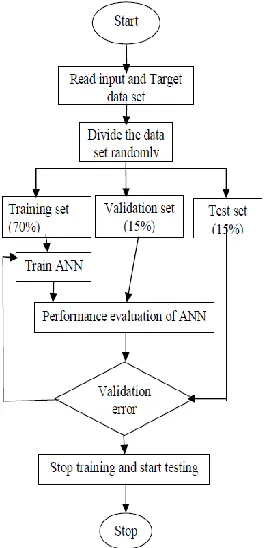
In the present work, LM training technique is used due to its faster training and good convergence [13].And this algorithm is suitable for medium sized neural network. And this algorithm combines steepest descent algorithm and the Gauss–Newton algorithm. In neural network, over fitting is also known as overtraining where further training will not result in better generalization. The error of validation set is periodically monitored during the training process. The training error usually decreases as the iteration grows, so does the validation error. When the overtraining starts to occur, the validation error typically tends to increase. Therefore, it would be useful and time saving to stop the training after the validation has increased for some specified number of iteration.
Fig. Flow chart for ANN implementation
D. Performance of ANN:- The performance of the feed forward back propagation neural network is evaluated by the percentages of classification accuracy (CA) and mean squared error (MSE) [24]. The percentages of CA for the neural network are calculated by using equation (6)
CONCLUSIONS
c e-ISSN: 2348-6848, p- ISSN: 2348-795X Volume 2, Issue 11, November 2015
International Journal of Research (IJR)
Available at http://internationaljournalofresearch.orgoutput for different buses which are tested in this work. Training process of ANN will take long time, but testing process requires only a few seconds for any system. The proposed approach provides fast computation of voltage stability indicator FVSI and can analyze any unknown load patterns. This powerful and versatile feature is useful for power system operation.
FUTURE RESEARCH
In fundamental theory, two issues remain to be addressed thoroughly:
* Determination of a theoretical basis to design ANN based on a priori knowledge of the process or system in question.
* Learning algorithms.
REFERENCES
[1] Sobajic, D.J., and Y-H Pao, "Artificial Neural Net Based Dynamic Security Assessment for Electric Power Systems," IEEE Transactions on Power Systems, Vol.4, No.1, February 1989, pp. 220-228.
[2] Santoso, N.I. and O.T. Tan, "Neural-Net Based Real-time Control Capacitors Installed on Distribution Systems," IEEE Transaction on Power Delivery, Vol.5, No.1, January 1990, pp. 266- 272.
[3] Ebron, S., D. Lubkerman, and M. White, "A Neural Network Approach To The Detection Of Incipient Faults On Power Distribution Feeders," IEEE Transactions on Power Delivery, Vol.5, No.2, April 1990, pp. 905-914.
[4] Pao, Y-H and D.J. Sobajic, "Combined Use Of Unsupervised And Supervised Learning For Dynamic Security Assessment," IEEE Transactions on Power Systems, Vol.7, No.2, May 1992, pp. 878-884.
[5] Niebur,D. and A.J. Germond, "Power System Static Security Assessment Using The Kohonen Neural Network Classifier," Neural Network Computing For the Electric Power Industry: Proceedings Of The 1992 INNS Summer Workshop, Editor Dejan J. Sobajic, Lawrance Erlbaum Associates, Publishers, Hillsdale, N.J., 1993, pp. 93-100.
[6] Hartana, R.K. and G.G. Richards, "Harmonic Source Monitoring and Identification Using Neural Networks," IEEE Transactions on Power Systems, Vol.5, No.4, November 1990, pp. 1098-1104.
[7] Ostojic, D.R. and G.T. Heydt, "Transient Stability Assessment By Pattern Recognition In The Frequency Domain," IEEE Transactions on Power Systems, Vol.6, No.1, February 1991, pp. 231- 237.
[8] Park, D.C., M.A. El-Sharkawi, R.J. Marks II, L.E. Atlas and M.J. Damborg, " Electric Load Forecasting Using An Artificial Neural Network," IEEE Transactions on Power Systems, Vol.6, No.2, May 1991, pp. 442-449.
[9] Aggoune, M., M.A. El-Sharkawi, D.C. Park, M.J. Damborg and R.J. Marks II, "Preliminary Results On Using Artificial Neural Networks For Security Assessment," IEEE Transactions on Power Systems, Vol.6, No.2, May 1991, pp. 890-896.
[10] Chen, C-R. and Y-Y Hsu, "Synchronous Machine Steady-State Stability Analysis Using An Artificial Neural Network," IEEE Transactions on Energy Conversion, Vol.6, No.1, March 1991, pp. 12-20.
[11] Chow, M-Y. and S.O. Yu, "Methodology For On-line Incipient Fault Detection In Single-Phase Squirrel-Cage Induction Motors Using Artificial Neural Networks," IEEE Transactions on Energy Conversion, Vol.6, No.3, September 1991, pp. 536-545.
[12] Hsu, Y-Y. and C-R. Chen, "Tuning Of Power System Stabilizers Using Artificial Neural Network," IEEE Transactions on Energy Conversion, Vol.6, No.4, December 1991, pp. 612-619.
[13] Uhrig, R.E., "Potential Use Of Neural Networks In Nuclear Power Plants," Neural Network Computing For the Electric Power Industry: Proceedings Of The 1992 INNS Summer Workshop, Editor Dejan J. Sobajic, Lawrance Erlbaum Associates, Publishers, Hillsdale, N.J., 1993, pp. 47- 50.
c e-ISSN: 2348-6848, p- ISSN: 2348-795X Volume 2, Issue 11, November 2015
International Journal of Research (IJR)
Available at http://internationaljournalofresearch.org[15] Ikonomopoulos, A., L.H. Tsoualas, and R.E. Uhrig, "Measuring Fuzzy Variables In A Nuclear Reactor Using Neural Networks," same source as [5], pp. 55-58.
[16] Lukic, Y.D., C.R. Stevens, and J. Si, "Application Of A Real-Time Artificial Neural Network For Classifying Nuclear Power Plant Transient Events," same source as [5], pp. 59-62.
[17] Boshers, J.A., Ch. Saylor, and R. Wood, "Control Rod Wear Recognition Using Neural Nets," same source as [5], pp. 63-67.